Quick answer: Before paying the final balance for custom advent calendar packaging, check documents that prove the ordered goods were produced to the approved specification, inspected against defined criteria, reconciled to the purchase order, and cleared for shipment. Key final balance payment documents normally include the controlled purchase order and specifications, approved sample or approval record, production and quantity records, inspection report, corrective-action evidence where defects occurred, packing information, and buyer release. Payment should follow documented acceptance rather than a supplier’s statement that production is finished.
Which final balance payment documents should buyers check?
Buyers should check a controlled set of commercial, technical, quality, quantity, and release documents rather than relying on one final inspection report. The objective is to establish an evidence chain from what was ordered to what was produced, inspected, corrected where necessary, packed, and approved.
The exact document set varies by product structure, purchase order terms, inspection plan, shipment arrangement, and whether any deviations occurred during production. A multi-component advent calendar may require more reconciliation evidence than a simple paper box because boards, printed wraps, inserts, drawers, doors, ribbons, magnets, accessories, and finished assemblies can reach completion at different times.

| Document or evidence | What the buyer should verify | Main risk controlled |
|---|---|---|
| Purchase order and amendments | Quantity, specification references, approved revisions, delivery terms, payment milestone, and inspection rights match the final agreement | Paying against obsolete or incomplete requirements |
| Controlled drawings and specifications | The revision used for bulk production is the buyer-approved revision | Production to an old structure or material requirement |
| Sample approval record | The approved reference and any documented deviations are identifiable | Supplier treating an unapproved sample as the production standard |
| Production and quantity records | Produced, rejected, reworked, scrapped, packed, and outstanding quantities can be reconciled | Hidden shortages or unresolved suspect stock |
| Inspection report | Inspection scope, sample quantity, criteria, measurements, defects, photographs, and disposition are clear | Releasing goods without objective quality evidence |
| Corrective-action and reinspection records | Any failed or conditional inspection has been closed with evidence | Paying while known defects remain unresolved |
| Packing records | Finished quantity and carton configuration correspond to the accepted goods | Quantity or identification errors after inspection |
| Buyer release or approval | An authorized person has documented the decision to release the payment or shipment | Informal approval bypassing agreed controls |
Why should the purchase order be checked again before payment?
The purchase order is the commercial control document against which the final payment milestone should be evaluated. Buyers should compare the final invoice and production status with the latest PO, amendments, specifications, approved quantities, and any written changes issued during the project.
This is particularly important when specifications changed after the deposit. A supplier may have correctly followed a later drawing while the original PO still references an earlier revision, or a buyer may have accepted a quantity adjustment without formally updating the order. Those discrepancies should be resolved before payment rather than reconstructed after shipment.
Check whether the PO also establishes conditions such as inspection rights, approval requirements, authorized subcontracting, or payment after satisfactory inspection. These are project-dependent contractual controls; they should not be assumed unless they appear in the actual purchasing documents.
How should drawings and sample approvals be verified?
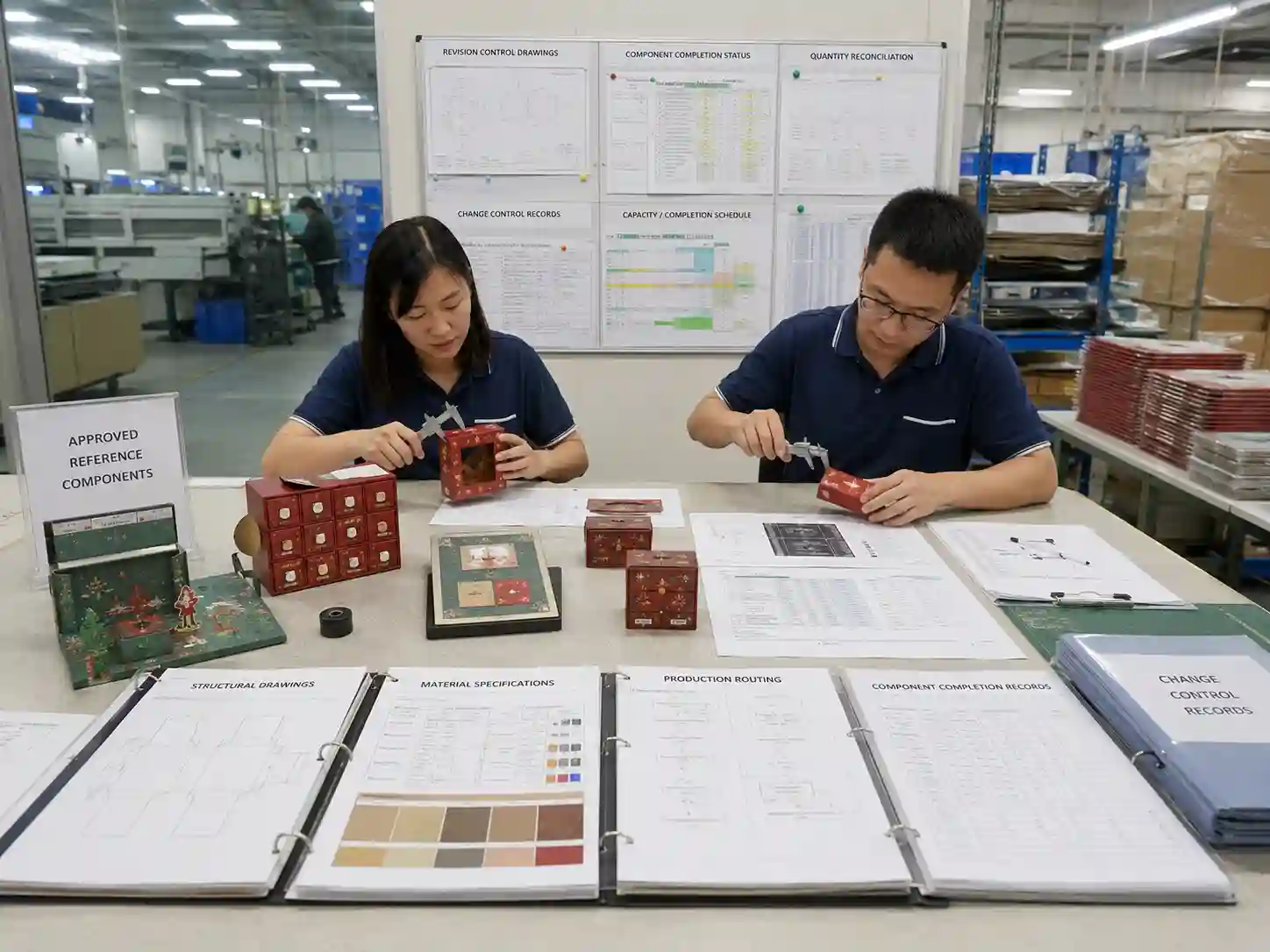
Confirm that the documents used to inspect finished goods are the same controlled requirements approved for bulk production. Revision numbers, dates, dimensions, materials, construction details, and documented exceptions should be traceable.
For an advent calendar, relevant controlled requirements might cover overall dimensions, compartment positions, board specifications, opening functions, insert fit, component orientation, or other project-specific characteristics. The buyer does not need to reapprove the entire design at final payment, but should confirm that inspection was performed against the correct baseline.
Where an approved physical sample is the reference, identify which sample is authoritative and connect it to its approval record. A photograph of an unspecified sample is weaker evidence than a controlled sample ID, drawing revision, approval date, and written acceptance record.
What should an acceptable final inspection report prove?
A final inspection report should show what was inspected, against which requirements, using what sampling or checking method, and with what result. A simple statement such as “QC passed” does not provide enough evidence for a controlled payment decision.
Review the inspection date and location, inspected and available quantities, specification references, sampling information, defect classification, measurements, functional checks, photographs, and final disposition where applicable. Measurement records should identify the relevant specification or tolerance rather than presenting isolated numbers without acceptance criteria.
The buyer should also confirm whether the inspection occurred when enough production was complete to represent the shipment. An inspection of a limited early quantity should not automatically be treated as evidence for units completed afterward.
Inspection requirements are project-dependent. Buyers should use the inspection plan and PO requirements established for their order rather than applying an arbitrary universal checklist.
Should the inspection report match factory quantity records?
Yes. The quantity available to the inspector should be compared with production, packing, and order quantities. Material differences need an explanation before release.
For example, if the PO calls for a defined finished quantity but the inspection report records substantially fewer completed units, the buyer should determine what remained unfinished at inspection time. The later units may require additional verification because they were not necessarily represented by the original inspection.
What documents are needed if defects or nonconformities were found?
If inspection or production identified a nonconformity, final payment should be supported by closure evidence rather than the supplier’s promise to correct it. The documentation should connect the original problem to containment, affected quantity, corrective work, and verification.
A practical corrective-action file may include the defect record, affected lot or quantity, segregation evidence, root-cause analysis where required, rework instructions, rework quantity, scrap or replacement records, and reinspection results. The depth of documentation should reflect the severity and extent of the issue.
The critical question is whether the evidence demonstrates that the accepted shipment no longer contains the known nonconformity within the agreed acceptance criteria. A corrective-action form alone does not prove implementation.
How can buyers verify that rework actually covered the affected quantity?
Reconcile quantities. Compare the number identified as suspect with quantities segregated, reworked, rejected, replaced, reinspected, and ultimately released.
Suppose 600 finished calendars are identified as potentially affected by an assembly problem. A record showing that 120 units were repaired does not close the issue unless evidence explains why the other 480 were conforming or how they were otherwise dispositioned. This is a sourcing-risk example where arithmetic and traceability can reveal a gap that a polished corrective-action report may hide.
Should subcontracting records be reviewed before the balance is released?
They should be reviewed when subcontracting is restricted, requires buyer approval, or could materially affect conformity or traceability. The purpose is to confirm that the actual production route remains consistent with the buyer’s agreed supplier controls.
For example, outsourced printing, die cutting, finishing, hand assembly, or packing may be relevant if the PO or supplier approval process requires disclosure. Evidence can include approved subcontractor records, routing records, job tickets, receiving inspection records, or other traceable production documents.
This does not mean every buyer needs every subcontractor document. The requirement should come from the project’s purchasing controls, risk assessment, or agreed supplier conditions.
How should production and packing quantities be reconciled?
Before final payment, establish a clear quantity bridge from the PO to finished accepted goods. Production records should explain shortages, excess units, rejects, replacements, rework, and packed quantities where these affect the shipment.
A useful reconciliation is:
ordered quantity → produced quantity → rejected/scrapped quantity → accepted finished quantity → packed quantity → shipment quantity.
These figures do not always have to be identical because approved overproduction, replacement allowances, samples, or other project-specific arrangements may exist. Differences should, however, be understood and documented.
For multi-component packaging, also investigate whether a shortage of one critical component prevents apparently completed quantities from becoming saleable finished units. A production schedule stating “100% complete” is less persuasive than records showing complete assemblies ready for inspection and packing.
What packing and shipment documents matter before payment?
Check packing evidence when the payment milestone is tied to finished, packed, or shipment-ready goods. The purpose is to confirm that the accepted production quantity has been converted into identifiable shipment units without losing traceability.
Depending on the project, useful evidence can include a packing list, carton quantity records, carton identification, pallet records, finished-goods inventory status, and shipment-release documentation. Transport documents should only be expected at this stage if the commercial arrangement and shipment sequence make them available before payment.
Do not demand a document that logically cannot exist yet. For example, some logistics records are generated only after cargo handover. The required evidence should match the actual payment milestone.
How should buyers separate supplier evidence from buyer approval?
Supplier documents establish evidence; they do not automatically authorize payment. The buyer should make a separate documented decision that the agreed payment conditions have been satisfied.
This distinction helps prevent a common control failure: the factory sends an inspection report, accounting assumes it means “approved,” and payment proceeds even though sourcing or quality has an unresolved deviation.
A practical workflow assigns responsibility. Quality verifies inspection and corrective-action closure; sourcing or purchasing checks PO and supplier-control conditions; logistics or operations checks relevant quantity and packing status; and the authorized buyer approves the payment milestone according to internal procedures.
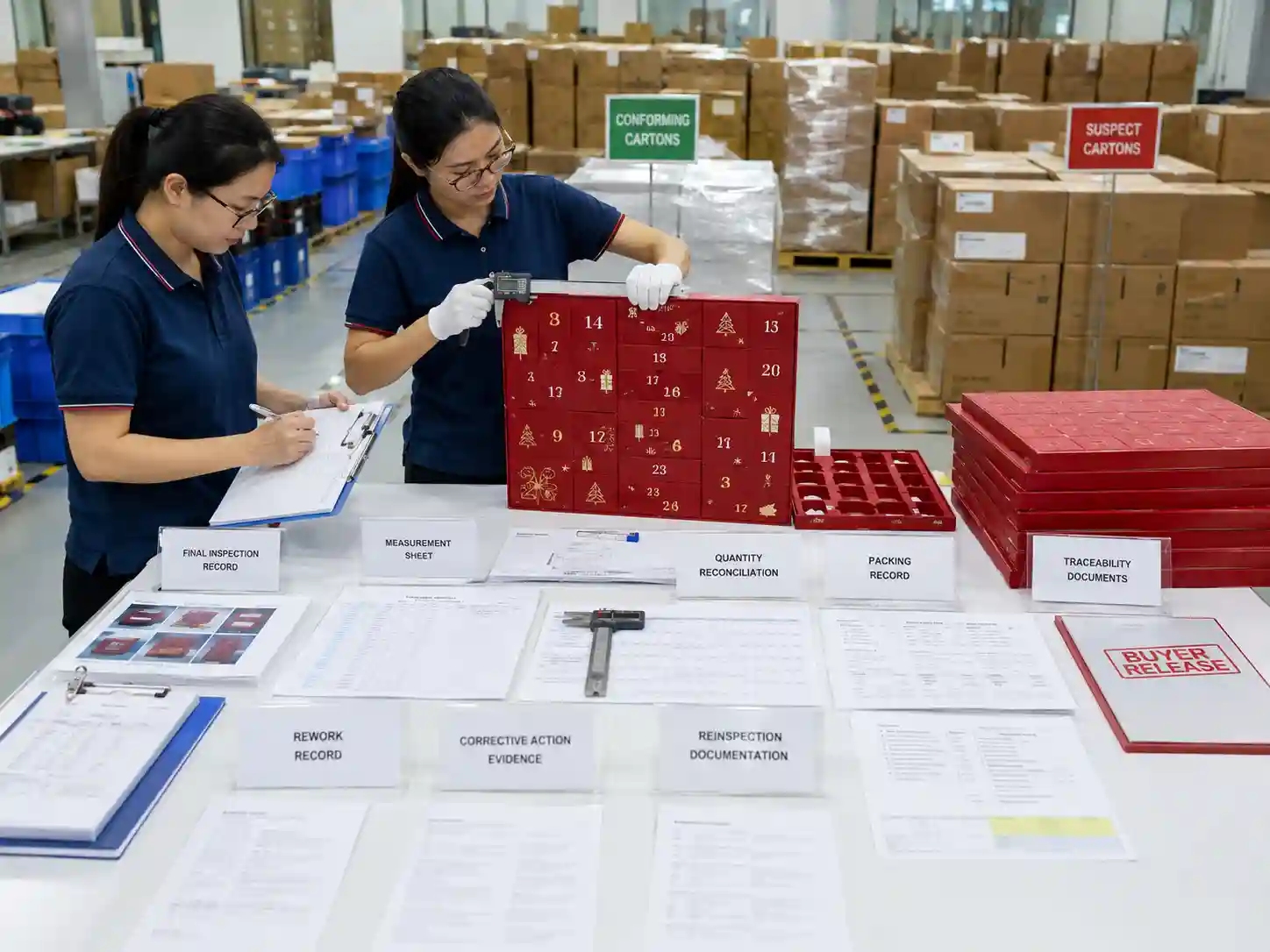
What verification checklist should be completed before final balance payment?
Use a short release checklist linked to the actual PO rather than collecting documents without reviewing them. Each item should be marked accepted, not applicable, or unresolved.
- Confirm the latest PO and all written amendments.
- Confirm the approved drawing, specification, and sample revision used for production.
- Verify that unauthorized specification substitutions have not been accepted implicitly.
- Check production completion and reconcile relevant quantities.
- Review the final inspection report against the agreed inspection criteria.
- Investigate any quantity completed after the inspected production lot.
- Close inspection failures, deviations, and corrective actions with objective evidence.
- Reconcile suspect, reworked, rejected, replacement, and released quantities where defects occurred.
- Check subcontracting evidence when approval or disclosure is required.
- Verify packing status and shipment-ready quantities when required by the payment milestone.
- Record unresolved exceptions and obtain explicit buyer disposition.
- Issue documented payment approval only after the required conditions are satisfied.
What should stop a buyer from releasing final payment?
Payment should normally be held when a material condition of the agreed payment milestone remains unverified. Examples include an inspection failure without verified closure, unexplained quantity discrepancies, production against an unapproved revision, unresolved substitution, incomplete corrective action, or missing approval required by the PO.
A missing document is not automatically evidence of defective goods. It is evidence that a required condition has not yet been demonstrated. The appropriate response is to identify the specific gap and request the evidence needed to close it.
Likewise, additional paperwork should not be invented late in the project merely to delay payment. Requirements should be traceable to the PO, specifications, inspection plan, supplier agreement, approved changes, or a documented response to an actual nonconformity.
How much documentation is enough for a final payment decision?
Enough documentation exists when the buyer can trace the order from approved requirements through production, inspection, exception closure, accepted quantity, and the applicable release milestone. More documents are not necessarily better; relevant and internally consistent evidence is what matters.
Buyers evaluating custom advent calendar box products should scale controls to structural complexity and sourcing risk. For projects requiring supplier capability and production support, the custom advent calendar box services page provides additional context, while information about the Giftpackpro packaging factory can support initial supplier evaluation.
FAQ: Is a passed final inspection report enough to release the balance?
Not necessarily. A passed inspection report is important quality evidence, but buyers should also check whether it covers the relevant finished quantity and correct specification revision and whether other contractual payment conditions have been satisfied.
FAQ: What if production was completed after the final inspection?
Determine how much production was completed afterward and whether the existing inspection can legitimately cover it under the agreed inspection plan. If a material quantity falls outside the inspected population, additional verification may be appropriate before payment.
FAQ: Should buyers require corrective-action documents after every minor defect?
No universal rule applies. Documentation should be proportional to the defect, affected quantity, recurrence risk, inspection result, and agreed quality controls. A significant or systematic nonconformity generally requires stronger closure evidence than an isolated issue already handled within the accepted inspection criteria.
FAQ: Who should authorize final balance payment?
The authorized buyer-side role should approve it according to the company’s purchasing controls. Supplier QC, factory sales staff, or an inspection company can provide evidence, but they should not be treated as substitutes for the buyer’s internal payment authorization.
For a custom advent calendar project, organize the required payment, inspection, specification, and supplier-control evidence before the balance milestone arrives. Request a custom quote to discuss the documentation and production-control requirements relevant to your packaging project.