
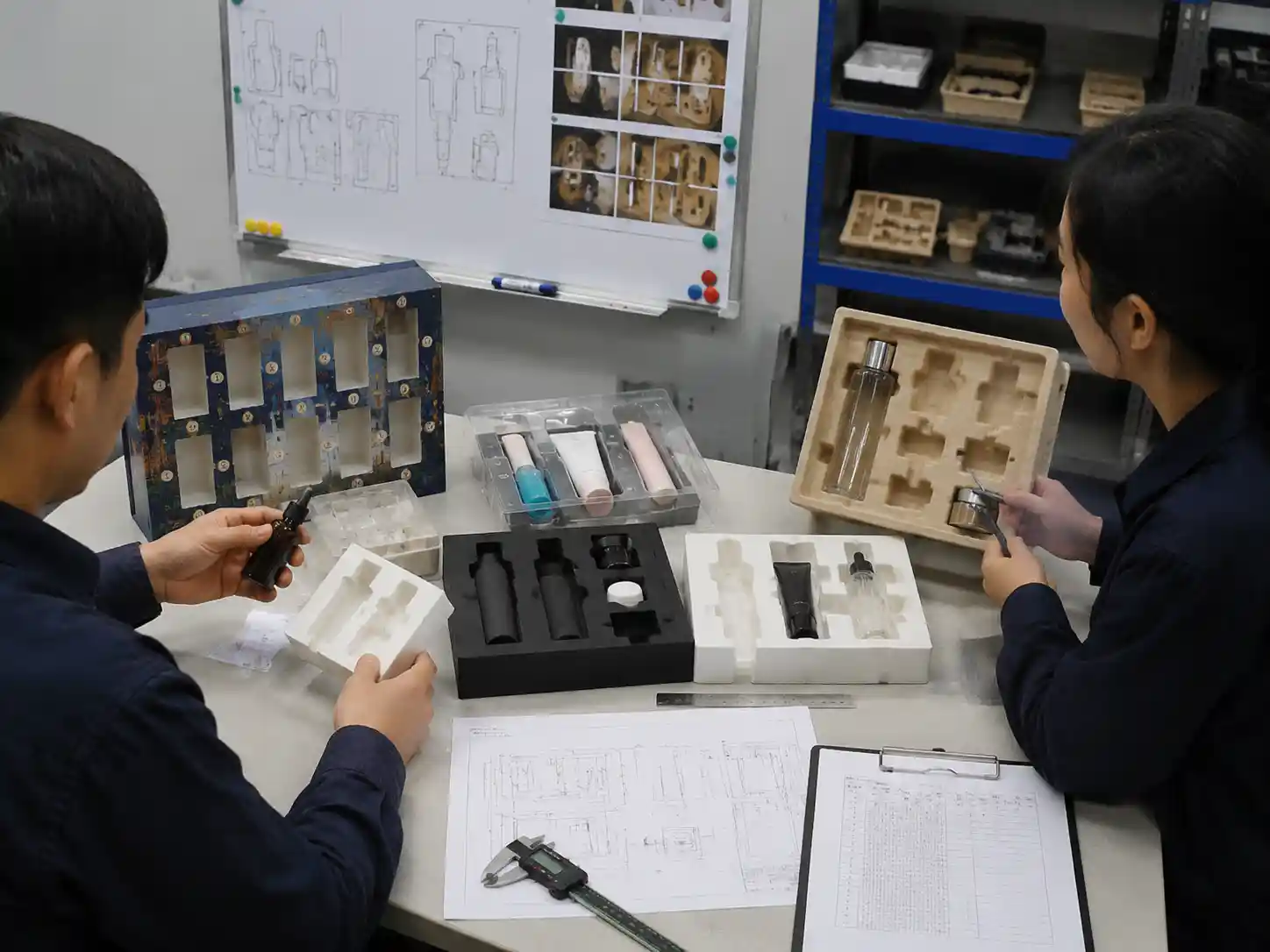
A fully loaded sample reveals insert problems that empty prototypes cannot show. The most important loaded sample insert failure checks evaluate whether products fit correctly, stay secure, remain easy to remove, and maintain orientation during handling and transport. By reviewing cavity geometry, retention points, product movement, and inspection records before production approval, teams can identify insert risks early and reduce avoidable packaging changes.
What should be checked first in a fully loaded insert sample?
The first check is whether the insert performs correctly with the actual products installed. A loaded sample should be inspected as a complete packaging system, including the insert, products, outer structure, and expected handling conditions.
Key first-stage checks include:
- Product dimensions match the approved cavity drawings.
- Products sit at the intended depth and orientation.
- Retention features hold products without excessive pressure.
- Removal access remains practical after loading all cavities.
- The insert does not deform the surrounding box structure.
Evidence should come from physical samples, cavity measurement records, fit-test notes, and approval comments rather than visual inspection alone.
Which cavity fit failures should be checked during loaded sample review?
Cavity fit failures occur when the insert geometry does not match the real product condition. A cavity that looks correct in an empty insert may perform differently once products, protective sleeves, caps, labels, or packaging variations are introduced.
How do you identify incorrect cavity dimensions?
Measure the loaded product position against the approved insert drawing. Common issues include excessive clearance, insufficient clearance, uneven contact points, and products sitting too high or too deep.
| Failure type | Inspection method | Possible risk |
|---|---|---|
| Loose cavity fit | Check side movement and product position after loading | Product shifting, poor presentation, transport damage |
| Tight cavity fit | Perform loading and removal trials | Difficulty removing products or insert deformation |
| Incorrect depth | Measure product height relative to insert surface | Uneven appearance or contact with the outer box |
How should retention failures be checked in a loaded sample?
Retention checks confirm that products remain stable without creating excessive force during packing or removal. The correct retention level depends on product shape, weight, material, and expected handling conditions.
Common retention failures include:
- Products rotating inside round or oversized cavities.
- Products lifting out during movement.
- Retention points pressing on sensitive surfaces.
- Insert tabs or walls collapsing under product weight.
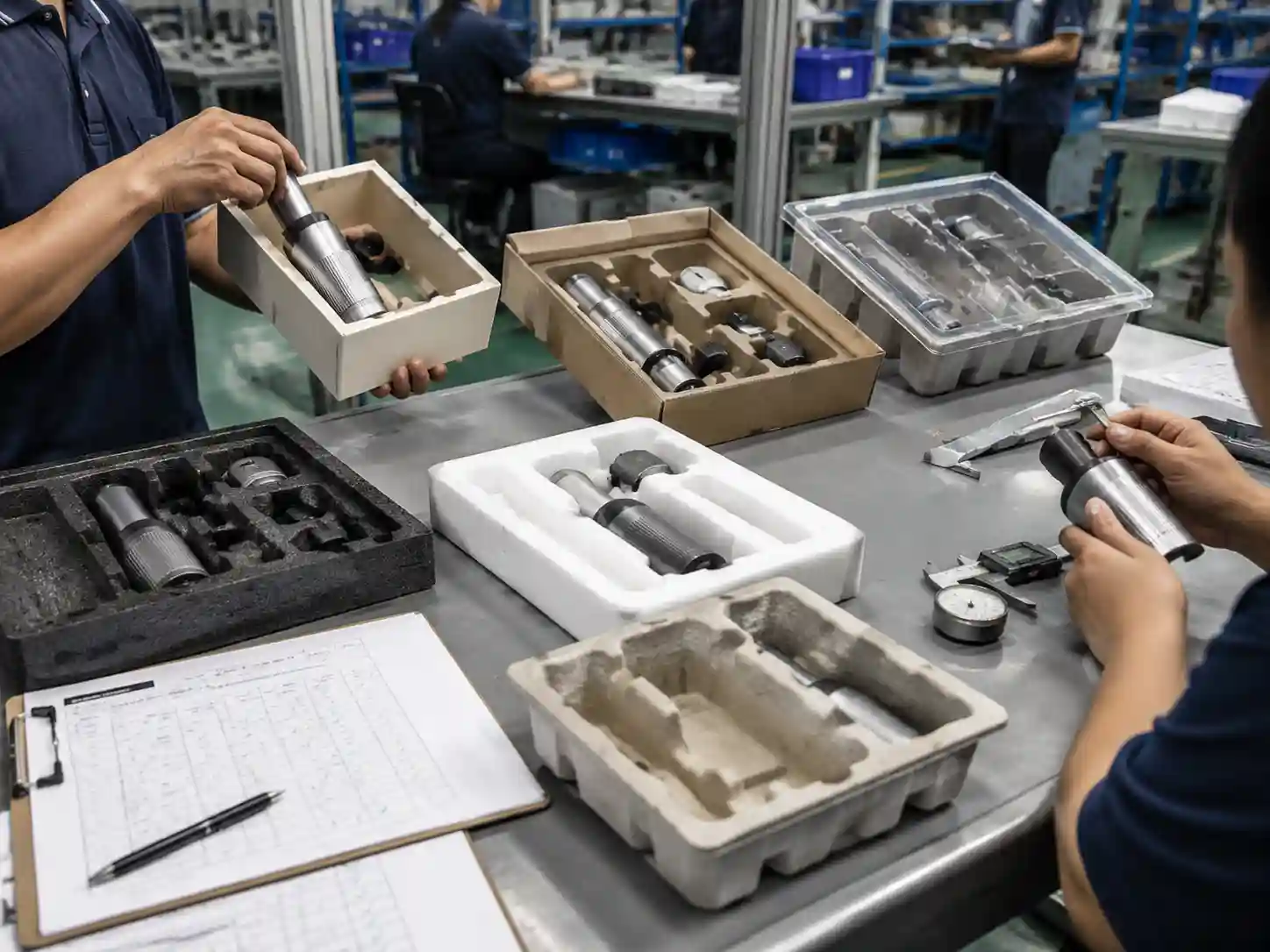
Retention performance can be verified through repeated loading trials, product movement checks, and review of contact areas between the product and insert.
| Insert feature | Failure to check | Verification approach |
|---|---|---|
| Paperboard locking tabs | Tabs opening or losing holding force | Load products and inspect tab engagement |
| PET cavity walls | Cracking, distortion, or weak support | Check cavity shape after loading |
| EVA or foam supports | Compression or excessive product pressure | Review fit pressure and removal effort |
| Molded pulp cavities | Uneven support points | Inspect product contact surfaces |
What removal access problems should be tested before approval?
A successful insert must secure the product while still allowing practical removal. Loaded samples should be tested by removing products from different cavity positions, especially deeper, tighter, or heavier items.
Check for:
- Finger access points blocked by surrounding products.
- Products requiring excessive force to remove.
- Insert damage after repeated removal.
- Difficulty caused by product orientation or cavity depth.
Buyer approval should consider both packaging protection and the expected user interaction with the finished package. Removal performance is often project-dependent because product shapes and handling expectations vary.
How do you check product orientation and movement inside inserts?
Orientation checks confirm that products remain positioned as designed after loading, closing, moving, and handling. This is especially important for irregular products, bottles, tubes, and items with visible front-facing requirements.
- Load every cavity with the approved product samples.
- Close and handle the package in the intended configuration.
- Inspect whether products rotate, tilt, or shift.
- Record any position changes and compare them with acceptance requirements.
Drawings, product dimension sheets, and loaded sample photographs help verify whether orientation results meet the approved design intent.
What transit-related insert failures can appear in a fully loaded sample?
Transit-related checks look for problems that appear after the insert is carrying the actual product weight. A loaded sample should be reviewed for movement, pressure concentration, and structural interaction.
- Products moving during handling simulation.
- Insert deformation caused by concentrated weight.
- Products contacting the outer box or neighboring items.
- Uneven load distribution across multiple cavities.
What evidence should be recorded during loaded sample inspection?
Useful approval records usually include:
- Approved insert drawings and revision numbers.
- Product measurement sheets.
- Loaded sample inspection photographs.
- Fit-test comments and corrective actions.
- Supplier quality review notes.
These records allow packaging engineers, sampling teams, and sourcing teams to confirm why an insert was approved and what conditions were validated.

Which loaded sample checks require buyer approval?
Buyers should approve any item that affects product protection, appearance, packing efficiency, or customer handling. The final acceptance criteria depend on product characteristics and packaging objectives.
Approval areas commonly include:
- Acceptable product movement level.
- Removal force and accessibility.
- Product orientation requirements.
- Insert material performance.
- Final cavity and retention design.
Some packaging facts can be measured directly, such as cavity dimensions and product position. Other decisions, such as acceptable movement or removal feel, require project-specific approval.
FAQs About Loaded Sample Insert Failure Checks
Can an empty insert sample confirm final performance?
No. Empty samples can verify basic structure, but only fully loaded samples show how products affect retention, deformation, and removal performance.
Should every cavity be tested in a multi-product calendar?
Yes. Different product shapes, weights, and positions can create different failure risks, so representative and complete loading checks are recommended.
When should insert problems be corrected?
Insert failures should be corrected before production approval because changes after tooling or mass production preparation may affect cost, timing, and packaging consistency.
Giftpackpro supports commercial packaging projects with custom advent calendar box solutions and insert evaluation processes. For a project-specific insert review, request a custom quote or explore our custom advent calendar box services.


