
Quick answer: A batch drawer movement inspection should check representative finished or in-process units for consistent opening, closing, alignment, clearance, and resistance. Inspectors should test drawers in their actual assembled positions, record recurring tight or loose locations, compare results with the approved sample or project criteria, and trace defects back to production batches. Any repeated functional problem should trigger segregation, investigation, corrective action, and reinspection before affected units proceed.
What should a drawer movement inspection actually check?
Drawer movement should be evaluated as a functional interaction between the drawer and its surrounding structure, not simply by measuring the drawer separately. A dimensionally acceptable drawer can still bind if the sleeve, divider, wrapped board, or assembled housing is distorted.
The basic check is straightforward: open and close each selected drawer through its normal travel and observe whether it moves smoothly without excessive force, uncontrolled looseness, scraping, twisting, or interference.
| Inspection point | What to check | Possible defect indication | Useful evidence |
|---|---|---|---|
| Initial opening | Drawer starts moving without abnormal resistance | Binding, edge interference, excessive friction | Functional test record and defect location |
| Full travel | Drawer moves through its intended range | Jamming, rubbing, structural obstruction | Inspector observation and photos if needed |
| Closing | Drawer returns to its intended seated position | Protrusion, misalignment, incomplete closure | Reference sample comparison |
| Side clearance | Movement remains reasonably consistent | Excessive lateral play or contact with adjacent parts | Measurement where the project defines a tolerance |
| Repeated operation | Movement remains functional after repeated handling | Progressive sticking, delamination, deformation | Project-specific functional test record |
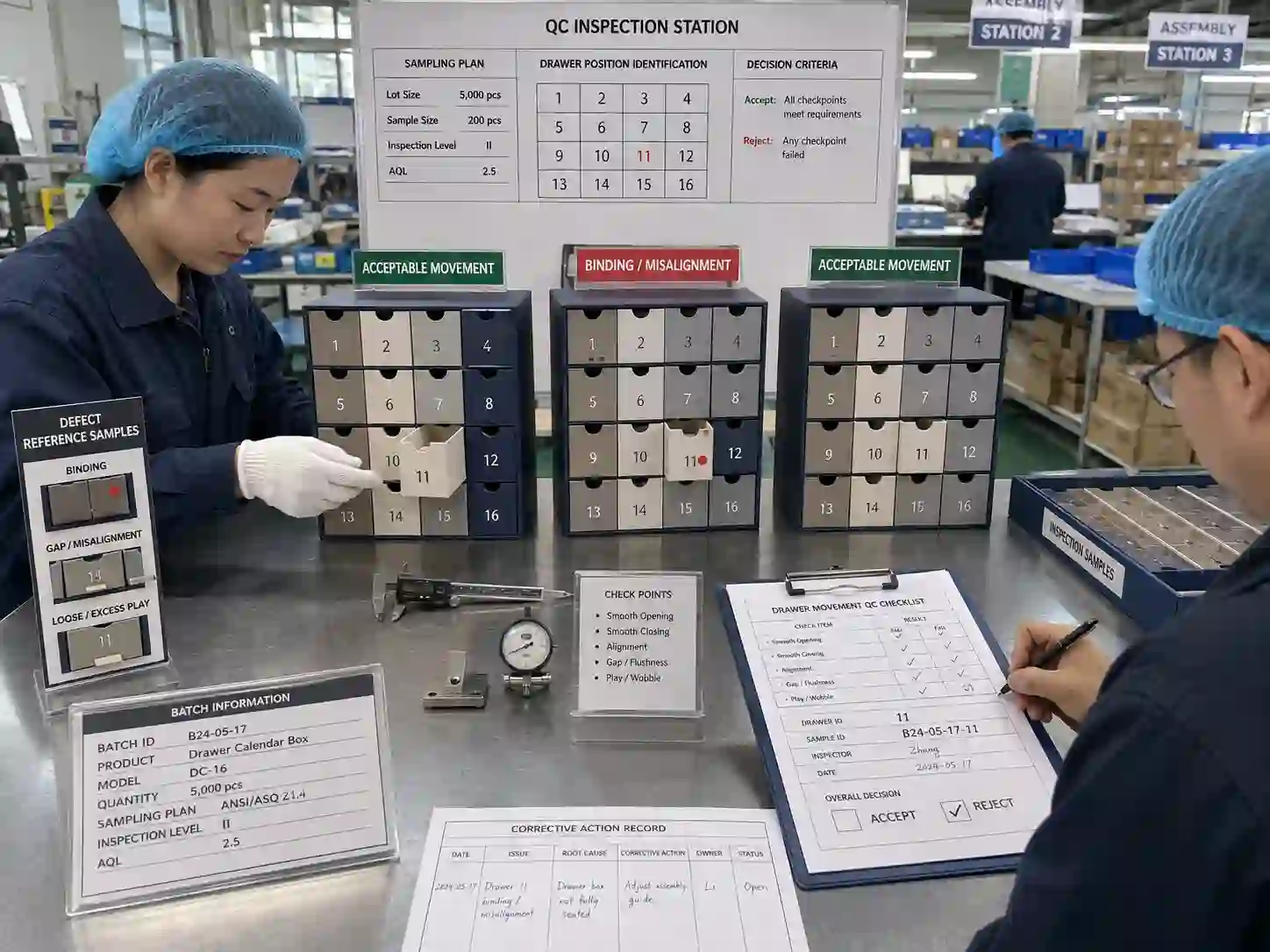
How should batch drawer movement inspection be sampled?
Inspection should cover units from across the production batch rather than relying on one convenient carton or one assembly station. The sampling plan itself is project-dependent and should be defined by the applicable QC plan, buyer requirement, approved inspection procedure, or agreed sampling method.
For multi-drawer advent calendars, inspectors should also avoid checking only the easiest drawer positions. Drawer behavior can vary by location because local clearances, divider alignment, wrapping buildup, board distortion, and assembly pressure are not always identical across the structure.
A practical production check may therefore distribute samples across different production periods, assembly operators or lines where relevant, and packed or staged groups. Within each sampled calendar, inspectors should test the drawer positions specified by the inspection plan.
If a particular position repeatedly binds—for example, drawers in one corner or one row—that pattern is more useful diagnostically than a simple total defect count. The inspection record should retain the drawer position whenever location may help identify the cause.
Should every drawer be expected to feel exactly the same?
No. Perfectly identical tactile resistance is not a realistic universal requirement for paper-based assembled packaging. The important question is whether variation remains inside the project’s approved functional range and does not interfere with intended use.
Acceptance criteria should therefore come from controlled project references rather than an inspector’s personal preference. Depending on the project, these references can include structural drawings, an approved sample, dimensional tolerances, functional approval notes, defect standards, or specific buyer requirements.
Where movement force is important enough to quantify, the test method should define how force is applied and measured. Without a controlled method, numerical readings from different inspectors may not be comparable.
For many projects, a documented functional classification—such as normal, tight but functional, unacceptable binding, or excessively loose—may be more practical than introducing an arbitrary force value. The buyer and supplier should agree on important subjective boundaries before bulk inspection.
What drawer movement defects should inspectors record?
Inspectors should record defects according to their observable functional effect and location. Terms such as “drawer problem” are too vague for useful production analysis.
- Binding: the drawer requires abnormal effort or stops during normal movement.
- Scraping or rubbing: drawer surfaces visibly or noticeably interfere with surrounding components.
- Incomplete closure: the drawer cannot return to its intended closed position.
- Excessive looseness: clearance allows unwanted movement, poor positioning, or an unacceptable assembled appearance.
- Misalignment: the drawer enters or exits at an angle because of drawer or housing geometry.
- Local obstruction: wrapped edges, glue buildup, divider displacement, or another component interferes with travel.
- Progressive failure: movement becomes worse during the specified repeated-operation check.
The defect definition should distinguish cosmetic variation from functional failure. A minor visual clearance difference is not automatically equivalent to a drawer that jams, while a visually subtle dimensional problem may be critical if it prevents normal operation.
How can inspectors determine why a drawer is sticking?
When repeated sticking appears, inspectors should separate the drawer from the surrounding structural causes before deciding on corrective action. Reworking the drawer alone will not solve a housing or divider problem.
- Identify and record the affected drawer position.
- Check whether the same location fails on other sampled units.
- Inspect the drawer for squareness, deformation, wrapped-edge buildup, or dimensional variation.
- Check the surrounding opening, divider position, and assembled housing.
- Compare relevant dimensions with controlled drawings or approved references.
- Review whether the problem is associated with a particular production period, material batch, machine, or assembly stage where traceability permits.
- Confirm the suspected correction on affected samples before releasing normal production.
Measurements are most useful when they test a specific hypothesis. For example, if several drawers bind on one side, measuring the opening width, drawer width, divider position, and local panel alignment can provide more useful evidence than measuring unrelated dimensions.
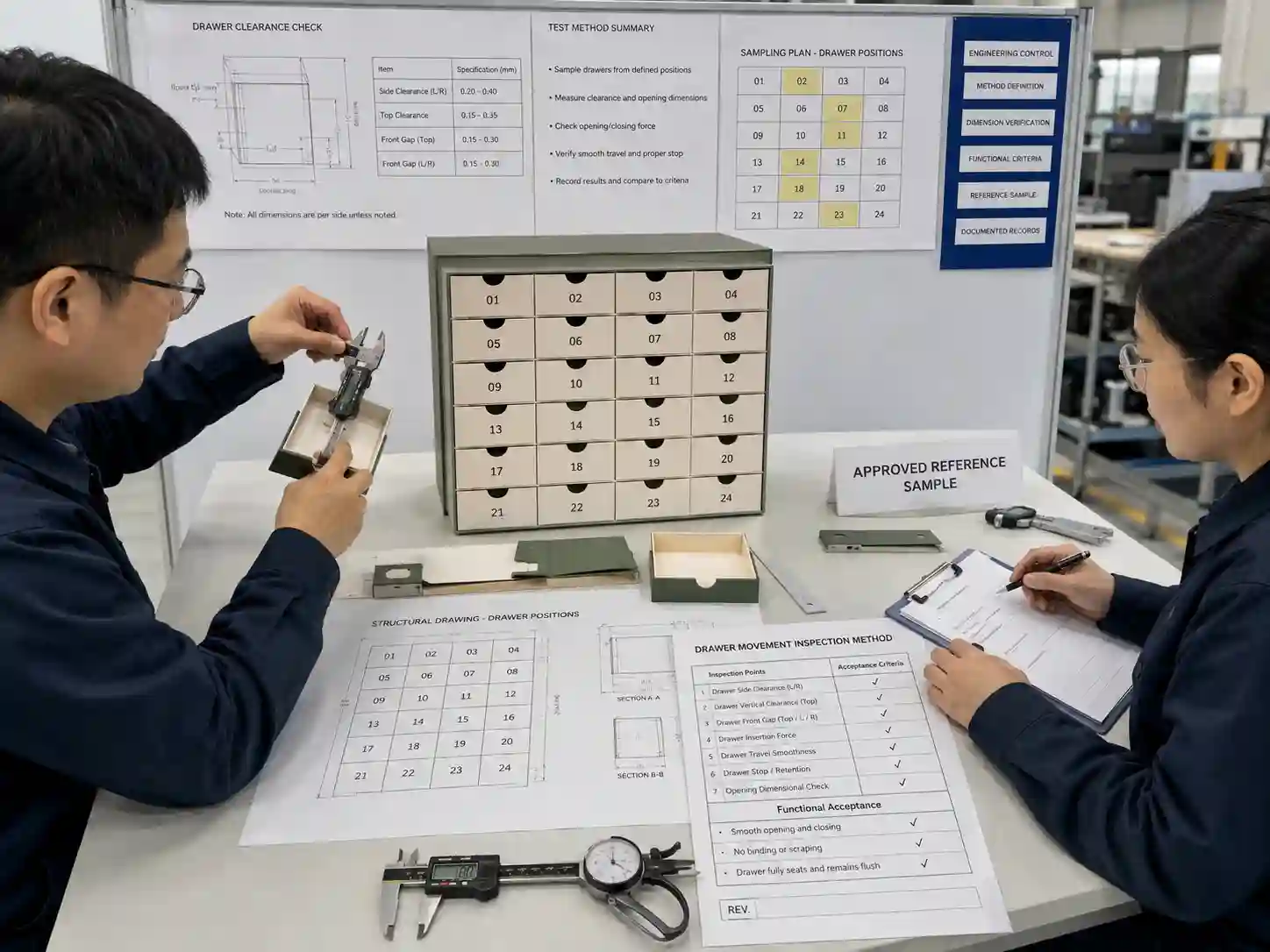
How should drawer movement results be traced to the production batch?
Functional inspection becomes more useful when the result can be connected to the units and production conditions involved. Traceability allows QC staff to determine whether a defect is isolated or potentially affects a defined portion of production.
What might a practical traceability record contain?
A project-specific record can connect the inspection result to information such as production date or period, batch or lot identification, assembly line or work area where applicable, sample quantity, inspected drawer positions, defect type, disposition, and reinspection status.
| Record field | Example of information to capture |
|---|---|
| Batch identification | Controlled internal batch or production reference |
| Sample reference | Sample number or carton reference |
| Drawer location | Position according to the project’s numbering system |
| Functional result | Pass, tight, binding, loose, incomplete closure, or approved project terminology |
| Observed cause | Recorded only when supported by inspection evidence |
| Disposition | Accepted, segregated, reworked, rejected, or awaiting review |
| Verification | Reinspection result after corrective action |
This record does not need to prove a root cause immediately. Its first purpose is to preserve enough information for investigation and containment rather than allowing defective and acceptable material to become mixed.
What should happen when repeated drawer movement defects are found?
Repeated defects should trigger containment before routine production continues through the affected stage. The scope of containment should follow the evidence: a localized assembly issue may require a different response from a defect appearing across multiple production periods.
A practical corrective-action sequence is to identify affected material, segregate it, determine the likely process cause, implement a controlled correction, and reinspect the relevant units. If the correction changes an approved structural or material requirement, it should not be treated as an informal production adjustment; the appropriate approval process should be followed.
Common investigation areas can include drawer dimensions, housing dimensions, divider placement, board flatness, wrapping buildup, adhesive application, assembly pressure, and component conditioning. Which factors matter must be established from the actual construction and inspection evidence.
QC records should show both the original nonconformity and the result after corrective action. A verbal statement that the problem was “fixed” provides weak evidence compared with a documented reinspection tied to the affected batch.
Which requirements are factual, project-dependent, or buyer-approved?
Keeping these categories separate prevents arbitrary inspection standards from being presented as universal packaging rules.
- Verifiable production facts: whether a tested drawer opens, travels, closes, rubs, jams, or shows excessive movement; relevant dimensions can also be measured when a defined method exists.
- Project-dependent recommendations: sampling quantity, number of drawer positions tested, repeated-operation cycles, measurement points, and inspection frequency depend on construction, risk, production process, and QC plan.
- Buyer or project approvals: acceptable tactile resistance, appearance boundaries, agreed tolerances, defect classifications, and departures from approved specifications should follow controlled approval records.
Before production inspection begins, the supplier and buyer should therefore make sure that inspectors have access to the applicable drawings, approved samples, inspection criteria, and current revision status. Giftpackpro’s custom advent calendar box services can be reviewed when planning project-specific structural and production requirements.
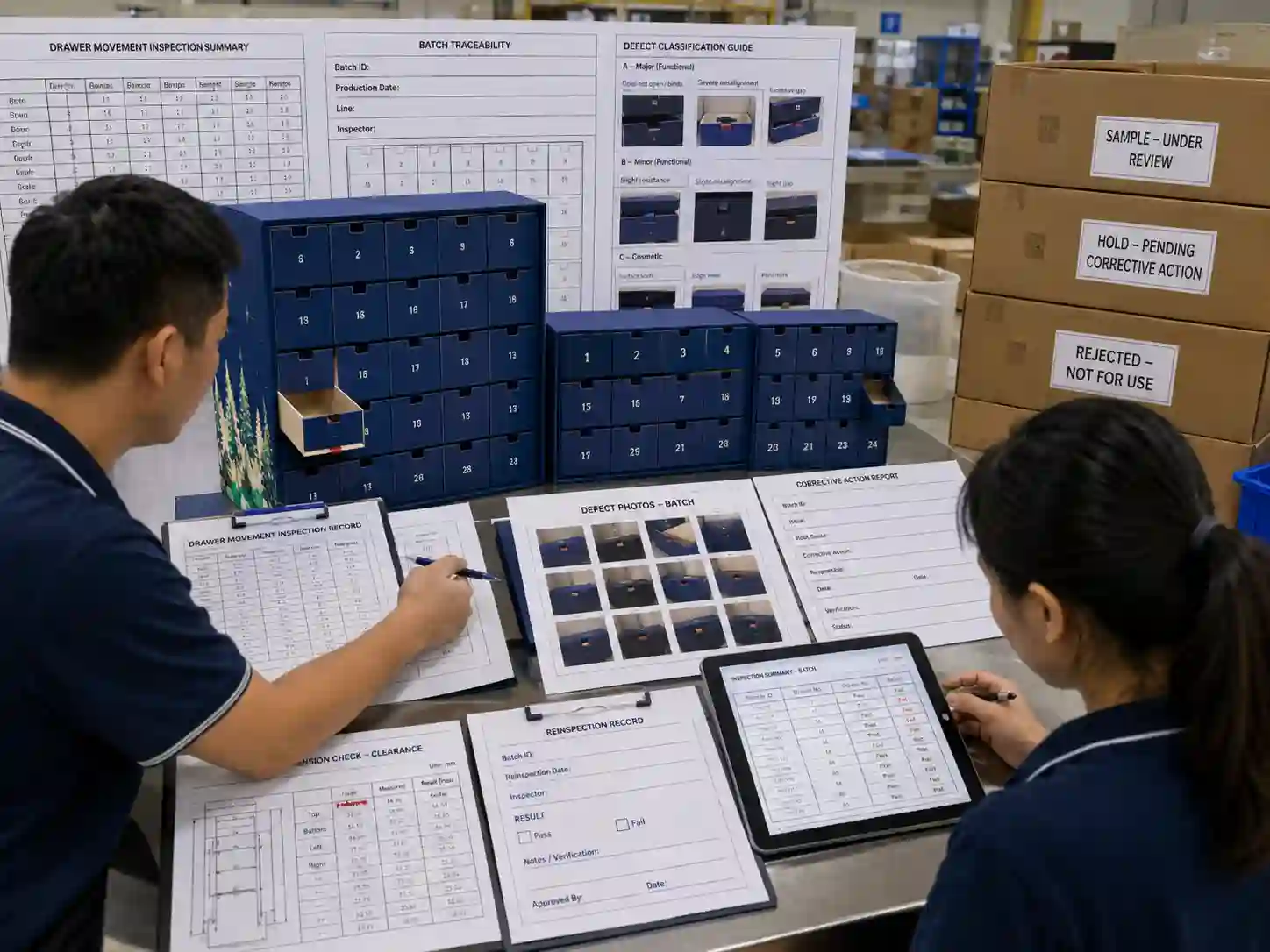
What evidence should a buyer request for drawer movement control?
Useful evidence should show what was checked, against which reference, and what happened when a defect was detected. A photograph of one freely moving drawer does not demonstrate batch-level control.
Depending on project risk and agreed documentation requirements, evidence may include inspection sheets, drawer-position records, measurement results, defect photographs, batch references, segregation records, corrective-action records, and reinspection results.
Buyers evaluating a custom structure can also review relevant custom advent calendar box products and discuss the required functional acceptance criteria before production inspection is finalized.
What are the most important questions to ask before approving the inspection method?
The inspection method is strongest when it defines the functional requirement before inspectors begin making pass-or-fail decisions.
- Which production stages require drawer movement checks?
- How are samples distributed across the batch?
- Which drawer positions must be tested?
- What reference defines acceptable movement?
- Which conditions count as functional defects?
- Are any movement or dimensional limits measurable?
- How are failed units identified and segregated?
- How is the affected batch scope determined?
- Who approves deviations from the agreed criteria?
- What evidence is required before segregated production is released?
FAQ: Should drawer movement be checked before or after final assembly?
Checks can be useful at more than one controlled production stage, but the final functional assessment should reflect the actual assembled geometry in which the drawer operates. Earlier checks can help detect component problems before additional assembly work makes rework more difficult.
FAQ: Is dimensional inspection enough to prove that drawers will move correctly?
No. Dimensions can help verify likely causes and compliance with drawings, but functional movement should still be tested because the interaction of multiple components, wrapping, adhesive, alignment, and assembly variation can affect operation.
FAQ: What should happen if only one drawer position repeatedly sticks?
The repeated location should be recorded and investigated rather than averaged into the overall defect rate without analysis. A consistent positional pattern can point toward local divider alignment, opening dimensions, panel distortion, or another structural condition.
For a custom advent calendar project requiring defined drawer movement criteria, inspection records, and production-quality requirements, request a custom quote and provide the product dimensions, structural requirements, and relevant approval references.


