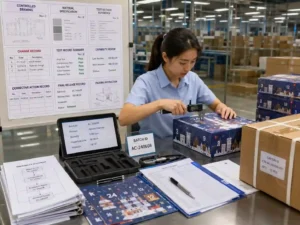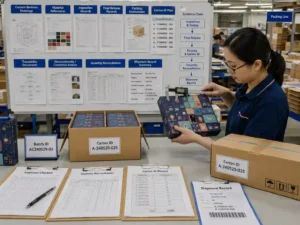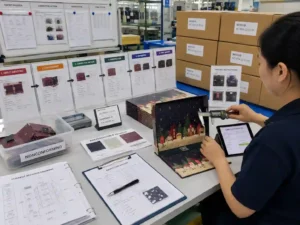
Quick answer: Designing removable inserts for reusable advent calendars requires balancing secure product retention with easy removal and repeat use. The insert system should be engineered around cavity geometry, product orientation, access points, material behavior, and loaded transport conditions. A successful design is usually verified through dimensional drawings, physical samples, fit checks, and handling tests before production approval.
How do you design removable reusable box inserts for advent calendars?
Removable reusable box inserts are designed by separating the product retention function from the outer calendar structure. The insert must hold each item securely during storage and transport while allowing the user to remove, replace, or reorganize products without damaging the box.
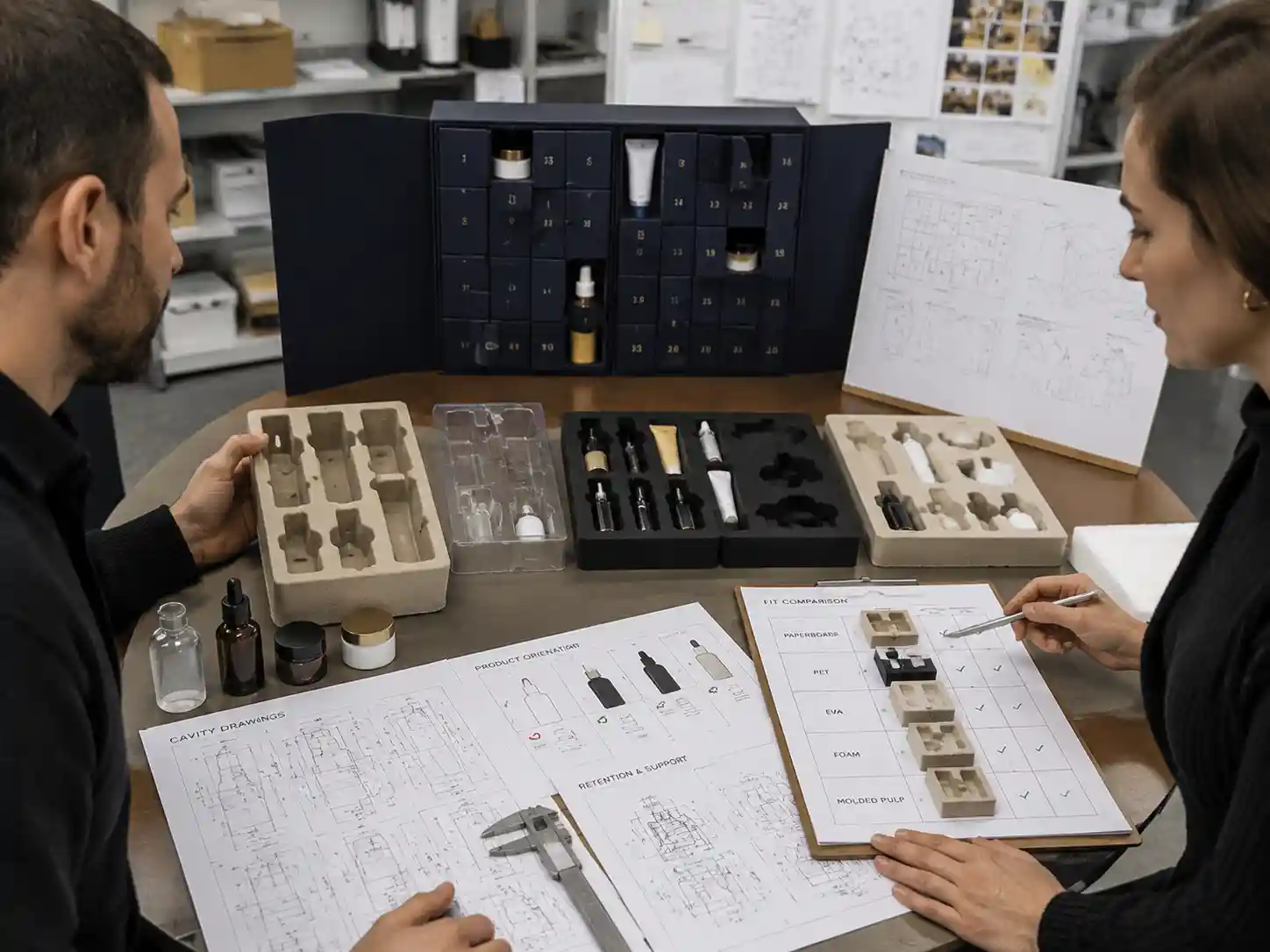
The design process normally starts with product dimensions, weight, shape, and handling requirements. Engineers then define cavity size, support areas, finger access, and removal clearance before selecting an insert material such as paperboard, PET, EVA, foam, or molded pulp.
What information is needed before creating removable insert cavities?
The insert design should be based on verified product information rather than estimated dimensions. Important inputs include:
- Product length, width, height, and maximum protruding points
- Product weight and center of gravity
- Packaging accessories such as caps, sleeves, bags, or labels that affect clearance
- Required product orientation inside each compartment
- Whether products need repeated removal and reinsertion
Drawings, physical samples, or approved reference units should be used to confirm these details. Differences between early samples and final production units can affect cavity pressure, fit, and removal performance.
How should cavity geometry be planned for removable inserts?
Cavity geometry should provide enough retention to prevent movement while maintaining enough clearance for easy removal. The correct balance depends on the product shape, material stiffness, and intended reuse cycle.
| Design area | Engineering consideration | Verification method |
|---|---|---|
| Cavity wall support | Controls product movement and rotation | Load product sample and check stability |
| Clearance zone | Prevents excessive friction during removal | Manual removal test with actual products |
| Finger access area | Allows users to grip smaller items | Check removal without pulling force on product labels |
| Bottom support | Distributes product weight | Inspect insert deformation under loaded conditions |
For reusable calendars, designers often avoid extremely tight cavities because repeated loading can weaken insert edges or make product removal inconsistent.
How do you choose the right retention method for removable inserts?
The retention method depends on product shape, weight, and whether the insert must be removed from the outer box. Different materials provide different levels of flexibility and support.
| Insert type | Common retention approach | Suitable considerations |
|---|---|---|
| Paperboard insert | Folded tabs, locking features, shaped cavities | Useful when recyclability and flat shipment are priorities |
| PET tray | Formed pockets and edge support | Suitable for precise cavity control and visibility |
| EVA insert | Compression-fit cavities | Useful for products requiring soft contact surfaces |
| Foam insert | Cut cavities with cushioning support | Requires attention to friction and surface marking |
| Molded pulp insert | Fiber-shaped supports and locating points | Requires careful cavity development for small products |

How do you test whether a removable insert works correctly?
A removable insert should be evaluated with physical samples, not only CAD drawings. The most important checks focus on product loading, removal, and stability.
- Confirm cavity dimensions: Compare the insert sample with approved product measurements and drawings.
- Perform loading checks: Place products into all cavities to verify consistent fit.
- Check removal access: Remove products repeatedly to identify tight areas, weak tabs, or damaged edges.
- Evaluate orientation: Confirm that products remain facing the intended direction after handling.
- Review loaded performance: Inspect whether the insert bends, collapses, or allows excessive movement.
Project-dependent requirements may vary depending on product weight, material selection, calendar size, and whether the insert is designed for seasonal reuse or long-term storage.
What transit checks should be completed for reusable insert designs?
Transit performance should confirm that the removable insert protects product position during movement without creating excessive compression on the contents.
- Check whether products remain seated after vibration or movement simulation.
- Inspect insert locking points and support areas after handling.
- Review whether heavier products create deformation or uneven loading.
- Confirm the insert remains correctly positioned inside the calendar structure.
Verification records may include cavity drawings, sample approval sheets, fit-test notes, inspection measurements, and photographs of loaded samples. These records help suppliers and buyers confirm the approved design reference.

Which design decisions require buyer approval?
Buyers should approve any decision that affects product appearance, removal experience, reuse expectations, or packaging performance.
- Final cavity dimensions and product orientation
- Insert material selection
- Retention strength and removal force expectations
- Visible insert surfaces and finishing requirements
- Sample evaluation results before production release
Supplier recommendations can guide these decisions, but the final approval should be based on the actual product samples and intended use conditions.
FAQs about removable advent calendar inserts
Can removable inserts be reused with different products?
Only if the replacement products have compatible dimensions and weight characteristics. Cavity geometry is normally developed around specific product measurements.
Are removable inserts always made from plastic materials?
No. Paperboard, molded pulp, foam, EVA, and PET can all be used depending on retention requirements, product protection needs, and design objectives.
Why is finger access important in reusable insert designs?
Finger access reduces the force needed to remove products and helps prevent damage to the insert, outer box, or product packaging during repeated use.
How can you develop a removable insert system for a custom advent calendar?
A practical development process combines product measurements, insert drawings, prototype validation, and approval records. Giftpackpro supports custom seasonal packaging projects through custom advent calendar box services and engineered packaging solutions.
For a removable insert design based on your product dimensions and reuse requirements, request a custom quote with your product samples or specifications.