Quick answer: Artwork ownership dieline confidentiality should be defined before production files are released. The purchase order or related agreement should identify who owns buyer-supplied artwork, who may use supplier-created dielines, which factories or subcontractors may receive files, how revisions are controlled, and what happens to files after the order. Buyers should verify these controls through written terms, file-transfer records, revision histories, subcontractor disclosures, and approved production documents rather than relying on verbal assurances.

What should artwork ownership and dieline confidentiality terms actually cover?
The terms should separate ownership, permitted use, confidentiality, access, revision control, and file retention. These are related controls, but they are not the same thing.
For a custom advent calendar, the controlled information may include graphic artwork, structural drawings, dielines, insert layouts, compartment dimensions, print-ready files, finishing locations, prototypes, CAD data, assembly references, and approved revisions. Some files may originate with the buyer, while others may be created or modified by the packaging supplier.
The commercial documents should therefore state which party owns or controls each category of file and what the supplier is permitted to do with it. A practical restriction is that confidential files are used only to quote, sample, manufacture, inspect, pack, or otherwise perform the authorized order.
Ownership should not be assumed merely because one party possesses a file. Buyers should have the contractual language reviewed for their jurisdiction and project because intellectual-property rights, commissioned design work, tooling arrangements, and pre-existing supplier know-how can be treated differently.
How should you distinguish buyer artwork from supplier-created dielines?
Create a simple file classification before releasing production data. This prevents a vague statement such as “all designs belong to the buyer” from creating uncertainty about supplier templates, engineering methods, or pre-existing technical information.
| File or information | Typical control question | Evidence to request |
|---|---|---|
| Buyer-supplied graphics | May they be used only for the named order? | PO clause, confidentiality agreement, controlled artwork record |
| Buyer-supplied structural drawing | Who may receive and modify it? | File-access list and revision history |
| Supplier-created dieline | Who owns it or has continuing usage rights? | Written commercial terms and drawing identification |
| Modified production dieline | Who approves structural changes? | Revision-controlled drawing and approval record |
| Insert or compartment layout | Can it be reused for another customer? | Confidentiality and permitted-use terms |
| Print-ready production file | Which production sites may access it? | Authorized-site list and file-transfer record |
| Physical samples or proofs | Can they be displayed, photographed, retained, or discarded? | Sample-control or disposal instruction |
The important point is not to apply the same ownership statement automatically to every file. Define the status of buyer-created intellectual property, supplier-created engineering, jointly revised files, and production-only derivatives separately where necessary.
How do you control who can receive confidential dielines?
Restrict access by company, production site, function, and purpose. A supplier should not interpret permission to manufacture as unlimited permission to distribute your files.
Before file release, identify the legal supplier receiving the order and the physical locations expected to perform printing, die cutting, rigid-box conversion, insert production, hand assembly, packing, or other relevant operations. If an operation will be subcontracted, determine whether that subcontractor needs the complete file or only the information necessary for its process.
For example, a subcontractor performing one finishing operation may not need complete customer graphics, product information, insert geometry, and assembly instructions. Limiting information to what is operationally required reduces unnecessary exposure.
What should you ask about subcontractors?
Ask whether confidential production information can be transferred to subcontractors and whether buyer approval is required first. This is especially important when printing, tooling, finishing, or hand assembly is performed away from the supplier location you originally evaluated.
A useful supplier review checks:
- which processes are performed in-house;
- which processes may be subcontracted;
- the identity and location of approved external production sites where relevant;
- whether subcontractors receive complete or limited production files;
- who authorizes file release;
- how obsolete revisions are withdrawn; and
- whether confidentiality obligations extend to authorized subcontractors.
This connects confidentiality control with supplier verification. Buyers evaluating a Giftpackpro packaging factory or another manufacturing source should confirm the actual production route rather than treating the contracting company’s office as the only place where files may travel.

How should dieline revisions be controlled before production?
Every production dieline should have an identifiable approved revision. Confidentiality protects access to the file; revision control protects the accuracy of the file being manufactured.
Use a file name, drawing number, revision identifier, approval date, or equivalent controlled reference. The purchase order or production authorization can then point to the approved version rather than referring vaguely to “the latest artwork.”
When engineering changes are necessary, record what changed and obtain the required buyer approval before the revised file replaces the previous production version. Relevant changes can include dimensions, compartment positions, cut lines, crease positions, artwork placement, finishing areas, window geometry, or assembly features.
Suppliers should also have a method for preventing obsolete versions from reaching production. Evidence can include revision logs, controlled production folders, approval emails, signed drawings, pre-production records, or document-control procedures.
What evidence should you verify before releasing final files?
Verify that confidentiality controls exist in the supplier’s actual workflow, not only in a sales statement. The required depth should reflect the sensitivity and commercial value of the project.
| Verification point | Useful evidence | Warning sign |
|---|---|---|
| Authorized production entity | PO details and confirmed production site | Unclear factory identity |
| File responsibility | Named department or controlled account | Files circulated through unidentified recipients |
| Revision control | Revision numbers and approval records | Multiple files marked “final” |
| Subcontracting | Process and site disclosure | Supplier will not identify where sensitive work occurs |
| Production authorization | Approved artwork/dieline reference | Production based on informal screenshots |
| Obsolete files | Withdrawal or archive procedure | Old and current files mixed together |
| Post-order retention | Written retention/deletion requirement | No defined policy for production files |
What should the purchase order say about confidential files?
The PO should identify the applicable confidentiality and file-control obligations or incorporate them from a separate agreement. The exact legal language is project-dependent, but operational responsibilities should be unambiguous.
Consider defining:
- which artwork, drawings, dielines, specifications, samples, and technical information are controlled;
- who owns each relevant category or what usage rights each party receives;
- the permitted purpose for using the information;
- which production sites and authorized subcontractors may receive it;
- whether buyer approval is required before further disclosure;
- who may revise production files and who approves those revisions;
- whether files or samples may be photographed, displayed, published, or used for promotion;
- how obsolete versions are withdrawn;
- how long controlled information may be retained after production; and
- what return, deletion, destruction, or archival evidence is required when applicable.
These provisions should be consistent with the broader purchase order rather than hidden in an unrelated email thread. Buyers arranging custom advent calendar box services should resolve important file-control questions before releasing unrestricted production artwork.
Which decisions require explicit buyer approval?
Any action that expands access or changes an approved production file should have a defined approval route. The supplier should not have to guess which decisions it can make independently.
Typical approval points include releasing confidential files to a previously undisclosed subcontractor, changing the production site, altering structural geometry, replacing an approved dieline, using customer-specific work in marketing materials, or retaining sensitive files beyond an agreed period.
Not every technical adjustment necessarily requires the same approval level. Projects vary. Buyers can define tolerances or categories of minor production adjustments that suppliers may handle internally while reserving structural, graphic, or commercially sensitive changes for written approval.
What is a practical pre-production verification checklist?
Complete the file-control check before final production authorization. It is much easier to restrict distribution before files spread across multiple factories, departments, and subcontractors.
- Identify buyer-supplied and supplier-created files separately.
- Confirm ownership or permitted-use terms for important artwork and dielines.
- Record the approved production file and revision.
- Confirm the contracting supplier and actual production site.
- Identify relevant subcontracted processes.
- Define whether subcontractor file release requires approval.
- Limit each recipient to the information needed for its work where practical.
- Confirm who can modify dielines or artwork.
- Keep written buyer approvals for controlled revisions.
- Define restrictions on photography, display, portfolio use, or publication when required.
- Define retention, return, archival, or deletion expectations where appropriate.
- Keep the final approved file set with the purchase and inspection records.
What does an artwork confidentiality failure look like in practice?
A common sourcing risk is uncontrolled file transfer rather than deliberate theft. For example, a supplier may send a complete production package to an external finishing or assembly company even though that subcontractor needs only one technical layer.
The buyer may then discover that the file exists at an undeclared site with no clear revision or deletion control. If the supplier later changes subcontractors, copies can remain in email accounts, shared folders, prepress systems, or local production computers.
The corrective response should address the process, not merely request a promise that it will not happen again. Identify every recipient, confirm which versions were transferred, withdraw unauthorized access where possible, establish the approved file route, document corrective action, and decide whether additional supplier or subcontractor controls are necessary before production continues.
How do you verify confidentiality without disrupting production?
Use proportionate controls tied to identifiable records. Most projects do not need an elaborate security system, but commercially sensitive projects need more than a generic confidentiality statement.
Start with the production route and file list. Confirm where the artwork goes, who needs it, which revision is approved, and what evidence proves those controls. During supplier review or pre-production verification, compare the stated workflow with purchase orders, production schedules, prepress records, drawing revisions, sample approvals, and subcontracting information.
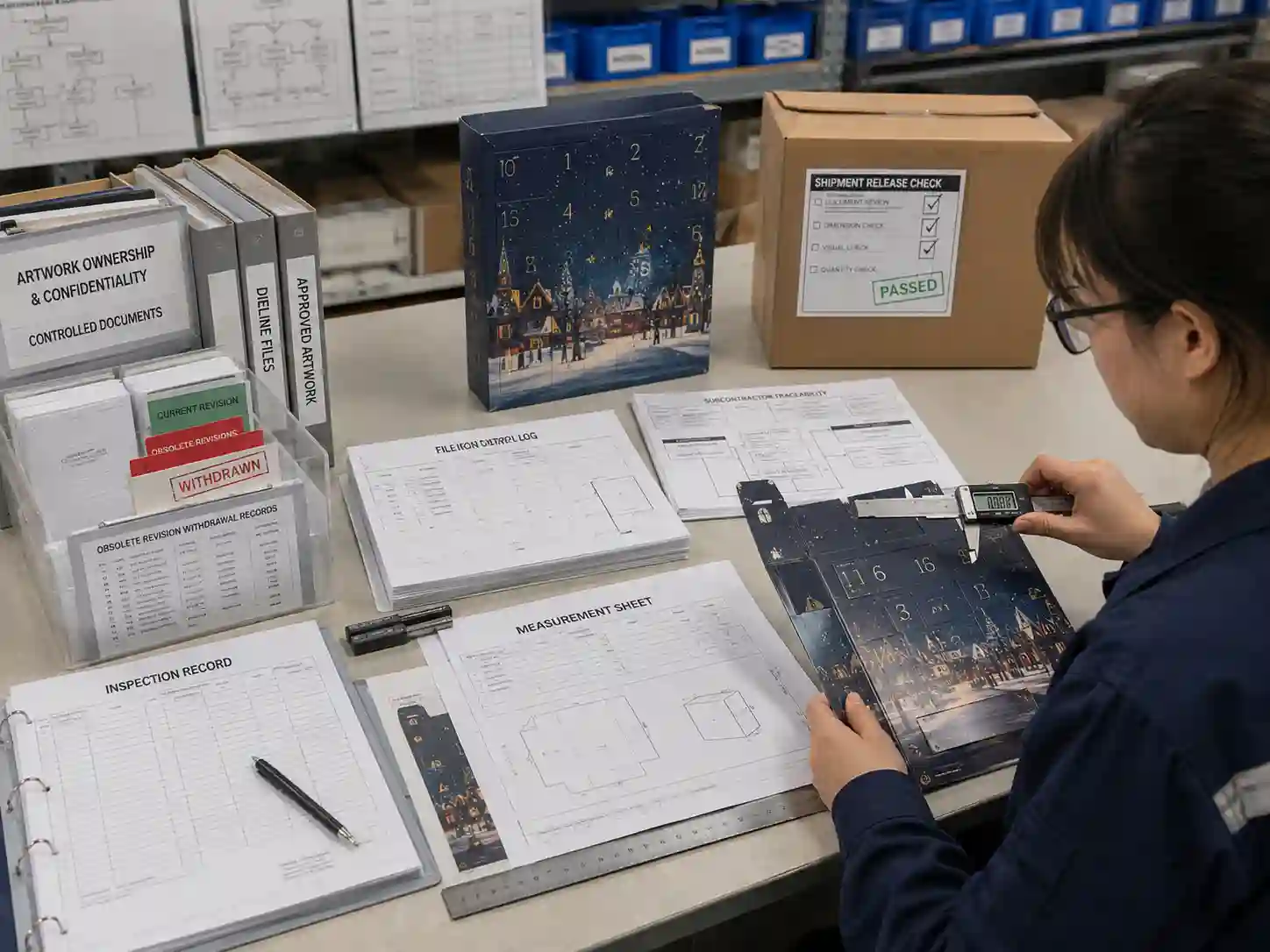
QC personnel can also verify that inspection records reference the same approved drawing or specification used for production. This connects confidentiality and document control to a practical shipment-release record without turning the inspection itself into a broad intellectual-property audit.
Should suppliers delete dielines after an order is completed?
There is no universal retention period suitable for every project. The buyer and supplier should agree on whether production files are deleted, returned, securely archived, or retained for authorized repeat orders.
Retention can be useful when repeat production is expected, but continued storage also extends the period during which confidential information must be controlled. The decision should therefore reflect repeat-order requirements, contractual obligations, recordkeeping needs, and the sensitivity of the files.
Can a supplier use completed packaging in its portfolio?
Do not assume that production authorization automatically permits promotional use. If confidentiality matters, specify whether completed samples, artwork, prototypes, photographs, or production footage may be displayed publicly.
This is particularly relevant before a product launch. A factory photograph showing unreleased artwork can disclose information even when the physical packaging never leaves the facility.
What if the supplier develops the dieline?
Supplier creation does not by itself answer every ownership or usage question. The commercial agreement should define whether the buyer receives ownership, an exclusive right, a project-specific license, or another agreed right to use the finished dieline.
Also distinguish customer-specific structural work from the supplier’s pre-existing engineering knowledge, standard constructions, manufacturing methods, or generic templates. Where ownership has significant commercial value, obtain appropriate legal advice rather than relying only on production terminology.
How should artwork and dieline controls be finalized before production?
Finish with three aligned records: the commercial terms defining rights and confidentiality, the approved production files defining what may be manufactured, and the supplier records showing where those files may be used. Together, these provide a practical control trail from buyer approval to production.
If you are preparing a custom seasonal packaging order and need to confirm the production route, approved files, and supplier responsibilities, request a custom quote and provide the relevant artwork, dieline status, confidentiality requirements, and project specifications for review.