Quick answer: Effective packaging payment milestone risk control links payments to verified project evidence rather than calendar dates alone. For complex advent calendar boxes, buyers can separate commercial commitment, approved samples or specifications, material readiness, production progress, final inspection, and shipment release into defined control points. The exact percentages are project-dependent. What matters is that each payment becomes due only after the supplier provides agreed evidence and the buyer records the required approval.

Which payment milestones reduce risk on complex packaging projects?
The most useful milestones correspond to events the buyer can verify: order authorization, specification or sample approval, material readiness, production progress, inspection acceptance, and shipment release. This prevents payment status from moving significantly ahead of verified manufacturing status.
A complex advent calendar may combine rigid board, printed wraps, doors or drawers, inserts, magnets, ribbons, accessory components, hand assembly, and outsourced processes. Because several operations can affect the final result, a single deposit followed by an almost-complete balance before meaningful verification can leave the buyer with limited commercial leverage if problems appear late.
A practical milestone structure can therefore include:
- Order commitment: payment after the purchase order, commercial terms, approved production location, and key responsibilities are confirmed.
- Technical approval: payment or authorization after required drawings, specifications, artwork revisions, samples, or controlled references are approved.
- Material or production readiness: payment only when agreed evidence shows that specified materials and critical components are ready and production conditions match the order.
- Production progress: where appropriate, payment against verifiable production status rather than an estimated completion date.
- Final inspection or corrective-action closure: payment after agreed inspection requirements have been satisfied and material nonconformities have been addressed.
- Shipment release: the remaining balance follows the agreed release conditions and required shipping documentation.
Not every project needs all six stages. A simpler construction may justify fewer milestones, while a multi-component calendar with several subcontracted processes may need more control points.
How should packaging payment milestone risk control be tied to evidence?
Each milestone should have a defined trigger, required evidence, approval owner, and consequence if the evidence is incomplete. A phrase such as “payment when production is nearly finished” is difficult to enforce because “nearly finished” has no objective verification method.
| Control point | Useful supplier evidence | Buyer verification | Risk controlled |
|---|---|---|---|
| Order authorization | Accepted PO, production-site details, disclosed subcontracting | Confirm supplier identity, responsibilities, specifications and approved sites | Paying before commercial scope is controlled |
| Technical approval | Revision-controlled drawing, specification, approved sample record | Check revision numbers and approval status | Production starting from obsolete or incomplete requirements |
| Material readiness | Material records, component references, purchasing or receiving records where agreed | Compare critical materials with approved specifications | Unapproved substitutions after deposit |
| Production progress | Production records, dated work-in-process evidence, capacity schedule | Verify that the evidence relates to the actual PO and approved factory | Payments advancing faster than real production |
| Inspection acceptance | Inspection report, measurements, defect records, corrective-action evidence | Review results against agreed acceptance criteria | Releasing most payment while defects remain unresolved |
| Shipment release | Final quantity records, packing checks and required shipment documents | Confirm agreed release conditions are complete | Losing leverage before final order status is verified |
The documents required should be agreed before the order is placed. Evidence added retrospectively is less effective because the supplier and buyer may disagree about what constitutes completion.
What should be verified before the initial payment?
The buyer should verify the contracting supplier, approved production location, technical scope, subcontracting rules, and purchase-order controls before making the initial commercial commitment. Payment terms cannot compensate for weak supplier verification.
For a complex advent calendar project, useful checks include:
- Confirm which legal entity receives the order and payment.
- Verify where rigid-box converting, printing, die cutting, insert production, assembly, packing, or other critical processes will occur.
- Identify which processes may be subcontracted and which require buyer authorization.
- Reference the applicable drawings, specifications, artwork revisions, samples, or approval records in the PO system.
- Define inspection rights and the conditions for production or shipment release.
- Confirm responsibility for nonconforming material, rework, replacement, and reinspection.
- Review whether the supplier’s production and capacity plan is credible for the required project sequence.
Buyers evaluating a new source can also review the Giftpackpro packaging factory information as part of their supplier-verification process before discussing project-specific commercial terms.
Should a milestone be linked to sample approval?
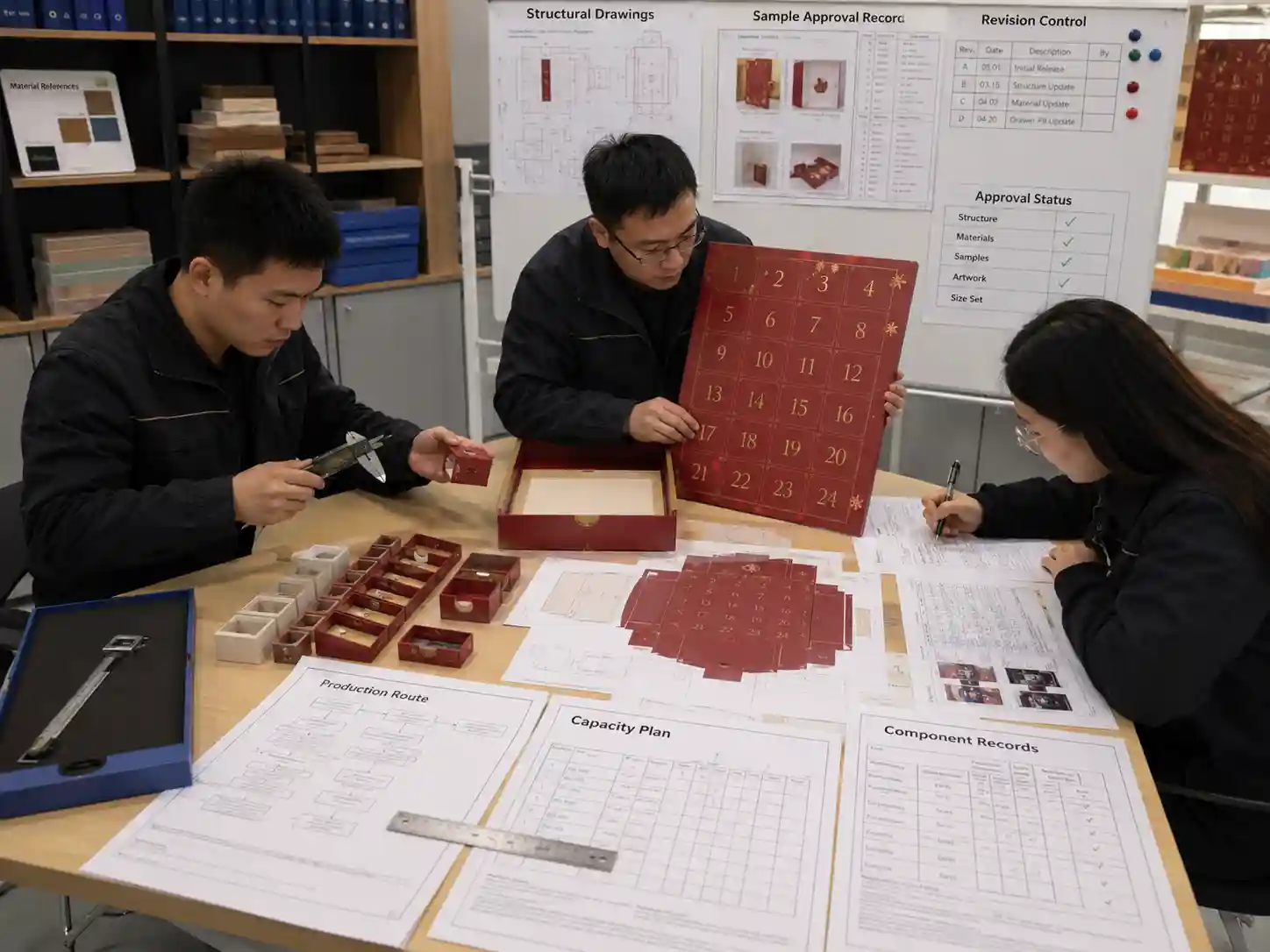
For projects where an approved sample is a production reference, linking further production authorization or a payment stage to documented approval can reduce ambiguity. The buyer should distinguish approval to continue engineering from approval to begin mass production.
A sample alone is not enough unless its status is controlled. The approval record should identify the relevant sample, drawing or specification revision, artwork revision where applicable, and any approved deviations.
If the buyer requests changes after approval, the parties should determine whether those changes affect tooling, purchased materials, production already completed, or the payment schedule. This is a project-dependent commercial decision and should be recorded rather than assumed.
When is material readiness a useful payment milestone?
Material readiness is useful when the supplier must commit substantial project-specific materials or components before assembly. However, the buyer should define what “material ready” means and what evidence is required before connecting it to payment.
For example, a supplier statement that “all materials have been ordered” does not necessarily prove that the correct materials were received. Depending on project risk, verification may use material specifications, receiving records, photographs linked to the PO, supplier purchase records, component samples, or inspection of critical incoming materials.
The level of verification should reflect the consequences of substitution. Critical board grades, specialty papers, structural components, magnets, ribbons, or other specified items may justify stronger controls than ordinary consumables.
How can buyers verify a production-progress milestone?
A progress payment should correspond to identifiable manufacturing output, not just a supplier’s percentage estimate. Evidence should demonstrate that work belongs to the correct order, is at the stated process stage, and is being produced at an approved location.
Useful evidence may include dated production records, work-in-process quantities, inspection records, traceable photographs, assembly records, or an on-site verification where risk justifies it. For subcontracted operations, buyers may also require evidence identifying the approved external facility responsible for that process.
What is a common sourcing-risk example?
Consider a multi-component calendar for which the supplier reports that production is 80% complete and requests the next payment. Photographs show stacks of printed material, but there is no traceable quantity record, no evidence of completed structural assembly, and no confirmation that inserts have passed dimensional checks.
The safer response is not automatically to reject payment. The buyer should compare the request with the agreed milestone definition and request the missing evidence. If the milestone requires completed assembly or measurable output, printed components alone do not demonstrate that the trigger has been reached.
How should final inspection affect the remaining balance?
Where inspection is part of the commercial control plan, a meaningful payment stage can be linked to inspection acceptance and closure of agreed corrective actions. The inspection requirements must be defined before production rather than introduced when goods are already complete.
Inspection evidence may include dimensions, workmanship findings, functional checks relevant to the approved specification, quantity verification, defect records, and photographs. If defects require rework, the buyer should determine whether reinspection or documented corrective-action closure is required before the associated milestone is approved.
Payment approval and quality approval should remain separate records. A QC inspector may confirm that specified inspection criteria were met, while procurement or an authorized buyer approves the commercial payment.

What should buyers check before approving each payment?
A short verification checklist helps prevent milestone payments from becoming routine accounting events. The approver should be able to trace the payment request to objective project evidence.
- Is this milestone defined in the PO, contract, or agreed commercial record?
- Has the supplier met the exact trigger rather than merely reached the expected date?
- Does the evidence identify the correct PO, product, revision, quantity, and production location?
- Are required buyer approvals recorded?
- Are any unauthorized material, structural, artwork, or subcontracting changes unresolved?
- Are inspection or measurement records required at this stage, and have they been reviewed?
- Are open nonconformities or corrective actions relevant to the milestone?
- Does approving payment unintentionally waive a requirement that should remain open?
Which payment percentages should buyers use?
There is no universal percentage split that is appropriate for every complex packaging order. Percentages are commercial terms and should reflect supplier relationship, project-specific material commitments, tooling or setup exposure, production duration, order complexity, inspection arrangements, and negotiating position.
The risk-control principle is more transferable than any particular percentage: avoid allowing payments to become substantially disconnected from verifiable project progress.
Buyers should also distinguish facts from approvals. A factory record showing that 10,000 components were produced is evidence of status; whether that evidence satisfies a contractual payment milestone is determined by the agreed terms and authorized buyer approval.
What payment terms should be written into the purchase order?
The PO should state milestone triggers precisely enough that both parties can determine whether each payment is due. It should also identify required documents, inspection rights, change-control consequences, and the treatment of unresolved nonconformities where applicable.
For complex projects, useful wording topics include the payment trigger, evidence required, responsible approver, approved production location, subcontracting restrictions, inspection stage, corrective-action requirements, and shipment-release condition. Commercial and legal wording should be reviewed according to the buyer’s own contracting procedures and jurisdiction.
Teams comparing constructions before issuing a PO can review custom advent calendar box products and custom advent calendar box services to identify the production stages that may need project-specific controls.
FAQs about packaging payment milestones
Should payment automatically become due on a scheduled date?
Not when the agreement defines a milestone by production or quality status. A date can support planning, but payment should follow the actual contractual trigger and required evidence if those conditions have been specified.
Can photographs prove that a production milestone is complete?
Photographs can support verification, but their strength depends on traceability. For higher-risk milestones, combine images with PO references, quantities, dates, production records, inspection records, or other evidence that connects the photographed goods to the actual order.
What happens if inspection finds defects before the final payment?
Follow the pre-agreed inspection, nonconformity, corrective-action, and payment terms. Depending on the contract, the next step may involve rework, replacement, documented corrective action, or reinspection before the relevant milestone can be approved.
Should subcontracted work change the payment structure?
It can. If a critical operation is performed externally, the buyer may require additional traceability or verification before approving a milestone, particularly when the approved production site or subcontractor is an explicit PO requirement.
How should buyers build a lower-risk payment plan?
Start with the manufacturing and approval sequence, then place payment milestones at points where progress can be objectively verified. Define the evidence before placing the order, preserve inspection and corrective-action rights, and require authorized buyer approval before each commercial release.
The objective is not to delay legitimate supplier payments. It is to keep commercial exposure aligned with demonstrated progress throughout a complex packaging project. For a project-specific review of construction, production stages, and sourcing requirements, request a custom quote from Giftpackpro.