Quick answer: Approved packaging subcontracting terms should identify which production processes may be outsourced, require the supplier to disclose and obtain approval for subcontractors, and keep the contracted supplier responsible for quality, traceability, timing, and corrective action. For custom advent calendar boxes, buyers should connect these terms to named processes, approved specifications, inspection access, production records, and change-control requirements rather than relying on a general statement that subcontracting is permitted.

What should approved packaging subcontracting terms actually define?
They should define the boundary between work the contracted factory performs itself and work it may place with another facility. The purchase order or controlled attachment should also state what requires buyer approval before production is transferred.
Packaging production often involves several distinct operations. Depending on the construction and finish, these can include printing, surface finishing, die cutting, greyboard cutting, paper mounting, rigid-box assembly, insert conversion, hand assembly, packing, or other specialist processes. Which operations are relevant is project-dependent.
A useful subcontracting clause therefore identifies processes rather than using vague wording such as “subcontracting allowed with approval.” It should establish:
- which operations are expected to be performed at the contracted factory;
- which operations may be subcontracted;
- which subcontractors or production sites have been approved, where applicable;
- what information must be submitted before a new subcontractor is used;
- whether written buyer approval is required before production is transferred;
- which specifications and approved references must follow the outsourced work;
- what production, inspection, and traceability records must be retained;
- who remains responsible when subcontracted work is nonconforming.
The commercial supplier should normally remain the accountable party under the purchase order unless the contract explicitly establishes a different arrangement. Outsourcing an operation should not automatically transfer responsibility for conformity to the buyer or to an unnamed third party.
Which subcontracted processes should the supplier disclose?
The supplier should disclose outsourced operations that can materially affect appearance, dimensions, structure, function, compliance requirements, traceability, or delivery. The exact list should follow the approved construction and manufacturing route for the specific packaging order.
| Process or evidence | What the buyer should establish | Useful verification evidence |
|---|---|---|
| Printing or specialist finishing | Whether work is internal or outsourced and which approved specification applies | Production route, approved artwork/revision, finish specification, inspection record |
| Die cutting or board conversion | Where dimensional-critical components are produced | Approved drawing, die-line revision, dimensional checks, first-piece record |
| Rigid-box or drawer assembly | Whether structural assembly occurs at the evaluated production site | Process flow, production-site record, assembly inspection results |
| Insert production | Who converts the insert and controls cavity dimensions | Approved drawing/sample, material reference, measurement report |
| Hand assembly or packing | Whether work moves to another workshop or facility | Site identification, work instructions, packing records, QC responsibility |
| New subcontractor | Whether buyer approval is required before use | Supplier disclosure, capability evidence, approval record, change authorization |
This evidence helps separate a verifiable production arrangement from an assumption. A supplier statement alone does not show where a critical operation will actually take place.
How should subcontractor approval work before production starts?
Approval should be documented before the affected operation begins. The buyer should know what is being outsourced, where it will be performed, why that facility is being used, and whether it can follow the approved packaging requirements.
A practical approval sequence is:
- Map the manufacturing route for the approved packaging construction.
- Identify operations performed outside the contracted factory.
- Record the subcontractor or external production site for critical outsourced operations.
- Review capability evidence relevant to the assigned process.
- Confirm that current drawings, artwork, material specifications, approved samples, tolerances, and QC requirements will be transferred correctly.
- Document buyer approval where the purchase order requires it.
- Require another approval if the subcontractor, site, process, or relevant specification changes.
Buyer approval is a control decision, not proof that every future output from the subcontractor will conform. Production and inspection evidence are still needed.
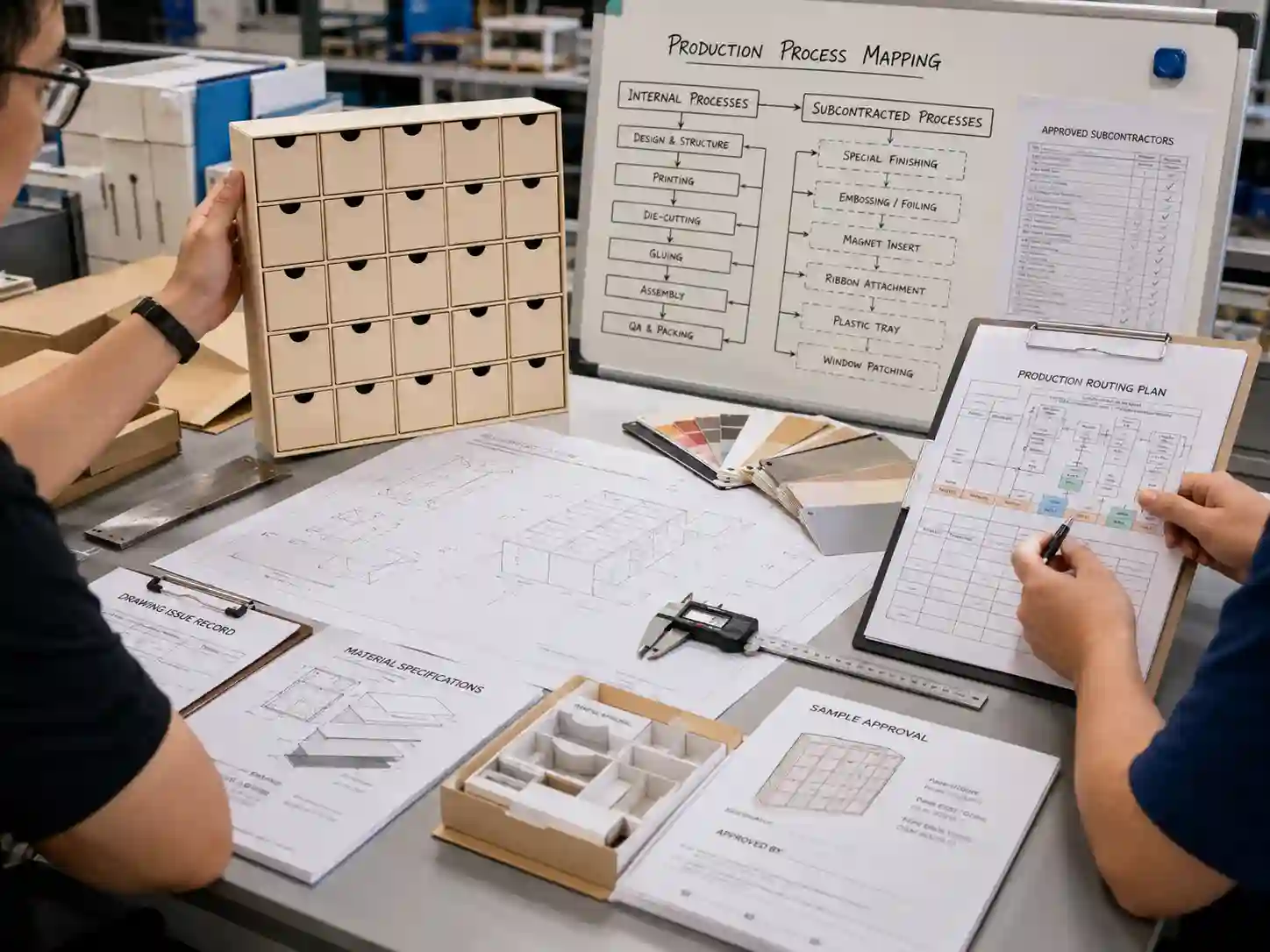
How do you verify that an approved subcontractor can perform the work?
Verification should match the risk of the outsourced operation. Buyers can review process capability, equipment, samples, measurements, production records, and inspection evidence rather than treating every subcontractor as requiring the same level of review.
For example, if a subcontractor converts structural components for an advent calendar, relevant evidence may include the approved structural drawing, board specification, cutting or converting equipment, dimensional measurement method, first-piece checks, and records linking the output to the order.
For a specialist decorative process, the evidence may instead focus on the approved artwork revision, finish reference, registration requirements, appearance standard, and inspection method.
What should a subcontractor verification checklist contain?
A focused checklist should answer whether the external facility can perform the assigned process under the same controlled requirements used to approve the packaging.
- Is the subcontractor’s legal or production-site identity recorded?
- Is the exact outsourced process identified?
- Has the facility’s relevant equipment or capability been reviewed?
- Does it receive the correct drawing, artwork, specification, and revision?
- Are approved samples or reference standards available where needed?
- Are critical measurements or appearance checks defined?
- Can output be traced to the relevant order, batch, or production record?
- Can inspection records be obtained from the supplier?
- Is the contracted supplier responsible for controlling nonconforming output?
- Does changing the subcontractor require authorization?
Some projects justify more extensive verification than others. A simple outsourced operation with low quality impact may require documentary review, while a critical structural or finishing process may justify sample validation, first-article inspection, or an on-site capability review.
What inspection rights should apply to subcontracted production?
Inspection rights should not disappear because production moves outside the contracted factory. The purchase order should state whether the buyer, its representative, or an appointed inspection company may review relevant production, records, work in progress, or finished goods associated with the order.
The practical wording depends on the commercial agreement and local circumstances, but the control objective is straightforward: subcontracting should not create an inspection blind spot.
The supplier should also be able to retrieve relevant evidence from its subcontractor. Depending on the operation, this could include incoming-material records, first-piece measurements, in-process checks, quantity records, nonconformity reports, or final inspection results.
What is the risk of allowing undisclosed subcontracting?
Undisclosed subcontracting weakens the connection between the factory that was evaluated and the factory actually producing the packaging. This can affect process capability, specification control, traceability, inspection access, capacity planning, and corrective action.
What does this sourcing risk look like in practice?
Consider an order approved using a structural sample produced by the contracted supplier. During peak production, part of the mounting and assembly work is transferred to an unreviewed workshop without notification.
The external workshop receives an older work instruction and does not use the same dimensional checkpoints. Finished drawer alignment begins to vary, but the issue is discovered only during final inspection.
The core control failure is not simply that another workshop participated. It is that the production change occurred without controlled disclosure, specification transfer, approval, and inspection evidence.
A stronger purchase order would require authorization before transferring the relevant process, identify the documents that must accompany the transfer, and keep the contracted supplier responsible for containment and corrective action.
How should changes to an approved subcontractor be controlled?
A supplier should not treat approval of one subcontractor as permission to use any subcontractor. The order should define which changes require renewed disclosure or buyer approval.
Typical triggers can include a change of production site, subcontractor, manufacturing process, critical equipment, specified material source where controlled by the order, or another factor that could affect approved packaging characteristics.
The buyer can then decide what evidence is necessary before approving the change. Depending on risk, this might be a document review, revised sample, measurement report, first-article inspection, process evidence, or production-site verification.
These are project-dependent recommendations. The required approval level should reflect the packaging structure, process risk, contractual requirements, and consequences of a late production failure.
Who owns corrective action when subcontracted work fails inspection?
The purchase order should clearly assign corrective-action responsibility to the contracted supplier unless another arrangement has been explicitly agreed. The buyer should not have to manage an unknown subcontractor directly to resolve ordinary supplier nonconformity.
When subcontracted work fails, useful evidence can include the affected quantity, lot or production reference, defect description, containment action, root-cause analysis where appropriate, corrective action, reinspection result, and authorization for release.
Payment milestones can also be aligned with required approval or inspection evidence where commercially appropriate. However, payment structure varies by contract and should not be treated as a substitute for production control.
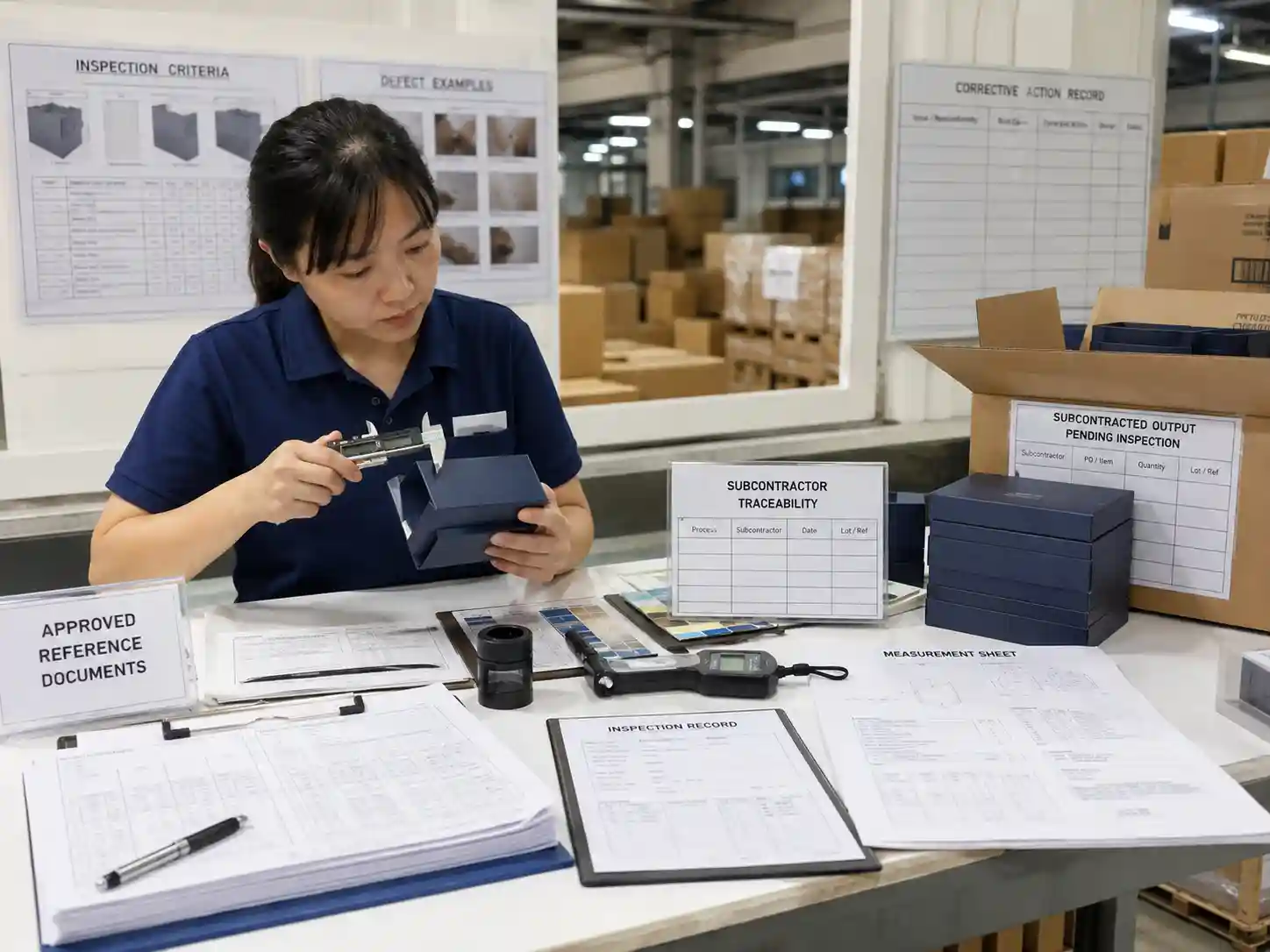
What should buyers put into the purchase order before approving subcontracting?
The purchase order should make subcontracting visible, controlled, and auditable. The final wording should reflect the actual production route rather than using a generic clause copied across unrelated packaging projects.
- Define the processes that may or may not be subcontracted.
- Require disclosure of relevant external production sites.
- Specify when written buyer approval is required.
- Require current controlled specifications to follow outsourced work.
- Preserve appropriate inspection and record-access rights.
- Require traceability appropriate to the outsourced process.
- Prohibit unapproved changes where they could affect conformity.
- Keep responsibility for subcontracted quality with the contracted supplier.
- Define notification, containment, and corrective-action expectations.
- Retain approval and inspection records with the order documentation.
Before issuing the order, buyers can compare these requirements with the supplier’s declared manufacturing route and the capabilities observed during factory verification. Information about the production organization can also be reviewed through the Giftpackpro packaging factory page, while relevant packaging formats are available under custom advent calendar box products.
Frequently asked questions about packaging subcontracting
Does every subcontracted packaging process need buyer approval?
Not necessarily. The approval threshold is project-dependent and should be defined in the purchase order. Buyers commonly apply tighter control to processes that materially affect structural performance, appearance, dimensions, traceability, compliance requirements, or delivery risk.
Is a subcontractor list enough to control outsourcing?
No. A list identifies facilities but does not establish which process each facility performs, which specification revision it receives, how its output is inspected, or how changes are controlled. Link each relevant subcontractor to a defined process and verification evidence.
Should an approved subcontractor receive the buyer’s controlled specifications?
Relevant controlled requirements should reach the facility performing the work. The contracted supplier should have a method for ensuring the correct drawings, artwork revisions, material requirements, approved references, tolerances, and inspection criteria are used.
Can subcontracting be changed after mass production begins?
Only according to the change-control terms established for the order. If the change could affect approved characteristics or production risk, requiring disclosure and authorization before transfer gives the buyer an opportunity to request appropriate verification evidence.
For a custom advent calendar project, define subcontracting controls while the production route and purchase-order requirements are still being reviewed. Request a custom quote to discuss the packaging specification and supplier-control requirements relevant to your order.