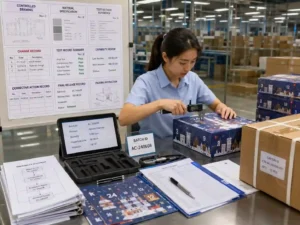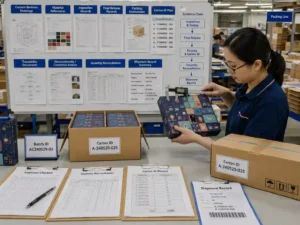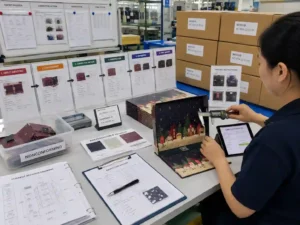
Quick answer: Effective advent calendar purchase order clauses should convert the approved packaging specification into enforceable production controls. The PO should identify approved drawings and samples, materials, subcontracting restrictions, inspection rights, production milestones, payment conditions, change-control rules, defect handling, and required production records. The objective is not to make the PO unnecessarily long, but to remove ambiguity about what the supplier must produce, what evidence must be available, and which changes require buyer approval.
What should an advent calendar box purchase order control?
The PO should control the commercial order and the production baseline used to manufacture it. A price, quantity, delivery date, and short product description are usually insufficient for a custom multi-component paper package.
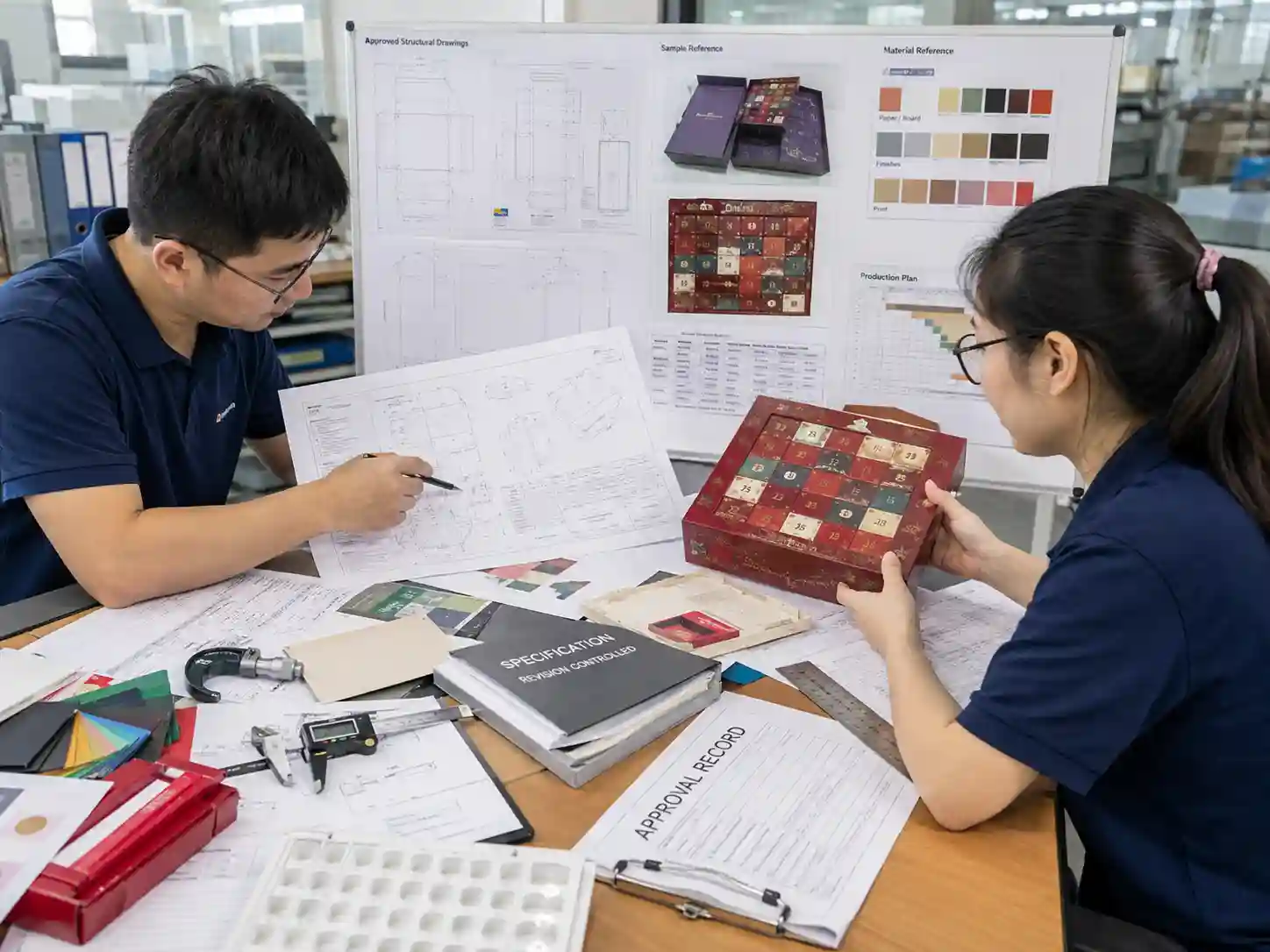
An advent calendar may involve an outer shell, drawers or doors, inserts, printed components, ribbons, magnets, adhesives, surface finishes, and manual assembly. Instead of attempting to describe every technical detail in one PO line, reference controlled documents by document name, drawing number, revision, or approval date.
A practical PO can reference:
- approved structural drawings and dielines;
- approved artwork revisions;
- material specifications and board thickness or grade where relevant;
- approved physical samples or retained reference samples;
- approved finishing and assembly requirements;
- inspection criteria and measurement methods;
- packing specifications directly relevant to order acceptance;
- agreed production and inspection milestones.
The supplier should be able to identify the exact revision being manufactured. This creates a traceable baseline if the buyer later finds a discrepancy.

Which advent calendar purchase order clauses reduce specification disputes?
The most useful clauses define which documents have authority and prohibit uncontrolled substitutions. If specifications conflict, the PO should also establish how the conflict must be resolved before production continues.
How should approved drawings and samples be referenced?
List approved references precisely enough that purchasing, engineering, production, and QC teams can retrieve the same version. Avoid wording such as “same as sample” when several sample rounds exist.
A reference may include a structural drawing revision, artwork revision, specification sheet, approval record, and dated retained sample. The buyer should separately approve the documents that establish the production baseline; the PO records those approvals rather than replacing the approval process.
How should material substitutions be controlled?
The PO should state that specified materials, components, construction methods, or finishes cannot be substituted without documented buyer approval when the substitution could affect appearance, dimensions, function, durability, compliance, or packing performance.
Verification should rely on appropriate evidence rather than supplier assurances alone. Depending on the project, evidence may include purchase records, material declarations, incoming-material records, board measurements, production samples, or inspection results.
Not every project requires the same evidence. A simple paper structure may need fewer controls than a calendar combining rigid board, specialty paper, magnets, ribbons, inserts, and multiple finishing operations.
Should subcontracting be addressed in the purchase order?
Yes, when subcontracted processes could materially affect quality, schedule, traceability, or compliance. The PO should identify whether important processes may be outsourced and what disclosure or approval is required.
Printing, lamination, die-cutting, foil stamping, specialty finishing, insert production, and hand assembly may be performed through different production arrangements. The relevant issue is not automatically whether outsourcing occurs; it is whether the supplier maintains effective control over outsourced work.
For critical processes, the PO can require the supplier to:
- disclose significant subcontracted processes;
- obtain approval before changing an approved production source where required;
- remain responsible for subcontractor quality;
- maintain traceable inspection or production records;
- make relevant records available during agreed inspections or investigations.
If factory verification is important before order placement, buyers can also review the capabilities described by the Giftpackpro packaging factory and confirm which processes and controls apply to the specific project.
What inspection rights should the PO contain?
The PO should define the buyer’s agreed right to inspect relevant materials, work in progress, finished goods, and supporting records at appropriate production stages. It should also clarify that an inspection does not automatically transfer responsibility for manufacturing conformity from the supplier to the buyer.
Depending on the risk level, inspection points can include incoming materials, first production units, in-process assembly, finished goods, or pre-shipment inspection.
| Control point | Evidence to request | Risk it helps control |
|---|---|---|
| Specification release | Approved drawing and artwork revision records | Production from obsolete files |
| Material verification | Material records and relevant measurements | Unapproved material substitution |
| First production output | First-article measurements and visual checks | Repeated dimensional or assembly errors |
| In-process production | Inspection records and production samples | Process drift during the run |
| Pre-shipment | Final inspection report and agreed supporting records | Shipment of nonconforming goods |
The exact sampling method, tolerances, defect classifications, and acceptance criteria are project-dependent and should be agreed before they are used as shipment-release conditions.
How should payment milestones be linked to production evidence?
Payment milestones should correspond to clearly defined commercial or production events rather than vague statements such as “balance before shipment.” The PO should state what evidence or approval is associated with each milestone where relevant.
For example, a project may distinguish order confirmation, specification approval, production authorization, inspection completion, and shipment release. The commercial payment structure itself varies by supplier relationship and project risk, so there is no universal percentage that should be written into every advent calendar PO.
More important is clarity. Buyers should know whether a payment becomes due because a calendar date was reached, a production stage was completed, an inspection was passed, or specific documents were provided.
How should production capacity and schedule commitments be written?
The PO should record agreed production milestones that matter to the order and require early notification when the supplier identifies a material risk to those milestones. This is particularly useful for seasonal packaging where a delay can compress inspection and shipping windows.
Relevant controls may include the agreed production start window, critical material readiness, assembly timing, inspection availability, and goods-ready date. These should reflect verified project planning rather than unsupported assumptions about factory capacity.
Before relying on a supplier’s capacity statement, buyers can request evidence appropriate to the order, such as a production schedule, equipment list, assembly-line plan, workload information, or material procurement status.
What should the PO say about engineering or artwork changes?
The PO should prohibit production changes that affect the approved product without documented authorization. This creates a formal change-control path when dimensions, materials, artwork, finishing, components, or assembly methods change after approval.
A useful change process requires the supplier to identify:
- what is changing;
- why the change is required;
- which drawings, samples, materials, or processes are affected;
- whether cost or schedule is affected;
- whether new sampling, testing, or inspection is necessary;
- which revised document becomes the new production reference.
The buyer is responsible for approving commercial or design changes within its authority. The supplier is responsible for preventing an unapproved change from silently entering production.
What should happen when nonconforming boxes are found?
The PO should define the required response to significant nonconformity without assuming that every defect has the same remedy. At minimum, it should establish containment, reporting, disposition approval, and corrective-action responsibilities.
Depending on severity, the supplier may need to identify affected quantities, segregate suspect goods, investigate the cause, propose rework or replacement, and provide evidence that corrective action was implemented.
Rework should not automatically be accepted. Where rework could affect appearance, dimensions, opening function, surface finish, structural integrity, or packing condition, the buyer should approve the proposed method before the affected goods are released.
What does a practical sourcing-risk example look like?
Suppose the approved calendar uses a specified rigid board construction and the supplier later proposes a different board because the original material will delay production. A verbal agreement between sales representatives creates a weak audit trail.
Under controlled PO terms, the supplier would issue a change request identifying the alternative material, affected components, schedule impact, and supporting evidence. The buyer could request measurements or a revised sample, approve or reject the change in writing, and update the controlled production reference. The important control is not simply detecting thinner board at final inspection; it is preventing an undocumented substitution from becoming accepted production.
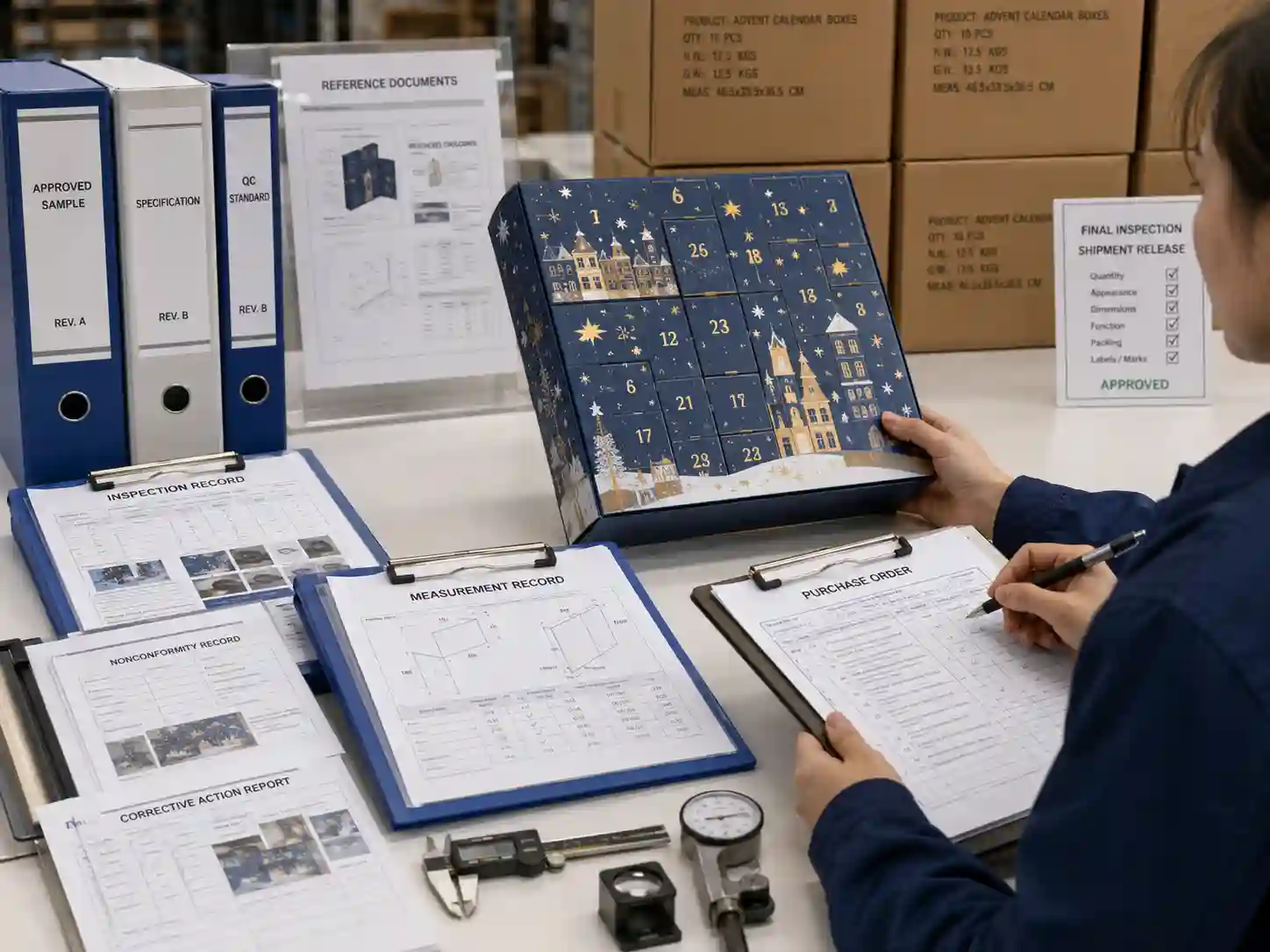
What evidence should buyers require before releasing the order?
Before production authorization, buyers should confirm that the PO references a complete and internally consistent approval package. Missing evidence should be resolved before it becomes a factory-floor interpretation problem.
| Verification item | Evidence | Buyer decision |
|---|---|---|
| Product definition | Current structural drawing and specification | Approved / revise |
| Artwork | Current artwork revision and approval record | Approved / revise |
| Physical reference | Approved or retained sample where required | Accepted / not applicable |
| Materials | Specified material references and verification evidence | Accepted / investigate |
| Production route | Critical process and subcontracting information | Accepted / approval required |
| Inspection | Inspection stage, criteria, method, and records | Confirmed / revise |
| Schedule | Production milestones and goods-ready commitment | Confirmed / escalate |
| Changes | Defined authorization and revision process | Confirmed |
This evidence separates three issues that are often mixed together: verifiable manufacturing facts, project-dependent requirements, and buyer approvals. The factory can provide evidence of what it plans to manufacture; engineering and procurement can define what the project requires; authorized buyer personnel approve deviations and commercial changes.
Which PO wording should buyers avoid?
Avoid clauses that sound strict but cannot be objectively verified. Terms such as “high quality,” “best material,” “perfect printing,” or “same as previous” provide little protection unless the reference and acceptance method are defined.
Replace subjective wording with controlled references and measurable evidence. “Match approved sample dated X and drawing revision Y” is more useful than “premium quality.” Likewise, “dimension measured according to approved drawing” is more actionable than “size must be accurate.”
Do PO clauses replace drawings, samples, and QC specifications?
No. The PO should connect the commercial order to controlled technical and quality documents rather than attempting to duplicate every detail inside the order itself.
For custom projects, the strongest control system is usually a hierarchy of approved PO terms, drawings, artwork, specifications, samples, change records, and inspection requirements. Buyers reviewing a new project can use custom advent calendar box services to understand the available customization workflow and then define the documents required for their specific order.
FAQ: Should the PO name the exact factory producing the calendars?
If factory identity is material to supplier approval, capacity verification, compliance, or quality control, the PO should identify the approved manufacturing entity or location and define whether a change requires authorization. The appropriate wording depends on the buyer’s sourcing policy and supplier structure.
FAQ: Should inspection be completed before the final payment?
This is a commercial decision rather than a universal rule. If inspection is linked to a payment milestone, the PO should clearly state which inspection, what acceptance criteria apply, and what happens if the result is nonconforming.
FAQ: Can an email approval authorize a PO change?
It can only serve as effective project authorization if the parties’ agreed procedure recognizes it and the sender has appropriate approval authority. For traceability, significant changes should still be captured in a controlled revision, change record, or amended PO reference.
How should buyers finalize the purchase order?
Before release, cross-check the PO against the latest approved technical documents and confirm that specifications, subcontracting controls, inspection rights, milestones, change authorization, and nonconformity procedures are internally consistent. The final PO should tell both sides not only what is being purchased, but also how conformity will be demonstrated.
For a project-specific review of drawings, specifications, production requirements, and supplier controls, request a custom quote from Giftpackpro.