
Quick answer: A 24 sku beauty product fit test should load all 24 final or dimensionally representative products into the intended cavities and evaluate each SKU against defined fit risks. Check retention, removal, orientation, pump and dropper clearance, glass contact, cap security, tube deformation, leakage evidence, scuffing and label visibility. Record the result by SKU and cavity number, photograph the approved orientations, document measurements where needed, correct failures, and repeat the loaded test before approving the packaging configuration.
What should a 24 SKU beauty product fit test prove?
The test should prove that every product can be loaded, retained, presented and removed without the packaging creating an unacceptable product or presentation risk. Passing 23 cavities does not demonstrate that the complete 24-SKU configuration works.
Mixed beauty assortments are more difficult than repeated-SKU packs because the failure mode changes from cavity to cavity. A glass serum bottle may need protection around its body and dropper. A pump bottle needs clearance that prevents accidental actuation. A flexible tube needs support without excessive compression. A decorated palette may fit dimensionally but still scuff against a tight retention feature.
The test therefore needs a cavity-by-cavity acceptance record rather than a general statement that the insert “fits.” Structural drawings, product dimensions, approved samples and loaded photographs provide evidence that the intended configuration was actually evaluated.
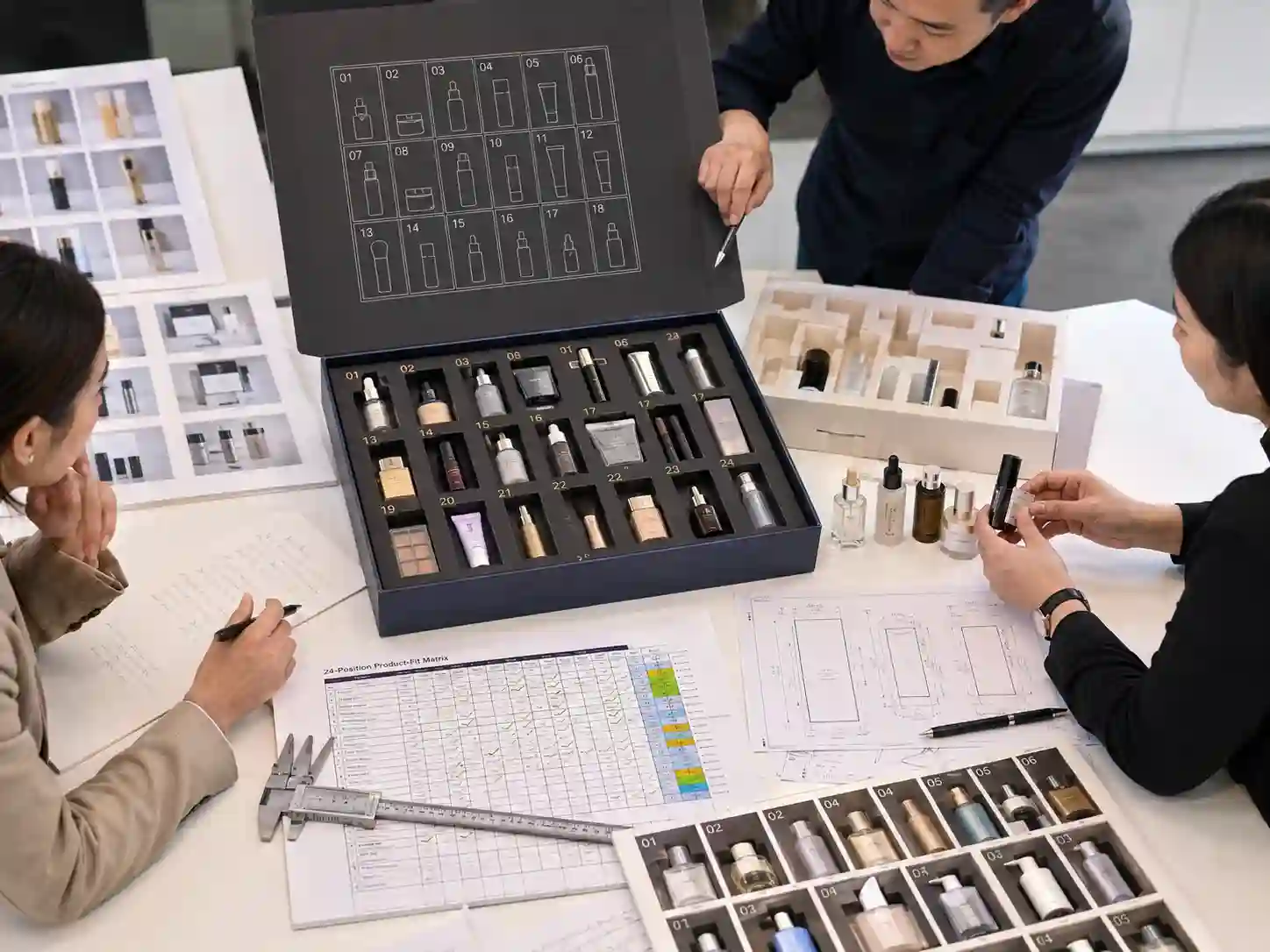
How do you prepare the 24 sku beauty product fit test?
Start by assigning a unique SKU and cavity number to every position. Then collect the final products where possible, or clearly identified representative samples whose critical dimensions, closures, materials and surface finishes match the intended products.
Create a product-fit matrix before testing. At minimum, record product type, overall dimensions, critical closure dimensions, intended orientation, cavity number and the specific risk that must be checked.
| Product type | Critical fit risk | What to verify | Useful evidence |
|---|---|---|---|
| Pump or airless bottle | Accidental dispenser actuation | Clearance around pump, shoulder and cap | Measurements and loaded photos |
| Glass serum bottle | Glass contact or dropper damage | Body support, separation and closure clearance | Cavity inspection and orientation photos |
| Jar | Lid contact or movement | Retention around stable body areas | Loaded fit record |
| Flexible tube | Crushing, bending or distortion | Support without excessive sidewall compression | Before-and-after inspection |
| Palette or decorated case | Scuffing | Contact points and removal path | Surface inspection |
| Lipstick, mascara or eyeliner | Cap movement and rotation | Retention and intended orientation | Loaded orientation photos |
| Perfume vial | Movement, glass contact or atomizer loading | Diameter fit and top clearance | Measurement and fit record |
Nominal dimensions alone are not enough for every decision. Actual products can include shoulders, hinges, pump heads, droppers, seams, caps and decorated surfaces that determine where an insert can safely make contact.
What steps should the loaded fit test follow?
Use the same sequence for all 24 positions so results can be compared and repeated. The objective is to turn subjective fit comments into documented checks.
- Confirm SKU identity. Match the physical sample to the product list, drawing or approved specification and assign it to the intended cavity.
- Inspect the unloaded cavity. Check dimensions, retention features, contact surfaces and any areas close to closures or decorated surfaces.
- Load the SKU in its intended orientation. Do not rotate a product simply to make an unsuitable cavity appear acceptable unless that orientation change is formally approved.
- Check insertion force and seating. The product should reach its intended position without damaging the product, closure or packaging.
- Check retention. Determine whether the SKU has excessive movement or can escape its intended position during normal handling of the pack.
- Inspect critical clearances. Pay particular attention to pumps, droppers, caps, atomizers, glass edges and flexible tube walls.
- Check removal. Confirm that the intended user-access area permits removal without excessive pulling, scraping or product deformation.
- Inspect the product again. Look for scuffing, crushed tubes, loose caps, closure movement, residue or other evidence of leakage.
- Record the result. Mark the SKU and cavity as pass, fail or requiring an approved change, with photographs and measurements where relevant.
Which risks need separate checks across the 24 SKUs?
Do not apply one generic “fit” criterion to every beauty product. Each SKU should have acceptance checks based on its geometry, material, closure and decorated surfaces.
How should pumps, droppers and caps be checked?
Pumps, droppers and caps should not become unintended load-bearing points. Verify that cavity walls, tabs and neighboring products do not press, loosen or obstruct these components.
For pump products, inspect the clearance above and around the actuator. For droppers and atomizers, check both lateral contact and top clearance. If closure security is important, compare the sample before and after loading rather than relying only on visual appearance.
How should glass and leakage risks be checked?
Glass products should be retained through suitable body support while avoiding hard product-to-product contact. The loaded test should also look for signs of leakage around closures, pumps and droppers.
A product-fit inspection can identify packaging-related leakage risks such as a pump being pressed or a closure being loaded by the insert. It should not be presented as proof of formula compatibility, closure validation or distribution performance unless those subjects have been tested separately under an appropriate method.

How should scuffing and flexible packs be checked?
Inspect decorated surfaces after insertion and removal because a cavity can retain a product successfully while still creating cosmetic damage. Tight edges, rough contact points and narrow removal paths deserve particular attention.
Flexible tubes and sachets require a different check. Look for bending, creasing, pinching and permanent deformation rather than simply measuring free space around the product.
How do you verify orientation and label visibility?
Define the intended orientation for each SKU and photograph the approved loaded position. The fit test should confirm that retention features do not force products to rotate or hide identification areas that need to remain visible.
Where batch codes, ingredient information or other required identification appears on the product or secondary carton, note its location in the fit matrix. Inspect the fully seated SKU to determine whether cavity walls, tabs or neighboring components obscure the relevant area.
This is project-dependent: the information that must remain visible in the final configuration depends on the product, market, labeling approach and pack design. The packaging team should therefore work from approved product artwork and compliance requirements rather than assuming that the same label zone applies to all 24 products.
What should be on the loaded-SKU checklist?
A useful checklist gives each cavity an individual result and makes failures traceable. It should be detailed enough for a supplier or QC inspector to repeat the approved evaluation.
- SKU name or controlled identifier and cavity number
- Sample version or product revision used for testing
- Intended loading orientation
- Product and critical closure dimensions where relevant
- Product seats fully in the intended cavity
- Retention is adequate without damaging the product
- Pump, dropper, atomizer and cap clearance is acceptable
- Glass does not make unintended contact with adjacent products
- Flexible packs are not excessively bent, pinched or compressed
- Decorated surfaces show no unacceptable contact damage after removal
- No packaging-induced closure movement or visible leakage evidence
- Required label or coded areas remain accessible or visible as specified
- Product can be removed through the intended access area
- Photograph or measurement reference is recorded
- Pass, fail or corrective-action status is documented
For mixed assortments, the checklist should remain linked to the exact product revision. A later change to a bottle diameter, pump head, cap, carton, tube length or palette thickness can invalidate an earlier fit result even if the marketing SKU name remains unchanged.
When should a failed cavity trigger another test?
Retest whenever a corrective change can affect fit, retention, clearance, removal or neighboring cavities. Changing a tab or cavity wall to solve one SKU can transfer the problem to another position.
Examples include widening a perfume-vial cavity, increasing pump clearance, changing a retention tab, moving a divider or changing product orientation. The revised prototype should be loaded with the affected SKU and any neighboring products whose fit could have changed.
For the final approval stage, a fully loaded configuration is more informative than checking 24 isolated cavities independently. The assembled structure can reveal interactions that are absent when a single cavity is tested on its own.
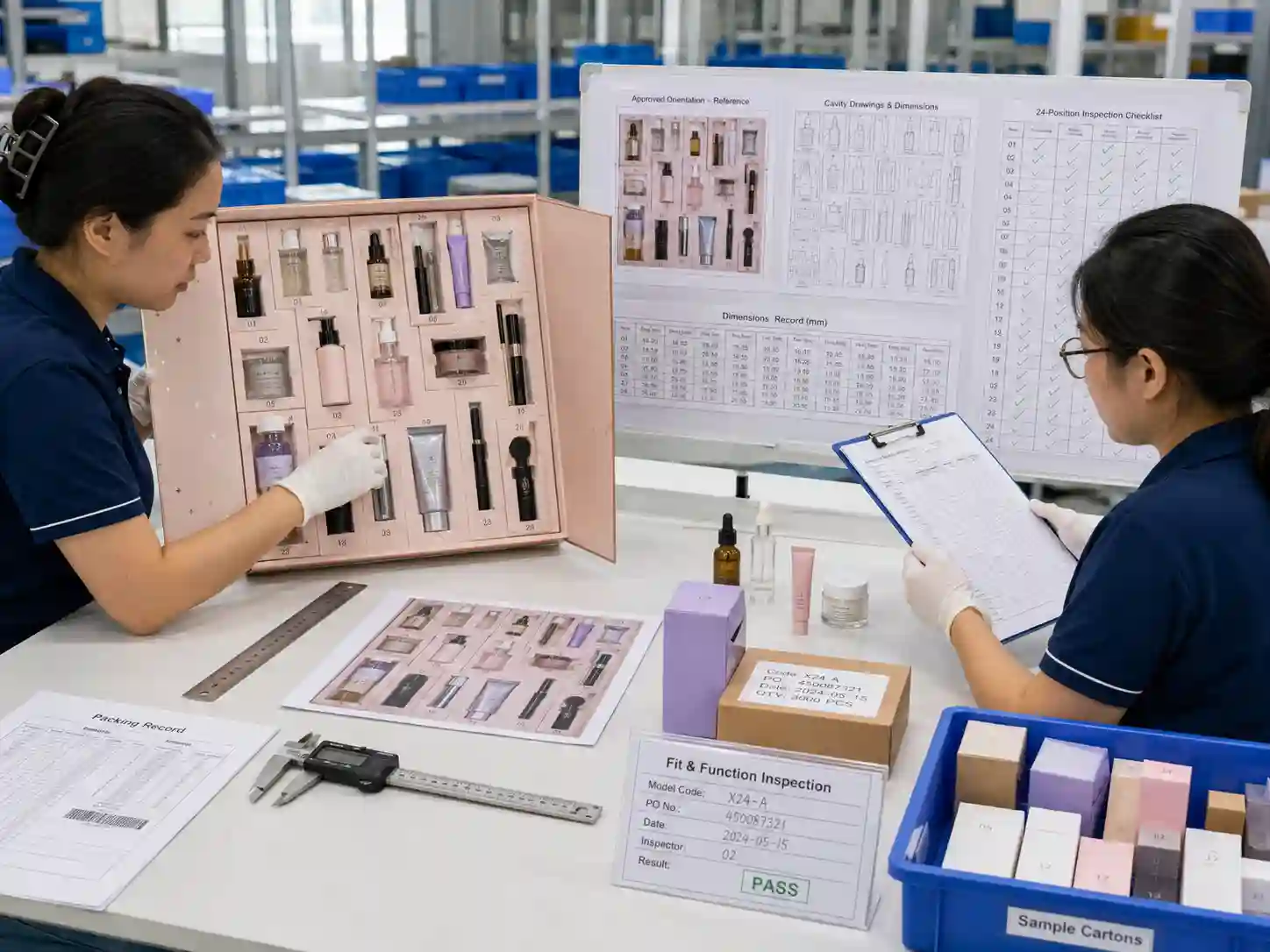
What evidence should buyers approve before production?
Approval should identify the exact loaded configuration rather than relying on a general prototype sign-off. Useful evidence includes the cavity drawing revision, product-fit matrix, measurements for critical areas, loaded photographs, failure and correction records, and the approved physical sample where applicable.
Verifiable facts are the recorded dimensions, observed contact points, sample identities and documented inspection results. Recommendations such as preferred clearance or retention geometry are project-dependent because product materials, dimensions and structures vary. Buyer approval establishes which product versions, orientations and acceptance decisions become the controlled reference for that project.
Teams developing the complete structure can review custom advent calendar box services and examples of custom advent calendar box products. Related engineering topics are also available in the advent calendar box buying guides.
What are common questions about mixed-SKU fit testing?
Do all 24 SKUs need physical samples?
Final physical products provide the strongest fit evidence because they include actual closures, materials and surfaces. When final products are unavailable, dimensionally representative samples can support development, but substitutions should be documented and affected positions rechecked when final products become available.
Is checking product dimensions enough?
No. Dimensions help define cavities, but a loaded test also evaluates contact points, insertion, retention, removal, orientation, closure clearance, deformation and surface effects that may not be obvious from length, width and height data alone.
Should every cavity use the same acceptance criteria?
No. The documentation format can be consistent, but the risk criteria should reflect each product. A glass dropper bottle, flexible tube and makeup palette have different critical failure modes.
What happens if one SKU changes after fit approval?
Compare the revised product against the approved dimensions and fit-critical features, then retest the affected cavity when the change could influence fit. Also inspect adjacent cavities if the packaging structure must be modified to accommodate the new version.
If you are preparing a 24-product beauty assortment, request a custom quote and provide the SKU list, product dimensions, closure details, intended orientations and available physical samples so the packaging fit requirements can be reviewed against the proposed structure.


