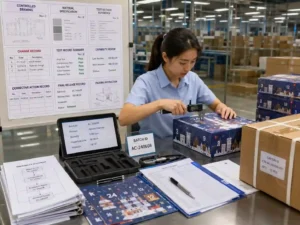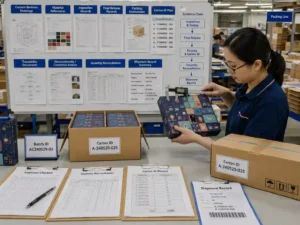
Quick answer: Batch code label visibility should be planned as part of product orientation and cavity design, not checked only after an advent calendar is assembled. Identify every required code or ingredient panel, define which information must remain readable before or after product removal, and position each SKU so insert walls, retention tabs, doors, sleeves, and neighboring products do not cover it. Verify the final arrangement with loaded samples, photographs, cavity drawings, and recorded inspection criteria.
What does batch code label visibility require in a beauty advent calendar?
It requires the packaging structure to preserve access to the product information that the project has identified as necessary to inspect or read. The exact requirement depends on the product, label layout, market, secondary packaging, and the brand’s regulatory and quality decisions.
Beauty calendars complicate this because the products may include glass serum bottles, pump bottles, jars, flexible tubes, perfume vials, palettes, lipsticks, mascara, sachets, and secondary cartons. Their batch codes and ingredient information can appear on different faces, bases, labels, crimp areas, cartons, or closures.
Before designing cavities, create a SKU record showing the code location, ingredient-label location, intended product orientation, and any area that must not be obstructed. Do not assume that two containers with similar dimensions use the same coding position.

Which packaging features most often hide codes or labels?
Insert walls, retention features, product rotation, deep cavities, and tightly packed neighboring SKUs are common causes. A product can fit securely while still being positioned incorrectly for identification or inspection.
| Product or feature | Visibility risk | Practical check |
|---|---|---|
| Glass serum bottle | Base or rear batch code hidden by a deep cavity | Confirm code location on the approved filled sample and check access after loading |
| Pump or airless bottle | Bottle rotates and turns the identification panel toward an insert wall | Check rotational control without pressing or loading the pump |
| Flexible tube | Tube folds, bends, or sinks below a retention feature | Load the actual filled tube and inspect label exposure and deformation |
| Jar | Bottom code becomes inaccessible in a close-fitting recess | Confirm whether inspection requires removal and document the approved method |
| Perfume vial | Small label rotates away from the opening | Check orientation after normal handling of the loaded prototype |
| Secondary carton | Ingredient panel faces downward or toward a cavity wall | Define the presentation face and information face on the packing specification |
Should every batch code be visible while the product remains inside the cavity?
Not necessarily. The project team should distinguish between information that must be visible in the packed presentation and information that may be inspected after the product is removed.
Trying to expose every surface can conflict with product retention, glass protection, pump clearance, scuff prevention, or presentation requirements. For example, a batch code printed on the bottom of a jar may reasonably require removal for inspection, while a brand-approved identification panel may need to face the calendar opening.
The important point is to define this deliberately. The packaging drawing or packing specification can identify the presentation face, code position, permitted covered areas, and required inspection method. Buyer or brand approval should resolve ambiguous cases rather than leaving the factory to infer which information has priority.
How should cavities control product orientation without damaging the pack?
Cavities should use the container geometry to limit unwanted movement while avoiding pressure on functional or vulnerable components. Orientation control should therefore be evaluated together with pumps, droppers, caps, glass surfaces, flexible packs, and decorated areas.
A shaped cavity may locate a rectangular carton reliably, but a cylindrical bottle can rotate unless another geometric feature controls it. Possible project-dependent solutions include support around a shoulder, controlled side contact, a keyed cavity shape, a separate collar, or another retention feature compatible with the product.
Do not solve label visibility by simply tightening the cavity. Excessive compression can scuff printed surfaces, deform tubes, load closures, or make products difficult to remove. Glass containers also require appropriate separation from hard neighboring components.
How should pumps, droppers, and caps affect orientation?
They should be treated as protected functional zones rather than convenient retention points. An insert should not depend on pressing a pump, loading a dropper bulb, or forcing a cap sideways merely to keep the label facing forward.
Record closure dimensions and clearances during sampling. Digital calipers, product drawings, photographs, and loaded prototypes provide better evidence than nominal bottle dimensions alone because closures often extend beyond the main container profile.
How can batch code label visibility be tested before approval?
Test a fully loaded representative calendar using the intended products or approved dimensional equivalents. Visibility should be evaluated after loading and normal handling, because an initially correct orientation is insufficient if the SKU can rotate, sink, or shift afterward.
- Create a SKU matrix identifying product dimensions, material, code position, ingredient-information position, presentation face, closure type, and sensitive surfaces.
- Mark required visible or accessible zones on the structural drawing or cavity-layout record.
- Load the prototype according to the proposed packing instructions.
- Photograph each SKU in its approved orientation before closing the calendar.
- Close, reopen, and handle the loaded sample using the project’s agreed evaluation procedure.
- Check for rotation, sinking, label obstruction, tube deformation, closure contact, leakage evidence, and surface scuffing.
- Remove products where required and confirm that batch codes or ingredient information remain readable and undamaged.
- Record deviations and update the insert or packing orientation before approval.

What should be recorded on the approved loaded sample?
The approval record should make correct orientation repeatable in production. A factory operator or QC inspector should not have to decide independently which face of each SKU belongs toward the opening.
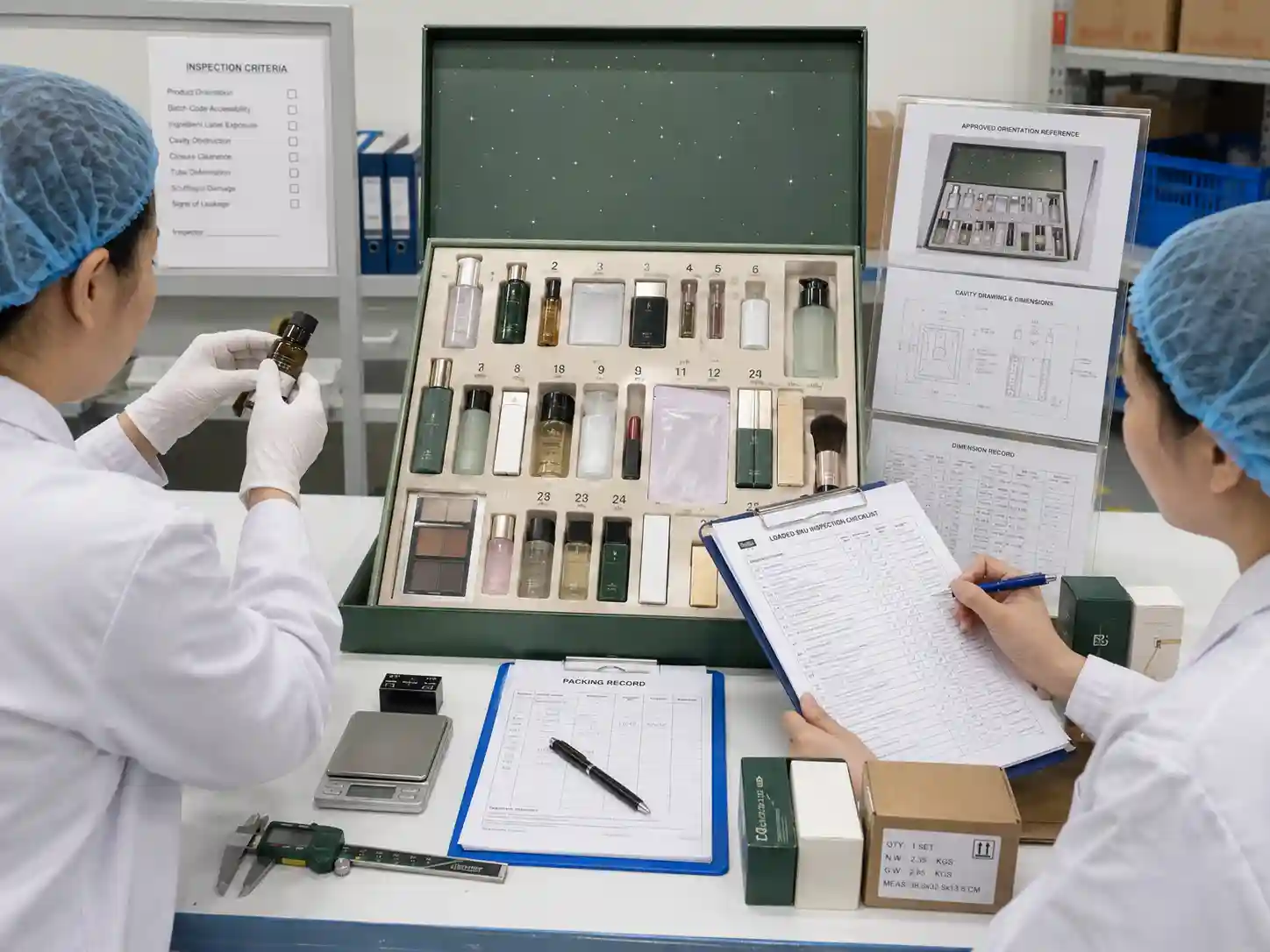
A useful loaded-SKU checklist can include:
- SKU or product reference matched to the correct cavity.
- Approved presentation direction shown by photograph or drawing.
- Batch-code location identified where relevant to inspection.
- Ingredient or information panel location identified where required.
- No insert edge obscuring an approved visible zone.
- Pump, dropper, atomizer, cap, or closure free from unintended pressure.
- Glass products separated from damaging contact points.
- Flexible tubes and sachets supported without excessive bending or compression.
- Printed, coated, or decorated surfaces checked for scuffing.
- Product remains adequately oriented after the agreed handling check.
The evidence can be incorporated into a packing specification, approved sample photographs, cavity drawings, inspection checklist, or other controlled project documentation. The exact document system varies by buyer and supplier.
How should QC verify label visibility during production?
QC should compare packed units with an approved reference rather than relying on a general instruction such as “labels face forward.” The reference should show what correct orientation means for each affected SKU.
Inspection can confirm the correct product is in the correct cavity, the approved face is oriented correctly, required information is visible or accessible as specified, and no structural feature has shifted into a prohibited area. Where codes must be readable, inspectors should also check that handling or cavity contact has not rubbed, smeared, or damaged them.
For mixed-SKU calendars, photographic packing references are particularly useful because 24 cavities can contain products with different orientation rules. Inspection records can identify the affected cavity or SKU rather than treating visibility as one calendar-wide pass/fail characteristic.
What should buyers approve before production?
Buyers should approve the visibility requirement, product orientation, loaded fit, and inspection reference for affected SKUs. Regulatory or brand-specific decisions about what information must remain exposed should come from the responsible product or compliance team, not be inferred by the packaging supplier.
Before approval, confirm which product samples and artwork versions are final enough to establish code and label positions. A later change in label dimensions, coding area, bottle geometry, secondary carton, closure, or product orientation can invalidate the earlier fit decision even when the outer calendar structure has not changed.
For projects requiring coordinated structural development, the custom advent calendar box services page provides an overview of relevant packaging support. Existing structures can also be reviewed through custom advent calendar box products.
What are the main mistakes to avoid?
The main mistake is treating label visibility as an artwork issue instead of a loaded-product engineering requirement. A label can be correctly printed and still become unusable when the product is inserted.
Other avoidable problems include approving empty inserts, using nominal dimensions without checking actual closure geometry, assuming cylindrical products will remain oriented, allowing retention tabs to cross coded areas, and changing products after fit approval without reviewing the loaded arrangement.
FAQ: Does the insert need a window around every batch code?
No. A dedicated opening is only one possible design response. Depending on the approved inspection requirement, the code may remain directly visible, become accessible after product removal, or be verified at another defined stage. The structural solution should follow the requirement rather than automatically adding windows.
FAQ: What happens if batch-code positions vary between production lots?
The packaging team should determine the permitted coding zone rather than approving only one exact code position. If the coding process can place information across a defined area, that entire relevant zone should be considered when evaluating insert obstruction.
FAQ: Should ingredient labels face the calendar opening?
Only when that orientation is required by the project’s presentation, inspection, or compliance specification. For some products, the front presentation panel has priority while ingredient information remains accessible after removal; other projects may specify a different arrangement.
FAQ: When should visibility be rechecked?
Recheck it when a change affects product geometry, label position, code area, secondary packaging, closure dimensions, cavity structure, or packing orientation. The need for renewed sampling or approval should be determined from the significance of that change.
For a new mixed-SKU beauty calendar, provide final or representative product dimensions, label and batch-code locations, closure details, and orientation requirements when you request a custom quote so the loaded layout can be reviewed against the actual packaging requirements.