Quick answer: Mixed beauty packaging materials should not be treated as one uniform loading problem. Glass bottles need controlled movement and impact protection, plastic pumps and caps need clearance from compression, and flexible tubes or sachets need support that prevents bending or an empty-looking compartment. The practical approach is to classify each SKU by its failure risks, design its contact points accordingly, then verify the complete loaded calendar for fit, orientation, leakage exposure, scuffing, and label visibility.

Why do mixed beauty packaging materials need SKU-specific handling?
Different packaging formats fail in different ways, so using the same cavity logic for every product can create avoidable damage. A rigid cavity that stabilizes a glass serum bottle may deform a soft tube, while a loose cavity suitable for a flexible sachet may allow a perfume vial to rattle.
Start with the actual production-intent SKUs rather than nominal product categories. Record the overall dimensions, closure geometry, center of mass, contact-sensitive surfaces, preferred orientation, and any protruding pump, dropper, atomizer, cap, hinge, or decorative component.
| Packaging format | Primary risks | Insert or compartment priority | Useful verification |
|---|---|---|---|
| Glass serum or fragrance bottle | Impact, rattling, dropper or cap damage | Stable body support with clearance around fragile closures | Loaded fit check, movement check, closure inspection |
| Plastic pump or airless bottle | Accidental actuation, cap release, scuffing | Support the body without loading the pump | Pump-clearance measurement and compression check |
| Jar or compact | Lid movement, surface scuffing, rotation | Control lateral movement and protect visible surfaces | Rotation check and cosmetic inspection |
| Flexible tube | Bending, denting, cap pressure | Support the tube without excessive cavity pressure | Loaded-shape and removal check |
| Sachet or flexible sample | Slumping, folding, poor presentation | Provide backing or controlled presentation area | Orientation and visual-fill check |
How should glass and rigid plastic products be separated and supported?
Glass should be restrained enough to limit uncontrolled movement, but the closure should not become the main structural contact point. Rigid plastic products can tolerate different contact conditions, yet pumps, thin caps, and decorative surfaces still require deliberate clearance.
For a glass dropper bottle, for example, the cavity can locate the stronger bottle body while leaving space around the dropper bulb, collar, and cap. For a pump bottle, the structural drawing should show whether the pump sits below surrounding insert features and whether anything can press the actuator when the calendar is closed.
When two glass products are adjacent, the insert structure should prevent direct glass-to-glass contact under expected movement. The required spacing and support geometry depend on bottle mass, shape, insert material, compartment arrangement, and the complete pack structure, so they should be confirmed with loaded samples rather than a universal clearance value.
What should you measure before approving rigid-product cavities?
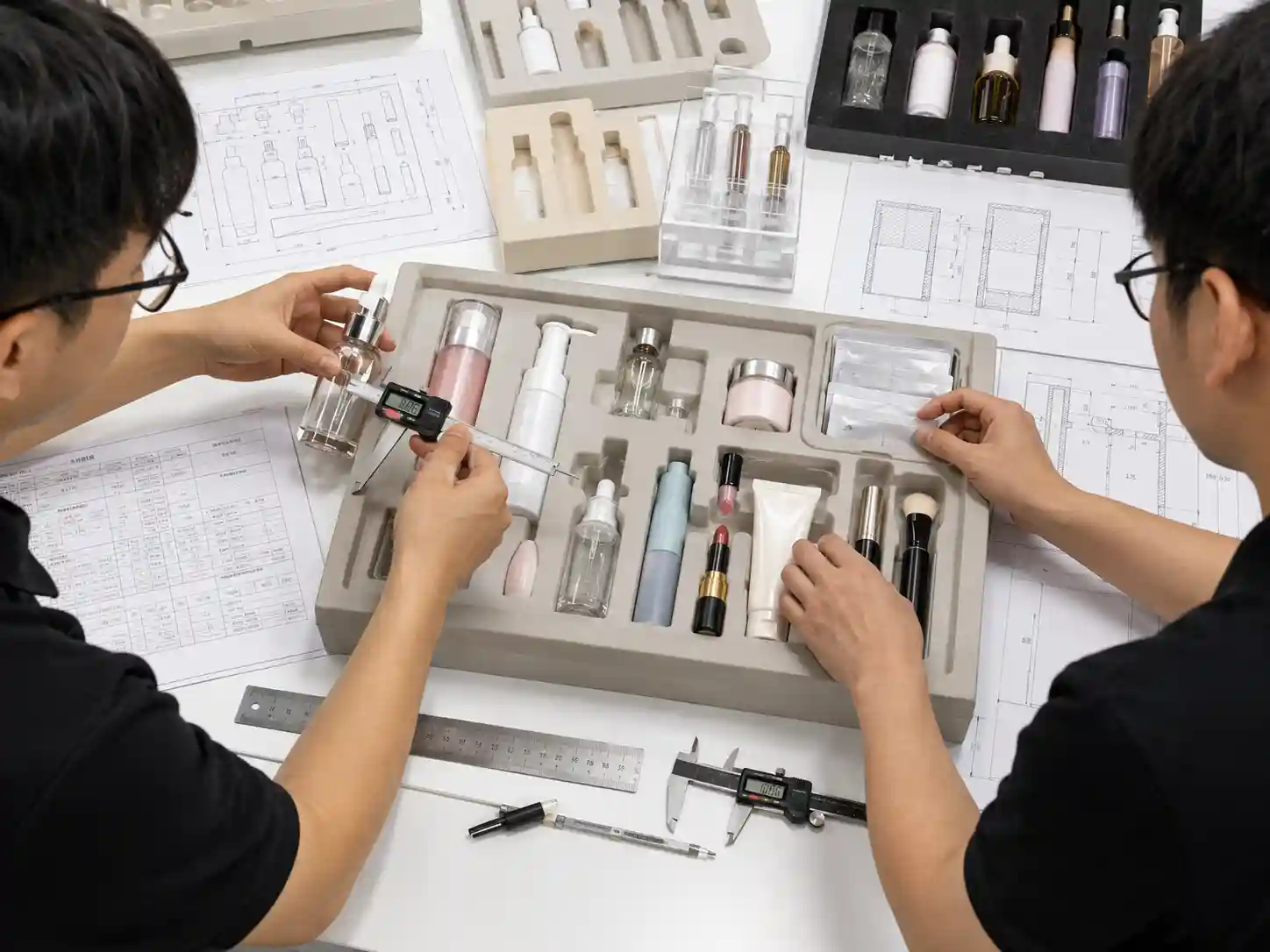
Measure the product at the features that actually control fit, not only its maximum length, width, and height. Important points can include shoulders, caps, pump heads, collars, dropper bulbs, jar lids, and irregular bottle bases.
Record these dimensions on a product drawing or fit sheet and compare them with the proposed cavity dimensions. If supplied components vary, evaluate representative samples and confirm which product dimensions the supplier is expected to design around.
How should flexible tubes and sachets be handled differently?
Flexible packs need presentation support without being squeezed into the same retention strategy used for rigid bottles. Excessive cavity pressure can bend a tube, crease a sachet, or make removal unnecessarily difficult.
A tube can often be located through its stronger regions while avoiding concentrated force on the sidewall or cap. A sachet may need a backing surface, pocket-like retention, or appropriately proportioned compartment so it stays visible instead of falling flat inside an oversized space.
Evaluate the product after it has remained loaded in the prototype, not only immediately after insertion. Check for permanent dents, folds, cap pressure, distortion, and changes in presentation.
How do you control pumps, droppers, caps, and leakage-sensitive closures?
Protect closures by preventing the insert, lid, drawer, or neighboring SKU from applying unintended force to them. Leakage control begins with the product’s closure integrity, but the calendar structure should avoid creating additional mechanical stress.
For each closure-sensitive SKU, check the loaded pack in its intended orientation. Confirm that pumps cannot be depressed, droppers are not carrying structural loads, screw caps are not being forced sideways, and removable caps cannot migrate into adjacent products.
Any signs of wetness, residue, loosened closures, damaged seals, or unexpected product odor during sample evaluation should be documented and investigated rather than treated as a cosmetic defect. Packaging engineers should distinguish between a product or closure problem and a secondary-packaging problem before changing the insert.
How do you prevent scuffing while keeping labels visible?
Control both contact surfaces and product rotation. A product can be structurally secure yet still fail presentation requirements if its printed bottle, metallic cap, carton, or label repeatedly rubs against a rough edge or rotates away from the intended viewing direction.
Mark the desired front-facing orientation on the loaded-SKU drawing or approval sample. Then identify where the insert contacts each product and whether those points touch decoration, labels, printed cartons, transparent surfaces, or other appearance-critical areas.
Label visibility is project-dependent. Some calendars require the product identity to face the opening immediately; others intentionally conceal part of the product. The approved loaded sample should therefore define orientation rather than leaving assembly operators to interpret it individually.
What fit-test process works for mixed glass, plastic, and flexible SKUs?
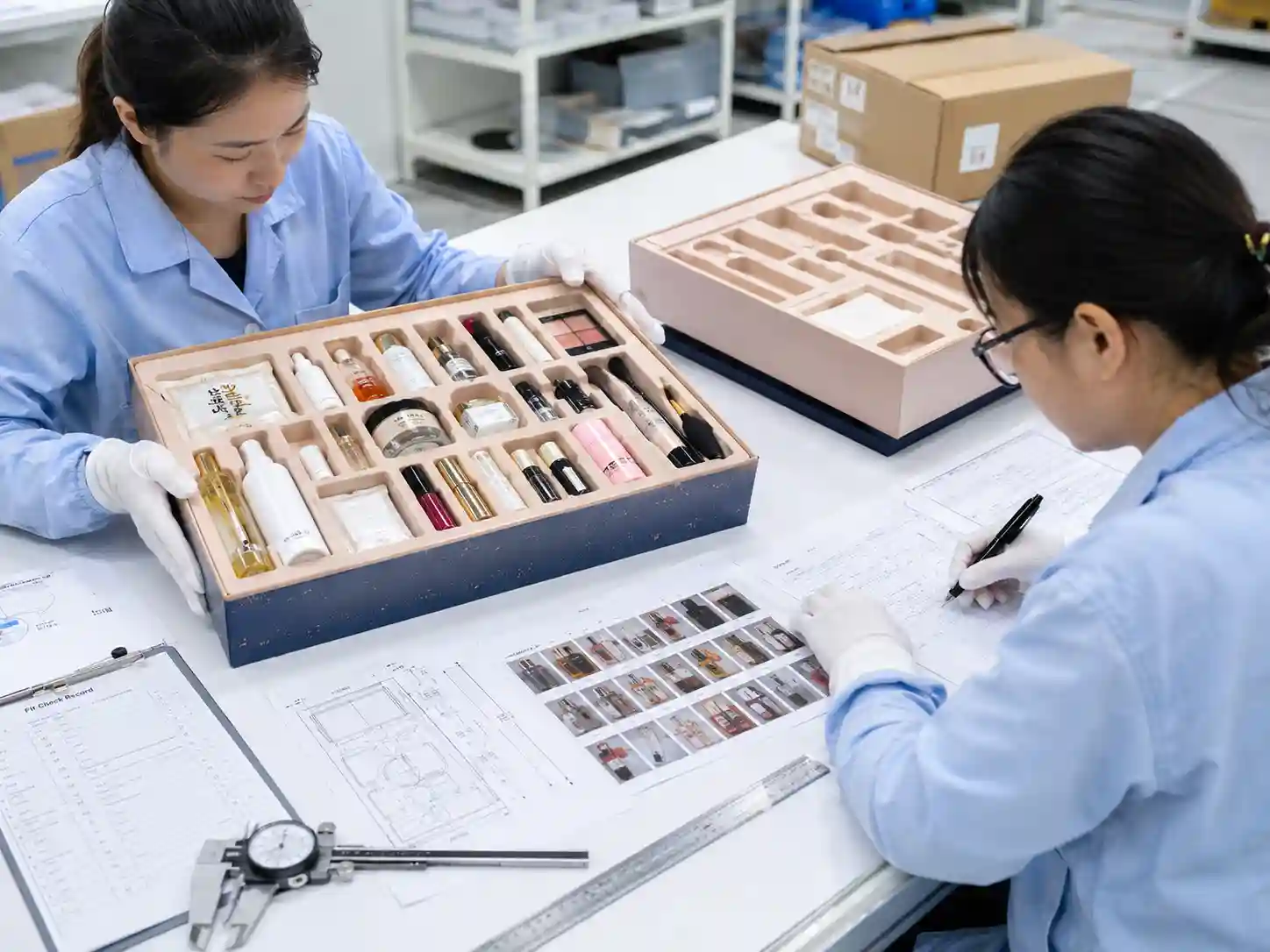
Test the complete assortment as a loaded system. Individual cavities can appear acceptable while neighboring products, closure heights, compartment walls, or the closed calendar create interference that is invisible during isolated checks.
- Identify each SKU. Record product format, dimensions, weight where relevant, closure type, orientation, and appearance-sensitive surfaces.
- Map failure risks. Mark glass impact zones, pumps, droppers, loose caps, flexible walls, decorated surfaces, and leakage-sensitive closures.
- Load the prototype. Use representative or production-intent products whenever available and place every SKU in its assigned position.
- Check retention. Look for rattling, rotation, excessive compression, glass-to-glass contact, tube deformation, and sachet slumping.
- Close the complete structure. Confirm that doors, drawers, covers, or upper components do not press pumps, caps, droppers, or tall products.
- Remove and inspect products. Look for scuffs, dents, loosened closures, residue, label damage, or other changes after handling.
- Record revisions. Update cavity drawings, dimension sheets, sample photographs, and approval records when fit geometry changes.
For broader structural options, buyers can review custom advent calendar box products or discuss project-specific construction through custom advent calendar box services.
What should a loaded-SKU approval checklist contain?
The approval record should make the accepted mixed-SKU arrangement reproducible. It should show what was checked, which sample or drawing was approved, and which details remain dependent on final product supply.
- Correct SKU assigned to each compartment
- Approved product orientation and front-facing direction
- No uncontrolled glass-to-glass or glass-to-rigid contact
- No insert pressure on pump actuators or fragile droppers
- Caps and closures remain seated after handling
- Flexible tubes remain free from unacceptable bending or denting
- Sachets remain positioned as intended
- Products can be inserted and removed without avoidable damage
- Appearance-critical surfaces show no unacceptable contact scuffing
- Required labels or product faces remain visible
- Closed structure provides sufficient clearance above tall closures
- Any leakage, residue, closure movement, or unusual odor is recorded
- Loaded sample matches the current cavity drawing and SKU schedule
Which decisions are facts, recommendations, and buyer approvals?
Keeping these categories separate makes mixed-SKU development easier to control. Measured product dimensions and observed fit results are verifiable facts; cavity strategy is an engineering recommendation; final presentation and acceptance criteria normally require buyer approval.
| Decision type | Examples | Evidence |
|---|---|---|
| Verifiable fact | SKU dimensions, closure geometry, observed pump interference, product rotation | Measurements, photographs, fit records, physical samples |
| Project-dependent recommendation | Support points, cavity shape, orientation method, separation strategy | Structural drawing, prototype, loaded evaluation |
| Buyer approval | Acceptable appearance, label direction, removal feel, presentation standard | Approved sample, signed drawing, approval record |
If a beauty SKU changes after approval, especially its bottle, pump, cap, dropper, secondary carton, or fill configuration, compare the revised product against the approved fit data before assuming the existing cavity remains suitable.
What evidence should you request before mixed-SKU production?
Request evidence that connects the final products to the approved structure. Useful records include current cavity drawings, SKU dimension sheets, photographs of the fully loaded sample, fit observations, revision records, and a clearly identified approved reference sample where applicable.
These records do not replace physical evaluation. They help packaging, sourcing, and supplier teams verify that later production is based on the same product geometry and loading arrangement that was reviewed during development. Related engineering topics can be explored through the advent calendar box buying guides.
FAQs about mixed beauty packaging materials
Can one insert material hold glass bottles, plastic containers, and flexible packs?
Potentially, but suitability depends on cavity geometry and the behavior required at each SKU position. The important question is whether each product receives appropriate support, clearance, surface protection, and retention in the complete loaded structure.
Should every beauty product fit tightly in its cavity?
No. A tight fit can be harmful when it compresses a flexible tube, presses a pump, loads a dropper, damages decoration, or makes removal difficult. Fit should control harmful movement without introducing a new failure mode.
What happens if the final beauty SKU differs from the sampling product?
Compare the final SKU with the approved dimensions and critical fit features. Changes to bottle shoulders, caps, pumps, droppers, tube profiles, secondary cartons, or overall height can justify another loaded-fit review even when the product name has not changed.
For a mixed beauty assortment that needs coordinated glass, plastic, flexible-pack, closure, and orientation review, request a custom quote and provide the available SKU drawings, dimensions, product samples, and loading requirements.