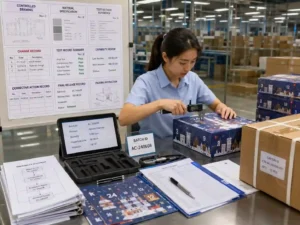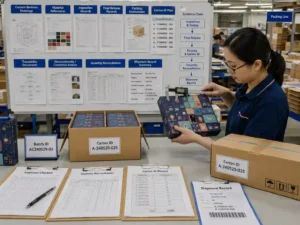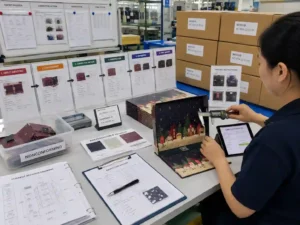
Retailer-specific labels and compliance panels are handled by defining required information areas before packaging production begins. A retailer compliance label panel must consider barcode visibility, product data, case-pack handling, shelf presentation, and fulfillment requirements. The process usually combines retailer specifications, packaging drawings, label placement checks, sample verification, and production inspection records to reduce avoidable receiving or listing issues.

What Is a retailer compliance label panel and why does it matter?
A retailer compliance label panel is a planned area on packaging where required identification, handling, barcode, or product information can be applied without damaging shelf appearance or fulfillment efficiency.
For advent calendar boxes, the panel location must balance several requirements:
- Barcode scanning access during warehouse or store receiving.
- Clear product identification for inventory handling.
- Compatibility with retailer-specific label formats.
- Protection of decorative surfaces, windows, foil effects, or printed artwork.
- Space for carton-level information when case packs are used.
The exact panel layout varies by retailer, sales channel, product category, and distribution process. Buyers should confirm the required information and placement rules before final packaging approval.
How do you plan retailer label placement on an advent calendar box?
Label placement is normally planned during packaging engineering using drawings, dimensions, and physical samples rather than adding labels after production has started.
Which packaging areas should be reviewed?
| Review area | What to check | Verification method |
|---|---|---|
| Barcode zone | Flat surface, scanner access, sufficient contrast, and no obstruction | Artwork drawing review and sample scanning check |
| Compliance panel | Required information area fits without affecting product presentation | Packaging mockup and measurement record |
| Shipping label area | Suitable position for cartons and logistics handling | Case-pack review and carton layout check |
| Artwork protection area | Labels do not cover important graphics or decorative finishes | Approved sample comparison |
Packaging engineers typically mark label zones on structural drawings or artwork files. The approved location becomes a reference during sampling and production checks.
How do retailer requirements affect shelf dimensions and fulfillment?
Retail requirements can influence more than the label itself because label placement affects how products are packed, displayed, and processed through supply chains.
For example, a barcode panel placed on a side surface may support easier warehouse scanning, while a front-facing label area may better support shelf identification. The correct choice depends on the retailer workflow.
- Shelf presentation: Labels should not interfere with the visible retail-facing surfaces.
- Case packs: Outer cartons may require separate identification areas for receiving.
- Parcel handling: Shipping labels and carton markings need accessible positions.
- Returns processing: Product identification should remain clear after handling.
- Listing data: Product information must match approved packaging records.
Giftpackpro supports custom advent calendar box projects by helping buyers align packaging structures, printed areas, and production requirements through custom advent calendar box services.

What checks should be completed before mass production?
Before production, buyers and suppliers should confirm that the approved packaging sample matches retailer label and compliance requirements.
Implementation checklist for retailer-specific packaging labels
- Confirm retailer label specifications and required information fields.
- Mark label and barcode positions on approved packaging drawings.
- Check label placement against shelf-facing surfaces and opening functions.
- Verify barcode readability using representative samples.
- Record approved dimensions, positions, and artwork references.
- Include label requirements in production and inspection documents.
- Review any changes before releasing updated packaging versions.
Evidence can include packaging drawings, annotated samples, approval forms, measurement records, and inspection photos. These records help prevent production teams from applying outdated label positions or incorrect packaging versions.
How do you control label differences between retailers?
Retailer variations are usually controlled by separating approved packaging versions, artwork references, and labeling instructions.
A practical approach is to maintain clear version records showing:
- Retailer-specific label requirements.
- Approved artwork or structural references.
- Label placement dimensions.
- Applicable case-pack information.
- Production approval status.
This prevents mixed components or incorrect labels from entering production when similar advent calendar designs are supplied to different channels.
What risks occur when compliance panels are not planned early?
Late label decisions can create packaging, fulfillment, and retail acceptance risks because available surfaces and production methods may already be fixed.
- Barcode areas may become difficult to scan.
- Labels may cover decorative printing or important product information.
- Carton handling information may become inconsistent.
- Retail receiving teams may need additional manual checks.
- Packaging changes may require additional approvals.
These risks are reduced when label requirements are included in the packaging specification rather than treated as a final-stage addition.

How are retailer label panels verified during quality inspection?
Quality inspection should confirm that finished packaging follows the approved label panel requirements, not only that the box appearance is acceptable.
Typical verification records may include:
- Label position measurements.
- Barcode area confirmation.
- Carton marking checks.
- Packaging version verification.
- Inspection photographs.
- Approved sample comparison.
The inspection method depends on the retailer program and packaging specification. Buyers should define which checks are required before production begins.
Frequently asked questions about retailer compliance label panels
Can the same advent calendar box use different retailer labels?
Yes, but each version should have clearly controlled label instructions and approval records. Differences in label location, information fields, or carton requirements should be documented before production.
Should barcode placement be decided before printing?
Yes. Barcode areas should be reviewed during artwork and structural planning because surface conditions, finishes, and available space can affect scanning performance.
Do online and retail channels require the same packaging labels?
Not always. Retail stores, distribution centers, and direct-to-consumer fulfillment channels may have different identification and handling requirements.
For projects requiring packaging coordination, buyers can review custom advent calendar box products or request a custom quote for further discussion.