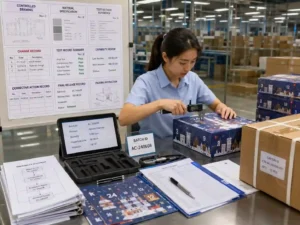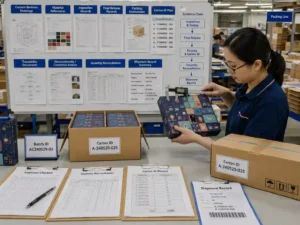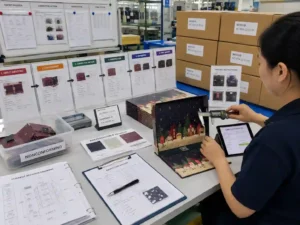
Quick answer: Before shipment, buyers should request pre shipment production records that show what was produced, how critical characteristics were checked, what defects were found, how affected units were controlled, and whether reinspection was completed. For complex advent calendar boxes, the most useful evidence normally includes in-process inspection records, functional checks, measurement results, lot traceability, nonconformance and rework records, and final release status. The exact record package should match the product risks and approved specifications.
Which production records should buyers request before shipment?
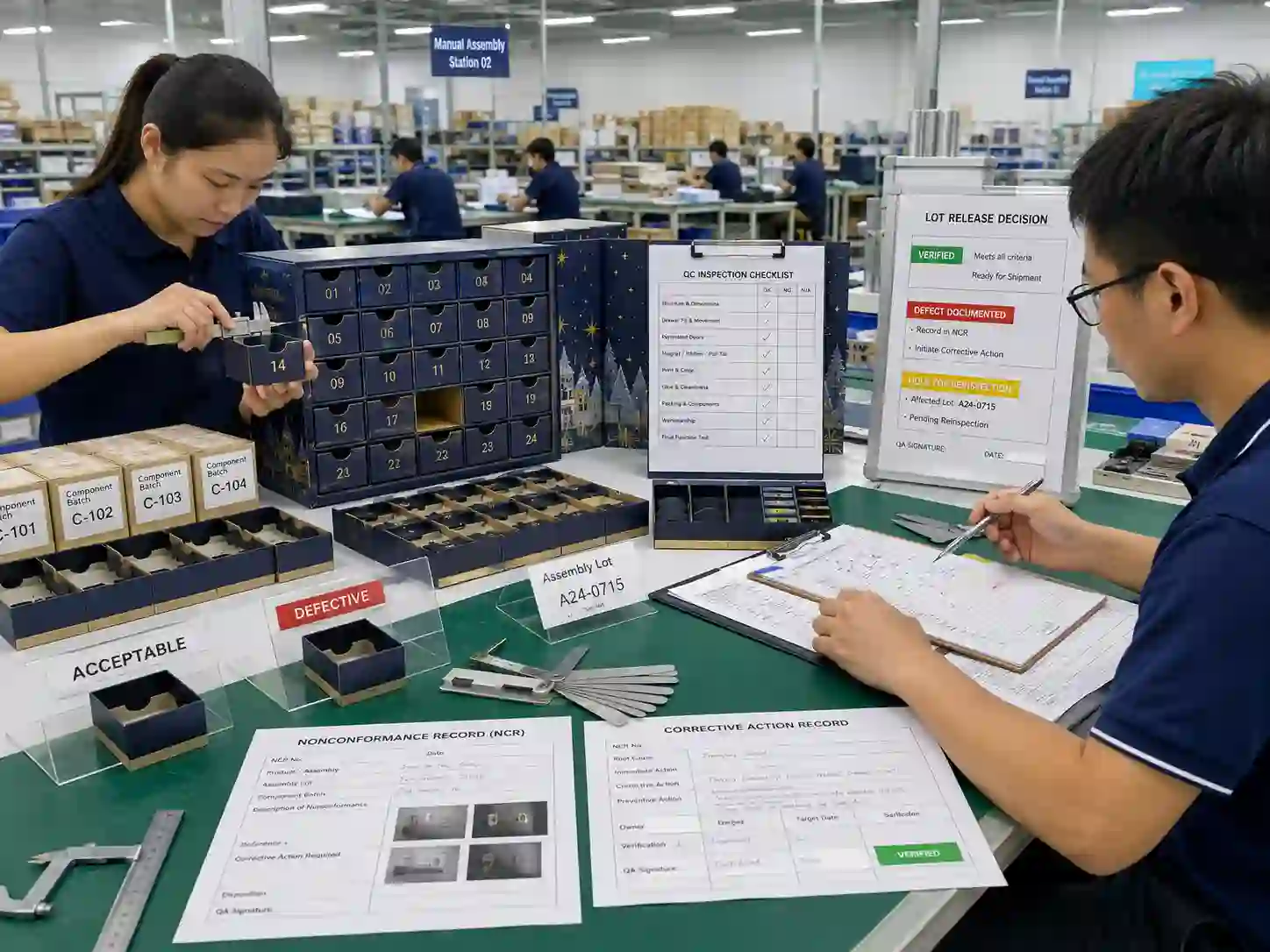
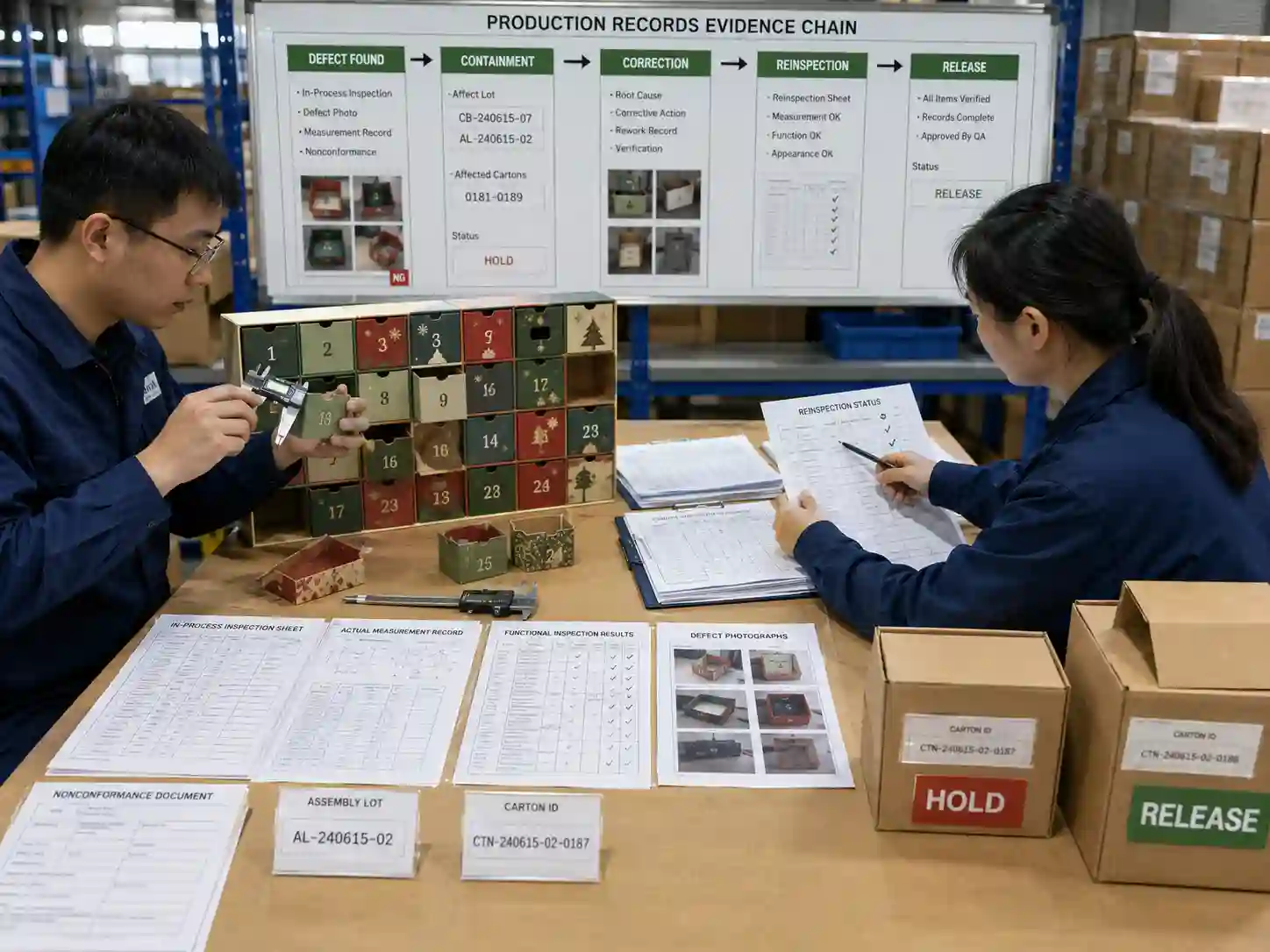
Buyers should request records that create a traceable evidence chain from production through inspection, defect handling, reinspection, and shipment release. A large folder of documents is not automatically useful; each record should answer a specific quality-control question.
The core package commonly includes:
- production lot or assembly batch identification;
- in-process inspection records;
- critical dimension measurement records;
- functional inspection results;
- quantity or component reconciliation records where relevant;
- nonconformance and defect records;
- rework or corrective-action records;
- reinspection results for affected units or lots;
- component-to-assembly traceability records where required;
- final inspection and release status.
These records should be compared with the approved drawing, specification, inspection criteria, approved sample, or other controlled project reference. They should not be treated as substitutes for those references.
What should pre shipment production records actually prove?
The records should prove that defined controls were performed and that significant failures were resolved before release. Buyers should look for identifiable lots, measurable results, inspection dates or stages, defect disposition, and evidence connecting reinspection to the original problem.
| Record | What It Should Show | What Buyers Should Verify |
|---|---|---|
| Production or assembly record | Lot, batch, production stage, quantity or relevant work order | The inspected material can be linked to the shipment |
| In-process QC record | Inspection points, results and status | Critical controls were performed during production, not reconstructed afterward |
| Measurement record | Measured characteristic, method and actual result | Results correspond to controlled tolerances or acceptance criteria |
| Functional inspection record | Function tested, sample or inspection scope, result | Relevant moving or interacting components were actually tested |
| Nonconformance record | Defect, affected lot or units and disposition | Failures were identified and contained |
| Rework and reinspection record | Correction performed and subsequent inspection result | Reworked products were verified again before release |
| Traceability record | Relationship between component, assembly and affected lot | A defect can be traced backward and affected units identified forward |
| Final release record | Inspection completion and release status | Open quality issues are not being carried into shipment without approval |
Why are in-process inspection records important?
In-process records show whether problems were controlled while the product was being manufactured rather than discovered only after final packing. This is especially useful for multi-component paper packaging because some characteristics become difficult to inspect after assembly.
Depending on the advent calendar structure, records may cover panel flatness, drawer or compartment dimensions, alignment, adhesive application, component sequence, artwork version control, assembly condition, or other defined characteristics.
A useful record identifies what was inspected and the result. For measurable characteristics, actual measurements are generally more informative than a page containing only repeated “PASS” marks.
Should buyers request every production measurement?
Not necessarily. The appropriate measurement record depends on the product design, inspection plan, tolerance risk, and agreed sampling method.
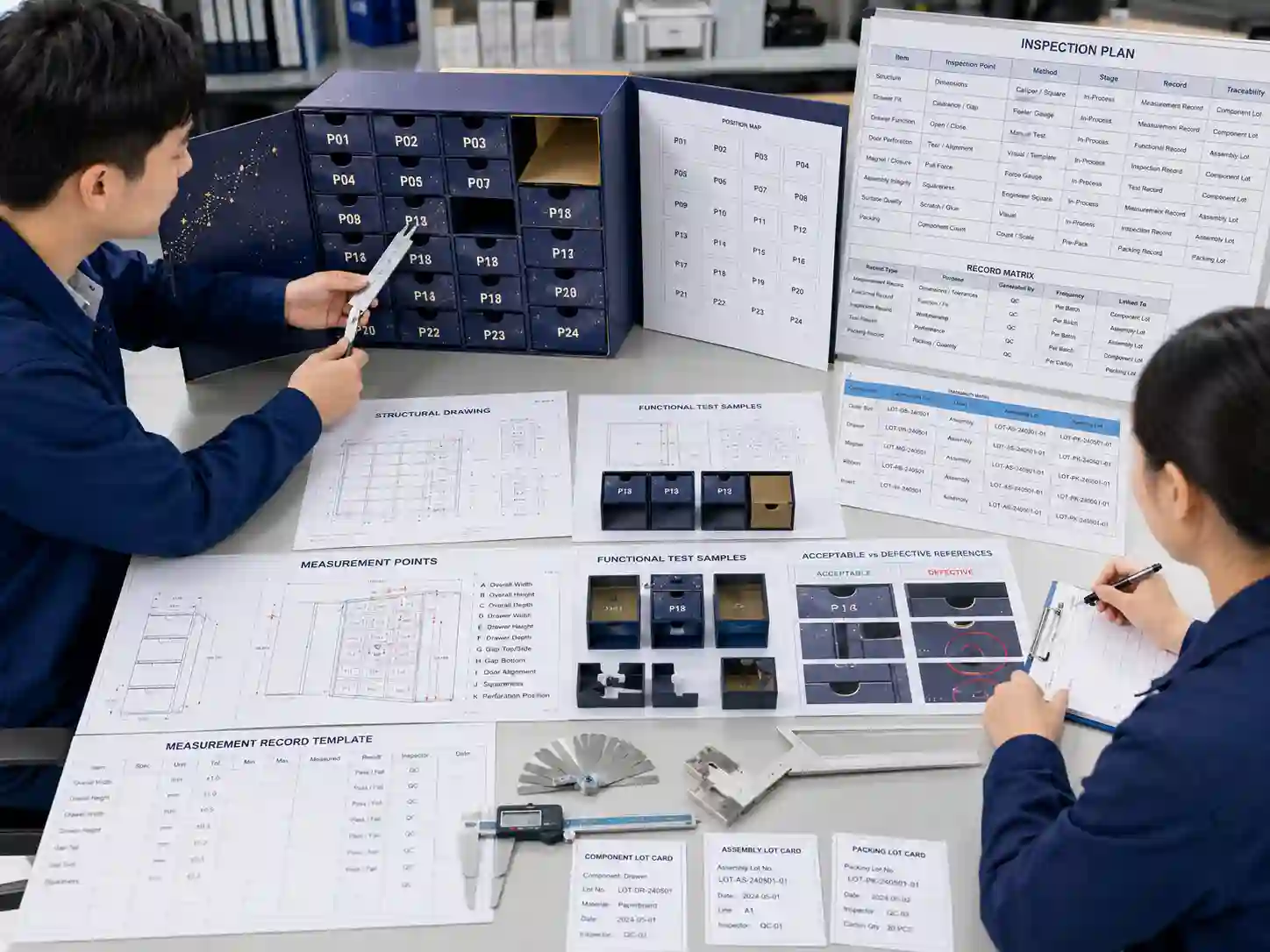
For example, an approved drawing might define a critical drawer width and housing clearance. The production record can then show the measured characteristic, inspection stage, selected units, actual readings, specified limits, and disposition of any out-of-tolerance result.
The drawing establishes the requirement; the production record provides evidence that the requirement was checked.
Which functional inspection records matter for advent calendar boxes?
Functional records should cover features whose failure would prevent the finished calendar from operating as intended. The exact checks vary with the structure rather than following one universal checklist.
Relevant examples can include:
- drawer insertion and removal;
- door opening or perforation behavior;
- magnetic closure function;
- ribbon or pull-tab attachment;
- compartment fit and accessibility;
- product-to-compartment fit where included in the approved inspection scope;
- closure interaction after the structure is fully assembled.
Buyers should distinguish between a dimensional check and a functional test. A drawer can meet one measured dimension yet still bind because of accumulated tolerances, panel distortion, alignment, or assembly variation.
How should buyers review defect and corrective-action records?
Defect records should show more than the total number of failures. Buyers need enough information to understand the defect type, affected production scope, containment decision, correction, and subsequent verification.
A practical review sequence is:
- Identify the defect and where it occurred.
- Confirm which component, assembly lot, or production quantity could be affected.
- Check whether affected material was segregated or otherwise controlled.
- Review the disposition: acceptance under approved criteria, rework, replacement, rejection, or another documented action.
- Confirm whether corrected products were reinspected.
- Check that the final release record reflects the completed disposition.
Repeated defects deserve particular attention. If the same functional or dimensional failure appears across multiple inspection points, the buyer should determine whether the supplier expanded the inspection scope, contained a larger lot, or introduced a corrective action appropriate to the risk.
What defect information should be visible?
The record should make the quality decision understandable without relying entirely on verbal explanation. The necessary detail depends on the defect, but useful evidence can include:
- defect description and classification;
- component or position reference;
- lot or batch identification;
- measured value when the defect is dimensional;
- photographs when visual evidence adds value;
- quantity or scope affected;
- disposition decision;
- rework status;
- reinspection result;
- final release or hold status.
How can traceability records connect a defect to the shipment?
Traceability records should allow the buyer or supplier to connect a discovered defect to the relevant component, assembly batch, and shipment quantity. The required depth depends on how the product is manufactured and how components are controlled.
What does a practical traceability example look like?
Suppose an inspector finds that a specific drawer position binds during movement testing. The record chain might identify the drawer position, its component batch, the assembly lot in which that batch was used, the cartons containing affected assemblies, and the subsequent containment and reinspection status.
| Traceability Step | Example Evidence |
|---|---|
| Defect detected | Functional inspection identifies binding at a defined position |
| Component identified | Position reference connects the failed drawer to its component batch |
| Assembly scope identified | Production record shows which assembly lot used that component batch |
| Containment defined | Affected assemblies or cartons are placed on hold |
| Correction completed | Rework or replacement is recorded |
| Reinspection completed | Affected scope is checked using the defined method |
| Release confirmed | Records show the relevant lot or cartons returned to releasable status |
This evidence chain is more useful than an isolated final inspection sheet because it shows what happened after the defect was discovered.
Which records are facts, which depend on the project, and which require buyer approval?
Keeping these categories separate prevents production records from being mistaken for engineering specifications or commercial approvals.
Verifiable production facts include recorded measurements, inspection results, batch identities, defect observations, rework completion, reinspection results, and documented production status. These should be supported by controlled records.
Project-dependent controls include sampling frequency, critical inspection points, tolerance limits, functional test methods, traceability depth, defect classification rules, and whether certain characteristics require sampling or full inspection. These should be defined from the actual product structure and risk.
Buyer approvals may be required for specification changes, deviations from approved requirements, concession of nonconforming material, or other changes that exceed the supplier’s authorized disposition process. A production record should document such approval where it affects shipment release rather than implying that the factory approved the change on the buyer’s behalf.
What warning signs should buyers look for in the record package?
The main warning sign is a broken evidence chain. A record package becomes less reliable when defects, measurements, lots, corrective actions, and release decisions cannot be connected.
- Inspection sheets contain only generic pass marks for characteristics that should have measurable results.
- Records do not identify the inspected production lot or assembly batch.
- A defect is documented but there is no corresponding containment or disposition.
- Rework is mentioned without a reinspection result.
- Inspection criteria do not correspond to the approved drawing or specification.
- Different artwork or component versions cannot be distinguished in the records.
- Defect photographs exist but cannot be linked to a component position or lot.
- A held lot appears as released without evidence showing why its status changed.
These conditions do not automatically prove that the shipment is defective, but they justify clarification before the records are accepted as evidence of production control.
When should buyers request these records?
The record requirements should be defined before production whenever possible, while the completed evidence package should be reviewed before shipment release. Asking for undefined documentation only after production can result in records that were never designed to capture the required evidence.
During project preparation, buyers and suppliers can identify critical characteristics, required records, inspection methods, traceability expectations, and responsibility for approving deviations. Before shipment, the buyer can then review whether the agreed evidence has actually been completed.
For custom calendar projects involving multiple components, the required documentation can also be aligned with the scope of custom advent calendar box services and the actual structure being manufactured.
Does a production record package replace final inspection?
No. Production records and final inspection answer different questions. Records provide evidence about process controls and earlier inspection stages, while final inspection evaluates the defined characteristics of the completed production lot according to the applicable inspection plan.
For example, a final inspector may confirm drawer function on selected finished units, while in-process records show that dimensions and assembly conditions were checked earlier when those characteristics were more accessible.
What should buyers do if production records show unresolved defects?
Buyers should first determine the affected scope and current disposition rather than treating an open defect as an administrative issue. Shipment release should be based on documented resolution, reinspection, or an explicitly authorized disposition appropriate to the project requirements.
If records show a failed measurement or functional test, ask for the corresponding containment, corrective or rework action, affected lot identification, and reinspection evidence. Where the proposed disposition changes an approved requirement, the necessary buyer approval should be documented before release.
What is the simplest way to review the complete record package?
Review it as an evidence chain: requirement, inspection, result, defect decision, correction, reinspection, and release. This approach is faster and more reliable than judging documents by page count.
For each critical characteristic, ask:
- What controlled requirement applies?
- How was it inspected or tested?
- What result was recorded?
- Was any nonconformance found?
- Which production scope was affected?
- What action was taken?
- Was the affected scope reinspected?
- What evidence supports final release?
For projects still being prepared, buyers can review relevant custom advent calendar box products and discuss the required inspection and documentation scope before production. To define production-record requirements for a specific calendar structure, request a custom quote and provide the applicable drawings, product configuration, inspection requirements, and approval criteria.
FAQs
Should buyers request photos with every production record?
No. Photos are most useful when they clarify visual defects, segregation, rework, or inspection conditions. Dimensional and functional controls often require measurements, test results, or traceability records in addition to photographs.
Are signed QC checklists enough before shipment?
Not by themselves for every project. A checklist can confirm that an inspection occurred, but critical measurable or functional characteristics may require actual readings, test results, defect records, or reinspection evidence.
How long should production records be retained?
Retention periods are project-dependent and should be defined by the applicable quality agreement, customer requirement, internal control system, or other relevant obligation. Buyers should agree on retention expectations rather than assuming one universal period.