
Quick answer: Loose component carton quantity verification should combine a controlled packing specification, component-level counting, carton-level reconciliation, and an independent final check. For multi-component advent calendar boxes, inspectors should verify not only the number of finished sets but also whether every required loose part is present in the correct quantity. Weight checks can support this process, but they should normally detect anomalies rather than replace direct counting unless the method has been validated for the specific pack configuration.
Why is carton quantity harder to verify when many loose components are involved?
A carton containing multiple loose components creates more opportunities for shortages, duplicates, mixing, and counting errors than a carton containing identical finished units. The main control challenge is therefore verifying the complete packing configuration rather than checking only the outer-carton quantity.
For example, one shipping carton might contain calendar bodies, drawers, dividers, accessory pieces, instruction sheets, or other separately packed components. A carton can contain the correct number of calendar bodies while still being incomplete because one component bundle is missing.
The required configuration should therefore be defined before packing starts. The controlled reference may be a packing specification, bill of materials, approved sample, packing drawing, component list, or buyer-approved packing instruction. The document should identify what belongs in one set and how many sets or component bundles belong in one carton.
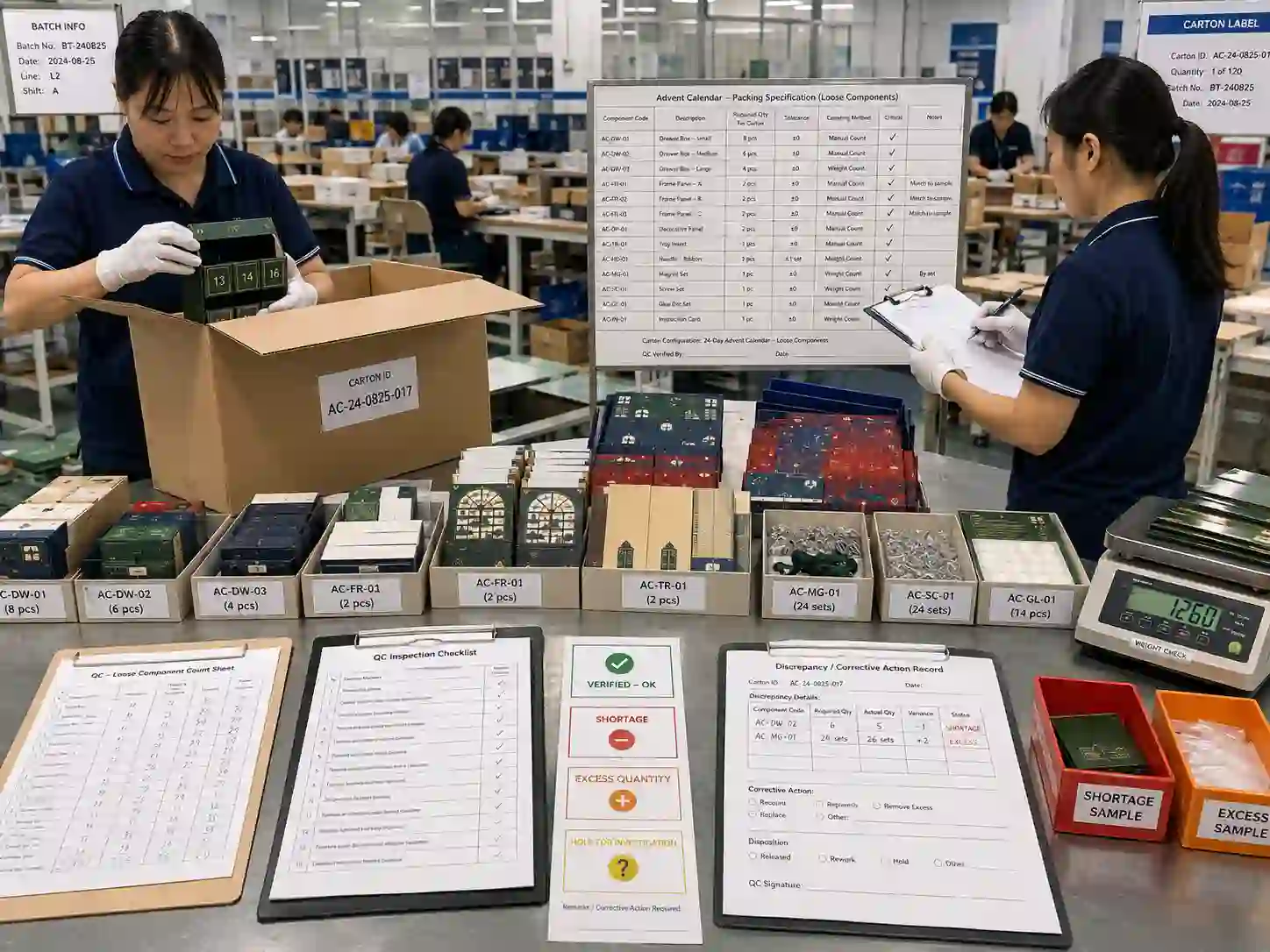
What should a loose component carton quantity verification process check?
The process should reconcile three levels: the required quantity per set, the number of sets or component groups packed, and the resulting total quantity expected in the carton. Inspectors should be able to trace the final carton back to the packing record used to establish those quantities.
| Verification point | What QC checks | Typical evidence | Risk if missed |
|---|---|---|---|
| Pack configuration | Correct component types and quantity per set | Controlled packing specification or BOM | Incorrect configuration repeated across cartons |
| Component count | Required number of each loose component | Count sheet, bundle identification, packing record | Shortage or excess components |
| Set reconciliation | Components correspond to the required number of complete sets | Set-level checklist or component matrix | Correct total pieces but incomplete sets |
| Carton reconciliation | Actual contents agree with the carton packing requirement | Carton ID and packing record | Wrong quantity shipped |
| Independent verification | Packed quantity is checked before carton release | QC signature, inspection record, scan or count record | Packing operator errors remain undetected |
How should components be counted before they enter the carton?
Loose components should be converted into controlled countable groups wherever practical. This reduces dependence on an operator repeatedly counting large quantities of individual pieces at the final packing station.
A practical sequence is:
- Confirm the current packing specification and component revision.
- Separate components by type, version, size, artwork, or position where these characteristics matter.
- Count components using the defined method.
- Place counted quantities into controlled bundles, trays, bags, partitions, or other clearly identifiable groups where appropriate.
- Identify the counted group so operators know its component type and intended quantity.
- Transfer the controlled group to the packing station.
- Record consumption or completion against the relevant packing batch or carton.
This method creates intermediate control points. If 24 different components are required for each calendar, for example, verifying organized component groups is generally more reliable than placing an unstructured pile of parts into a carton and attempting to reconstruct the count afterward.
Should every component be counted individually?
Not necessarily. The appropriate method depends on component geometry, quantity, packing sequence, automation, and the consequence of a shortage.
Direct piece counting provides strong evidence for small or critical quantities. Pre-counted bundles, compartmented trays, fixtures, pick-to-position systems, counters, or scanning may be more efficient for repetitive operations. Whatever method is selected should make omissions and duplicates detectable.
Can carton weight be used to verify loose component quantities?
Carton weight can be a useful secondary control when missing or excess components create a measurable weight difference. It should not automatically be treated as proof that every component is present.
The method becomes less reliable when natural variation in paperboard, wrapped boxes, adhesives, moisture, printed materials, protective packaging, or component weights approaches the weight of the missing item.
A weight-based check should therefore be established from project-specific evidence. The team can measure representative correctly packed cartons, understand normal weight variation, confirm scale resolution, and deliberately test cartons with known missing or excess components.
If a missing component cannot be distinguished reliably from normal pack-weight variation, weighing should remain an anomaly screen rather than the primary quantity verification method.
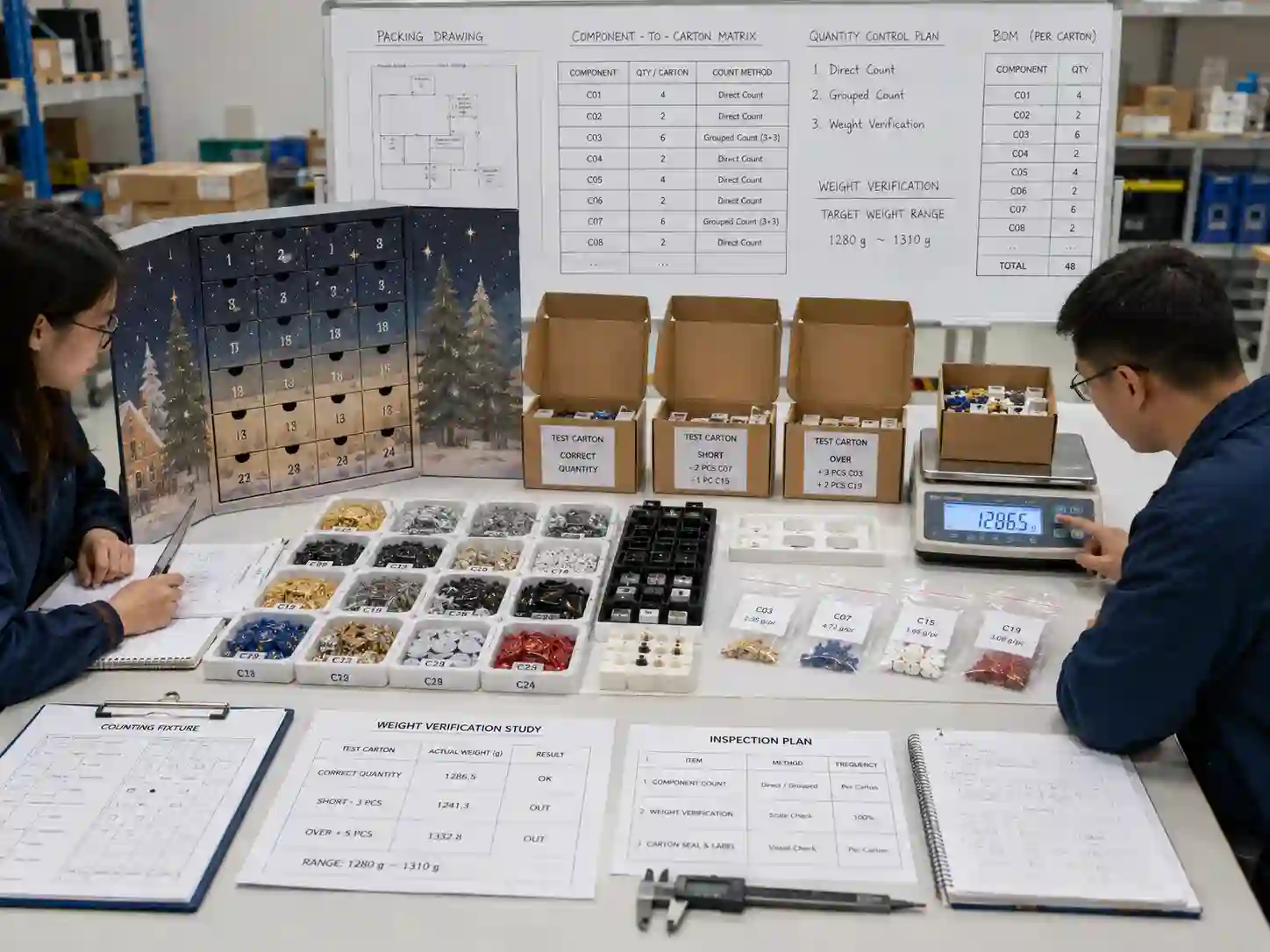
How do you reconcile a carton containing several component types?
Use a component-to-carton matrix that converts the approved packing configuration into expected quantities. This makes the relationship between sets, loose parts, and carton totals explicit.
For example, assume a project requires one body, 24 loose drawers, one divider assembly, and one accessory pack per calendar, with 10 calendar sets allocated to one carton. The controlled record would expect 10 bodies, 240 drawers, 10 divider assemblies, and 10 accessory packs.
The important control is not the example quantity itself; actual quantities are project-dependent. The principle is that each required component has an expected carton quantity derived from an approved packing configuration.
What should happen if the totals do not reconcile?
The affected carton should not be treated as verified until the discrepancy is investigated. QC should identify whether the cause is a counting error, missing component, duplicate component, wrong component version, incorrect packing instruction, or an error in the recorded quantity.
A useful defect checklist includes:
- missing component or component bundle;
- excess component or duplicate bundle;
- correct piece count but wrong component type;
- mixed artwork, size, language, or structural revision;
- incomplete set despite an apparently correct total piece count;
- carton label quantity inconsistent with actual contents;
- packing record inconsistent with the controlled specification;
- weight outside the validated range when weight screening is used;
- unidentified or untraceable loose components.
What traceability should connect loose components to the finished carton?
Traceability should make it possible to identify which component batches and packing records contributed to an affected carton or production lot. The level of detail should match the project’s risk and production system.
A practical traceability example is:
Component batch → counted component group → packing batch or station record → carton ID → inspection/reinspection status.
Suppose QC finds a shortage during final carton verification. The carton ID should lead back to the relevant packing record. That record can help determine which component group was being consumed, which other cartons may have been packed during the same period, and whether additional containment is justified.
This evidence is more useful than an isolated final inspection result because it supports investigation and corrective action rather than merely identifying one incorrect carton.
How should QC sample and verify packed cartons?
The inspection plan should define which checks are performed during packing and which are repeated on completed cartons. Sampling level, frequency, and escalation rules are project-dependent and should reflect the complexity of the configuration and the risk associated with shortages.
In-process checks can detect a counting problem before many cartons are affected. Final verification can then confirm that completed cartons match the approved configuration and associated records.
Where a defect is found, the response should be based on the failure mode rather than automatically accepting the remaining cartons. A recurring component shortage may justify containment, expanded inspection, recounting, or temporary 100% verification of the affected quantity until the process is shown to be under control.
Which decisions require buyer approval?
Buyer-controlled requirements should be distinguished from factory inspection methods. The buyer may need to approve the final packing configuration, components per set, sets per carton, acceptable substitutions if any, labeling requirements, and any project-specific quantity tolerance.
The supplier can propose counting methods, fixtures, weighing controls, inspection frequencies, and traceability records, but these controls should not silently change an approved packing configuration.
What records should be retained as verification evidence?
Useful records show what was required, what was checked, what failed, and what happened afterward. The exact document format varies by factory and project.
Evidence may include:
- approved packing specification or component matrix;
- current BOM or controlled packing drawing where applicable;
- component count or bundle records;
- packing batch and carton identification;
- in-process inspection records;
- carton weight records when weighing is a validated control;
- nonconformance and shortage records;
- containment or recount records;
- corrective-action documentation;
- reinspection and release status.
For complex custom advent calendar box products, these records help purchasing and quality teams distinguish a verified packing process from a simple statement that carton quantities were checked.
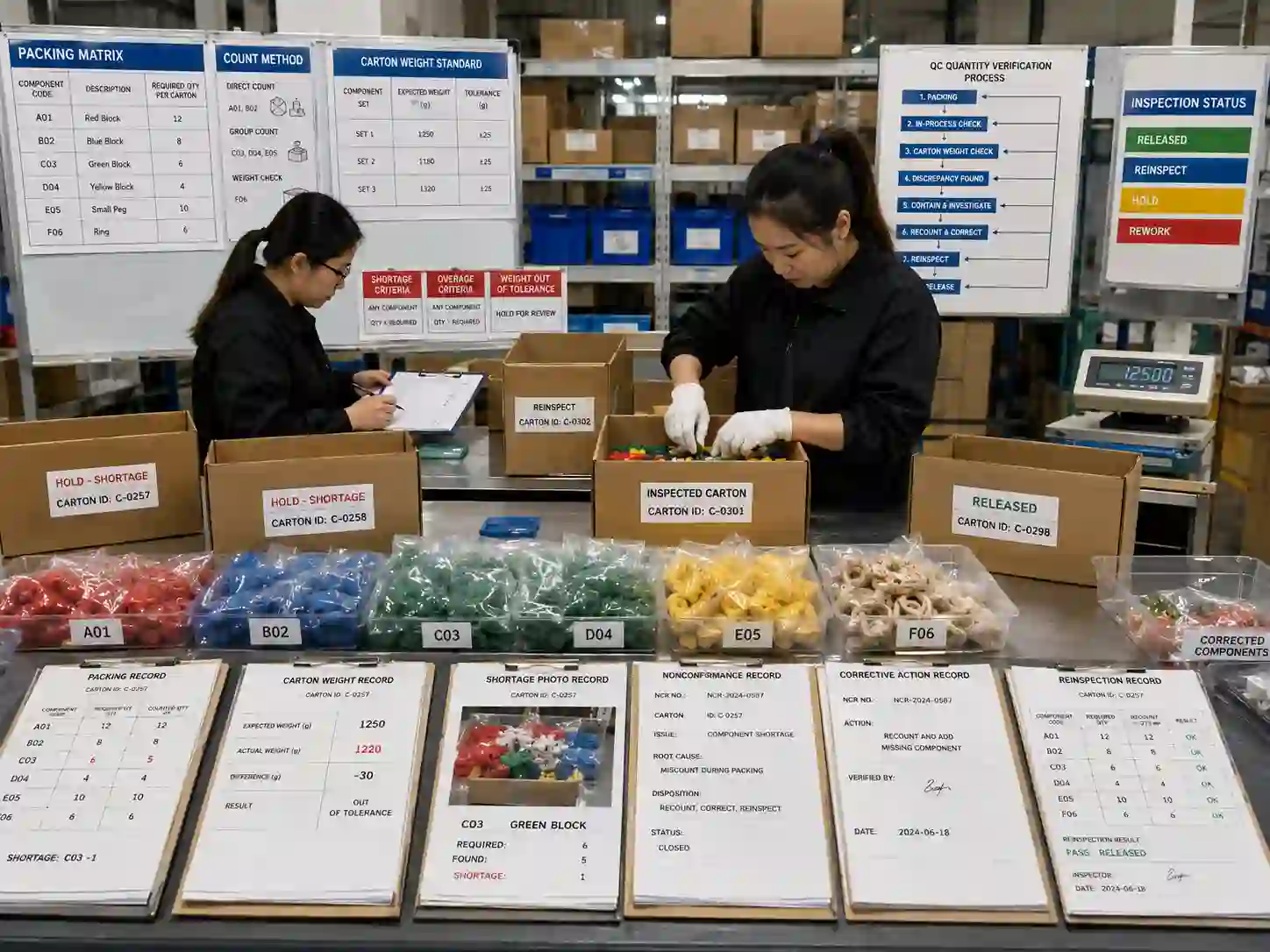
How should quantity discrepancies be corrected before release?
First contain the affected carton or identifiable packing lot, then determine the scope of the discrepancy before release. Correcting the one carton where a shortage was discovered does not demonstrate that neighboring cartons are correct.
The investigation should compare component consumption, packing records, remaining stock, carton counts, and any relevant weight or inspection data. If the evidence indicates that additional cartons may be affected, the inspection scope should expand accordingly.
After correction, affected cartons should be reverified against the controlled packing specification. The record should show the original discrepancy, corrective action, reinspection result, and release status.
Teams developing a new multi-component packing configuration can also discuss counting, packing, and inspection requirements with custom advent calendar box services before the production control plan is finalized.
What is the most reliable overall control method?
The strongest method is a layered system: define the configuration, control component counts before packing, reconcile components to sets and cartons, perform independent verification, and retain traceable records. No single weight reading or final carton count provides the same level of evidence.
The exact combination of direct counting, pre-counted groups, fixtures, scanning, weighing, sampling, and full inspection should be selected from actual component characteristics and packing risks. The final acceptance basis should remain tied to the buyer-approved packing configuration.
FAQs about loose component carton quantity verification
Is checking the number of finished calendar bodies enough?
No. When other components are packed loose, the finished-body count does not prove that the carton contains enough parts to create the required number of complete sets. Each required component category should be reconciled to the approved configuration.
Can a correct carton weight prove that all components are present?
Not always. Different combinations of missing and excess components can potentially produce similar total weights, while normal material variation can mask small shortages. Weight verification is strongest when supported by project-specific validation and another counting control.
Should a shortage found in one carton trigger checks on other cartons?
It can. QC should use packing sequence, component consumption, batch records, carton IDs, and the apparent failure cause to determine the potentially affected scope. Repeated or systemic shortages justify broader containment than an isolated, clearly explained error.
Who should approve the final components-per-carton requirement?
The required packing configuration should come from controlled project documentation and any necessary buyer approval. Production and QC should verify against that requirement rather than changing quantities at the packing station without authorization.
For a multi-component advent calendar project that needs a defined packing and quantity-verification approach, request a custom quote and provide the component list, intended pack configuration, and relevant inspection requirements for review.


