
Quick answer: A failed inspection corrective action audit should verify more than whether defective boxes were repaired. Buyers should confirm the original defect was contained, the affected production scope was identified, the cause was investigated, corrective action was implemented, and the affected units were reinspected against the original acceptance criteria. The audit should end with traceable evidence showing which lots were affected, what changed, who verified the correction, and whether shipment release is justified.
What should a corrective action audit prove after a failed inspection?
The audit should prove that the supplier has controlled both the detected defect and the production process that created it. A closed corrective-action form alone is not sufficient evidence.
For a multi-component advent calendar, a failed inspection may involve drawer binding, excessive gaps, warped panels, incorrect component positions, weak pull tabs, glue contamination, mixed artwork, damaged surfaces, or another defined nonconformance. The audit should connect the inspection finding to the affected material, production operation, correction, and final verification.
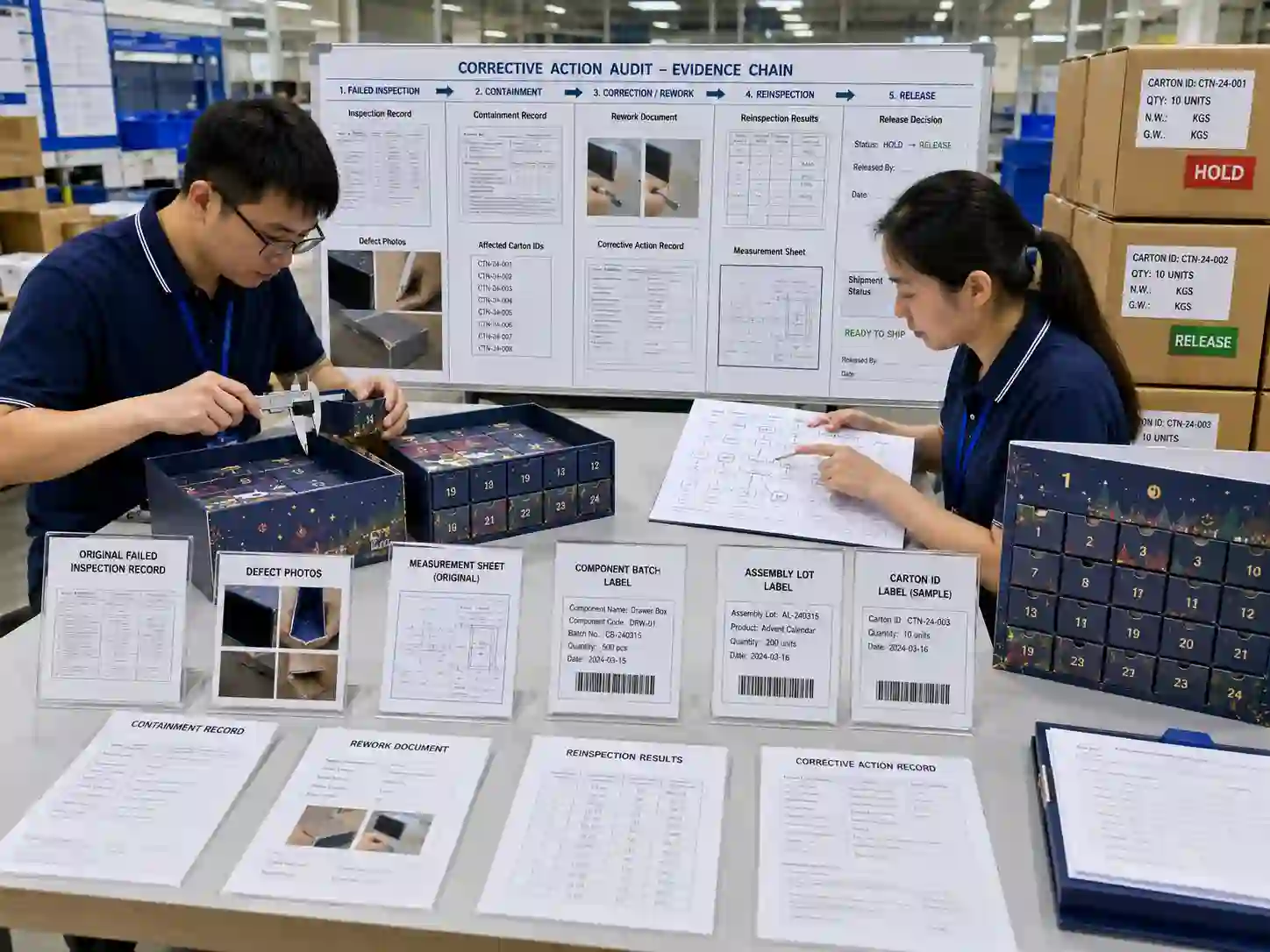
The core evidence chain is:
- Original inspection result and defect evidence.
- Identification and containment of potentially affected production.
- Investigation of the defect source or contributing process condition.
- Documented correction and corrective action.
- Reinspection using an appropriate method.
- Traceable disposition and shipment-release decision.
These steps are generally verifiable through inspection reports, measurement records, photographs, lot identification, production records, rework records, and reinspection results. The exact inspection frequency and corrective-action method remain project-dependent.
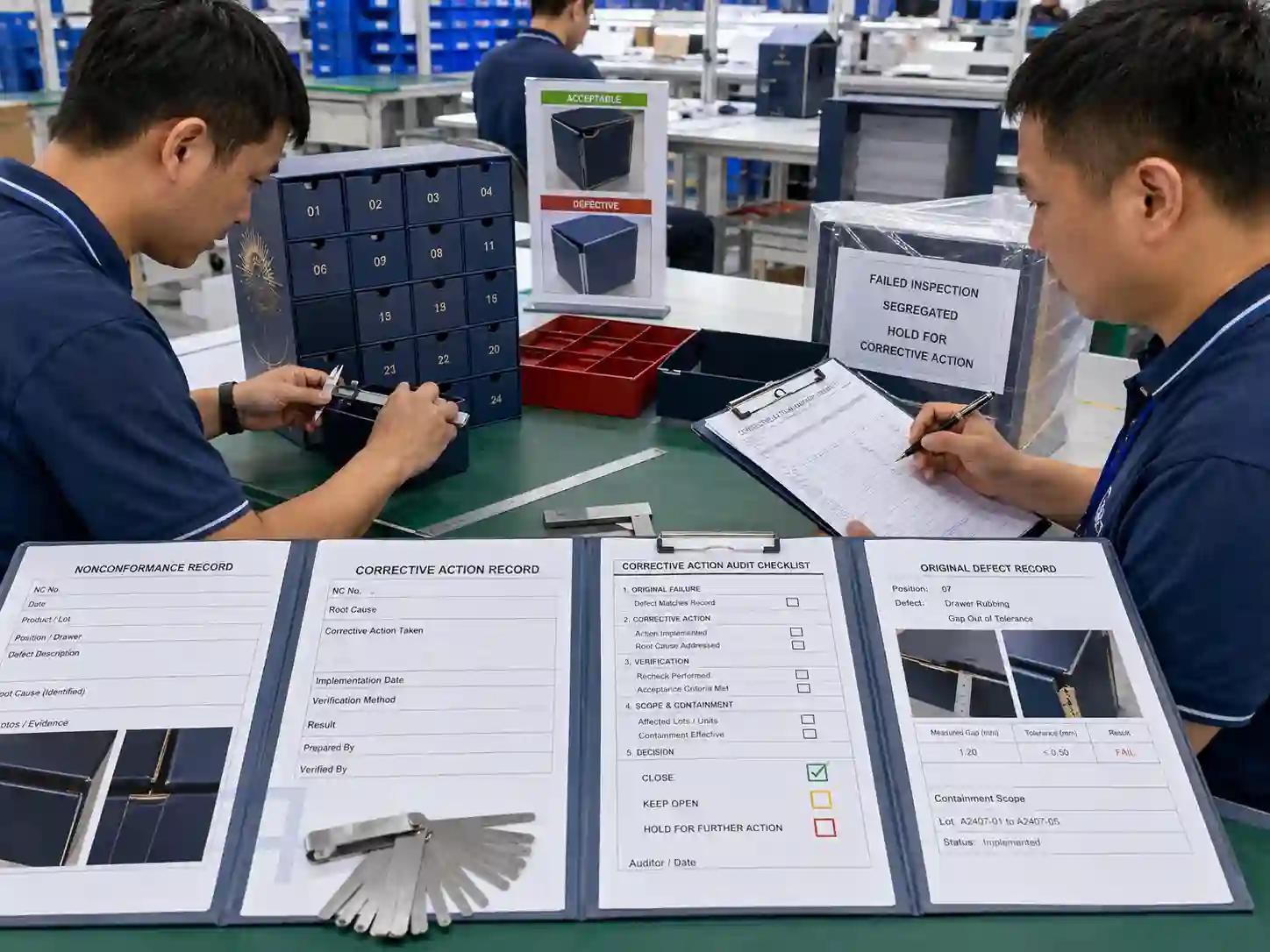
How should buyers perform a failed inspection corrective action audit?
Start with the original failure rather than the supplier’s completed corrective-action report. The auditor should reconstruct what happened from the first recorded nonconformance through final reinspection.
1. Can the original defect be reproduced or objectively verified?
The first check is whether the failure is clearly defined. The inspection report should identify the characteristic that failed, the inspection method, the acceptance criterion, and the actual result where measurement is possible.
For example, “drawer difficult to open” is less useful than identifying the affected drawer position, observed interference, relevant clearance measurement, sample quantity, and reference criterion. Dimensional failures should normally be supported by measurement records; functional and workmanship failures may require controlled samples, photographs, videos, fixtures, or agreed defect references.
2. Was the affected production contained correctly?
Containment should prevent potentially nonconforming units from moving into packing or shipment while the problem is investigated. The audit should therefore check when the defect occurred and which material or assemblies could share the same exposure.
Useful identifiers may include component batch numbers, assembly lot numbers, production dates, workstations, operators or shifts, carton IDs, and rework status.
A common audit risk is containment that starts only with the inspected carton. If the same component batch was used across several assembly lots, the potential scope may be larger than the initially failed sample.
3. Does the stated cause explain the actual failure?
The corrective-action record should connect the observed defect to a plausible production condition. Statements such as “operator mistake” or “QC will pay more attention” do not by themselves demonstrate that the cause has been established.
For a binding drawer, for example, the investigation might examine drawer dimensions, housing dimensions, wrapped-board thickness, glue buildup, panel squareness, assembly positioning, or deformation. The relevant cause depends on the construction and actual evidence.
Buyers do not need to prescribe the supplier’s root-cause method, but they should expect the explanation to be consistent with drawings, measurements, samples, process observations, and production records.
4. Was the corrective action actually implemented?
An audit should distinguish between a proposed action and an implemented action. Evidence should show what physically changed in production and when the change took effect.
This may include revised workstation instructions, adjusted fixtures, corrected machine or tooling settings, replacement components, improved assembly controls, additional in-process measurements, or controlled rework instructions.
If a drawing, inspection specification, or controlled production instruction changes, the revision status should also be clear so obsolete requirements are not accidentally reused.
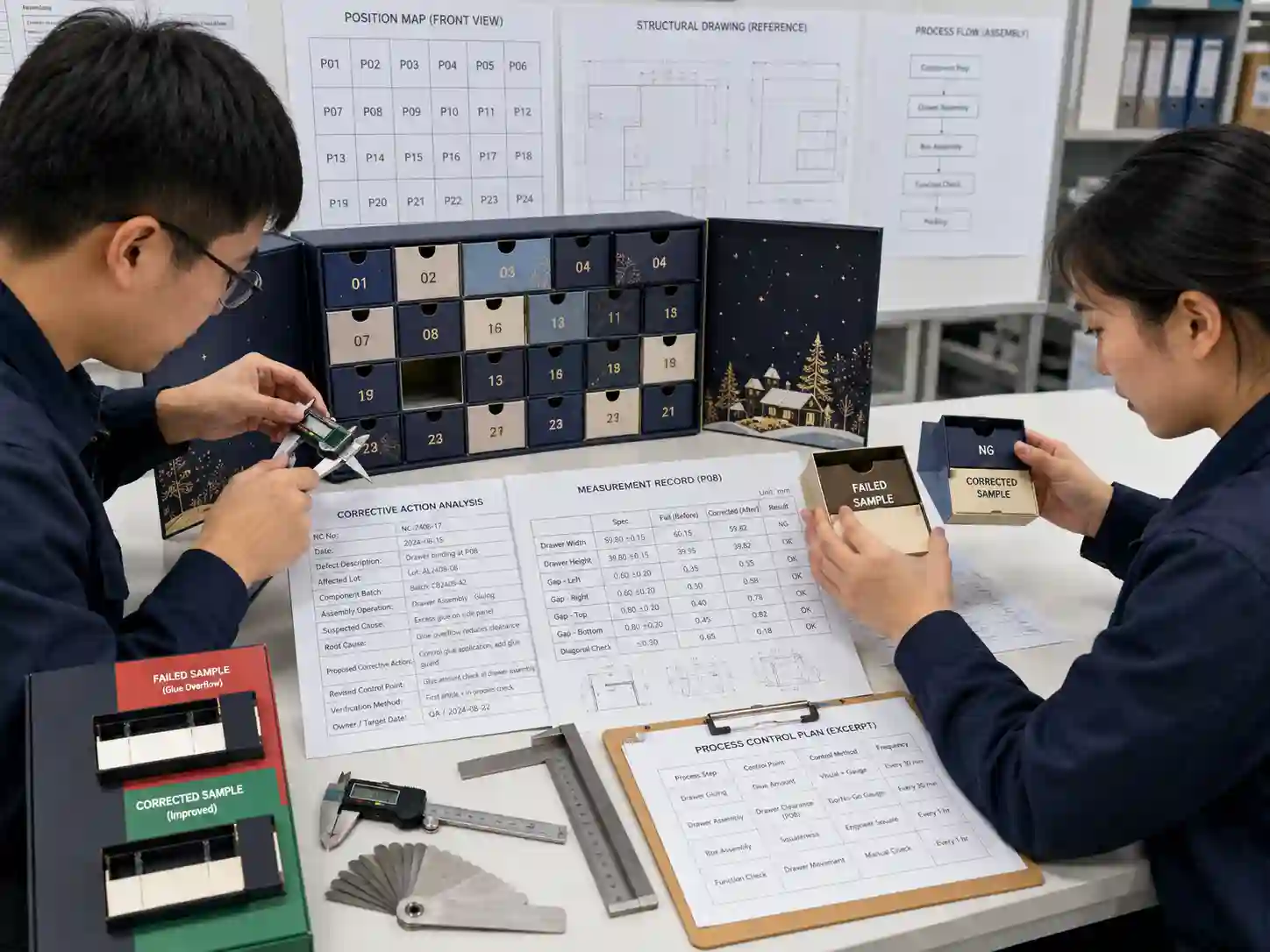
What evidence should be checked before accepting the corrective action?
Evidence should demonstrate containment, implementation, verification, and traceability. The following table provides a practical audit structure.
| Audit point | Evidence to review | What the buyer should verify |
|---|---|---|
| Original failure | Inspection report, measurements, defect photos, failed samples | The defect and acceptance criterion are clearly identified |
| Containment | Lot records, carton IDs, segregation records | Potentially affected production was identified and controlled |
| Cause investigation | Measurements, process checks, component records, investigation notes | The stated cause is supported by evidence |
| Correction | Rework records, replacement records, corrected samples | Existing defective units received an appropriate disposition |
| Corrective action | Updated process controls, instructions, fixtures, inspection points | The process condition associated with recurrence has been addressed |
| Reinspection | Inspection sheets, measurements, functional test results | Corrected production was checked against defined criteria |
| Release | Final status, lot references, approval record | Only verified production is released for shipment |
How should corrected advent calendar boxes be reinspected?
Reinspection should target the original failure mode while also checking whether the correction introduced another defect. Simply confirming that rework was completed does not demonstrate conformity.
If drawers previously failed because of binding, the reinspection should repeat the relevant movement or clearance check. If the corrective action involved replacing wrapped panels, inspection may also need to confirm alignment, squareness, surface condition, and assembly fit.
The appropriate reinspection quantity depends on the failure mode, defect severity, production scope, process confidence, and buyer requirements. A buyer may require expanded sampling or full screening where the risk warrants it, but this should be defined according to the project rather than treated as a universal rule.
What should the reinspection record contain?
The record should allow another reviewer to understand what was checked and connect the result to the corrected production.
- Affected component or assembly identification.
- Lot, batch, or carton reference where applicable.
- Original failed characteristic.
- Reinspection method and acceptance criterion.
- Actual measurements or functional results where relevant.
- Quantity reinspected and quantity failed.
- Inspector and inspection status.
- Disposition of any repeated failures.
How can traceability confirm that the corrective action covered the right production?
Traceability should connect the original defect to every production group reasonably exposed to the same cause. This prevents a supplier from correcting inspected samples while leaving related cartons unchecked.
What does a practical traceability example look like?
Assume inspection identifies repeated binding at one drawer position. Records show that the affected drawer components came from component batch C07 and were assembled into lots A31 and A32.
The audit should trace C07 into those assembly lots, identify the relevant packed cartons, confirm their containment status, and document the corrective action and reinspection results. If the investigation shows that another component batch or assembly lot was not exposed to the same condition, that exclusion should be supported by production records rather than assumption.
A useful traceability chain is:
Defect record → component batch → assembly lot → affected carton IDs → containment → correction or rework → reinspection record → final disposition.
This evidence chain is especially useful for calendars containing many individually produced and manually assembled components.
Which warning signs suggest the corrective action should not be closed?
The action should remain open when evidence does not demonstrate effective control of the failure. Documentation completeness alone should not determine closure.
- The defect description does not match the original inspection finding.
- The affected lot or component scope cannot be established.
- Only the failed inspection samples were repaired.
- The stated cause is unsupported by measurements or process evidence.
- The corrective action consists only of reminders or additional attention.
- Reinspection uses different or weaker acceptance criteria.
- Repeated failures appear during reinspection without further investigation.
- Corrected units cannot be traced to rework and reinspection records.
- Shipment status was changed before verification was completed.
These conditions do not automatically identify the technical cause of a problem, but they indicate that the evidence chain is incomplete and further supplier verification is appropriate.
Who should approve shipment after corrective action?
The supplier should provide objective evidence that the affected production has passed the required verification, while the buyer retains any approval authority defined by the purchase specification, inspection plan, or project agreement.
Supplier QC may confirm completion of containment, correction, and reinspection. Packaging engineers may need to evaluate structural or dimensional changes. The buyer or appointed inspector may then review the evidence when external approval is required.
Shipment release should therefore be separated from the technical act of repairing a defect. Rework completion means the work was performed; release means the available evidence supports acceptance under the applicable requirements.
What should buyers request in the final corrective-action package?
The final package should be concise enough to audit but detailed enough to reconstruct the failure and response. Buyers can request records appropriate to the defect rather than demanding unrelated production paperwork.
- Original failed inspection report.
- Defect photographs and measurement results where relevant.
- Affected batch, lot, and carton identification.
- Containment record.
- Cause investigation evidence.
- Correction and rework records.
- Evidence that corrective measures were implemented.
- Reinspection results.
- Repeated-failure records, if any.
- Final disposition or release status.
For custom calendar projects, buyers can define these evidence expectations during quality planning through custom advent calendar box services. Examples of relevant structures and configurations are also available among custom advent calendar box products.
What varies from one corrective action audit to another?
The evidence principle remains consistent, but the inspection method, sample quantity, measurements, containment scope, and approval authority vary with the product and failure mode.
Verifiable facts include recorded dimensions, defect counts, component batches, assembly lots, carton IDs, inspection results, and documented process changes.
Project-dependent recommendations include whether to expand sampling, perform 100% screening, add temporary in-process checks, or require additional functional testing.
Buyer approvals include acceptance of deviations, revised criteria, structural changes, or shipment release where the agreed project controls reserve those decisions for the buyer.
FAQs about auditing corrective actions after failed inspections
Is rework evidence enough to close a failed inspection?
No. Rework evidence shows that an action was performed, but closure should also consider whether the affected scope was controlled and whether reinspection demonstrates conformity against the required criteria.
Should every failed inspection require 100% reinspection?
Not automatically. Reinspection scope should reflect the defect type, severity, potential affected quantity, process evidence, recurrence risk, and agreed inspection requirements. Some failures justify full screening; others can be verified through an appropriate sampling plan.
What happens if the same defect appears again during reinspection?
A repeated failure is evidence that the existing correction or corrective action may not be effective or that the affected scope was underestimated. The supplier should reassess containment, cause, corrective action, and reinspection scope before release.
Can photographs replace measurement records?
Only when photographs adequately demonstrate the characteristic being evaluated. Dimensional and tolerance-related failures normally require measurements, while photographs can be useful supporting evidence for visible workmanship defects, segregation, or rework status.
For a custom advent calendar project with defined inspection, traceability, and corrective-action requirements, request a custom quote and provide the structure, product configuration, drawings, and quality requirements that need to be controlled.


