Quick answer: Preventing foil cracking box hinges starts long before production. Successful projects combine suitable board selection, correct grain direction, properly designed score lines, appropriate foil placement, controlled folding methods, and production validation using physical samples. Instead of relying on a single solution, packaging teams should verify artwork, tooling, finishing compatibility, and fold performance before approving mass production.
Why does foil crack across hinges and fold lines?
Foil is a decorative layer bonded to the surface of paperboard. During folding, the outer surface stretches while the inner surface compresses. If the foil cannot flex with the substrate, visible fractures, whitening, or separation may appear along the crease.
Cracking is usually the result of multiple contributing factors rather than one isolated defect. Material properties, scoring geometry, finishing combinations, fold direction, and production handling all influence the final appearance.
Which design decisions reduce foil cracking box hinges?
The most effective prevention begins during structural and artwork design instead of after printing.
Keep decorative foil away from critical fold areas
Whenever branding requirements allow, avoid placing continuous foil directly over heavily stressed hinges. Narrow foil gaps or interrupted decorative elements often produce better durability while remaining visually acceptable.
Align grain direction appropriately
Paper fibers fold more cleanly when the board grain is correctly aligned with the structural design. Poor grain orientation increases surface stress and raises the risk of decorative layer failure.
Design suitable score widths
Score channels should match the selected board thickness. Overly narrow scores compress fibers excessively, while shallow scores require greater folding force, increasing the chance of foil fracture.
Consider hinge geometry
Book-style advent calendar boxes, magnetic closures, and rigid wrapped constructions may all require different hinge widths and folding methods. Structural drawings should identify these critical areas before artwork approval.
How do finishing combinations influence durability?
Individual finishes may perform well independently but behave differently when combined. The complete finishing sequence should always be evaluated as a system.
| Finishing Combination | Potential Risk | Typical Recommendation |
|---|---|---|
| Foil over heavy fold | Surface cracking | Reduce foil coverage near crease |
| Foil + deep emboss | Additional surface stress | Increase spacing between effects where practical |
| Foil + soft-touch lamination | Adhesion variability | Verify compatibility during sampling |
| Foil + spot UV | Registration complexity | Approve production proof before tooling release |
| Foil on textured specialty paper | Uneven foil transfer | Evaluate with physical production samples |
What production checks should be completed before approval?
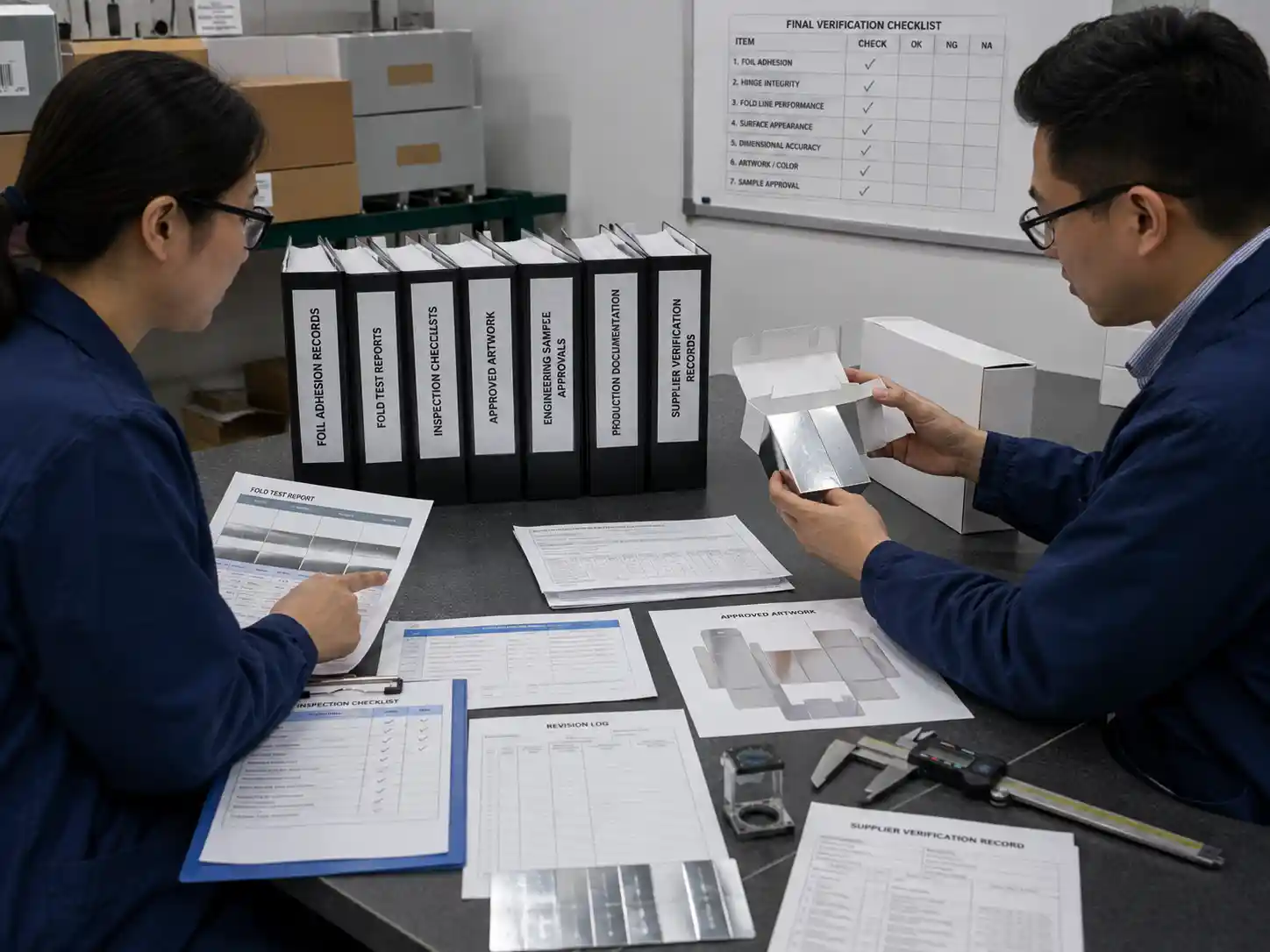
Production samples provide the most reliable evidence that decorative finishes will survive repeated opening and closing.
Packaging engineers typically evaluate:
- Fold quality after initial forming
- Foil continuity across score lines
- Surface whitening or fiber exposure
- Registration between foil, embossing, and printed graphics
- Adhesion after repeated opening cycles
- Visual consistency under production lighting
Photographs alone rarely provide enough evidence. Physical inspection remains the preferred approval method for premium packaging.
How can adhesion be verified before mass production?
Foil durability depends on both the decorative layer and the substrate beneath it. Adhesion should therefore be confirmed throughout sampling and production approval.
| Adhesion Checklist | Evidence to Review |
|---|---|
| Approved board specification | Material approval record |
| Foil specification | Supplier technical documentation |
| Lamination compatibility | Sample evaluation report |
| Score quality | Die-cut inspection |
| Repeated fold test | Engineering sample record |
| Final production approval | Signed artwork and sample approval files |
How should engineering samples be evaluated?
Engineering samples demonstrate whether the complete manufacturing process performs as expected before production begins.
Typical evaluations include repeated opening cycles, visual inspection under normal lighting, close examination of hinge edges, and comparison against approved master samples.
Where embossing, spot UV, or multiple decorative layers are present, inspectors should verify that registration remains consistent after folding and handling.
What varies between different packaging projects?
There is no universal specification that guarantees crack-free foil on every package. Performance depends on the complete production system.
| Project Variable | Possible Impact |
|---|---|
| Board thickness | Changes required score dimensions |
| Specialty paper surface | May affect foil transfer quality |
| Foil type | Different flexibility characteristics |
| Lamination type | Can influence adhesion performance |
| Hinge construction | Changes bending stress distribution |
| Opening frequency | Affects durability expectations |
How can buyers verify production readiness?
Important claims should be supported with objective evidence rather than visual inspection alone.
Useful approval records include:
- Approved structural drawings
- Artwork approval files
- Production PDF and revision history
- Foil specification documents
- Material approval records
- Engineering sample reports
- Folding and appearance inspection records
- Final production approval documentation
These records create traceability if decorative performance differs between sampling and production.
Finish-selection example
A premium book-style advent calendar includes metallic foil across the front cover with an embossed logo and soft-touch lamination. During engineering review, the foil artwork is moved slightly away from the primary hinge, the score profile is adjusted for the selected board thickness, and repeated fold testing confirms that no visible cracking appears after multiple opening cycles. The approved sample then becomes the production reference for supplier quality inspections.
Frequently asked questions
Can embossing increase foil cracking?
Yes. Embossing changes surface geometry and can concentrate stress near folds. Engineering samples should verify that both decorative effects perform together.
Should foil always stop before a fold line?
Not necessarily. Some projects successfully carry foil across folds, but doing so requires compatible materials, appropriate scoring, and verified production testing.
Is lamination enough to prevent cracking?
No. Lamination may improve surface durability, but it does not eliminate stresses caused by incorrect scoring, unsuitable materials, or poor hinge design.
What approval evidence is most valuable?
Signed artwork approvals, engineering sample evaluations, fold test records, inspection reports, and approved production samples provide the strongest evidence before manufacturing.
Conclusion
Preventing foil cracking across hinges requires coordination between structural engineering, artwork preparation, finishing selection, tooling, and production quality control. Physical samples, documented inspections, and validated folding performance provide more reliable assurance than artwork review alone.
To learn more about premium seasonal packaging, visit our advent calendar box buying guides, explore our custom advent calendar box products, review our custom advent calendar box services, or request a custom quote for your next project.