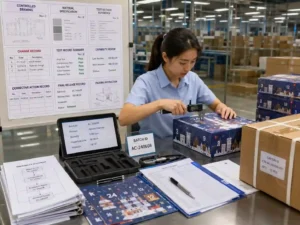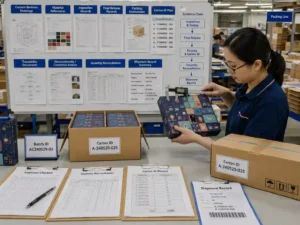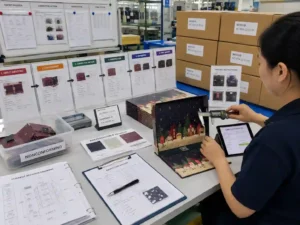
Quick answer: An artwork approval record should document exactly what artwork was approved, who approved it, when it was approved, and which production files were released. A complete record normally includes the approved PDF, revision number, dieline version, color references, barcode verification, preflight results, multilingual copy confirmation, finishing layers, approval signatures, and supporting inspection documents. Keeping these records allows both the buyer and manufacturer to verify that production matches the approved design if questions arise later.
Why is an artwork approval record important?
An artwork approval record creates a traceable link between the approved design and the files used in production. It reduces misunderstandings when several revisions, departments, or suppliers are involved.
Rather than relying on emails or screenshots, the approval record provides controlled evidence showing exactly which artwork version was released for manufacturing.
- Confirms the final production artwork.
- Reduces revision mistakes.
- Supports quality inspections.
- Provides documentation during supplier reviews.
- Simplifies future reorders and design updates.
What documents should an artwork approval record contain?
The record should combine artwork files with supporting verification documents instead of storing only a signed PDF.
| Document | Purpose | How to Verify |
|---|---|---|
| Approved production PDF | Master reference artwork | Revision number matches release |
| Dieline drawing | Confirms structure and fold lines | Compare with engineering drawing |
| Revision history | Tracks design changes | Review version log |
| Preflight report | Confirms technical file integrity | Review software report |
| Color reference | Records approved colors | Pantone numbers or approved proof |
| Barcode verification | Confirms barcode quality | Scanner report |
| Approval signatures | Identifies responsible reviewers | Name and approval date |
Which artwork details should always be verified before approval?
The approval record should confirm both visual appearance and technical production requirements.
Dielines and structural layout
The approved file should reference the correct dieline revision, panel dimensions, fold positions, glue areas, safe areas, bleed, and cut lines. Engineering drawings should match the artwork release.
Artwork layers
Separate production layers should be reviewed before approval, including:
- CMYK artwork
- Spot colors
- White ink (if applicable)
- Foil layers
- Emboss and deboss layers
- Spot UV or varnish layers
- Dielines
Color control
The record should identify the approved color references used during production.
- Pantone references where applicable
- CMYK process artwork
- Approved digital or contract proof
- Special finish references
Barcode verification
Each production barcode should be checked before approval. The approval record should reference the barcode verification report and identify the barcode location within the artwork.
Multilingual copy
The approval record should confirm that all required languages, regulatory information, ingredient lists, warnings, and mandatory product information have been reviewed by the responsible party.
What technical checks should accompany the approval?
An approved design is only suitable for production if technical file checks have also been completed.
Preflight checklist
| Check | Status Before Approval |
|---|---|
| Images at final effective resolution | Verified |
| Fonts embedded or outlined | Verified |
| Linked images present | Verified |
| Correct bleed and safe areas | Verified |
| Correct artwork layers | Verified |
| Color mode confirmed | Verified |
| Barcode scan passed | Verified |
| Overprint and transparency checked | Verified |
These checks provide objective evidence that the production files meet technical requirements before printing begins.
Who should approve the artwork?
Approval responsibilities vary between projects, but each approval should clearly identify the reviewer and date.
| Role | Typical Responsibility |
|---|---|
| Brand team | Graphics, branding, claims |
| Packaging designer | Layout and artwork accuracy |
| Prepress engineer | Technical file validation |
| Packaging supplier | Manufacturing feasibility |
| Purchasing or project manager | Final release confirmation |
What should an approval record look like?
A practical approval record combines technical documents with clear release information.
Approval example
- Project: 24-day advent calendar gift box
- Artwork revision: Rev C
- Dieline version: DL-24-05
- Production PDF: Approved
- Preflight report: Passed
- Pantone references: Confirmed
- Barcode verification: Passed
- Finishing layers: Foil, emboss, spot UV confirmed
- Copy review: Approved
- Approved by: Brand manager, packaging engineer, supplier prepress team
- Approval date recorded
This type of documentation allows production, quality control, and future revisions to reference the same approved package.
Which items are verifiable, project-dependent, or buyer approvals?
| Category | Examples |
|---|---|
| Verifiable facts | Revision numbers, preflight reports, barcode scan results, color references, file names |
| Project-dependent recommendations | Approval workflow, required reviewers, supporting documents, proofing method |
| Buyer approvals | Graphics, multilingual copy, product claims, branding, regulatory content, final production release |
Frequently asked questions
Should email approval alone be treated as an artwork approval record?
No. Emails may support the approval history, but they should reference a controlled artwork package containing the approved files, revision information, and verification documents.
Should previous artwork revisions be retained?
Yes. Earlier revisions should remain archived with revision history to support traceability and avoid accidental reuse.
Who should keep the approval record?
Both the buyer and the packaging supplier should maintain identical controlled records to ensure the same approved files are referenced during production and future repeat orders.
How long should supporting documents be retained?
Retention policies differ by company, but records are commonly kept for future production runs, audits, and product updates so approved artwork can be traced if questions arise later.
Before releasing production artwork, ensure every approval is supported by documented evidence rather than verbal confirmation. If you are developing seasonal packaging, explore our advent calendar box buying guides, learn about our custom advent calendar box services, browse our custom advent calendar box products, or request a custom quote for your next project.