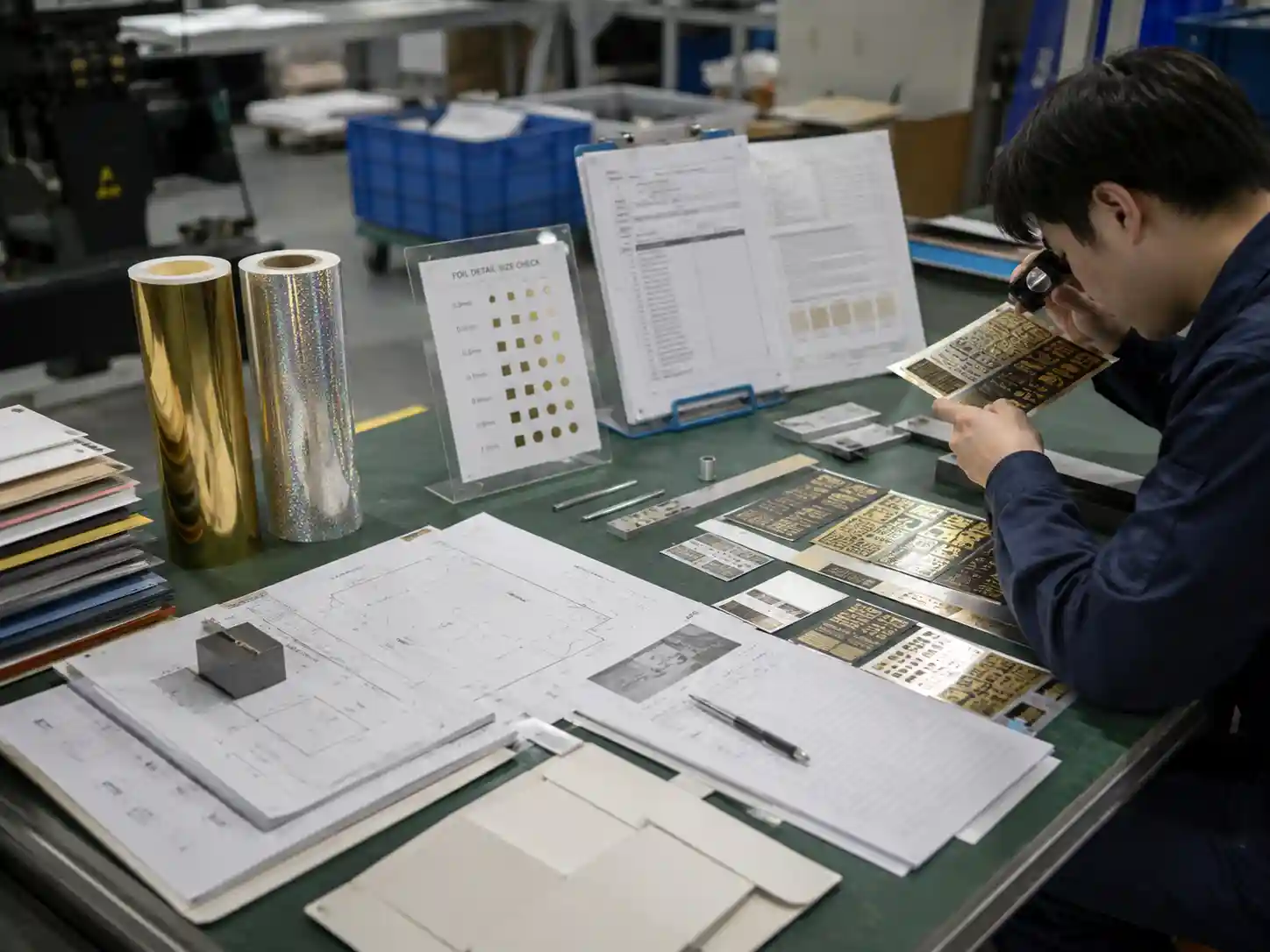
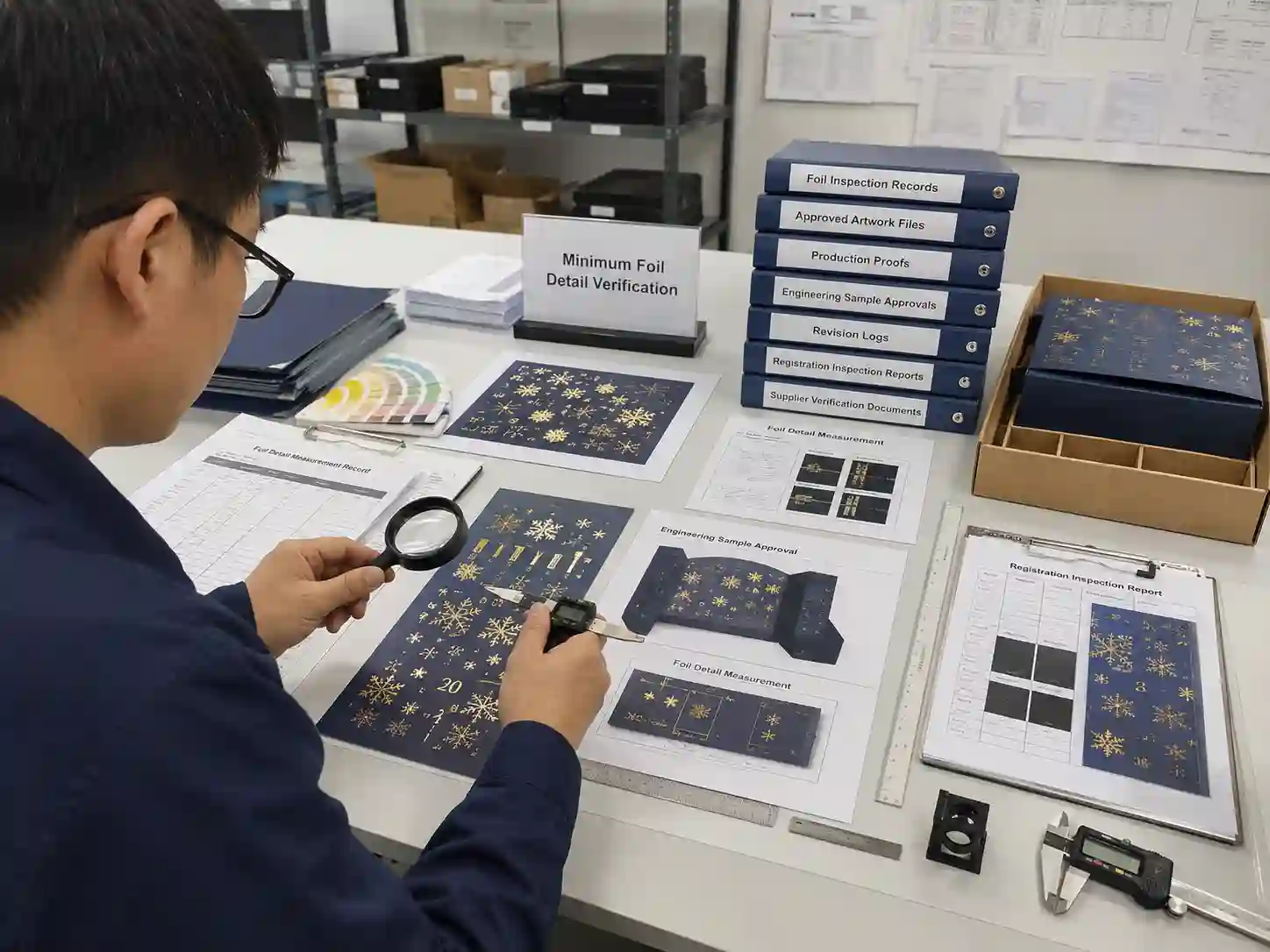
Quick answer: The practical limit for foil detail depends on the foil process, substrate, artwork design, embossing, lamination, and production tolerances rather than a single universal measurement. Small metallic elements that appear sharp on-screen may lose definition, bridge together, or fail to transfer consistently during stamping. Before approving artwork, designers should verify minimum foil detail size packaging through engineering samples, production proofs, and documented approval records instead of relying solely on digital artwork.
Why does minimum foil detail size packaging matter?
Foil stamping is a mechanical transfer process rather than a printed ink layer. Extremely fine lines, tiny lettering, or closely spaced decorative patterns may not reproduce consistently across every production sheet.
The goal is not simply to create the smallest possible foil feature, but to achieve details that remain visually consistent after stamping, folding, transport, retail handling, and repeated opening of the advent calendar.
Projects with premium metallic decoration often combine foil with embossing, spot UV, textured papers, or lamination, making artwork tolerances even more important.
What determines how small foil details can be?
Several production variables influence successful foil reproduction. No single specification applies to every project.
- Foil die manufacturing accuracy.
- Paper surface smoothness or texture.
- Board thickness and rigidity.
- Foil grade and release characteristics.
- Embossing or debossing combined with foil.
- Lamination type and adhesion.
- Press pressure, dwell time, and temperature.
- Registration tolerance with printed graphics.
A design that performs well on coated paper may not produce equally clean edges on heavily textured specialty paper. Likewise, adding embossing around delicate foil graphics may require larger clearances than flat foil alone.
How should designers evaluate fine foil artwork?
Artwork should be reviewed as an engineered production file rather than purely as a graphic design.
Review positive and negative elements separately
Small metallic lines and reversed foil openings behave differently during stamping. Both require sufficient spacing to prevent bridging or incomplete transfer.
Check isolated details and dense decorative areas
Individual icons may stamp perfectly while intricate background patterns become difficult to reproduce consistently across large production runs.
Inspect artwork at final production size
Viewing artwork at excessive screen magnification can create unrealistic expectations. Approval should always be based on actual printed scale.
Which project conditions increase production risk?
| Project condition | Potential risk | Recommended verification |
|---|---|---|
| Very fine foil lines | Incomplete foil transfer | Engineering sample review |
| Tiny reversed foil text | Loss of legibility | Production proof inspection |
| Textured specialty paper | Broken foil edges | Material compatibility testing |
| Foil combined with embossing | Registration variation | Combined tooling approval |
| Foil across fold lines | Cracking after folding | Repeated fold testing |
| Spot UV beside foil | Edge alignment variation | Registration inspection |
| Laminated surface | Foil adhesion inconsistency | Adhesion verification |
How can production teams verify small foil features before mass production?
Verification should rely on physical evidence rather than artwork assumptions.
- Review engineering drawings alongside production artwork.
- Approve foil tooling layouts.
- Produce representative engineering samples.
- Inspect foil edges under suitable lighting.
- Compare multiple sheets instead of one perfect sample.
- Perform fold testing where decorated panels include hinges.
- Confirm registration with printed graphics.
- Document final approval before production release.
These checks help identify whether fine decorative elements remain consistent throughout realistic manufacturing conditions.
Does combining foil with other finishes affect minimum detail?
Yes. Multiple decorative processes interact with each other.
Embossing changes board geometry, textured papers introduce uneven surfaces, and lamination alters foil adhesion characteristics. Spot UV placed close to metallic decoration also increases registration requirements.
For this reason, artwork that works successfully as foil alone may require modification when additional premium finishes are introduced.
What approval records should buyers request?
Production approval should include objective documentation instead of verbal confirmation.
- Approved production artwork.
- Revision-controlled foil layer files.
- Engineering sample photographs.
- Foil die approval records.
- Material specifications.
- Production proof approvals.
- Registration inspection reports.
- Fold-test or handling observations when applicable.
These records provide traceability if artwork changes or additional production runs are required later.
What is verified, what depends on the project, and what requires buyer approval?
Verifiable production facts
- Foil transfer quality can be inspected on physical samples.
- Registration can be measured against approved artwork.
- Edge definition can be compared across multiple production sheets.
- Fold performance can be evaluated through repeated opening tests.
Project-dependent recommendations
- Acceptable minimum feature size varies by foil system.
- Paper texture changes achievable detail.
- Embossing and lamination influence artwork limitations.
- Decorative density affects tooling performance.
Buyer approvals
- Final engineering sample.
- Foil colour and finish.
- Artwork revision.
- Production proof.
- Inspection documentation.
Finish approval checklist
| Checkpoint | Status before release |
|---|---|
| Foil artwork reviewed at final size | ✓ |
| Engineering sample approved | ✓ |
| Registration inspected | ✓ |
| Foil edges visually checked | ✓ |
| Combined finish compatibility verified | ✓ |
| Approval documents archived | ✓ |
Example: balancing appearance and manufacturability
A luxury advent calendar uses metallic snowflakes, embossed logos, and spot UV highlights on laminated paperboard. During sampling, the engineering team finds that several decorative foil elements become inconsistent on textured paper. Rather than reducing the overall premium appearance, the artwork is adjusted by simplifying the smallest decorative elements while maintaining the overall visual design. Updated production proofs are reviewed, registration is confirmed, and the revised sample becomes the approved production reference.
Frequently asked questions
Should foil artwork always be tested on the final material?
Yes. Changing paper, lamination, or surface texture may affect foil transfer quality even when artwork remains unchanged.
Can digital artwork accurately predict foil quality?
No. Digital files help verify layout, but physical samples remain necessary to evaluate transfer quality, edge definition, and registration.
Does embossing always reduce achievable foil detail?
Not necessarily. However, combining embossing with foil increases tooling complexity and should be validated through engineering samples.
When should artwork be revised?
If production samples show incomplete transfer, merged details, poor registration, or durability concerns, artwork should be revised before production approval rather than relying on process adjustments alone.
If your project includes intricate metallic decoration, embossing, or multiple premium finishes, Giftpackpro can help review artwork during sampling and production planning. Explore our custom advent calendar box products, learn about our custom advent calendar box services, browse additional advent calendar box buying guides, or request a custom quote for engineering support before production.