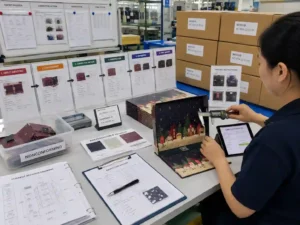
Quick answer: To pack advent calendar boxes for international shipping, buyers must secure both the products inside each compartment and the finished calendar inside its export carton. The correct solution starts with accurate product dimensions, weights, orientations, and fragility data. These details determine whether the project needs a paperboard insert, PET tray, EVA insert, foam, molded pulp, or a combined structure. Buyers should approve a fully loaded pre-production sample, test compartment retention and box function, define protective wrapping, confirm export-carton strength, and document pallet and shipping-mark requirements. Packing specifications should be agreed before mass production, not after the finished boxes are ready to ship.
What must buyers define before choosing an international shipping pack?
Buyers should define the complete packed product—not only the retail box dimensions—before a supplier develops the insert and export packing. Product size, weight, fragility, orientation, surface sensitivity, shipping method, and destination all affect the packaging structure.
A supplier cannot engineer reliable export protection from an artwork file and an approximate box size. The factory needs physical samples or controlled product drawings showing the maximum dimensions of every item. Flexible sachets, bottles with pumps, glass containers, candles, jewelry cards, and irregular accessories behave differently during vibration, handling, and stacking.
Prepare the following information at the beginning of the project:
- Quantity, dimensions, weight, and material of every product.
- Required product orientation and the position of the visible face.
- Identification of glass, ceramic, sharp, liquid-filled, or easily scratched items.
- Whether the products will be loaded at the packaging factory, at another factory, or in the destination market.
- Preferred calendar structure, such as a rigid box, drawer box, door-opening box, book-style box, folding carton, or fold-out design.
- Expected transport method, including parcel delivery, air freight, sea freight, or mixed distribution.
- Retail, e-commerce, warehouse, and pallet-handling requirements.
Buyer tip: Use maximum product dimensions rather than nominal catalogue dimensions. A cap, crimp, pouch seal, folded leaflet, or attached ribbon can become the true size that controls the cavity.
Which advent calendar structure is easiest to protect during shipping?
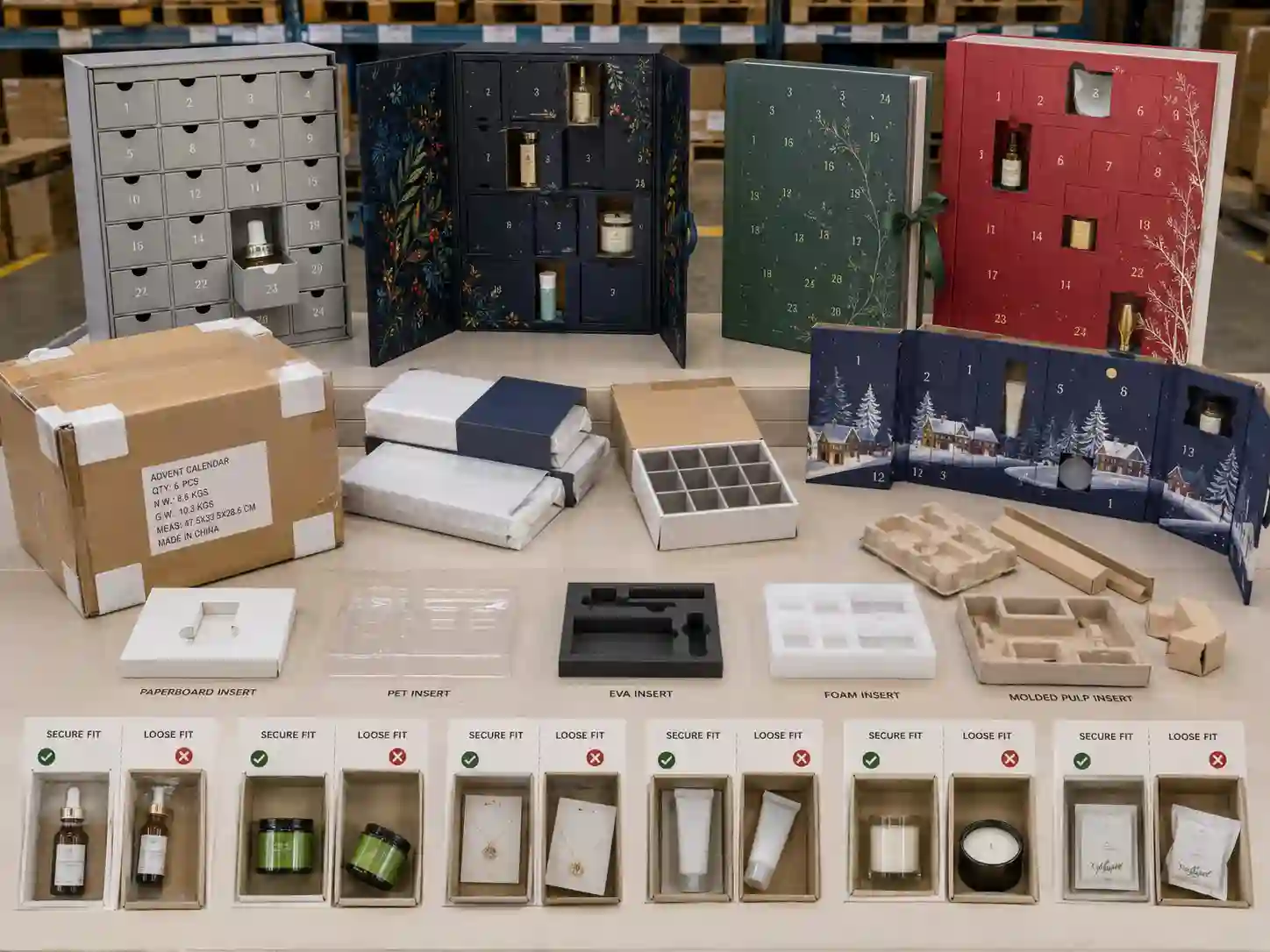
No single structure is best for every project. A rigid greyboard box generally provides more panel stiffness, while a folding carton offers lower weight and more efficient shipping volume. Drawer and door-opening designs require additional checks because movement can cause drawers to migrate or doors to distort.
Rigid greyboard calendars
Rigid boxes are suitable for premium products, heavier assortments, and high-value presentation. Greyboard panels can resist bending better than lightweight paperboard, but the finished box is heavier and may need corner protection, tissue wrapping, a fitted sleeve, or a protective bag to prevent surface rubbing.
Large rigid boxes should also be checked for unsupported spans. A wide front panel can bow even when thick greyboard is used if the internal tray does not provide sufficient support.
Drawer-style calendars
Drawer boxes provide a strong unboxing experience, but every drawer needs controlled clearance. Too much clearance allows movement during transport; too little clearance can make the drawer difficult to open after lamination, wrapping, assembly, or humidity changes.
For export packing, the factory may use a fitted outer sleeve, paper band, retention board, or protective bag to prevent drawers from sliding out. The selected method should be tested on a fully loaded box because product weight changes drawer movement.
Door-opening and perforated-door calendars
Door-opening boxes depend on accurate alignment between the printed door, cut line, insert cavity, and product position. A product that shifts behind the panel can block a door or become damaged when the customer opens it.
Folding-carton versions may need internal partitions or perimeter support to stop the front and back panels from collapsing inward. Rigid door-opening versions need checks for hinge strength, magnet alignment when used, and pressure marks from the loaded products.
Fold-out and book-style calendars
Fold-out structures create large presentation areas but add hinges, folds, ribbons, magnets, or closing panels. The supplier should test whether the closed structure remains flat and whether the outer carton applies uneven pressure to raised areas.
Buyers comparing custom advent calendar box products should evaluate the structure with the final product weight rather than judging an empty display sample.
How do paperboard, PET, EVA, foam, and molded pulp inserts compare?
The insert should be selected according to product protection, cavity accuracy, visual presentation, sustainability targets, assembly method, and budget. Material thickness alone does not determine performance; cavity geometry and structural support are equally important.
| Insert option | Best suited to | International shipping strengths | Points buyers must check |
|---|---|---|---|
| Folded paperboard insert | Sachets, cards, lightweight bottles, stationery, small accessories | Lightweight, printable, easy to integrate with partitions, efficient to ship flat in some designs | Board stiffness, fold direction, locking tabs, product retention, assembly time, edge pressure |
| Clear PET tray | Cosmetics, formed containers, products needing precise presentation | Accurate formed cavities, good visibility during packing, repeatable product positioning | Tray thickness, cavity draft, anti-scratch needs, recycling requirements, product compatibility |
| EVA insert | Jewelry, tools, glass bottles, premium accessories, products requiring a close fit | Strong retention, clean appearance, controlled cavity depth, useful for mixed product shapes | Density, odor, surface finish, cavity tolerance, color consistency, adhesive method |
| Foam insert | Fragile or irregular products requiring cushioning | Good shock absorption and flexible cavity development | Foam type, density, compression recovery, surface rubbing, destination-market requirements |
| Molded pulp insert | Bottles, candles, personal-care products, larger repeatable shapes | Three-dimensional support, useful edge protection, paper-based presentation | Tooling, surface texture, dimensional variation, drying deformation, product scuffing |
| Hybrid insert | Calendars containing products of different weights and shapes | Allows local reinforcement without overengineering every compartment | Assembly sequence, material compatibility, recycling separation, total labor and cost |
Factory tip: A deep cavity is not automatically a secure cavity. Retention usually depends on contact points near the product’s stable body, while caps, pumps, seals, and decorative components should not carry compression loads.
Which insert should be chosen for fragile or mixed products?
Choose the insert by identifying the highest-risk product first, then engineer the remaining compartments around the box dimensions and weight distribution. A mixed calendar often needs more than one retention method.
Use this practical decision guide
- For flat sachets, cards, or envelopes: Start with folded paperboard pockets, slots, retaining flaps, or partitions. Check whether flexible products can migrate behind the insert.
- For small plastic bottles and tubes: Consider formed PET, folded paperboard cradles, or molded pulp. Support the main container body without pressing pumps or closures.
- For glass bottles or ceramic items: Use close-fitting EVA, suitable foam, molded pulp, or a reinforced paper structure. Prevent product-to-product and product-to-panel contact.
- For candles: Support the base and side wall. Confirm that the cavity does not mark labels, dent soft containers, or allow the candle to strike the calendar face.
- For mixed products: Balance heavy items across the layout. Place heavy products near structurally supported zones rather than grouping them along one unsupported edge.
- For scratch-sensitive finishes: Add tissue, a paper sleeve, a soft contact layer, or a protective bag after compatibility testing.
Fragile-product protection should be evaluated as a complete system: product, insert, calendar box, protective wrap, inner packing, export carton, and pallet. Improving only one component may not correct the actual failure point.
How should product-fit tolerances be engineered?
Insert cavities need enough clearance for normal product and production variation, but not enough space to permit damaging movement. The correct tolerance depends on the product material, insert material, cavity shape, loading method, and acceptable removal force.
For each compartment, the supplier should review:
- Maximum product length, width, height, and weight.
- Variation between product batches and filling conditions.
- Compression-sensitive components such as pumps, caps, seals, cartons, and labels.
- Finger access or pull-tab access for product removal.
- Contact surfaces that could scratch, crease, or remove printing.
- Cavity depth and the distance between the product and front door.
- Insert deflection when the calendar is held vertically.
- Clearance required for drawer movement, door opening, and box closing.
A practical fit test should include normal handling positions: flat, upright, tilted, inverted, opened, closed, and lightly shaken. The product should remain controlled without becoming so tight that loading damages the retail product or customers cannot remove it.
Quotable QC rule: An insert should be approved by measured fit, loaded function, and transport behavior—not by appearance alone.
What should happen during dieline development and sampling?
The dieline should be developed around verified products and the selected insert, then reviewed through structural prototypes and a loaded pre-production sample. Artwork should not be finalized before the main dimensions, opening positions, folds, and compartment layout are stable.

A controlled development process normally includes:
- Collection of physical products or dimensioned product drawings.
- Initial structure and compartment-layout proposal.
- Material selection for greyboard, paperboard, insert, wrapping paper, and protective components.
- Blank structural prototype to check dimensions, assembly, and product fit.
- Dieline revision after loading and function tests.
- Printed sample using the intended CMYK artwork, Pantone references, and finishing positions.
- Fully loaded pre-production sample with the intended insert and closing method.
- Written approval of the box, insert, artwork, finish, packing method, and acceptable tolerances.
The loaded sample should contain production-representative products. Empty containers, lightweight mock-ups, or undersized samples may hide problems involving panel bowing, drawer movement, insert collapse, and carton weight.
Through its custom advent calendar box services, a supplier should be able to explain which dimensions are confirmed, which are provisional, and which require physical testing before mass production.
How do printing and finishing choices affect export packing?
Printing and finishing can change both the appearance and the handling sensitivity of the calendar. Buyers should include surface-protection requirements when approving CMYK printing, Pantone colors, foil stamping, embossing, spot UV, matte lamination, or gloss lamination.
Matte surfaces can show rubbing or fingerprints, while glossy surfaces may reveal scratches and pressure marks. Raised foil, embossing, closures, ribbons, and decorative elements can create local pressure points when boxes are stacked too tightly.
The printed sample should be checked for:
- Color against the approved proof or physical Pantone reference.
- Registration between printing, die cutting, doors, windows, and insert cavities.
- Foil or spot UV cracking near folds and hinges.
- Surface rubbing after wrapping and carton movement.
- Pressure marks caused by inserts, products, magnets, or stacked boxes.
- Glue or adhesive transfer onto visible surfaces.
Protective tissue, paper sheets, sleeves, bags, and dividers should be clean, appropriately sized, and included in the approved packing specification. They should not be added informally during final packing without testing.
How should finished advent calendar boxes be packed for export?
Finished calendars should be immobilized, separated from abrasive contact, protected at vulnerable edges, and packed in export cartons that suit the loaded weight and distribution method. The carton count should be chosen by engineering and handling needs, not simply by fitting the maximum number of boxes into one carton.
Recommended packing sequence
- Complete the final inspection and remove dust, scraps, adhesive residue, and rejected pieces.
- Confirm that all products are correctly loaded and every compartment, drawer, or door functions.
- Close and secure drawers, panels, sleeves, ribbons, magnets, or locking tabs.
- Apply the approved tissue wrap, protective sleeve, paper band, bag, or surface-protection layer.
- Add dividers, paper pads, edge protection, or corner guards where required.
- Load calendars in the approved orientation and quantity per export carton.
- Fill controlled gaps without creating excessive compression.
- Seal cartons consistently and apply the approved shipping marks.
- Record carton dimensions, gross weight, net weight, quantity, and carton number.
- Stack cartons according to the pallet-loading plan and apply corner boards and stretch wrap when palletized shipping is specified.
Export cartons should be tested using the actual packed quantity. A carton that performs well with empty samples may fail when the loaded calendar boxes create concentrated pressure or excessive gross weight.
Buyers planning formal distribution testing can review the official ISTA test-procedure information and agree with their logistics team or testing laboratory on an appropriate protocol. The test method should match the intended distribution environment rather than being selected only because it is familiar.
What QC checks should be completed before shipment?
Final QC should confirm product count, insert retention, box function, appearance, packing materials, carton data, and pallet configuration against the approved pre-production sample and written specification.
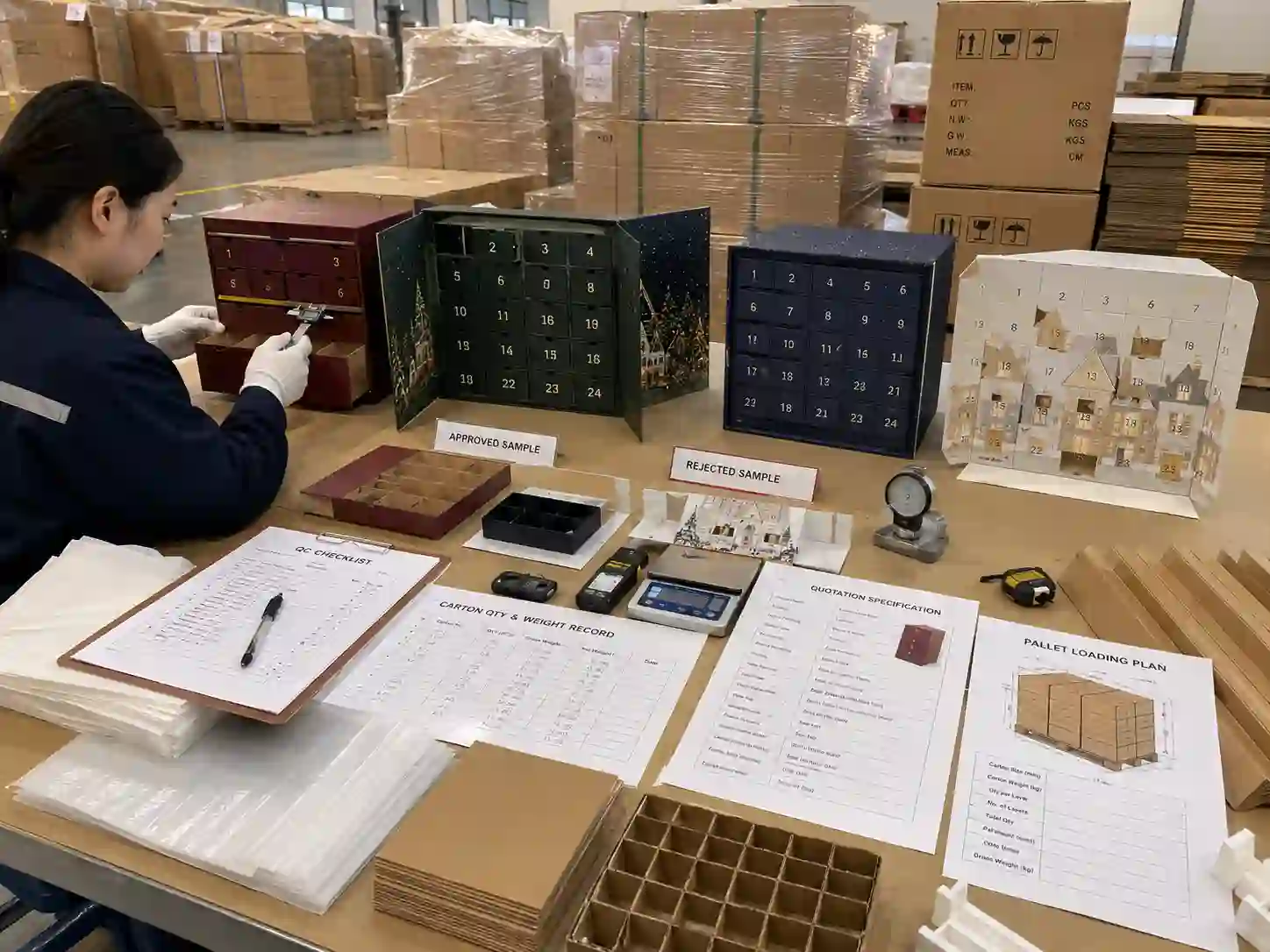
Practical pre-shipment QC checklist
- Verify calendar dimensions and box squareness.
- Confirm the correct products and quantities in every compartment.
- Check cavity fit and product orientation.
- Test drawer opening, door opening, hinges, magnets, sleeves, and closures.
- Inspect insert locking tabs, glue points, supports, and partitions.
- Perform a controlled loaded shake and orientation test.
- Inspect printing, lamination, foil stamping, embossing, and spot UV.
- Check corners, edges, panels, and visible surfaces for crushing or rubbing.
- Compare production against the signed pre-production sample.
- Verify protective tissue, sleeves, dividers, corner guards, and carton quantity.
- Measure export-carton dimensions and gross weight.
- Confirm shipping marks, barcodes, carton numbers, and destination information.
- Review pallet pattern, stack height, corner boards, and stretch wrapping.
- Record defects, corrective actions, reinspection results, and released quantity.
QC tip: Inspect samples from different cartons, packing stations, production times, and pallet positions. A single top-carton sample may not represent compression, handling, or assembly variation across the shipment.
How do MOQ, cost, and lead time change with the packing method?
MOQ, unit cost, and lead time are influenced by the calendar structure, insert process, material usage, tooling, assembly labor, product loading, protective packing, and export-carton configuration. Buyers should compare quotations using the same technical specification.
Important cost drivers include:
- Rigid greyboard construction versus folding-carton construction.
- Number and size of drawers, doors, partitions, and separate components.
- Custom tooling for PET trays, molded pulp, EVA, or foam cavities.
- Insert assembly and manual product-loading time.
- Special papers, Pantone printing, foil stamping, embossing, and spot UV.
- Protective sleeves, tissue, bags, dividers, and corner guards.
- Carton quantity, carton grade, palletization, and destination labeling.
- Required prototypes, printed samples, testing, inspection, and rework allowance.
Lead time should be divided into structure development, artwork preparation, sampling, approval, material procurement, mass production, product loading, QC, and export packing. Late product changes can require a new insert, dieline, sample, carton calculation, and pallet plan.
For paper-based material claims, buyers should request documentation that matches the actual order and verify the supplier’s scope rather than relying on a logo shown in general marketing materials. The FSC chain-of-custody information is a useful official reference when certified material and on-product claims are required.
How should buyers compare advent calendar packaging suppliers?
Compare suppliers by their ability to control the complete packed system, not only by the unit price of the empty box. A suitable supplier should ask detailed questions about products, inserts, loading, transport, inspection, and export cartons before confirming the final quotation.
| Supplier comparison point | What a buyer should request | Warning sign |
|---|---|---|
| Structural development | Dieline process, prototype stages, tolerance review, loaded-fit procedure | Final dimensions quoted without product data |
| Insert engineering | Material options, cavity method, retention logic, product-removal test | Insert selected only by appearance or lowest price |
| Sample control | Blank sample, printed sample, loaded pre-production sample, revision record | Mass production starts from digital artwork approval alone |
| Production QC | Inspection criteria, defect limits, function checks, measurement records | No written comparison against an approved sample |
| Export packing | Carton specification, packing quantity, weights, pallet plan, shipping marks | Export details are postponed until production is complete |
| Commercial quotation | Clear inclusions for tooling, samples, packing, loading, inspection, and freight basis | Low headline price with undefined packing or sample charges |
Buyers can review the capabilities of the Giftpackpro packaging factory and compare them with the written requirements of their project. Supplier evaluation should include communication accuracy, revision control, sample consistency, production capacity, QC reporting, and response to identified risks.
What information is needed for an accurate quotation?
An accurate quotation requires product, box, insert, printing, quantity, packing, and delivery information. Missing details usually result in provisional pricing that may change after sampling.
RFQ preparation checklist
- Target order quantity and any forecast for repeat orders.
- Required delivery date and destination country or port.
- Product list with dimensions, weights, photos, and fragility notes.
- Physical samples or confirmation of when samples will be available.
- Preferred box structure and approximate finished dimensions.
- Number of compartments, drawers, or opening doors.
- Preferred insert material or required performance.
- Artwork status, print colors, Pantone references, and finishing requirements.
- Loading responsibility and product-delivery schedule.
- Retail barcode, carton label, shipping-mark, and pallet requirements.
- Required sample stages, QC documentation, or transport testing.
- Preferred Incoterm or quotation basis.
Buyers who are still selecting a structure can use the advent calendar box buying guides to organize their requirements or discuss options with a custom advent calendar boxes manufacturer before final artwork preparation.
What common international packing mistakes should buyers avoid?
The most common mistakes come from designing the visible box before engineering product retention and transport protection. These errors become expensive when they are discovered after artwork approval or mass production.
- Using estimated product dimensions: Small differences can block drawers, misalign doors, or loosen cavities.
- Approving an empty sample: It does not reveal weight distribution, panel bowing, insert collapse, or drawer migration.
- Ignoring removal access: A secure cavity may still fail if customers cannot remove the product safely.
- Placing heavy products together: Concentrated weight can deform panels and destabilize the packed calendar.
- Testing only the retail box: International shipping performance depends on the export carton and pallet system as well.
- Choosing the largest carton count: Excessive gross weight can increase crushing and manual-handling damage.
- Leaving shipping marks until the end: Carton labels, barcodes, destination marks, and pallet data should be confirmed before packing.
- Changing products after insert approval: A new cap, pouch size, label, or product weight may require retesting and dieline revision.
What should buyers send Giftpackpro before requesting a sample or quotation?
Send the target quantity, product dimensions and weights, compartment list, reference structure, artwork status, insert preference, delivery destination, required date, and packing expectations. Physical products are strongly recommended before final insert approval.
Giftpackpro can then review the box structure, insert material, dieline, sample stages, production method, QC points, export-carton quantity, and pallet requirements. Buyers can explore custom advent calendar box services or request a custom quote with a more complete RFQ.
FAQ: Packing advent calendar boxes for international shipping
Should every product have a tight-fitting cavity?
No. The cavity should control movement without compressing vulnerable components or making product removal difficult. Flexible sachets, glass bottles, tubes, and jewelry cards need different contact points and clearances.
Is an EVA insert always better than a paper insert?
No. EVA provides strong retention for many premium or fragile products, but a properly engineered paperboard insert may be more suitable for lightweight products, recyclable-material goals, flat packing, or lower assembly complexity.
When is molded pulp appropriate?
Molded pulp is useful for repeatable three-dimensional products that need body support and edge protection. Buyers should evaluate tooling, surface texture, dimensional variation, moisture sensitivity, and possible scuffing during sampling.
Do buyers need a fully loaded pre-production sample?
A loaded pre-production sample is strongly recommended whenever product weight, fragility, compartment alignment, drawer movement, door function, or export protection affects performance. It creates a practical reference for mass production and final QC.
Can the export carton be designed after mass production?
That approach creates unnecessary risk. The carton quantity, orientation, protective materials, dimensions, weight, shipping marks, and pallet layout should be confirmed with production-representative samples before bulk packing begins.
What is the best way to pack advent calendar boxes for international shipping?
The best method is a verified packaging system combining accurate product-fit engineering, a suitable insert, a structurally stable calendar, controlled surface protection, reinforced export cartons, clear shipping marks, and an approved pallet plan. The final choice should be validated with loaded samples and documented QC checks.
Build the shipping pack around the real products
To pack advent calendar boxes international shipping projects successfully, begin with verified product data and engineer outward: product cavity, insert, calendar structure, protective wrap, export carton, and pallet. Approve the loaded system before mass production and include every packing component in the quotation and QC specification. This approach gives buyers a clearer basis for comparing structures, suppliers, costs, samples, and shipment readiness.