
Quick answer: Effective export packing for advent calendar boxes begins before the master carton is designed. Buyers must match the retail box structure, insert, product weight, surface finish, carton orientation, pallet layout, and transport route. A rigid drawer box may need drawer-retention sleeves and corner protection, while a folding carton may need compression support and carefully controlled stacking. Before approving mass production, confirm a loaded pre-production sample, export-carton specification, packing sequence, carton quantity, gross weight, shipping marks, pallet pattern, and transit-test plan. The best packing solution protects the finished presentation without adding unnecessary volume, labor, or freight cost.
Why must export packing be considered during box development?
Export packing should be engineered at the same time as the advent calendar structure because the retail box dimensions, weight distribution, moving parts, and surface finish determine how it must be protected. Treating the export carton as a last-minute purchasing item often creates avoidable damage, excessive freight volume, or inefficient manual packing.
Custom advent calendars are more complex than standard folding cartons. They may contain 12, 24, or more compartments, multiple drawers, perforated doors, magnetic closures, fold-out panels, paper inserts, PET trays, EVA inserts, or mixed products with different weights. These features create risks such as panel bowing, crushed corners, drawer movement, torn doors, insert displacement, abrasion, and product migration during transport.
A buyer working with a custom advent calendar boxes manufacturer should therefore discuss retail-box engineering and export protection as one connected project. The supplier needs to know not only the finished box size, but also the loaded weight, product positions, shipping method, destination, pallet requirements, and expected handling conditions.
Quotable buyer principle: The export carton protects the outside of an advent calendar, but the insert and internal structure must protect it from forces generated by the products inside.
Which advent calendar structures need different export-packing solutions?
Drawer boxes, door-opening calendars, book-style rigid boxes, folding cartons, and fold-out structures do not behave the same way during shipping. Buyers should compare their protection requirements before choosing a structure based only on appearance.

| Advent calendar structure | Main transport risks | Typical protection considerations | Buyer checks |
|---|---|---|---|
| Multi-drawer rigid box | Drawers sliding out, fascia abrasion, uneven weight distribution, crushed outer corners | Close-fitting sleeve, tissue or protective sheet, drawer-retention method, corner support, controlled carton orientation | Shake the loaded sample, check every drawer after testing, confirm heavy products are not concentrated on one side |
| Door-opening rigid box | Doors opening in transit, hinges creasing, magnetic panels shifting, surface rubbing | Closure band or sleeve, protective paper, fitted inner support, stable face-to-face packing | Inspect hinge areas, door alignment, magnets, foil, lamination, and panel flatness after packing |
| Book-style rigid box | Spine stress, cover bowing, magnetic closure movement, edge crushing | Spine clearance, cover support, tissue sheet, corner protection, suitable stacking direction | Open and close the sample after transport simulation; compare squareness with the approved sample |
| Folding paperboard calendar | Panel compression, perforated doors tearing, carton deformation, print scuffing | Inner support, dividers, controlled carton count, stronger corrugated carton, flat or erected packing decision | Confirm whether the calendar ships flat, partially assembled, or fully loaded; test door strength and panel compression |
| Fold-out or wing-panel calendar | Panels unfolding, hinge stress, irregular packed shape, pressure on projecting sections | Securing band, shaped pad, outer sleeve, reinforced carton arrangement, clear packing instructions | Check opening sequence, panel alignment, packed dimensions, and pressure points around folds |
Buyer tip: Ask the supplier to show both the retail-box dimensions and the packed-unit dimensions. A protective sleeve, tissue wrap, corner guard, or outer paper band can change the export-carton layout and freight volume.
How do size, layout, and dieline decisions affect export packing?
The finished size and dieline determine carton efficiency, stacking stability, pallet utilization, and the amount of empty space around each unit. Even a small dimensional change can alter the number of calendars per export carton or the number of cartons per pallet.
Before locking the dieline, the factory should review:
- Finished outer dimensions in length, width, and height.
- Maximum dimensions when doors, pull tabs, ribbons, or closures project beyond the main body.
- Loaded weight and product-weight distribution.
- Board grain direction, hinge positions, drawer clearance, and assembly tolerances.
- Protective sleeve, tissue, paper pad, divider, corner guard, or polybag requirements.
- Export-carton internal dimensions and corrugated-board allowance.
- Carton orientation on the pallet and permitted overhang.
- Container-loading or airfreight dimensional-weight implications.
A dieline should not be approved solely because the blank prototype folds correctly. The supplier should also calculate how the assembled and loaded box fits into its export carton. Oversized pull tabs, thick magnetic closures, protruding ribbons, and deep drawers can produce unexpected pressure points.
Factory tip: Carton calculations should use the protected packed unit, not only the nominal retail-box size shown on the structural drawing.
How should inserts protect the products and the calendar structure?
The insert must hold each product securely enough to prevent movement without creating excessive insertion pressure, blocked drawers, distorted doors, or visible panel bulging. Export damage often begins when a heavy or loose product moves inside a compartment and repeatedly strikes the surrounding structure.
Paper inserts
Folded paperboard inserts are suitable for many lightweight cosmetics, stationery items, tea sachets, jewelry cards, and small accessories. Their performance depends on board thickness, fold design, locking tabs, cavity dimensions, finger access, and support beneath the product. A paper insert may also provide compression support between the front and back panels.
Clear PET trays
PET trays can provide accurate product positioning and good visibility during assembly, but the cavity must match the actual production product rather than an early nominal drawing. Buyers should check flange width, tray depth, edge clearance, deformation under load, and whether the tray rubs against printed or laminated surfaces.
EVA, foam, and molded pulp
EVA and foam inserts can provide strong retention for heavier or fragile items, although buyers should confirm density, thickness, odor, surface appearance, cutting quality, and compatibility with the product. Molded pulp can be considered where its shape, surface texture, tolerance, and project quantities suit the design.
For every insert type, send the supplier final production samples of the products whenever possible. Measurements alone may not reveal flexible pouches, tapered bottles, pump heads, caps, irregular accessories, or changes in center of gravity.
QC tip: Insert testing should include loading, unloading, finger access, shaking, inversion where appropriate, drawer operation, door alignment, and inspection for product contact with printed surfaces.
Which materials and finishes need extra protection?
Rigid greyboard boxes usually resist panel compression better than lightweight paperboard structures, but their wrapped corners, edges, and decorative surfaces can be vulnerable to impact and abrasion. Folding cartons may be lighter and more freight-efficient, but they require careful control of compression, moisture exposure, and stacking.

Surface finishes also influence the export-packing method:
- Matte lamination: Can show rubbing, polishing, fingerprints, or pressure marks, especially on dark solid colors.
- Gloss lamination: Can reveal scratches and scuffs under retail lighting.
- Foil stamping: Requires protection from direct friction, pressure lines, and misaligned stacking.
- Embossing: Raised details can flatten or mark adjacent boxes if units are tightly packed face to face.
- Spot UV: Contrasting gloss areas may scuff or transfer pressure marks without separator sheets.
- Uncoated or specialty paper: May require additional protection from dirt, moisture, and handling marks.
Artwork approval should include a CMYK proof or printed sample, and spot colors should be checked against the agreed physical Pantone reference where applicable. Buyers should specify whether color approval is based on a digital proof, contract proof, printed sample, or signed pre-production sample.
When responsible material sourcing is required, buyers can ask suppliers to document the exact paper and chain-of-custody requirements and verify relevant information through the official Forest Stewardship Council website. Do not assume that a general material statement automatically covers every printed component or production order.
What should be approved during sampling?
Buyers should approve the structural prototype, printed sample, loaded sample, and export-packing method as separate checkpoints. A beautiful empty sample does not prove that the calendar will assemble, load, close, stack, and ship correctly in mass production.
- Blank structural prototype: Confirm dimensions, opening method, drawer clearance, door positions, insert geometry, and assembly sequence.
- Printed sample: Confirm artwork position, CMYK color, Pantone references, lamination, foil stamping, embossing, spot UV, and wrapping quality.
- Loaded sample: Insert final products and inspect product orientation, weight distribution, cavity fit, door closure, drawer movement, and overall deformation.
- Pre-production sample: Approve materials, construction, print, finish, insert, accessories, packing method, and workmanship standard before mass production.
- Packed-carton sample: Confirm unit protection, carton quantity, net and gross weight, carton dimensions, sealing method, shipping marks, and pallet layout.
Quotable sampling rule: Export packing should be approved with the actual loaded calendar whenever product weight or movement can affect the structure.
Giftpackpro’s custom advent calendar box services can be used to coordinate structure, dieline, insert, printing, sample, and packing requirements as connected approval stages rather than isolated purchasing decisions.
How should buyers evaluate the MOQ, cost, and lead-time impact?
MOQ, unit cost, and lead time depend on the complete specification, not only the external box style. Structure complexity, insert tooling, print setup, manual assembly, loading, protective materials, export-carton quantity, and pallet requirements can all affect the quotation.
Important cost drivers include:
- Rigid greyboard construction versus folding paperboard construction.
- Number and size of drawers, doors, panels, magnets, ribbons, and accessories.
- Paper insert versus PET tray, EVA, foam, or molded pulp.
- Custom tooling, cutting dies, forming molds, and setup requirements.
- CMYK printing, Pantone colors, foil stamping, embossing, spot UV, and lamination.
- Manual assembly, product loading, inspection, and individual wrapping.
- Protective sleeves, tissue sheets, paper pads, dividers, and corner guards.
- Export-carton strength, carton quantity, pallets, stretch wrap, and shipping marks.
Lead time should be divided into design confirmation, dieline development, sample production, sample shipping, buyer review, revisions, material preparation, printing, finishing, assembly, loading, QC, export packing, and logistics booking. Buyers should leave time for at least one revision cycle rather than planning from an ideal first-approval scenario.
What QC checks are required before export packing?
Final QC should verify the approved specification, functional performance, appearance, loaded product fit, packing method, and carton information. Inspection should cover beginning, middle, and end production stages where practical, not only a few finished units after all boxes have been packed.
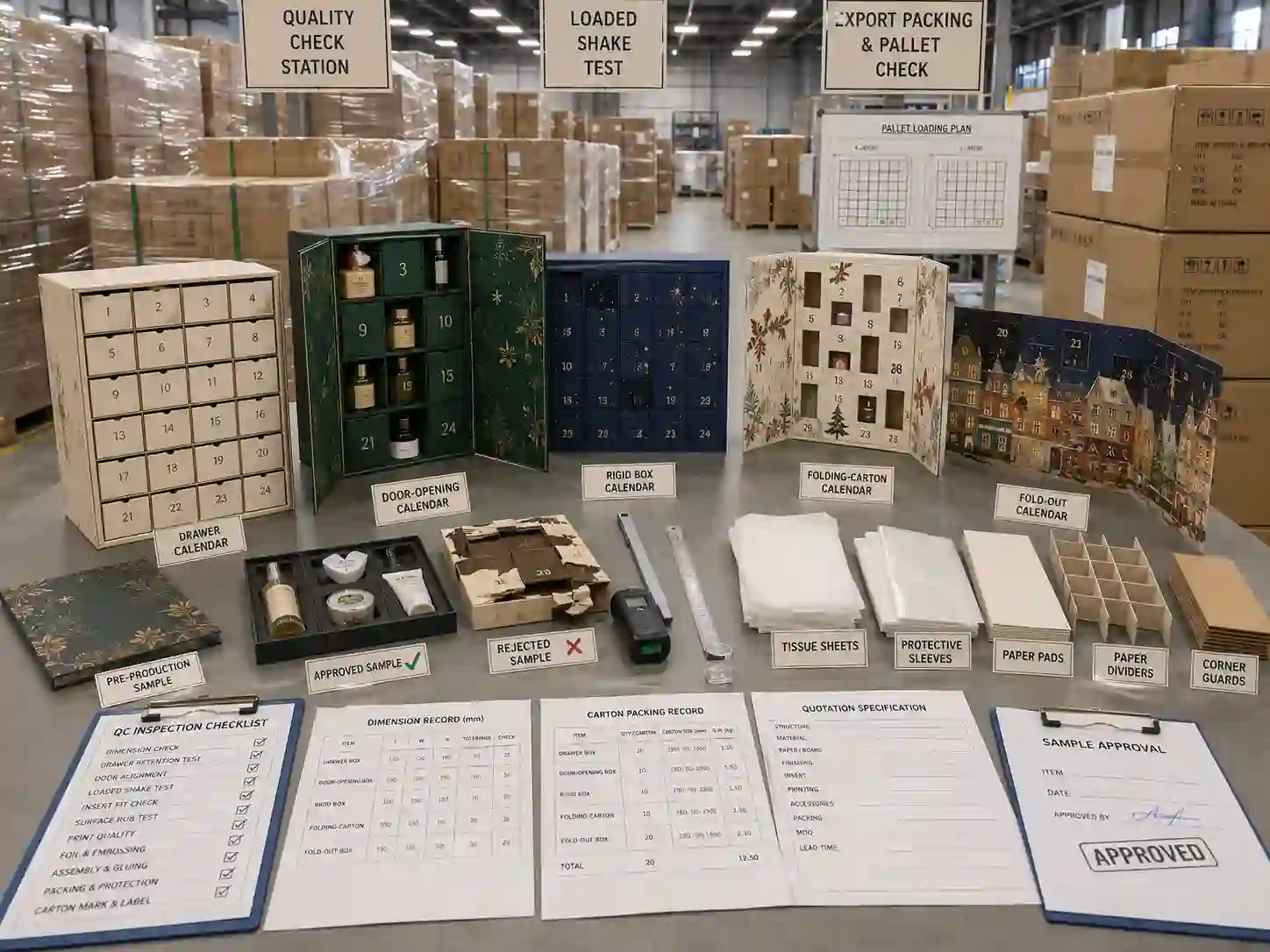
Practical advent calendar QC checklist
- Finished dimensions match the approved drawing and tolerance agreement.
- Rigid panels are square, flat, and securely wrapped.
- Folding-carton panels are correctly creased, glued, and locked.
- Drawers slide without blocking, excessive looseness, or uncontrolled opening.
- Doors align with the insert cavities and open without tearing.
- Magnets, ribbons, pull tabs, hinges, and closures function correctly.
- Products fit the insert with adequate retention and finger access.
- Heavy products do not distort panels or concentrate weight on one corner.
- Artwork, numbering, foil, embossing, spot UV, and color match the approved sample.
- Surfaces are free from visible scuffs, glue marks, dents, scratches, and contamination.
- Protective sheets, sleeves, pads, dividers, and corner guards are placed consistently.
- Export cartons have the approved quantity, sealing, dimensions, weight, and shipping marks.
- Pallet stacking is stable, stretch wrap is controlled, and cartons do not overhang the pallet.
For projects with significant transport risk, buyers may request a documented transit-test plan based on the product, route, handling method, and commercial requirements. The International Safe Transit Association provides official information about packaged-product testing. The appropriate test approach should be selected for the actual distribution system rather than copied from an unrelated package.
How should export cartons, pallets, and shipping marks be specified?
The packing specification should state exactly how many retail units go into each export carton, how each unit is oriented, what protective materials are used, and how cartons are sealed and palletized. Verbal instructions are not enough for repeatable mass-production packing.
Export-carton specification
Confirm the corrugated-board specification, internal and external carton dimensions, units per carton, divider arrangement, carton sealing method, maximum intended stacking, net weight, gross weight, and handling requirements. Avoid excessive empty space, but do not pack the calendars so tightly that pressure damages edges, closures, or decorative finishes.
Pallet plan
The pallet plan should show cartons per layer, number of layers, total pallet height, gross pallet weight, corner boards where required, stretch wrapping, straps if applicable, and any restrictions on pallet overhang. Palletization may reduce manual handling damage but can also affect container utilization and freight cost.
Shipping marks
Shipping marks should be approved before carton printing or labeling. Typical information may include consignee reference, purchase-order number, item code, carton number, quantity, destination, country of origin where required, gross and net weight, carton dimensions, and handling symbols. Buyers should provide exact mark content and barcode data rather than asking the factory to invent them.
Buyer tip: Include a packing diagram with the purchase order. It is easier to inspect “four calendars per carton, faces inward, tissue between units, corner guards on four sides” than a vague instruction such as “pack securely.”
How should buyers compare potential suppliers?
Compare suppliers by how clearly they connect structural engineering, sampling, production control, and export packing. A low initial unit price is not a complete comparison if the quotation excludes tooling, protective materials, pallets, testing, loading labor, or revised carton dimensions.
Supplier decision guide
| Evaluation question | Strong supplier response | Warning sign |
|---|---|---|
| Can the supplier review the loaded product layout? | Requests product samples, weights, dimensions, orientation, and cavity tolerances | Quotes the insert using only an exterior box photo |
| Is export packing included in development? | Provides carton layout, packed dimensions, quantity, weight, and protection details | Plans the carton only after mass production is finished |
| How is sample approval controlled? | Uses signed specifications, revision records, and an approved pre-production sample | Relies on chat messages without a consolidated approval document |
| How is quality checked? | Explains dimensional, functional, print, insert, loading, and packing inspections | States only that quality will be “checked carefully” |
| Is the quotation complete? | Separates structure, insert, printing, finishing, tooling, packing, pallet, and delivery terms | Provides one price without specification assumptions or exclusions |
Buyers can review the Giftpackpro packaging factory, compare relevant custom advent calendar box products, and use the company’s advent calendar box buying guides to prepare technical questions before supplier discussions.
What information should be included in an RFQ?
A useful RFQ gives the supplier enough information to calculate the box, insert, sample, production, export carton, pallet, and delivery requirements. Missing product or packing details usually lead to provisional pricing that must be revised later.
Quotation-preparation checklist
- Target structure: drawer, door-opening, book-style rigid, folding carton, fold-out, or another format.
- Finished dimensions or maximum permitted retail dimensions.
- Number of compartments and proposed product layout.
- Product dimensions, weights, photographs, and physical samples.
- Preferred insert: paper, PET, EVA, foam, molded pulp, or supplier recommendation.
- Material expectations, including paperboard or greyboard requirements.
- Artwork files, color requirements, and finish references.
- Required quantity and possible reorder quantities.
- Sample type, sample quantity, and approval deadline.
- Target mass-production completion date.
- Individual wrapping, sleeve, tissue, divider, and corner-protection requirements.
- Units per export carton, pallet preference, and maximum carton-weight restrictions.
- Shipping marks, barcode data, destination, and trade terms.
- Any requested inspection, transit testing, material documentation, or compliance verification.
Which export-packing mistakes should buyers avoid?
The most common mistakes come from approving the retail appearance without validating the loaded product, packed dimensions, and production packing sequence.
- Approving an empty sample: The structure may deform after products are inserted.
- Using estimated products for insert development: Final bottles, pouches, or accessories may not fit the approved cavities.
- Ignoring drawer retention: Drawers can move even when each product is held securely.
- Allowing direct surface contact: Matte, gloss, foil, embossed, or spot-UV surfaces may rub during long-distance transport.
- Leaving carton quantity undecided: Late changes can increase dimensions, weight, material use, and freight cost.
- Using generic shipping marks: Incorrect purchase-order, barcode, destination, or carton-number data can disrupt receiving.
- Skipping the pallet calculation: A carton can be strong individually but unstable in the planned pallet pattern.
- Comparing incomplete quotations: One supplier may include protective materials and pallets while another excludes them.
Frequently asked questions about export packing advent calendar boxes
Should rigid advent calendar boxes always be palletized?
Not automatically. The decision depends on box value, carton strength, route, handling, shipment size, container utilization, destination requirements, and freight method. Buyers should compare pallet protection with the additional volume and cost.
Can multiple advent calendar designs share one export-carton size?
They can when packed-unit dimensions, weights, and protection requirements are compatible. However, using one oversized carton for several designs may create empty space, poor stacking, or higher dimensional freight cost.
How many units should be packed in one export carton?
There is no universal quantity. The correct number depends on unit dimensions, loaded weight, structural strength, manual-handling limits, carton performance, pallet layout, and freight efficiency.
Is a stronger export carton enough to prevent damage?
No. A stronger carton cannot correct loose products, moving drawers, unsupported panels, direct surface rubbing, or poor internal spacing. Protection must work at product, insert, retail-box, export-carton, and pallet levels.
When should shipping marks be approved?
Approve them before export cartons are printed or labels are produced. Provide the final purchase-order references, item codes, carton numbering, destination details, barcode data, and handling instructions in writing.
Should transit testing be completed before mass production?
Testing should be completed early enough to allow corrective changes. A loaded pre-production sample or representative packed sample is more informative than testing an empty display box.
What should buyers prepare before requesting a sample or quotation?
For accurate export packing advent calendar boxes planning, prepare the target structure, finished size, compartment layout, final product samples, unit weights, insert preference, artwork, finishes, order quantity, schedule, shipping destination, carton restrictions, pallet preference, and shipping-mark requirements. These details allow the supplier to evaluate the complete packed system rather than quote only the decorative retail box.
To discuss a new project, review Giftpackpro’s structure and packing capabilities and request a custom quote with your product list, target quantity, delivery schedule, and available artwork or dieline files.


