
Quick answer: To choose suitable export cartons for advent calendar boxes, buyers must match the outer carton strength, dimensions, internal protection, carton quantity, handling method, and pallet plan to the finished packaging structure. A folding carton may need protection against crushing, while a rigid drawer box requires stronger corner support and tighter movement control. Printed finishes also affect packing decisions: matte lamination can show rubbing, foil stamping can scratch, and embossed areas can flatten under pressure. The export-carton specification should therefore be confirmed using fully loaded pre-production samples, not empty boxes or theoretical dimensions alone.
The right export carton is not simply the cheapest corrugated box that fits the product. It is part of the packaging engineering system that protects the advent calendar’s structure, inserts, products, artwork, and surface finishing from the factory to the buyer’s warehouse.
What should buyers understand before choosing export cartons?
Buyers should first confirm the finished advent calendar structure, loaded weight, surface finish, packing orientation, shipping method, and acceptable damage risk. These details determine how much compression strength, internal separation, and abrasion protection the export carton requires.
A rigid greyboard calendar with multiple drawers behaves differently during shipping from a flat folding-carton calendar. The rigid box may resist panel bending but remain vulnerable to crushed corners, displaced drawers, magnetic-flap damage, and surface rubbing. A folding paperboard calendar is lighter but may deform when cartons are stacked too high or when empty space inside the shipper allows movement.
Before choosing a carton, provide the supplier with:
- Finished advent calendar dimensions and tolerances
- Net weight of one fully loaded calendar
- Product type, cavity layout, and weight distribution
- Calendar structure, such as drawer box, door-opening box, book-style rigid box, fold-out box, or folding carton
- Paper, greyboard, insert, and surface-finishing specifications
- Required units per export carton
- Shipping method: courier, air freight, sea freight, palletized freight, or mixed handling
- Destination-market labeling and shipping-mark requirements
Buyer tip: Request the proposed export-carton dimensions, gross weight, units per carton, and pallet quantity before approving mass production. These figures affect freight cost, warehouse handling, and the landed cost per advent calendar.
How does the advent calendar structure affect carton selection?
The structure determines the main transit risks. Buyers should select the carton and internal protection around the weakest part of the finished calendar, not only around its overall dimensions.

| Advent calendar structure | Main shipping risks | Recommended carton considerations |
|---|---|---|
| Rigid drawer box | Drawer movement, crushed corners, panel rubbing, ribbon damage | Close-fitting sleeves or bags, paper pads, strong edge support, controlled carton clearance |
| Rigid door-opening box | Door misalignment, magnetic-flap stress, hinge damage, surface scratches | Door secured closed, face-to-face separation, corner protection, limited internal movement |
| Book-style rigid box | Spine cracking, cover bowing, magnetic closure opening | Spine-support orientation, protective sheet between units, compression control |
| Folding paperboard calendar | Panel crushing, perforated-door deformation, edge dents | Dividers, correctly sized master carton, reduced unsupported voids, stack-height limits |
| Fold-out or modular calendar | Panel shifting, hinge stress, uneven load concentration | Closed-position restraint, shaped pads, balanced orientation, loaded transit testing |
How much clearance should be left inside the export carton?
There should be enough clearance for protective materials and efficient packing, but not so much that the finished boxes can slide, tilt, or collide. Excessive clearance is often filled with loose paper after the carton design has already been approved, creating inconsistent protection between cartons.
The factory should calculate clearance using the maximum finished-box dimensions, including expected assembly tolerances, wrapped tissue, protective sleeves, dividers, and corner guards. A carton based only on the nominal dieline dimension may become too tight when greyboard thickness, wrapped-paper overlap, lamination, or hand assembly increases the final size.
Should advent calendars be packed flat or fully assembled?
Most rigid advent calendar boxes must be exported fully assembled because their structure, drawers, wrapped panels, and inserts cannot be efficiently flattened. Folding cartons may be shipped flat when the buyer has suitable assembly and product-loading capability, but this transfers labor, setup, and quality responsibility to the destination.
Buyers comparing flat and assembled supply should evaluate:
- Freight volume savings
- Local assembly and product-loading costs
- Risk of incorrect folding or door assembly
- Insert placement and product-loading accuracy
- Final appearance after local packing
- Warehouse space and production scheduling
Which corrugated carton specification is suitable?
The suitable corrugated specification depends on gross carton weight, carton dimensions, stacking pattern, humidity exposure, handling intensity, and transport duration. Board grade should therefore be selected from packaging data and physical testing rather than a single universal flute recommendation.
Common options include single-wall and double-wall corrugated cartons. Lightweight folding-carton calendars may be suitable for a well-designed single-wall shipper, while heavy rigid drawer calendars often require stronger corrugated construction, reinforced corners, or lower units per carton.
What should be included in the export-carton specification?
A useful specification should identify more than the outside dimensions. Ask the supplier to record:
- Carton style and corrugated construction
- Internal and external dimensions
- Board grade or agreed performance requirement
- Units per carton and packing orientation
- Net and gross carton weight
- Internal pads, dividers, sleeves, or corner guards
- Carton closure method and tape arrangement
- Shipping marks, carton number, and barcode area
- Pallet quantity, layer pattern, and finished pallet height
- Any stacking or handling restrictions
Buyers may also ask whether the proposed pack has been assessed using a recognized distribution-testing approach. The International Safe Transit Association provides information about transport-testing procedures, but the appropriate test sequence should be selected according to the actual distribution route and package type.
Factory tip: A heavier carton is not automatically a better solution. Poor dimensions, weak corner geometry, excessive void space, or an unstable pallet pattern can still cause damage even when stronger corrugated material is used.
How do inserts and loaded products change the carton requirement?
Export cartons must be designed around fully loaded calendars because products can significantly change weight distribution and structural behavior. A cosmetic bottle, candle, tea container, jewelry item, or small accessory may create concentrated loads that are not visible when an empty sample is tested.
The internal insert should retain each product during vibration and repeated handling. Paper inserts, PET trays, EVA inserts, foam, and molded pulp each distribute force differently. If products can escape from their cavities, they may damage doors, drawers, artwork, or neighboring products even when the outer carton remains undamaged.
During loaded testing, check whether:
- Products remain inside their intended cavities
- Heavy products are concentrated in one corner
- Drawer bottoms sag under product weight
- Perforated doors are pressed outward from behind
- PET trays crack or deform
- Paper inserts collapse at narrow bridges
- EVA or foam inserts leave pressure marks on products
- The calendar remains square after repeated movement
A reliable custom advent calendar boxes manufacturer should review product dimensions, weights, orientations, and tolerances before finalizing both the insert and the export carton.
How should printing and finishing affect export packing?
Printed and decorative surfaces require protection from abrasion, pressure, temperature, and contact transfer. The carton configuration should prevent finished faces from rubbing directly against corrugated board, rough dividers, exposed staples, or neighboring boxes.

How should CMYK and Pantone artwork be checked before packing?
CMYK artwork should be reviewed for image resolution, total ink coverage, small text, gradients, and color consistency across connected panels. Pantone references should be confirmed using a physical color standard under controlled lighting because screen displays and digital printouts are not dependable production references.
Before mass production, buyers should approve:
- Final dieline and artwork orientation
- Bleed, safe area, cut lines, and crease positions
- CMYK image quality and black-text settings
- Pantone color references where specified
- Barcode size, contrast, and quiet zone
- Foil, embossing, and spot-UV registration layers
- Legal text, warnings, recycling marks, and country-of-origin information where applicable
Does lamination change the export-pack design?
Yes. Matte lamination can reveal scuffing or polishing marks when boxes rub during transit, while gloss lamination may show scratches, fingerprints, and pressure lines. Soft-touch surfaces can be especially sensitive to abrasion and should be tested with the actual tissue, sleeve, bag, and divider materials intended for bulk packing.
Protective options can include tissue sheets, smooth paper pads, fitted paper sleeves, polyethylene bags where appropriate, or individual corrugated cells. The selected material should not transfer color, leave texture marks, or react with the printed surface.
How should foil stamping, embossing, and spot UV be protected?
Foil stamping can scratch or transfer when two decorated faces are pressed together. Embossed elements may flatten under concentrated compression, and spot UV can develop rub marks where raised glossy areas contact another surface.
The factory should identify the decorated face in the packing diagram and avoid direct contact with rough materials. Large foil areas, deep embossing, and raised spot-UV patterns may require an interleaving sheet or a different box orientation.
QC tip: Conduct a surface-rub check using production-equivalent printed samples and the actual packing materials. A clean visual sample on a presentation table does not prove that the finish will survive thousands of kilometers of transport.
What samples should be approved before the export carton?
The export carton should be finalized after the advent calendar structure, insert, artwork, finish, and loaded weight are sufficiently stable. Approving the shipper too early can cause incorrect dimensions, excess void space, or a carton that cannot accommodate protective materials.
- Structural prototype: Confirms dimensions, opening method, drawer movement, insert concept, and product fit.
- Printed sample: Confirms artwork placement, CMYK reproduction, Pantone direction, lamination, foil stamping, embossing, and spot UV.
- Loaded pre-production sample: Confirms final product weight, insert retention, assembly tolerance, surface protection, and packing orientation.
- Export-pack sample: Confirms units per carton, dividers, corner protection, gross weight, closure, shipping marks, and pallet arrangement.
The signed or otherwise approved pre-production sample should become the visual and functional reference for mass production. Differences between the approved sample and bulk output should be recorded and resolved before shipment.
Giftpackpro’s custom advent calendar box services can cover structural development, insert planning, artwork coordination, sampling, production, quality control, and export-pack preparation as part of one purchasing workflow.
How should buyers evaluate MOQ, cost, and lead time?
MOQ and unit cost are influenced by the advent calendar construction, printing process, finishing setup, insert material, manual assembly, packing method, and carton utilization. Buyers should compare complete project specifications rather than comparing only the calendar-box price.
Important cost drivers include:
- Rigid greyboard construction versus folding paperboard
- Number of drawers, doors, internal components, and wrapped parts
- Custom PET, EVA, foam, molded-pulp, or paper insert tooling
- CMYK printing and Pantone spot-color requirements
- Foil stamping plate size and number of foil colors
- Embossing or debossing tooling
- Spot-UV coverage and registration complexity
- Individual tissue, sleeve, bag, divider, and corner protection
- Units per export carton and total freight volume
- Palletization and special shipping-mark requirements
Lead time should be separated into artwork and engineering review, sample production, sample approval, material preparation, printing, finishing, assembly, product loading if included, QC, and export packing. Buyer-side delays in confirming the dieline, color proof, products, or shipping marks can affect the production schedule.
Quotable buying principle: The lowest carton cost is not the lowest delivered cost when it increases product damage, repacking labor, freight volume, or retail rejection risk.
What QC checks are required for cartons and finished calendars?
QC should confirm the finished calendar and the complete export pack. Inspectors should compare production units with the approved sample and verify dimensions, function, print quality, protective packing, carton records, and pallet stability.
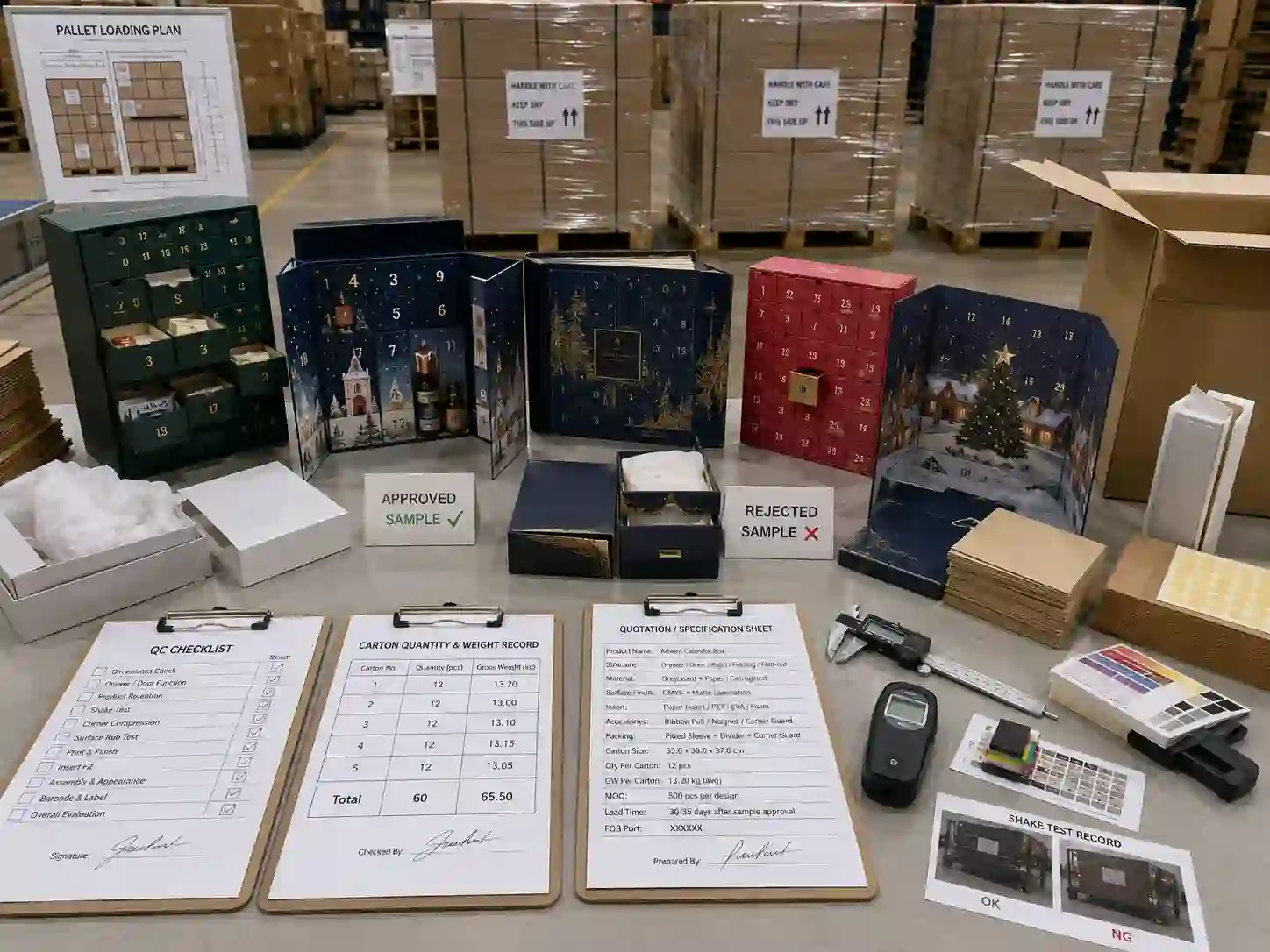
Practical export-packing QC checklist
- Confirm the finished calendar dimensions against the approved tolerance
- Check drawer movement, door alignment, magnetic closure, and fold-out panels
- Verify products remain secured in the insert
- Inspect CMYK and Pantone color direction against the approved proof
- Check foil, embossing, spot UV, lamination, registration, and surface cleanliness
- Confirm tissue, sleeves, bags, pads, dividers, and corner guards are correctly placed
- Check export-carton dimensions and units per carton
- Record net weight, gross weight, and carton quantity
- Verify tape closure and carton-edge condition
- Confirm shipping marks, carton numbers, barcodes, and handling symbols
- Inspect pallet pattern, overhang, corner boards, stretch wrap, and total height
- Retain packing photographs and inspection records before dispatch
Buyers can ask the supplier to explain the sampling and inspection process used by the Giftpackpro packaging factory. Certification, test reports, material claims, and inspection procedures should be verified against the needs of the specific order rather than assumed from marketing language.
How should cartons be arranged on a pallet?
A pallet plan should keep cartons stable, avoid excessive overhang, distribute weight evenly, and remain compatible with warehouse and container handling. Carton dimensions should ideally be planned with pallet efficiency in mind, but the finished packaging must not be compressed merely to improve pallet utilization.
Review these pallet details before shipment:
- Cartons per layer and number of layers
- Interlocking or column-stacking pattern
- Total pallet dimensions and gross weight
- Maximum carton overhang
- Use of corner boards, top sheets, straps, and stretch wrap
- Moisture protection where relevant
- Forklift access and warehouse height limits
- Container-loading arrangement
For non-palletized shipments, the supplier should still evaluate carton stacking, container voids, floor moisture, and movement during loading. Buyers sourcing paper-based materials may also review chain-of-custody options and sourcing information through the official Forest Stewardship Council website when relevant to their purchasing policy.
How can buyers compare carton proposals from different suppliers?
Compare suppliers using the same RFQ specification and ask each supplier to state assumptions clearly. A low quotation based on fewer units per calendar, lighter corrugated board, no dividers, or non-palletized shipping is not directly comparable with a complete export-ready proposal.
Supplier decision guide
| Decision area | What a buyer should request | Warning sign |
|---|---|---|
| Engineering | Finished dimensions, tolerance, packing orientation, and carton drawing | Carton proposed before product and sample details are confirmed |
| Surface protection | Actual tissue, sleeve, divider, or bag specification | Generic statement that lamination alone prevents scratches |
| Loaded testing | Evidence that fully loaded samples were checked | Only empty display samples are evaluated |
| Quotation | Units per carton, gross weight, carton size, and pallet data | Freight data omitted or described as approximate without assumptions |
| QC | Inspection checklist and approved-sample comparison | No documented tolerances or defect criteria |
| Production control | Clear sample approval and change-management process | Materials or packing may be substituted without approval |
Reviewing a supplier’s custom advent calendar box products can help identify available structures, but the final carton must still be engineered for the buyer’s exact size, product load, finish, and distribution route.
What information is needed for an accurate quotation?
An accurate quotation requires complete product, packaging, artwork, order, and logistics information. Missing details force suppliers to estimate, making quotations difficult to compare and increasing the risk of later cost changes.
RFQ preparation checklist
- Required advent calendar style and reference images
- Finished size or product dimensions for size development
- Number, size, and layout of compartments
- Product dimensions, weights, and fragility information
- Preferred paperboard, greyboard, and insert material
- Artwork file, dieline status, CMYK and Pantone requirements
- Matte or gloss lamination selection
- Foil stamping, embossing, debossing, or spot-UV details
- Order quantity and expected repeat-order quantity
- Required sample type and approval deadline
- Product-loading requirements, if any
- Individual protection and export-carton expectations
- Palletization requirements
- Destination country, delivery term, and target shipment date
- Shipping marks, barcode files, and labeling instructions
Buyers who are still developing specifications can review additional advent calendar box buying guides before sending the RFQ.
What common carton-selection mistakes should buyers avoid?
The most common mistake is approving the export carton separately from the finished packaging. The shipper, internal protection, loaded calendar, and pallet pattern should be treated as one system.
- Using empty-sample dimensions: Loaded products and protective wrapping can change the required carton size.
- Ignoring assembly tolerance: Rigid boxes may vary slightly because of wrapped-board thickness and manual assembly.
- Packing too many units per carton: Heavy cartons are harder to handle and may increase drop or corner-damage risk.
- Leaving uncontrolled void space: Movement can damage drawers, doors, corners, and decorative finishes.
- Assuming lamination prevents all rubbing: Matte, gloss, and soft-touch finishes still require transit evaluation.
- Approving artwork without the dieline: Foil, embossing, barcodes, and important text may cross folds or cut lines.
- Skipping a loaded pre-production sample: Empty boxes cannot reveal product-retention and weight-distribution problems.
- Comparing incomplete quotations: Carton quantity, packing materials, pallets, and testing may be excluded.
- Confirming shipping marks too late: Late changes can delay packing or require relabeling.
FAQ about export cartons for advent calendar boxes
How many advent calendar boxes should be packed in one export carton?
The quantity should be based on the calendar dimensions, loaded weight, corrugated-carton strength, handling limits, and pallet efficiency. Heavy rigid calendars may need fewer units per carton than lightweight folding cartons.
Are double-wall cartons always required for rigid advent calendars?
No. Double-wall construction may be appropriate for heavy or demanding shipments, but the decision should consider carton size, gross weight, stacking, handling, and test results. A correctly designed single-wall carton may outperform a poorly sized double-wall carton.
Should every advent calendar have an individual protective sleeve?
Not necessarily, but sensitive printed finishes and decorative faces often benefit from tissue, a smooth paper sleeve, a fitted bag, or another non-abrasive barrier. The protection should be tested against the actual lamination, foil, embossing, and spot UV.
When should the export carton be approved?
Final approval should follow confirmation of the finished dimensions, insert, loaded weight, printing, surface finishing, and individual protection. An export-pack sample should be checked before bulk packing begins.
Can the supplier estimate freight before mass production?
Yes, but the estimate is more reliable after the structure and export-carton plan are confirmed. Buyers should request carton dimensions, gross weight, carton count, pallet quantity, and total shipment volume with the quotation.
What is the difference between a prototype and a pre-production sample?
A prototype primarily confirms structure, dimensions, opening method, and insert fit. A pre-production sample should closely represent the approved materials, printing, finishing, assembly, products, and packing method intended for mass production.
Prepare your project before requesting a sample or quotation
To select reliable export cartons for advent calendar boxes, send the supplier your product dimensions and weights, preferred calendar structure, compartment layout, artwork requirements, finishing specifications, order quantity, destination, and target delivery schedule. Also state whether you require product loading, individual surface protection, palletization, transit testing, or specific shipping marks.
Giftpackpro can review these details and recommend a structure, insert, sample route, protective packing method, carton configuration, and quotation basis. Use the project information above to request a custom quote for export-ready custom advent calendar packaging.