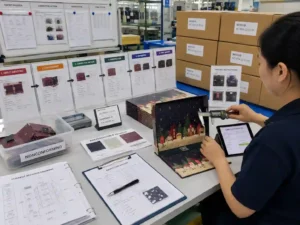
Quick answer: An effective advent calendar box strength check should be completed on a fully assembled, product-loaded pre-production sample before mass production begins. Buyers should evaluate panel rigidity, compartment support, insert fit, drawer or door operation, adhesive bonding, surface durability, stacking resistance, and export-carton protection. The test must use actual product weights and realistic handling conditions rather than an empty display sample. Approval records should identify the materials, dimensions, tolerances, printing standard, assembly method, inspection points, and packing configuration that the factory must reproduce during bulk production.
Box strength is not determined by paper thickness alone. It depends on the complete packaging system: structure, greyboard or paperboard grade, grain direction, insert design, adhesive coverage, compartment layout, product weight distribution, assembly accuracy, surface finishing, and shipping method. A strong-looking prototype can still fail when drawers are loaded, perforated doors are opened repeatedly, or finished cartons are stacked for export.
What should buyers understand before checking box strength?
Buyers should first define how the box will be filled, handled, displayed, transported, and opened. Strength requirements for a lightweight tea calendar are different from those for a rigid box containing candles, cosmetic bottles, coffee capsules, jewelry, or beverage samples.
Before asking a supplier to test durability, provide the actual product dimensions, unit weights, total loaded weight, center of gravity, filling direction, retail display position, and expected shipping method. Without this information, the factory can only assess the empty packaging structure.
A practical strength review should answer five questions:
- Can the outer box maintain its shape when fully loaded?
- Can each insert or compartment retain the product during handling?
- Can drawers, doors, hinges, magnets, ribbons, and closures operate without structural damage?
- Can the printed and laminated surfaces resist cracking, rubbing, lifting, or delamination?
- Can the packed units survive carton stacking, warehouse handling, and international transport?
Buyer tip: Send production-equivalent products or accurate dummy weights for sampling. Testing an empty advent calendar can hide insert collapse, drawer sagging, door bulging, and uneven load distribution.
Which advent calendar structures require different strength checks?
Each structure has different load paths and failure points. Buyers should compare the design according to its actual construction instead of applying one generic inspection method to every calendar.
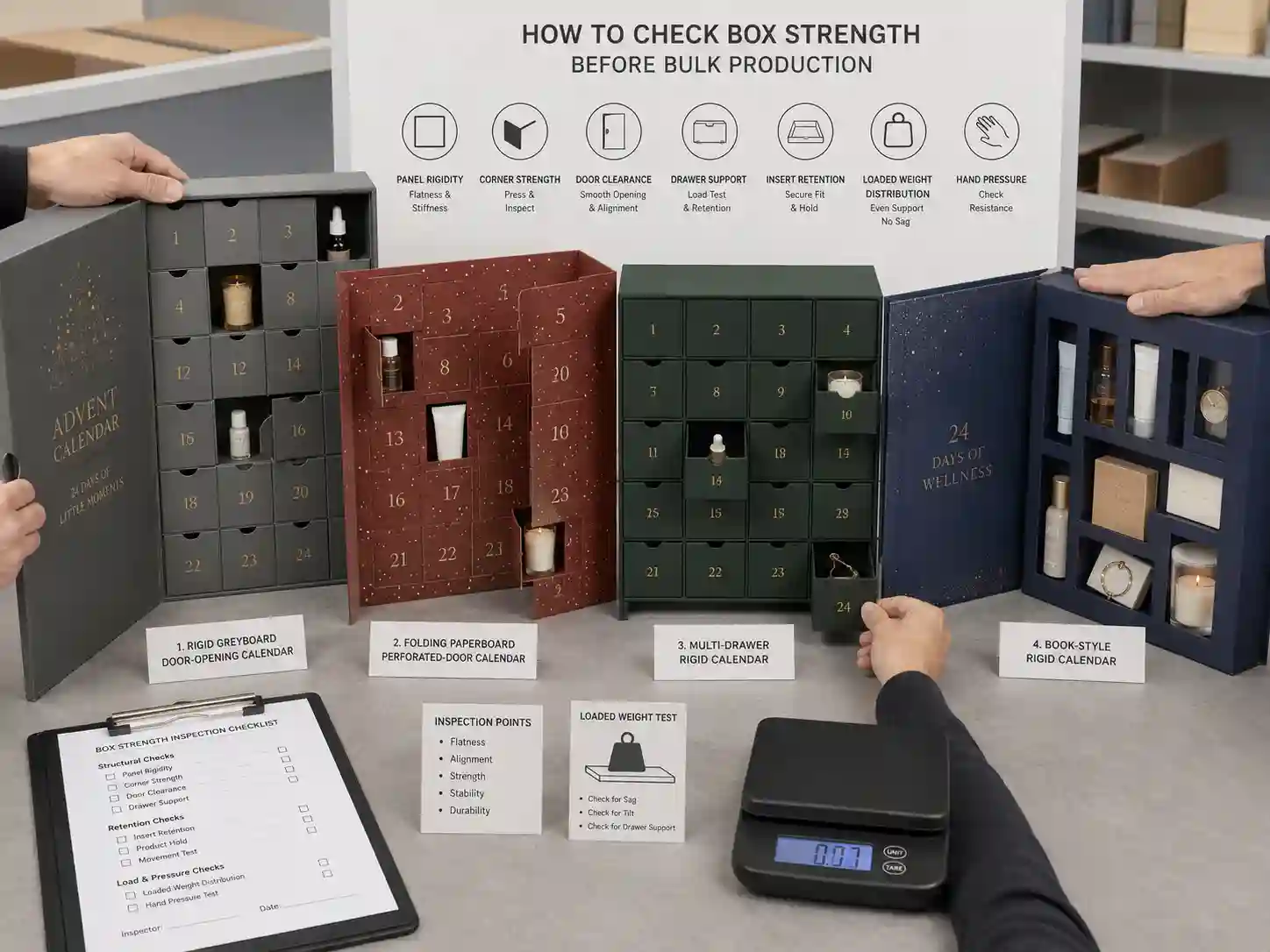
| Box structure | Main strength risks | Important checks before approval |
|---|---|---|
| Rigid door-opening box | Panel bowing, weak internal walls, loose wrapping, damaged perforations | Check greyboard thickness, internal grid support, door opening force, hinge direction, edge wrapping, and loaded panel flatness. |
| Folding paperboard calendar | Panel flexing, crushed corners, weak locking tabs, tearing around perforations | Check paperboard grade, grain direction, crease depth, locking structure, glue areas, compartment support, and carton recovery after folding. |
| Multi-drawer rigid box | Cabinet deformation, drawer sagging, misaligned fronts, excessive sliding friction | Test the loaded cabinet, drawer clearance, drawer-bottom support, front-panel bonding, ribbon pulls, finger notches, and repeated opening cycles. |
| Book-style rigid box | Spine cracking, cover warping, weak hinge gaps, magnet misalignment | Check spine width, hinge clearance, cover-board balance, magnet position, opening angle, and resistance to repeated opening. |
| Drawer-and-door hybrid | Uneven load distribution, interaction between moving parts, internal frame distortion | Test every drawer and door with products installed, especially corner compartments and heavily loaded central areas. |
A rigid box normally offers greater perceived strength, but poor greyboard joints or inadequate internal reinforcement can still cause failure. A well-engineered folding carton may perform better than an oversized rigid box when its paperboard grade, crease design, locking structure, and insert support are correctly specified.
Buyers reviewing custom advent calendar box products should therefore compare construction details, not only external appearance or quoted board thickness.
How should materials be selected for adequate box strength?
Material selection should be based on the loaded box weight, panel size, structural span, opening mechanism, and shipping conditions. Increasing material thickness without correcting the structure can add cost while leaving the original weakness unresolved.
Greyboard for rigid boxes
Greyboard supports the shape of rigid boxes, book-style boxes, and drawer cabinets. The supplier should confirm board thickness, density, moisture condition, flatness, joint construction, and whether reinforcement is needed around large unsupported panels.
Long panels can bow even when thick board is used. Internal partitions, framed edges, double-board areas, or revised panel dimensions may provide better support than simply increasing the entire box specification.
Paperboard for folding cartons
Paperboard strength depends on grade, caliper, stiffness, grain direction, coating, crease design, and converting quality. The grain direction should be considered when panels fold, doors open, or long surfaces must remain flat.
Deep or incorrectly positioned creases can crack the printed surface or weaken the folding line. This risk increases when heavy ink coverage, foil stamping, embossing, spot UV, matte lamination, or gloss lamination crosses a fold or perforation.
Wrapping paper and surface finishing
Printed wrapping paper does not replace the structural board, but it affects dimensional stability and joint performance. Uneven adhesive application, excessive moisture, or unbalanced wrapping can create warping after assembly.
CMYK printing and Pantone color approval should be completed together with finishing checks. A visually approved proof is not enough if the laminate lifts at corners, foil cracks on folds, or embossed areas weaken the door panel.
Factory tip: Material samples should be conditioned and assembled using production-intent adhesive, wrapping paper, lamination, and drying time. A hand-made sample produced with different glue or board may not accurately represent mass production strength.
How do inserts affect the strength of an advent calendar box?
The insert is part of the structural system. It must hold each product securely, distribute weight into supported areas, and prevent movement that could damage doors, drawers, compartments, or printed surfaces.
Common options include paper inserts, folded paperboard grids, clear PET trays, EVA inserts, foam, and molded pulp. The correct choice depends on product weight, shape, fragility, presentation requirements, sustainability targets, and budget.
- Paper inserts: Cost-efficient and suitable for many lightweight products, but locking tabs and support walls must be tested under load.
- PET trays: Provide precise cavities and product visibility, but tray thickness, flange support, and cavity depth must prevent flexing or product release.
- EVA inserts: Offer accurate retention for premium or fragile items, but cavity tolerance and adhesive bonding require control.
- Foam inserts: Can cushion irregular products, although buyers should confirm compression recovery, cutting quality, and surface compatibility.
- Molded pulp: Can provide protective support for selected products, but tooling, dimensional tolerance, surface texture, and moisture sensitivity must be reviewed.
The insert test should use actual products and include upside-down handling, side loading, light shaking, repeated removal, and reinstallation. Check whether products rise above the approved height, press against doors, interfere with drawer movement, or transfer excessive force to unsupported panels.
QC tip: Measure product-to-cavity clearance and product height during sample approval. Small dimensional changes in bulk products can create major assembly problems when 24 compartments must align with doors or drawer openings.
What tests should be completed on the prototype and pre-production sample?
Buyers should approve strength through staged sampling. A blank prototype confirms the basic structure, while a printed sample and pre-production sample verify the final combination of materials, artwork, finishing, inserts, assembly, and loaded performance.
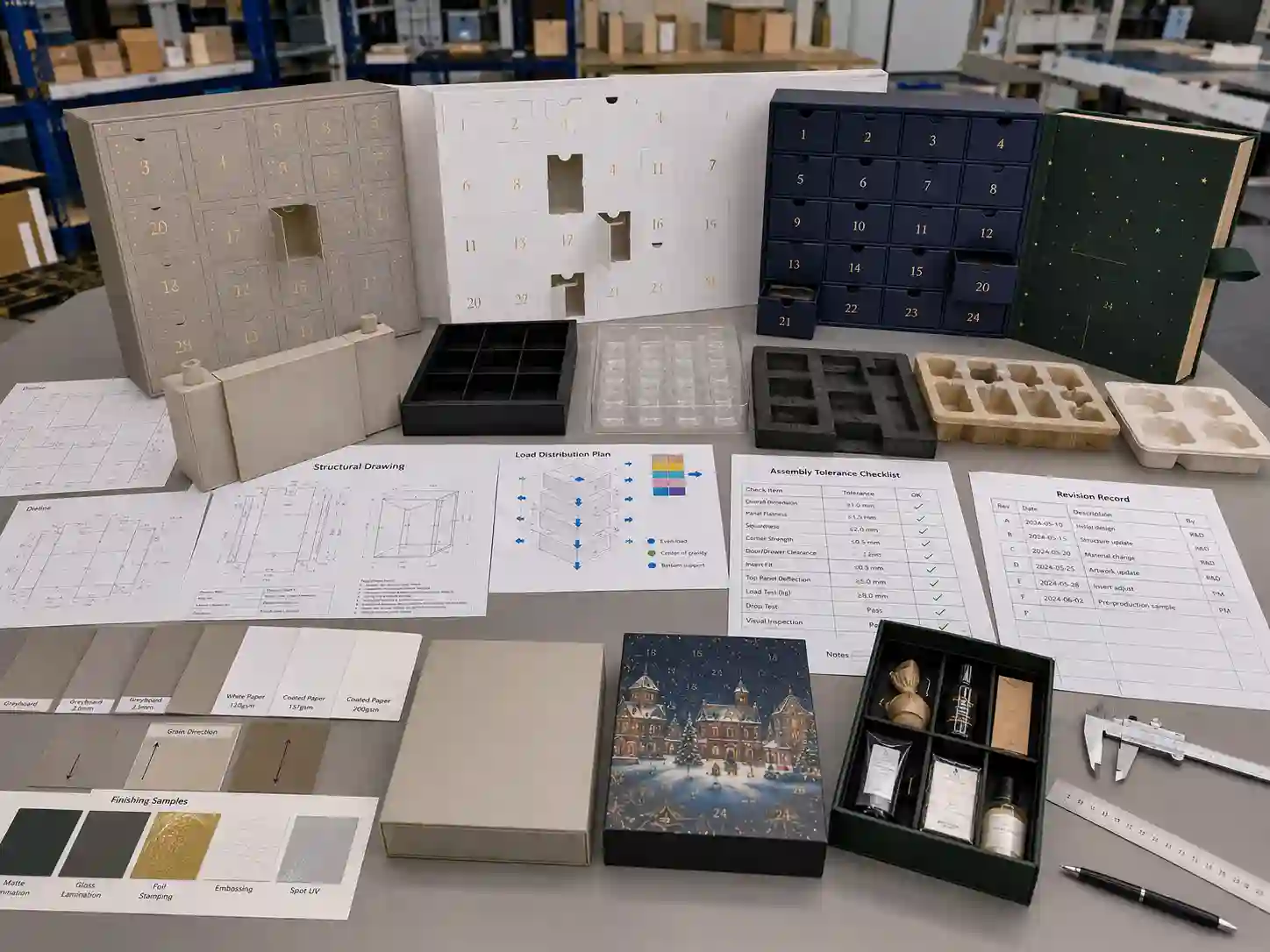
1. Check dimensions and structural alignment
Measure the finished outer dimensions, panel squareness, compartment positions, drawer openings, door locations, hinge gaps, and insert height against the approved dieline. Misalignment can concentrate load on one panel or prevent moving parts from working correctly.
2. Perform a loaded hold test
Fill every compartment with the intended product or an equivalent dummy weight. Lift the box from the expected handling points and observe panel flex, joint movement, drawer cabinet distortion, handle stress, and insert collapse.
3. Check panel and corner resistance
Apply controlled hand pressure to broad panels, corners, edges, and unsupported areas. The purpose is not to damage the sample deliberately, but to identify flexing, board separation, weak joints, or permanent deformation under normal handling.
4. Cycle all doors, drawers, and closures
Open and close representative small, large, corner, center, and heavily loaded compartments repeatedly. Check for perforation tearing, hinge fatigue, drawer friction, ribbon detachment, magnet movement, paper cracking, and interference between the product and opening mechanism.
5. Review stacking and compression behavior
Stack packed samples or apply an agreed simulated top load based on the export-carton arrangement. Inspect for box bowing, lid compression, drawer jamming, door distortion, and permanent panel changes after the load is removed.
6. Simulate distribution handling
Evaluate the packed configuration under realistic lifting, turning, vibration, and controlled drop conditions agreed with the supplier. For formal distribution testing, buyers may consult packaging-test guidance from the International Safe Transit Association and determine an appropriate protocol with their logistics or testing partner.
There is no single universal test level for every advent calendar. The correct test depends on gross weight, product fragility, transport route, palletization, parcel delivery exposure, and customer requirements.
What should be included in an advent calendar box strength check?
A repeatable advent calendar box strength check should use an approved checklist rather than informal visual comments. Record the test method, sample status, product load, result, defect location, required correction, and final approval decision.
- Confirm the sample uses the proposed production materials and finished dimensions.
- Compare the assembled sample with the approved dieline and specification sheet.
- Load all compartments with actual products or verified equivalent weights.
- Inspect outer panels for bowing, twisting, gaps, dents, and uneven edges.
- Check greyboard joints, paperboard locks, glue seams, wrapped edges, and corner bonding.
- Test paper inserts, PET trays, EVA inserts, foam, or molded pulp for product retention.
- Open and close all drawers, doors, covers, ribbons, magnets, and closures.
- Inspect perforations, creases, hinges, drawer bottoms, cabinet walls, and internal grids.
- Check CMYK or Pantone color references and inspect lamination, foil stamping, embossing, and spot UV around stress areas.
- Review stacking resistance using the intended unit orientation and carton packing pattern.
- Inspect the sample after handling tests for permanent deformation or functional change.
- Document approved tolerances and sign the pre-production sample before mass production.
The signed sample should remain available at the factory as the production reference. Buyers may also retain a duplicate reference sample for incoming inspection or third-party comparison.
How should strength be controlled during mass production?
Strength control should continue after sample approval because bulk-production variation can arise from board moisture, cutting accuracy, glue quantity, drying time, assembly pressure, insert dimensions, and operator handling.
Key production inspection points include:
- Incoming greyboard, paperboard, wrapping paper, insert material, magnets, ribbons, and adhesive verification.
- Dieline, cutting, scoring, perforation, and crease-position checks before assembly.
- First-piece approval for printing, lamination, foil stamping, embossing, and spot UV.
- Assembly checks for squareness, joint gaps, glue coverage, wrapping tension, and drying time.
- Insert-fit checks with approved products or gauges.
- In-process drawer, door, hinge, and closure testing.
- Final random inspection of loaded or simulated-load units.
- Export-carton weight, dimensions, quantity, shipping marks, and pallet-pattern verification.
Quotable QC principle: A pre-production sample defines the target, but in-process inspection confirms whether the factory is repeatedly reproducing that target.
When evaluating a Giftpackpro packaging factory or another potential supplier, ask how first-piece approval, production sampling, defect classification, corrective action, and final inspection are documented. Do not rely only on photographs of one finished sample.
How do printing and finishing influence durability?
Printing and finishing can weaken high-stress areas when artwork and structural lines are not coordinated. Buyers should review the artwork proof together with the dieline rather than approving graphics separately.
Avoid placing critical foil, heavy spot UV, dense ink coverage, or deep embossing directly across narrow hinges, perforations, drawer folds, locking tabs, or heavily creased areas unless the supplier has tested the combination. Matte lamination may show scuffing on dark colors, while gloss lamination can highlight scratches or uneven surfaces.
During sample review, check:
- Cracking or whitening along folds and perforations.
- Lamination lifting at corners, edges, hinges, and finger notches.
- Foil breaking or transferring in frequently handled areas.
- Embossed or debossed sections reducing local panel stiffness.
- Spot UV interfering with folding, gluing, or surface adhesion.
- Artwork registration around doors, drawers, and compartment numbers.
Giftpackpro’s custom advent calendar box services can be used to review the relationship between structural design, insert engineering, artwork, sampling, and production requirements before a buyer releases a final order.
How should buyers compare suppliers and quotations?
Compare quotations using the same specification. A lower price may reflect thinner material, a simplified insert, fewer inspection steps, lighter export cartons, different finishing, or a sample that does not represent the proposed production method.
Use this decision guide:
| Decision point | Preferred supplier response | Warning sign |
|---|---|---|
| Material specification | Lists board type, thickness or grade, wrapping paper, insert material, and finishing. | Uses vague descriptions such as “strong board” without measurable details. |
| Sample process | Explains blank prototype, printed sample, revisions, and pre-production approval. | Moves directly to mass production based only on artwork files or photos. |
| Product-fit testing | Requests product dimensions, weights, tolerances, and physical samples. | Designs inserts without verified product data. |
| Strength verification | Proposes loaded functional, stacking, handling, and packing checks. | Checks only the empty box appearance. |
| Mass-production QC | Defines incoming, first-piece, in-process, and final inspection points. | Provides no documented production-control plan. |
| Export packing | Specifies carton construction, unit protection, carton quantity, gross weight, pallet plan, and shipping marks. | Quotes “standard export packing” without details. |
MOQ can also affect strength and cost. At lower quantities, some structures, molded inserts, special paper grades, or automated processes may be less economical. At higher quantities, tooling, assembly fixtures, inspection gauges, and optimized pallet loading may reduce unit cost and improve consistency.
Ask each supplier to separate sample charges, tooling costs, unit price, packing cost, freight assumptions, and optional testing. This makes the quotation easier to compare and reduces hidden specification differences.
What export-packing details protect the finished boxes?
Even a strong retail box can arrive damaged if the export carton and pallet plan are inadequate. Export packing should control compression, movement, moisture exposure, abrasion, corner damage, and excessive carton weight.

Confirm the following before shipment:
- Protective tissue, paper pads, sleeves, dividers, or individual bags where required.
- Corner protectors or edge protection for premium rigid boxes.
- Correct unit orientation inside the export carton.
- Carton board specification and reinforcement appropriate to gross weight.
- Maximum carton quantity and gross weight that can be handled safely.
- Void reduction so products do not move during transport.
- Clear shipping marks, carton numbers, quantities, dimensions, and gross and net weights.
- Pallet dimensions, loading pattern, stacking height, stretch wrapping, and strapping when palletization is required.
Buyers should also confirm whether the order will move by full-container load, less-than-container load, air freight, courier, or e-commerce parcel distribution. Each route creates different handling and compression risks.
For sustainability or chain-of-custody requirements, buyers can review official information from the Forest Stewardship Council and ask suppliers to provide applicable documentation for verification rather than assuming every paper material carries the same claim.
What information should be prepared before requesting a quotation?
A complete RFQ helps the supplier engineer the correct strength level and quote comparable materials, sampling, QC, and export packing. Prepare the following information:
- Box style: rigid box, folding carton, drawer box, door-opening box, book-style box, or hybrid.
- Required finished dimensions and number of compartments.
- Product dimensions, unit weights, total loaded weight, and dimensional tolerances.
- Preferred insert type and product presentation direction.
- Artwork files, color references, dieline status, and required finishing.
- Order quantity, target MOQ, destination country, and expected delivery date.
- Retail, wholesale, e-commerce, or promotional distribution method.
- Sampling requirements, including blank prototype, printed sample, and pre-production sample.
- Required inspection scope, product-loading test, and any third-party testing expectations.
- Unit packing, export-carton, pallet, barcode, and shipping-mark requirements.
Buyers can study additional advent calendar box buying guides before preparing the RFQ or contact a custom advent calendar boxes manufacturer with the full product and distribution brief.
Which common box-strength mistakes should buyers avoid?
The most common mistake is approving appearance before validating loaded performance. A calendar may look correct on a showroom table but fail after filling, stacking, or repeated opening.
- Testing an empty sample instead of a fully loaded sample.
- Approving the outer box before confirming insert dimensions.
- Selecting board thickness without reviewing panel spans and internal support.
- Ignoring product-weight differences between compartments.
- Using preliminary product dimensions to create final tooling.
- Approving artwork without checking folds, perforations, hinges, and glue areas.
- Skipping repeated drawer, door, magnet, ribbon, or closure tests.
- Assuming a handmade prototype will exactly represent mass-production assembly.
- Leaving strength requirements, tolerances, and defect criteria out of the purchase specification.
- Reviewing the retail box but not the export-carton and pallet configuration.
Frequently asked questions about advent calendar box strength
Is thicker greyboard always stronger?
No. Greyboard thickness is only one factor. Panel size, density, moisture, joint design, internal partitions, wrapping balance, adhesive, and load distribution can be equally important. Structural reinforcement may be more effective than increasing every panel thickness.
Should every compartment be tested with the actual product?
Yes, whenever possible. At minimum, test the smallest, largest, heaviest, tallest, corner, center, and most difficult-to-access compartments. Final approval should use a complete loaded sample when product variation may affect the structure.
What is the difference between a prototype and a pre-production sample?
A prototype normally confirms structure, dimensions, opening method, and insert fit. A pre-production sample should use production-intent materials, printing, finishing, assembly, inserts, accessories, and packing so it can serve as the reference for mass production.
Can a strong box still be damaged during shipping?
Yes. Unit-box strength does not replace export protection. Carton compression, excessive gross weight, empty space, poor orientation, moisture, repeated handling, and unsuitable pallet stacking can damage otherwise acceptable packaging.
Does strength testing increase lead time?
Sampling and revisions add time before production, but they reduce the risk of discovering structural problems after materials have been printed or assembled. Buyers should include prototype approval, artwork proofing, pre-production sampling, testing, mass production, inspection, and export packing in the lead-time plan.
What should be signed before bulk production starts?
Approve the dieline, finished dimensions, material specification, artwork, color standard, surface finishing, insert fit, loaded sample performance, assembly tolerances, QC checklist, packing method, shipping marks, and pre-production sample.
What should you send Giftpackpro for a sample or quotation?
For a reliable advent calendar box strength check, prepare the box style, dimensions, product sizes and weights, compartment layout, artwork requirements, finishing, order quantity, destination, delivery schedule, testing expectations, and export-packing method. Giftpackpro can then assess structure, material, insert support, sampling steps, production controls, and quotation details using the same project brief.
To begin, request a custom quote and include product drawings, physical samples where available, target quantity, required lead time, and photographs or reference files showing the intended opening and display method.