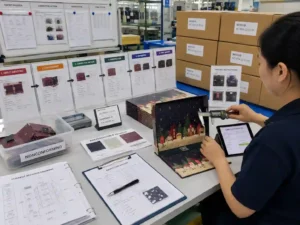
Quick answer: Most advent calendar box assembly problems can be prevented by confirming the structure, assembly sequence, insert tolerance, product loading method, and export-packing format before mass production. Buyers should test a fully assembled and product-loaded sample rather than approving only a flat dieline or empty prototype. The supplier should also define whether boxes will ship flat, partially assembled, or fully assembled; document every folding and gluing step; inspect squareness, drawer clearance, door opening, insert retention, and panel strength; and design master cartons and pallets around the finished packing method. Clear RFQ specifications and an approved pre-production sample reduce rework, packing delays, transit damage, and inconsistent presentation at the destination.
Why do advent calendar box assembly problems occur?
Assembly failures usually occur because the structure, product fit, production process, and shipping method were treated as separate decisions. In practice, they affect one another and must be engineered together.
An advent calendar may look correct in artwork proofs but still become difficult to assemble when wrapped greyboard panels are slightly oversized, folding-carton scores are too shallow, drawers fit too tightly, paper inserts shift during loading, or decorative finishes cross important fold lines. Problems may also appear only after the box is filled, stacked in an export carton, transported, and reopened at the destination.
Common assembly defects include:
- Rigid box panels that are not square or do not close evenly.
- Drawer cabinets with inconsistent openings or tight drawer clearance.
- Door-opening boxes with perforations that tear unpredictably.
- Folding cartons with cracked folds, unlocked tabs, or bowed panels.
- Paper inserts that collapse, lift, rotate, or interfere with products.
- PET trays, EVA inserts, foam, or molded pulp components that do not seat correctly.
- Wrapped edges that lift because of insufficient glue or poor board preparation.
- Finished boxes that deform inside master cartons or on pallets.
- Flat-packed boxes that require undocumented tools or excessive labor at the destination.
Buyer tip: Do not evaluate assembly only by asking whether the box “can be put together.” Measure how long assembly takes, how much operator skill is required, what errors are possible, and whether the assembled box remains stable after product loading and international transport.
Which advent calendar structure is least likely to cause assembly problems?
No structure is automatically problem-free. The safest option is the structure that matches the product dimensions, order volume, destination labor, presentation requirements, and shipping budget.

| Structure | Main assembly risks | Suitable packing approach | Buyer decision point |
|---|---|---|---|
| Rigid door-opening box | Panel misalignment, door clearance, weak perforations, wrapped-edge lifting | Usually assembled or partially assembled | Choose when presentation and structural stability justify higher shipping volume |
| Rigid multi-drawer box | Tight drawers, uneven cabinet openings, misaligned fronts, loose ribbon pulls | Usually fully assembled | Confirm drawer tolerance with actual loaded products |
| Book-style rigid box | Hinge tension, cover spring-back, magnet alignment, internal tray movement | Usually assembled | Test repeated opening and closing after transit simulation |
| Folding paperboard calendar | Incorrect folding sequence, cracked scores, unsecured tabs, bowed panels | Flat or partially assembled | Best where freight efficiency and local assembly capacity are priorities |
| Drawer-and-door hybrid | Multiple tolerance interactions and complicated assembly sequence | Usually assembled | Approve a detailed prototype before finalizing artwork |
Rigid boxes made from greyboard generally arrive in a more finished condition, but they occupy more shipping volume. Folding cartons made from paperboard can reduce freight volume when shipped flat, but they require controlled folding, locking, gluing, and product-loading procedures.
Buyers comparing custom advent calendar box products should request both the finished external dimensions and the shipping configuration. Two visually similar calendars can have very different assembly labor, carton quantities, pallet utilization, and damage risks.
Should advent calendar boxes be shipped flat or assembled?
Choose flat packing when freight savings are important and the destination has reliable assembly labor, space, instructions, and quality control. Choose assembled packing when the structure is complex, presentation consistency is critical, or local assembly errors would create more cost than the freight savings.
When is flat packing practical?
Flat packing is most practical for folding paperboard structures with a repeatable sequence of folds, tabs, and glue points. It can also work for selected collapsible rigid structures designed specifically for flat shipment.
Before approving flat packing, buyers should verify:
- The box can be assembled without specialist equipment.
- The folding sequence is clear and difficult to perform incorrectly.
- Glue, tape, or locking tabs remain accessible during assembly.
- The destination team knows the expected assembly time per unit.
- Instructions include photographs or diagrams, not text alone.
- Assembly fixtures or positioning jigs are supplied when required.
- The insert and products can be loaded without deforming the box.
- Finished units can be inspected before entering retail or fulfillment channels.
Factory tip: A flat-packed structure should be assembled repeatedly by operators who did not participate in its development. If they consistently need verbal guidance from the sample engineer, the structure or instructions are not yet ready for destination assembly.
When is assembled packing safer?
Assembled packing is usually safer for rigid drawer boxes, book-style calendars, complex door-opening boxes, and structures with magnets, ribbons, multiple wrapped panels, or tightly controlled product presentation.
The higher freight volume can be justified when it prevents drawer jamming, crooked covers, damaged corners, incorrect insert placement, or inconsistent retail appearance. Buyers should compare landed cost rather than unit packaging price alone.
When does partially assembled packing make sense?
Partial assembly can balance freight efficiency and process control. For example, the factory may glue the main cabinet, install critical inserts, and pack drawers separately for final loading at the destination. Another option is to ship a rigid outer shell assembled while supplying product trays or internal sleeves separately.
The quotation should state exactly which components are assembled, nested, folded, glued, taped, or supplied loose. The term “flat packed” is not specific enough for purchasing approval.
How should the structure and dieline be checked before production?
The dieline must be reviewed as an assembly document, not only as an artwork template. Critical fold lines, glue areas, grain direction, wrapped edges, perforations, finger notches, drawer gaps, and insert positions should be identified before artwork approval.
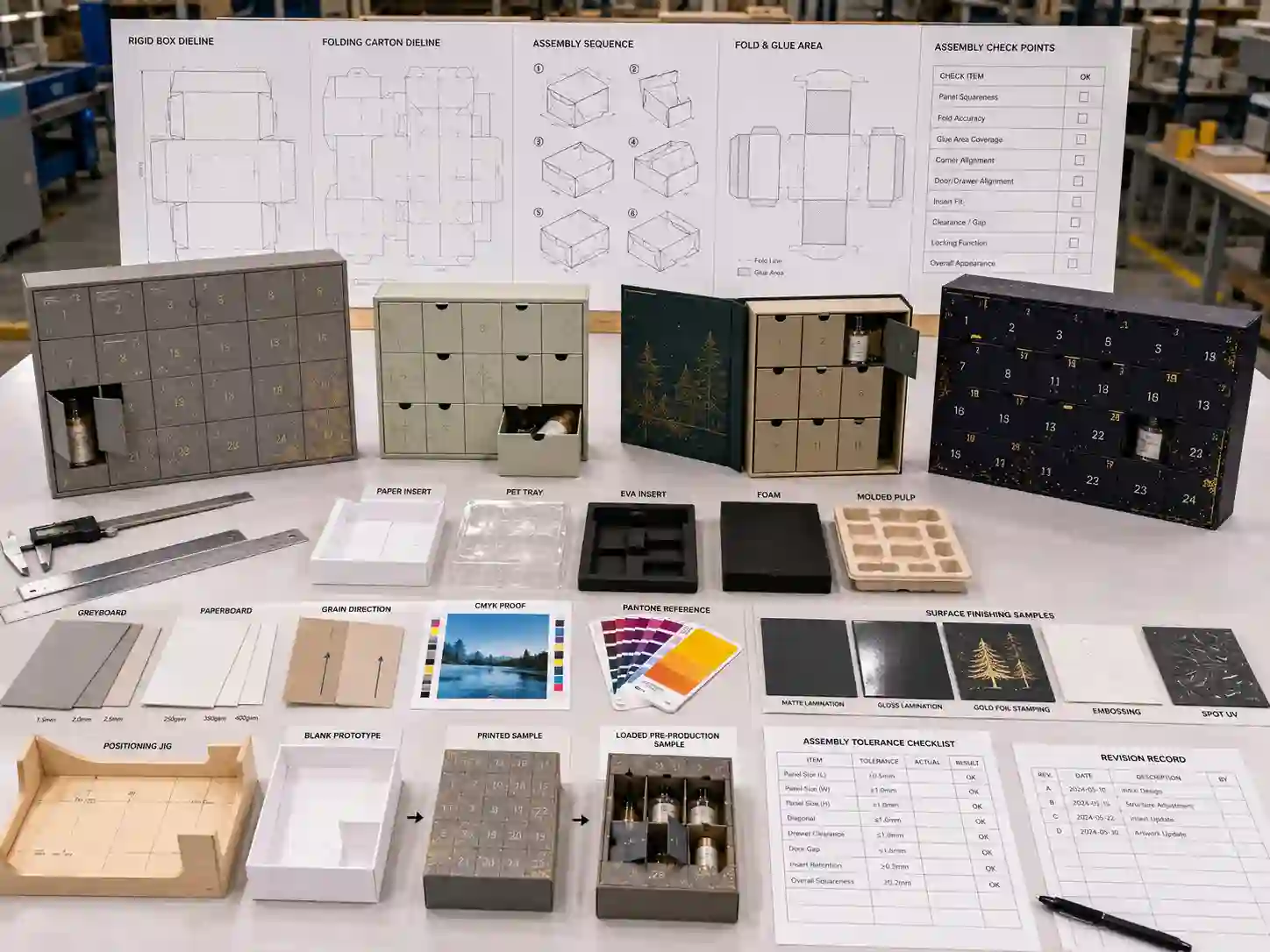
For folding cartons, paper grain should support the intended folding direction. Heavy ink coverage, foil stamping, embossing, spot UV, matte lamination, or gloss lamination across a score can change folding behavior. A visually attractive finish can create cracked edges or spring-back if the score depth and material combination are not tested.
For rigid boxes, the board thickness, wrapping paper, turn-in allowance, joint construction, and adhesive application affect the final dimensions. Small variations accumulate across a multi-drawer cabinet. A difference of less than a millimeter at several joints can become a visible alignment or drawer-clearance problem.
Ask the supplier to identify:
- Finished dimensions and permitted dimensional tolerance.
- Greyboard or paperboard thickness.
- Paper grain direction where folding performance is important.
- Glue areas and surfaces that must remain glue-free.
- Score, perforation, hinge, and locking-tab details.
- Drawer clearance and cabinet opening dimensions.
- Insert position relative to doors, drawers, and products.
- Decorative finishes that cross folds or assembly joints.
- Assembly sequence and required fixtures.
A qualified custom advent calendar boxes manufacturer should be able to explain how the dieline controls assembly rather than supplying only a visual rendering.
How do inserts contribute to assembly failures?
Inserts cause assembly problems when they are designed independently from the product, box structure, loading sequence, and transport orientation. The insert must locate the product while allowing the box to be assembled and closed without excessive pressure.
A paper insert may be economical and recyclable within suitable paper streams, but narrow walls can buckle during product loading. A clear PET tray offers consistent cavities but requires controlled flange dimensions and accurate seating. EVA insert and foam can provide strong retention, although material thickness and compression must be tested. Molded pulp can support sustainability goals, but tooling tolerances, surface texture, and product removal need evaluation.
What product-fit checks should buyers request?
- Test the actual saleable product rather than a rough substitute.
- Include caps, pumps, labels, wrappers, sachet seals, and accessories in measurements.
- Check the heaviest and tallest products, not only average items.
- Confirm whether products are loaded before or after the insert is installed.
- Test cavities in corner, center, top, and bottom positions.
- Turn the loaded calendar through likely shipping orientations.
- Check whether products can migrate and obstruct drawers or doors.
- Confirm that customers can remove the product without tearing the surrounding structure.
QC tip: Insert approval should include an empty fit check, a loaded fit check, a movement check, and an access check. Passing only the empty fit check does not demonstrate production suitability.
What sample stages prevent assembly problems before mass production?
Buyers should use at least a structural prototype and a fully printed, product-loaded pre-production sample for complex calendars. Each sample stage should answer a different purchasing question.
- Dieline review: Confirms dimensions, folds, glue areas, perforations, doors, drawers, and insert locations.
- Blank prototype: Tests the basic structure and assembly sequence without waiting for final printing.
- Printed sample: Checks CMYK reproduction, Pantone references, artwork position, lamination, foil stamping, embossing, and spot UV.
- Product-loaded sample: Tests insert retention, panel stress, drawer movement, door access, balance, and closure.
- Pre-production sample: Establishes the approved material, construction, artwork, finish, assembly method, and packing standard for mass production.
The signed sample should be supported by an approval record listing approved dimensions, materials, colors, finishes, inserts, accessories, packing format, and accepted revisions. Verbal approval or approval through scattered messages creates unnecessary production risk.
Giftpackpro’s custom advent calendar box services can be used to coordinate structural development, sample review, printing requirements, insert fit, production control, and export-packing specifications.
How should buyers set assembly quality-control standards?
QC standards should define measurable defects and sampling points instead of relying on terms such as “good assembly.” Inspection should cover incoming materials, work in progress, finished boxes, product-loaded samples, and export packing.
A practical assembly inspection should check:
- External dimensions, squareness, and panel flatness.
- Glue adhesion, exposed glue, stains, and wrapped-edge lifting.
- Door position, perforation consistency, and opening force.
- Drawer alignment, sliding clearance, pull ribbon security, and repeated cycles.
- Cover alignment, hinge movement, and magnet position where applicable.
- Insert seating, cavity alignment, and product retention.
- Printing registration, color consistency, scratches, scuffing, and lamination defects.
- Barcode or label position where the buyer supplies retail data.
- Accessory count and numbered-compartment sequence.
- Packing quantity, protective materials, carton condition, and shipping marks.
For high-risk structures, the inspection team should open and close representative drawers and doors several times. Fully loaded units should also be selected from different production periods to identify changes between the beginning, middle, and end of the run.
Buyers can ask whether the supplier follows a documented quality-management process and may verify applicable systems against official information from the International Organization for Standardization. Certification status should always be checked directly rather than assumed from marketing statements.
How does MOQ affect assembly method and cost?
MOQ affects whether manual assembly, semi-automated processes, custom tooling, dedicated fixtures, and specialized packing are economical. Complex structures normally require more labor and setup than simple folding cartons.
Important cost drivers include:
- Number of box components and separate assembly operations.
- Rigid greyboard construction versus folding paperboard.
- Number and size of drawers, doors, magnets, ribbons, and accessories.
- Insert material, tooling, cavity count, and product-loading requirements.
- Printing coverage and finishing combinations.
- Flat, partial, or full factory assembly.
- Individual protection, master-carton strength, and pallet requirements.
- Inspection level and destination-specific labeling.
A lower unit quote may exclude assembly, insert installation, product loading, protective materials, palletization, or shipping marks. Buyers should compare quotations line by line and confirm the same scope.
How should assembled boxes be protected in master cartons?
Master cartons should prevent movement, compression, corner impact, surface abrasion, and moisture exposure under the expected shipping conditions. Carton dimensions should be developed around the finished box and its protective materials, not selected from an existing carton simply because it is available.
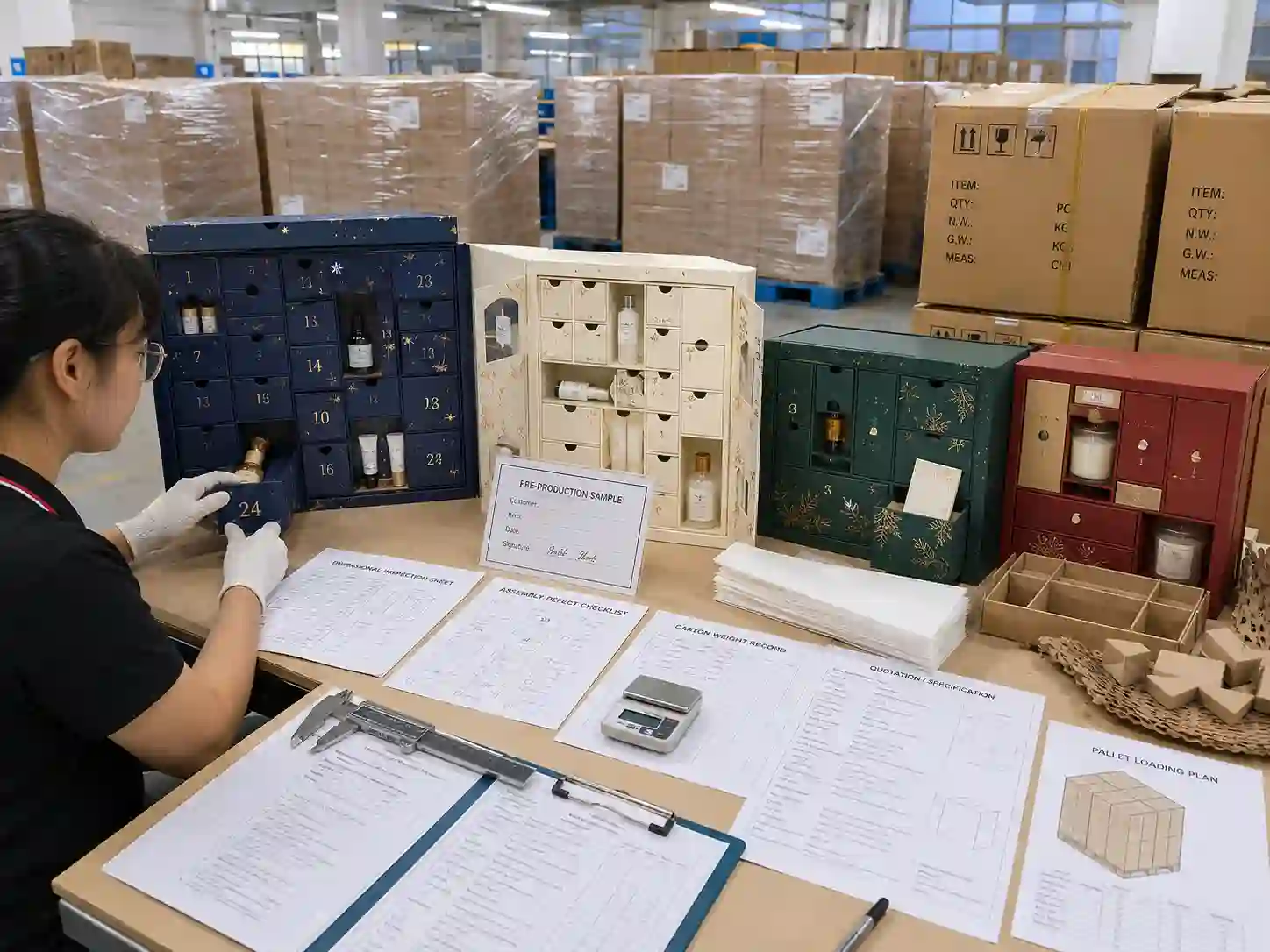
Protection may include tissue paper, paper sleeves, polybags where appropriate, paper pads, partitions, dividers, corner protectors, top and bottom pads, and reinforced corrugated export cartons. The correct combination depends on box weight, surface finish, carton quantity, transport mode, and pallet pattern.
Glossy, dark, foil-stamped, or heavily laminated surfaces may show abrasion more easily. Drawer fronts and door panels can also shift if packed with insufficient support. Empty space inside the carton should not allow finished boxes to move during handling.
Factory tip: An export carton should be tested with the actual packed quantity and protective materials. Testing an empty carton or a carton filled with substitute weight does not reveal surface rubbing, corner pressure, or internal component movement.
What palletizing decisions reduce shipping damage?
Palletizing should keep cartons within the pallet footprint, distribute weight evenly, avoid excessive stack height, and protect cartons from strap or stretch-wrap pressure. The pallet plan should be confirmed before production if carton dimensions affect container utilization.
Buyers should request:
- Master-carton dimensions, gross weight, and net weight.
- Number of finished boxes per carton.
- Cartons per pallet and total pallet quantity.
- Pallet dimensions and loaded pallet height.
- Stacking orientation and maximum planned layers.
- Use of corner boards, top sheets, straps, and stretch wrap.
- Photographs of the packed cartons and completed pallets.
- Container-loading plan when shipment volume is significant.
For formal distribution testing, buyers can discuss appropriate procedures with their logistics team and review official resources from the International Safe Transit Association. The selected test method should reflect the real distribution route, package weight, pallet format, and handling environment.
What information belongs on shipping marks?
Shipping marks should help warehouses, freight handlers, and receiving teams identify cartons without exposing unnecessary commercial information. The required format should be approved before carton printing.
Typical shipping-mark fields include:
- Buyer or consignee reference.
- Purchase order number.
- Product or SKU code.
- Carton number and total carton count.
- Quantity per carton.
- Country of origin where required.
- Gross weight, net weight, and carton dimensions.
- Handling or orientation marks when applicable.
- Destination or warehouse reference.
Barcode formats, retailer labels, Amazon or e-commerce fulfillment labels, and warehouse routing labels should be supplied as final data rather than recreated by the packaging factory. Buyers should also specify whether labels are applied to each box, master carton, pallet, or multiple levels.
How should buyers compare potential suppliers?
Compare suppliers by their ability to control the complete assembly and export-packing process, not only by sample appearance or quoted unit price.
Supplier decision guide
- Choose a supplier with structural development support when products vary in size, weight, or opening method.
- Choose a supplier with documented sample approval when artwork and finishing must align with doors, drawers, or folds.
- Choose a supplier with insert-testing capability when product movement could block compartments or damage presentation.
- Choose a supplier with assembly fixtures and work instructions when the calendar has many repeated components.
- Choose a supplier with export-packing experience when finished surfaces, corners, or moving parts are vulnerable in transit.
- Choose based on landed cost when comparing flat-packed and assembled options.
Ask prospective suppliers to explain their process for dieline checking, prototype revision, material control, printing proof approval, assembly tolerance, in-process inspection, final QC, master-carton development, pallet planning, and shipment documentation.
The Giftpackpro packaging factory page provides additional background for buyers evaluating production capability and supplier fit. Related advent calendar box buying guides can also help purchasing teams prepare technical requirements before requesting prices.
What should buyers prepare before requesting a quotation?
A complete RFQ allows suppliers to quote the same structure, assembly scope, and export-packing standard. Without this information, quoted prices may not be directly comparable.
Practical RFQ checklist
- Box style: rigid box, folding carton, drawer box, door-opening box, book-style box, or hybrid.
- Finished external dimensions and required compartment count.
- Actual product dimensions, weights, photographs, and product samples if available.
- Preferred insert: paper insert, PET tray, EVA insert, foam, molded pulp, or supplier recommendation.
- Material expectations for greyboard, paperboard, wrapping paper, and corrugated cartons.
- Artwork files, dieline status, CMYK requirements, and Pantone references.
- Required finishes such as foil stamping, embossing, spot UV, matte lamination, or gloss lamination.
- Target order quantity and expected repeat-order plan.
- Required sample type and approval schedule.
- Preferred packing method: flat, partially assembled, or fully assembled.
- Whether the factory installs inserts or loads products.
- Individual protection, quantity per export carton, and pallet requirements.
- Shipping marks, barcode labels, warehouse labels, and destination instructions.
- Requested delivery date, shipping destination, and preferred transport mode.
- Inspection, testing, or compliance documentation that must be verified.
The quotation should separate tooling, samples, printing plates where applicable, unit production, assembly, accessories, insert installation, individual packing, master cartons, palletization, and other requested services. It should also state the estimated sample lead time and mass-production lead time after final approval.
Which common purchasing mistakes should be avoided?
The most damaging mistake is approving appearance without approving the real assembly and packing process. A beautiful sample does not prove that thousands of units can be assembled consistently and delivered without damage.
- Approving artwork before the final dieline and structure are locked.
- Using estimated product dimensions instead of actual production items.
- Testing an empty box but not a fully loaded box.
- Ignoring assembly labor when choosing flat packing.
- Failing to define drawer, door, insert, or panel tolerances.
- Applying foil, lamination, or heavy printing across untested fold areas.
- Approving a sample without documenting materials and revisions.
- Comparing quotations with different assembly and packing scopes.
- Leaving shipping marks and warehouse labels until production is finished.
- Choosing master cartons without testing the real packed configuration.
- Ignoring pallet height, carton overhang, and container utilization.
Frequently asked questions about advent calendar box assembly problems
Can a rigid advent calendar box be shipped flat?
Traditional rigid boxes are normally shipped assembled because their greyboard panels are permanently wrapped and glued. Some collapsible rigid structures can ship flat, but they require purpose-designed joints, tapes, magnets, or locking systems and should be tested for repeated setup and loaded strength.
How much clearance should drawers have?
There is no universal clearance because it depends on board thickness, wrapping paper, adhesive buildup, drawer size, cabinet construction, humidity, and production capability. The supplier should propose a tolerance based on the selected materials and verify it through repeated sample and production checks.
Does a printed sample prove the box can be mass-produced?
No. A printed sample proves the appearance and selected construction only when it uses production-representative materials and processes. A pre-production sample plus documented mass-production controls is needed to establish the approved standard.
Is flat packing always cheaper?
No. Flat packing may reduce freight volume but can add destination labor, storage, training, glue or tape, assembly fixtures, inspection, and rework. Buyers should calculate the complete landed and operating cost.
Should products be loaded before shipment?
Factory product loading can improve consistency when products and packaging are available at the same location. Destination loading may be necessary when products come from multiple suppliers or have special handling requirements. The loading location should be decided before the insert, assembly sequence, quotation, and packing plan are finalized.
How can buyers reduce transit damage to assembled calendars?
Use product-loaded testing, properly sized master cartons, surface protection, internal dividers or pads, corner protection, controlled carton weight, stable pallet patterns, and documented loading photographs. The protection level should match the box finish and the real distribution route.
How can Giftpackpro help prevent advent calendar box assembly problems?
Preventing advent calendar box assembly problems requires coordinated decisions about structure, insert fit, artwork, samples, assembly tolerances, mass production, QC, export cartons, palletizing, and shipping marks. Buyers should prepare the box style, product dimensions and weights, quantity, artwork requirements, insert preference, packing method, destination, and required delivery schedule before requesting a sample or quotation.
Send these details through the request a custom quote page so Giftpackpro can review the assembly risks, recommend an appropriate packing format, and prepare a quotation with clearly defined production and export-packing scope.