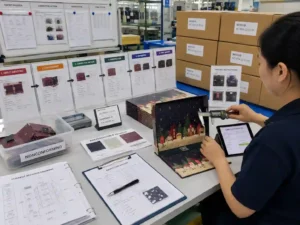
Quick answer: To check advent calendar box insert fit, test the insert with final production products rather than dimensions alone. Confirm cavity length, width, depth, grip, removal clearance, orientation, weight support, door or drawer clearance, and resistance to movement during shipping. The loaded prototype should be opened, closed, tilted, lightly shaken, and packed into its intended export carton. Buyers should also verify the insert dieline, material thickness, printing alignment, surface finishing, product sequence, and acceptable assembly tolerances before approving a pre-production sample. A good fit holds each product securely without crushing packaging, blocking access, damaging decoration, or creating excessive empty space.
What does “good insert fit” mean for an advent calendar box?
A good insert fit keeps every item in its assigned position through assembly, retail handling, and transportation while allowing the customer to remove it without damage. It is not simply a cavity that matches the product’s nominal dimensions.
For a commercial advent calendar, the buyer must evaluate the complete interaction between the product, insert, outer structure, opening method, and decorative finish. A cavity may fit correctly on a flat engineering drawing but fail after the insert is folded, glued, laminated, or installed inside a rigid box.
Correct fit normally requires the following:
- The product can be loaded without excessive force.
- The product does not fall out when the box is tilted or handled.
- The cavity does not crush cartons, labels, caps, pumps, sachets, or fragile components.
- The product can be removed with fingers, a pull tab, a ribbon, or an access notch.
- The insert does not interfere with doors, drawers, lids, magnets, hinges, or closing panels.
- The displayed product orientation matches the approved layout.
- The loaded insert remains flat and structurally stable.
- Printing and finishing remain aligned after die-cutting, folding, and assembly.
Buyer tip: Treat the product, insert, and calendar structure as one packaging system. Approving these components separately increases the risk of fit problems during mass production.
Which advent calendar structures change the insert-fit requirements?
The outer box structure determines how much retention, clearance, and dimensional tolerance the insert needs. A door-opening paperboard calendar has different engineering requirements from a rigid drawer box or book-style calendar.

| Calendar structure | Main insert-fit concern | Recommended buyer check |
|---|---|---|
| Door-opening paperboard box | Products may press against perforated doors or fall away from the opening. | Check cavity position against every door, finger access, product visibility, and front-panel bulging. |
| Rigid drawer box | A loaded insert may rub against the drawer walls or make the drawer difficult to slide. | Test drawer movement with all products loaded and verify side, top, and pull-ribbon clearance. |
| Book-style rigid box | Heavy products can pull on the hinge or shift when the box is displayed vertically. | Test both flat and upright orientations, hinge stress, magnetic closure, and product retention. |
| Folding-carton calendar | Panel bowing and folding tolerances can reduce internal space. | Check the erected production sample rather than relying only on the flat dieline. |
| Multi-layer or fold-out calendar | Products in one section may collide with another section when panels close. | Perform a full closing-path test and measure clearance between loaded layers. |
Buyers comparing custom advent calendar box products should review both the empty structure and a fully loaded sample. An empty drawer may move smoothly, while the same drawer can jam after an EVA insert, product, instruction leaflet, and ribbon are added.
How should buyers measure products before an insert dieline is made?
Measure the actual production product at its widest, longest, and deepest points, including caps, pumps, wrappers, folded seals, hang tabs, labels, and secondary cartons. Supplier specification sheets alone are rarely enough for reliable insert engineering.
For every calendar item, prepare:
- Maximum product length, width, and height.
- Product weight and center of gravity.
- Shape details, including tapered, curved, flexible, or irregular areas.
- Fragile points such as glass edges, pumps, caps, seals, and decorative sleeves.
- Required display direction and label-facing position.
- Acceptable pressure points and areas that must not be compressed.
- Removal method, such as finger notch, thumb cut, ribbon, or push-out opening.
- Expected dimensional variation between product production batches.
Physical samples are strongly preferred. When samples are unavailable, buyers should provide dimensioned drawings, photographs from several angles, product weight, and information about flexible or protruding components.
Factory tip: Measure several units when the product itself has production variation. Designing a cavity around one unusually small sample can cause loading failures when larger units arrive for calendar assembly.
How much tolerance should an advent calendar insert have?
Insert tolerance must allow efficient loading and product variation without permitting visible movement. There is no universal clearance because paperboard, PET, EVA, foam, and molded pulp behave differently.
The packaging engineer should consider:
- Variation in the product dimensions.
- Insert material thickness and compression.
- Die-cutting, thermoforming, molding, folding, and gluing tolerances.
- Lamination or printed-paper wrap thickness.
- Manual versus automated product loading.
- Temperature and humidity effects on paper-based components.
- Whether the product is retained by friction, tabs, walls, straps, or a lid.
A rigid glass bottle may need controlled clearance plus support around the body, while a flexible sachet may need side guides or a folded pocket to prevent sliding. An EVA cavity can use light compression, but a paper insert that is too tight may crease the product carton or slow the packing line.
Quotable buyer rule: The correct cavity is not the smallest cavity that accepts the product; it is the smallest cavity that supports repeatable loading, secure retention, easy removal, and acceptable mass-production tolerance.
Which insert material is best for the product?
The best material depends on product weight, shape, fragility, presentation, sustainability targets, budget, and calendar structure. Buyers should compare performance in a loaded sample rather than selecting an insert only by appearance.
| Insert option | Best suited to | Advantages | Points to verify |
|---|---|---|---|
| Folded paperboard insert | Cartons, sachets, stationery, tea, small accessories, and lightweight products | Printable, recyclable in suitable local streams, efficient for custom compartments | Fold strength, tab locking, wall collapse, board grain, loading speed, and print cracking |
| Clear PET tray | Products requiring visibility or precisely formed cavities | Accurate shape retention and clean presentation | Tray gauge, sharp edges, anti-scratch handling, recycled-content requirements, and local recycling guidance |
| EVA insert | Jewelry, mini bottles, tools, and premium gift products | Good grip, clean die-cut cavities, and premium appearance | Density, odor, color consistency, compression, surface marks, and removal access |
| Foam insert | Fragile, irregular, or impact-sensitive products | Cushioning and flexible cavity design | Foam type, density, recovery, odor, dust, discoloration, and compliance requirements |
| Molded pulp | Bottles, jars, food containers, and sustainability-focused projects | Good structural support and paper-based presentation | Surface texture, molding tolerance, moisture sensitivity, drying consistency, and tooling cost |
| Greyboard platform with paper wrap | Premium rigid calendars and heavier product sets | Strong presentation platform and coordinated decoration | Wrapped-edge thickness, cavity accuracy, corner finish, glue marks, and overall weight |
Giftpackpro can evaluate these options through its custom advent calendar box services, but the buyer should provide final product samples and performance priorities before requesting a firm recommendation.
How do printing and finishing affect insert fit?
Printing and finishing can change dimensions, folding behavior, friction, and visual alignment. CMYK printing, Pantone colors, lamination, foil stamping, embossing, and spot UV should therefore be checked on the assembled insert, not only on flat proof sheets.

What should buyers check on CMYK and Pantone artwork?
CMYK is appropriate for photographic or multi-color artwork, while Pantone references can help control important solid brand colors. However, color appearance changes with paper shade, coating, lamination, ink density, and surrounding colors.
Buyers should confirm:
- The correct color mode and approved color references are used.
- Artwork is linked to the latest insert dieline revision.
- Important graphics do not cross fold lines, glue areas, slots, or locking tabs.
- Product numbers and door numbers match the loading plan.
- Barcodes and small text remain readable after printing and finishing.
- Bleed, safety margins, overprint, trapping, and image resolution have been checked.
For responsible paper sourcing requirements, buyers can review chain-of-custody information from the official Forest Stewardship Council and ask the supplier to provide project-specific documentation when applicable.
Can lamination make cavities or folds tighter?
Yes. Matte lamination and gloss lamination add a film layer that can slightly affect thickness, stiffness, folding, and surface friction. On wrapped insert components, overlapping paper and film at edges can reduce usable cavity space.
Check for cracked folds, lifting film, trapped air, scuffing, fingerprint visibility, and resistance when products slide into or out of the cavity. A high-friction matte surface may grip some cartons more strongly than an unlaminated or gloss surface.
Can foil stamping, embossing, or spot UV interfere with fit?
These finishes should be kept away from functional fold lines, glue zones, narrow locking tabs, and areas where products rub against the insert. Heavy embossing can distort a panel, while thick spot UV or foil details may scratch delicate product surfaces.
Buyer tip: Approve decorative finishes on a converted sample whenever they are close to a cavity edge or structural fold. A flat foil sample cannot prove that a finished insert will fold, lock, and load correctly.
What insert-fit tests should be completed during sampling?
The supplier should test the insert at prototype, revised sample, and pre-production sample stages. The buyer should approve a fully assembled and fully loaded sample before mass production whenever possible.
- Dimensional check: Measure the finished cavities, insert height, outer structure, drawers, doors, and closing clearances.
- Loading test: Load every item in the approved sequence and record any excessive force, deformation, or slow operation.
- Retention test: Tilt the calendar forward, backward, and sideways to check whether products escape or rotate.
- Removal test: Confirm that users can remove each product without tearing the insert or damaging the item.
- Opening test: Open all doors, drawers, panels, and lids with the calendar fully loaded.
- Closing test: Check magnets, ribbons, hinges, sleeves, and locking tabs for obstruction.
- Appearance test: Confirm consistent product height, orientation, spacing, and visibility.
- Handling simulation: Lightly shake and move the packed sample in expected retail and fulfillment orientations.
- Carton test: Pack the calendar with its protective materials into the proposed export carton and inspect for compression or movement.
- Repeat test: Use several inserts and several product units to identify production variation.
Where a formal distribution test is appropriate, buyers can discuss a test plan based on their transport route and handling risks. The official International Safe Transit Association provides information about packaged-product testing frameworks.
How should buyers approve the sample and dieline?
Approval should cover measurable specifications, not only visual appearance. The signed sample, dieline revision, material specification, artwork files, and loading plan should all describe the same construction.
The approval record should identify:
- Finished box dimensions and insert dimensions.
- Structure type, board grade, and material thickness.
- Insert material, density, gauge, or paper specification.
- Cavity dimensions and product allocation.
- Finger notches, ribbons, tabs, straps, and retention features.
- CMYK profile, Pantone references, and approved proof type.
- Matte or gloss lamination specification.
- Foil color, embossing or debossing depth, and spot UV areas.
- Dieline and artwork revision numbers.
- Approved physical sample date and signed comments.
- Permitted tolerances and critical defect criteria.
- Export-packing method and carton requirements.
A prototype may be suitable for checking dimensions and fit, but it may not represent final offset printing, production tooling, lamination, foil stamping, or assembly. For higher-risk orders, a pre-production sample made with production-intent materials and processes provides stronger approval control.
What should QC inspect during mass production?
Mass-production QC should compare random units with the approved sample and specification. Insert fit must be checked throughout production because die-cutting, gluing, molding, material batches, and assembly can drift.
A practical advent calendar box insert fit checklist includes:
- Correct insert material and thickness.
- Correct cavity count, size, and sequence.
- No reversed, missing, or blocked cavities.
- Clean die-cut edges without excessive paper dust or foam residue.
- Secure tabs, glue joints, walls, and platforms.
- No glue transfer inside product-contact areas.
- Products load without crushing or cosmetic damage.
- Products remain retained after tilt and handling checks.
- Doors and drawers align with the correct products.
- All products remain removable by the intended method.
- Printed numbers, colors, foil, embossing, and spot UV match the approved standard.
- The loaded calendar closes correctly and remains level.
QC tip: Inspect loaded units, not only empty boxes. Many critical defects—drawer jamming, panel bulging, insert collapse, product rotation, and closure failure—appear only after all products are installed.
How do export packing and shipping conditions affect insert fit?
Export packing must prevent the calendar from being compressed, abraded, dropped inside an oversized carton, or loaded in an orientation that causes products to escape from their cavities. A correct insert cannot compensate for weak outer packing.
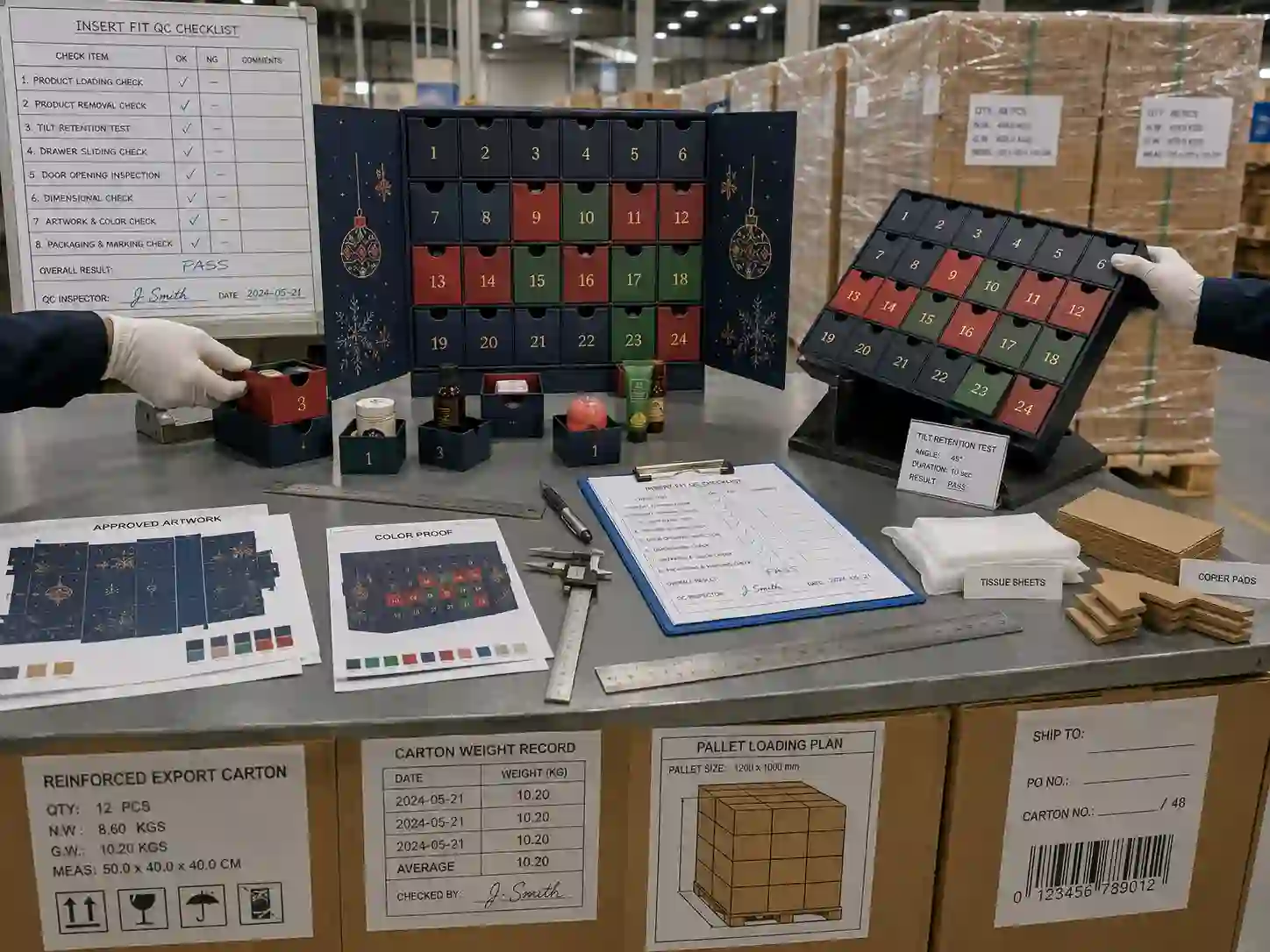
Depending on the project, protective packing may include tissue sheets, paper pads, sleeves, polybags where appropriate, corner protectors, dividers, reinforced export cartons, and stretch-wrapped pallets. The buyer should confirm carton quantity, gross and net weight, carton dimensions, pallet pattern, shipping marks, barcode label area, and orientation symbols before dispatch.
For e-commerce or parcel distribution, the retail advent calendar may require an additional mailer or cushioning system. For palletized wholesale shipments, carton compression strength, stacking height, pallet overhang, and container loading conditions become more important.
The Giftpackpro packaging factory can review production and packing details, but buyers should disclose the intended route: factory-to-warehouse, palletized retail distribution, parcel fulfillment, or direct-to-consumer shipment.
How should buyers compare insert proposals from different suppliers?
Compare suppliers using the same product set, structure brief, quality target, and packing requirements. A lower quotation may exclude tooling, printed prototypes, premium material density, assembly, fit testing, protective packing, or pre-shipment inspection.
Use this decision guide:
| Buyer priority | Likely direction | Questions to ask the supplier |
|---|---|---|
| Lower unit cost | Folded paperboard insert and efficient folding-carton structure | Will the insert support the loaded weight, and is manual assembly included? |
| Premium appearance | Rigid box with wrapped platform, EVA, foam, or formed tray | What material density, wrapping method, and finish tolerances are specified? |
| Fragile products | Cushioned cavities, molded pulp, foam, or supported PET tray | How are impact points, caps, glass edges, and product movement controlled? |
| Paper-based material target | Engineered paperboard or molded-pulp insert | Can the design pass loading, retention, removal, and transport checks? |
| Fast product loading | Open-access tray or simple paperboard cavities | How many seconds are required to load each calendar, and are cavities easy to identify? |
| Complex product assortment | Mixed cavity sizes with numbered loading plan | How will the supplier prevent product-position and door-number errors? |
A capable supplier should be able to explain why a specific material, tolerance, retention method, and sample process suit the project. Buyers can review additional advent calendar box buying guides when preparing supplier-comparison documents.
What affects MOQ, cost, and lead time?
MOQ, price, and lead time depend on the calendar structure, insert material, tooling, artwork, finishing, assembly complexity, product count, quality requirements, and export packing. Insert fit can affect cost because tighter tolerances and complex cavities may require more development work or specialized tooling.
Common cost drivers include:
- Number of unique cavity sizes.
- Paperboard die-cutting tools, PET forming molds, or molded-pulp tooling.
- EVA or foam density, thickness, lamination, and multi-layer construction.
- Rigid-box greyboard thickness and wrapping complexity.
- CMYK coverage and number of Pantone colors.
- Foil stamping area, multiple foil colors, embossing, and spot UV.
- Manual insert assembly and product-loading requirements.
- Prototype quantity and pre-production sample method.
- Inspection level, packing materials, export-carton strength, and palletization.
Lead time should be separated into structural design, dieline preparation, prototype production, artwork proofing, sample revision, material procurement, mass production, QC, and export packing. Buyers should also reserve time to send products to the factory and review physical samples.
What information is needed for an accurate quotation?
An accurate quotation requires more than the outer box size and order quantity. Provide a complete RFQ package so the supplier can calculate the structure, insert, printing, labor, tooling, packing, and shipping volume consistently.
Prepare the following:
- Target quantity and preferred delivery date.
- Product list with dimensions, weights, photographs, and physical samples when available.
- Preferred calendar structure and opening method.
- Required cavity sequence and product orientation.
- Insert preference or performance priorities.
- Finished box dimensions or size limitations.
- Artwork status and required CMYK, Pantone, foil, embossing, spot UV, or lamination details.
- Sample requirements, including blank prototype, printed sample, or pre-production sample.
- Expected quality checks and approval process.
- Retail, wholesale, e-commerce, or parcel-distribution method.
- Export-carton, pallet, shipping-mark, barcode, and labeling requirements.
- Destination country and preferred shipping terms for quotation comparison.
Buyers researching a custom advent calendar boxes manufacturer should request a specification-based quotation rather than comparing headline unit prices alone.
Which common insert-fit mistakes should buyers avoid?
The most common mistake is approving the insert without final products. Other failures usually come from incomplete dimensions, outdated dielines, insufficient removal access, or testing only an empty calendar.
- Using nominal product dimensions without measuring caps, seals, wrappers, or cartons.
- Allowing no tolerance for product and packaging variation.
- Ignoring product weight and center of gravity.
- Approving a cavity that holds the item but makes removal difficult.
- Testing drawers or doors before products are loaded.
- Placing foil, embossing, or spot UV across functional folds and glue zones.
- Changing the product after the insert dieline has been approved.
- Approving artwork on an obsolete dieline revision.
- Failing to define orientation, numbering, and loading sequence.
- Skipping export-carton and handling simulation checks.
- Comparing quotations that use different insert materials or sample standards.
Frequently asked questions about advent calendar box insert fit
Should the product fit tightly inside the insert?
It should fit securely, but not so tightly that loading damages the product or removal becomes difficult. The correct grip depends on the material, product variation, weight, and retention method.
Can a dieline prove that the insert will fit?
A dieline is necessary for dimension and artwork review, but it cannot fully prove fit. Buyers should test an erected insert with actual products because material thickness, folds, glue, wrapping, and assembly affect the finished cavity.
Is a blank prototype enough for approval?
A blank prototype can confirm structure and preliminary fit. It may not represent final printing, lamination, foil stamping, embossing, spot UV, production tooling, or material behavior, so higher-risk projects should include a production-intent sample.
Can one insert combine paperboard, PET, EVA, or foam?
Yes. Hybrid inserts can solve different retention or presentation needs, but they increase material, assembly, recycling-separation, and quotation complexity. The supplier should explain how the components are fixed and inspected.
What happens if the product changes after sample approval?
The supplier should recheck the cavity, dieline, loaded weight, closing clearance, packing method, and quotation. Even a small cap, label, carton, or sachet change can affect loading and retention.
How many loaded samples should a buyer review?
The appropriate number depends on project risk and product variation. At minimum, review one complete loaded sample and ask the factory to repeat fit checks across several insert and product units before mass production.
What should buyers send Giftpackpro before requesting a sample or quote?
To evaluate advent calendar box insert fit, send Giftpackpro the product dimensions, weights, photographs, physical samples, preferred structure, quantity, delivery target, insert priorities, artwork requirements, finishing details, and export-packing method. Clearly identify fragile areas, required product orientation, removal method, and any fixed retail or shipping dimensions.
Buyers can request a custom quote with these details and specify whether they need a blank prototype, printed sample, or pre-production sample. A complete RFQ allows the factory to assess structure, insert engineering, CMYK or Pantone proofing, lamination, foil stamping, embossing, spot UV, MOQ, lead time, QC, and export packing as one coordinated packaging project.