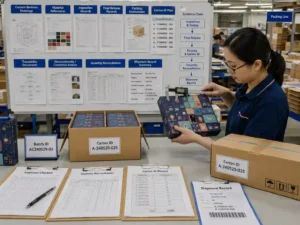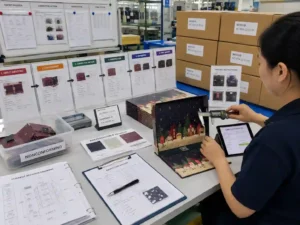
Quick answer: To check an advent calendar box sample before approval, test it as a complete packaging system rather than reviewing appearance alone. Confirm the external size, compartment layout, product fit, insert retention, opening sequence, board strength, printing, finishing, assembly tolerances, and export protection. Load the actual products whenever possible, operate every drawer or door repeatedly, compare the sample with the approved dieline and artwork, and record all corrections in one signed specification. The approved sample should represent mass-production materials and processes closely enough to become the quality reference for production, inspection, packing, and shipment.
A sample is the buyer’s opportunity to identify structural and visual problems before tooling, material purchasing, printing, and assembly begin at scale. A small inconvenience on one prototype—such as a tight drawer, weak paper hinge, shallow insert cavity, or incorrect product orientation—can become a costly defect when repeated across thousands of calendars.
This guide explains how overseas brands, wholesalers, retail buyers, e-commerce sellers, gift companies, and purchasing teams should evaluate samples supplied by a custom advent calendar boxes manufacturer.
What should buyers confirm before reviewing the sample?
Before inspecting the physical sample, confirm which development stage it represents. A white prototype, digitally printed sample, production-process sample, and loaded pre-production sample answer different questions and should not be approved for the same purpose.
| Sample type | What it can verify | What it may not represent | Recommended buyer decision |
|---|---|---|---|
| White structural prototype | Size, layout, opening method, compartment arrangement, basic assembly | Final colors, paper texture, foil, lamination, production printing | Approve structure only |
| Digitally printed sample | Artwork position, numbering, text size, visual hierarchy, approximate color | Exact offset-print color, foil tooling, embossing depth, production coating | Approve layout with stated limitations |
| Function sample | Drawer movement, door opening, hinge action, insert fit, product loading | Final decorative finish if substitute materials are used | Approve mechanical performance |
| Pre-production sample | Final structure, specified materials, printing, finishing, assembly, loaded fit | Natural production variation across the full order | Use as the signed approval reference |
Ask the supplier to state all sample substitutions in writing. For example, a sample may use digital printing instead of offset printing, hand-cut inserts instead of die-cut inserts, or a similar paper because the production stock has not yet been purchased.
Buyer tip: Never approve an entire order based on an attractive presentation sample if the supplier has not identified which elements will change during mass production.
Which advent calendar structure is being approved?
The sample must be checked against the intended retail application, product weight, opening experience, target price, and shipping method. Drawer, door-opening, rigid, folding-carton, and fold-out calendars require different inspection priorities.

How should a rigid drawer calendar be tested?
For a rigid drawer box, check the greyboard thickness, wrapped-paper adhesion, drawer clearance, ribbon-pull strength, and alignment of the complete drawer grid. Every drawer should open without excessive force but should not slide out when the calendar is tilted during handling.
- Open and close every drawer at least 10 times.
- Check whether wrapped edges rub against adjacent drawers.
- Load the actual products and repeat the opening test.
- Confirm that drawer fronts remain level and gaps appear consistent.
- Inspect corners for lifting paper, exposed greyboard, glue marks, or crushing.
- Check whether ribbons, thumb notches, or pull tabs are easy to use.
Rigid drawer calendars may require extra internal clearance because wrapping paper, glue, and manual assembly introduce thickness variation. A drawer that fits perfectly in a hand-made prototype can become tight if the production tolerance is not included in the structure.
What matters in a door-opening box?
A door-opening calendar depends on clean scoring, controlled perforation, sufficient product clearance, and a stable tray or compartment wall behind each door. The door should stay closed before opening but tear or fold without damaging adjacent artwork.
- Open every door in the intended numerical sequence.
- Check whether perforations tear cleanly rather than removing large printed areas.
- Confirm that the product does not press against the door from behind.
- Inspect narrow bridges between neighboring doors for tearing or deformation.
- Check that fingers can reach and remove each product.
- Confirm that the opened door does not expose glue, rough paper fibers, or unfinished edges unnecessarily.
Door size should be based on the removal path, not only the product’s front dimensions. A bottle with a wide shoulder, for example, may fit inside a cavity but still be impossible to remove through a narrow rectangular opening.
How should a fold-out or book-style calendar be reviewed?
Fold-out and book-style calendars require special attention to hinge width, panel weight, magnet or ribbon closure, and the alignment of graphics across moving panels. Open the calendar on a flat table and in the position expected at retail or during unboxing.
Check whether the structure remains stable when fully opened, whether heavy panels pull against the hinge, and whether repeated folding causes surface cracking. For magnetic closures, verify closure strength with all products loaded; an empty sample can close correctly while a loaded calendar bows outward.
When is a folding carton more suitable than a rigid box?
A paperboard folding carton is usually more compact for storage and shipping, while a rigid box provides greater perceived value and dimensional stability. The sample should prove whether the selected paperboard caliper can support the loaded weight without panel bowing, tab release, or base failure.
Buyers can compare structural possibilities through Giftpackpro’s custom advent calendar box products before confirming which format should be sampled.
How should buyers check an advent calendar box sample for size and layout?
Check the sample by comparing three data sets: the approved dieline, the physical packaging dimensions, and the actual products. A calendar should not be approved from a PDF rendering or external measurement alone.
- Measure the finished external length, width, and depth.
- Measure important internal cavities, drawers, and door openings.
- Record product dimensions at their widest, tallest, and deepest points.
- Confirm the product orientation in every numbered position.
- Check removal clearance for fingers, pull tabs, and irregular product shapes.
- Calculate the loaded weight and confirm that the structure supports it.
- Measure the packed export-carton dimensions if freight efficiency matters.
Allowances should reflect both product variation and packaging variation. Flexible sachets may expand after filling, molded containers may vary slightly between batches, and wrapped rigid components can gain thickness during assembly.
Factory tip: The most reliable product-fit test uses production-equivalent filled products, caps, sachets, accessories, and retail labels. Empty bottles or simplified dummy blocks may not reproduce the actual center of gravity or removal difficulty.
Does every product fit securely in its insert?
An insert is acceptable only when it holds the product during transport, presents it correctly after opening, and allows the buyer’s customer to remove it without damage. Test each cavity individually and then test the fully loaded calendar.
What should be checked on a paper insert?
For a folded paper insert, inspect locking tabs, support walls, crease accuracy, finger notches, and resistance to collapse. Heavy or tall products may require double walls, cross supports, or a supporting platform beneath the visible insert.
Check whether cut edges scratch labels, whether narrow bridges tear during loading, and whether products lean after the calendar is moved. Paper inserts can support recycling-oriented packaging goals, but their strength depends on board grade, grain direction, structure, and loaded weight.
How should a PET tray be tested?
A PET tray should retain products without excessive flexing, whitening, cracking, or sharp edges. Confirm the tray thickness, cavity depth, flange width, and removal points. Transparent trays also expose dust, scratches, and inconsistent product positioning more visibly than opaque inserts.
When do EVA or foam inserts need extra review?
EVA and foam inserts are useful for compact, fragile, or premium products, but buyers should inspect odor, dust, surface marks, cut accuracy, adhesive performance, and compression recovery. Confirm whether the material color, density, and lamination shown in the sample are identical to those quoted for production.
What should buyers verify with molded pulp?
Molded pulp can provide shaped support, but its surface, wall thickness, moisture response, and dimensional precision differ from PET or foam. Check whether the product sits level, whether pulp fibers mark delicate finishes, and whether cavities remain stable under stacking pressure.
QC tip: Shake the closed, fully loaded calendar gently in several directions. Movement, rattling, product rotation, and insert lifting often reveal fit problems that are not visible during a static desk review.
How should the dieline and artwork be checked?
Compare the assembled sample directly with the final dieline and artwork file. Confirm panel orientation, door numbering, reading direction, glue zones, cut lines, crease lines, bleed, safe areas, and the position of decorative finishes.

Review the sample in its complete opening sequence, because artwork errors often appear only when panels move. Text can become inverted on a fold-out panel, numbers can be hidden by a drawer edge, or a foil element can cross a crease and crack.
- Confirm that all numbered compartments are present and in the approved sequence.
- Check barcodes, legal text, warnings, recycling marks, and country-specific copy.
- Verify that important text is outside cut, crease, perforation, and glue areas.
- Check image continuity across doors, drawers, and folding panels.
- Confirm that the internal artwork matches the correct compartment.
- Inspect spelling, punctuation, dates, product names, and language versions.
- Check that barcode quiet zones and contrast are not interrupted by finishes.
For retail barcodes and logistics labels, buyers can review official guidance from GS1 barcode standards.
Does the printing sample represent mass production?
The buyer should establish whether color is being approved from a digital proof, a press proof, a printed sample, or a physical Pantone reference. These methods do not produce identical results.
Check CMYK images for skin-tone neutrality, shadow detail, small reversed text, gradients, and banding. For spot colors, record the Pantone reference and approved tolerance. Compare color under consistent neutral lighting rather than beside a window where daylight changes throughout the day.
Decorative finishes should also be assessed for production feasibility:
- Foil stamping: Check registration, pinholes, edge definition, and performance across textured paper.
- Embossing or debossing: Check depth, alignment, paper cracking, and distortion on the reverse side.
- Spot UV: Check gloss level, registration, dust marks, and adhesion over the printed surface.
- Matte lamination: Check scuff resistance, silvering, fingerprints, and edge lifting.
- Gloss lamination: Check reflections, scratches, trapped particles, and color change.
Ask whether the sample finish was applied by production machinery or by a small sample process. Hand-applied foil or manually laminated sample panels may look different from the bulk result.
What functional tests should be completed before approval?
The sample should survive repeated opening, handling, loading, closing, and normal movement without losing its intended function. Functional testing should reproduce realistic buyer and consumer handling rather than a single careful demonstration.
Practical sample approval checklist
- All doors, drawers, panels, and closures operate correctly.
- The loaded calendar stands level without twisting or leaning.
- Products remain in their assigned compartments after movement.
- Finger notches and removal spaces are large enough.
- Ribbons, magnets, tabs, and handles remain attached.
- Paper hinges and fold lines do not crack excessively.
- Glue does not release under moderate pulling or flexing.
- Printed surfaces do not rub against moving structural parts.
- No sharp edges, exposed staples, loose magnets, or uncontrolled adhesive remain.
- The sample closes correctly after all products are loaded.
- The calendar fits the intended retail shelf, master carton, or e-commerce shipper.
- Accessories and instruction cards fit without creating pressure points.
Where practical, keep one tested sample and one untouched approval sample. The tested unit provides evidence of functional performance, while the untouched unit remains a clean visual reference.
How should buyers evaluate production tolerances?
A handmade sample can be more precise than normal production, so buyers should not approve only the exact sample dimensions. They should agree on measurable tolerances for critical features.
Critical controls may include finished size, drawer clearance, door position, compartment size, insert depth, artwork-to-cut registration, foil registration, board thickness, and color range. The acceptable tolerance should reflect the structure and manufacturing method rather than an unrealistic universal number.
Ask the supplier which dimensions are critical to product fit and which are non-critical cosmetic dimensions. Product cavities, narrow drawer channels, magnet locations, and multi-panel alignment generally need closer control than hidden internal overlaps.
A reliable supplier should be able to explain how the dieline, cutting tools, board grain, wrapping process, assembly jig, and inspection method affect dimensional consistency. Buyers can learn more about these development steps through custom advent calendar box services.
How do MOQ, cost, and lead time affect sample approval?
Sample approval should lock the specification used for the quotation. Changing the board, insert, dimensions, printing process, finish, or packing method after approval can change the MOQ, unit cost, tooling charge, production time, carton quantity, and freight volume.
Important cost drivers include:
- Rigid greyboard construction versus folding paperboard construction
- Number and size of drawers, doors, dividers, and assembled components
- Hand assembly and product-loading requirements
- Custom PET, EVA, foam, molded-pulp, or paper insert tooling
- Special paper, Pantone printing, foil stamping, embossing, and spot UV
- Finished dimensions and the number of units per export carton
- Protective packing, individual sleeves, tissue, corner protectors, and pallets
- Required inspection, testing, and pre-shipment documentation
MOQ is not determined only by the box style. It may be influenced by printing-sheet utilization, special-material minimums, tooling efficiency, finishing setup, and assembly capacity. The supplier should state whether the sample price and production quotation include the same specification.
What should be inspected in export packing?
Before approval, review how the finished calendars will be protected from compression, abrasion, moisture exposure, corner damage, and movement inside the export carton. A strong presentation box can still arrive damaged if carton strength and internal protection are inadequate.
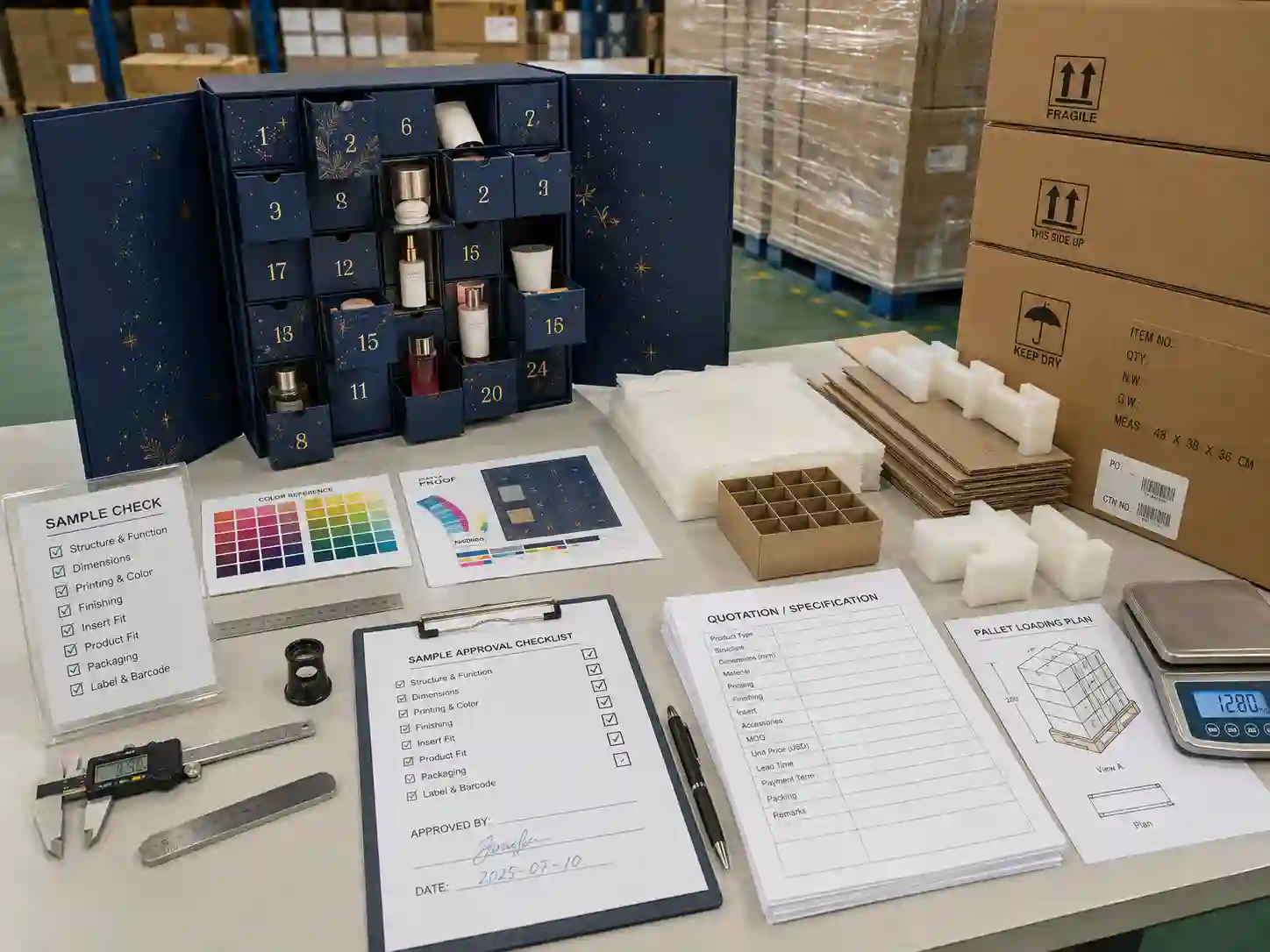
- Confirm the number of calendars per export carton.
- Check carton dimensions, gross weight, and net weight.
- Review calendar orientation and internal stacking pattern.
- Confirm the use of tissue, paper pads, partitions, sleeves, or corner protectors.
- Check whether exposed foil, matte lamination, or dark colors can rub during transit.
- Verify shipping marks, carton numbers, barcodes, and handling symbols.
- Confirm pallet dimensions, stacking height, stretch wrap, and corner boards when pallets are required.
- Review the e-commerce shipper separately if individual parcel delivery is planned.
For higher-risk distribution, buyers can discuss transit-test planning based on recognized procedures from the International Safe Transit Association. The appropriate test depends on the shipment method, product weight, carton configuration, and distribution environment.
Factory tip: Ask the factory to photograph the proposed packing sequence and prepare one packed master-carton sample when freight damage would create a significant launch risk.
How should buyers compare sample quality between suppliers?
Compare suppliers using the same product information, target structure, materials, artwork, and packing requirements. A lower quotation is not directly comparable if it excludes final inserts, finishing, protective packing, tooling, or a production-equivalent sample.
| Supplier comparison point | What a buyer should request | Warning sign |
|---|---|---|
| Structural engineering | Dieline explanation, product-clearance logic, tolerance plan | Structure copied without checking actual products |
| Sample transparency | Written list of substitute materials and processes | Sample presented as production-equivalent without details |
| Insert development | Loaded fit test and cavity measurements | Insert designed from product photos only |
| Printing control | Color reference, proof method, finish specification | No defined color-approval standard |
| Production QC | Critical inspection points and approved reference sample | Quality described only as “good” or “high quality” |
| Export packing | Carton specification, packing quantity, gross weight, pallet plan | Packing details postponed until after production |
| Quotation clarity | Itemized specification, MOQ, lead time, tooling, packing, payment terms | Low unit price with major items unspecified |
Supplier capability should also be evaluated through communication quality, revision control, sample records, production planning, and willingness to identify risks. Information about the Giftpackpro packaging factory can help purchasing teams understand the factory-side development approach before starting a project.
What approval method reduces production disputes?
Use one consolidated approval document supported by a signed physical sample, approved dieline, final artwork, color reference, material list, insert specification, packing method, and revision number. Verbal approvals spread across emails and chat messages are difficult to control during production.
Recommended approval record
- Assign the project and revision number.
- List finished dimensions and critical internal dimensions.
- Identify board, paper, insert, printing, and finishing specifications.
- Attach the final dieline and artwork files.
- Record approved Pantone colors or signed printed references.
- Photograph the loaded sample from multiple angles.
- List all accepted deviations and required corrections.
- Confirm export-carton quantity and protection method.
- State whether another corrected sample is required.
- Obtain written approval from the authorized buyer and supplier contacts.
The signed sample is often called a golden sample or approval sample. It should be stored safely and used during mass production, final inspection, and dispute resolution.
Which sample problems should stop approval?
Do not approve the sample when a problem can affect product loading, opening function, legal copy, barcode use, retail presentation, production consistency, or transit protection. Cosmetic preferences can sometimes be documented as tolerances, but structural failures should be corrected before production.
- Products cannot be removed without damaging the box or product.
- Loaded drawers jam, fall out, or rub against neighboring components.
- Doors open accidentally or tear neighboring graphics.
- The insert collapses, lifts, or allows products to move between compartments.
- The calendar bows, twists, or fails to close when fully loaded.
- Artwork orientation, numbering, language, barcode, or legal text is incorrect.
- The sample uses unspecified materials or processes that differ materially from the quotation.
- The supplier cannot define tolerances for critical dimensions.
- Export packing has not been considered for a fragile or scuff-sensitive design.
What should buyers prepare before requesting a quotation or sample?
A complete RFQ helps the supplier recommend a realistic structure and reduces repeated sample revisions. Prepare the following information before contacting the factory:
- Target order quantity and expected repeat quantity
- Required delivery date and destination country
- Product list with dimensions, weight, photos, and orientation
- Number of compartments and preferred opening sequence
- Preferred structure: drawer, door-opening, rigid, folding carton, book-style, or fold-out
- Material and sustainability preferences
- Insert preference or required product protection
- Artwork status, color requirements, and decorative finishes
- Retail, wholesale, promotional, or e-commerce distribution method
- Individual packing, export-carton, pallet, barcode, and shipping-mark requirements
- Required sample type and approval deadline
- Inspection, compliance, or testing requirements to be verified
Additional purchasing references are available in Giftpackpro’s advent calendar box buying guides.
Decision guide: approve, revise, or resample?
Approve the sample when the structure, product fit, opening function, materials, artwork, finish, tolerances, and packing method match the documented specification.
Approve with recorded corrections only when the changes are minor, measurable, and do not require structural retesting—for example, correcting a small text error while keeping the approved dieline unchanged.
Request a revised sample when changes affect compartment dimensions, product orientation, insert retention, drawer clearance, door perforation, hinge performance, closure strength, material thickness, or other functional features.
Request a pre-production sample when the reviewed prototype used substitute materials or processes and the final result cannot be reliably judged from the current sample.
Frequently asked questions about advent calendar sample approval
Should the buyer send actual products to the packaging factory?
Yes, whenever possible. Actual filled products allow the factory to check maximum dimensions, weight distribution, cap clearance, insert retention, loading sequence, and removal access. For regulated or difficult-to-ship products, accurate dummy samples may be used if they reproduce the final size, shape, and weight.
How many sample revisions are usually required?
The number depends on the completeness of the RFQ, product complexity, structure, artwork readiness, and required finishes. A project with confirmed products and an approved structural direction may need fewer revisions than a project in which products, dimensions, and artwork continue changing.
Can a digital sample be used for final approval?
A digital sample can support artwork and layout review, but it may not accurately represent offset-print color, Pantone matching, foil, embossing, lamination, die-cut precision, or production assembly. Final approval should clearly state which characteristics remain subject to production-process confirmation.
Should buyers approve an unloaded sample?
An unloaded sample is insufficient for final functional approval. Product weight and shape can affect drawer movement, panel bowing, insert stability, closure strength, carton compression, and export packing.
What happens after the sample is approved?
The supplier should freeze the approved specification, confirm the quotation, arrange tooling and materials, prepare production instructions, establish QC checkpoints, and schedule mass production. Any later change should be documented as a new revision and reviewed for cost and lead-time impact.
Can the approved sample be used for final inspection?
Yes. The signed approval sample, final artwork, material specification, and packing instructions should be available to the production and QC teams. Inspectors can compare mass-produced units with this reference while also checking agreed measurable tolerances.
Prepare a reliable sample approval package
To check advent calendar box sample details effectively, send Giftpackpro the actual products or accurate product specifications, required compartment count, preferred structure, artwork status, target quantity, delivery schedule, and export-packing needs. The factory can then prepare an appropriate prototype, record production-equivalent specifications, and identify issues before bulk manufacturing.
Buyers planning a new seasonal packaging project can request a custom quote with product dimensions, quantities, reference images, artwork files, and required delivery information.