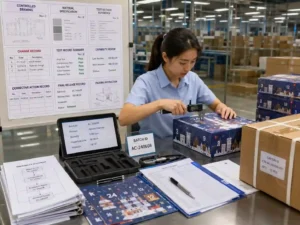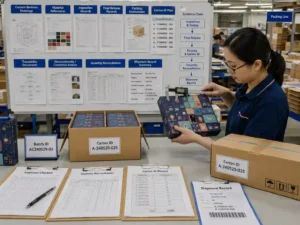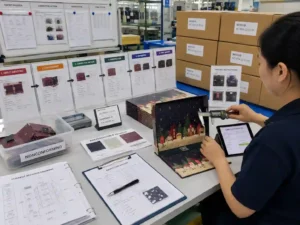
Quick answer: The advent calendar box sampling process converts a buyer’s product dimensions, structure concept, artwork, materials, and packing requirements into a physical prototype that can be tested before mass production. A packaging supplier normally checks the dieline, builds the outer box and compartments, tests product fit, applies the selected printing and finishes, assembles the sample, and records revisions. The buyer then reviews appearance, opening function, insert security, product loading, assembly tolerance, retail presentation, and shipping protection. A sample is not only a visual mock-up; it is the main approval reference for quotation confirmation, production planning, quality control, and final delivery.
Why should buyers sample an advent calendar box before ordering?
Buyers should request a sample because advent calendar packaging combines multiple components that must work together: the outer structure, doors or drawers, internal compartments, product inserts, printed artwork, finishing, assembly, and export packing. A flat dieline or digital rendering cannot fully confirm whether those parts will function correctly after production.
Sampling is especially important when the calendar holds products with different dimensions, weights, or fragility levels. Cosmetic bottles may need neck support, tea sachets may require shallow compartments, jewelry cards may need finger-access space, and glass containers may require stronger partitions or cushioning. The sample allows these details to be tested with actual or accurately simulated products.
A useful sample should answer five commercial questions:
- Does the selected structure match the target retail price and campaign positioning?
- Can every product be loaded, removed, and displayed without damage?
- Will the printed artwork align correctly across doors, drawers, panels, and wrapped edges?
- Can the factory reproduce the approved construction consistently during mass production?
- Can the assembled or flat-packed boxes survive export handling within the planned shipping volume?
Buyer tip: Treat sampling as a packaging-engineering stage, not as a request for a decorative display piece. A visually attractive sample that has not been tested with the real products may still fail during filling, retail handling, or transportation.
Which sample type should a buyer request?
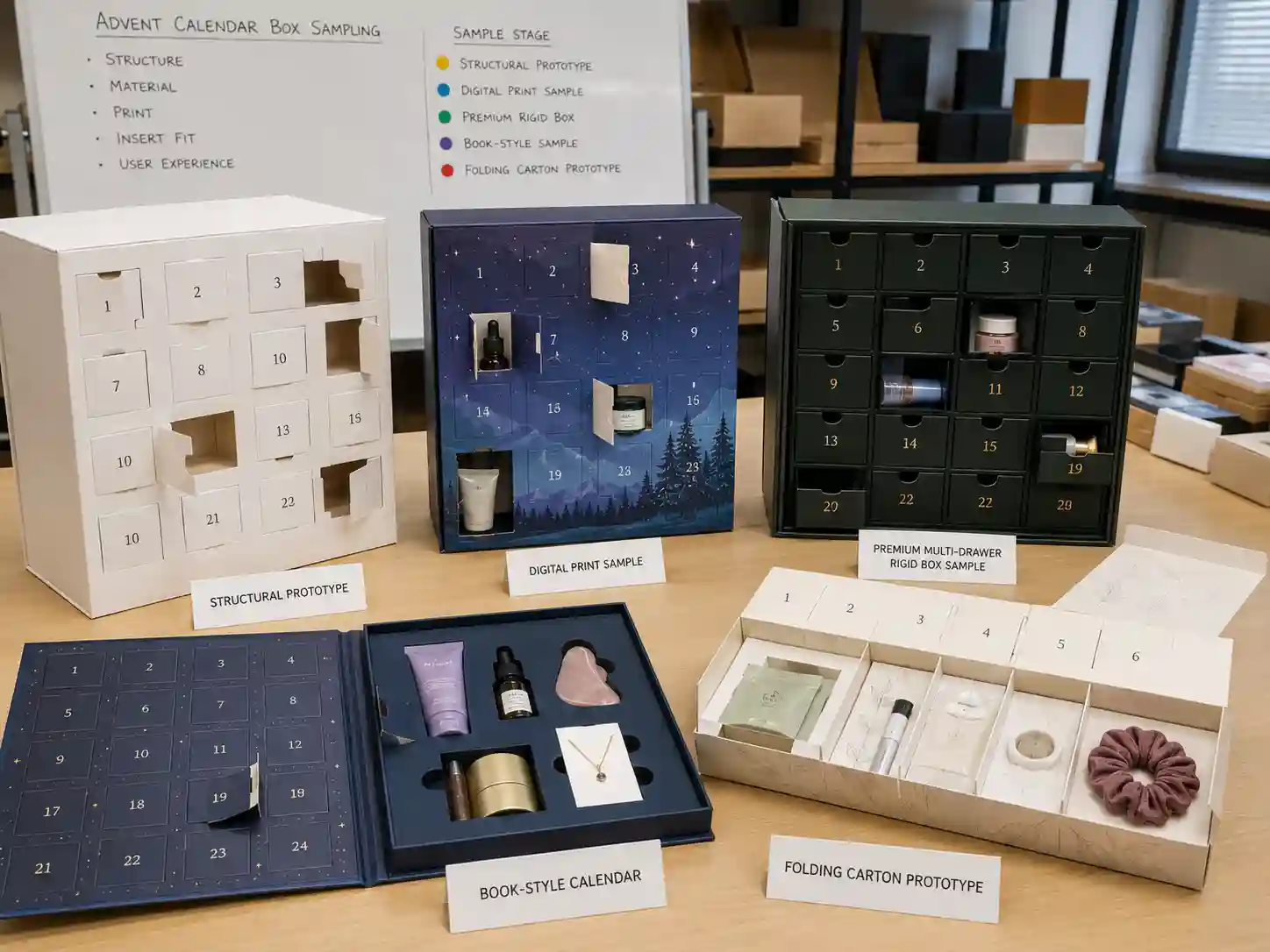
The correct sample type depends on what the buyer needs to approve. A structural prototype is suitable for checking dimensions and function, while a printed pre-production sample is needed when color, finishing, and final assembly must be confirmed.
| Sample type | What it normally includes | Best use | Main limitation |
|---|---|---|---|
| Digital rendering | Three-dimensional appearance, proposed artwork, opening view, and product arrangement | Early concept comparison and internal presentation | Cannot prove material strength, color accuracy, or product fit |
| White structural prototype | Unprinted paperboard or greyboard structure, doors, drawers, compartments, and insert | Checking size, opening method, assembly, and product loading | Does not show final printing or decorative finishes |
| Digitally printed sample | Printed graphics, approximate colors, structure, insert, and hand-applied finishes where possible | Artwork review, photography, sales meetings, and campaign approval | Color and finishing may differ from offset-printed mass production |
| Production-process sample | Materials, printing, lamination, foil stamping, embossing, spot UV, and assembly close to the intended bulk process | Final approval before a high-value or technically complex order | Higher cost and longer preparation time |
| Loaded pre-production sample | Near-final box loaded with actual products and packed as proposed for shipment | Confirming fit, user access, QC criteria, packing method, and production reference | Requires final products, artwork, and specifications to be available |
For a new structure, buyers often begin with a white prototype and then move to a printed sample after the dimensions are approved. This reduces the risk of paying for printing and finishing before the engineering has been confirmed.
What structure decisions are tested during sampling?
The sample should prove that the chosen box structure can support the products, operate smoothly, and meet the intended retail or e-commerce presentation. The structure must be evaluated as a complete system rather than as an outer box alone.
Rigid box, folding carton, or hybrid construction?
A rigid box normally uses wrapped greyboard and offers a premium appearance, strong panel stability, and good support for drawers or doors. It is appropriate for higher-value gift sets but usually requires more assembly labor and shipping space.
A folding carton uses printed paperboard that can often be delivered flat. It can reduce freight volume and assembly cost, although the board thickness, locking tabs, compartment design, and loading method need careful testing. Hybrid calendars may combine a folding outer sleeve with rigid drawers, paper inserts, or modular trays.
During sampling, buyers should compare:
- Overall dimensions and box depth after assembly
- Door-opening, book-style, drawer, sleeve, or folding-carton operation
- Panel flatness and resistance to bowing
- Drawer sliding clearance and pull-tab access
- Door perforation strength and opening direction
- Magnet, ribbon, paper hinge, or locking-tab performance
- Stability when the calendar is displayed upright
- Ease of filling products during final packing
Factory tip: Drawer calendars require controlled clearance between each drawer and its surrounding cavity. Too little clearance can cause sticking after paper wrapping or humidity changes; too much clearance can create uneven gaps and a loose appearance.
How are door-opening calendars evaluated?
For a door-opening box, the supplier should check whether perforations tear cleanly without damaging neighboring graphics or exposing unwanted white paper fibers. The buyer should also confirm that the product can be removed through the door opening without crushing the compartment.
The door number, hinge direction, thumb notch, perforation depth, and internal cavity position must align. If a product sits too close to the door, it may press against the printed panel or fall forward during transport. If it sits too far behind the opening, the customer may have difficulty removing it.
How are inserts and product fit tested?
Insert testing confirms that each product remains in the correct position while still being easy to load and remove. The supplier should use actual products whenever possible because catalog dimensions do not always include caps, pumps, sachet seals, labels, or irregular shapes.
Common insert options include folded paper inserts, corrugated partitions, clear PET trays, EVA inserts, foam supports, and molded pulp. The correct choice depends on product weight, surface sensitivity, sustainability requirements, presentation, and budget.
What product information does the factory need?
For each compartment, provide the product’s maximum length, width, height, weight, orientation, fragile areas, and any required finger-access space. When physical products are unavailable, send accurate dummy products or three-dimensional files supported by verified measurements.
The factory may add working clearance around each item, but the amount should be decided according to the product shape and insert material. A rigid bottle in a PET cavity needs different clearance from a flexible sachet held by a folded paper slot. Clearance that is too tight slows product loading; clearance that is too loose allows movement and scuffing.
A product-fit test should cover:
- Place every item in its assigned cavity using the planned loading orientation.
- Check whether caps, pumps, seals, or corners contact the box walls.
- Close all doors, drawers, sleeves, and lids without pressure marks.
- Move and gently rotate the loaded sample to identify loose products.
- Open each compartment and remove the product using normal finger access.
- Reload the product to evaluate factory packing efficiency.
- Inspect the printed surfaces and products for scratching or compression.
Quotable buyer guidance: The external box dimension should be finalized only after the compartment layout, insert thickness, product clearance, and board construction have been tested together.
What happens to the dieline and artwork during sampling?
The supplier checks whether the artwork fits the approved dieline and whether important design elements remain clear after cutting, folding, wrapping, perforating, and assembly. Artwork approval should occur after the structural dimensions are stable.
A dieline review normally covers cut lines, crease lines, perforations, glue areas, wrapped edges, bleed, safe zones, drawer faces, door numbers, barcodes, and finishing positions. For a rigid box, graphics may cross wrapped edges or separate paper panels. For a folding carton, artwork must account for folds, locking tabs, and glue flaps.
The sample review should confirm:
- CMYK images have suitable resolution and color settings.
- Pantone references are identified where spot-color matching is required.
- Foil stamping, embossing, debossing, or spot UV areas are supplied as separate artwork layers.
- Small text and thin lines remain printable after finishing.
- Door numbers remain centered after perforation and assembly.
- Barcodes and regulatory text are positioned on flat, readable surfaces.
- Matte lamination or gloss lamination produces the intended contrast and handling resistance.
Digital printing is commonly used for early samples because it avoids full production setup, but its color and surface appearance may not exactly match offset printing. Buyers should ask the supplier to state which features are representative of mass production and which are only simulated.
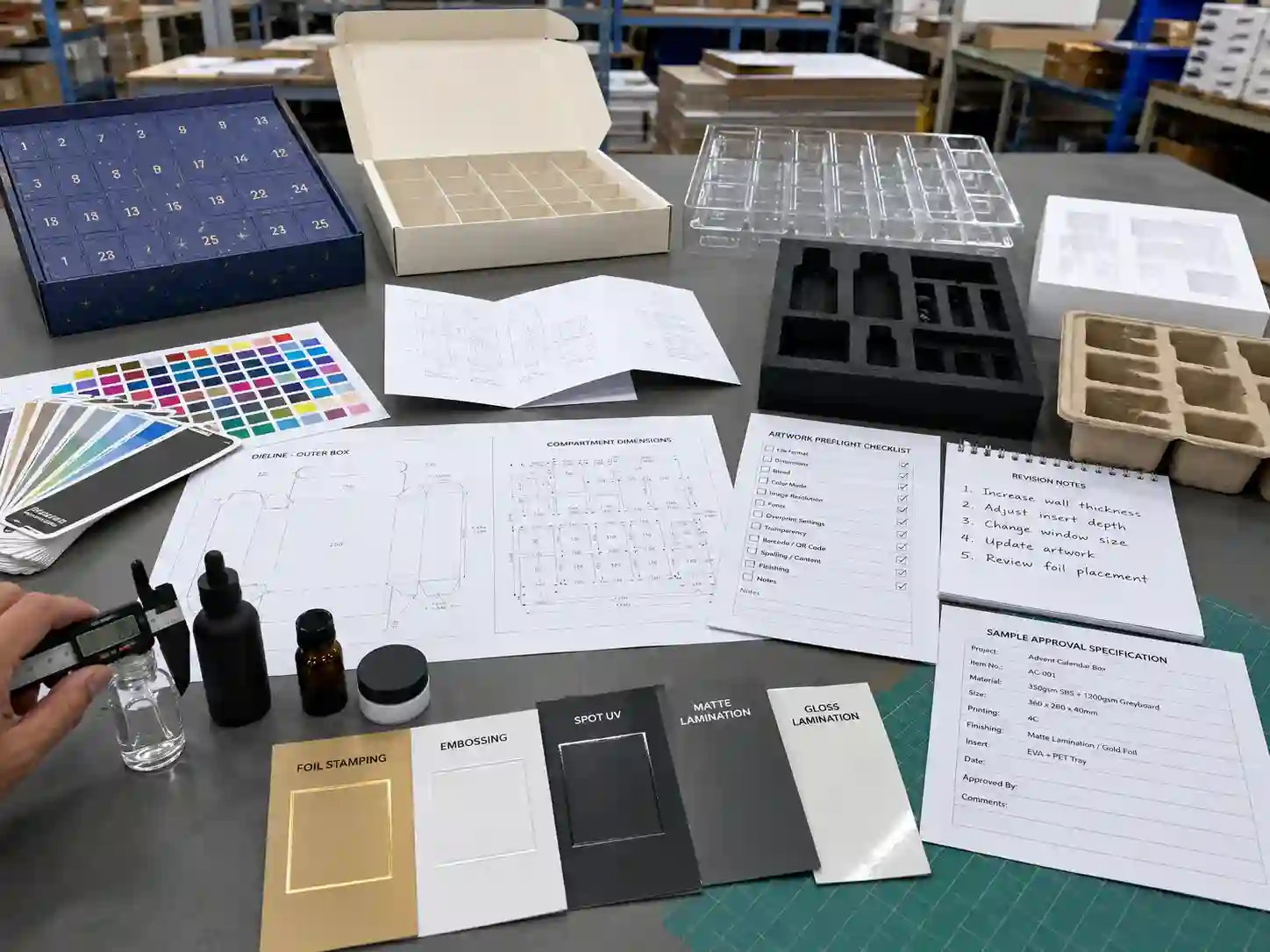
What happens during the advent calendar box sampling process?
The advent calendar box sampling process normally moves through specification review, structural engineering, prototype building, product-fit testing, artwork proofing, printed sample production, inspection, and buyer approval. Complex projects may repeat some stages before the sample is released for mass production.
- RFQ and specification review: The supplier reviews the product list, box concept, quantity, target market, printing, finishes, insert preference, packing method, and delivery deadline.
- Compartment planning: Products are assigned to cavities according to size, weight, sequence, presentation, and balance within the box.
- Dieline development: The factory creates or adjusts the cutting and creasing layout for the outer box, drawers, doors, partitions, and insert.
- White prototype production: An unprinted structure is cut and assembled to test dimensions, opening function, panel strength, and product loading.
- Structural revision: Drawer gaps, door openings, cavity sizes, insert supports, board thickness, and assembly methods are corrected.
- Artwork placement: Approved graphics are applied to the final dieline, followed by a digital proof or printed proof for review.
- Printed sample production: The factory prints, laminates, cuts, wraps, finishes, and assembles the sample using the agreed sample method.
- Loaded inspection: Products are inserted and the supplier checks appearance, fit, closure, opening, alignment, and handling.
- Buyer approval: The buyer approves the sample or issues a consolidated revision list with marked photos and measurable requirements.
- Pre-production confirmation: Final materials, artwork files, specifications, packing instructions, QC points, and approved sample references are frozen for mass production.
Buyers can review related custom advent calendar box services to understand how structural development, sample production, printing, assembly, and export packing may be organized within one project.
How long does sampling take, and what affects the cost?
Sampling lead time depends on structural complexity, the availability of products and artwork, the sample method, finishing processes, and the number of revision rounds. Buyers should request a project-specific schedule instead of assuming one universal sampling period.
A simple unprinted folding-carton prototype is generally faster to prepare than a multi-drawer rigid box with wrapped components, magnets, foil stamping, embossing, and a custom PET or molded insert. A production-process sample can also require tooling, printing setup, or outsourced finishing coordination.
Typical sample cost drivers include:
- Structural engineering and dieline development
- Number of drawers, doors, trays, sleeves, and internal components
- Hand assembly required for rigid-box prototypes
- Custom cutting dies, foil dies, embossing plates, or tray tooling
- Greyboard, paperboard, specialty paper, insert, and accessory materials
- Digital printing versus production printing
- Foil stamping, spot UV, embossing, lamination, magnets, ribbons, or handles
- International courier cost for bulky assembled samples
- Additional samples for separate offices, photographers, or testing locations
Buyer tip: Ask the quotation to separate sample charges, tooling charges, courier charges, and refundable or non-refundable items. This makes supplier comparisons more accurate.
How does sampling affect MOQ and the mass-production quotation?
The sample confirms the specification on which MOQ and bulk pricing are calculated. Changes made after sampling—such as increasing board thickness, replacing a paper insert with PET, adding drawers, or changing from matte lamination to specialty paper—can change both the unit price and the practical MOQ.
MOQ may be influenced by printing setup, material purchasing quantities, custom insert tooling, finishing processes, and production efficiency. Buyers comparing quotations should make sure each supplier is pricing the same structure, dimensions, materials, insert type, printing process, finishing, assembly level, and packing method.
Which quotation is actually comparable?
A lower quotation is not necessarily equivalent if it uses thinner board, fewer wrapped components, a simpler insert, digital printing instead of offset printing, reduced finishing coverage, weaker export cartons, or flat packing instead of assembled packing.
Use this decision guide:
- Choose a white prototype first when product sizes, compartment layout, or opening function are not yet confirmed.
- Choose a digitally printed sample when the structure is approved but marketing teams need an appearance sample.
- Choose a production-process sample when exact finishing, premium materials, or retail approval carries high commercial risk.
- Choose a loaded pre-production sample when final product fit, packing labor, transit behavior, and QC standards must be documented.
- Request multiple identical samples when the brand, importer, filling company, inspection team, and factory need matching approval references.
Buyers can compare possible formats through the custom advent calendar box products page or discuss a custom structure with a custom advent calendar boxes manufacturer.
What quality-control checks should be completed before sample approval?
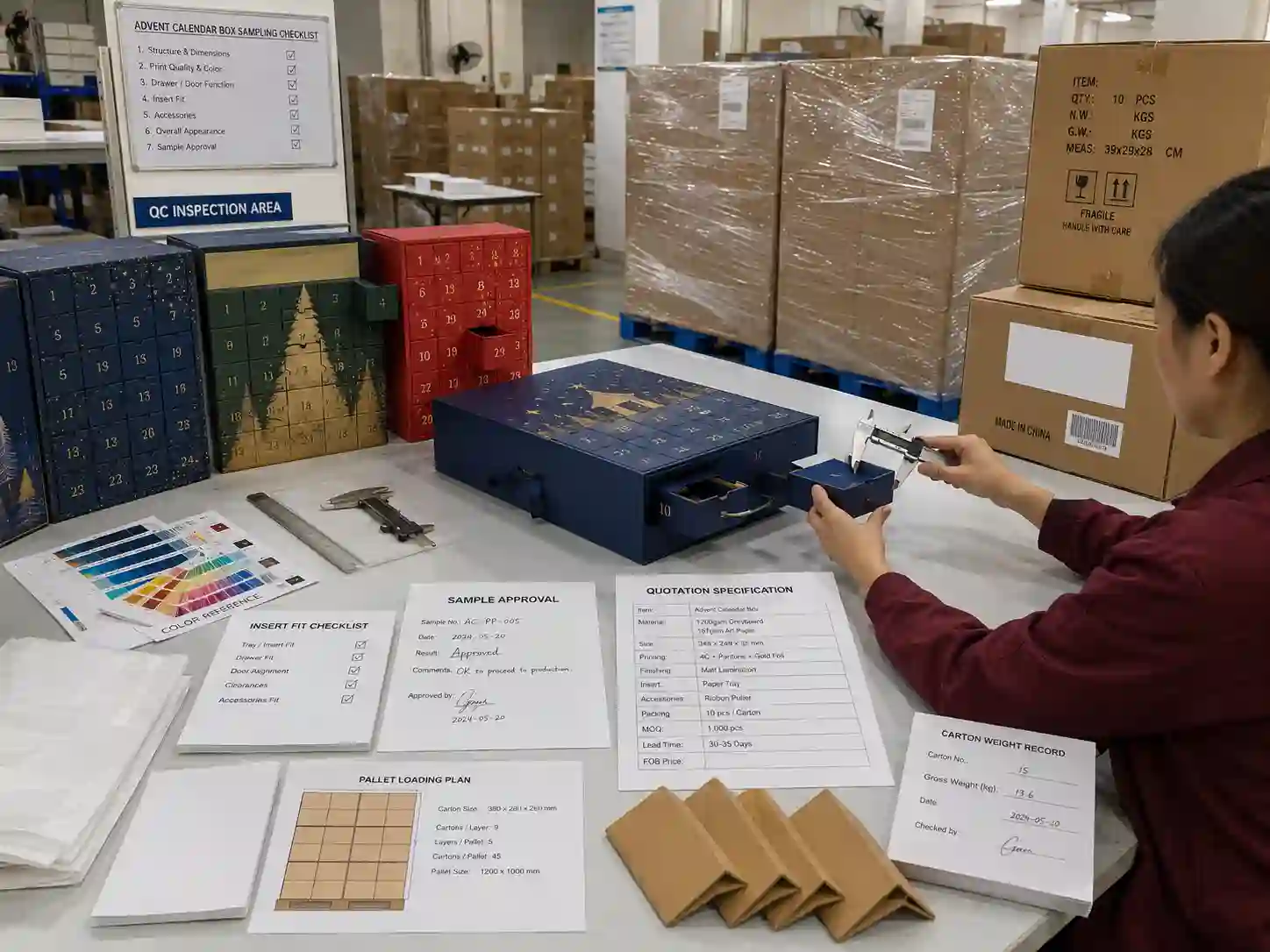
Sample approval should be based on measurable construction and functional requirements, not only on whether the box looks attractive. The approved sample, signed specification, artwork file, color reference, and revision record should work together as the QC standard.
A practical approval checklist includes:
- Overall box dimensions and compartment dimensions are recorded.
- Greyboard, paperboard, wrapping paper, insert, and accessory materials are identified.
- Doors open cleanly and perforations do not damage adjacent panels.
- Drawers slide consistently without sticking or excessive gaps.
- Products remain secure when the sample is moved in normal orientations.
- Products can be removed without tools or damage.
- Printed color is checked against the approved proof or Pantone reference.
- Foil, embossing, spot UV, and lamination are correctly positioned.
- Wrapped corners, edges, joints, and glue areas are clean.
- Door numbers, text, barcodes, and shipping information are correct.
- Loaded box weight and center of gravity are acceptable.
- Export-packing requirements are documented before production begins.
QC tip: Record acceptable tolerances and defect limits in writing. A sample alone may not show how much variation is permitted for dimensions, drawer gaps, color, foil registration, glue marks, or surface scratches.
How should export packing be tested during sampling?
The supplier should evaluate how the sample will be protected, packed into export cartons, palletized, and delivered. This is important because an elaborate calendar may pass appearance inspection but still develop crushed corners, rubbed surfaces, open drawers, or distorted panels during transport.
Depending on the structure, packing may include tissue sheets, paper pads, polybags where permitted, corner protectors, partitions, individual shipping boxes, reinforced export cartons, and pallet stretch wrap. Flat-packed folding cartons may reduce freight volume, while assembled rigid calendars normally require more protective space.
The buyer should confirm carton quantity, carton dimensions, gross weight, net weight, pallet limits, shipping marks, barcode label area, and orientation requirements. For projects needing distribution testing, buyers can discuss suitable procedures with their logistics provider or refer to the official International Safe Transit Association resources.
When responsible paper sourcing is part of the specification, buyers should request documentary verification from the supplier and can review information from the official Forest Stewardship Council. Certification claims should be checked for the specific material, supplier, and order rather than assumed from a general statement.
How should buyers compare advent calendar box suppliers?
Compare suppliers by the clarity of their engineering process, sample documentation, production controls, and quotation details—not only by sample appearance or unit price. A reliable supplier should identify risks before bulk production and explain which sample features will match the final manufacturing process.
Ask each supplier:
- Who develops the dieline, insert, and product-loading plan?
- Can the supplier build both structural and printed samples?
- Which sample processes differ from mass production?
- How are artwork revisions and sample versions controlled?
- Can actual products be tested before approval?
- Which QC records will be used during mass production?
- How will printed color and finishing be approved?
- Can the supplier provide carton and pallet data before shipment?
- Which components are produced in-house and which are subcontracted?
- How are delays, defects, or specification changes communicated?
Information about the Giftpackpro packaging factory can help purchasing teams understand the supplier’s positioning, while additional advent calendar box buying guides can support structure, insert, printing, MOQ, and shipping decisions.
What information should be prepared before requesting a quotation?
A complete RFQ allows the supplier to recommend the correct sample path and prepare a more comparable quotation. Missing product dimensions, quantity, artwork, or packing requirements usually leads to assumptions that may later change the price.
Prepare the following:
- Required order quantity and estimated repeat volume
- Target delivery date and destination country
- Preferred structure or reference drawing
- Product list with dimensions, weights, photos, and loading orientation
- Number and sequence of doors, drawers, or compartments
- Preferred rigid box, folding carton, or hybrid construction
- Insert preference, sustainability requirements, and product-protection needs
- Artwork status, colors, printing, lamination, and special finishes
- Required sample type and number of sample sets
- Retail, e-commerce, filling, export-carton, and pallet requirements
- Barcode, label, compliance-text, or shipping-mark requirements
- Inspection, testing, or third-party verification expectations
A buyer can then request a custom quote with enough information for Giftpackpro to review the structure, sample method, potential tooling, MOQ, lead time, and export-packing plan.
What sampling mistakes should buyers avoid?
The most common mistake is approving appearance before confirming product fit and production feasibility. Buyers should freeze the product list, dimensions, insert arrangement, and opening method before approving final artwork and decorative finishing.
- Do not approve a sample loaded only with visually similar products when the actual products differ in weight or shape.
- Do not assume digital sample colors will automatically match offset mass production.
- Do not change compartment dimensions without checking the external box size and shipping volume.
- Do not compare quotations based on photographs without comparing written specifications.
- Do not approve a drawer box without testing sliding clearance after wrapping and loading.
- Do not overlook filling efficiency; a difficult insert can increase packing labor and product damage.
- Do not leave export-carton design until the bulk boxes are completed.
- Do not issue revisions through scattered messages; use one numbered revision document.
- Do not begin mass production until the final dieline, artwork, materials, finishes, insert, packing, and QC requirements are approved.
Frequently asked questions about advent calendar box sampling
Is a white prototype enough for production approval?
A white prototype is enough to approve structure, dimensions, opening function, and basic product fit, but it is not enough to approve printed color, lamination, foil stamping, embossing, spot UV, or final surface quality. Complex projects normally need a printed or pre-production reference as well.
Should actual products be sent to the packaging factory?
Actual products are strongly recommended when dimensions are irregular, tolerances are tight, surfaces are fragile, or weight affects the insert. Secure dummy products may be acceptable when final products are unavailable, provided their dimensions and weight accurately represent production items.
Can one sample be used for photography and production approval?
It can, but a photography sample may prioritize appearance while using simulated finishes or hand assembly. Buyers should confirm whether it also represents the approved materials, construction, and production process before using it as the mass-production standard.
Why does the sample differ slightly from mass production?
Samples may be digitally printed, hand cut, manually wrapped, or assembled without full production tooling. These methods can create differences in color, edge consistency, foil registration, or component fit. The supplier should disclose these expected differences before approval.
When should a pre-production sample be requested?
Request a pre-production sample when the project uses a new structure, premium finishes, strict retail approval, unusual products, tight insert tolerances, or a high order value. It is also useful when multiple filling or inspection teams need a final physical reference.
Does sample approval lock the bulk price?
Sample approval supports final pricing only when the quantity, materials, dimensions, printing, finishes, insert, accessories, assembly, QC, and packing method remain unchanged. Any later specification change should be reviewed for cost and lead-time impact.
Prepare the right information before starting your sample
The advent calendar box sampling process is most effective when the buyer provides confirmed product data, a clear structure objective, realistic printing requirements, an estimated order quantity, a delivery schedule, and export-packing expectations. Giftpackpro can review these details and recommend whether the project should begin with a white prototype, printed sample, or loaded pre-production sample.
Before sending an RFQ, prepare your product dimensions and weights, compartment plan, artwork status, preferred materials, finishing requirements, order quantity, destination, and target delivery date. These details help the factory identify engineering risks, calculate a more accurate quotation, and build a sample that can become a practical reference for mass production and QC.