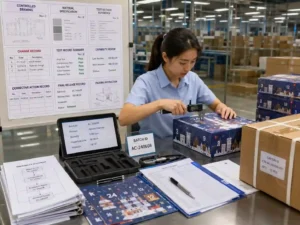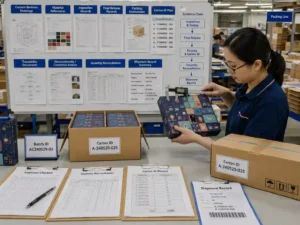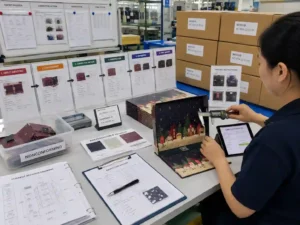
Quick answer: A custom advent calendar box sample is made by confirming the product dimensions, selecting a box structure, engineering the compartments and inserts, preparing a dieline, checking artwork, producing a prototype, loading the actual products, and recording approval requirements before mass production. Buyers should normally review more than appearance. The sample must confirm product fit, door or drawer operation, board strength, print color, finishing position, assembly tolerance, packing method, and shipping protection. The most reliable approval process uses a written specification, actual product samples, marked revision notes, and a final pre-production sample that becomes the reference standard for bulk production and QC.
Why should buyers make a sample before ordering custom advent calendar boxes?
A sample is necessary because an advent calendar combines structural packaging, multiple product compartments, printed graphics, inserts, manual assembly, and repeated opening functions. A flat artwork proof alone cannot confirm whether the finished calendar will work correctly.
The sample helps a buyer identify practical problems before materials are purchased for mass production. These problems may include drawers that bind, doors that tear, products that rotate inside cavities, bottles that collide with the outer lid, foil that crosses a crease, or an assembled box that is too large for the planned export carton.
A properly approved sample should answer five questions:
- Does the structure remain stable when all products are loaded?
- Does every product fit its assigned compartment without excessive movement?
- Can customers open the doors, drawers, or book-style panels without damaging the box?
- Do the printed colors, text, numbers, and decorative finishes match the approved artwork?
- Can the calendar be packed and shipped without crushing, abrasion, or component movement?
Buyer tip: Treat the sample as an engineering approval tool, not only as a sales presentation model. A visually attractive sample can still fail during filling, retail handling, or e-commerce delivery.
Which type of custom advent calendar box sample do you need?
The correct sample type depends on what the buyer needs to approve. A structure-only prototype is suitable for early engineering, while a production-equivalent pre-production sample is needed before approving bulk printing and assembly.
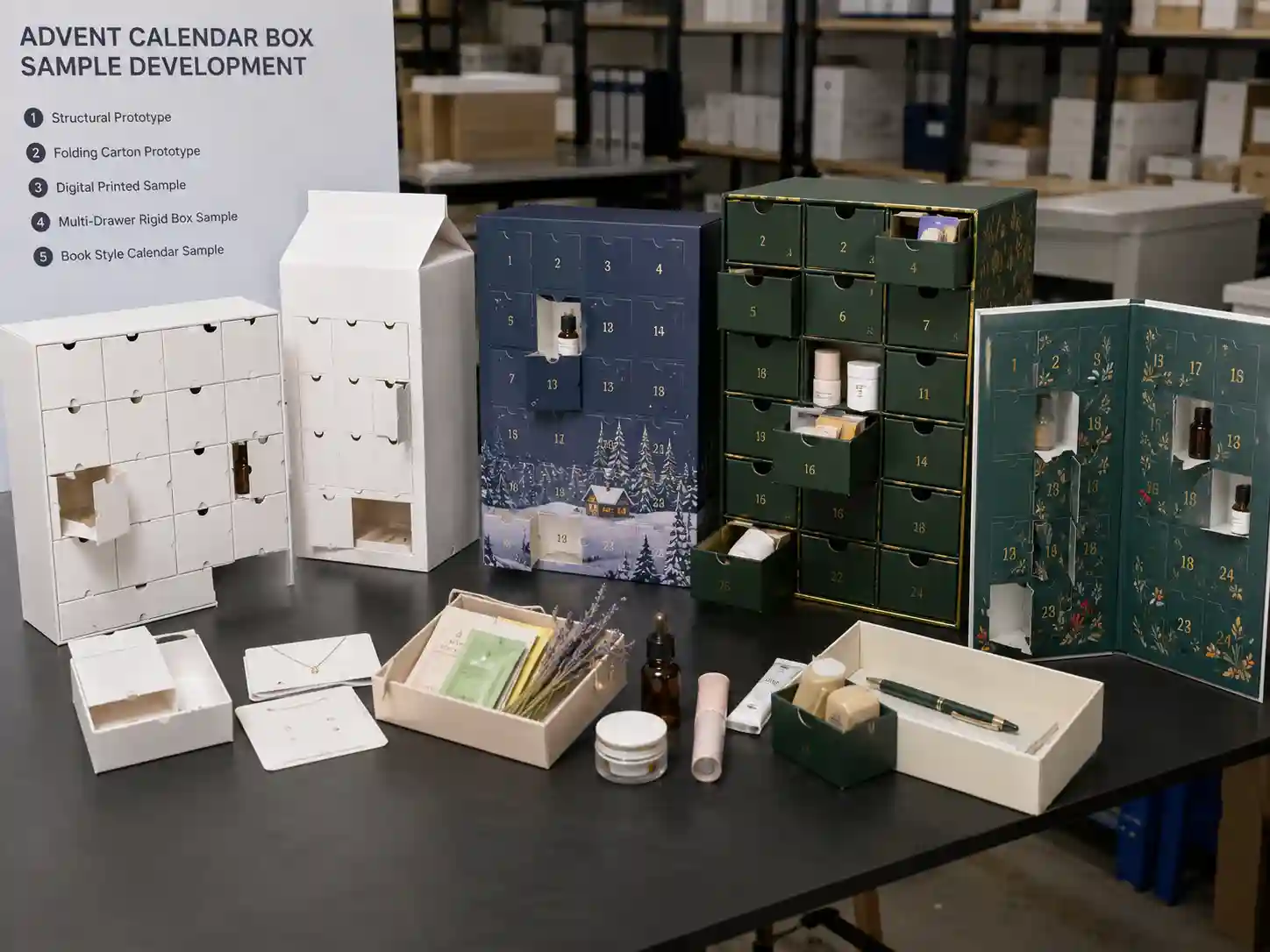
| Sample type | Main purpose | Typical features | What it cannot fully confirm |
|---|---|---|---|
| Digital 3D rendering | Review concept and visual direction | Structure visualization, artwork placement, approximate finishes | Board strength, insert fit, opening function, real color |
| White structural prototype | Check dimensions and construction | Unprinted paperboard or greyboard, working doors or drawers, basic insert | Final print color, foil quality, lamination, exact surface appearance |
| Digitally printed sample | Review graphics and overall presentation | Printed artwork, approximate colors, assembled structure, sample insert | Exact offset-print color or all mass-production finishes |
| Finish test or wet proof | Approve critical decoration | Actual paper, foil stamping, embossing, spot UV, lamination, color proof | Complete box function unless combined with a structural sample |
| Loaded functional sample | Test actual products and user interaction | Real products, engineered cavities, opening tests, weight and balance review | Mass-production consistency unless production materials are used |
| Pre-production sample | Set the approval standard for bulk production | Confirmed materials, printing, finishes, insert, assembly and packing details | Nothing significant should remain unapproved before production |
A complex rigid drawer box may require a white prototype, a printed sample, and a final pre-production sample. A simpler folding carton with die-cut doors may need fewer stages when the products, structure, and artwork are straightforward.
Which advent calendar structure should be sampled first?
Buyers should sample the structure that best matches the product weight, presentation level, filling method, shipping plan, and target cost. Changing the structure after artwork approval can require a new dieline, new insert dimensions, and another sampling cycle.
When is a rigid box sample appropriate?
A rigid box sample is appropriate for premium gift sets, heavier products, reusable presentation, and structures requiring strong hinges, drawers, or book-style panels. Greyboard thickness, wrapped-paper grain direction, hinge gaps, magnet position, and drawer clearance all need physical testing.
For a multi-drawer rigid calendar, the sample should confirm that each drawer slides smoothly after the box is fully wrapped. A drawer that works in an unfinished prototype may become too tight after paper wrapping, glue application, or humidity-related material movement.
When should buyers test a folding carton sample?
A folding carton sample is suitable when lower weight, flat packing, automated die cutting, and more efficient shipping volume are priorities. The prototype should confirm crease performance, locking tabs, door perforations, internal partitions, and the time required for assembly.
Door-opening folding calendars require special attention around perforation strength. The doors must remain closed during packing and transport but still open cleanly without tearing adjacent printed areas.
What must be tested on drawer and door-opening boxes?
Drawer boxes require sliding tolerance, pull-tab strength, stop features, and product-load testing. Door-opening boxes require perforation testing, finger access, hinge direction, cavity clearance, and checks that the product cannot push the door open from behind.
Buyers can compare these structures through Giftpackpro’s custom advent calendar box products or discuss development options with a custom advent calendar boxes manufacturer before requesting a physical prototype.
What product information is required before insert engineering begins?
The factory needs accurate product data before it can engineer the insert. Outer box dimensions should not be finalized by guessing from product descriptions or website images.
For each item, prepare:
- Product length, width, height, diameter, and weight
- The widest point, including caps, pumps, seals, handles, or folded sachet edges
- Product orientation inside the calendar
- Fragile, sharp, leaking, or pressure-sensitive areas
- Whether the consumer must remove the item using fingers, a ribbon, or a lift tab
- Whether products will be filled into the calendar by the factory or by the buyer
- Actual products, empty containers, or accurate 3D files when available
A practical starting point is to allow controlled clearance around the product instead of making the cavity exactly equal to the nominal product size. Rigid bottles may need approximately 1–2 mm of initial engineering clearance on relevant sides, followed by physical fit testing. Flexible sachets, fabric items, and products with dimensional variation may need more.
Factory tip: Send several units when product dimensions vary between batches. Engineering an insert around one unusually small unit can create filling problems during the campaign.
Which insert should be used in the sample?
The insert should be selected according to product shape, weight, protection level, sustainability goals, appearance, and filling method. The sample must use an insert close enough to the intended production material to provide meaningful fit results.
Paper inserts and paperboard partitions
Folded paper inserts are useful for lightweight products, flat-packed projects, and packaging programs that prioritize fiber-based materials. The sample should test fold direction, locking tabs, product retention, finger access, and whether printed or unprinted edges remain visible.
Paper partitions are economical for regularly shaped products but may not hold curved bottles or small accessories securely without additional tabs or supports.
PET trays
A clear or colored PET tray can provide precise cavities, high product visibility, and efficient loading. The sample should verify tray thickness, edge clearance, cavity depth, de-nesting, static attraction, and whether the tray moves inside the outer structure.
Thermoformed tray tooling may not be economical during the earliest concept stage. A factory may first use a mock-up tray or CNC-cut material, then produce a closer-to-production tray after dimensions are approved.
EVA and foam inserts
EVA and foam are suitable for small, fragile, premium, or irregular products that require strong retention. Sampling should confirm density, thickness, cut-edge quality, odor, surface lamination, pull-out access, and possible compression marks on delicate products.
Molded pulp inserts
Molded pulp can be considered when protective shaping and fiber-based presentation are important. Its sample process may involve tooling and should account for surface texture, dimensional tolerance, nesting, product friction, and moisture sensitivity.
Material sourcing claims should be verified through documentation rather than assumed from appearance. Buyers interested in responsibly sourced paper can review the official Forest Stewardship Council information and ask the supplier what chain-of-custody evidence can be provided for the specific order.
How is the dieline developed and checked?
The dieline is developed after the structure, product layout, insert type, and main dimensions are confirmed. It should be checked structurally before final artwork is placed.
- The buyer provides product data, target box style, compartment count, and filling requirements.
- The packaging engineer creates the outer structure and internal layout.
- A blank prototype is cut and assembled.
- Actual products are loaded and removed repeatedly.
- Clearances, folds, doors, drawers, supports, and insert locks are revised.
- The approved structural dieline is released for artwork placement.
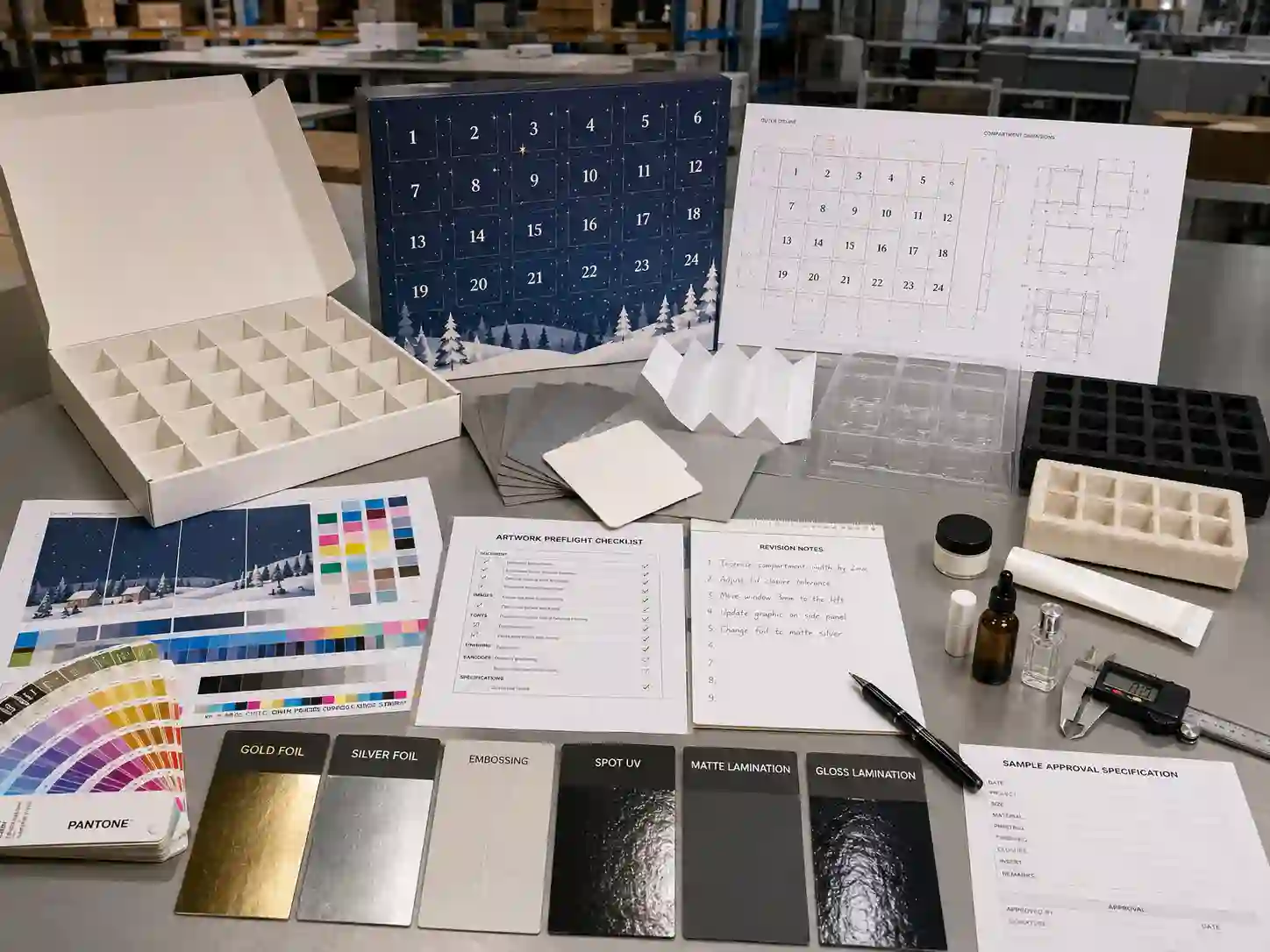
Dieline review should include cut lines, crease lines, perforations, glue areas, bleed, safe zones, grain direction, wrapped edges, hidden panels, and finishing areas. Text and numbered doors should not be placed too close to cuts or folds.
Buyer tip: Do not resize a factory dieline inside design software without approval. Even a small proportional change can affect drawer fit, wrapped-board gaps, insert alignment, or finished box dimensions.
How should artwork and print finishes be approved on the sample?
Artwork approval should separate content accuracy from color and finishing approval. A PDF can confirm text and placement, but it cannot reliably represent the final paper texture, Pantone color, foil reflection, embossing depth, or lamination appearance.
The artwork package should include:
- Editable vector files with linked or embedded images
- CMYK artwork and clearly identified Pantone references
- Outlined fonts or supplied font files where licensing permits
- Bleed and safe margins based on the approved dieline
- Separate layers for foil stamping, embossing, debossing, spot UV, and die cutting
- Barcode specifications and a quiet zone around the code
- A numbered-door map matching the product filling plan
- Version number and approval date
For color-critical campaigns, buyers should approve a physical proof or printed sheet using the intended substrate. The same CMYK file may appear different on coated paper, uncoated paper, textured stock, or material covered with matte lamination.
Foil stamping should be checked for registration, pinholes, incomplete coverage, cracking across folds, and excessive pressure. Embossing should be evaluated from both sides of the paper because deep tooling can affect nearby graphics or wrapped edges. Spot UV needs sufficient separation from folds and cut lines to avoid cracking or registration problems.
What is the step-by-step sampling process?
A controlled sampling process moves from information collection to structure approval, appearance approval, loaded testing, and written sign-off. Each stage should close specific risks before the next stage begins.
- Define the brief: Confirm product assortment, target structure, retail channel, budget direction, filling location, order quantity, launch date, and shipping destination.
- Review the products: Measure actual items and identify fragile parts, size variation, weight distribution, and removal requirements.
- Prepare the structural concept: Select a rigid box, folding carton, drawer box, book-style box, or hybrid construction.
- Engineer the insert: Assign each product to a compartment and develop cavities, partitions, supports, or pull-out features.
- Make a white prototype: Check dimensions, doors, drawers, hinges, folding, assembly, and product fit.
- Revise the dieline: Record dimensional changes instead of correcting the sample informally without updating files.
- Prepare and preflight artwork: Check copy, numbering, bleed, color mode, finishing layers, barcodes, and legal information supplied by the buyer.
- Produce the printed sample: Apply the closest practical paper, printing, lamination, foil, embossing, or spot UV process.
- Conduct loaded testing: Fill every compartment, operate all openings, move the sample through handling positions, and inspect product movement.
- Approve the packing method: Define tissue, sleeves, corner protection, inner cartons, export cartons, and pallet requirements.
- Issue written approval: Sign or confirm the pre-production sample, specification sheet, approved artwork, and revision record.
Indicative lead times vary by complexity. A white structural prototype may take approximately 3–7 working days after the engineering details are confirmed. A printed sample often requires about 7–15 working days, while complex tooling, specialty paper, molded inserts, or multiple revisions can extend the schedule.
How much does an advent calendar sample cost?
Sample cost is driven by engineering time, materials, manual assembly, printing method, finishing setup, insert tooling, courier delivery, and the number of revisions. It should not be compared only by the physical size of the box.
Common cost drivers include:
- Number and complexity of doors, drawers, compartments, or moving parts
- Rigid greyboard construction versus folding paperboard
- Custom thermoformed, molded pulp, EVA, or foam insert development
- Digital printing versus production-equivalent offset printing
- Foil dies, embossing dies, cutting dies, and tray tooling
- Specialty paper, textured stock, magnets, ribbons, and hardware
- Hand assembly and product loading
- International courier cost based on volumetric weight
A low-cost mock-up may be sufficient for initial size confirmation, but it should not be accepted as proof of final mass-production quality. Ask the supplier to state which sample elements are production-equivalent and which are simulated.
Does the sample affect MOQ and mass-production pricing?
The sample does not by itself determine MOQ, but it confirms specifications that influence MOQ and unit price. Custom paper, printing, dies, inserts, manual assembly, and finishing setup can each create different minimum production requirements.
Buyers should request quotations at realistic quantity tiers, such as an initial campaign quantity and one or two higher-volume options. The quotation should clearly state whether tooling, sample fees, product loading, export cartons, pallets, and delivery are included.
A supplier should not reduce the quoted price by silently changing the approved sample specification. Compare board thickness, paper type, printing process, insert material, finish coverage, accessories, carton strength, and packing quantity line by line.
How should buyers inspect and approve the sample?
Sample approval should use a written checklist and the actual products. Verbal comments such as “make it stronger” or “improve the color” are too vague for repeatable production control.
Practical custom advent calendar box sample checklist
- Confirm closed and open box dimensions.
- Check greyboard or paperboard thickness against the specification.
- Load all products in the assigned order.
- Verify that products do not collide when the box closes.
- Check cavity retention by gently rotating and handling the loaded calendar.
- Open and close every drawer, door, lid, and magnetic panel several times.
- Inspect door perforations, finger notches, ribbons, pull tabs, and drawer stops.
- Check printed text, dates, numbering, symbols, barcodes, and product maps.
- Compare CMYK and Pantone colors under consistent lighting.
- Inspect foil stamping, embossing, spot UV, matte lamination, and gloss lamination.
- Check glue marks, exposed greyboard, bubbling, warping, scratches, and dirty edges.
- Confirm insert position, visible gaps, and product-removal access.
- Weigh the loaded sample for carton and freight planning.
- Photograph approved details and record all final revisions.
QC tip: Keep one approved pre-production sample at the factory and one with the buyer when practical. Both samples should carry the same approval version, date, artwork reference, and material specification.
How should sample packing and export delivery be planned?
The sample should be packed in a way that protects its appearance without hiding weaknesses in the planned production packing. A courier sample may need additional protection, but the buyer should still review the proposed bulk packing separately.
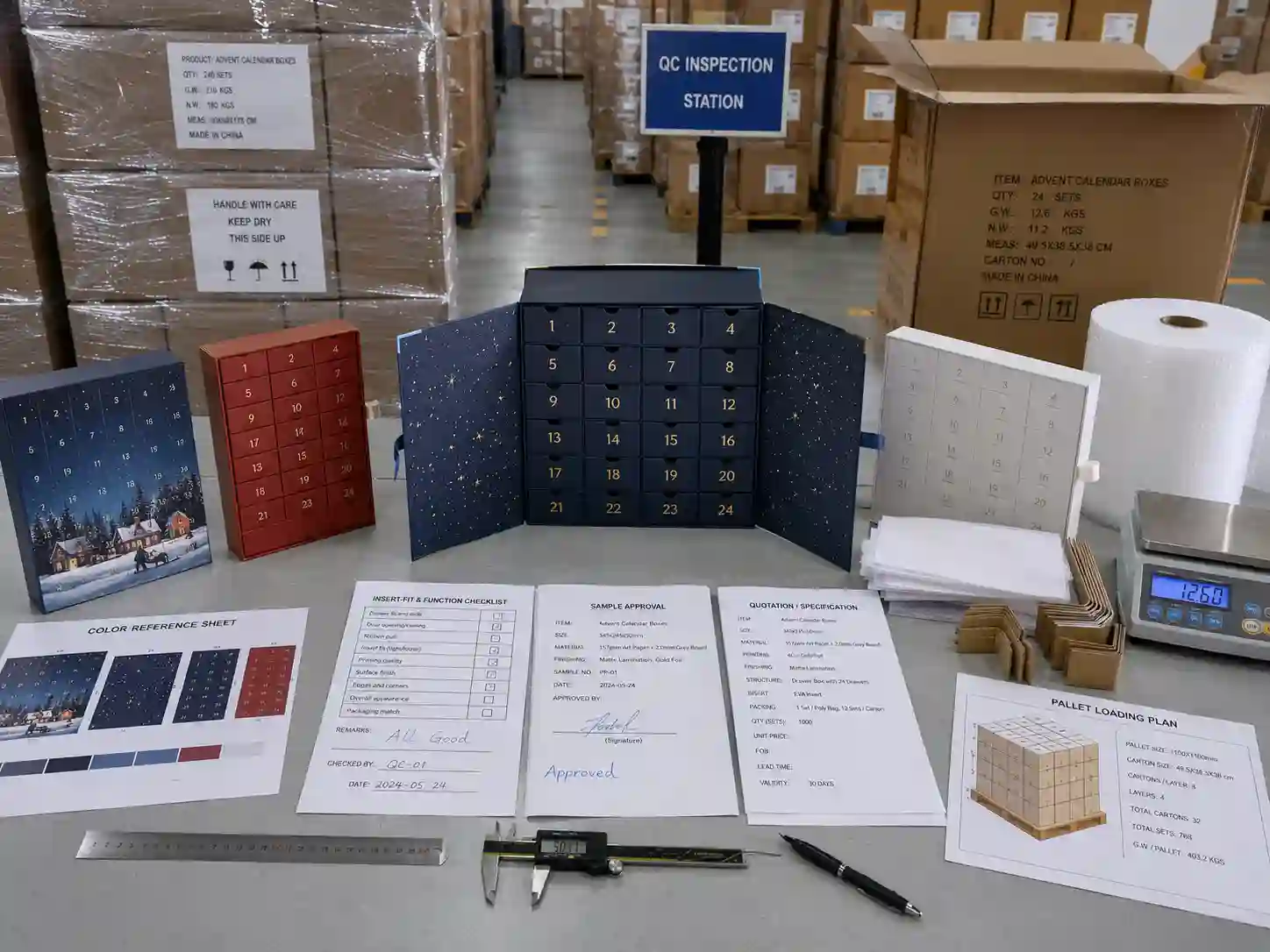
Typical protection can include tissue sheets, paper pads, corner protectors, individual sleeves, inner cartons, reinforced export cartons, and controlled empty space. Heavy calendars may need double-wall cartons or lower carton quantities to keep handling weight practical.
For mass production, the packing specification should define:
- Whether calendars are shipped assembled or flat packed
- Units per inner carton and export carton
- Carton dimensions, gross weight, and net weight
- Orientation arrows and handling instructions
- Shipping marks, item codes, purchase-order numbers, and barcode areas
- Pallet size, stacking pattern, corner boards, strapping, and stretch wrap
- Moisture protection requirements for the route and storage conditions
Where distribution testing is required, buyers can discuss an appropriate test plan with their logistics team and review information from the official International Safe Transit Association. The selected test level should reflect the product, sales channel, shipping route, and final packed configuration.
How can buyers compare sample-making suppliers?
Compare suppliers by their engineering process, communication quality, revision control, material transparency, and ability to reproduce the approved sample in mass production. A polished presentation sample is not enough if the factory cannot explain how it will control bulk production.
| Decision point | Stronger supplier response | Warning sign |
|---|---|---|
| Product-fit engineering | Requests actual products, dimensions, weights, tolerances, and filling method | Quotes only from a reference image |
| Sample scope | Explains what is production-equivalent and what is simulated | Calls every prototype a final sample |
| Revision control | Updates the dieline, specification, and revision number after changes | Makes undocumented hand adjustments |
| Material confirmation | Lists board, paper, insert, finish, accessories, and packing materials | Uses terms such as “premium material” without specifications |
| QC planning | Defines inspection points from incoming material to final packing | Relies only on finished-product inspection |
| Quotation clarity | Separates sampling, tooling, production, loading, packing, and freight | Provides one total with unclear inclusions |
| Production transfer | Keeps an approved sample and production specification as QC references | Cannot explain how sample details will be repeated in bulk |
Buyers can review the Giftpackpro packaging factory, explore available custom advent calendar box services, and read additional advent calendar box buying guides when building a supplier-comparison checklist.
What mistakes commonly delay sample approval?
Most delays come from incomplete product information, premature artwork approval, unclear revision responsibility, or changes introduced after the structure has been finalized.
- Using estimated product sizes: Small errors multiply across 12, 24, or more compartments.
- Starting artwork before the dieline is stable: Structural revisions then require artwork repositioning and another preflight check.
- Testing with empty containers only: Final product weight can affect drawer movement, board deformation, and insert performance.
- Approving color on a monitor: Screen appearance is not a reliable substitute for a physical print reference.
- Ignoring the filling process: An insert may hold products well but take too long to assemble or load.
- Changing products after insert approval: A new cap, pump, sachet seal, or accessory can invalidate the cavity dimensions.
- Not checking shipping volume: Premium structures can create unexpectedly high volumetric freight costs.
- Approving through scattered messages: Comments should be consolidated into one numbered revision document.
What should buyers prepare before requesting a quotation and sample?
A complete RFQ allows the factory to recommend the correct sample route and produce a more comparable quotation. Missing details usually lead to assumptions, provisional pricing, or repeated questions.
Sample and quotation preparation checklist
- Target box style or reference structure
- Number of compartments, doors, or drawers
- Product list with dimensions, weights, and photos
- Actual products or accurate models for fit testing
- Preferred insert material and sustainability priorities
- Expected order quantity and possible quantity tiers
- Artwork status and required printing or finishes
- Required sample type and approval purpose
- Product-filling location and assembly responsibility
- Retail, wholesale, Amazon, or e-commerce distribution channel
- Required launch date and latest acceptable delivery date
- Shipping destination, packing preference, and pallet requirements
- Any testing, labeling, documentation, or compliance requirements
Decision guide: Choose a white prototype when dimensions and product fit are still uncertain. Choose a digitally printed sample when the structure is approved but visual review is needed. Choose a production-equivalent pre-production sample when the order is ready for final material, printing, finishing, assembly, QC, and packing approval.
Frequently asked questions about custom advent calendar box samples
Can a sample be made without sending the real products?
Yes, but the risk is higher. Accurate dimensions, weights, photos, and 3D models can support early engineering, while final approval should ideally use actual products or production-representative containers.
Can one sample confirm both structure and print color?
Sometimes, but not always. A digitally printed sample can show the overall design while differing from offset-printed mass production. Color-critical projects may need a separate press proof, Pantone reference, or printed production sheet.
Should every compartment have the same tolerance?
No. Clearances should reflect each product’s shape, dimensional variation, surface sensitivity, orientation, and removal method. A rigid glass bottle, flexible sachet, jewelry card, and fabric accessory require different retention strategies.
What happens when the sample needs revisions?
The buyer should issue consolidated, numbered comments. The supplier should update the dieline, artwork, insert drawing, specification, or packing plan affected by those comments before producing the next version.
Is a handmade sample identical to mass production?
Not necessarily. Handmade cutting, digital printing, manual wrapping, and substitute tooling may create differences. The supplier should identify these differences and explain how production materials and machinery will affect the final result.
Can the sample fee be refunded after placing an order?
Policies vary by project and supplier. Buyers should ask whether sample, tooling, printing setup, and courier charges are refundable, creditable, or non-refundable before approving development.
How many samples should a buyer order?
At least one is needed for approval, but multiple samples may be useful for the buyer, filling partner, photography team, retailer, testing laboratory, and factory QC reference. The required number should be confirmed before production starts.
When is the sample officially approved?
Approval is complete when the buyer confirms the physical sample, final artwork, material specification, insert layout, revision record, packing method, and any agreed deviations. Approval should be written and traceable.
Requesting a custom advent calendar box sample from Giftpackpro
A successful custom advent calendar box sample begins with accurate product data and a clearly defined approval objective. Before contacting Giftpackpro, prepare the product dimensions, compartment plan, preferred structure, insert direction, order quantity, artwork status, target delivery date, and shipping destination.
Giftpackpro can review these details, recommend a suitable prototype or pre-production sample, and prepare a quotation covering relevant materials, printing, finishes, inserts, tooling, assembly, QC, and export packing. Use the project checklist above to request a custom quote and reduce avoidable revisions before mass production.