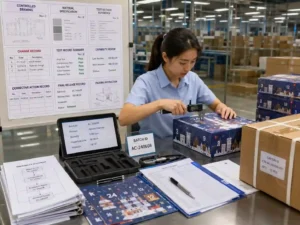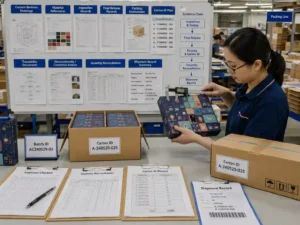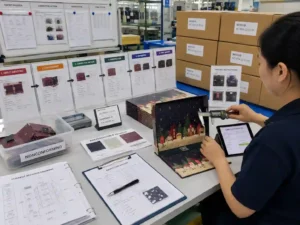
Quick answer: The advent calendar box production process starts with product measurements, structure selection, compartment planning, and dieline engineering. It then moves through insert testing, material specification, artwork proofing, blank and printed samples, pre-production approval, printing, die-cutting, assembly, quality control, export packing, and shipment. For retail and e-commerce campaigns, buyers must plan backward from the required launch date and approve the loaded sample—not only an empty box. Structure, insert tolerance, artwork accuracy, assembly time, carton protection, and delivery schedule should be confirmed before mass production begins.
A successful project is not simply a printed box with numbered doors. It is an engineered packaging system that must hold multiple products, survive assembly and transportation, present correctly on a retail shelf or online product page, and arrive before a fixed seasonal launch date.
This guide explains the process from the buyer’s perspective, including the decisions that affect quotations, samples, lead time, quality, shipping volume, campaign readiness, and supplier reliability.
What should buyers decide before the production process begins?
Before a factory prepares a dieline, the buyer should confirm the product assortment, sales channel, target launch date, packaging format, expected order quantity, and packing method. Missing product data at this stage is one of the most common causes of sample revisions and production delays.
Prepare the actual dimensions and weights of every item that will be packed. For irregular products, send physical samples or dimensioned drawings showing caps, pumps, folded edges, fragile areas, and orientation requirements. A bottle measured only at its widest point may still fail to fit if its shoulder, cap, or pump collides with the insert.
Information needed for packaging engineering
- Product name, quantity, dimensions, weight, and fragility for every compartment
- Required product orientation, such as upright, flat, label-facing, or cap-up
- Retail channel: physical store, direct-to-consumer, marketplace, subscription box, or promotional distribution
- Desired box type, opening experience, and target retail positioning
- Target order quantity and possible reorder volume
- Required delivery destination, launch date, and latest acceptable arrival date
- Artwork format, printing colors, finishes, barcodes, warnings, and legal text
- Whether boxes should be shipped assembled, partly assembled, or flat packed
Buyer tip: Build the packaging schedule backward from the date products must be available in the warehouse, not from the public campaign launch. Allow time for inbound inspection, fulfillment preparation, photography, product-page setup, retailer distribution, and possible customs delays.
Which advent calendar structure fits the sales channel?
The correct structure depends on product weight, desired presentation, assembly capacity, shipping-cost target, and whether the package will be displayed on a shelf or shipped individually to e-commerce customers. A visually impressive structure may create unnecessary freight and fulfillment costs if it is not matched to the campaign.
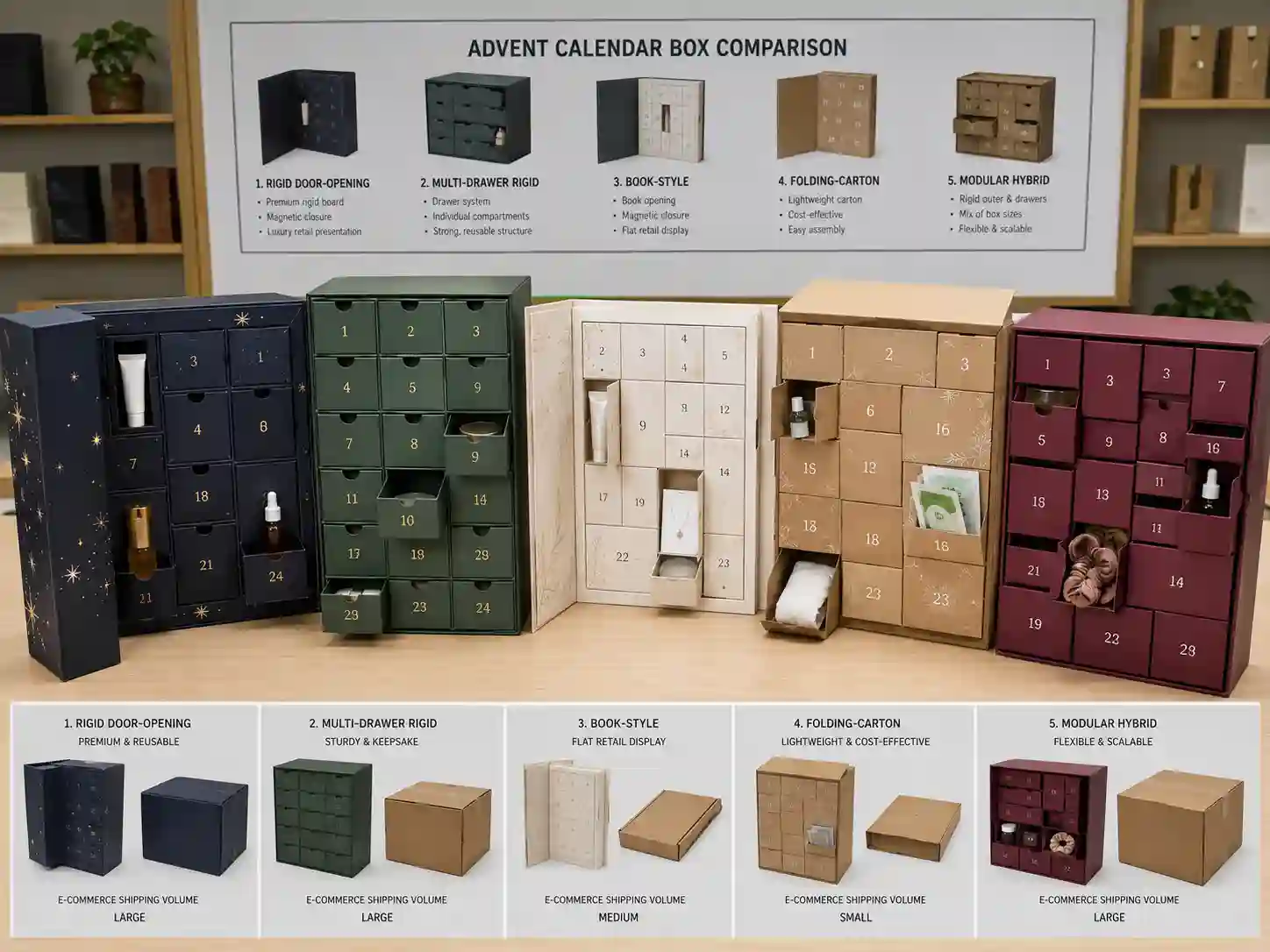
| Structure | Best suited to | Production considerations | Retail and e-commerce impact |
|---|---|---|---|
| Rigid door-opening box | Premium beauty, jewelry, wellness, and gift collections | Requires greyboard wrapping, accurate door registration, insert support, and controlled hand assembly | Strong shelf presence and unboxing value, but higher unit weight and shipping volume |
| Multi-drawer rigid box | Premium products with different sizes or repeated daily use | Drawer clearance, pull-tab strength, sleeve alignment, and anti-jamming tolerance must be tested | High perceived value; assembled packing normally increases freight cost |
| Book-style rigid box | Gift sets requiring a strong front cover and presentation opening | Hinge width, magnet position, cover flatness, and loaded weight distribution are critical | Useful for campaign photography and gifting, but requires protective export packing |
| Folding-carton calendar | Higher-volume retail, promotional programs, and cost-sensitive campaigns | Paperboard grade, locking tabs, crease strength, door perforation, and assembly instructions matter | Can reduce freight through flat packing and supports efficient retail distribution |
| Modular or hybrid structure | Mixed products, refill concepts, or campaigns requiring flexible compartments | More components mean tighter control of part identification, packing sequence, and final assembly | Flexible for product variation but may increase labor and fulfillment complexity |
A rigid box is not automatically the best option for a premium campaign. A well-engineered folding carton with precise printing, foil stamping, embossing, and a secure insert can perform better when thousands of units must be distributed through retail networks. Conversely, a heavy assortment of bottles or candles may require greyboard walls and reinforced internal support.
Buyers comparing concepts can review custom advent calendar box products and discuss structural feasibility through Giftpackpro’s custom advent calendar box services.
How does the dieline control the entire production process?
The dieline converts the packaging concept into a manufacturable layout. It defines cut lines, crease lines, door positions, drawer dimensions, glue areas, insert openings, bleed, safe zones, and assembly relationships between components.
For an advent calendar, the dieline must coordinate the outer structure with every compartment. A door that looks correctly positioned in artwork can still open onto an insert wall, product cap, drawer divider, or structural support if the dieline and insert drawing are developed separately.
Key dieline checks before artwork starts
- Confirm the internal usable dimensions, not only the external box dimensions.
- Check the number, size, and sequence of doors or drawers.
- Verify finger notches, ribbon pulls, perforations, and opening direction.
- Confirm glue flaps do not block compartments or printed content.
- Allow for paper wrapping thickness, board thickness, folds, and assembly tolerance.
- Check that barcodes, warnings, and legal text remain visible after folding.
- Review how the box will be packed into the export carton.
Factory tip: Artwork should be placed only on the approved production dieline. Resizing an old design or transferring artwork from a different structure can shift door numbers, foil areas, barcodes, and front-panel graphics.
How are inserts engineered around the products?
The insert should immobilize products without making them difficult to remove. Its material, cavity dimensions, support depth, and retention method must be selected according to product shape, weight, fragility, presentation, and sustainability requirements.
A paper insert may work for lightweight sachets, stationery, or small cartons. A clear PET tray can provide accurate molded cavities and product visibility. EVA insert and foam can hold delicate or high-value items securely, while molded pulp may suit projects that prioritize fiber-based materials and can accept its texture and tooling limitations.
| Insert option | Main advantages | Important checks |
|---|---|---|
| Folded paper insert | Printable, lightweight, often flat-packable, and suitable for many rectangular products | Compression strength, locking tabs, fold accuracy, and product movement |
| PET tray | Precise cavities, good product retention, and efficient loading | Material thickness, cavity draft, sharp edges, deformation, and recycling requirements |
| EVA insert | Clean premium appearance and accurate fit for jewelry, bottles, and accessories | Density, odor, color consistency, surface marks, and removal clearance |
| Foam support | Useful for cushioning, height adjustment, and fragile products | Compression recovery, adhesive performance, dust, and material restrictions |
| Molded pulp | Fiber-based construction and useful protection for suitable product shapes | Tooling, moisture, dimensional variation, surface finish, and cavity accuracy |
Insert dimensions should include controlled clearance rather than matching the product dimensions exactly. Too little clearance causes difficult loading, crushed labels, scratched surfaces, or deformed trays. Too much clearance allows movement, noise, rotated products, and damage during transportation.
Quotable QC principle: An insert is approved only when the real products can be loaded, removed, shaken, transported, and presented in the required orientation without unacceptable movement or damage.
What happens during material, artwork, and finish planning?
Once the structure and insert concept are stable, the factory specifies paperboard or greyboard thickness, wrapping paper, insert material, printing process, surface finish, and assembly method. These specifications should be recorded in the quotation and sample approval documents.
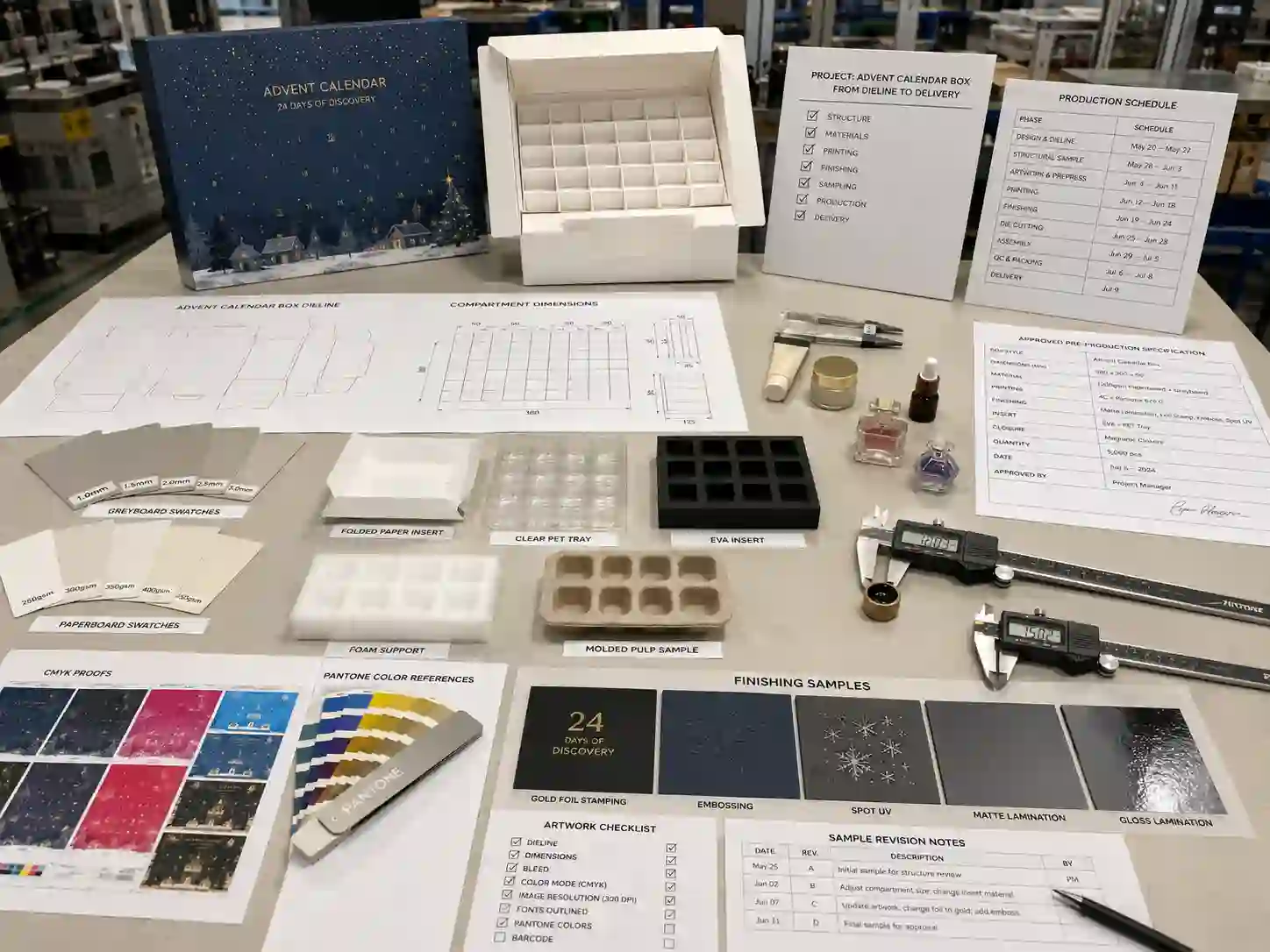
CMYK printing is suitable for photographic and multicolor artwork, while Pantone references can be used for important brand colors. Buyers should understand that CMYK simulations, screen displays, digital proofs, offset-printed samples, and production sheets can appear different because they use different devices and materials.
Common finishes include matte lamination, gloss lamination, foil stamping, embossing, debossing, and spot UV. Each finish must be checked against folds, doors, edges, and glue areas. Fine foil lines close to a crease may crack or become misregistered. Heavy embossing can distort a door or interfere with lamination if the design is not engineered correctly.
Artwork approval checklist
- Use the latest approved dieline and clearly separate cut, crease, perforation, and artwork layers.
- Add sufficient bleed and keep important content inside the safe area.
- Convert or package fonts according to the printer’s file requirements.
- Define CMYK and Pantone colors clearly.
- Create separate layers for foil stamping, embossing, spot UV, white ink, and other finishes.
- Check door numbers, product sequence, languages, warnings, barcodes, and shipping-related labels.
- Verify artwork orientation on every folded panel, drawer, and internal component.
For traceable retail inventory, buyers should obtain and manage barcode identifiers through the appropriate official channel, such as GS1’s guidance on GTIN identification, rather than asking the packaging factory to invent retail barcode data.
Which samples should be approved before mass production?
Buyers should approve the project in stages: structural prototype, printed sample when required, and a fully loaded pre-production sample. Each stage answers a different production question and should not be treated as interchangeable.
1. Blank structural prototype
The blank sample checks dimensions, opening method, compartment layout, insert fit, drawer movement, assembly sequence, and overall product loading. It is usually the fastest way to identify structural problems before paying for full printing and finishing.
2. Printed prototype
The printed sample evaluates artwork scale, color direction, finish placement, text readability, numbering, lamination, and visual presentation. Depending on the sample method, its color and finish may not perfectly reproduce offset mass production, so acceptable reference standards should be documented.
3. Loaded pre-production sample
The pre-production sample should use approved materials, real or weight-equivalent products, final insert dimensions, production artwork, and the intended assembly method. This sample becomes the operational reference for mass production and QC.
Buyer tip: Photograph the approved sample from the front, back, sides, open position, and fully loaded interior. Record dimensions, material specifications, approved color references, finish locations, and any accepted tolerances. Verbal approval alone is difficult to use during production inspection.
How do MOQ and cost change during production planning?
MOQ is influenced by structure, material purchasing, printing setup, die-cutting tools, molded insert tooling, finishing processes, and assembly efficiency. Buyers should compare total project cost and delivered cost rather than selecting a supplier only by the lowest unit price.
The largest cost drivers commonly include:
- Rigid construction versus folding-carton construction
- Overall box size and board consumption
- Number of doors, drawers, trays, partitions, and separate components
- Insert material and tooling requirements
- Printing colors and specialty finishes
- Hand assembly, product loading, and component sorting
- Assembled versus flat-packed export configuration
- Inspection level, protective packing, and pallet requirements
Quantity breaks should use the same specifications. A lower quotation at a larger quantity is not directly comparable if the board thickness, insert material, surface finish, export carton strength, or inspection method has changed.
What happens during mass production?
Mass production normally follows a controlled sequence: incoming material preparation, printing, surface finishing, mounting or lamination, die-cutting, component forming, rigid-box wrapping where applicable, insert production, assembly, in-process inspection, final inspection, and export packing.
The exact flow depends on whether the calendar is a rigid box, drawer box, door-opening box, folding carton, or hybrid system. Multiple components may be produced on different lines and brought together for final assembly, so component identification and quantity control are essential.
Typical factory production sequence
- Confirm the signed specification, artwork, approved sample, quantity, and packing instructions.
- Purchase and inspect paper, paperboard, greyboard, insert materials, ribbons, magnets, and accessories.
- Print outer wraps, folding cartons, internal panels, drawers, doors, and instruction sheets.
- Apply matte or gloss lamination, foil stamping, embossing, spot UV, or other finishes.
- Die-cut, crease, perforate, trim, and strip printed components.
- Form inserts, trays, partitions, drawers, sleeves, and structural supports.
- Wrap and assemble rigid components or fold and glue paperboard components.
- Combine the outer box, insert, doors, drawers, ribbons, and accessories.
- Conduct in-process checks against the approved pre-production sample.
- Complete final QC, protective packing, carton sealing, and pallet preparation.
Quotable production rule: The approved sample controls appearance, but the written specification controls materials, dimensions, tolerances, packing quantity, and inspection requirements.
How should quality control cover function as well as appearance?
Advent calendar QC should check structural function, product fit, print quality, finish registration, assembly consistency, and shipping protection. Inspecting only the front artwork can miss problems that appear when products are loaded or doors are opened repeatedly.
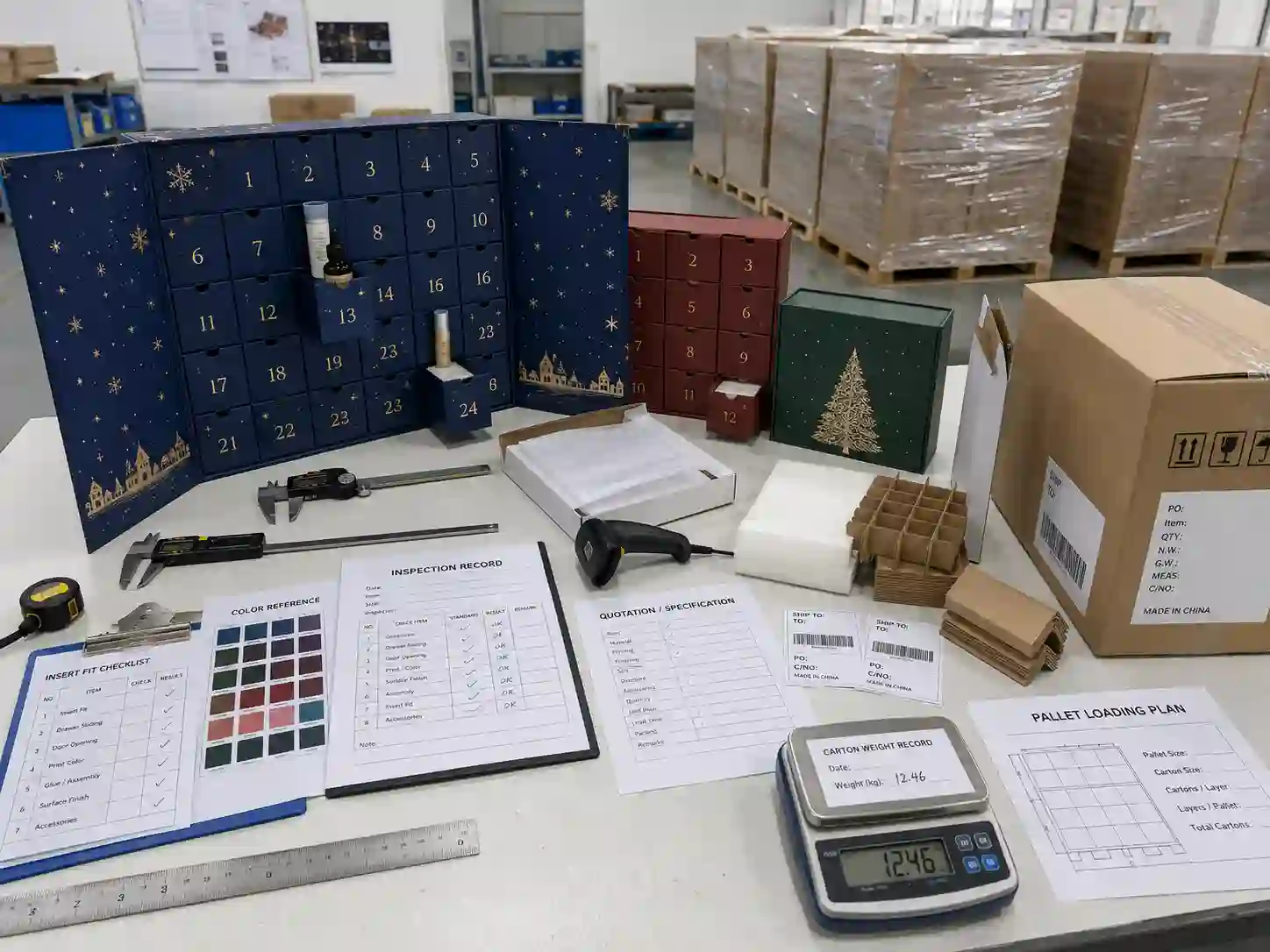
Critical inspection points
- External and internal dimensions within agreed tolerance
- Correct number, position, sequence, and orientation of doors or drawers
- Door perforations that open cleanly without uncontrolled tearing
- Drawers that slide without jamming, excessive looseness, or surface abrasion
- Insert cavities that hold the approved products securely
- Correct paper, greyboard, paperboard, insert, ribbon, and accessory specifications
- CMYK and Pantone color comparison against approved references
- Foil, embossing, spot UV, and lamination registration
- No exposed glue, warped panels, lifted corners, crushed edges, or scratched surfaces
- Correct barcode, warning, language, product sequence, and shipping-mark information
- Export carton quantity, carton dimensions, gross weight, and pallet arrangement
Inspection criteria should distinguish critical, major, and minor defects. Buyers can also ask how the supplier defines sampling quantity and acceptance limits. Where transportation risk is high, discuss distribution testing with a qualified laboratory. The International Safe Transit Association publishes recognized packaged-product test procedures that buyers can review when developing a test plan.
How should export packing be designed for retail and e-commerce delivery?
Export packing should protect finished calendars from compression, abrasion, moisture, movement, and handling damage while keeping carton size and pallet efficiency under control. The right method depends on whether the calendar ships assembled or flat packed.
Assembled rigid calendars often need tissue sheets, paper pads, protective sleeves, corner protectors, partitions, and reinforced export cartons. Flat-packed folding cartons may require bundled components, assembly instructions, quantity labels, and controlled stacking to avoid crease damage.
Export-packing decisions to confirm
- Units per export carton and whether each unit needs an individual protective bag or sleeve
- Use of tissue, pads, partitions, corner protection, or internal carton reinforcement
- Maximum carton gross weight and handling requirements
- Carton dimensions for container loading, courier limits, or warehouse racking
- Shipping marks, purchase-order numbers, item codes, carton sequence, and barcode areas
- Pallet size, cartons per layer, total pallet height, stretch wrap, and edge protection
- Whether mixed designs, languages, or product versions require separate identification
For direct-to-consumer programs, the retail advent calendar may also need a separate e-commerce shipper. Sending a presentation box inside an oversized master carton without individual protection can lead to edge crushing and surface abrasion during parcel handling.
How should buyers plan lead time around a seasonal campaign?
Lead time should include engineering, sample revisions, artwork approval, material purchasing, production, inspection, export packing, international transportation, customs clearance, and destination handling. Seasonal launch projects should include contingency time because a missed retail window cannot always be recovered with faster production.
| Project stage | Buyer responsibility | Supplier responsibility |
|---|---|---|
| Concept and RFQ | Provide product data, quantity, sales channel, target date, and design direction | Recommend structure, identify risks, and issue a clear quotation |
| Engineering | Confirm assortment and product orientation | Develop dieline, insert plan, material specification, and packing concept |
| Sampling | Review promptly and consolidate revision comments | Produce samples, document deviations, and update drawings |
| Pre-production | Approve artwork, loaded sample, specifications, and shipping marks | Lock production files, materials, QC criteria, and schedule |
| Mass production | Avoid late design changes and provide shipment instructions | Control printing, assembly, inspection, packing, and progress reporting |
| Delivery | Arrange import, warehouse receiving, and campaign distribution | Provide packing data and shipment documents according to the order |
How should buyers compare advent calendar box suppliers?
Compare suppliers by engineering capability, specification clarity, sample accuracy, production control, communication, and export experience—not only by the quoted unit price. A reliable supplier should identify risks before production and explain how each structure will be manufactured, inspected, packed, and delivered.
Supplier decision guide
- Choose a supplier with structural engineering support when products vary significantly in size, weight, or fragility.
- Prioritize sampling capability when the campaign uses complex doors, drawers, molded inserts, or multiple finishes.
- Review assembly control when many hand-assembled components must remain aligned.
- Check export-packing experience when rigid calendars will travel long distances or enter parcel networks.
- Request a detailed quotation when comparing factories so hidden specification differences are visible.
- Verify production and inspection arrangements through documents, sample records, video review, audits, or third-party inspection when appropriate.
Buyers can learn more about the Giftpackpro packaging factory, compare guidance in the advent calendar box buying guides, or work with a custom advent calendar boxes manufacturer on structure and production planning.
What should be included in an advent calendar box quotation?
A useful quotation should state exactly what is included. Vague descriptions such as “premium box with insert” are not enough for comparing suppliers or approving a purchase order.
Practical RFQ and quotation checklist
- Finished external and internal box dimensions
- Structure type and number of doors, drawers, or compartments
- Paper, paperboard, greyboard, and insert specifications
- Printing method, CMYK or Pantone requirements, and surface finishes
- Insert type, cavity layout, tooling, and product-fit requirements
- Accessories such as ribbons, magnets, pull tabs, windows, or sleeves
- Order quantity and quantity-break options
- Sample type, sample cost, tooling cost, and sample schedule
- Mass-production lead time after final approval
- Assembly condition and whether product loading is included
- Units per export carton, carton size, gross weight, and pallet method
- Quality-control standard and inspection arrangement
- Price basis, payment terms, trade terms, quotation validity, and delivery destination
Buyer tip: Ask suppliers to quote the same approved specification. A price comparison is unreliable when one quotation uses thicker greyboard, a PET tray, protective sleeves, and reinforced cartons while another assumes thin board, a paper insert, and basic bulk packing.
What common production mistakes should buyers avoid?
The most expensive mistakes usually begin before mass production. They include approving artwork before structure testing, using estimated product dimensions, ignoring loaded-box weight, changing the assortment after insert tooling, and treating the delivery date as the production completion date.
- Do not approve an empty sample when the final products are available for testing.
- Do not place artwork on an unconfirmed dieline.
- Do not assume all compartments can use identical tolerances.
- Do not select a rigid structure without checking freight and fulfillment costs.
- Do not add foil, embossing, or spot UV without checking folds and registration limits.
- Do not start production before barcode data, languages, warnings, and shipping marks are final.
- Do not compare quotations that use different materials or packing methods.
- Do not leave e-commerce shipping protection until production is complete.
- Do not schedule arrival too close to photography, retailer intake, or campaign launch dates.
What should buyers prepare before requesting a sample or quotation?
To begin the advent calendar box production process efficiently, prepare the product list, exact dimensions and weights, reference images, preferred structure, quantity, destination, required arrival date, artwork status, finishing requirements, and packing expectations. Physical product samples are strongly recommended for irregular, fragile, or heavy items.
Giftpackpro can use this information to review product fit, recommend a rigid box or folding carton structure, plan the insert, estimate MOQ, prepare a sample route, and clarify production and export-packing requirements. Buyers ready to compare options can request a custom quote with their product data and campaign schedule.
Frequently asked questions about the advent calendar box production process
Should the structure or artwork be developed first?
The structure and dieline should be confirmed before final artwork placement. Early visual concepts are useful, but production artwork must use the approved dieline to keep doors, drawers, folds, finishes, and legal information correctly positioned.
Is a blank sample enough for production approval?
A blank sample is suitable for checking structure and fit, but it does not confirm color, printing, foil registration, embossing, lamination, or final appearance. Complex retail projects should normally include a printed sample or pre-production reference.
Why must real products be tested inside the insert?
Digital dimensions do not fully show label friction, flexible packaging, cap movement, fragile surfaces, center of gravity, or loading difficulty. Testing real products reveals whether the insert provides practical clearance and retention.
Can an advent calendar box be shipped flat packed?
Many folding-carton and modular structures can be designed for flat packing. Most fully wrapped rigid boxes are shipped assembled, although some hybrid rigid concepts may reduce volume. The decision should consider destination labor, assembly consistency, and freight savings.
What affects the production lead time most?
Structure complexity, sample revisions, material availability, custom insert tooling, specialty finishes, hand assembly, order quantity, inspection, and export packing can all affect lead time. Slow artwork or sample approval can also delay the production start.
When should e-commerce shipping tests be considered?
Testing should be considered when presentation boxes will be shipped individually, when products are fragile or heavy, or when cosmetic damage would create returns. The test plan should represent the actual product, retail box, protective shipper, and packing configuration.
What is the best way to reduce production risk?
Freeze the product assortment early, provide accurate product data, approve a loaded pre-production sample, sign a detailed specification, define QC criteria, and confirm export packing before mass production. These controls connect the dieline, sample, production line, and delivered goods to the same approved standard.