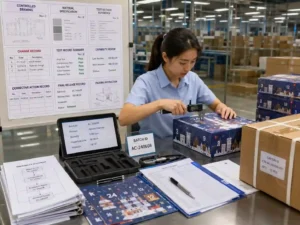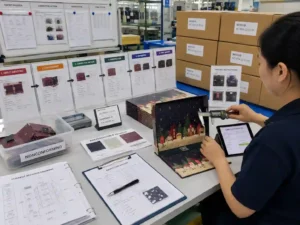
Quick answer: Luxury advent calendar boxes are priced according to structure complexity, overall dimensions, compartment count, insert engineering, board thickness, printing, finishing, assembly labor, order quantity, and export packing. Buyers should confirm the product dimensions and weights before selecting a rigid box, drawer box, door-opening box, or folding carton. A reliable quotation also requires a compartment layout, material expectations, artwork details, quantity, delivery destination, and packing requirements. The lowest unit price is not always the lowest total cost: poor insert fit, excessive box volume, fragile finishing, or weak export cartons can create product damage, rework, freight waste, and missed seasonal delivery dates.
For brands and purchasing teams, the main objective is to balance presentation, product protection, production efficiency, and landed cost. Working with a capable custom advent calendar boxes manufacturer helps buyers evaluate these factors before approving a structure or requesting mass production.
What should buyers decide before choosing luxury advent calendar boxes?
Buyers should first define the products, retail channel, target presentation level, budget range, required quantity, and launch deadline. These decisions determine whether the packaging should use rigid greyboard construction, paperboard folding cartons, drawers, hinged doors, removable trays, or another engineered format.
A luxury appearance does not come from foil stamping alone. It depends on the complete packaging system: structural proportions, smooth paper wrapping, accurate compartment alignment, stable opening functions, controlled color, clean assembly, and an insert that presents every item consistently.
Before discussing decoration, prepare the following product information:
- Exact length, width, height, and weight of every product.
- Product orientation inside each compartment.
- Fragility risks, including glass bottles, candles, jewelry, capsules, or delicate accessories.
- Whether the products will be packed before or after the calendars arrive.
- Required number of compartments, such as 12, 24, or 25.
- Retail channel requirements for stores, e-commerce, subscription campaigns, or wholesale distribution.
- Expected order quantity and possible quantity breaks.
- Target delivery date and destination country.
Buyer tip: Do not finalize the outer box size before the insert layout is tested. The product arrangement determines the practical internal dimensions, while board thickness, wrapping paper, drawer clearance, and insert walls add further space.
Which luxury advent calendar structure offers the best balance of cost and presentation?
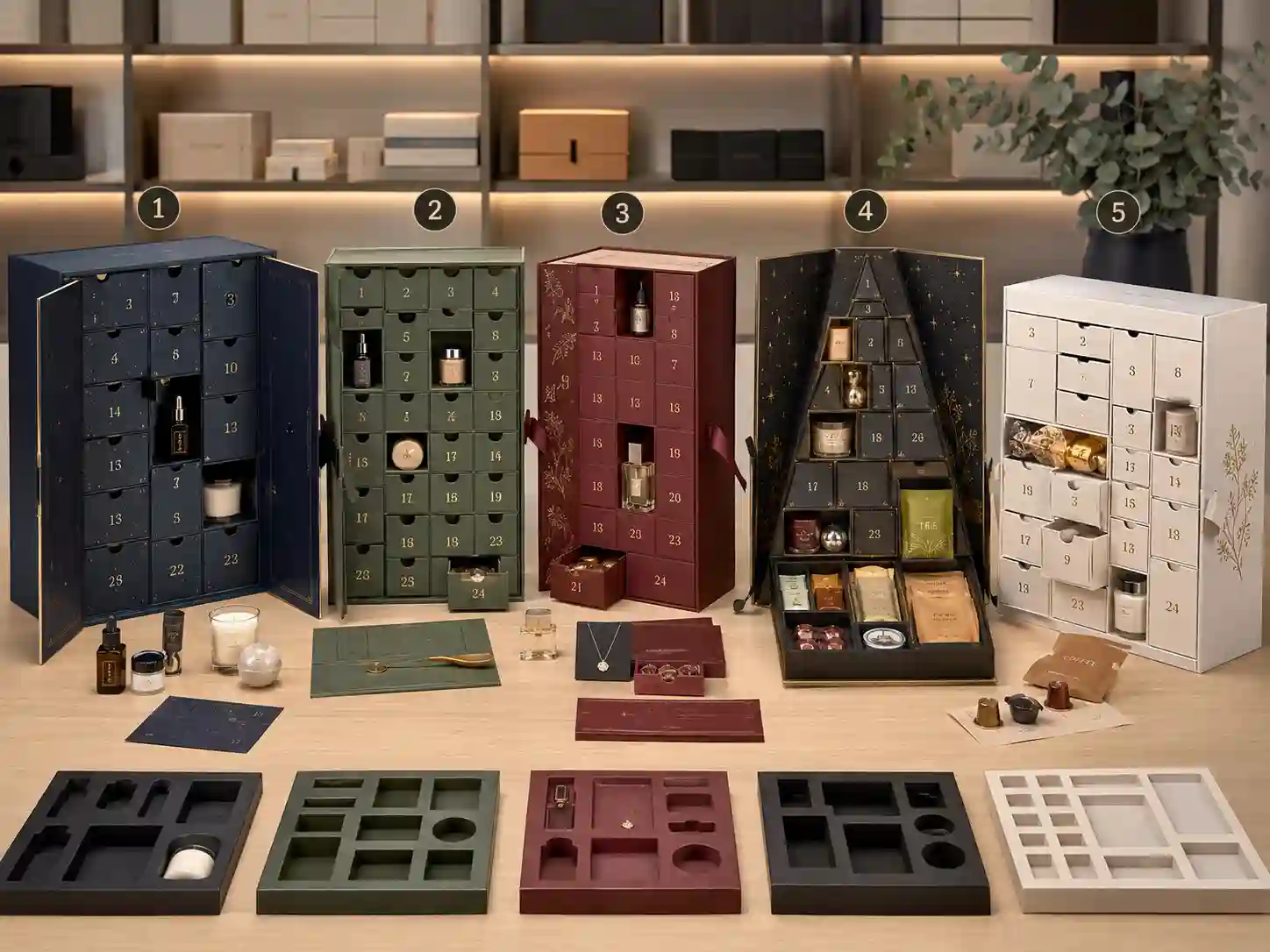
The best structure depends on product value, weight, display expectations, assembly labor, and freight limits. Rigid door-opening and drawer formats usually offer a stronger premium presentation, while folding carton formats can reduce material use, shipping volume, and unit cost.
| Structure | Best suited to | Main cost drivers | Buyer considerations |
|---|---|---|---|
| Rigid door-opening box | Cosmetics, fragrance samples, jewelry, premium gifts, candles | Greyboard, wrapped panels, hinges, magnets or ribbons, compartment assembly | Strong presentation but higher hand-assembly labor and shipping volume |
| Multi-drawer rigid box | Beauty sets, jewelry, tea, coffee capsules, mixed gift collections | Individual drawer production, sleeves, handles, precise fitting, manual loading | Excellent unboxing experience; test drawer clearance and loaded weight |
| Book-style rigid box | Compact premium sets, sample collections, accessories | Wrapped greyboard shell, hinge area, closure, internal tray | Efficient presentation, but the spine and closure must withstand repeated opening |
| Fold-out display calendar | Retail displays, promotional campaigns, lightweight products | Multiple panels, hinges, reinforcement, insert alignment | Creates a large visual area but may require more testing and assembly |
| Premium folding carton | Chocolate, tea, stationery, samples, lightweight gifts | Paperboard grade, die cutting, gluing, printing, surface finishing | Lower freight volume and faster assembly, but less rigid than greyboard formats |
When is a rigid box worth the additional cost?
A rigid box is usually justified when the calendar supports a premium retail price, contains fragile or high-value products, or must remain attractive after repeated opening. Greyboard thickness commonly affects panel stiffness, edge appearance, wrapping difficulty, and final weight.
However, thicker board is not automatically better. Excessive board thickness can increase material cost, box weight, wrapping difficulty, and freight charges without adding meaningful protection. The factory should recommend board thickness based on the box span, loaded weight, opening method, and structural reinforcement.
When is a folding carton more economical?
Folding cartons are often more economical when products are lightweight, the order quantity is sufficient for efficient die cutting and gluing, and the buyer accepts a less rigid presentation. They can also ship flat or partially assembled in some designs, reducing carton volume.
A well-engineered paperboard calendar can still look premium with high-quality printing, matte lamination, foil stamping, embossing, spot UV, and an accurately fitted insert. The trade-off is lower resistance to compression and repeated handling compared with a rigid greyboard structure.
How do inserts affect product protection, appearance, and quotation cost?
The insert is a packaging-engineering component, not simply a divider. It controls product movement, compartment spacing, presentation height, opening access, loaded weight distribution, and the final outer dimensions.
For luxury advent calendar boxes, each cavity should be designed around the actual product rather than an estimated size. A bottle cap, pouch seal, jewelry card corner, candle lid, or irregular accessory can require extra clearance even when the nominal product dimensions appear correct.
Which insert material should buyers choose?
| Insert type | Advantages | Cost considerations | Typical applications |
|---|---|---|---|
| Folded paper insert | Printable, recyclable in many systems, lightweight, suitable for compartment grids | Complex folds and manual assembly increase labor | Tea, stationery, cards, small gifts, lightweight cosmetics |
| PET tray | Accurate formed cavities, good product visibility, efficient loading | Tooling may be required; material thickness and color affect price | Cosmetic bottles, capsules, accessories, confectionery packs |
| EVA insert | Clean premium appearance, strong product retention, precise cutouts | Material thickness, density, lamination, and cutting complexity increase cost | Jewelry, glass bottles, metal accessories, premium samples |
| Foam insert | Good cushioning and flexible cavity design | Density, thickness, surface treatment, and material requirements affect price | Fragile products, bottles, technical gift items |
| Molded pulp | Protective, formed structure, paper-based appearance | Tooling, minimum production quantity, surface quality, and drying control matter | Candles, jars, bottles, sustainable gift programs |
Factory tip: An insert that is too tight can scratch labels, deform cartons, or slow product loading. An insert that is too loose can allow movement, noise, door bulging, or damage during transport. Prototype testing should include both insertion and removal by the intended packing team.
What product-fit tolerances should be checked?
Tolerance depends on the material and product. Paper inserts need allowance for board thickness, folds, glue areas, and production variation. PET trays need draft angles and forming tolerances. EVA and foam need suitable compression without making removal difficult.
The factory should evaluate:
- Clearance around the widest and tallest product points.
- Whether the product can rotate or lift during transit.
- Finger access for easy removal.
- Loaded compartment depth and presentation height.
- Insert strength under the heaviest products.
- Interaction between insert walls and doors or drawers.
- Potential abrasion on labels, foil decoration, painted surfaces, or glass.
- Whether all products can be packed efficiently during fulfillment.
Which materials and printing choices have the greatest effect on price?
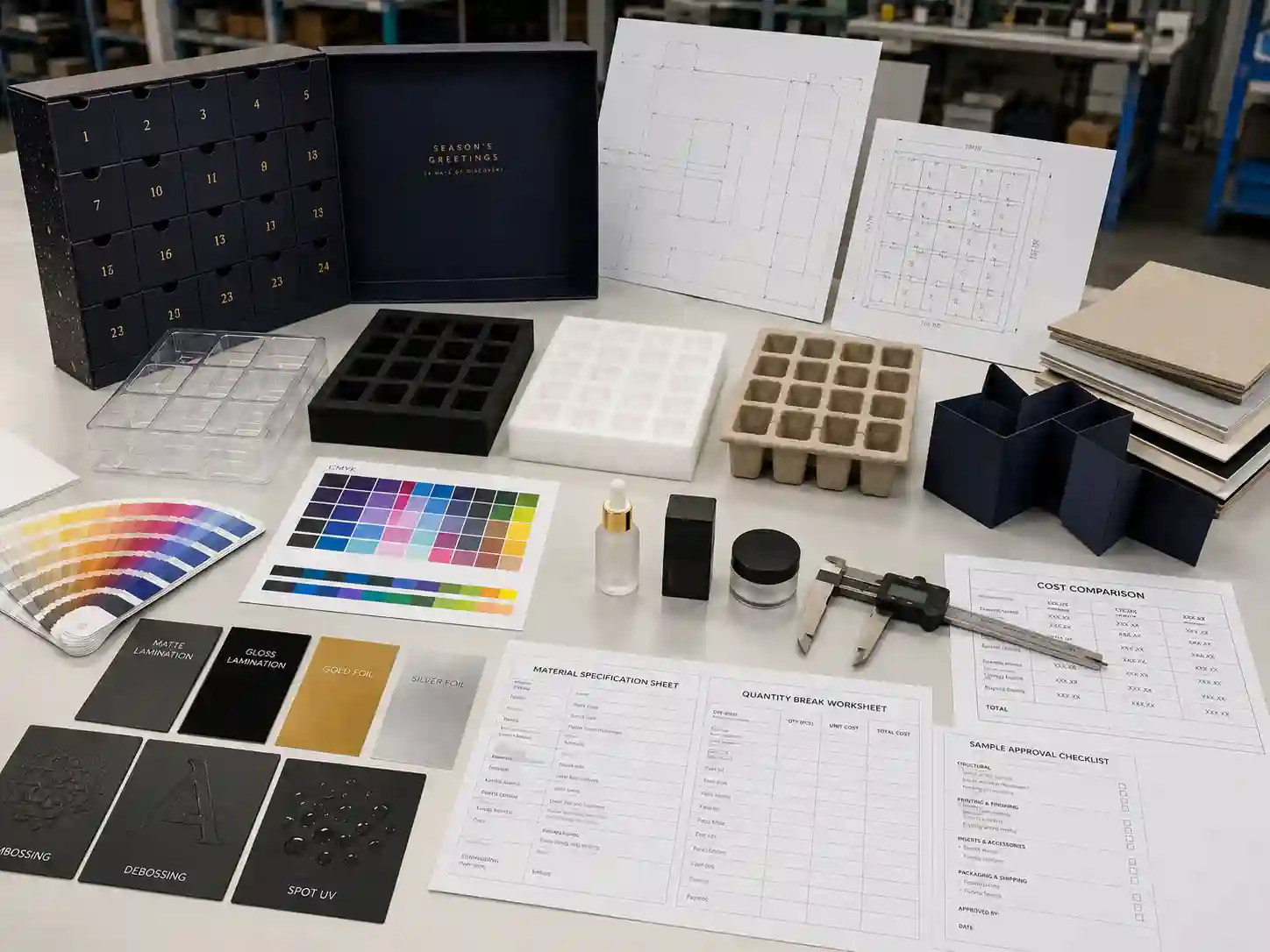
The largest material and print cost differences usually come from box construction, overall size, greyboard or paperboard grade, specialty paper, number of printed components, finishing coverage, and manual assembly. Buyers should compare complete specifications rather than comparing quotations based only on the external dimensions.
How do paperboard and greyboard specifications affect cost?
Rigid boxes generally use greyboard wrapped with printed or specialty paper. Folding cartons use printable paperboard that is die cut, creased, folded, and glued. Higher board weight can improve stiffness, but it may also increase cutting pressure, box weight, wrapping difficulty, and shipping cost.
Specialty papers may create a premium texture without heavy printing, but buyers should confirm color consistency, stock availability, rub resistance, and compatibility with foil stamping or lamination. Material availability can also influence lead time, particularly for custom-dyed or imported paper.
Should buyers use CMYK or Pantone colors?
CMYK is suitable for photographic artwork, gradients, and multi-color graphics. Pantone spot colors are useful when a specific solid brand color must be controlled more closely, although the final appearance still varies with paper, coating, and printing process.
For color-sensitive projects, request a printed proof or production-material proof instead of approving color only from a monitor. The buyer should also identify which colors are critical and provide an approved physical reference where possible.
Which finishes add cost without always adding value?
Foil stamping, embossing, spot UV, matte lamination, and gloss lamination can support premium positioning, but each process adds setup, tooling, production handling, and inspection requirements. Applying several finishes to every panel may increase cost and defect risk without improving the buyer’s main visual message.
A cost-controlled approach is to prioritize one or two focal treatments:
- Foil stamping on the front title or numbered doors.
- Embossing on a logo area or central graphic.
- Spot UV over selected patterns rather than full coverage.
- Matte lamination for a soft visual base and improved scuff resistance.
- Gloss lamination where strong color contrast or wipe-clean performance is required.
Buyer tip: Ask the supplier to separate structural cost, insert cost, printing and finishing cost, packing cost, and tooling charges where practical. This makes value engineering easier than negotiating one unexplained unit price.
What are the main cost drivers for luxury advent calendar boxes?
The main cost drivers are material consumption, production complexity, labor time, tooling, finishing passes, rejection risk, packing method, and order quantity. The external box size alone does not explain the quotation.
- Structure complexity: Multiple drawers, hinged panels, magnets, ribbons, and layered components require more cutting, wrapping, gluing, fitting, and inspection.
- Overall dimensions: Larger boxes consume more paper, board, insert material, carton space, and pallet volume.
- Compartment count: More doors or drawers increase die-cutting complexity and assembly labor.
- Insert engineering: Irregular products, multiple product sizes, and fragile items require more prototype work and material.
- Printing coverage: Printing both sides, using multiple paper wraps, or adding Pantone colors increases setup and process steps.
- Finishing: Foil stamping, embossing, spot UV, and specialty lamination require tooling, registration control, and additional QC.
- Manual assembly: Rigid calendars often involve significant hand wrapping, drawer assembly, insert placement, and cleaning.
- MOQ: Low quantities must absorb setup, tooling, sampling, and production preparation across fewer units.
- Export packing: Protective tissue, paper pads, corner protectors, stronger cartons, pallets, and shipping marks add cost but reduce damage risk.
What MOQ should buyers expect, and why does it vary?
MOQ varies according to the structure, material sourcing, printing setup, tooling, assembly method, and factory production plan. There is no responsible universal MOQ for all luxury advent calendar boxes.
A folding carton may support a different economical quantity from a hand-assembled rigid drawer calendar. PET or molded pulp inserts may involve tooling and material production minimums. Specialty paper suppliers can also impose minimum purchase quantities that exceed the number of sheets needed for a small order.
When requesting prices, ask for quantity breaks such as:
- Prototype or sample quantity.
- Low commercial quantity for a test campaign.
- Standard production quantity.
- Higher-volume quantity for cost optimization.
Comparing several quantity levels shows whether the main cost is driven by fixed setup expenses or by variable material and labor. Buyers can review structure options through Giftpackpro’s custom advent calendar box products and discuss suitable production routes through its custom advent calendar box services.
How can buyers reduce cost without making the packaging look cheap?
Effective cost control removes unnecessary complexity while protecting the visible customer experience. The best savings often come from structure optimization, size reduction, simplified inserts, selective finishing, and efficient export packing.
Practical decision guide for cost control
| Buyer priority | Recommended decision | Cost-control logic |
|---|---|---|
| Premium shelf presentation | Use a rigid outer structure with a simpler internal paper insert | Preserves the visible premium shell while reducing hidden material cost |
| Lower freight cost | Reduce empty compartment space or consider a folding carton format | Smaller cartons and improved pallet density reduce logistics volume |
| Strong product retention | Use engineered cavities only where needed | Avoids using thick EVA or foam across the entire calendar |
| High-impact decoration | Select one focal foil or embossing area | Reduces tooling, registration, and rejection risk |
| Small test order | Use available papers, standard materials, and limited finishes | Avoids custom material minimums and excessive setup cost |
| Faster assembly | Standardize drawer sizes or repeated compartment modules | Reduces part variation and manual fitting time |
Another important cost-control method is reducing the total box footprint. A few millimeters removed from repeated compartments can create meaningful savings across paper consumption, greyboard, inserts, export cartons, and freight. However, dimensions should only be reduced after physical product-fit testing.
What samples should be approved before mass production?
Buyers should approve the structure, product fit, materials, artwork, color, finishing, and packing method before mass production. A single sample may not prove every production detail, so the approval process should match the project risk.
Blank structural prototype
A blank prototype checks dimensions, opening functions, insert fit, compartment access, product orientation, and overall stability. It is especially useful before final artwork because structural corrections can change the dieline.
Printed sample
A printed sample demonstrates artwork scale, colors, paper appearance, finishing placement, and overall presentation. Buyers should confirm whether the sample uses production materials and production processes or a digital approximation.
Pre-production sample
A pre-production sample should represent the approved mass-production specification as closely as possible. It becomes an important reference for incoming materials, printing, assembly, final inspection, and buyer approval.
The approval record should identify the sample version, dieline version, artwork file, color reference, materials, finishing, insert specification, accessories, and packing method. Uncontrolled revisions are a common cause of errors.
Factory tip: Product samples supplied for insert testing should be final or dimensionally identical to the production products. Temporary containers, unfilled bottles, or hand-cut labels can produce misleading fit results.
What should quality control cover during mass production?
QC should verify materials, printing, dimensions, assembly, product fit, opening functions, appearance, and export packing. Inspection should be based on the approved specification and sample rather than subjective descriptions such as “premium quality.”
Important inspection points include:
- Greyboard or paperboard thickness and stiffness.
- Wrapped edge alignment and corner condition.
- Correct dieline, compartment count, and numbering sequence.
- CMYK and Pantone color comparison against approved references.
- Foil stamping position, coverage, adhesion, and edge quality.
- Embossing depth and registration.
- Spot UV position and surface condition.
- Lamination adhesion, scratches, bubbles, and scuffing.
- Drawer sliding, door opening, magnetic closure, and ribbon attachment.
- Insert dimensions, cavity fit, and loaded-product stability.
- Glue marks, dust, fingerprints, odor, and visible assembly defects.
- Export carton strength, quantity, labels, and shipping marks.
QC tip: A calendar should be tested in its loaded condition. Empty drawers and doors may function correctly but bind, sag, or open during handling after products are inserted.
How should luxury advent calendar boxes be packed for export?
Export packing should protect finished surfaces, corners, closures, inserts, and moving components while controlling carton weight and pallet volume. Premium boxes can be damaged by abrasion and compression even when their basic structure remains intact.
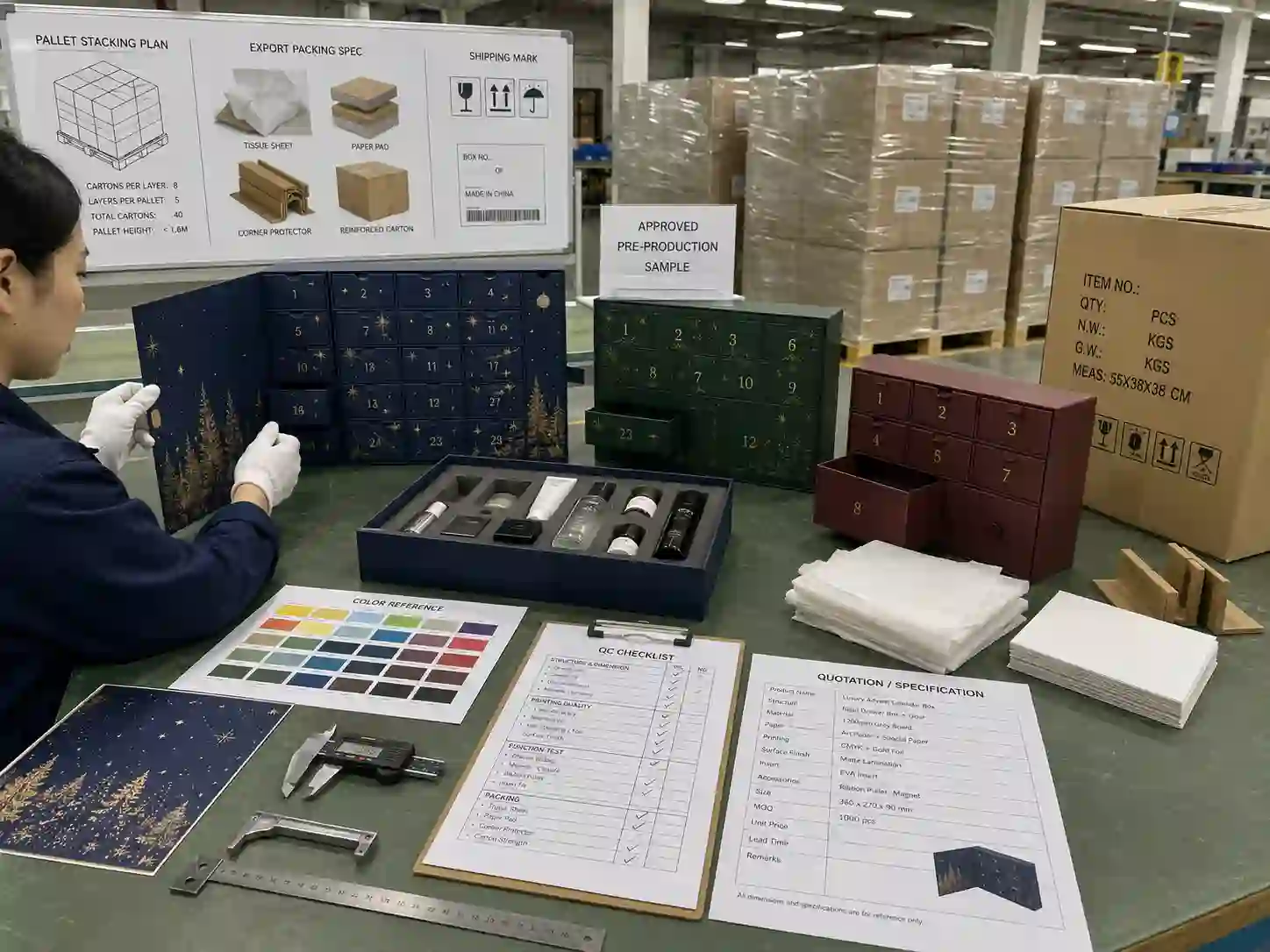
Depending on the design and shipping method, protection may include tissue paper, glassine sheets, polybags where acceptable, paper pads, corner protectors, divider pads, reinforced export cartons, palletization, stretch wrap, and moisture protection.
Buyers should confirm:
- Units per export carton.
- Individual protective wrapping method.
- Carton dimensions, gross weight, and net weight.
- Carton board grade and reinforcement method.
- Shipping marks, barcode label area, and destination labels.
- Whether the goods will be palletized.
- Pallet dimensions, height limits, and stacking pattern.
- Whether transit or drop testing is required.
For formal distribution programs, buyers may review test planning through the official International Safe Transit Association. Buyers making responsible paper-sourcing claims should also verify chain-of-custody requirements through the official Forest Stewardship Council rather than relying only on a supplier’s general material description.
What information is needed for an accurate quotation?
An accurate quotation requires more than a reference photo and target quantity. The supplier needs enough information to estimate material consumption, tooling, printing, finishing, insert production, labor, QC, and export packing.
Luxury advent calendar quotation checklist
- Required structure or reference style.
- Finished external dimensions.
- Number of doors, drawers, or compartments.
- Exact product dimensions and weights.
- Product arrangement or preferred compartment layout.
- Preferred paperboard, greyboard, or specialty paper.
- Insert material: paper, PET, EVA, foam, molded pulp, or supplier recommendation.
- Artwork colors: CMYK, Pantone, or both.
- Required finishes: lamination, foil stamping, embossing, spot UV, or other treatments.
- Accessories such as magnets, ribbons, handles, windows, or sleeves.
- Order quantity and requested quantity breaks.
- Sample type and approval deadline.
- Required mass-production completion date.
- Individual packing and export carton requirements.
- Shipping destination, delivery terms, or freight quotation request.
- Any retail testing, labeling, recycling, or compliance requirements.
A professional quotation should clearly identify the included specifications, quantity, unit price, tooling or sample charges, packing method, production lead time, quotation validity, and delivery terms. When comparing suppliers, check whether each quotation is based on the same materials, dimensions, finishing coverage, insert design, and carton specification.
How should buyers compare luxury advent calendar box suppliers?
Buyers should compare engineering ability, sampling accuracy, communication, production control, QC documentation, export-packing experience, and specification transparency—not only the quoted unit price.
Ask potential suppliers how they manage:
- Dieline revisions and version control.
- Physical product-fit testing.
- Printed proof and color approval.
- Tooling for foil, embossing, PET, or molded pulp.
- Material substitutions and approval procedures.
- Pre-production sample approval.
- In-process and final inspection.
- Defect classification and corrective action.
- Export carton design and pallet planning.
- Seasonal production schedules and lead-time risks.
The Giftpackpro packaging factory works with overseas packaging buyers on structure development, sampling, bulk production, inspection, and export packing. Buyers can also review additional advent calendar box buying guides when preparing specifications.
What common purchasing mistakes should be avoided?
The most common mistakes are requesting a price before defining the product fit, approving artwork before the dieline is stable, comparing unmatched quotations, and leaving export packing decisions until production is complete.
- Using estimated product dimensions: Small errors multiplied across many compartments can make the entire calendar larger or cause fit failures.
- Choosing a structure from appearance alone: A reference image does not show board thickness, insert construction, assembly method, or loaded performance.
- Adding too many finishes: Multiple decorative processes increase setup, lead time, registration risk, and rejection rates.
- Ignoring assembly labor: Drawers, doors, ribbons, magnets, and layered inserts may require substantial handwork.
- Approving color on screen only: Monitor colors do not reliably represent printed CMYK, Pantone, foil, or specialty paper.
- Skipping the loaded test: Products can cause drawers to jam, doors to bulge, or inserts to collapse.
- Focusing only on unit price: Oversized boxes and weak cartons can create higher freight, damage, and replacement costs.
- Starting too late: Sampling, artwork revision, material purchasing, production, inspection, and international shipping all require schedule allowance.
Frequently asked questions about luxury advent calendar boxes
Why are rigid luxury advent calendar boxes more expensive?
Rigid formats use thicker greyboard, wrapped components, more separate parts, and greater manual assembly than standard folding cartons. Drawers, doors, magnets, ribbons, inserts, and surface finishing add further material, tooling, and labor.
Can one insert hold products with different shapes and weights?
Yes, but the insert must distribute weight and control each product separately. Mixed sets may combine folded paper partitions with PET, EVA, foam, or reinforcement pieces where heavier or fragile products need extra support.
Does a lower MOQ always mean a higher unit price?
Usually, fixed costs such as dielines, tooling, printing setup, sample development, and production preparation are divided across fewer units. The final price also depends on whether materials and production methods are practical at the requested quantity.
How can buyers shorten the sampling process?
Provide final product samples, accurate dimensions, a clear compartment plan, confirmed material expectations, and editable artwork. Approve the blank prototype before finalizing artwork, and consolidate revision comments into one controlled feedback document.
Should the buyer approve a pre-production sample?
A pre-production sample is strongly recommended for complex, high-value, color-sensitive, or seasonal projects. It provides a physical reference for materials, printing, finishing, assembly, product fit, and final QC.
What affects the production lead time?
Lead time is influenced by material availability, sample approval, tooling, printing and finishing processes, assembly complexity, order quantity, QC requirements, packing, and factory capacity. Seasonal projects should include time for revisions and international shipping.
Can sustainable materials reduce packaging performance?
Not necessarily, but material choices must match the structure, product weight, moisture exposure, surface requirements, and distribution method. Buyers should test the complete package rather than assume that one material label guarantees performance.
What is the best way to compare supplier quotations?
Create a specification comparison sheet covering dimensions, board grades, insert materials, printing colors, finishing areas, accessories, sample charges, tooling, packing, lead time, and delivery terms. A cheaper quotation may be based on a thinner board, simpler insert, reduced finishing, or lighter export carton.
What should buyers prepare before requesting a sample or quotation?
Prepare the product list, exact dimensions and weights, required compartment count, preferred structure, target quantity, artwork status, finishing expectations, delivery destination, and required launch date. Product photos and physical samples are particularly useful when the items have irregular shapes or fragile surfaces.
Giftpackpro can review these details and recommend structure, insert, material, sampling, cost-control, QC, and export-packing options for luxury advent calendar boxes. Send a complete RFQ through the request a custom quote page so the quotation can be based on a defined specification rather than assumptions.