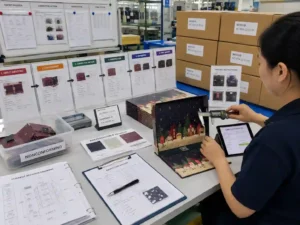
Quick answer: To design luxury advent calendar boxes for a seasonal campaign, begin with the products rather than the exterior artwork. Confirm every product’s dimensions, weight, fragility, orientation, regulatory needs, and release sequence before selecting a rigid box, drawer box, door-opening box, fold-out structure, or premium folding carton. The insert must hold each item securely while allowing customers to remove it without damage. Buyers should then approve the dieline, materials, printing proof, functional prototype, loaded product test, pre-production sample, QC standard, and export-packing method. A complete RFQ should include quantities, delivery destination, launch date, product data, finishes, packing requirements, and reference images.
What should buyers define before designing luxury advent calendar boxes?
Buyers should define the campaign objective, product assortment, sales channel, target retail price, required delivery date, and packaging budget before requesting structural concepts. These decisions determine whether the box should prioritize premium presentation, compact shipping, retail shelf efficiency, e-commerce protection, or repeated opening performance.
A luxury calendar containing fragrance samples or jewelry requires a different engineering approach from one containing chocolates, candles, toys, tea sachets, or coffee capsules. The product information should therefore be treated as the starting point for the packaging specification.
- Campaign format: Confirm whether the calendar has 12, 24, 25, or another number of compartments.
- Product list: Record the length, width, height, weight, material, fragility, and preferred orientation of every item.
- Sales channel: Identify whether the calendar will be sold in stores, shipped individually through e-commerce, distributed through wholesalers, or used as a corporate gift.
- Display requirements: Define the front-facing artwork area, shelf footprint, hanging restrictions, barcode location, and whether the packaging must stand upright.
- Customer interaction: Decide whether items are accessed through perforated doors, sliding drawers, removable trays, envelopes, or individually packed compartments.
- Logistics target: Set limits for finished size, unit weight, export-carton quantity, pallet height, and shipping method.
Buyer tip: Do not finalize the outer dimensions from artwork alone. A calendar that appears attractive in a rendering may become oversized or unstable after insert walls, drawer clearances, product tolerances, and board thicknesses are added.
Which structure is best for different seasonal campaign applications?
The best structure depends on product weight, assortment complexity, opening experience, price position, and shipping constraints. Rigid calendars normally provide the strongest premium presentation, while folding cartons can reduce material use, packing volume, and assembly cost for higher-volume campaigns.
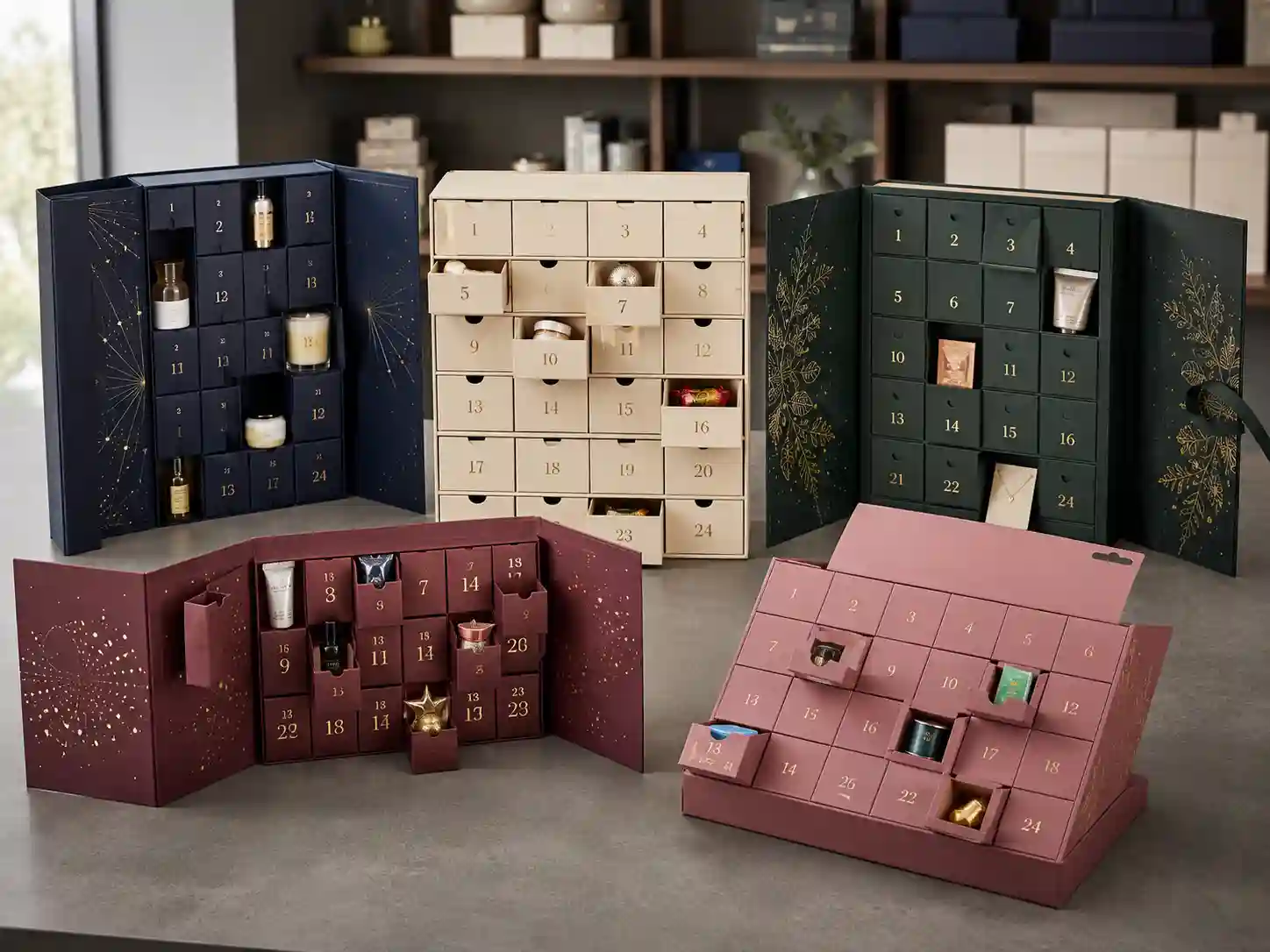
| Structure | Best suited to | Main advantages | Key engineering checks |
|---|---|---|---|
| Rigid door-opening box | Cosmetics, skincare, fragrance samples, jewelry, premium gifts | Large branding surface, strong display impact, premium hand feel | Door alignment, hinge strength, magnet position, compartment access, overall weight |
| Rigid drawer box | Jewelry, tea, coffee, stationery, small accessories, mixed gift sets | Organized presentation, reusable format, strong product separation | Drawer clearance, pull-ribbon strength, stop position, friction, loaded-drawer sagging |
| Book-style rigid calendar | Beauty sets, candles, gourmet gifts, corporate campaigns | Premium unboxing, broad artwork area, multiple internal layouts | Spine width, lid opening angle, hinge paper, magnet strength, weight distribution |
| Fold-out calendar | Toys, mixed gifts, confectionery, creative retail promotions | Large visual display, interactive opening sequence, flexible storytelling panels | Panel balance, hinge fatigue, tabletop stability, closing accuracy, shipping thickness |
| Premium folding carton | Chocolate, candy, tea, coffee capsules, lightweight samples | Efficient material use, lower shipping volume, faster assembly options | Carton compression, perforation quality, product migration, glue strength, shelf stability |
When should a buyer choose a rigid box?
Choose a rigid box when presentation value, structural strength, and repeated handling are more important than flat-packing efficiency. Greyboard wrapped with printed paper can support doors, drawers, book-style covers, and deeper compartments, but it also increases unit weight, manual assembly, carton volume, and freight cost.
Rigid constructions are especially suitable when the calendar contains glass cosmetic containers, small candles, jewelry boxes, premium beverage accessories, or a mixed assortment with substantial weight. The manufacturer should calculate how the load is distributed across shelves, drawer walls, and the outer shell.
When is a folding carton more practical?
A folding carton is often more practical for lightweight, high-volume programs with controlled product dimensions. It can be supplied flat or partially assembled and may use folded paperboard dividers, perforated doors, or a formed tray.
For chocolates, tea sachets, coffee pods, candy, cards, and lightweight toys, a well-engineered folding carton can still look premium when combined with accurate printing, matte lamination, foil stamping, embossing, or spot UV. However, its compression resistance and opening performance must be tested with the actual loaded products.
How should the application category change the packaging design?
Each product category creates different requirements for compartment depth, material compatibility, access, protection, and visual presentation. Buyers should not reuse one insert specification across unrelated product categories without conducting new fit tests.
Cosmetics and fragrance samples
Cosmetic minis may include tubes, pumps, glass jars, bottles, sachets, and sample cards in one calendar. Each shape should have a defined orientation so labels face forward and products do not rotate during transport. Deep bottles may require neck support or a two-level insert rather than a simple surface cutout.
PET trays, EVA inserts, foam, or reinforced paperboard inserts can be considered according to product weight and sustainability goals. For glass containers, test drop movement, cap clearance, and whether adjacent products can strike each other.
Chocolate, candy, tea, and coffee
Food-related calendars require attention to primary product wrapping, odor transfer, grease resistance, temperature exposure, and local food-contact obligations. The decorative calendar should not be assumed to provide the product’s primary food barrier unless its materials and use have been assessed accordingly.
Chocolate compartments need sufficient clearance to avoid edge damage but should not allow pieces to migrate behind the tray. Tea envelopes and coffee capsules need finger-access space so customers can lift them out without tearing the insert. Buyers selling into regulated markets should review applicable official guidance, such as the U.S. FDA information on food-contact substances, with their compliance specialists.
Candles and beverage-related gifts
Small candles create concentrated weight and may have glass, ceramic, or metal containers. Their insert cavities should support the base and control lateral movement. Where scented candles are combined with tea, coffee, or other absorbent products, buyers should consider odor separation and individual primary packaging.
Beverage campaigns may contain bottles, sachets, mixers, tools, or tasting accessories. Heavy liquid containers usually require stronger board, reinforced partitions, and a calendar orientation that keeps bottles upright. Shipping a calendar containing liquids may also introduce carrier and destination-specific requirements outside the packaging factory’s scope, so these should be confirmed early.
Jewelry, toys, and mixed gift collections
Jewelry needs controlled presentation and protection from scratching, tangling, or movement. Small paper cards, flocked EVA, foam pads, pouches, or miniature drawers may be used depending on the item. Ensure that earrings, chains, bracelets, and charms cannot slip through insert gaps.
Toys and mixed gift assortments frequently have irregular dimensions. Rather than making every compartment identical, group products by size and weight. Heavy items should normally be positioned near the bottom or close to structural walls to reduce panel distortion and tipping.
How should inserts be engineered for product fit and removal?
An effective insert controls movement without making the product difficult to remove. The correct cavity allowance depends on the product material, manufacturing tolerance, surface finish, opening direction, and whether the product is loaded by hand or with assembly aids.
| Insert type | Typical applications | Advantages | Buyer checks |
|---|---|---|---|
| Folded paper insert | Tea, coffee, cards, cosmetics, toys, lightweight gifts | Printable, recyclable in many collection systems, flexible compartment design | Fold strength, locking tabs, wall height, product movement, assembly time |
| PET tray | Cosmetics, confectionery with primary wrapping, capsules, shaped products | Precise cavities, visibility, efficient loading | Material thickness, cavity draft, anti-static needs, removal access, recycling requirements |
| EVA insert | Jewelry, glass bottles, premium accessories, tools | Accurate fit, cushioning, premium appearance | Density, odor, color consistency, surface marking, adhesive quality |
| Foam insert | Fragile samples, candles, glass items, irregular accessories | Strong cushioning and shape control | Compression recovery, odor, cutting accuracy, material restrictions, exposed edges |
| Molded pulp | Candles, bottles, accessories, sustainability-focused gift sets | Protective formed structure and fiber-based appearance | Tooling, surface texture, moisture response, dimensional tolerance, product scuffing |
Factory tip: Product-fit approval should use production-representative products whenever possible. Empty sample containers, hand-cut mockups, or 3D-printed substitutes may be useful during development, but differences in weight, cap shape, label thickness, and surface friction can change the final fit.
The loaded prototype should be turned upright, placed flat, gently shaken, opened repeatedly, and checked after simulated packing. Buyers should verify that products remain in their assigned compartments and that fingers can access each item without tearing the door, tray, or decorative surface.
Which materials and finishes create a luxury appearance without unnecessary cost?
Luxury presentation comes from coordinated structure, proportion, color control, tactile materials, and accurate assembly—not from adding every available finish. Buyers should select one or two focal effects and apply them where they strengthen brand recognition.

Rigid calendars commonly use greyboard wrapped with coated, uncoated, textured, or specialty paper. Folding calendars generally use printed paperboard selected according to stiffness, fold performance, surface quality, and required thickness. Board specifications should be confirmed during sampling because nominal thickness alone does not describe rigidity or surface performance.
How should buyers choose printing and finishing?
- CMYK printing: Suitable for photographic graphics, gradients, illustrations, and multicolor seasonal artwork.
- Pantone color matching: Useful when a brand color must be controlled more closely across packaging components.
- Matte lamination: Creates a subdued premium surface and provides handling protection, although dark colors may still show rubbing or fingerprints.
- Gloss lamination: Increases reflectivity and color intensity but can make scratches or glare more visible.
- Foil stamping: Works well for logos, borders, numbers, and limited decorative highlights.
- Embossing or debossing: Adds tactile hierarchy but requires suitable artwork spacing, board support, and tooling.
- Spot UV: Creates contrast on selected graphic areas and should be registered carefully with the printed artwork.
Foil, embossing, spot UV, specialty papers, magnetic closures, ribbons, and complex assembly all affect quotation and lead time. Instead of requesting “luxury finishing” as a general instruction, identify the exact areas, dimensions, colors, and effects on the artwork.
Buyers considering responsibly sourced fiber can ask suppliers to provide current documentation for verification and may consult the Forest Stewardship Council for information about FSC claims and chain-of-custody requirements. A logo or claim should not be printed until the required authorization and artwork rules have been confirmed.
What artwork and dieline checks prevent production problems?
Artwork should be created on the supplier-approved dieline after the structure and insert layout are sufficiently stable. Applying final artwork to an early concept dieline can cause repeated revisions when compartment sizes, hinge positions, doors, glue flaps, or board thicknesses change.
A practical artwork review should cover:
- Confirm the correct dieline version and revision date.
- Keep logos, numbers, legal text, and barcodes inside safe areas.
- Extend background graphics through the required bleed.
- Check the reading direction on drawers, doors, fold-out panels, and internal surfaces.
- Separate CMYK artwork, Pantone colors, white ink, foil, embossing, debossing, and spot UV into clearly named layers.
- Convert or package fonts and provide linked high-resolution images.
- Check whether dark colors cross wrapped edges, corners, hinges, or high-rub areas.
- Verify barcode size, contrast, quiet zones, and final printed position with the relevant retail system.
- Confirm all calendar numbers and ensure no compartment is duplicated or omitted.
- Approve a final artwork PDF and color reference before printed sampling.
Buyer tip: A digital rendering confirms appearance but does not approve print color, foil registration, embossing depth, paper texture, drawer movement, or loaded-product fit.
What sampling process should buyers require before mass production?
Buyers should approve samples in stages so structural, visual, and production risks are identified before bulk materials are committed. The exact sequence depends on complexity, but a luxury seasonal calendar often needs more than one prototype.
Recommended sample stages
- Structural mockup or blank sample: Checks finished size, opening method, compartment arrangement, product access, insert fit, and basic assembly.
- Printed prototype: Reviews artwork placement, color direction, surface material, lamination, foil, embossing, and overall appearance.
- Loaded-product sample: Uses the intended products to test movement, weight distribution, closure performance, and customer removal.
- Pre-production sample: Represents the approved production specification as closely as practical before mass production proceeds.
Each approval should be documented with photographs, measurements, signed comments, or an agreed sample retained by both buyer and factory. Verbal approval of a video call is not sufficient for complex details such as color limits, gaps, edge wrapping, insert height, and finish registration.
Quotable purchasing principle: The most useful advent calendar sample is not the one that looks best when empty; it is the one that proves the approved products can be loaded, shipped, displayed, opened, and removed as intended.
How do MOQ, cost drivers, and lead time affect the design?
MOQ and cost depend on structure, dimensions, materials, printing, finishing, insert type, tooling, assembly labor, packing method, and order quantity. Buyers should request itemized assumptions rather than comparing only the final unit price.
Important cost drivers include:
- Rigid construction versus folding carton construction
- Number of drawers, doors, internal boxes, and hand-assembled components
- Board thickness and specialty wrapping paper
- Insert material, cavity complexity, and tooling
- Foil colors, embossing dies, spot UV screens, and print passes
- Magnets, ribbons, metal accessories, windows, and closures
- Individual polybags, tissue, sleeves, labels, and protective components
- Assembled packing versus flat or partially assembled packing
- Export-carton quantity, pallet requirements, and destination labeling
Lead time should be planned backward from the required warehouse date, not the public campaign launch date. The schedule may need to include structural development, product-data confirmation, artwork preparation, blank sampling, printed sampling, revisions, material procurement, mass production, assembly, QC, export packing, booking, customs processing, and international transport.
Buyer tip: Late product changes can affect more than the insert. A taller bottle or heavier candle may require a new cavity, deeper compartment, stronger shelf, larger outer box, revised export carton, and updated freight calculation.
How should buyers evaluate a luxury advent calendar supplier?
Buyers should compare suppliers by engineering process, sample control, communication accuracy, quality documentation, assembly capability, and export-packing experience—not by quotation price alone.
Supplier comparison checklist
- Can the supplier review individual product dimensions and propose a compartment layout?
- Does the quotation clearly state structure, board, paper, insert, printing, finishing, accessories, packing, MOQ, and delivery terms?
- Will the supplier provide a controlled dieline with revision records?
- Can blank, printed, loaded, and pre-production samples be arranged where required?
- Are color references, approved samples, and measurable tolerances recorded for production?
- Does the factory have experience assembling drawers, doors, magnets, ribbons, inserts, and mixed manual components?
- Are incoming materials, printing, die-cutting, wrapping, assembly, function, and final packing inspected?
- Can the supplier explain export-carton construction, unit orientation, corner protection, palletization, and shipping marks?
- Can production progress and quality issues be communicated with photographs and traceable records?
- Can the supplier support repeat orders using approved specifications and retained reference information?
Buyers can review Giftpackpro’s custom advent calendar box services, compare example custom advent calendar box products, learn about the Giftpackpro packaging factory, and use the advent calendar box buying guides to organize sourcing questions before supplier evaluation.
Which QC checks matter during mass production?
QC should verify materials, print appearance, dimensions, assembly, function, product fit, and packing against the approved specification. Visual inspection alone is insufficient for a calendar with multiple doors, drawers, inserts, and loaded products.
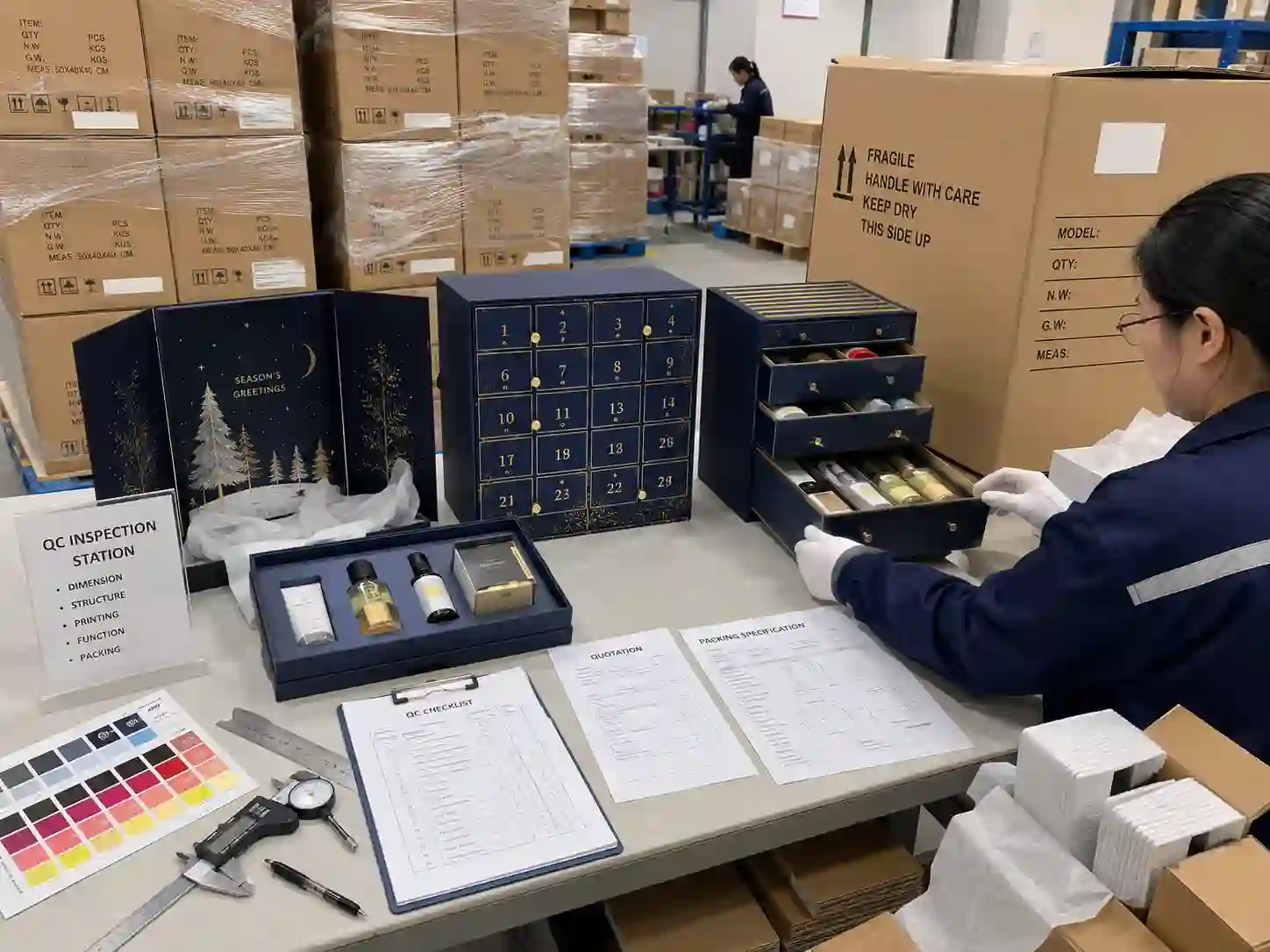
Practical production and final-inspection points
- Material check: Confirm paper, board thickness, insert material, color, texture, magnets, ribbons, and accessories.
- Printing check: Compare color with the approved proof or physical reference under agreed lighting.
- Finish check: Inspect foil coverage, embossing position, spot UV registration, lamination, scuffing, and scratches.
- Die-cutting check: Examine perforated doors, fold lines, cut edges, drawer components, tabs, and insert cavities.
- Assembly check: Measure gaps, corners, wrapped edges, hinge alignment, glue control, panel squareness, and closure position.
- Function check: Open doors and drawers repeatedly and confirm magnets, ribbons, stops, and fold-out panels work correctly.
- Product-fit check: Load representative products and verify orientation, movement, access, and weight distribution.
- Count check: Confirm all numbered compartments, components, instruction cards, labels, and accessories are present.
- Packing check: Verify protective materials, unit orientation, carton quantity, carton dimensions, gross weight, and shipping marks.
QC tip: Inspection criteria should distinguish acceptable handmade variation from functional defects. For example, a minor visual gap may be acceptable within an agreed tolerance, while a drawer that jams after loading or a product that falls behind the insert is a functional failure.
How should luxury advent calendar boxes be packed for export?
Export packing should protect corners, printed surfaces, closures, drawers, and internal components from compression, abrasion, moisture exposure, and movement. The correct method depends on whether calendars are shipped flat, partially assembled, fully assembled, or already loaded with products.
Fully assembled rigid calendars usually consume more carton and pallet volume than folding cartons, but attempting to reduce carton size too aggressively can cause rubbing, crushed corners, bent doors, or distorted outer sleeves. Protective options may include tissue, bags, paper pads, corner protectors, partitions, top and bottom pads, and reinforced export cartons.
Buyers should confirm:
- Units per export carton
- Unit orientation inside the carton
- Carton board specification and closure method
- Internal pads, partitions, corner protectors, or abrasion protection
- Carton dimensions, net weight, and gross weight
- Pallet size, stacking pattern, maximum pallet height, and stretch wrapping
- Shipping marks, purchase-order data, carton numbering, and barcode labels
- Whether transport testing or customer-specific packing tests are required
For high-value or heavy programs, buyers may discuss distribution testing based on the intended shipping environment. The International Safe Transit Association provides information about transport-testing procedures, but the appropriate protocol and acceptance criteria should be selected by the buyer, testing laboratory, and logistics stakeholders.
What information should be included in a quotation request?
A complete RFQ allows the supplier to recommend a realistic structure and reduces hidden assumptions between quotations. Buyers should provide confirmed data where available and label estimates clearly.
Luxury advent calendar RFQ checklist
- Required quantity and possible reorder quantity
- Number of calendar compartments
- Product list with dimensions, weight, photographs, and orientation
- Any fragile, liquid, scented, sharp, food-related, or regulated items
- Preferred rigid, drawer, door-opening, fold-out, or folding carton structure
- Target finished size or maximum retail shelf footprint
- Preferred paper, board, insert, printing, lamination, and finishing
- Artwork status and required dieline date
- Sample type required and product samples available for fit testing
- Unit packing, export-carton, pallet, shipping-mark, and barcode requirements
- Delivery destination and requested trade terms
- Required warehouse date and campaign launch date
- Testing, inspection, compliance, or documentation requirements
- Reference photographs showing the expected quality level
When comparing quotations, verify that each supplier has priced the same dimensions, materials, insert, finishes, accessories, sample scope, packing method, and delivery basis. A low quotation may exclude tooling, hand assembly, protective packing, pallets, or other required components.
What common design and purchasing mistakes should buyers avoid?
The most common mistakes are approving artwork before structure, estimating product sizes, under-testing loaded samples, and delaying export-packing decisions. These errors often appear late, when revisions affect tooling, materials, assembly, and shipping calculations.
- Designing equal-sized compartments for products with very different dimensions
- Ignoring caps, pumps, wrappers, hang tabs, labels, and protective bags when measuring products
- Selecting an insert only by appearance rather than weight, fragility, removal, and transport performance
- Approving an empty prototype without loading actual products
- Using excessive finishes without checking registration limits and handling durability
- Failing to test door perforations, drawers, hinges, ribbons, and magnets repeatedly
- Changing products after the dieline and artwork have been approved
- Comparing quotations with different material and packing assumptions
- Scheduling production from the launch date instead of the required warehouse date
- Leaving carton labels, shipping marks, pallet rules, and retailer requirements until final inspection
Frequently asked questions about luxury advent calendar boxes
What is the best structure for a premium beauty calendar?
A rigid door-opening, book-style, or drawer structure is commonly suitable for premium beauty assortments because it supports deeper compartments and strong presentation. The final choice should be based on bottle height, total weight, product access, retail footprint, and shipping cost.
Can one calendar use different insert materials?
Yes. A mixed calendar can combine paperboard dividers with PET cavities, EVA pads, foam supports, pouches, or product cards. However, combining materials increases assembly steps and may affect recycling instructions, procurement, and QC.
Should products be sent to the packaging factory for sampling?
Physical products are strongly recommended for final fit approval, especially for glass bottles, pumps, jewelry, candles, capsules, irregular toys, and products with flexible wrappers. Accurate 3D data can support early development but may not reproduce weight, friction, or manufacturing variation.
What usually affects the MOQ?
MOQ is influenced by material purchasing, printing setup, tooling, finishing setup, component sourcing, manual assembly, and production efficiency. Buyers should ask whether the stated MOQ applies to one artwork, one structure, and one delivery rather than assuming quantities can be divided among multiple designs.
How early should a seasonal campaign begin packaging development?
Development should begin early enough to complete product confirmation, structural design, sampling, revisions, artwork approval, material procurement, mass production, inspection, and international shipping before the warehouse deadline. Complex rigid calendars and mixed-product assortments generally require more development coordination than standard folding cartons.
How can buyers reduce cost without making the calendar look basic?
Control the finished size, reduce unnecessary internal components, use a well-engineered paper insert, limit premium finishes to high-impact areas, standardize drawer sizes, and optimize export-carton efficiency. Good proportions, accurate color, clean wrapping, and reliable function often create more value than multiple decorative processes.
What should buyers prepare before requesting a sample or quotation?
Prepare the product dimensions and weights, campaign quantity, compartment count, preferred structure, reference images, artwork status, finish requirements, packing method, delivery destination, and required warehouse date. Clearly identify which details are confirmed and which require factory recommendations.
Giftpackpro can review these details as a custom advent calendar boxes manufacturer and help evaluate structure, inserts, sampling, production, QC, and export packing. To begin a luxury advent calendar boxes project, organize the RFQ checklist above and request a custom quote with product photographs or samples whenever available.