Quick answer: Promotional gift advent calendar boxes should be planned around product size, gift sequence, box structure, insert protection, printing finish, MOQ, assembly labor, and export packing requirements. For B2B buyers, the lowest unit price is not always the best option because complex doors, drawers, rigid materials, PET trays, foil stamping, and manual loading can all change the final quotation. A reliable supplier should help check the dieline, test product fit, prepare a sample or pre-production sample, confirm packing method, and quote clearly by structure, material, finish, quantity, and shipping-ready carton details.
What should buyers understand before ordering promotional gift advent calendar boxes?
Buyers should understand that promotional gift advent calendar boxes are engineered packaging projects, not only printed boxes. The final cost and production result depend on the structure, insert, artwork, product loading method, MOQ, finishing process, and export packing plan.
For overseas brands, wholesalers, gift companies, retailers, and e-commerce sellers, the main purpose is usually to create a limited-time campaign pack that can hold multiple small gifts in a controlled presentation. The box may be used for cosmetics, chocolate, candles, jewelry cards, toys, tea sachets, coffee capsules, beverage samples, stationery, accessories, or mixed promotional gift sets.
Before comparing suppliers, buyers should define whether the project is for retail shelf display, e-commerce delivery, corporate gifting, distributor promotion, subscription campaign, or seasonal wholesale sales. A box that looks attractive on a retail shelf may need different strength, insert security, and outer carton protection than a box shipped directly to consumers.
Giftpackpro works as a custom advent calendar boxes manufacturer for B2B buyers who need structure planning, sample review, mass production, QC, and export packing support. The best results come when the buyer treats the box as a product-fit and supply-chain project from the beginning.
Which structure is best for promotional gift advent calendar boxes?
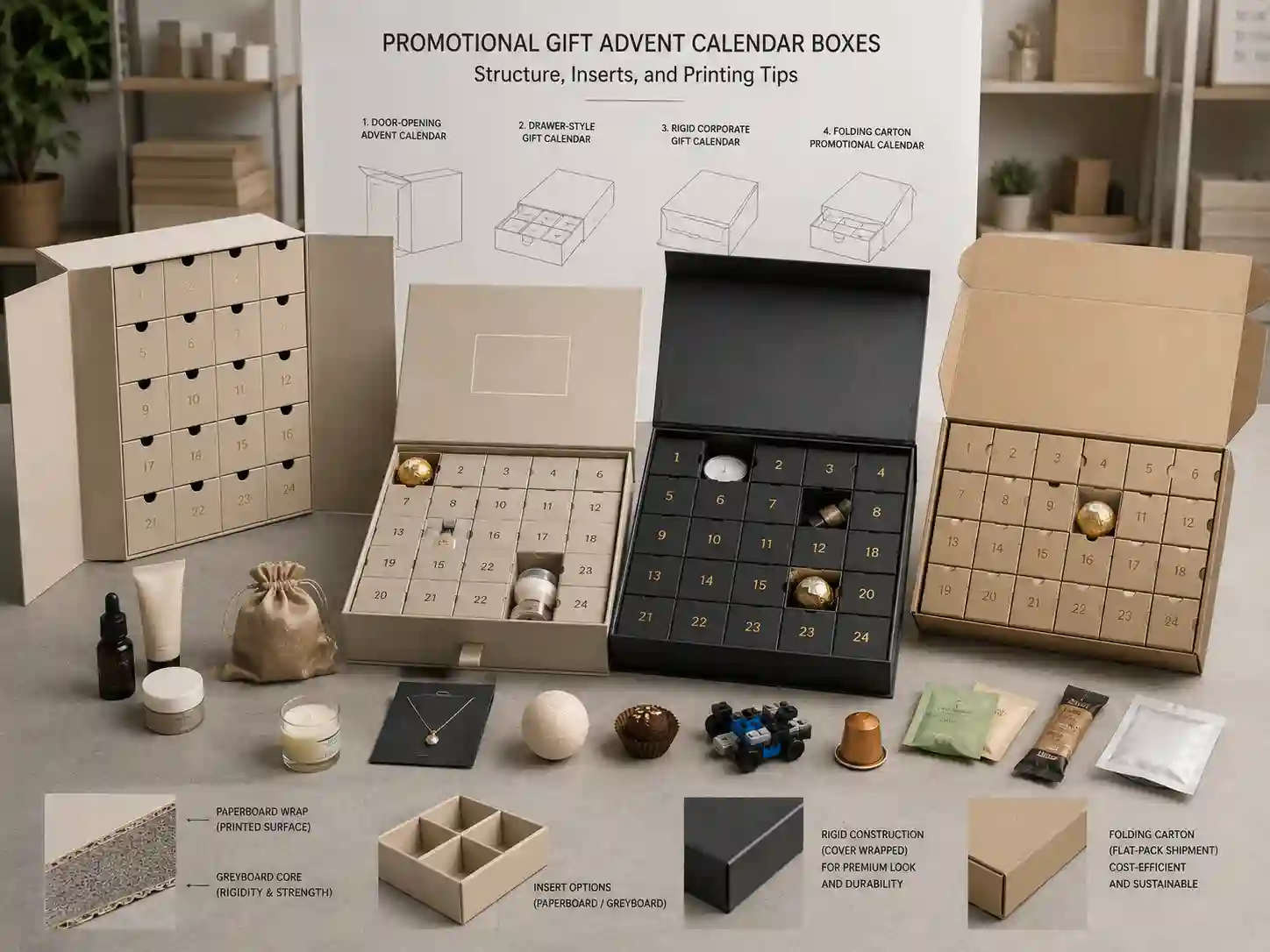
The best structure depends on product weight, gift count, opening experience, target price, and packing method. Door-opening boxes are common for lightweight items, drawer boxes feel more premium, rigid boxes support higher-value gifts, and folding carton structures can help control cost for larger promotional quantities.
| Structure option | Best for | Cost impact | Buyer notes |
|---|---|---|---|
| Door-opening advent calendar box | Flat or lightweight gifts, retail display, numbered daily opening | Medium, depending on door quantity and die-cut complexity | Door size and tear resistance must be tested before mass production. |
| Drawer box | Premium promotional gifts, jewelry cards, candles, accessories, cosmetic minis | Medium to high because of more parts and manual assembly | Drawer sliding tolerance and pull ribbon strength should be checked in sampling. |
| Rigid box | Higher-value gift campaigns, corporate gifts, luxury seasonal kits | Higher because greyboard, wrapping paper, labor, and packing volume increase cost | Good for perceived value, but freight and storage volume should be calculated early. |
| Folding carton calendar | Large promotional runs, lighter products, price-sensitive campaigns | Lower to medium depending on board grade and printing finish | Needs careful compression testing if products are shipped inside the box. |
| Book-style magnetic box | Gift sets, VIP campaigns, limited seasonal collections | Higher because of rigid board, magnets, wrapping, and assembly | Confirm magnet position, export rules, and closure performance during sampling. |
Buyer tip: If the campaign uses mixed items, do not select the structure only by appearance. Sort all gifts by weight, height, fragility, and loading sequence first. The heaviest or tallest item often decides the box depth, insert material, and carton strength.
For a 12-day or 24-day promotional calendar, the compartment layout should be drawn around actual product dimensions instead of estimated sizes. A few millimeters of tolerance can affect door closure, drawer movement, insert grip, and packing efficiency. If products are supplied by different vendors, buyers should collect final product samples or accurate CAD-style dimensions before confirming the dieline.
How do inserts affect cost, protection, and user experience?
Inserts decide how products stay in position during production, export shipping, warehouse handling, and final opening. The insert choice also affects tooling cost, assembly speed, sustainability claims, and the final quotation.
Paper inserts are often suitable for lightweight gifts and cost-sensitive projects. PET trays can hold small products in accurate shapes and are useful when visibility or clean placement is important. EVA inserts and foam provide cushioning for fragile or higher-value items but can increase material cost and may not fit every sustainability requirement. Molded pulp can support eco-focused campaigns, but mold cost, shape detail, and drying tolerance should be reviewed early.
For promotional gift advent calendar boxes, the insert should not only hold each item; it should also work with the opening method. A product placed behind a small paper door must be easy to remove without tearing the main panel. A drawer calendar must prevent items from moving into the sliding path. A rigid gift calendar must balance premium presentation with efficient hand loading.
Which insert should buyers choose for different promotional gifts?
Choose the insert according to product shape, fragility, target price, and campaign positioning. A simple paper insert may be enough for tea sachets, flat cards, or wrapped items, while PET, EVA, foam, or molded pulp may be better for bottles, candles, delicate accessories, or mixed gift sets.
- Paper insert: suitable for flat, light, or flexible items such as cards, sachets, small pouches, coupons, and stationery pieces.
- PET tray: useful for accurate product cavities, cosmetic minis, coffee capsules, toy accessories, and small packaged goods.
- EVA insert: suitable for premium items that need clean presentation and firm grip, such as jewelry cards, small bottles, or gift accessories.
- Foam insert: practical for cushioning fragile items, but buyers should confirm odor, compression, and material preference.
- Molded pulp insert: useful for eco-positioned projects, heavier gifts, or campaigns where plastic reduction is a priority.
Factory tip: Insert testing should use real loaded products, not empty cavities. Weight distribution, shaking, drawer movement, door opening, and carton stacking can reveal problems that are invisible in a clean mockup.
What materials drive the price of custom advent calendar boxes?
The main material cost drivers are paperboard grade, greyboard thickness, printed paper coverage, insert material, lamination, specialty paper, and the amount of structural waste created by the dieline. Larger box size and deeper compartments usually increase both material cost and freight volume.
Rigid promotional calendars normally use greyboard wrapped with printed art paper. They feel stronger and more premium, but greyboard thickness, wrapping labor, and shipping volume increase cost. Folding carton calendars usually use paperboard, which can reduce unit cost and packing volume, but the structure must be designed carefully to support products and survive distribution.
For international campaigns, buyers should also decide whether they need FSC-related material claims. If sustainability claims are important, buyers should verify the supplier’s chain-of-custody documentation and check official guidance from FSC before printing logos or statements on packaging.
Which printing and finishing choices affect quotation most?
Printing and finishing affect both appearance and cost. CMYK printing is common for full-color artwork, Pantone colors help control brand-critical shades, while foil stamping, embossing, spot UV, matte lamination, and gloss lamination add visual value but also add process cost and lead time.
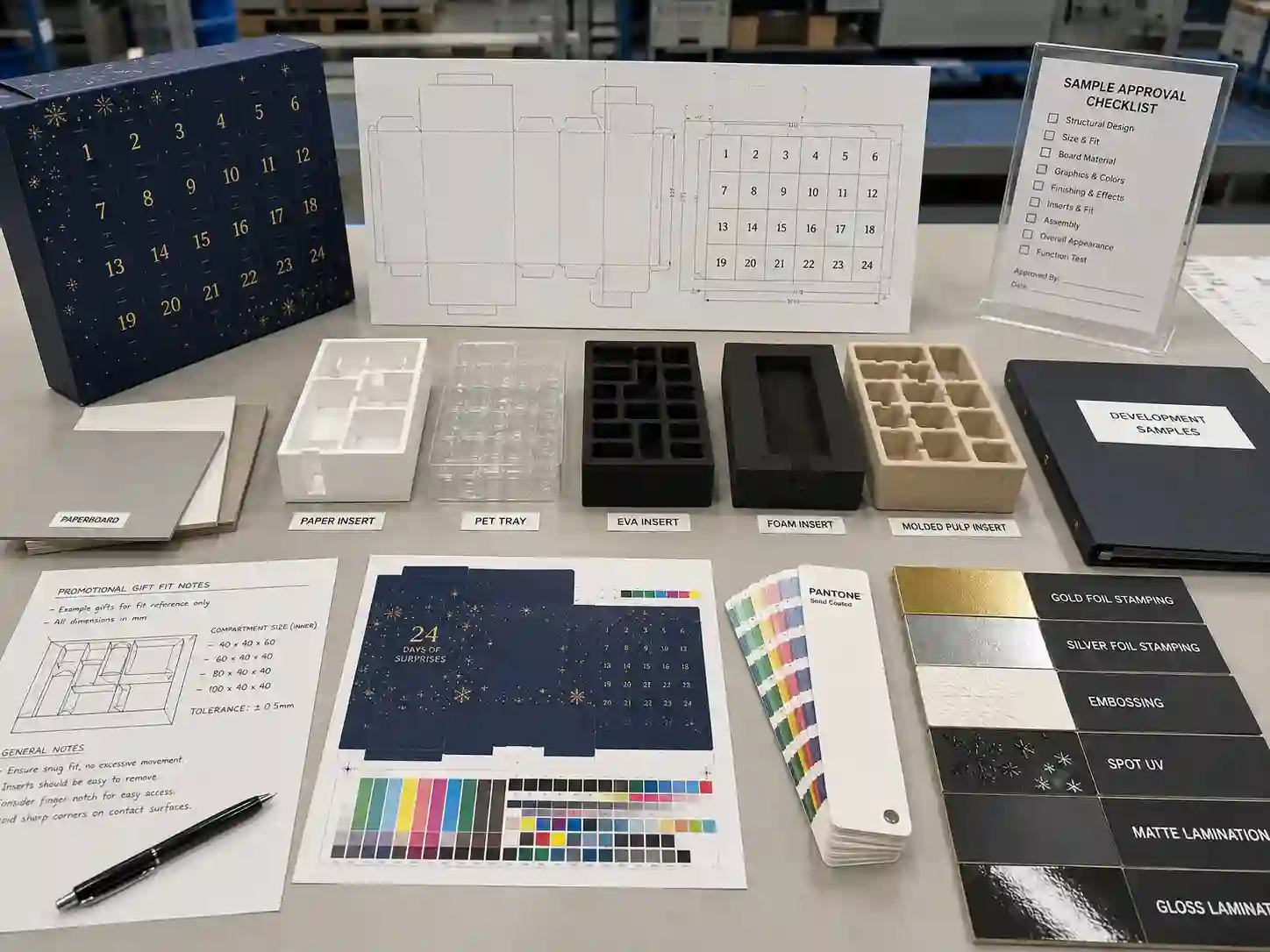
For promotional gift advent calendar boxes, artwork is more complex than a normal gift box because every door, drawer, compartment number, insert position, and warning label must match the dieline. If the box includes numbered doors, buyers should check whether the number positions are readable after die-cutting and whether artwork crosses any fold, cut, or tear line.
Matte lamination is often selected for a premium and modern look. Gloss lamination can make colors appear brighter and can support strong retail shelf presence. Foil stamping works well for campaign titles, numbers, borders, and seasonal accents, but it should be used with enough spacing from die-cut lines. Embossing and spot UV can add texture, but both require careful registration and proof review.
Buyer tip: A beautiful finish can become a production problem if it is placed too close to a door edge, fold line, or tear point. Ask the supplier to check the artwork against the dieline before approving expensive finishing plates.
How do MOQ and quantity affect unit price?
MOQ affects unit price because setup cost, printing plates, die-cut tooling, finishing setup, insert tooling, sample preparation, and labor planning are spread across the order quantity. A higher quantity usually reduces unit price, but it may increase inventory risk, storage cost, and campaign timing pressure.
There is no universal MOQ that fits every promotional calendar project. A simple folding carton calendar with paper insert may be easier to produce at a lower quantity than a rigid drawer calendar with EVA insert, foil stamping, and multiple hand-assembled parts. Buyers should ask suppliers to quote several quantity breaks, such as a trial quantity, a regular wholesale quantity, and a full campaign quantity.
| Cost driver | Why it changes the quotation | How buyers can control it |
|---|---|---|
| Box size and depth | More paper, greyboard, insert material, and freight volume | Group products by height and avoid oversizing every compartment for one large item. |
| Structure complexity | More die-cutting, folding, gluing, and manual assembly | Compare door-opening, drawer, and folding carton options before finalizing design. |
| Insert type | Different tooling, material, and assembly requirements | Use paper inserts where possible and reserve PET, EVA, foam, or molded pulp for items that need them. |
| Printing finish | Foil, embossing, spot UV, and lamination add setup and processing cost | Apply special finishes to key visual areas instead of the entire box. |
| Manual loading | Hand placement and sequence checking increase labor | Prepare a clear loading map and keep gift shapes consistent when possible. |
| Export packing | Carton grade, protectors, pallets, labels, and packing volume affect cost | Confirm shipping method, carton weight limits, and pallet requirements before production. |
Quotable B2B point: The cheapest promotional calendar box is not always the lowest campaign cost; oversized structure, slow assembly, weak inserts, and poor export packing can create higher total cost after production.
How should buyers prepare a quotation request?
Buyers should prepare product dimensions, gift count, target structure, insert preference, artwork files, quantity range, finishing requirements, delivery market, packing method, and target launch date before requesting a quotation. A clear RFQ helps the factory quote faster and reduces price changes after sampling.
When asking Giftpackpro to request a custom quote, buyers can send a simple brief first, then improve it with samples, dieline comments, and packing requirements. If the project is still early, the custom advent calendar box services page can help clarify which development steps are needed before mass production.
Quotation preparation checklist
- Product list with quantity per calendar, product name, size, weight, and fragility notes.
- Required number of compartments, such as 7, 12, 24, or a custom promotional sequence.
- Preferred structure: door-opening box, drawer box, rigid box, folding carton, book-style box, or custom structure.
- Insert preference: paper insert, PET tray, EVA insert, foam, molded pulp, or supplier recommendation.
- Artwork status: finished AI/PDF file, draft concept, color reference, Pantone reference, or need for dieline support.
- Printing and finishing: CMYK, Pantone, matte lamination, gloss lamination, foil stamping, embossing, or spot UV.
- Quantity range and expected MOQ flexibility, including test order and bulk order plan.
- Sample requirement: white sample, digital printed sample, finished sample, or pre-production sample.
- Export market, shipping method, carton label rules, barcode area, pallet requirement, and shipping marks.
- Required delivery date, retail launch date, warehouse appointment date, or e-commerce campaign date.
What sampling steps reduce risk before mass production?
Sampling reduces risk by testing structure, product fit, artwork position, opening function, insert grip, material feel, and packing method before mass production. Buyers should approve the sample in writing and keep one approved reference sample for QC comparison.
A white sample is useful for checking size, structure, compartments, drawers, doors, and insert layout before artwork is printed. A printed sample helps review color, artwork position, finishing, and overall presentation. A pre-production sample should represent the approved materials and process as closely as possible before bulk production starts.
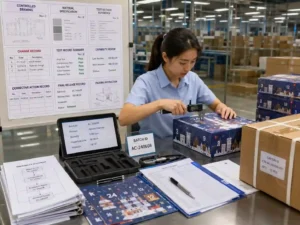
For promotional gift advent calendar boxes, sample approval should include loaded product testing. The buyer and supplier should check whether each item fits smoothly, whether compartments are easy to access, whether doors tear correctly, whether drawers slide without blocking, and whether the box remains stable when fully loaded.
QC tip: Do not approve a calendar sample based only on exterior photos. Ask for open-door photos, loaded insert photos, side-view depth photos, carton packing photos, and a short function test if doors or drawers are critical.
How should buyers compare suppliers for promotional gift advent calendar boxes?
Buyers should compare suppliers by engineering support, sample accuracy, insert testing ability, printing control, QC process, export packing experience, communication clarity, and quotation transparency. A low price is only useful if the supplier can repeat the approved sample in mass production.
A good supplier should ask detailed questions before quoting. If a supplier quotes immediately without product dimensions, structure details, insert requirements, artwork information, or packing method, the price may be incomplete. Buyers should also ask whether the supplier can provide dieline review, material suggestions, pre-production sample support, final inspection, and export carton planning.
Giftpackpro’s custom advent calendar box products page can be used to compare common structures and application styles, while the Giftpackpro packaging factory page gives buyers a better sense of factory-side packaging capability. Buyers can also review advent calendar box buying guides when preparing internal purchasing notes.
Supplier comparison decision guide
| Buyer priority | Recommended supplier capability | Warning sign |
|---|---|---|
| Accurate product fit | Can check product dimensions, insert drawings, and loaded samples | Only asks for box size and ignores product details |
| Controlled printing result | Can review dieline, CMYK/Pantone proof, and finishing position | Cannot explain color proof or finishing tolerance |
| Cost control | Can compare structures, materials, inserts, and quantity breaks | Quotes one option without explaining cost drivers |
| Reliable export packing | Can plan export carton size, carton label, shipping marks, and pallet method | Only discusses the box and not the outer packing |
| Mass production repeatability | Uses approved sample, QC checklist, and final inspection standard | Cannot define acceptance criteria before production |
What QC details matter before shipment?
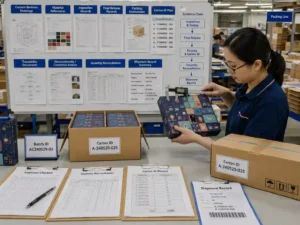
QC should confirm that mass production matches the approved sample in structure, color, finishing, insert fit, opening function, assembly quality, labeling, and export packing. For promotional gift packaging, function testing is as important as appearance inspection.
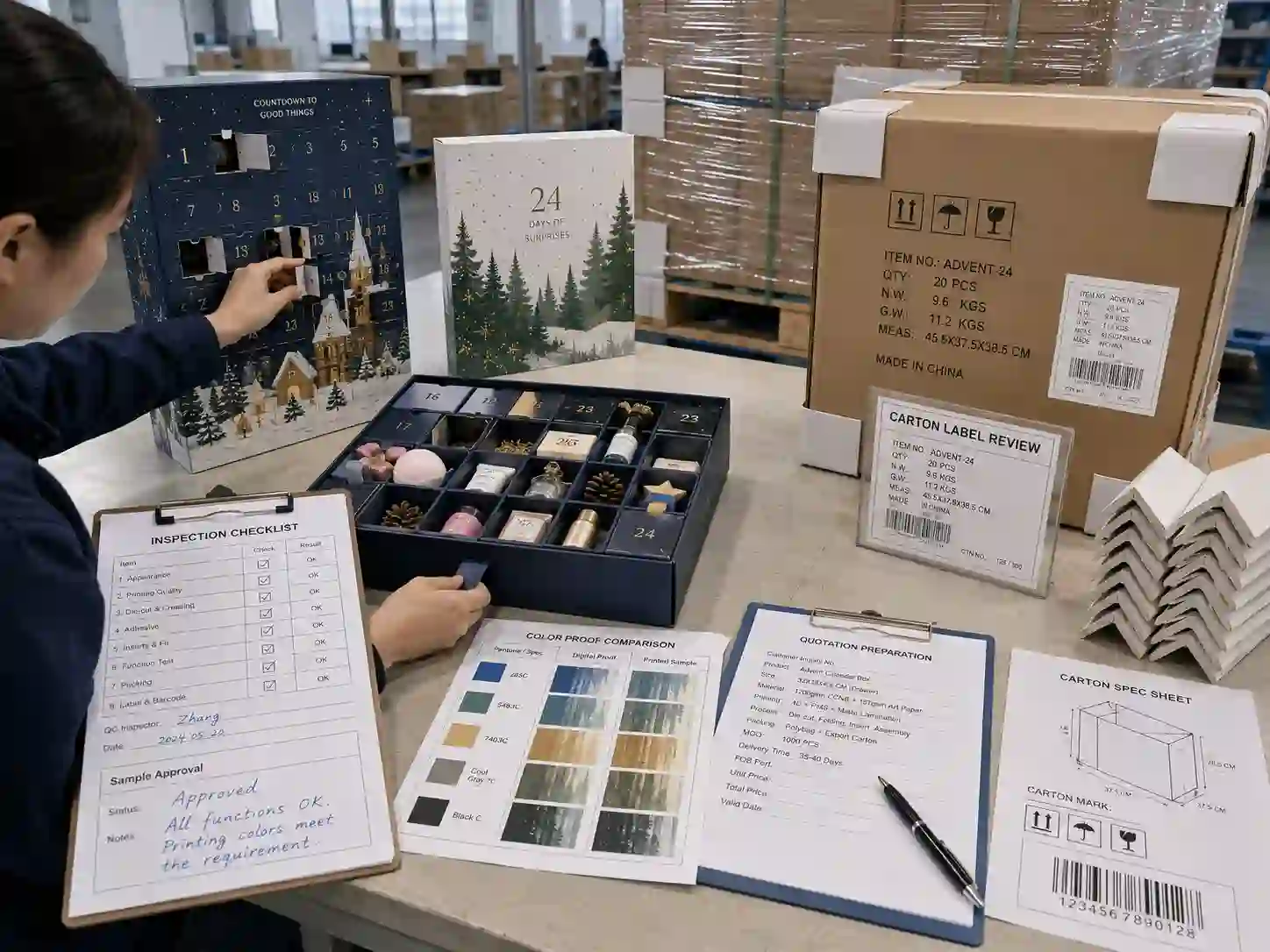
Final inspection should include carton count, product loading accuracy if loading is included, door sequence, drawer movement, glue strength, board flatness, lamination quality, foil or spot UV registration, barcode label area, carton label placement, and shipping marks. For retail or e-commerce buyers using barcodes, GS1’s official barcode resources at GS1 can help teams understand barcode standards before artwork is finalized.
Export packing should be discussed before production, not after the goods are finished. Heavy rigid calendars may need stronger export cartons, corner protectors, pallet wrapping, or weight limits per carton. Folding carton calendars may need protection against compression and moisture during long-distance transport. Buyers should confirm whether the boxes ship empty, flat, assembled, or pre-loaded with gifts because this changes carton size, labor, and damage risk.
Practical QC checklist for buyers
- Compare mass production color against approved proof or approved sample.
- Check dieline alignment, door cutting, drawer gaps, fold lines, and opening function.
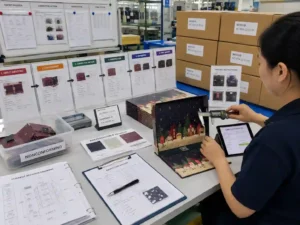
- Test insert fit with real products, including shaking, removal, and re-closing where relevant.
- Inspect lamination, foil stamping, embossing, spot UV, scuffing, glue marks, and edge quality.
- Confirm all numbers, warnings, barcode areas, generic labels, and shipping marks are correct.
- Review export carton strength, carton weight, packing direction, corner protection, and pallet plan.
- Keep approved samples and inspection photos for internal purchasing records.
How can buyers control cost without weakening the packaging?
Buyers can control cost by simplifying the structure, reducing oversized compartments, choosing insert materials by actual risk, limiting special finishes to high-impact areas, and confirming quantity breaks early. Cost control should protect function first and reduce unnecessary complexity second.
If the gift items are lightweight, a folding carton or door-opening paperboard structure may offer better campaign economics than a heavy rigid box. If only a few items are fragile, mixed insert engineering may be better than using expensive cushioning for every compartment. If the design uses foil stamping, it may be more cost-effective to foil only the campaign title, numbers, or logo area rather than large backgrounds.
Buyers should also check assembly cost. A box with many tiny drawers, ribbons, sleeves, labels, or hand-loaded compartments may look attractive but can increase labor cost and lead time. Clear loading maps, consistent product sizes, and logical compartment sequence help reduce mistakes during production.
Factory tip: The best cost-saving change is often made at the dieline stage. Once tooling, printing, and finishing are approved, small structure changes can become expensive delays.
What common mistakes should buyers avoid?
The most common mistakes are requesting a quote without product dimensions, approving artwork before dieline checking, choosing inserts without loaded testing, comparing prices without matching specifications, and leaving export packing details until the end.
- Mistake 1: Quoting from a picture only. A reference image cannot define board thickness, insert material, finishing process, carton packing, or loading labor.
- Mistake 2: Oversizing the whole calendar. One tall item can make every compartment deeper, increasing paper, greyboard, insert, carton, and freight cost.
- Mistake 3: Ignoring assembly tolerance. Drawer boxes, doors, and inserts need practical clearance, not only attractive renderings.
- Mistake 4: Using too many finishes. Foil, embossing, spot UV, and lamination should support the sales message, not create unnecessary cost and registration risk.
- Mistake 5: Skipping pre-production confirmation. A final sample or pre-production sample is important when the project uses new structure, new inserts, or high-value printing.
- Mistake 6: Not defining carton labels. Shipping marks, barcode areas, SKU labels, and warehouse labels should be planned before cartons are printed.
FAQ: Promotional gift advent calendar boxes for B2B buyers
What information is needed to quote promotional gift advent calendar boxes?
A supplier usually needs product dimensions, gift count, structure preference, insert type, material requirements, artwork status, printing finish, quantity, sample needs, packing method, and delivery schedule. More complete information leads to a more accurate quotation.
Can one advent calendar box hold different product categories?
Yes, but mixed gifts require careful insert planning and weight distribution. Cosmetic minis, wrapped chocolates, small candles, jewelry cards, tea sachets, coffee capsules, and toy accessories can share one calendar if each compartment is engineered around the actual item.
Is a rigid box always better than a folding carton calendar?
No. A rigid box offers a premium feel, but it is not always the best cost or logistics choice. Folding carton calendars can be more efficient for lightweight products, larger quantities, and price-sensitive promotional campaigns.
How can buyers reduce MOQ pressure?
Buyers can ask for simplified structures, standard material options, fewer special finishes, shared production-friendly dimensions, and multiple quantity breaks. A trial quantity may be possible for some projects, but complex custom tooling and manual assembly usually require higher production volume.
Should buyers approve a white sample or printed sample?
For a new structure, buyers should usually approve a white sample first to confirm size, compartments, and function. A printed or finished sample should follow when color, artwork position, lamination, foil stamping, embossing, or spot UV must be checked.
What affects lead time most?
Lead time is affected by dieline confirmation, artwork approval, sample revisions, material sourcing, printing, finishing, insert production, manual assembly, QC, export packing, and shipping schedule. Late artwork changes and insert fit problems are common causes of delay.
CTA: What should buyers prepare before asking Giftpackpro for a sample or quotation?
To develop promotional gift advent calendar boxes efficiently, prepare a product list, item dimensions, target quantity, preferred structure, insert requirement, artwork or design direction, finishing expectations, packing method, and required delivery date. If the project is still flexible, Giftpackpro can compare structure, insert, material, MOQ, and cost-control options before sampling.
For practical next steps, review available custom advent calendar box products, check custom advent calendar box services, read more advent calendar box buying guides, and then request a custom quote with your product details and campaign schedule.