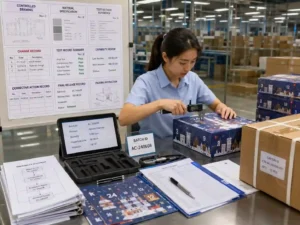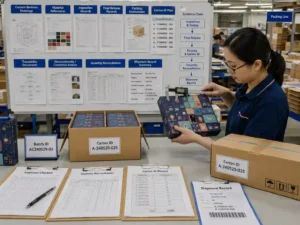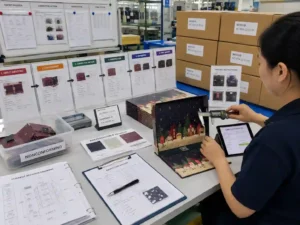
Quick answer: Corporate gift advent calendar boxes are custom seasonal packaging solutions designed for branded promotional gifts, employee gifts, VIP client kits, retail campaigns, and distributor programs. For B2B buyers, the key decisions are structure, insert protection, material grade, printing finish, sampling method, MOQ, QC plan, export packing, and quotation details. A successful project should start with product dimensions, gift weight, campaign quantity, artwork direction, delivery deadline, and sample approval requirements. Before mass production, buyers should review a blank sample for structure and a printed sample or pre-production sample for color, finishing, insert fit, and assembly tolerance.
What should buyers understand before choosing corporate gift advent calendar boxes?
Buyers should understand that corporate gift advent calendar boxes are not only decorative gift packaging; they are engineered multi-compartment packaging systems. Each compartment must protect the gift item, support the opening experience, match brand artwork, and survive export transportation.
Corporate gift projects often involve mixed items such as stationery, candles, mini cosmetics, small accessories, tea sachets, coffee capsules, snack packs, gift cards, samples, or promotional merchandise. Because these items vary in size, weight, fragility, and presentation value, the box structure and insert design must be planned before artwork is finalized.
For overseas brands and purchasing teams, the best supplier discussion starts with packaging purpose. A box for a VIP client gift has different requirements from a wholesale promotional pack, an Amazon gift set, or a retail shelf campaign. A corporate HR gift may prioritize premium unboxing and secure transit, while a distributor campaign may prioritize carton efficiency, MOQ control, and fast sampling.
As a custom advent calendar boxes manufacturer, Giftpackpro usually reviews structure, insert fit, printing process, sample approval, production schedule, QC checkpoints, and export packing together because one decision affects the others.
Which box structure works best for a corporate gifting campaign?
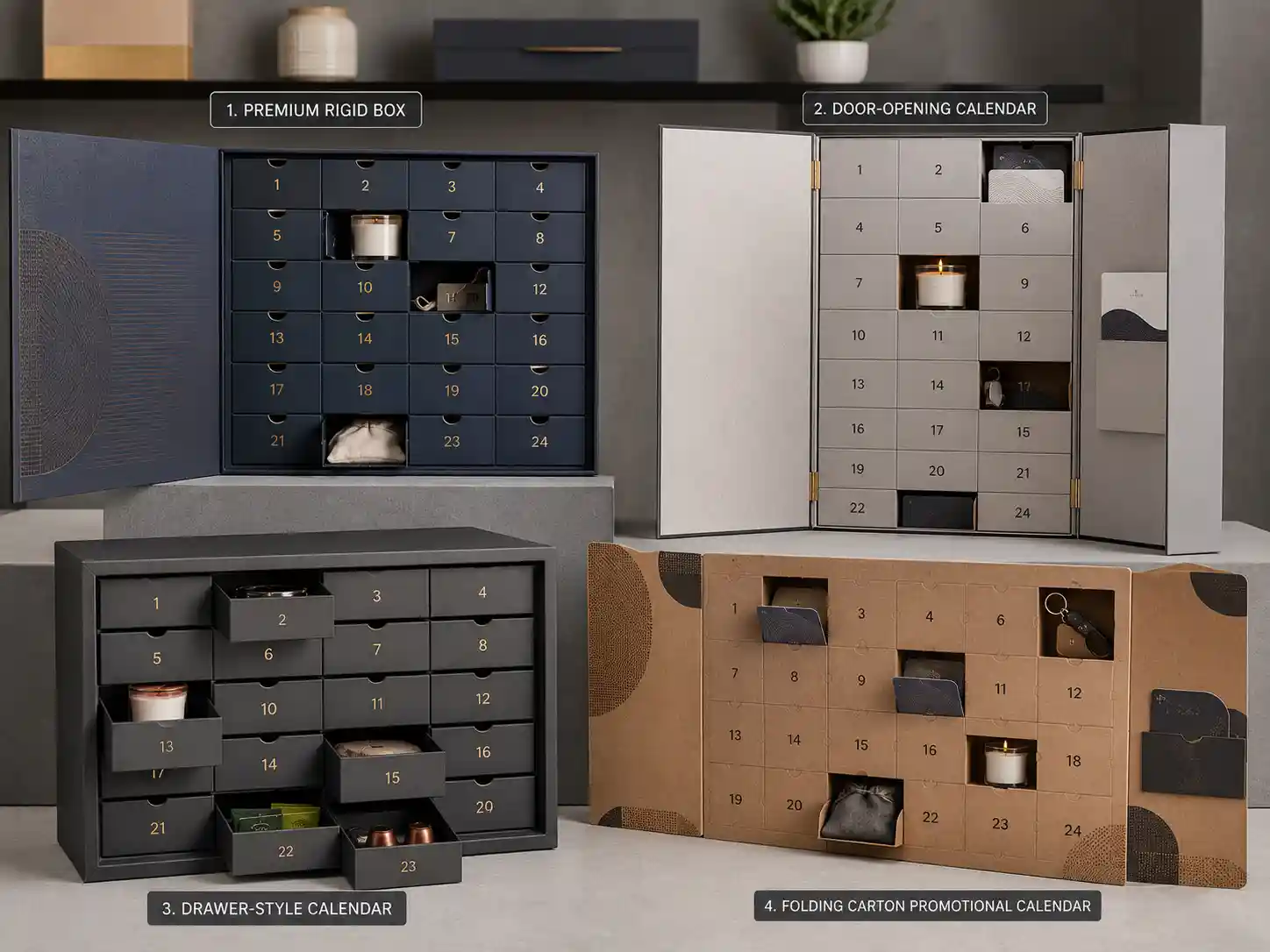
The best structure depends on gift weight, campaign positioning, display style, assembly budget, and delivery channel. Rigid boxes usually feel more premium, folding cartons are more cost-efficient, drawer boxes create a reusable experience, and door-opening boxes work well for classic numbered gift reveals.
Corporate gift advent calendar boxes should balance brand impression with production reality. A structure that looks impressive in a rendering may become expensive or slow if it requires too much manual assembly, complex insert loading, or fragile finishing alignment.
| Structure option | Best for | Buyer advantages | Key sampling checks |
|---|---|---|---|
| Rigid box with compartments | VIP client gifts, luxury corporate campaigns, premium sample kits | Strong structure, high perceived value, suitable for heavier mixed gifts | Greyboard thickness, wrap alignment, corner quality, insert stability, shipping weight |
| Door-opening advent calendar box | Classic countdown promotions, retail shelf displays, branded seasonal campaigns | Clear numbered layout, strong campaign storytelling, good front-panel impact | Door perforation, tear resistance, compartment spacing, artwork registration |
| Drawer box advent calendar | Reusable corporate gifts, multi-day employee programs, premium promotional sets | Good product access, reusable drawers, strong presentation value | Drawer sliding tolerance, pull tab strength, inner tray fit, assembly consistency |
| Folding carton calendar | Large-volume promotions, lightweight samples, cost-sensitive campaigns | Lower shipping volume, faster production, efficient material usage | Paperboard stiffness, folding accuracy, locking tabs, product load limit |
Buyer tip: For mixed corporate gifts, do not approve the outer structure before checking the heaviest and tallest item. One oversized gift can force a larger box, thicker insert, stronger board, and higher export carton cost.
How should inserts be designed for corporate gifts?
Inserts should be designed around the exact product dimensions, loading direction, and transport risk. A good insert prevents movement, supports neat presentation, and keeps the box easy to assemble during mass production.
Corporate gift advent calendar boxes often include many small SKUs in one package. Each cavity should have enough tolerance for manual loading but not so much space that the gift rattles during transit. For fragile gifts such as mini glass bottles, candles, or delicate accessories, the insert may need extra side clearance, deeper cavities, or protective material around high-risk areas.
Which insert material should buyers compare?
Buyers should compare insert materials by protection, appearance, sustainability preference, MOQ impact, tooling needs, and unit cost. The lowest-cost insert is not always the best choice if it causes product shifting, cracked samples, poor presentation, or slow assembly.
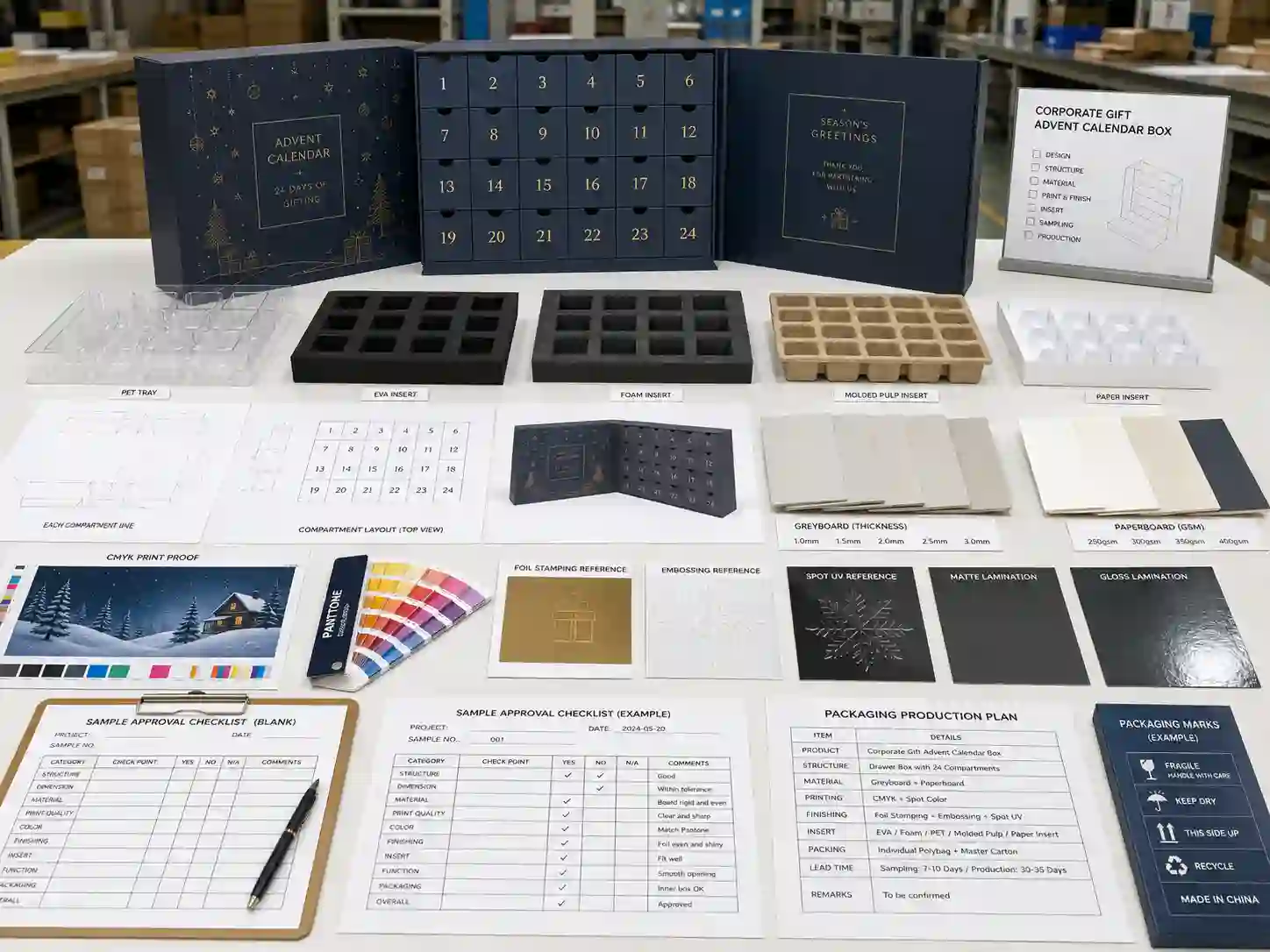
- Paper insert: Good for lightweight gifts, flat stationery, tea sachets, small pouches, and buyers who prefer a paper-based packaging solution.
- PET tray: Suitable for molded cavities, clear product positioning, and mixed items that require accurate shape control.
- EVA insert: Useful for premium gifts, heavier items, bottles, electronics accessories, or items needing a clean fitted look.
- Foam insert: Helps protect fragile or irregular items but should be checked against buyer sustainability and disposal requirements.
- Molded pulp insert: A practical option for brands seeking a molded, paper-based insert, especially when the product shape and volume support tooling.
Factory tip: Insert tolerance should be checked with real products, not only 3D dimensions. Flexible pouches, paper sleeves, shrink-wrapped items, and soft gift bags can change shape during loading and export shipping.
What materials and finishes matter most for branded corporate packaging?
Material and finishing decisions should support both brand appearance and structural performance. For corporate gifts, buyers often choose paperboard or greyboard based on weight, premium feel, box size, and shipping route.
Rigid corporate advent calendars usually use greyboard wrapped with printed paper. Folding carton styles usually use paperboard such as SBS, CCNB, or kraft paperboard depending on budget and appearance. For heavier gifts or tall box formats, board thickness and reinforcement areas should be reviewed during sampling.
Printing and finishing options can include CMYK, Pantone spot color, foil stamping, embossing, spot UV, matte lamination, and gloss lamination. A corporate campaign with strict brand colors should not rely only on screen previews. It should include color proofing and, when necessary, Pantone references.
How should buyers control brand color and artwork risk?
Buyers should prepare final artwork on the approved dieline and review all cut lines, bleed, safe zones, numbering, barcode areas, and opening marks before sample production. A small artwork error can become expensive when repeated across 24 or 25 compartments.
- Confirm whether the calendar uses 12, 24, 25, or another compartment count.
- Check that numbers align with doors, drawers, sleeves, or pull tabs.
- Keep important logos, QR codes, and text away from folds, perforations, and glue areas.
- Use CMYK for full-color graphics and Pantone references for critical corporate colors.
- Confirm foil stamping, embossing, and spot UV areas with separate artwork layers.
- Check matte lamination or gloss lamination against scratch risk, fingerprint visibility, and brand style.
Quotable B2B statement: A corporate advent calendar dieline is a production document, not just a design template; it controls structure, insert fit, artwork position, finishing registration, assembly speed, and final QC.
How does the sampling process work for corporate gift advent calendar boxes?
The sampling process usually moves from structure confirmation to artwork confirmation and then to pre-production approval. Buyers should use blank samples to test size and structure, printed samples to review brand appearance, and pre-production samples to approve the final production standard.
For Month 07 sampling and prototyping planning, buyers should not treat the sample as a simple visual mockup. The sample is the first serious test of whether the box can be produced, assembled, filled, packed, shipped, and presented consistently.
What is the difference between blank sample, printed sample, and pre-production sample?
A blank sample checks structure and product fit before printing. A printed sample checks artwork, color, finishing, and overall presentation. A pre-production sample confirms the approved standard before mass production starts.
| Sample type | Main purpose | What buyers should check | When to use it |
|---|---|---|---|
| Blank sample | Confirm size, structure, insert, opening method, and product fit | Compartment dimensions, drawer movement, door tear line, insert grip, loading sequence | Before final artwork or when product dimensions are uncertain |
| Printed sample | Review artwork, color, surface finish, and brand presentation | CMYK result, Pantone match, foil position, embossing depth, lamination effect | Before internal buyer approval, sales presentation, or retailer review |
| Pre-production sample | Approve the mass production benchmark | Final material, final insert, final printing, final packing method, final label position | Before bulk production and final purchase order release |
How many sample revisions should buyers expect?
Buyers should plan for at least one revision if the project has custom inserts, mixed gifts, special finishing, or strict brand color requirements. Revisions are normal when the first sample reveals insert tolerance, product movement, color difference, or assembly issues.
Common revision points include increasing compartment depth, changing paperboard thickness, adjusting drawer clearance, widening a PET tray cavity, strengthening a door-opening line, modifying foam density, or moving artwork away from folds and glue zones.
Buyer tip: Send real product samples or accurate dummy products to the packaging factory whenever possible. If the factory only receives dimensions, the prototype may miss soft packaging bulge, cap height, bottle shoulder shape, or gift pouch thickness.
What MOQ and cost drivers should buyers consider before requesting a quotation?
MOQ and cost depend on structure complexity, material, printing, finishing, insert type, assembly labor, sample requirements, and export packing. Buyers should not compare quotations only by unit price unless the same structure, material, insert, sample standard, and packing method are included.
Corporate gift advent calendar boxes can involve more manual work than standard gift boxes. Drawer assembly, door die-cutting, insert loading, foil stamping alignment, and multi-compartment QC all affect price and lead time. A supplier with a lower unit price may exclude sample cost, insert tooling, export carton upgrades, or pallet packing.
Which cost items are often missed in early RFQs?
- Dieline development and structural engineering time.
- Blank sample, printed sample, and pre-production sample fees.
- PET tray mold, EVA cutting tool, foam cutting tool, or molded pulp tooling.
- Special finishing setup for foil stamping, embossing, debossing, or spot UV.
- Manual assembly, drawer loading, ribbon or pull-tab installation, and insert placement.
- Export carton, corner protector, pallet, pallet wrap, and shipping marks.
- Barcode label area, carton label format, and retailer packing requirements.
Factory tip: A lower MOQ may be possible for simpler paperboard structures, but complex rigid calendars with custom inserts and special finishing usually require more setup time and stronger production planning.
How should buyers choose and compare suppliers?
Buyers should compare suppliers by packaging engineering ability, sampling accuracy, communication speed, artwork checking process, QC discipline, export packing experience, and quotation transparency. The right supplier should help prevent production problems before mass production begins.
A corporate gift campaign often has a fixed launch date. Late sample approval, unclear artwork, unstable insert fit, or weak packing can put the full campaign at risk. Buyers should ask suppliers how they check dielines, how they test inserts, how they control color, and how they pack export cartons.
Supplier comparison decision guide
| Decision point | Stronger supplier response | Risk signal |
|---|---|---|
| Structure advice | Explains rigid box, folding carton, drawer box, and door-opening box options based on gift weight and budget | Only quotes from a picture without checking dimensions or weight |
| Insert planning | Requests product size, weight, shape, and loading direction before recommending paper insert, PET tray, EVA, foam, or molded pulp | Uses one insert material for every project without product-fit testing |
| Sampling process | Separates blank sample, printed sample, and pre-production sample approval | Moves to mass production without a clear signed sample standard |
| Artwork control | Checks dieline, bleed, safe area, numbering, CMYK/Pantone, finishing layers, and barcode position | Accepts artwork without technical review |
| Export packing | Confirms carton size, gross weight, shipping marks, corner protection, and pallet method | Quotes only product unit price with no packing details |
Buyers can review custom advent calendar box services to understand how structure development, sampling, printing, production, and packing support should connect in one project workflow.
What QC checks are important before mass production and shipment?
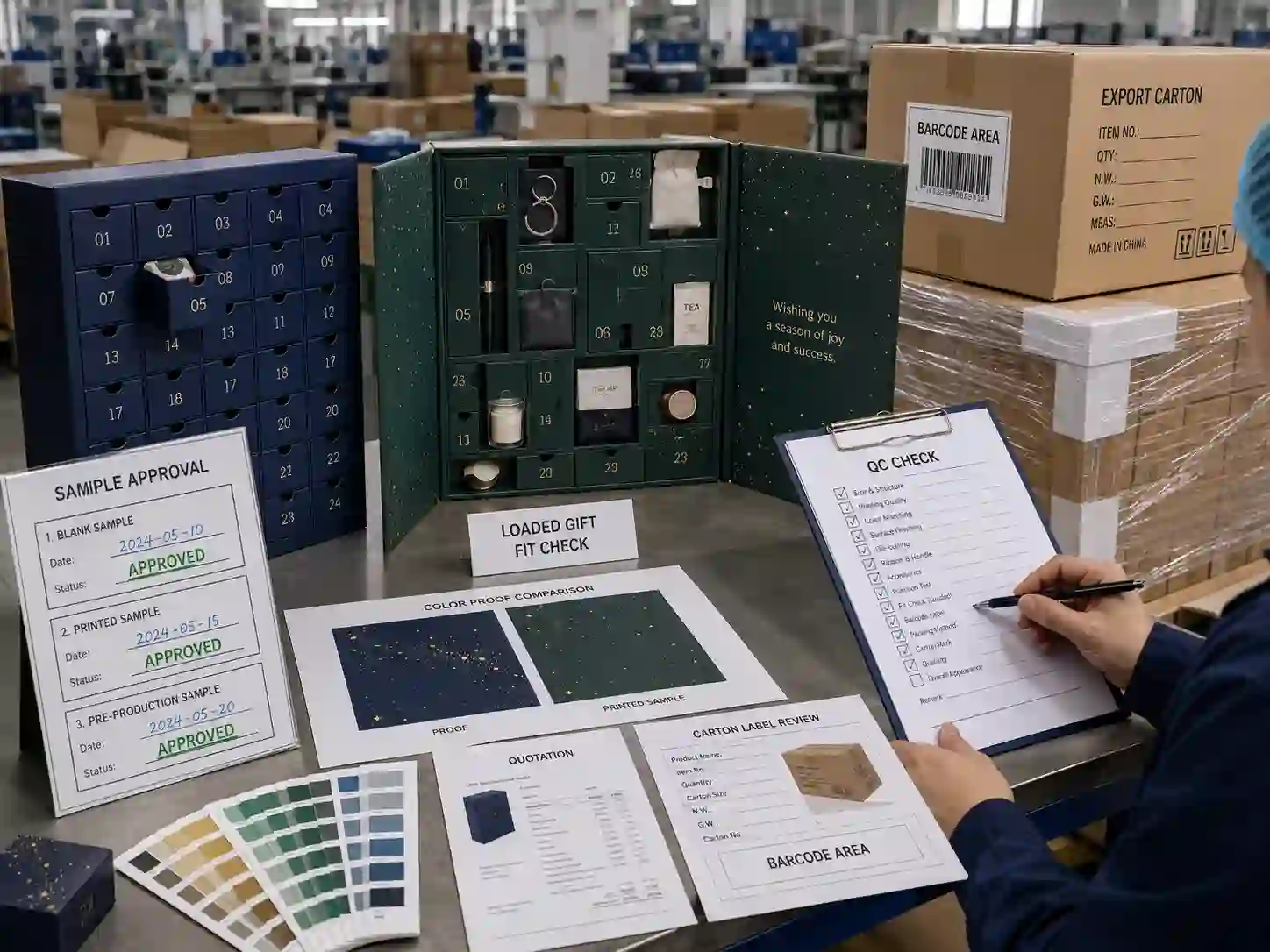
QC should confirm that the final goods match the approved sample in structure, color, insert fit, function, assembly, quantity, labeling, and export packing. For corporate gift advent calendar boxes, QC must check both appearance and function because each compartment is part of the customer experience.
Important checks include paper material, greyboard thickness, box size tolerance, drawer sliding, door-opening function, glue strength, insert placement, print registration, finishing position, surface scratches, color consistency, barcode readability, carton strength, and shipping marks.
Practical QC checklist for corporate gift advent calendar boxes
- Compare mass production pieces with the approved pre-production sample.
- Measure outer box size, compartment size, and insert cavity size.
- Test door-opening, drawer sliding, pull-tab strength, and closure performance.
- Check whether gifts fit securely without crushing, rattling, or falling out.
- Review CMYK color, Pantone color, foil stamping, embossing, spot UV, matte lamination, and gloss lamination consistency.
- Inspect corners, edges, glue lines, lamination bubbles, scratches, stains, and dents.
- Confirm quantity per export carton and carton gross weight.
- Check barcode label area, carton label, shipping marks, and pallet instructions.
QC tip: For drawer and door-opening calendars, function testing should be repeated across production batches, not only checked on one golden sample. Small tolerance changes can affect opening feel and product access.
How should export packing be planned for overseas shipments?
Export packing should protect the finished calendars from compression, corner damage, moisture exposure, and handling shock. Because corporate gift advent calendars can be large, decorated, and partially handmade, carton design and pallet planning should be confirmed before shipment.
Buyers should ask for carton dimensions, quantity per carton, gross weight, net weight, shipping marks, pallet height, and whether corner protectors or pallet wrap are included. For e-commerce or retailer programs, carton labels and barcode positions may need to follow warehouse requirements.
For transport testing references, buyers can review official resources from ISTA. If barcodes are used on retail or logistics labels, buyers can also check GS1 barcode standards.
Export cartons should be strong enough for the product weight and shipping route. Large calendars with rigid boxes may need fewer pieces per carton to reduce compression. Lightweight folding carton calendars may allow more efficient carton packing, but they still need protection against dents and crushed corners.
What information should buyers prepare before requesting a quote?
Buyers should prepare product details, structure preference, quantity, artwork status, sample needs, packing requirements, and delivery deadline before requesting a quotation. The more complete the RFQ, the more accurate the price, MOQ, lead time, and sample plan will be.
Giftpackpro can usually provide more practical feedback when buyers share both marketing goals and technical details. A simple reference photo is helpful, but it is not enough for accurate corporate packaging development.
RFQ preparation checklist
- Target box type: rigid box, folding carton, drawer box, door-opening box, or unsure.
- Calendar count: 7, 12, 24, 25, 31, or custom compartment layout.
- Product list: item name, size, weight, material, fragility, and quantity per calendar.
- Insert preference: paper insert, PET tray, EVA insert, foam, molded pulp, or factory recommendation.
- Artwork status: concept only, dieline needed, print-ready file, or existing sample to match.
- Printing and finishing: CMYK, Pantone, foil stamping, embossing, spot UV, matte lamination, gloss lamination, or other requirements.
- Sample plan: blank sample, printed sample, pre-production sample, or urgent review sample.
- Order quantity and target MOQ flexibility.
- Delivery destination, shipping method, carton label needs, barcode area, and pallet requirements.
- Target approval date, mass production deadline, and final launch date.
Buyers can browse custom advent calendar box products for structure references, read more advent calendar box buying guides, or contact the Giftpackpro packaging factory team when preparing a new project.
What common mistakes should buyers avoid?
The most common mistakes are approving artwork before structure, ignoring insert testing, comparing incomplete quotations, rushing sample approval, and underestimating export packing. These mistakes can increase cost, delay production, or reduce the final gift presentation quality.
- Approving design before product fit: A beautiful layout may fail if the items do not fit securely inside each compartment.
- Skipping blank samples: Printed samples cost more to revise if the basic structure or insert is wrong.
- Ignoring assembly tolerance: Drawer boxes and door-opening boxes need controlled clearance so they open smoothly.
- Using low-resolution artwork: Corporate gift packaging often has large print areas, so weak artwork becomes visible quickly.
- Forgetting carton labels: Retailers, warehouses, and e-commerce channels may need specific barcode and shipping mark formats.
- Choosing finish without testing: Foil stamping, embossing, and spot UV can look different across paper surfaces and colors.
- Comparing only unit price: Tooling, sample, packing, pallet, and revision costs may change the real landed cost.
FAQ: Corporate gift advent calendar boxes for B2B buyers
What is the best structure for corporate gift advent calendar boxes?
The best structure depends on gift weight, presentation level, budget, and channel. Rigid boxes are suitable for premium corporate gifts, drawer boxes work well for reusable gift programs, door-opening boxes fit classic countdown campaigns, and folding cartons are practical for lighter, higher-volume promotions.
Do buyers need a blank sample before a printed sample?
A blank sample is strongly recommended when the products are mixed, heavy, fragile, or irregular. It allows buyers to approve structure, insert fit, opening function, and assembly tolerance before paying for printed sample production.
What is a pre-production sample?
A pre-production sample is the final approved reference for mass production. It should show the confirmed material, structure, insert, printing, finishing, and packing method so both buyer and factory share the same production standard.
Which insert is best for corporate gifts?
There is no universal best insert. Paper inserts are useful for lightweight items, PET trays support shaped cavities, EVA inserts create a premium fitted look, foam protects fragile pieces, and molded pulp can support paper-based molded protection when tooling and quantity are suitable.
How long does sampling take?
Sampling lead time depends on structure complexity, artwork readiness, insert tooling, printing, and finishing. Buyers should confirm timing with the factory during RFQ because blank samples, printed samples, and pre-production samples may each require different preparation steps.
What affects MOQ for custom corporate advent calendar boxes?
MOQ is affected by material sourcing, print setup, die-cut tooling, insert tooling, special finishing, assembly labor, and packing method. Simpler paperboard structures may allow more flexible quantities than complex rigid boxes with custom molded inserts.
Can corporate gift advent calendars be made for e-commerce shipping?
Yes, but e-commerce projects need stronger attention to carton protection, corner strength, product movement, barcode label area, and drop-handling risk. Buyers should discuss export carton and pallet packing during the quotation stage, not after production.
Ready to develop corporate gift advent calendar boxes?
For accurate sampling and quotation, prepare your product dimensions, target quantity, preferred structure, insert requirements, artwork status, finishing options, delivery deadline, and export packing needs. Giftpackpro can help buyers review structure, sample approach, production feasibility, and quotation details before moving into mass production.
To start a practical RFQ for corporate gift advent calendar boxes, use the project checklist above and request a custom quote with product details, reference photos, artwork files, and target schedule.