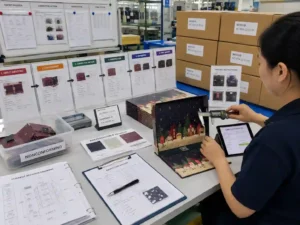
Quick answer: To design corporate gift advent calendar boxes for seasonal campaigns, buyers should confirm the gift list, box structure, insert method, artwork requirements, sample approval process, production tolerance, QC checkpoints, and export packing plan before mass production starts. Corporate gift projects usually combine presentation value with practical shipping durability, so the packaging must protect mixed items such as stationery, tea sachets, candles, accessories, coffee capsules, vouchers, or sample-size products while keeping compartments neat and easy to open. A reliable supplier should help check the dieline, test insert fit, review printing proofs, control assembly quality, and prepare export cartons with clear shipping marks.
Corporate gift advent calendar boxes are different from consumer novelty packaging because they often support brand gifting, retail promotions, loyalty campaigns, distributor programs, employee gifts, and e-commerce gift sets. Buyers need packaging that looks premium, opens smoothly, holds mixed gifts securely, and survives international shipping without crushed corners, loose inserts, color deviation, or damaged drawers.
Giftpackpro works as a custom advent calendar boxes manufacturer for B2B buyers who need seasonal paper gift packaging with practical engineering support, not just decorative box production. The most successful projects start with a clear product list, accurate dimensions, approved artwork, realistic lead time, and a written QC standard before bulk production begins.
What should buyers confirm before designing corporate gift advent calendar boxes?
Buyers should confirm the campaign purpose, gift item list, quantity, sales channel, delivery destination, opening experience, and budget level before choosing the box structure. These details decide whether the project should use a rigid box, folding carton, drawer box, door-opening box, or mixed structure.
A corporate gift calendar may need to hold different product types in one package: a keychain, small candle, notebook card, tea sachet, coffee capsule, gift card, pouch, mini bottle, or accessory. Each item has a different weight, height, friction surface, and damage risk. If the gift list changes after the dieline is approved, the insert layout may need to be revised, which can affect sampling time, tooling cost, and production schedule.
Buyer tip: Do not start artwork before the final compartment layout is confirmed. In corporate gift packaging, the artwork and structure are connected because numbered doors, drawer fronts, insert openings, and product names must align with the dieline.
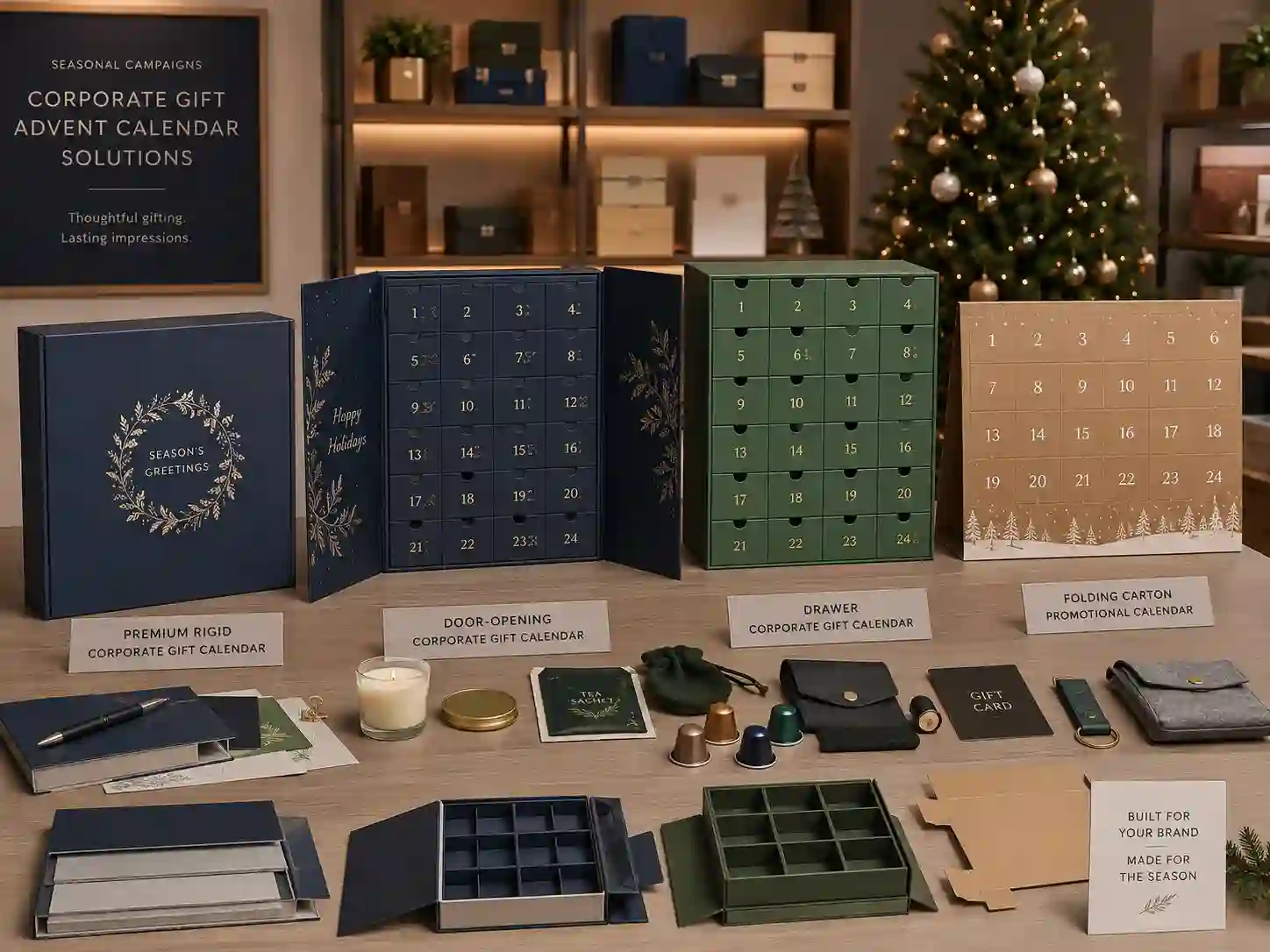
Which structure is best for a seasonal corporate gift campaign?
The best structure depends on product weight, campaign positioning, packing speed, shipping route, and the user experience you want. A premium executive gift may need a rigid greyboard structure, while a high-volume promotional campaign may work better with a folding carton or lightweight paperboard design.
| Structure option | Best for | Key production checks | Buyer considerations |
|---|---|---|---|
| Door-opening box | Classic numbered reveal experience, retail display, corporate seasonal gifting | Door perforation, opening force, printed number alignment, inner tray position | Good visual impact, but door strength and insert clearance must be tested |
| Drawer box | Premium corporate gifts, reusable packaging, heavier items | Drawer sliding tolerance, pull tab strength, sleeve fit, glue strength | Higher perceived value, usually higher material and assembly cost |
| Rigid box | Executive gifting, luxury gift sets, high-value seasonal campaigns | Greyboard thickness, wrapping accuracy, corner finish, magnet or ribbon placement | Strong presentation, but heavier for shipping and usually longer production time |
| Folding carton | Large-volume campaigns, e-commerce promotions, lightweight gifts | Crease line accuracy, locking tabs, paperboard stiffness, carton compression | Cost-efficient, but less premium than rigid box options |
| Book-style calendar | Corporate storytelling, brand message pages, mixed small gifts | Spine strength, hinge durability, panel flatness, insert bonding | Useful when buyers need a branded presentation area and compartment layout |
For corporate gift advent calendar boxes, the structure should be selected after product testing, not only from a catalog image. A drawer box that looks elegant may fail if the loaded gift weight makes drawers slide poorly. A door-opening box may look simple but requires careful testing of paperboard stiffness, door cutting depth, and finger access.
How should inserts be designed for mixed corporate gifts?
Inserts should hold each gift in the correct position, prevent movement during shipping, and support easy removal by the recipient. The right insert depends on product weight, surface material, shape, fragility, and sustainability expectations.
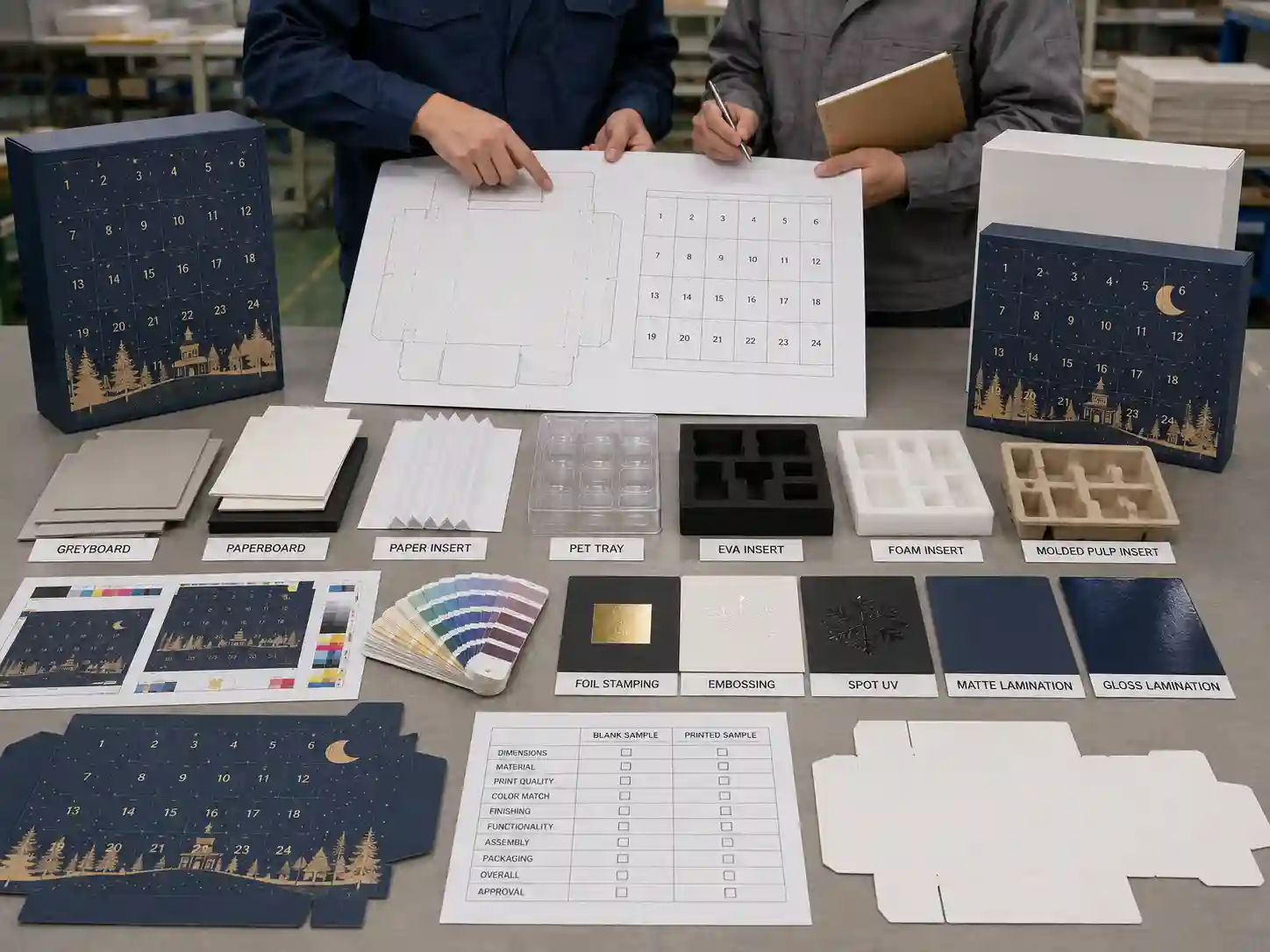
Paper insert options are common for stationery, cards, sachets, flat accessories, and lightweight promotional gifts. PET trays are useful when the buyer needs accurate cavities, smooth product presentation, or moisture-resistant surfaces. EVA insert and foam can help protect heavier or fragile items, but buyers should check appearance, odor, compression recovery, and market expectations. Molded pulp may be suitable when the campaign needs a more fiber-based insert solution, but tooling, cavity precision, and surface texture should be reviewed during sampling.
What insert details should be tested before mass production?
The insert test should confirm cavity size, loaded height, product movement, door clearance, finger access, assembly speed, and drop or vibration risk. A good insert is not only attractive; it must also support consistent packing during mass production.
- Measure every gift item by length, width, height, weight, and orientation.
- Confirm whether products are packed loose, wrapped, bagged, boxed, or sleeved.
- Check whether tall items push against doors, lids, or drawer panels.
- Test whether small items fall under the insert during shaking or transport.
- Confirm whether workers can load items quickly without damaging print or inserts.
- Check whether the customer can remove each item without tearing the box.
Factory tip: For mixed corporate gift calendars, one or two “problem items” often decide the whole insert layout. Heavy candles, round coffee capsules, glass mini bottles, and thick pouches should be tested first because they affect compartment depth, support points, and export packing strength.
What materials work best for corporate gift advent calendar boxes?
Material selection should balance appearance, stiffness, cost, production speed, and shipping durability. Corporate gift calendars often use paperboard for folding cartons and greyboard for rigid boxes, with coated paper, specialty paper, or printed wrapping paper for the visible surface.
Greyboard thickness should match the loaded weight and box size. If the board is too thin, the box may bend, warp, or show weak corners after assembly. If the board is too thick, the box becomes heavier, costlier, and less efficient for pallet loading. Paperboard should be tested for crease quality, door performance, and compression resistance, especially when multiple compartments are cut into the surface.
Buyers who require responsibly sourced paper materials can ask suppliers to explain available chain-of-custody options and verify claims through official sources such as the Forest Stewardship Council. Certification requirements should be discussed at quotation stage because they can affect material sourcing, documentation, lead time, and cost.
How should artwork, printing, and finishing be controlled?
Artwork should be checked against the final dieline before printing proof approval. The most important checks are bleed, safe area, door number placement, color mode, barcode area, fold lines, glue areas, and finishing layers.
Corporate gift projects often require clean brand presentation, so printing control matters. CMYK printing is common for full-color artwork, while Pantone matching may be needed for brand colors. Foil stamping, embossing, spot UV, matte lamination, and gloss lamination can improve shelf presence, but they also add production steps and tolerance risks. For example, foil stamping must align with printed artwork, embossing should not weaken small door panels, and lamination must not crack at folding or opening points.
What should be checked on the printing proof?
The printing proof should confirm color direction, text readability, logo spacing, finishing position, and the relationship between artwork and structure. Buyers should never approve a proof by appearance only; they should compare it with the dieline and actual sample structure.
- Confirm that all door numbers match the intended opening sequence.
- Check whether small text remains readable after lamination or spot UV.
- Review Pantone targets under consistent lighting.
- Confirm that foil stamping and embossing do not cross crease lines unless tested.
- Check barcode size and quiet zone if retail scanning is required.
- Ensure glue areas and hidden flaps do not contain critical artwork.
If barcodes are used for retail or warehouse tracking, buyers can refer to official barcode guidance from GS1 and confirm the final barcode file, size, contrast, and placement before mass printing.
How does sampling reduce production risk?
Sampling reduces risk by proving the structure, insert fit, artwork alignment, material feel, and opening function before mass production. For corporate gift advent calendar boxes, buyers should use samples to approve engineering details, not just visual design.
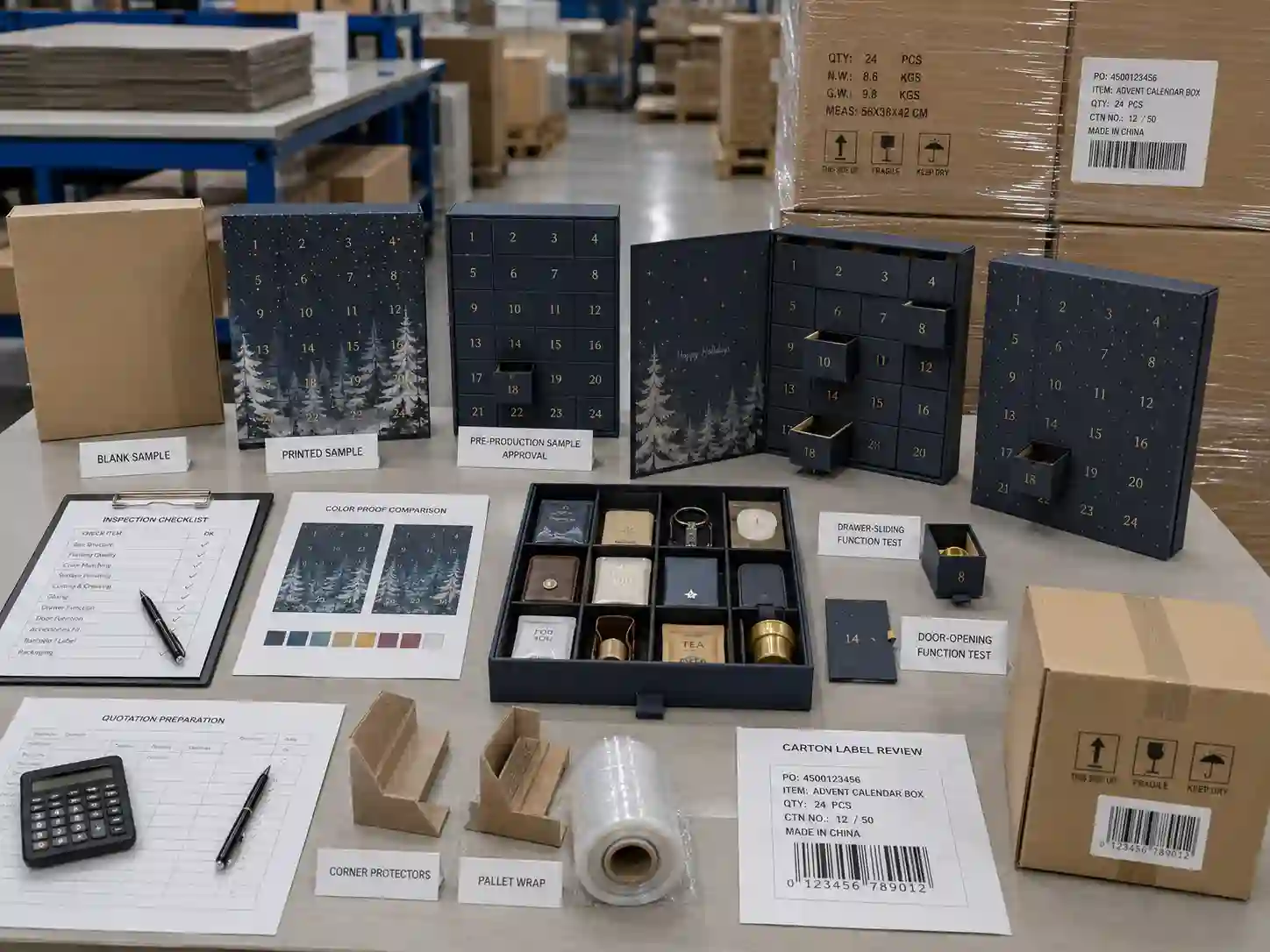
A blank sample is useful for confirming structure, size, compartment layout, opening function, and product fit before investing in full printed artwork. A printed sample shows color, finishing, surface effect, and brand presentation. A pre-production sample is the final production reference used by the factory and buyer before mass production begins.
What should be included in a sample approval record?
A sample approval record should clearly state what is approved, what still needs revision, and which version is the mass production reference. This avoids disputes when small changes happen between prototype and bulk production.
- Approved dieline version and date
- Approved material thickness and surface paper
- Approved insert material and cavity layout
- Approved printing file and color reference
- Approved finishing process, such as foil stamping or matte lamination
- Approved loaded sample test results
- Approved export carton style and packing method if already tested
Quotable B2B statement: A corporate gift calendar sample should be approved as a production control document, not as a decorative mockup.
What production steps should buyers understand?
Buyers should understand the main production flow so they can plan approvals and avoid schedule pressure. Typical steps include dieline confirmation, material preparation, printing, surface finishing, die-cutting, insert production, box forming, assembly, packing, inspection, and export carton preparation.
- Dieline confirmation: The supplier checks structure, compartment layout, fold lines, cut lines, glue areas, and artwork position.
- Material preparation: Paperboard, greyboard, wrapping paper, insert material, glue, ribbon, magnets, or other accessories are prepared.
- Printing and finishing: CMYK or Pantone printing is completed, followed by lamination, foil stamping, embossing, spot UV, or other processes.
- Die-cutting: Doors, windows, panels, trays, and insert shapes are cut according to the approved tool and dieline.
- Assembly: Workers form boxes, glue panels, place inserts, attach ribbons or magnets, and check function.
- Loading test or packing simulation: Sample products are placed into compartments to confirm fit and handling.
- Final QC and export packing: Finished goods are inspected, counted, packed into export cartons, labeled, and prepared for shipment.
Production control is especially important when the design has many compartments. A 24-day or 25-day calendar has many repeated details, and a small cutting or gluing deviation can affect opening performance across the whole box.
Which QC points matter most for corporate gift advent calendar boxes?
The most important QC points are structure accuracy, insert fit, printing consistency, door or drawer function, assembly strength, surface cleanliness, carton packing, and loaded durability. Buyers should define acceptable standards before production starts.
| QC area | What to inspect | Why it matters |
|---|---|---|
| Dieline and dimensions | Box size, compartment size, door position, drawer clearance | Prevents misfit products and poor opening function |
| Insert fit | Cavity size, product movement, loaded height, removal access | Keeps mixed corporate gifts secure and presentable |
| Printing | Color consistency, registration, text clarity, number alignment | Protects brand image and retail presentation |
| Finishing | Foil alignment, embossing depth, spot UV position, lamination quality | Prevents visible defects on premium gift packaging |
| Assembly | Glue strength, corner quality, panel flatness, drawer sliding | Improves durability during handling and shipping |
| Export packing | Carton strength, inner protection, shipping marks, pallet stability | Reduces transit damage and warehouse handling issues |
QC tip: For drawer-style corporate calendars, test sliding after the drawer is loaded, not only when empty. Product weight can change friction, alignment, and the feeling of quality.
How should buyers plan MOQ, lead time, and cost drivers?
MOQ, lead time, and cost depend on structure complexity, material, insert type, printing, finishing, quantity, packing method, and sample revisions. Buyers should compare suppliers based on the full production plan, not only the unit price.
Rigid box calendars usually require more manual assembly than folding carton calendars. PET tray or molded pulp inserts may require tooling. Foil stamping, embossing, spot UV, and multiple Pantone colors can add setup time and cost. Export packing requirements, such as stronger cartons, corner protectors, pallet wrapping, or special shipping marks, can also affect the final quotation.
A realistic lead time should include artwork checking, blank sample, printed sample, buyer revisions, pre-production sample approval, mass production, QC, packing, and shipment preparation. Rush schedules are possible only when the structure is simple, the artwork is ready, and the buyer can approve samples quickly.
Decision guide: how should buyers choose the right option?
Buyers should choose the option that matches product weight, brand positioning, budget, channel, and delivery risk. The most expensive structure is not always the best choice if the campaign requires high-volume distribution or low freight cost.
| Buyer priority | Recommended direction | Reason |
|---|---|---|
| Premium executive gifting | Rigid box, drawer box, book-style structure, greyboard, refined finishing | Creates stronger presentation value and better perceived quality |
| Large promotional quantity | Folding carton or optimized paperboard structure | Controls material, labor, and shipping cost |
| Mixed fragile items | Custom insert with foam, EVA, PET tray, or reinforced paper insert | Improves product protection and compartment stability |
| Retail shelf display | Door-opening box with clear front artwork and barcode area | Supports visual impact and scanning requirements |
| E-commerce shipment | Durable outer box, tight insert fit, stronger export carton | Reduces damage risk during parcel or warehouse handling |
If buyers are unsure where to start, reviewing custom advent calendar box products can help compare structure directions, while custom advent calendar box services can help clarify sampling, customization, and production support.
How should export packing be planned?
Export packing should be planned around carton strength, product weight, box surface protection, loading quantity, pallet stability, and destination handling conditions. A beautiful gift calendar can still fail commercially if corners arrive crushed or cartons are mislabeled.
Corporate gift advent calendar boxes may require individual polybags, tissue wrapping, corner protectors, inner cartons, master export cartons, or palletized packing depending on surface finish and shipping route. Matte lamination can show scuffs, gloss lamination can show scratches, and foil areas can be damaged by rubbing if protection is weak.
Shipping marks should be generic, accurate, and aligned with the buyer’s warehouse or freight forwarder requirements. Carton labels may include item number, quantity, carton number, gross weight, net weight, carton size, country of origin when required, and barcode label area if needed.
What should buyers prepare before requesting a quotation?
Buyers should prepare enough information for the supplier to estimate structure, material, insert, printing, sample, MOQ, lead time, and export packing accurately. A clear RFQ helps avoid vague pricing and repeated revisions.
- Target quantity or estimated MOQ range
- Gift item list with dimensions, weights, photos, and packing form
- Preferred structure: door-opening box, drawer box, rigid box, folding carton, or open to recommendation
- Number of compartments and opening sequence
- Material preference: paperboard, greyboard, specialty paper, PET tray, paper insert, EVA insert, foam, or molded pulp
- Artwork files, brand color references, CMYK or Pantone requirements
- Finishing needs such as foil stamping, embossing, spot UV, matte lamination, or gloss lamination
- Sales channel: retail, corporate gifting, e-commerce, wholesale, or distributor program
- Destination country and export packing expectations
- Required sample type: blank sample, printed sample, or pre-production sample
- Target delivery date and shipping method
Buyers can request a custom quote from Giftpackpro with these details, or first review more advent calendar box buying guides to prepare structure and production questions before starting a project.
How should buyers compare suppliers?
Buyers should compare suppliers by engineering support, sample accuracy, QC process, communication quality, production experience, export packing ability, and quotation clarity. A low unit price is risky if it excludes insert tooling, sample revisions, carton protection, or finishing setup.
When comparing suppliers, ask whether the factory can check dielines, make structural prototypes, test loaded samples, control printing proof approval, inspect assembly tolerance, and provide carton packing recommendations. A strong supplier should explain trade-offs clearly instead of pushing one standard box style for every campaign.
The Giftpackpro packaging factory page can help buyers understand factory-side support and communication style before sending a detailed RFQ.
What common mistakes should buyers avoid?
The most common mistakes are starting artwork too early, changing gift items after sample approval, ignoring insert tolerance, choosing finishing without testing, and treating export packing as an afterthought. These mistakes can delay production or create quality problems during delivery.
- Approving a visual rendering without a physical product-fit test
- Using one compartment size for products with different heights and weights
- Placing critical artwork too close to cut lines, doors, folds, or glue areas
- Choosing heavy gift items without checking board strength and carton loading
- Ignoring barcode placement until after artwork approval
- Approving color without a printed proof or clear reference
- Skipping pre-production sample approval before mass production
- Using weak export cartons for premium rigid box calendars
Quotable B2B statement: The best corporate gift advent calendar box is engineered around the actual gift items, not around a generic 24-compartment layout.
FAQ: corporate gift advent calendar boxes for seasonal campaigns
What is the best structure for corporate gift advent calendar boxes?
The best structure depends on gift weight, quantity, budget, and campaign positioning. Rigid drawer boxes work well for premium corporate gifts, while folding carton or paperboard door-opening boxes can be better for larger promotional quantities.
Do buyers need a blank sample before a printed sample?
A blank sample is strongly recommended when the box has custom compartments, mixed gift items, or a new structure. It helps confirm size, insert fit, door function, drawer sliding, and assembly before printed sample costs are added.
Which insert material is best for mixed corporate gifts?
Paper inserts are suitable for many lightweight gifts, PET trays provide accurate cavities, EVA and foam protect heavier or fragile items, and molded pulp can support fiber-based packaging goals. The best insert should be confirmed through loaded sample testing.
How can buyers control the cost of custom advent calendar boxes?
Buyers can control cost by simplifying structure, reducing unnecessary finishing, confirming the gift list early, choosing efficient insert materials, approving samples quickly, and using export packing that protects goods without excessive carton volume.
What quality problems should be checked before shipment?
Buyers should check dimensions, insert fit, door or drawer function, printing color, foil or embossing position, lamination quality, glue strength, surface cleanliness, carton label accuracy, and export carton strength before shipment.
What should be included in a quotation request?
A quotation request should include quantity, gift item sizes and weights, structure preference, compartment count, artwork requirements, material and finishing preferences, sample needs, delivery date, destination, and packing requirements.
CTA: how to start a production-ready corporate gift calendar project
To start a production-ready project for corporate gift advent calendar boxes, prepare your gift item list, target quantity, preferred structure, artwork direction, insert expectations, delivery date, and export packing requirements. Giftpackpro can then help review the dieline, recommend materials, develop a sample, check product fit, and prepare a quotation based on practical production and QC needs.
For buyers comparing suppliers or preparing a seasonal campaign, the key is simple: approve the structure and sample before mass production, define QC points before shipment, and make sure the export packing is strong enough for the real delivery route.