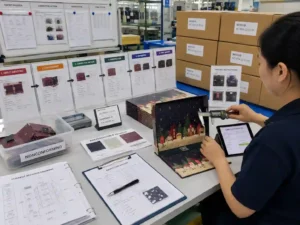
Quick answer: Dog treat advent calendar boxes should be designed around treat size, pouch thickness, daily compartment layout, retail display needs, and export packing method. B2B buyers should confirm the box structure, insert material, dieline, artwork proof, MOQ, sampling process, QC checks, and carton packing plan before placing a bulk order. For pet treat brands, the biggest risks are poor compartment fit, weak door performance, crushed corners, inaccurate color, unclear shipping marks, and late sample approval. A reliable supplier should help turn product dimensions, campaign quantity, artwork, and delivery date into a practical custom packaging plan.
For overseas brands, wholesalers, retail buyers, Amazon sellers, and purchasing teams, dog treat advent calendar boxes are not just seasonal gift packaging. They are engineered retail packs that must hold pouches, biscuits, chews, sachets, or mixed pet gift items securely through assembly, shipping, storage, and consumer opening. This guide answers common buyer questions about structure, inserts, printing, sampling, production, QC, export packing, and quotation preparation.
What should buyers confirm before choosing dog treat advent calendar boxes?
Buyers should confirm the product list, compartment count, target box size, retail channel, packaging budget, order quantity, and required delivery date before choosing the structure. These decisions affect every later step, including material thickness, insert design, printing method, sample cost, lead time, and export carton plan.
A dog treat calendar often contains products with different shapes: flat biscuit sachets, small pouch packs, dental chews, soft treats, freeze-dried samples, or small pet accessories. The box cannot be designed accurately from a general idea such as “24 dog treats.” The factory needs actual product dimensions, weight, packaging thickness, and whether the items are already sealed in food-safe primary packaging.
Buyer tip: For pet treats, the advent calendar box is usually secondary packaging. Buyers should confirm food-contact responsibilities for the inner pouch, sachet, or wrap separately. If food-contact materials are involved, review official guidance such as the FDA food-contact substances guidance or the applicable rules in your sales market.
Before contacting a custom advent calendar boxes manufacturer, prepare a simple product matrix: item name, packed size, weight, daily position, opening direction, and whether the treat should be visible, hidden, or fixed in place. This small step prevents many sampling delays.
Which box structure is best for dog treat advent calendar boxes?
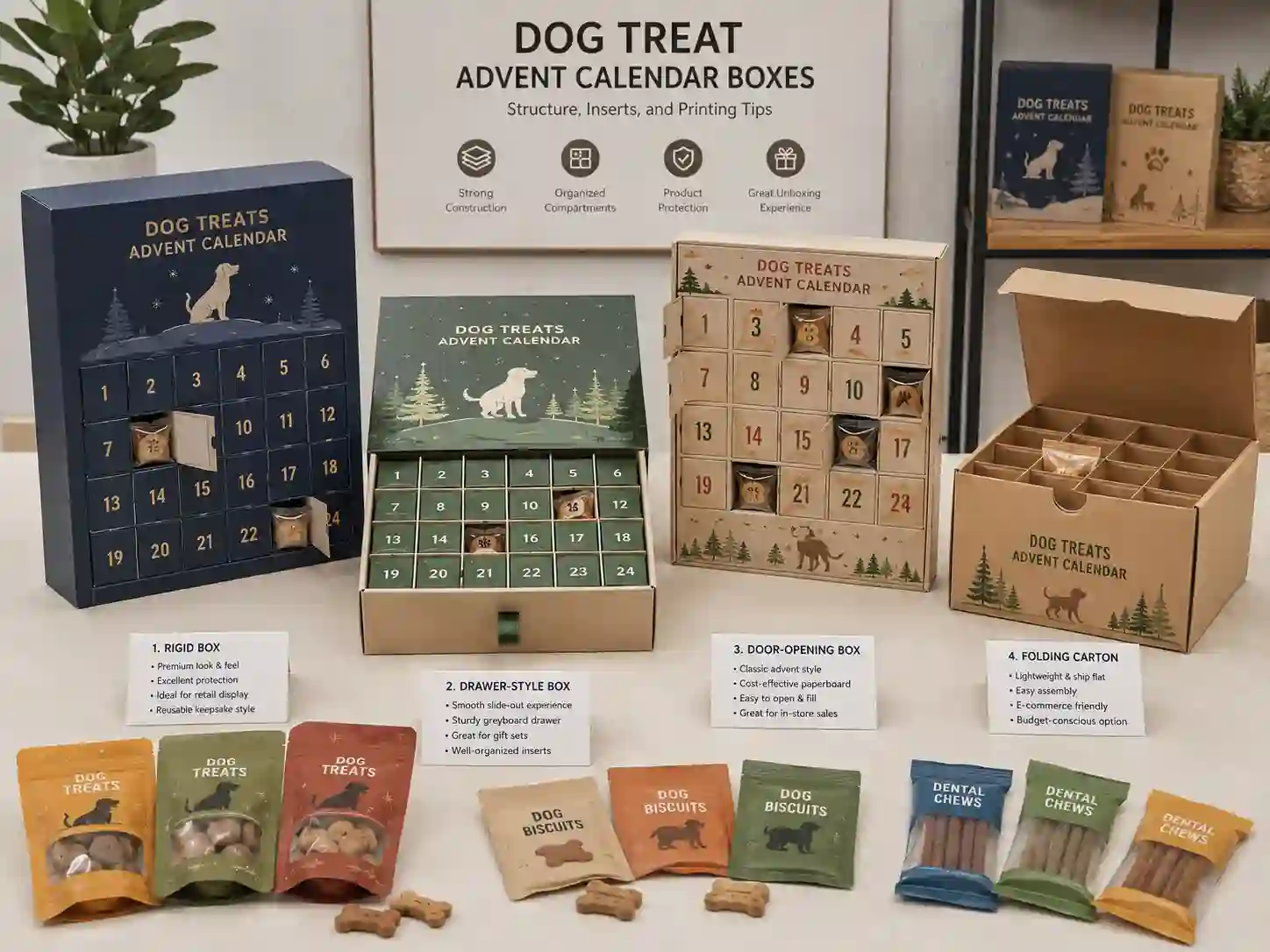
The best structure depends on treat weight, retail price point, assembly method, and sales channel. Rigid boxes are stronger and more premium, folding cartons are more cost-efficient, drawer boxes improve the unboxing experience, and door-opening boxes are familiar for numbered daily access.
| Structure option | Best for | Buyer advantages | Watch points |
|---|---|---|---|
| Door-opening paperboard calendar | Lightweight sachets, biscuit packs, small chew samples | Classic advent layout, clear numbered doors, efficient retail presentation | Door perforation, paperboard thickness, and insert alignment must be tested |
| Rigid box with paperboard insert | Premium pet gift sets, heavier treat pouches, retail gift campaigns | Strong structure, better corner protection, higher perceived value | Higher material cost, larger shipping volume, longer sample development |
| Drawer box | Mixed treats, pet accessories, reusable gift packs | Smooth opening experience, good for e-commerce gift positioning | Drawer friction, rail tolerance, and insert movement must be controlled |
| Folding carton calendar | Large-volume promotions, lighter SKUs, price-sensitive campaigns | Lower unit cost, flat packing potential, efficient mass production | Less rigid than greyboard; needs careful carton packing to reduce crushing |
| Book-style rigid calendar | Gift sets with strong shelf-display needs | Premium front cover, strong branding area, suitable for influencer or launch kits | Magnet, hinge, and closure alignment require pre-production sample approval |
For pet treat brands selling through retail shelves, the front panel must communicate clearly while the box remains stable upright. For e-commerce sellers, the outer structure must survive parcel handling and warehouse picking. For wholesale buyers, carton efficiency and pallet loading may matter more than decorative complexity.
Quotable factory insight: A calendar structure should be selected after insert testing, not before it. If the treat pouch thickness changes by only a few millimeters, the compartment depth, door tension, drawer clearance, and export carton count can all change.
How should inserts be designed for dog treat pouches, biscuits, and dental chews?
Inserts should stop products from sliding, bulging, or pressing against the numbered doors during shipping. The right insert depends on product weight, shape, hygiene expectations, sustainability goals, and the buyer’s target price.
Common insert options include paper insert, PET tray, EVA insert, foam insert, and molded pulp. For dog treat advent calendar boxes, paperboard inserts are often practical for dry sachets and lightweight pouches. PET trays can support more consistent cavities for shaped products, while EVA or foam may be used for delicate premium samples or small accessories. Molded pulp can support sustainability positioning but requires early tooling and fit testing.
When is a paper insert enough?
A paper insert is usually enough when each treat is lightweight, flat, and already sealed in a stable pouch or sachet. It is cost-efficient, easy to print or fold, and often works well with folding carton or door-opening structures.
The key is to check whether the product can move behind the doors. If a pouch slides away from its opening, the customer may tear the door and still not reach the item easily. If the pouch is too thick, it may create a visible bulge or stress mark on the front panel.
When should buyers consider PET, EVA, foam, or molded pulp?
Buyers should consider formed or cushioned inserts when the products have irregular shapes, higher weight, fragile edges, or mixed dimensions. These insert types can improve product presentation and reduce movement, but they can also increase tooling, sample time, and unit cost.
- PET tray: useful for shaped cavities, consistent product positioning, and visual order during assembly.
- EVA insert: suitable for premium gift sets, small accessories, or items requiring a firmer hold.
- Foam insert: useful for cushioning, but buyers should confirm appearance, smell, density, and market suitability.
- Molded pulp: useful for paper-based sustainability goals, but cavity tolerance and surface finish need early review.
QC tip: Insert approval should include a loaded sample, not only an empty tray or flat dieline. The factory should test real pouches, dental chews, and sachets in the correct sequence to check pressure, shaking, opening access, and visual flatness.
What material choices affect strength, cost, and shipping performance?
Material choice affects box rigidity, door performance, print quality, carton weight, and damage rate. Buyers should compare paperboard grade, greyboard thickness, corrugated support, lamination, and insert material before confirming a quotation.
For rigid box calendars, greyboard is commonly used to create a strong base structure, then wrapped with printed paper. Thicker greyboard can improve premium feel and stacking strength, but it also increases cost and shipping weight. For folding carton calendars, paperboard thickness and grain direction become important because the box must fold cleanly while still supporting product weight.
Dog treat items can be denser than cosmetic samples or tea sachets. Dental chews and biscuit packs may add uneven pressure across the calendar. If the box has 12 or 24 compartments, the supplier should check the total loaded weight, not only the empty packaging weight.
Buyers who require certified paper materials should verify documentation directly with the supplier and relevant certification owner. For example, forestry-related claims can be checked through the official FSC website. Do not rely only on a logo shown in a quotation sheet.
How should artwork, dieline, and printing be prepared?
Artwork should be prepared on the approved dieline, with clear bleed, cut lines, fold lines, door numbers, barcode area, warning text, and shipping or retail label zones. Printing should be checked through CMYK proof, Pantone matching where needed, and finishing samples for foil stamping, embossing, spot UV, matte lamination, or gloss lamination.
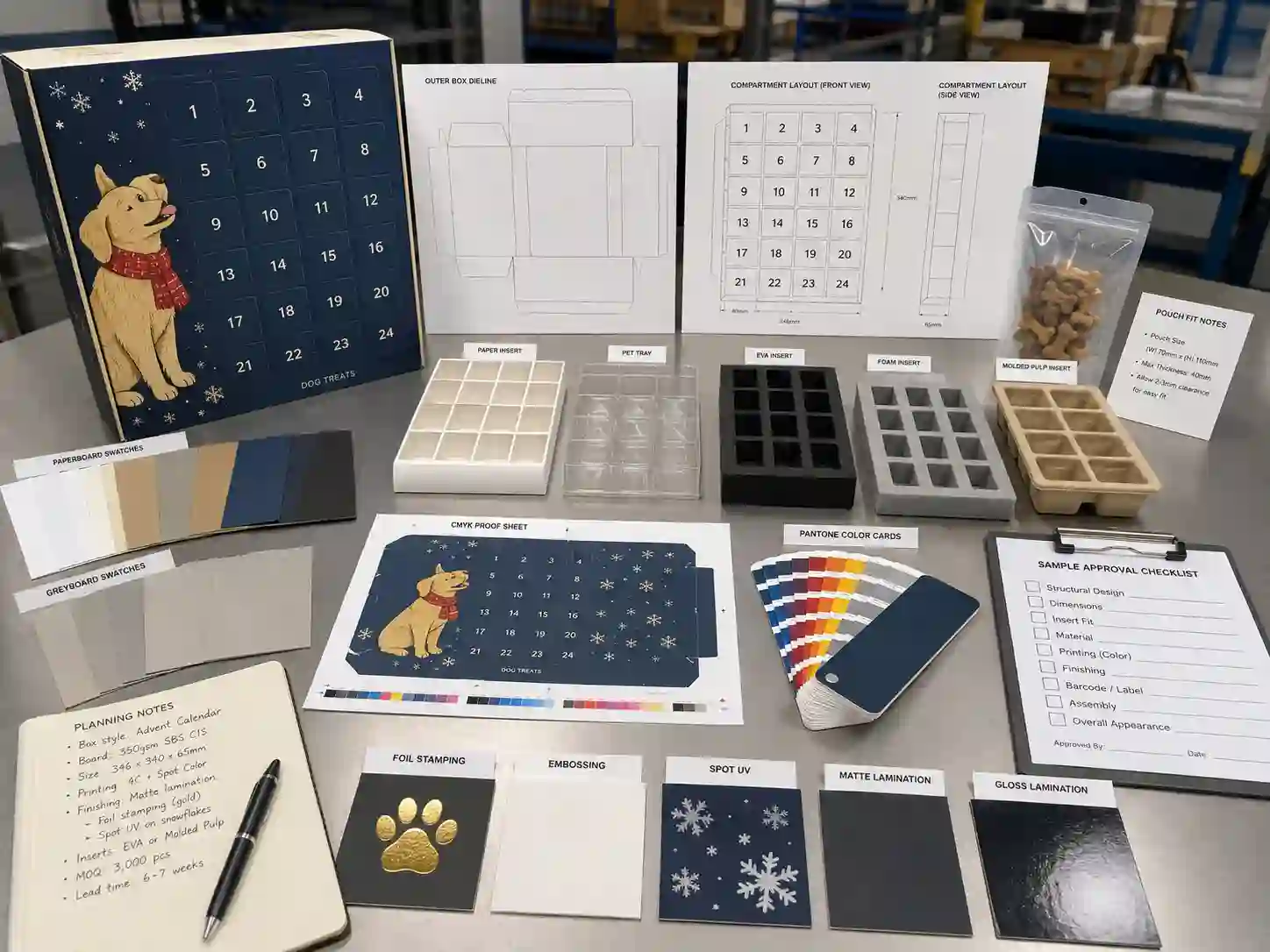
Dog treat advent calendars often include many small numbered doors or drawer fronts. This makes artwork alignment more sensitive than on a simple gift box. If the numbers are too close to perforation lines, folds, or drawer cuts, they may look uneven after die-cutting. If the barcode area is placed across a fold or textured finish, scanning may become unreliable.
What should be checked on the dieline?
The dieline should confirm the box outline, compartment positions, opening method, glue areas, fold lines, perforation lines, and insert placement. Buyers should review it with both marketing and operations teams before approving a printed sample.
- Confirm that each dog treat fits the assigned compartment.
- Check whether heavy items are spread evenly across the layout.
- Keep door numbers away from cut and crease lines.
- Leave enough space for barcode labels, warning text, ingredient reference, or retail stickers.
- Confirm whether the box will be packed flat, semi-assembled, or fully assembled.
Which printing and finishing choices matter most?
Printing and finishing should support brand presentation without making production unstable. CMYK is suitable for full-color graphics, while Pantone may be needed for strict brand color matching. Foil stamping, embossing, spot UV, matte lamination, and gloss lamination can improve shelf impact but require careful proofing.
Factory tip: Premium finishes should be tested on the same paper surface planned for mass production. Foil adhesion, embossing depth, and spot UV registration can look different when paper texture, lamination, or board thickness changes.
What sample process helps avoid mass production mistakes?
A good sampling process should move from structure confirmation to printed proof and then pre-production sample approval. Buyers should not approve mass production from artwork renderings alone, especially when the calendar includes multiple compartments and real loaded products.
Typical sample stages include a blank structural prototype, printed sample, loaded fit sample, and pre-production sample. The blank sample checks size and opening function. The printed sample checks artwork, color, finishing, and surface quality. The loaded sample checks whether the actual dog treats fit properly after shaking, standing, and opening.
- Blank prototype: confirms box size, compartment layout, insert fit, and opening method.
- Artwork proof: checks dieline placement, door numbers, barcode area, and color direction.
- Printed sample: confirms CMYK, Pantone, lamination, foil stamping, embossing, or spot UV effect.
- Loaded sample: tests real pouches, biscuits, chews, or toy samples inside the compartments.
- Pre-production sample: becomes the approved reference for mass production and QC inspection.
Giftpackpro’s custom advent calendar box services can support structure development, insert testing, sample review, and production planning when buyers provide accurate product dimensions and campaign requirements.
How do MOQ, cost, and lead time usually change?
MOQ, cost, and lead time change according to structure complexity, material thickness, insert type, printing coverage, finishing process, assembly labor, and carton packing method. A simple folding carton calendar usually has a different cost base from a rigid drawer box with EVA insert and foil stamping.
Buyers should avoid comparing only the unit price without checking what is included. One supplier may quote only the printed outer box, while another includes insert, assembly, export carton, sample fee, and pallet packing. For dog treat advent calendar boxes, product loading may be handled by the buyer, co-packer, or factory depending on the project scope and food-handling requirements.
Common cost drivers buyers should compare
- Rigid box versus folding carton construction.
- Greyboard thickness and paperboard grade.
- Paper insert versus PET tray, EVA, foam, or molded pulp insert.
- Number of compartments, drawers, doors, or die-cut openings.
- CMYK only versus Pantone matching and premium finishing.
- Manual assembly requirements and packing complexity.
- Flat packing versus fully assembled export packing.
- Sample rounds, proofing requirements, and urgent production schedule.
Buyer tip: Ask suppliers to separate tooling, sample, unit production, assembly, inner packing, export carton, and pallet costs. A clear quotation makes supplier comparison easier and reduces hidden cost disputes later.
What QC checks are important before shipment?
QC should check structure strength, insert fit, opening function, print accuracy, finishing quality, assembly consistency, carton packing, and shipping marks. For pet treat calendars, loaded fit and door access are especially important because customers must be able to remove the treat without tearing the box apart.
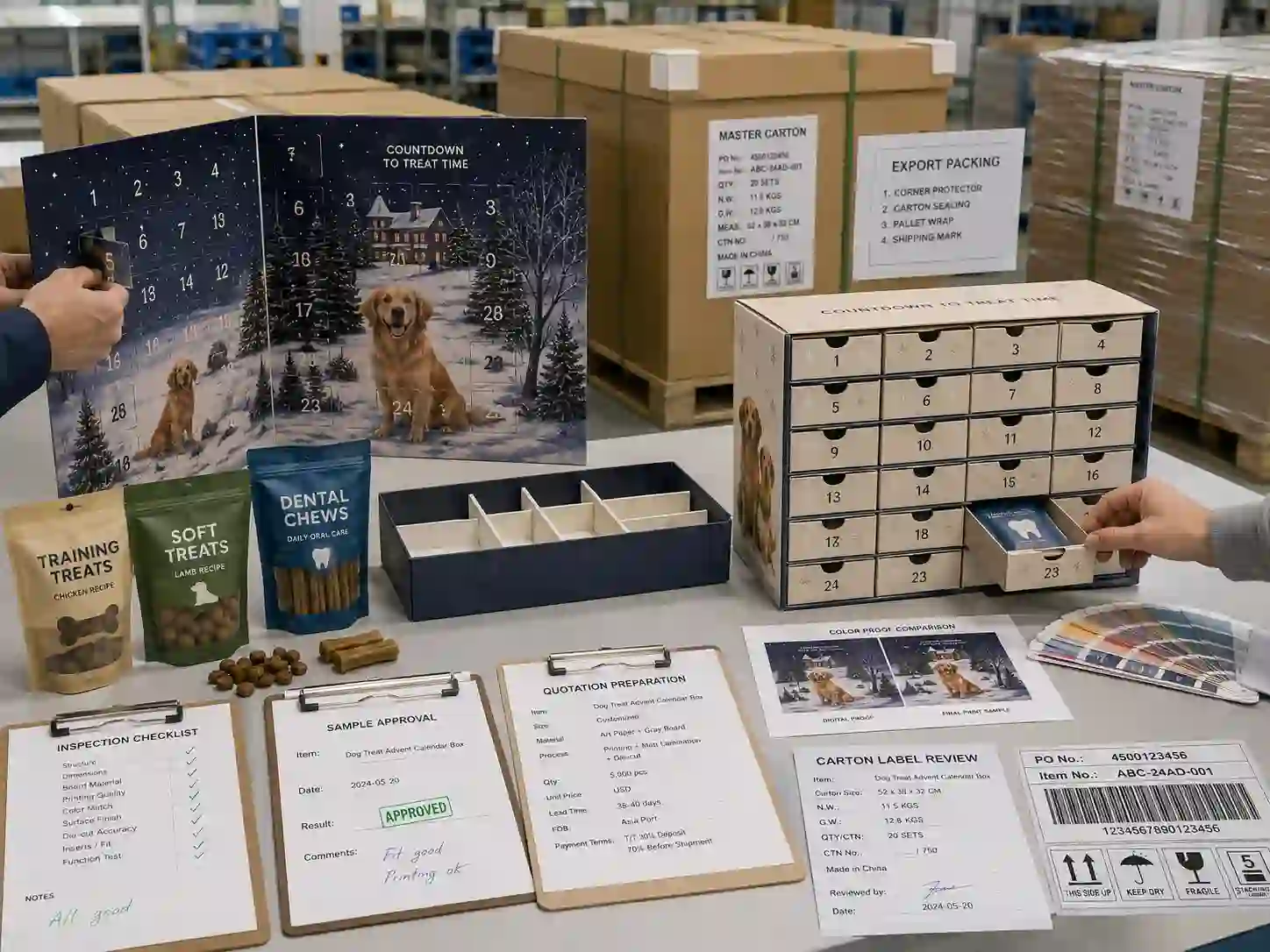
A practical inspection should compare mass production against the approved pre-production sample. Inspectors should check dimensions, color, lamination, glue strength, drawer movement, door perforation, insert position, barcode label area, carton label, and export packing condition.
Practical QC checklist for dog treat advent calendar boxes
- Box size matches approved dieline and sample.
- Compartments match the final product matrix.
- Loaded pouches or chews do not bulge, crush, or shift excessively.
- Numbered doors open correctly without tearing surrounding panels.
- Drawer boxes slide smoothly without being too loose or too tight.
- Paper insert, PET tray, EVA, foam, or molded pulp insert is positioned correctly.
- CMYK or Pantone color matches the approved proof within agreed tolerance.
- Foil stamping, embossing, spot UV, matte lamination, or gloss lamination is clean and aligned.
- Glue areas are secure with no open edges, stains, or overflow.
- Barcode label area is flat, readable, and not blocked by texture or folds.
- Export cartons show correct shipping marks, quantity, item code, and handling symbols.
- Cartons are packed with suitable corner protection, dividers, or pallet wrapping if required.
QC tip: For calendars with heavier dental chews, request a simple shake test and standing test during sample approval. If items move behind the wrong door, the issue should be solved before mass production, not during final inspection.
How should export packing be planned for retail and e-commerce shipments?
Export packing should protect the finished calendar while keeping carton size, gross weight, pallet efficiency, and shipping marks practical. The right packing method depends on whether the calendars are shipped flat, semi-assembled, fully assembled, or loaded with products.
Flat packing can reduce shipping volume for folding carton structures, but it shifts more assembly work to the buyer or co-packer. Fully assembled packing improves convenience but increases carton volume and may require stronger export cartons, corner protectors, and pallet wrap. Rigid boxes usually need more protection because corners and wrapped paper surfaces can be damaged during long-distance shipping.
For Amazon or e-commerce channels, buyers should also think about parcel handling after the goods arrive. A calendar that survives ocean freight may still fail if it is shipped to the final customer without enough outer protection. Retail buyers may need master cartons with clear shipping marks, while direct-to-consumer sellers may need individual mailer testing.
Where buyers require transit validation, packaging test planning can reference procedures from organizations such as ISTA. The exact test plan should match product weight, sales channel, and logistics route.
How should buyers compare suppliers for this packaging project?
Buyers should compare suppliers by structure engineering ability, insert testing, sample accuracy, communication quality, QC process, export packing experience, and quotation transparency. The lowest unit price is not always the best option if the supplier cannot control fit, color, assembly, or shipping damage.
When reviewing a supplier, ask whether they can provide dieline support, material suggestions, blank sample, printed sample, pre-production sample, mass production timeline, QC checklist, and export carton specification. A factory-side team should be able to explain why a certain board thickness, insert type, or packing method is suitable for your product weight and channel.
Decision guide: which option should you choose?
| Buyer situation | Recommended direction | Reason |
|---|---|---|
| Large promotion with lightweight treat sachets | Folding carton or paperboard door-opening calendar | Better cost control and efficient production for higher quantity runs |
| Premium retail gift set with higher shelf value | Rigid box or book-style calendar with paperboard or formed insert | Stronger presentation, better structure, and more premium hand feel |
| Mixed pouches, dental chews, and accessories | Rigid drawer box or reinforced calendar with tested insert | Improves product separation and reduces movement during shipping |
| Sustainability-focused campaign | Paperboard structure with paper insert or molded pulp insert | Supports paper-based packaging direction, subject to fit and market requirements |
| E-commerce gift set shipped individually | Stronger outer box, protective export carton, and parcel handling review | Reduces corner damage, crushing, and customer-return risk |
The Giftpackpro packaging factory works with B2B buyers who need seasonal paper gift packaging, custom advent calendar structures, sample development, and export packing support. Buyers can also review custom advent calendar box products to compare possible structures before starting a project brief.
What information should be prepared before requesting a quotation?
Buyers should prepare product dimensions, quantity, structure preference, compartment count, artwork status, insert requirements, packing method, delivery schedule, destination country, and any compliance or retail requirements. The more complete the RFQ, the more accurate the quotation.
A weak RFQ says, “Please quote 24-day dog treat advent calendar.” A useful RFQ says, “Please quote a 24-compartment rigid dog treat advent calendar box for sealed treat pouches, each pouch 60 × 80 × 12 mm, total loaded weight about 650 g, CMYK print with matte lamination, paper insert or PET tray option, 5,000 and 10,000 pcs, export cartons with shipping marks, delivery to port or warehouse.”
RFQ checklist for dog treat advent calendar boxes
- Project name and target launch season.
- Required quantity and possible reorder quantity.
- Number of calendar days or compartments.
- Product dimensions, pouch thickness, and weight for each item.
- Preferred structure: rigid box, folding carton, drawer box, door-opening box, or book-style box.
- Insert preference: paper insert, PET tray, EVA, foam, molded pulp, or supplier recommendation.
- Artwork status: final artwork, rough concept, or need for dieline first.
- Printing requirements: CMYK, Pantone, foil stamping, embossing, spot UV, matte lamination, gloss lamination.
- Sample requirements: blank sample, printed sample, loaded sample, or pre-production sample.
- Export packing method: flat, semi-assembled, assembled, or loaded.
- Carton label, shipping marks, pallet requirements, and destination.
- Required quotation terms, lead time target, and approval deadline.
Buyers who are still comparing options can use Giftpackpro’s advent calendar box buying guides to prepare clearer questions before moving to quotation.
What common mistakes should buyers avoid?
The most common mistakes are starting artwork before fit testing, choosing a structure by appearance only, ignoring product weight, approving samples without loaded products, and comparing quotations with different specifications. These mistakes often cause delays, extra cost, or shipment damage.
- Mistake 1: Designing around empty compartments. Always test with real dog treat pouches, sachets, biscuits, or chews.
- Mistake 2: Ignoring door-opening tolerance. Numbered doors need controlled perforation and paperboard strength.
- Mistake 3: Overusing finishes without proofing. Foil, embossing, and spot UV require registration checks on the final material.
- Mistake 4: Approving color from screen only. Use printed proofs for CMYK and Pantone-sensitive brand colors.
- Mistake 5: Treating MOQ as the only buying factor. Sample quality, QC, communication, and packing reliability matter just as much.
- Mistake 6: Forgetting export carton design. A beautiful retail box still needs protective master cartons and clear shipping marks.
FAQ: What do B2B buyers ask about dog treat advent calendar boxes?
Can one calendar hold different dog treat sizes?
Yes, but the insert and compartment layout must be designed around the largest and thickest products first. Mixed sizes may require varied cavity depths, separate paperboard partitions, or a formed PET tray to prevent movement.
Should the buyer choose a 12-day or 24-day layout?
A 12-day layout is often easier for larger pouches, premium chews, or heavier products. A 24-day layout works well for small sachets or lightweight daily treats, but it requires more careful compartment spacing and door alignment.
Is a rigid box always better than a folding carton?
No. A rigid box is stronger and more premium, but a folding carton may be better for large promotional runs, lighter products, or flat-packing needs. The best option depends on product weight, budget, sales channel, and required presentation.
Can buyers supply their own artwork?
Yes. Buyers can supply artwork, but it should be placed on the approved dieline with correct bleed, resolution, color mode, door numbers, barcode area, and finishing layers. The supplier should review technical print readiness before sampling.
What sample should be approved before mass production?
Buyers should approve a pre-production sample that matches the final structure, material, print, finishing, insert, and loaded product fit. This sample should become the reference for mass production and final QC.
What affects lead time most?
Lead time is affected by sample approval speed, structure complexity, insert tooling, artwork revisions, printing and finishing processes, assembly workload, production quantity, and export packing requirements. Late artwork approval is one of the most common schedule risks.
How can buyers reduce shipping damage?
Buyers can reduce shipping damage by confirming carton strength, packing direction, inner protection, corner protectors, pallet wrap, carton weight limits, and clear shipping marks. For e-commerce, individual parcel handling should also be considered.
How can buyers start a dog treat advent calendar boxes project with Giftpackpro?
To start a practical project, prepare your product sizes, compartment count, preferred structure, insert requirement, artwork status, target MOQ, sample deadline, delivery date, and export packing needs. With these details, Giftpackpro can help compare structure options, suggest materials, prepare dielines, develop samples, and provide a clearer quotation for dog treat advent calendar boxes.
For faster communication, include photos or drawings of the treats, pouch dimensions, target calendar size, and any retail or e-commerce requirements. Buyers ready to review structure, sampling, MOQ, QC, and export packing details can request a custom quote from Giftpackpro with their project brief.