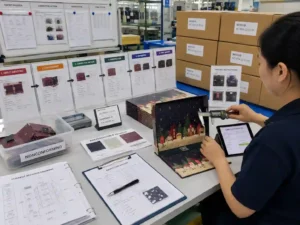
Quick answer: Designing dog treat advent calendar boxes for seasonal campaigns means matching the calendar structure, compartment layout, insert material, artwork, retail display needs, e-commerce shipping route, and export packing method before sampling starts. Buyers should confirm dog treat pouch sizes, dental chew dimensions, daily portion weight, odor control needs, shelf display direction, barcode position, carton packing method, and campaign launch date early. A good design is not only attractive; it must hold treats securely, open smoothly, pass insert fit checks, protect the product during export, and give procurement teams enough quotation detail to compare factories fairly.
For overseas brands, wholesalers, retail buyers, Amazon sellers, and gift companies, dog treat advent calendar boxes are seasonal packaging projects with tight timing. They usually involve multiple SKUs, printed outer boxes, numbered doors or drawers, food-safe primary packs, fitted inserts, export cartons, and campaign-specific artwork. This guide explains how to design custom advent calendar boxes for dog treat programs that need to work on retail shelves, in e-commerce gift sets, and across seasonal promotional campaigns.
What should buyers decide before designing dog treat advent calendar boxes?
Buyers should decide the sales channel, product mix, treat dimensions, campaign quantity, launch date, and packaging budget before choosing the box structure. These inputs affect the dieline, insert design, MOQ, sample type, printing method, export packing, and supplier quotation.
A dog treat calendar for a retail chain may need a strong front-facing display, a clean barcode area, shelf-ready carton planning, and consistent door-opening performance. An e-commerce gift set may need stronger board, better compression resistance, tighter insert holding, and master carton testing because it may pass through parcel networks. A distributor promotion may need flexible artwork, cost control, and fast sample approval.
Before contacting a factory, prepare the product list by day or compartment. Include pouch width, height, thickness, filled weight, material type, and whether the item is a biscuit sachet, soft treat pouch, dental chew, small toy, or mixed pet accessory. The box is engineered around the filled product, not around the artwork alone.
Buyer tip: For dog treat advent calendar boxes, the most important early question is not “What is the cheapest box?” It is “Which structure protects the filled treat packs while still supporting retail display, smooth opening, and seasonal campaign timing?”
Which box structure works best for retail and e-commerce dog treat campaigns?
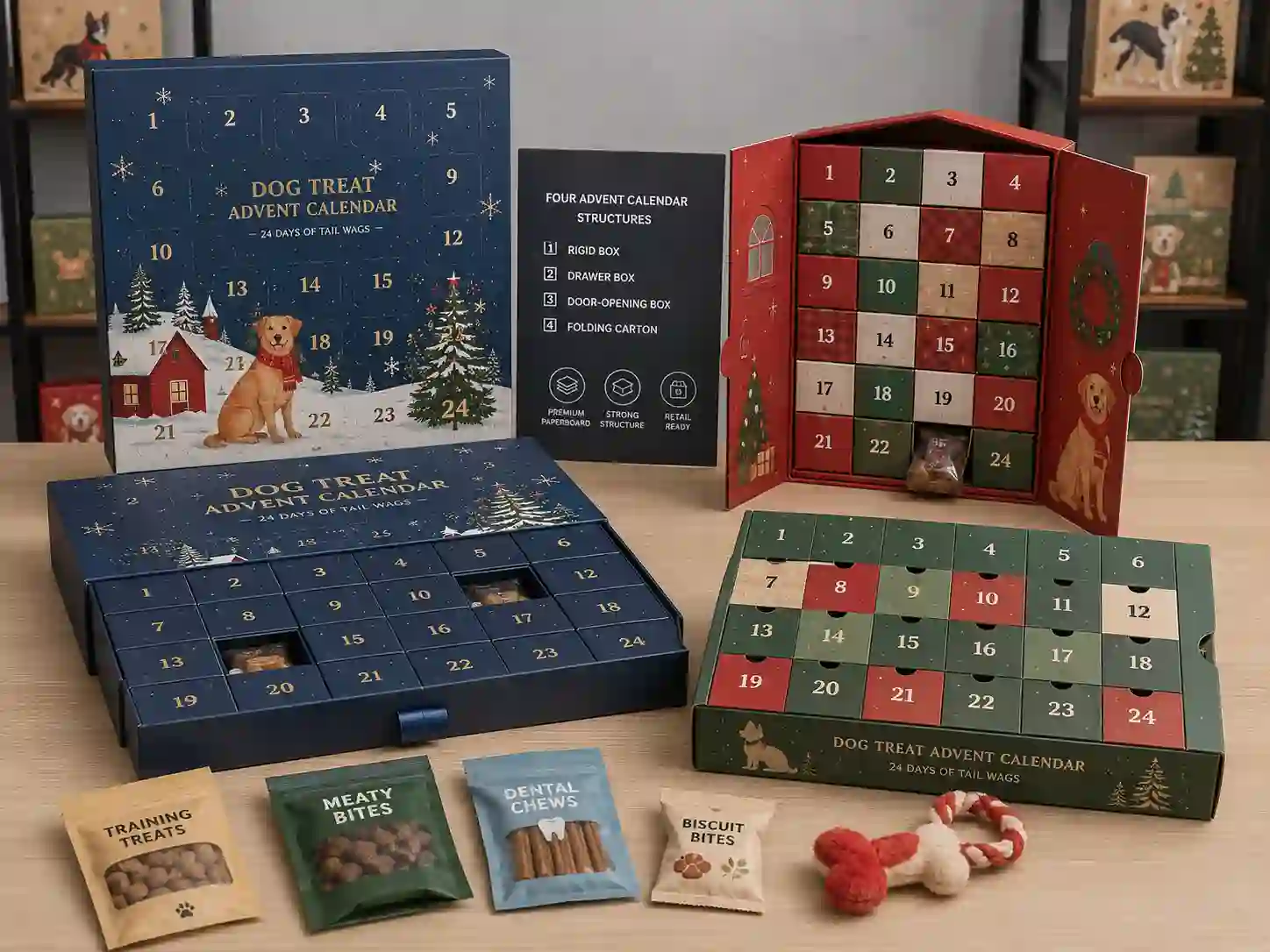
The best structure depends on price level, product weight, sales channel, and how buyers want the customer to open the calendar. Rigid boxes feel premium and protect heavier treat mixes, while folding cartons are better for lighter campaigns and larger promotional quantities.
| Structure option | Best use case | Buyer advantages | Design watch points |
|---|---|---|---|
| Door-opening paperboard calendar | Retail shelf programs, standard daily treat sachets, supermarket or pet-store campaigns | Clear numbered front panel, familiar advent layout, efficient production for volume orders | Door perforation strength, compartment alignment, treat movement behind doors, front panel flatness |
| Drawer box | Premium dog treat gift sets, mixed chew and pouch combinations, reusable presentation | Stronger opening experience, good product separation, premium gift appearance | Drawer sliding tolerance, handle strength, board thickness, packing volume, higher labor cost |
| Rigid box with insert | High-value seasonal gift campaigns, heavier treats, retail buyers seeking stronger shelf impact | Excellent structure, better compression resistance, strong gift-set positioning | Higher unit cost, longer sample time, assembled packing volume, export carton optimization |
| Folding carton calendar | Cost-sensitive promotions, lightweight treats, large campaigns | Lower freight volume when flat packed, efficient printing, suitable for large MOQ planning | Limited load capacity, insert support, carton locking strength, risk of deformation if overloaded |
| Book-style calendar | Gift company programs, pet subscription boxes, premium e-commerce bundles | Strong unboxing effect, good for storytelling panels and mixed product layouts | Magnet or ribbon choice, hinge durability, inner tray fit, larger shipping carton size |
For retail shelf campaigns, buyers should confirm the display angle, front panel size, hanger or shelf-standing requirement, and whether the box must fit a specific retail shelf depth. For e-commerce, buyers should discuss compression strength, corner protection, and whether the calendar will ship alone or inside another mailer or gift carton.
Factory tip: A door-opening calendar with lightweight sachets can often use paperboard inserts, but mixed dental chews and thicker treat pouches may require a stronger tray, deeper compartments, or a rigid outer structure to prevent bulging.
How should inserts be designed for dog treat fit and compartment control?
Inserts should be designed around the real filled product dimensions, not empty pouch dimensions. Dog treats can be bulky, irregular, oily, or air-filled, so the insert must control movement while allowing easy loading and door opening.
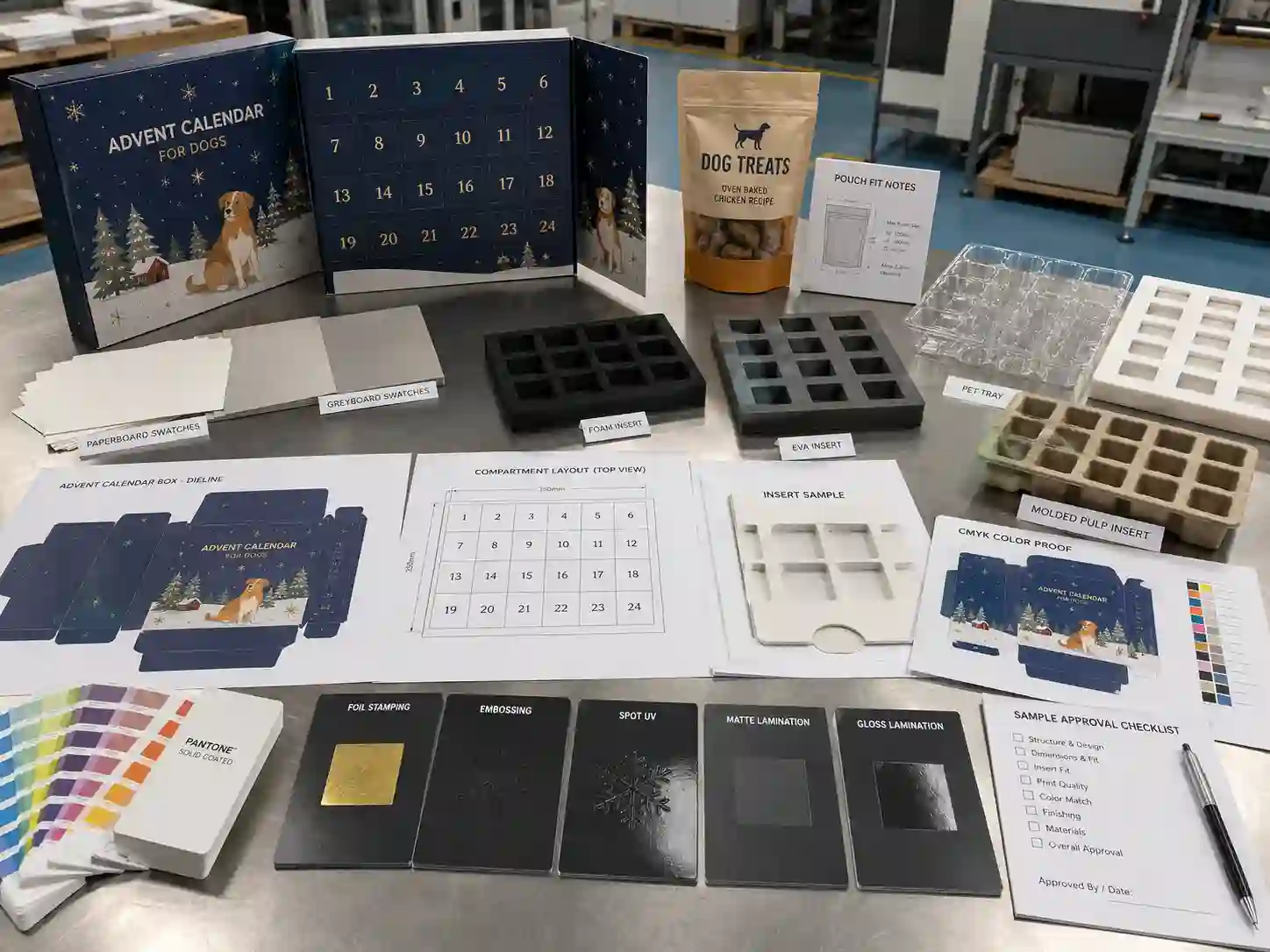
Common insert options include paper insert, PET tray, EVA insert, foam, and molded pulp. Paperboard inserts are common for lightweight sachets and offer good print and recycling potential. PET trays provide clean cavity definition for shaped items but may affect sustainability targets. EVA and foam can hold delicate accessories or mixed gift items, but buyers should review material expectations with their retail channel. Molded pulp can be useful for buyers seeking a paper-based insert option, especially when the product shape is stable enough for molded cavities.
For dog treat advent calendar boxes, insert engineering should consider pouch bulge, treat dust, sealed-edge thickness, compartment depth, and loading sequence. If a treat pouch is 12 mm thick when empty but 22 mm thick when filled, the calendar must be designed around the filled thickness. If a dental chew is long and rigid, it may need a horizontal cavity or angled placement. If the product includes multiple treat types, the factory should receive a compartment map showing which item goes into each numbered day.
What product-fit details should buyers send to the factory?
Buyers should send accurate product dimensions, weights, photos, and loading requirements so the factory can prepare a realistic dieline and insert sample. Without this data, quotations may look attractive but fail during prototype testing.
- Filled pouch width, height, thickness, and weight for each treat pack
- Dental chew length, diameter, flexibility, and packaging method
- Daily compartment count, such as 12-day, 24-day, or campaign-specific layouts
- Whether products are loaded by the factory, by the buyer, or by a co-packer
- Required opening style: perforated door, drawer, window, sleeve, or book-style opening
- Primary packaging status, especially sealed food-contact pouch or sachet information
- Any barcode, warning, ingredient, batch, or local-language label area needed on the box
For food-related pet products, buyers should also verify the suitability of primary product packaging and any food-contact expectations with their own compliance team. Official guidance such as the FDA food contact substances guidance can help buyers understand why food-contact responsibility should be reviewed carefully, especially when paper packaging, trays, adhesives, or inks may be close to edible products.
How should artwork and printing support seasonal campaign planning?
Artwork should be planned around retail visibility, numbered doors, dieline accuracy, legal label areas, barcode scanning, and campaign timing. A beautiful design can still fail if the door numbers cross cut lines, the barcode area is curved, or important copy sits too close to folding edges.
For dog treat calendars, artwork usually needs to balance pet-category cues with clear B2B packaging functions. Buyers should reserve space for product name, item count, net weight or content description where applicable, feeding or storage instructions if required, importer details, barcode, recycling marks, and campaign messages. Avoid placing important content on deep creases, perforation lines, drawer pull areas, or glue flaps.
Printing choices should match the retail positioning. CMYK printing is suitable for most seasonal designs. Pantone colors may be needed for brand color consistency across product ranges. Matte lamination can create a premium soft look, while gloss lamination can make colors brighter and improve wipe resistance. Foil stamping, embossing, and spot UV can add premium shelf impact, but they also add cost, sample review steps, and production alignment requirements.
Which finishing options are practical for dog treat advent calendars?
The practical finishing choice depends on campaign budget, retail positioning, and production tolerance. Premium finishes should be used where they improve shelf recognition or gift value, not simply to make the specification longer.
- Matte lamination: good for premium pet gift sets and soft seasonal artwork.
- Gloss lamination: useful when buyers want brighter color and higher surface shine.
- Foil stamping: effective for logos, numbers, badges, or limited-edition campaign marks.
- Embossing: suitable for premium panels but should avoid perforated door areas.
- Spot UV: useful for highlighting numbers, icons, or product claims on selected areas.
Buyer tip: If the calendar uses many small numbered doors, confirm the door-opening test on a printed or pre-production sample. Heavy ink coverage, lamination, and perforation settings can affect whether doors open cleanly.
How do buyers connect packaging design to retail shelf and e-commerce performance?
Buyers should design the calendar differently for retail shelf, e-commerce fulfillment, and promotional gifting because each channel creates different handling risks. Retail needs front-panel impact and consistent shelf presentation; e-commerce needs crush resistance and export packing control.
For retail, the front panel should communicate quickly at shelf distance. Numbered doors should be easy to understand, but not so weak that they open during handling. If the calendar stands upright, the base panel and internal insert must support the filled weight. If the design includes a window, buyers should confirm whether the window weakens the structure or exposes products to movement.
For e-commerce, the box may be shipped through multiple handling points. A rigid box or reinforced folding structure may reduce damage complaints. If the calendar ships in a mailer, the supplier should test corner protection, carton compression, and product movement. If the calendar is part of a larger gift bundle, the packaging team should confirm how it fits with other items in the outer carton.
Decision guide: which design direction fits your campaign?
Use the decision guide below to narrow the design direction before requesting samples. This helps avoid comparing quotations for completely different structures.
| Campaign priority | Recommended direction | Reason |
|---|---|---|
| Lowest landed cost for large seasonal promotion | Folding carton or paperboard door-opening calendar | Efficient printing and packing can reduce unit cost and shipping volume when the product is lightweight. |
| Premium pet gift set for retail buyers | Rigid box, drawer box, or book-style calendar | Stronger board and premium presentation support higher retail positioning. |
| Mixed dog treats, chews, and accessories | Rigid box with custom insert or drawer structure | Different product depths and shapes need better compartment control. |
| Amazon or parcel-based e-commerce | Reinforced structure with protective export carton planning | Parcel handling increases the importance of compression strength and corner protection. |
| Fast seasonal launch with limited development time | Simple paperboard calendar using standard insert logic | Lower structural complexity can shorten sampling and approval cycles. |
What sampling process should buyers expect before mass production?
Buyers should expect blank structural samples, printed samples, and a pre-production sample when the calendar is complex or high value. Sampling confirms size, structure, insert fit, artwork position, material feel, and opening function before mass production begins.
A blank sample is useful for checking the box size, board thickness, drawer movement, door function, and insert cavity layout. A printed sample checks artwork, color, lamination, finishing, barcode location, and front-panel appearance. A pre-production sample is the final approved reference before bulk production and should represent the agreed material, printing, structure, and assembly method.
For dog treat advent calendar boxes, the sample should be tested with real filled pouches or accurate dummy products. If the buyer only checks an empty calendar, problems may appear later: pouches may push doors outward, drawers may jam, cavities may be too shallow, or the filled calendar may deform when stacked.
Practical sample approval checklist
Use this checklist before signing off a dog treat calendar sample for production.
- Confirm the dieline matches the approved structure and all cut, fold, glue, perforation, and window lines.
- Load actual dog treat pouches, sachets, chews, or dummy products into every compartment.
- Check that numbered doors open without tearing neighboring doors or exposing the wrong compartment.
- Test drawer movement after loading products, not only when the drawer is empty.
- Confirm paperboard, greyboard, PET tray, paper insert, EVA, foam, or molded pulp materials match the approved specification.
- Review CMYK or Pantone color accuracy against the signed color proof.
- Check foil stamping, embossing, spot UV, matte lamination, or gloss lamination alignment.
- Confirm barcode size, quiet zone, and flat scanning area. Buyers can also review official barcode guidance from GS1 barcode standards.
- Inspect carton packing method, unit protection, and shipping marks before bulk export packing is finalized.
QC tip: The approved sample should not be treated as a decoration sample only. It should become the production control reference for structure, color, insert fit, assembly tolerance, and packing method.
What are the main cost drivers and MOQ factors?
The main cost drivers are box structure, board thickness, insert material, calendar size, printing coverage, finishing, assembly labor, sample complexity, packing volume, and order quantity. MOQ is affected by paper purchasing, printing setup, tooling, insert production, and factory production planning.
A simple folding carton calendar usually has a different cost structure from a rigid drawer calendar. Rigid boxes use greyboard, wrapping paper, more hand assembly, and more packing space. Door-opening calendars may require accurate die-cutting and perforation control. Drawer boxes require drawer tolerance checks and sometimes more labor. PET trays, EVA inserts, foam inserts, and molded pulp inserts may need molds or setup costs, especially for custom cavity shapes.
Finishing also affects price. Foil stamping, embossing, spot UV, and special lamination can improve shelf impact, but they add setup, alignment checks, and sample approval steps. Buyers should ask the supplier to separate the quotation by structure, insert, printing, finishing, packing, and tooling where possible. This makes it easier to compare alternatives fairly.
Quotable B2B note: A reliable quotation for dog treat advent calendar boxes should be based on filled product dimensions, approved structure, insert specification, printing process, finishing method, packing plan, order quantity, and delivery terms—not only on an outer box size.
How should buyers compare suppliers for seasonal dog treat calendar projects?
Buyers should compare suppliers by engineering support, sample accuracy, communication quality, production control, export packing experience, and quotation transparency. The lowest unit price may become expensive if the calendar fails insert testing, misses the launch date, or arrives damaged.
When comparing factories, ask whether they can review dielines, recommend insert changes, make blank and printed samples, control color proofing, inspect door-opening function, and prepare export cartons suitable for the shipping route. Also check whether they understand overseas buyer communication, file preparation, carton labels, pallet loading, and seasonal campaign deadlines.
Giftpackpro works as a custom advent calendar boxes manufacturer for B2B buyers who need seasonal paper packaging from concept to bulk export. Buyers can review custom advent calendar box services to understand how structure, sampling, printing, inserts, and production support can fit different campaign plans. For design references, buyers can also browse custom advent calendar box products and related advent calendar box buying guides.
Supplier comparison checklist
- Can the supplier engineer the insert around real dog treat pouch dimensions?
- Can they provide a dieline before artwork finalization?
- Do they offer blank samples, printed samples, and pre-production sample review?
- Can they explain MOQ, tooling, finishing, and packing cost drivers clearly?
- Do they check door opening, drawer sliding, insert loading, and carton packing during QC?
- Can they prepare export cartons, pallet plans, shipping marks, and carton labels for overseas shipment?
- Do they communicate lead time by sample, approval, material preparation, mass production, and packing stage?
What QC and export packing details matter before shipment?
QC and export packing should confirm that every calendar matches the approved sample and can survive handling through cartons, pallets, warehouses, and retail or e-commerce fulfillment. For seasonal campaigns, late discovery of quality issues can be more costly than the defect itself.
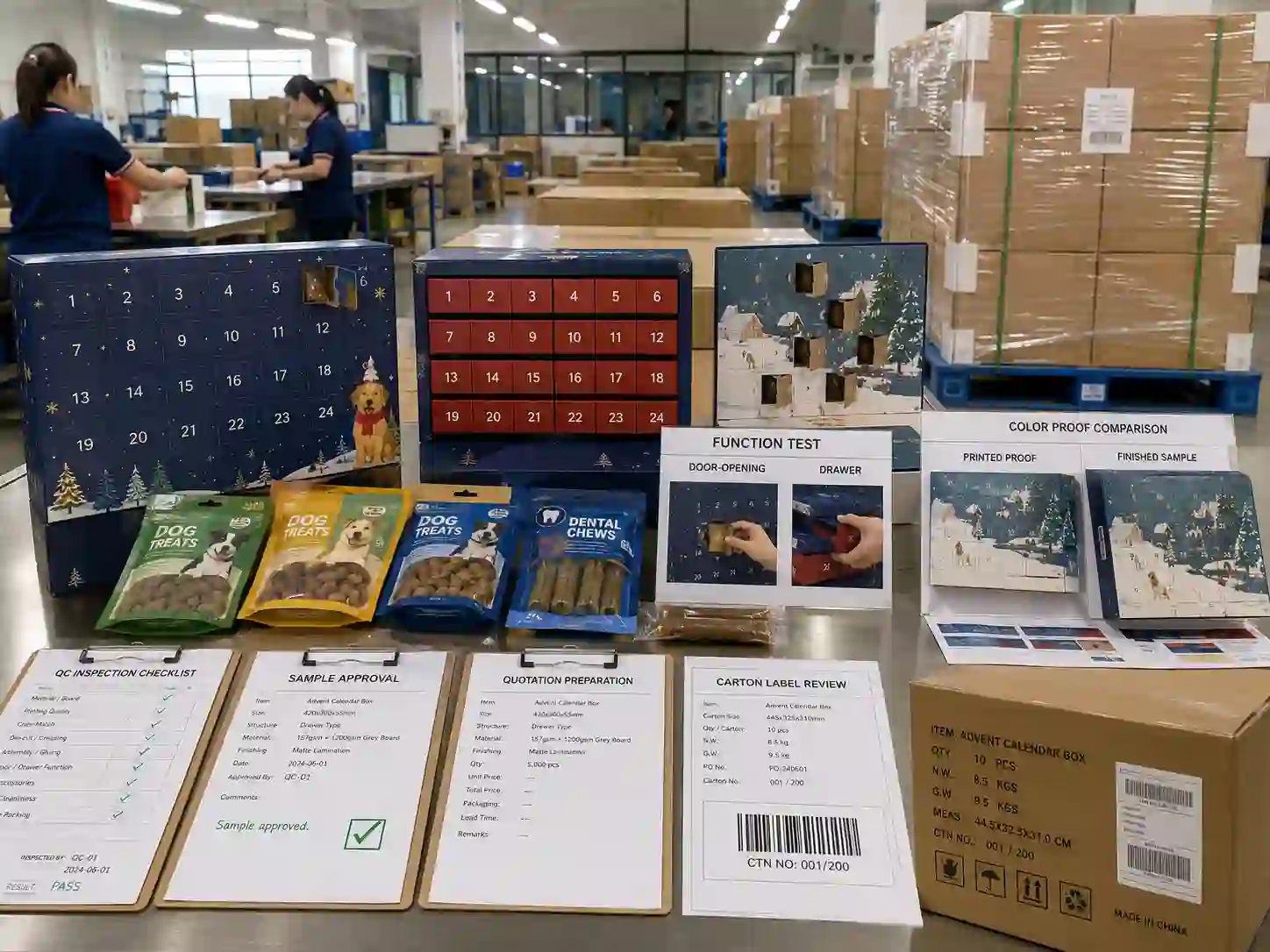
Key inspection points include outer dimensions, board thickness, print color, finishing position, door perforation strength, drawer movement, insert alignment, glue strength, loaded product fit, carton quantity, shipping marks, barcode label area, and pallet stability. For export packing, buyers should decide whether calendars ship flat, semi-assembled, or fully assembled. Flat packing can reduce volume for some folding carton designs, while assembled packing is often needed for rigid boxes, drawer boxes, and pre-loaded gift calendars.
Export cartons should match the box weight and shipping route. Heavy dog treat calendars may require stronger corrugated cartons, corner protectors, moisture control discussion, pallet wrap, and clear shipping marks. If the products are going to retail distribution centers, buyers should confirm carton labels, pallet height, carton weight limits, and barcode or routing label requirements before production packing begins.
QC checklist for production and packing
- Compare mass production units against the signed pre-production sample.
- Measure box size, compartment size, and insert depth at production intervals.
- Test random loaded units for door opening, drawer sliding, and product movement.
- Check color consistency against approved CMYK proof or Pantone reference.
- Inspect foil stamping, embossing, spot UV, lamination, and glue areas.
- Review export carton strength, carton count, inner protection, and pallet stacking.
- Confirm shipping marks, carton labels, barcode label space, and packing list consistency.
Factory tip: For seasonal dog treat calendars, QC should include both empty-box inspection and loaded-box simulation. A calendar that looks perfect when empty can still fail when treat pouches press against doors or drawers during stacking.
What information should buyers prepare before requesting a quotation?
Buyers should prepare product details, target structure, order quantity, artwork status, insert preference, packing method, destination market, and launch schedule before requesting a quotation. The more complete the RFQ, the more useful the supplier response will be.
Before asking the Giftpackpro packaging factory for a sample or quotation, prepare the following:
- Project name and campaign type, such as retail shelf, e-commerce gift set, or distributor promotion
- Target quantity and expected repeat order possibility
- Calendar format, such as 12-day, 24-day, drawer, door-opening, rigid, folding carton, or book-style
- Outer box size target or product layout requirements
- Filled dog treat pouch dimensions, weights, and photos
- Preferred insert type: paper insert, PET tray, EVA insert, foam, or molded pulp
- Artwork files, brand color references, CMYK or Pantone requirements, and dieline status
- Finishing needs, such as matte lamination, gloss lamination, foil stamping, embossing, or spot UV
- Sample requirements: blank prototype, printed sample, or pre-production sample
- Export packing requirements, carton labels, shipping marks, pallet needs, and destination country
- Target delivery date, launch date, and any retail routing requirements
A complete RFQ allows the supplier to quote the correct structure instead of guessing. It also helps purchasing teams compare cost, lead time, sample fees, tooling, payment terms, and packing assumptions across different suppliers.
What common mistakes should buyers avoid?
Buyers should avoid approving artwork before product fit is confirmed, comparing quotations with different structures, and ignoring export packing until the end. These mistakes can cause sample revisions, higher costs, production delays, or damaged calendars.
- Using empty pouch measurements: filled dog treat pouches can be much thicker than flat packaging files suggest.
- Choosing a structure only by photo: a rigid drawer box and folding carton may look similar online but have very different cost, labor, and freight implications.
- Ignoring door tolerance: perforated doors must be strong enough for shipping but easy enough for the end user to open.
- Overloading lightweight paperboard: heavy chews can deform a calendar designed for small sachets.
- Adding too many finishes: foil, embossing, spot UV, and special lamination should support the retail goal, not complicate production without purpose.
- Waiting too long to confirm packing: carton size, pallet plan, shipping marks, and barcode areas affect export readiness.
- Comparing vague quotations: quotes without board grade, insert type, printing method, finishing, packing, and quantity assumptions are difficult to evaluate.
FAQ: Dog treat advent calendar boxes for seasonal campaigns
What is the best structure for dog treat advent calendar boxes?
The best structure depends on product weight and sales channel. Door-opening paperboard calendars work well for standard treat sachets, folding cartons suit lighter promotional campaigns, and rigid box or drawer box designs are better for premium sets or mixed treat and chew combinations.
Can one calendar hold different dog treat sizes?
Yes, but the insert and compartment map must be engineered for each item. Mixed pouches, biscuits, dental chews, and accessories may need different cavity depths, stronger inserts, or a drawer layout instead of one flat door-opening panel.
Should buyers choose paper inserts or plastic trays?
Paper inserts are common for lightweight sachets and paper-based packaging goals. PET trays can provide precise cavity control for shaped products. EVA, foam, and molded pulp may be used for special layouts, but the final choice should match product weight, campaign positioning, cost target, and retailer expectations.
How early should buyers start sampling?
Buyers should begin sampling as early as possible once product dimensions and campaign quantity are known. Seasonal calendars need time for dieline development, blank prototype review, printed sample approval, pre-production checks, mass production, QC, export packing, and international shipping.
What affects MOQ for custom dog treat calendars?
MOQ is affected by board purchasing, printing setup, insert tooling, finishing process, structure complexity, and factory scheduling. A simple paperboard calendar usually has a different MOQ and cost profile from a rigid drawer calendar with custom insert and premium finishing.
Can Giftpackpro help with both sample and quotation preparation?
Yes. Buyers can prepare product dimensions, artwork status, target quantity, structure preference, insert needs, and shipping requirements, then request a custom quote from Giftpackpro for dog treat advent calendar boxes. Clear RFQ information helps the team recommend a practical structure, sample route, and production plan.
How should buyers move from design idea to production-ready packaging?
Buyers should move from campaign goal to product-fit data, then to structure selection, insert design, dieline, sample approval, quotation confirmation, mass production, QC, and export packing. This sequence reduces revision risk and helps the packaging support both retail shelf impact and e-commerce delivery.
For seasonal pet campaigns, dog treat advent calendar boxes should be treated as engineered promotional packaging, not only printed gift boxes. The right supplier should help buyers connect product fit, structure, artwork, sample approval, MOQ, lead time, QC, export carton planning, pallet packing, shipping marks, and quotation detail into one workable project. When the design brief is clear, the sample is tested with real filled products, and the export packing is planned early, buyers can launch dog treat calendar programs with fewer surprises and stronger purchasing control.