
Quick answer: Dog treat advent calendar boxes are custom seasonal paper packaging systems designed to hold sealed dog treat pouches, biscuit sachets, dental chew packs, or small pet gifts in numbered compartments. For brands and importers, the main decisions are structure strength, insert fit, food-safe separation, artwork accuracy, MOQ, sample approval, supplier reliability, and export packing. A good quotation should not only list unit price; it should define material, box style, insert type, printing, finishing, assembly method, carton packing, sample cost, lead time, payment terms, and QC standards before mass production.
For overseas buyers, dog treat advent calendar boxes are not simple decorative holiday boxes. They are multi-component custom advent calendar boxes that must protect food-grade inner packs, keep the retail display clean, survive international shipping, and support seasonal launch schedules. This guide explains how brands, wholesalers, pet product companies, Amazon sellers, gift companies, and purchasing teams can compare China factories, review quotations, prepare artwork, approve samples, and reduce supply risk.
What should buyers understand before choosing dog treat advent calendar boxes?
Buyers should understand the product size, treat weight, compartment layout, retail channel, and shipping method before choosing the box structure. Dog treats are usually packed in sealed pouches or sachets, so the calendar box must manage weight distribution, compartment access, and insert stability rather than direct food contact alone.
A dog treat calendar may contain dry biscuit sachets, freeze-dried treat packs, dental chew packs, soft chew mini bags, training treat pouches, or mixed pet gift items. Each item has different thickness, odor barrier requirements, and compression risk. The outer calendar should be engineered around the packed product dimensions, not only around a visual design concept.
For B2B purchasing, the most important early question is: will the calendar be shipped empty for local filling, shipped assembled with inserts, or filled at another co-packing facility? This decision affects box strength, insert tolerance, master carton size, freight cost, and inspection responsibility. If the pet treats are filled separately, buyers should confirm whether the packaging factory only supplies the paper box or also provides assembly support.
Buyer tip: Before asking any supplier for a quotation, prepare the packed dog treat size, weight per compartment, total calendar weight, expected order quantity, target retail price level, delivery country, and whether the calendar will be flat packed or assembled.
Which structure is best for dog treat advent calendar boxes?
The best structure depends on treat weight, price positioning, display needs, and logistics cost. Rigid boxes are stronger and more premium, while folding cartons are more cost-efficient for lighter dog treat sachets and larger retail campaigns.
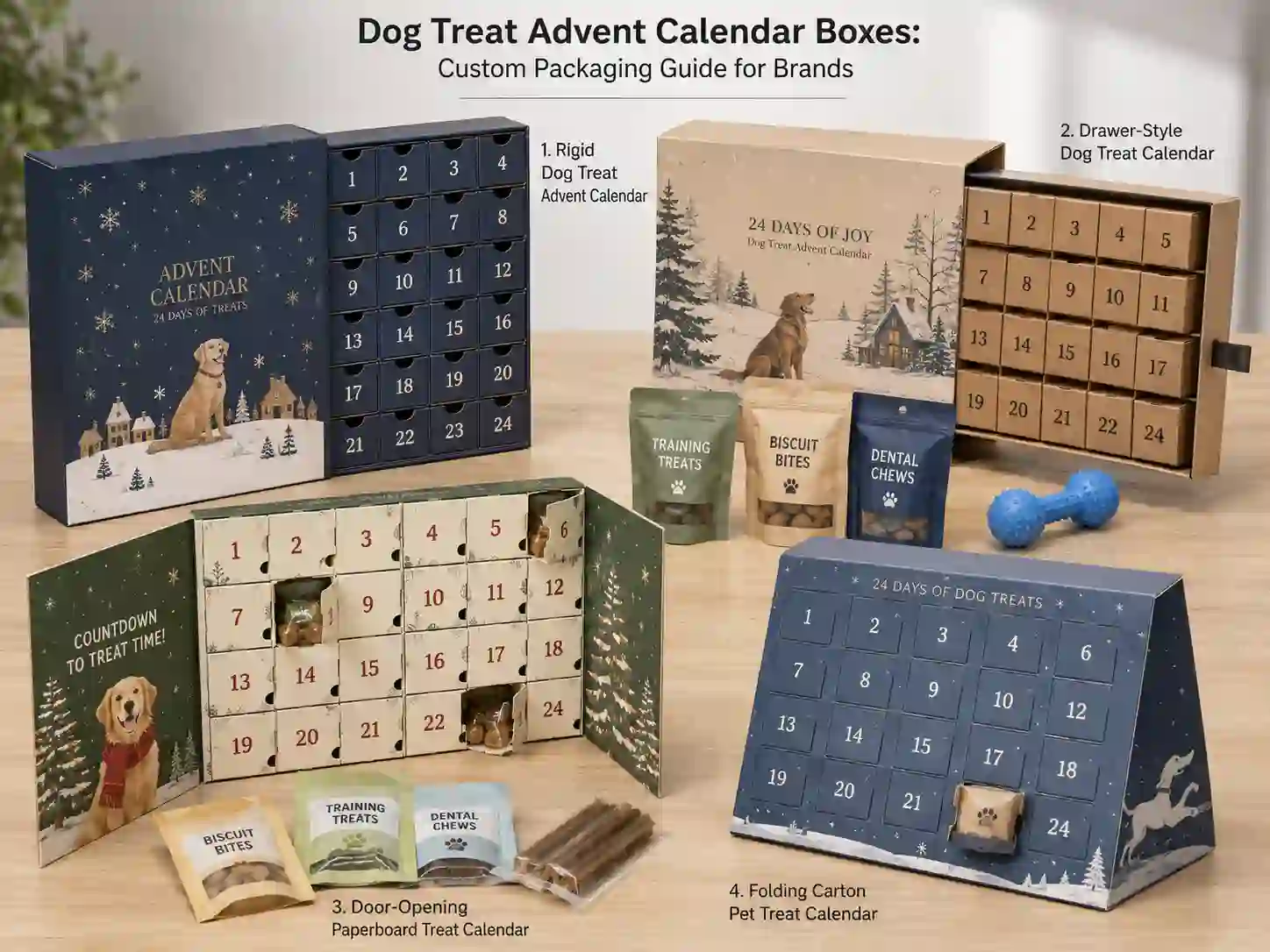
| Box structure | Best use case | Key advantages | Buyer considerations |
|---|---|---|---|
| Door-opening paperboard calendar | Light to medium dog biscuit sachets or training treat packs | Classic numbered doors, good shelf display, efficient production | Door perforation strength and insert alignment must be tested before mass production. |
| Rigid box with numbered compartments | Premium pet treat gift sets, heavier chew packs, retail gift campaigns | Strong greyboard structure, better display value, improved protection | Higher material cost, higher freight volume, longer sampling and production time. |
| Drawer box calendar | Mixed dog treats, dental chews, small pet accessories, refillable gift sets | Good user experience, reusable feel, strong compartment separation | Drawer tolerance, pull tabs, and assembly labor affect cost and QC. |
| Folding carton calendar | Large-volume promotions, e-commerce bundles, lightweight sachets | Lower unit cost, flat-packing advantage, efficient export packing | Less premium feel and lower compression resistance than rigid box options. |
| Book-style advent calendar box | Premium seasonal pet gift programs and retailer-exclusive sets | Large artwork area, strong gifting impression, suitable for mixed SKUs | Magnetic closure, hinge durability, and insert fixing need careful sample review. |
For dog treat advent calendar boxes, structure selection should start from load-bearing requirements. A 24-compartment calendar with biscuit sachets may look light, but the total weight can become concentrated along the bottom edge during shipping. If the box bends, doors may pop open, inserts may shift, or compartments may collapse.
Rigid box structures normally use greyboard wrapped with printed paper. They are suitable for premium dog treat gift sets and retail shelf displays. Folding carton calendars use paperboard and are often more economical for high-volume promotions. Door-opening boxes create a familiar retail display format, while drawer boxes support better product access and a higher perceived value.
As a custom advent calendar boxes manufacturer, Giftpackpro usually recommends confirming product weight and distribution before finalizing whether a rigid box, folding carton, drawer box, or door-opening box is the right structure.
How should inserts be designed for dog treat pouches and chew packs?
Inserts should hold every dog treat pack in position without crushing the pouch, blocking the door, or allowing items to slide during transport. The insert design must be based on the actual packed product, not only on estimated artwork dimensions.
Common insert options include paper insert, PET tray, EVA insert, foam insert, and molded pulp. For many dog treat advent calendars, paperboard inserts are practical because they are cost-efficient, printable if needed, and easier to recycle than some plastic or foam options. PET trays can give precise cavity shape for small sachets, but buyers should consider material preference, recycling requirements, and tooling needs. EVA and foam are usually used when products are fragile or require a premium fitted feel, but they may not match every sustainability target.
Dog treats also create packaging-specific challenges. Sachets may be soft and flexible, dental chews may be long and irregular, and biscuit packs may contain air inside the pouch. If the insert cavity is too tight, pouches wrinkle and doors bulge. If it is too loose, products move during export shipping and create a poor opening experience.
What insert details should be checked before sample approval?
Buyers should check cavity size, product removal, insert fixing, door clearance, and loaded-box weight before approving a sample. A good-looking empty prototype is not enough for a dog treat calendar project.
- Confirm every packed dog treat SKU has its own cavity size or shared cavity tolerance.
- Check whether pouches can be inserted quickly during packing without tearing or folding.
- Test whether the numbered doors open cleanly without pulling the insert out.
- Review whether long dental chew packs need horizontal compartments instead of square cavities.
- Check whether heavier items should be placed lower in the layout for better weight balance.
- Confirm whether the insert is glued, locked, folded, or held by box pressure.
Factory tip: For mixed dog treat calendars, send real filled pouches or accurate dummy samples to the packaging factory. Empty flat pouch dimensions can mislead the insert engineer because sealed food packs often become thicker after filling.
Which materials and finishes affect cost, strength, and retail appearance?
Material choice affects strength, appearance, cost, production speed, and export durability. Dog treat advent calendar boxes commonly use paperboard for folding cartons and greyboard plus printed wrapping paper for rigid box structures.
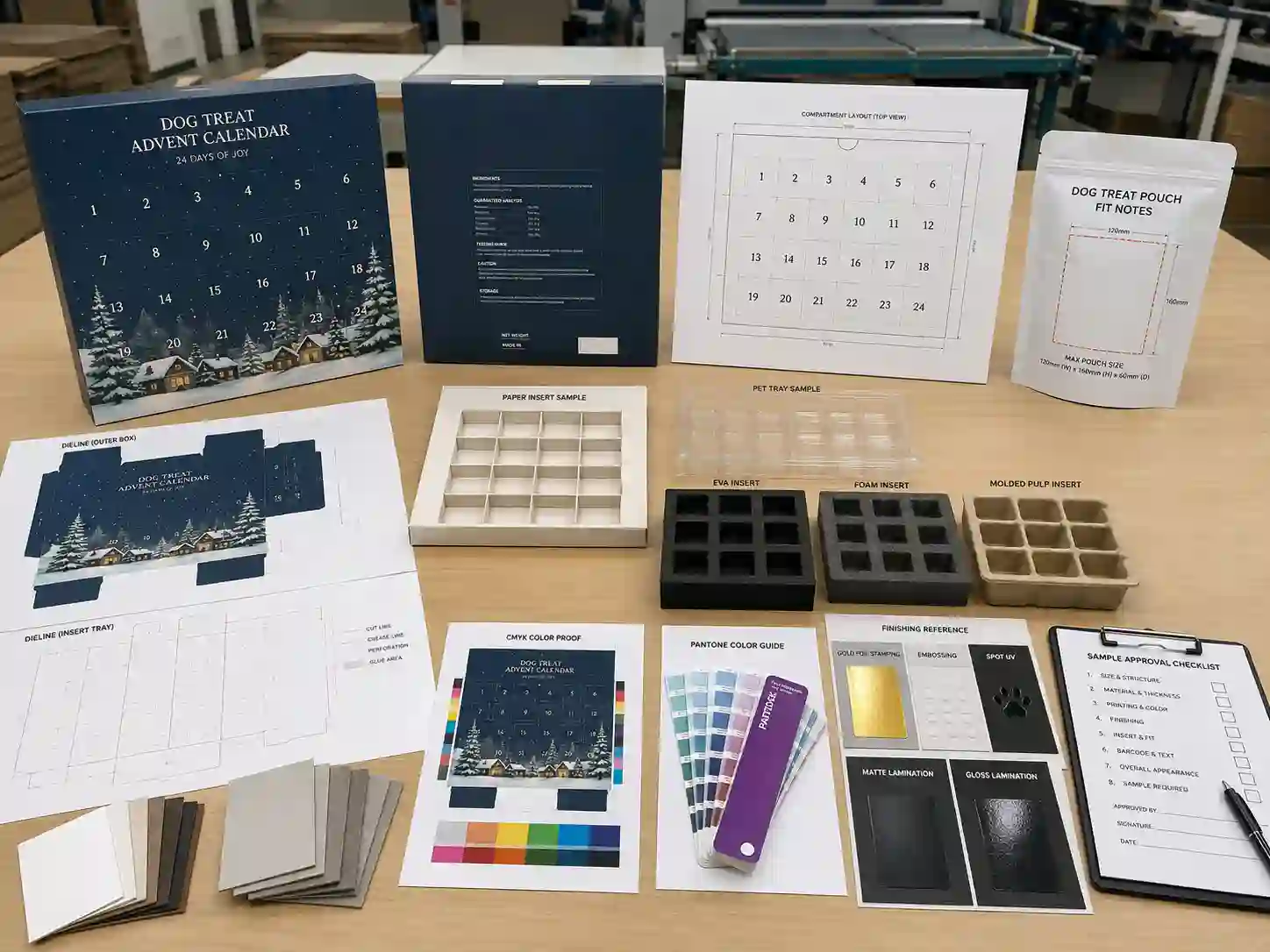
For paperboard calendars, buyers should review board thickness, stiffness, surface finish, and perforation performance. For rigid calendars, greyboard thickness must match the total loaded weight and box size. A large calendar with 24 dog treat sachets needs stronger board than a small 12-day promotional set.
Printing and finishing choices influence both visual quality and quotation. CMYK printing is common for full-color seasonal artwork. Pantone color matching may be needed for brand colors. Matte lamination can reduce glare and create a softer premium feel, while gloss lamination can make colors brighter. Foil stamping, embossing, and spot UV can upgrade the front panel, but they add tooling, setup, and inspection points.
Buyers should also consider responsible paper sourcing and compliance expectations in the destination market. If FSC-certified paper is required, buyers should verify chain-of-custody documentation with the supplier and review official information from FSC. For pet treat projects, the outer calendar normally does not replace the sealed food-contact pouch, but any food-contact material claims should be verified with the correct supplier documentation and destination-market requirements.
How should buyers compare China suppliers for dog treat advent calendar boxes?
Buyers should compare suppliers by engineering capability, sample accuracy, communication speed, quotation transparency, QC process, export packing experience, and reliability—not by unit price alone. A lower quotation can become more expensive if it excludes insert tooling, assembly, stronger cartons, artwork revision, or realistic packing costs.
China sourcing for seasonal pet packaging requires early planning because advent calendar production often compresses artwork approval, sample revision, bulk production, inspection, and shipping into a tight retail deadline. The supplier should be able to review dieline files, advise structure improvements, prepare prototypes, explain cost drivers, and confirm realistic lead time before order placement.
| Supplier comparison point | What to ask | Why it matters |
|---|---|---|
| Engineering support | Can the factory review dog treat pouch sizes, weight, and compartment layout before quoting? | Good structure planning reduces insert failure, door bulging, and shipping damage. |
| Quotation detail | Does the quote separate box, insert, printing, finishing, sample, tooling, packing, and freight terms? | Transparent quotations are easier to compare between suppliers. |
| Sample process | Will the supplier provide blank sample, digital proof, printed sample, or pre-production sample? | Different sample types answer different risk questions. |
| Communication | Does the supplier ask useful technical questions or only quote from photos? | Technical communication shows whether the project is being engineered properly. |
| QC and export packing | Can the factory define inspection points, export carton strength, pallet method, and shipping marks? | Seasonal packaging has little time for replacement if damage appears after arrival. |
Buyer tip: When comparing two quotations, confirm whether both suppliers are quoting the same board thickness, insert material, printing method, finishing, assembly level, carton packing, and Incoterms. If these details are different, the unit prices are not directly comparable.
What quotation details should be prepared before contacting a supplier?
Buyers should prepare product dimensions, product weight, compartment count, box style, artwork requirements, order quantity, target launch date, packing method, and delivery destination before asking for a quotation. The more complete the RFQ, the more accurate the price and lead time.
For dog treat advent calendar boxes, a strong RFQ should include both design intent and production facts. The supplier needs to know whether the calendar is for retail shelf display, e-commerce shipping, wholesale gift programs, or private-label pet product campaigns. Each channel has different strength and packing requirements.
RFQ checklist for dog treat advent calendar boxes
- Calendar format: 12-day, 24-day, 25-day, or custom compartment count.
- Box structure: rigid box, folding carton, drawer box, door-opening box, book-style box, or undecided.
- Outer box size or target retail display size.
- Each dog treat pouch size, thickness, and filled weight.
- Total loaded calendar weight.
- Insert preference: paper insert, PET tray, EVA insert, foam, molded pulp, or supplier recommendation.
- Printing: CMYK, Pantone color, inside printing, outside printing, or special color control.
- Finishing: matte lamination, gloss lamination, foil stamping, embossing, spot UV, ribbon, magnetic closure, or window.
- Artwork status: ready dieline, rough layout, reference sample, or need dieline support.
- Required sample type: blank prototype, printed sample, or pre-production sample.
- MOQ and estimated annual or campaign quantity.
- Packing method: flat packed, semi-assembled, or fully assembled.
- Export requirements: carton size limit, pallet requirement, shipping marks, barcode label area, and destination country.
- Target delivery date and preferred shipping method.
Giftpackpro’s custom advent calendar box services can support structure planning, dieline preparation, material selection, printing proof review, sample making, bulk production, QC, and export packing for custom dog treat calendar projects. Buyers can also review custom advent calendar box products for structure ideas before sending an RFQ.
How do MOQ, cost, and lead time change by structure and customization?
MOQ, cost, and lead time change mainly because of structure complexity, material thickness, insert type, printing coverage, finishing process, assembly labor, and packing method. A simple folding carton calendar usually has a different cost model from a rigid drawer calendar with multiple inserts and foil stamping.
Common cost drivers include greyboard thickness, paperboard grade, box size, number of compartments, insert material, printed surface area, Pantone matching, foil stamping plate, embossing mold, spot UV screen, lamination, magnetic closure, ribbon, hand assembly, and export carton configuration. Buyers should also ask whether the quotation includes sample cost, tooling cost, packing materials, and inspection support.
Lead time should be discussed in stages: dieline confirmation, blank sample, artwork proof, printed sample, pre-production sample, mass production, final inspection, export packing, and shipping. For seasonal pet campaigns, the risk is not only production time but also revision time. Artwork changes, insert corrections, and delayed treat samples can push the schedule.
Quotable B2B statement: For dog treat advent calendar boxes, a reliable lead-time plan should start from sample approval, not from the first inquiry date, because mass production quality depends on confirmed structure, artwork, insert fit, and packing method.
What sample process reduces risk before mass production?
A proper sample process reduces structure, fit, color, and assembly risk before mass production starts. Buyers should not approve bulk production from a visual mockup alone when the calendar will hold real dog treat packs.
- Dieline review: Confirm box size, door position, insert layout, glue areas, bleed, safety lines, and barcode label area.
- Blank prototype: Test structure, opening function, insert fit, product loading, and weight balance without final printing.
- Artwork proof: Check CMYK, Pantone references, text, nutrition or product claim placement if printed on outer packaging, numbering, and legal copy supplied by the buyer.
- Printed sample: Review color, lamination, foil stamping, embossing, spot UV, door perforation, and overall retail appearance.
- Loaded test: Place real dog treat sachets or accurate dummy packs into all compartments and check bulging, shifting, and opening experience.
- Pre-production sample: Approve the final standard for mass production, QC reference, and export packing confirmation.
For buyers working with a China supplier, written sample approval is important. The approval record should define the accepted structure, color tolerance, insert material, finishing, assembly method, and packing method. Photos are useful, but they should not replace a physical sample when fit and strength matter.
What QC points matter most for dog treat advent calendar boxes?
QC should focus on structure strength, compartment accuracy, door opening, insert position, printing quality, finishing alignment, assembly consistency, and export carton protection. Dog treat calendars often fail because of small tolerance issues across many compartments.
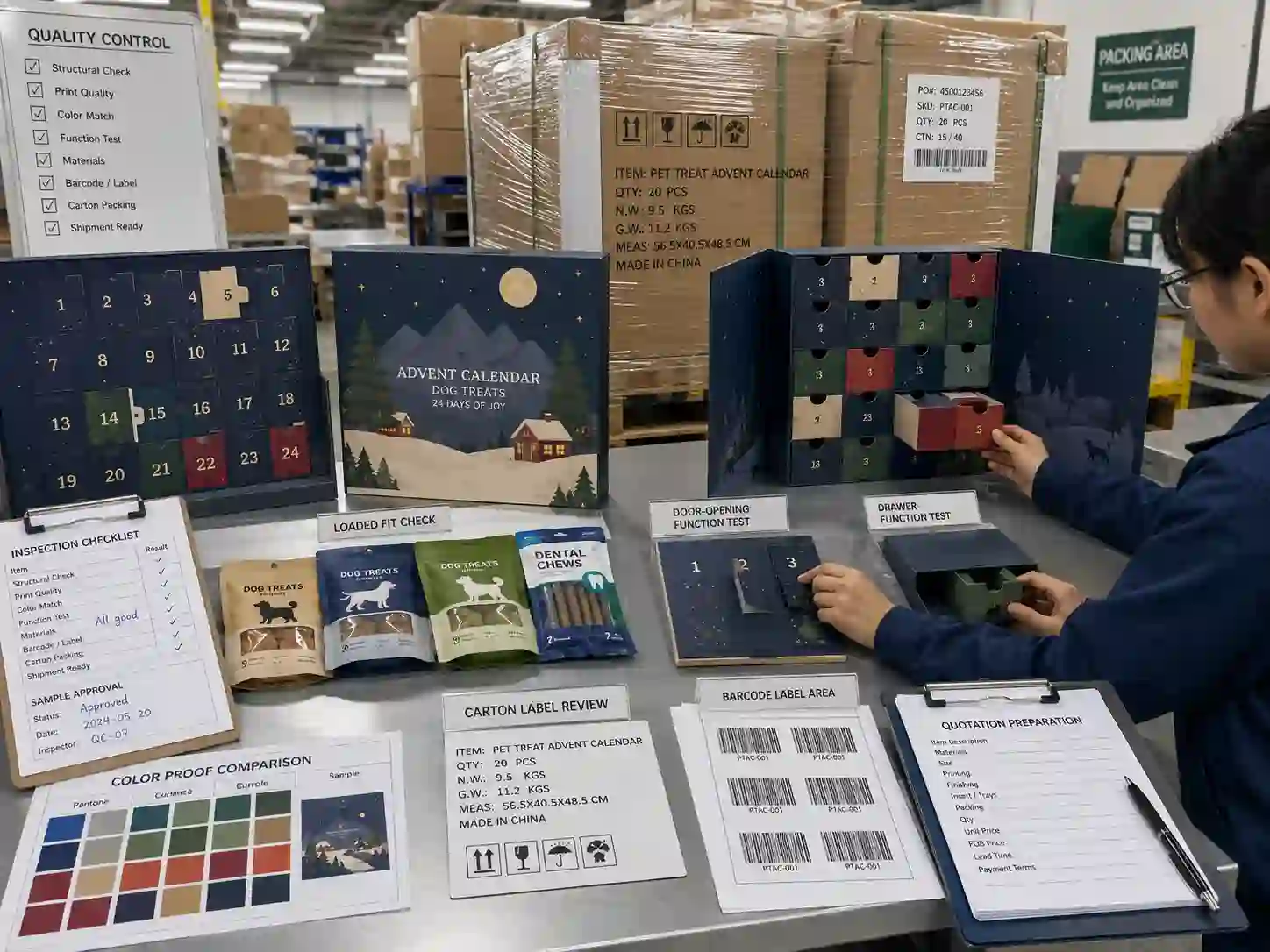
During mass production, the factory should check incoming material, printing sheets, lamination quality, die-cutting accuracy, gluing strength, insert assembly, door perforation, numbering sequence, and final packing. For rigid boxes, corner strength, wrap alignment, glue marks, and greyboard flatness should be inspected. For folding carton calendars, scoring, folding, locking tabs, and compression resistance are important.
Buyers should also ask how the factory handles inspection sampling, defect classification, and corrective action. If a door tears too easily or an insert shifts during a loading test, the issue should be corrected before final assembly. For export shipping, buyers can consider packaging performance guidance from ISTA when discussing transit testing and carton protection with suppliers or logistics partners.
Practical QC checklist for buyers
- Check outer box dimensions against the approved dieline.
- Confirm all numbered doors are in the correct sequence and open correctly.
- Test insert cavities with real filled dog treat packs.
- Inspect whether pouches press against doors or create visible bulging.
- Check print color against approved proof or Pantone reference.
- Review foil stamping, embossing, spot UV, and lamination for alignment and defects.
- Confirm glue strength, corner quality, drawer movement, or magnetic closure function where applicable.
- Check export carton strength, carton labels, shipping marks, pallet plan, and moisture protection.
QC tip: For pet treat calendars, perform at least one loaded carton check before shipment. Testing only empty calendars can miss compression, shifting, and door-bulging problems caused by the actual product weight.
How should export packing be planned for overseas buyers?
Export packing should protect the calendar structure, preserve retail appearance, and match the buyer’s warehouse handling requirements. The choice between flat packing, assembled packing, and fully loaded packing has a major impact on carton size, labor cost, freight cost, and damage risk.
Flat packing can reduce volume for certain folding carton structures, but it may shift assembly work to the buyer or co-packer. Assembled empty calendars save local labor but increase shipping volume. Fully loaded calendars require stronger master cartons, clear packing orientation, and careful product weight distribution. Pallet loading, corner protectors, carton sealing, shipping marks, and barcode label areas should be confirmed before final packing.
Export cartons should not be selected only by the lowest cost. A weak carton can collapse during stacking and damage finished calendars. Buyers should confirm carton material, quantity per carton, gross weight, carton dimensions, pallet height, and whether corner protectors or pallet wrap are needed. If retail cartons must remain clean, inner polybags, tissue protection, or dividers may be required depending on the finish.
Decision guide: how should buyers choose the right solution?
Buyers should choose the packaging solution by matching product weight, retail positioning, budget, launch timeline, and supplier capability. The right dog treat calendar is the one that can be produced consistently, packed safely, and delivered on time—not only the one that looks best in a rendering.
| Buyer priority | Recommended direction | Why |
|---|---|---|
| Lowest practical cost for large retail volume | Folding carton with paper insert | Efficient material use, faster production, and easier flat-packing options. |
| Premium pet gift positioning | Rigid box or book-style greyboard calendar | Stronger presentation, better shelf impact, and improved gifting value. |
| Mixed treats and small accessories | Drawer box or rigid calendar with custom insert | Better separation for different product sizes and weights. |
| Sustainability-focused program | Paperboard structure with paper insert or molded pulp insert | Reduces reliance on plastic trays where product protection allows. |
| Tight timeline | Simpler structure with fewer special finishes | Reduces tooling, revision, hand assembly, and QC complexity. |
What common mistakes should buyers avoid?
Buyers should avoid choosing a supplier from price alone, approving samples without real product testing, and finalizing artwork before the dieline is confirmed. Most avoidable problems come from missing technical details before mass production.
- Quoting from photos only: A supplier cannot accurately quote structure, insert, and carton packing from a reference image without dimensions and weight.
- Ignoring filled pouch thickness: Dog treat sachets often become thicker after filling, which can cause doors to bulge.
- Overusing premium finishes: Foil stamping, embossing, and spot UV can improve appearance, but too many processes increase cost, lead time, and defect risk.
- Approving empty samples only: Empty box testing does not confirm loaded performance.
- Comparing unclear quotations: A low price may exclude insert tooling, sample revisions, stronger export cartons, or assembly labor.
- Leaving shipping marks too late: Carton labels, barcode areas, and pallet requirements should be planned before packing.
- Starting too late for seasonal launch: Dog treat advent calendar projects need time for sampling, artwork revision, mass production, inspection, and international shipping.
Why does supplier reliability matter for seasonal dog treat packaging?
Supplier reliability matters because dog treat advent calendar boxes are deadline-driven retail packaging. If structure, sample, production, or export packing fails, the buyer may not have enough time to remake seasonal inventory.
Reliable suppliers ask technical questions early, document quotation details, review dielines carefully, provide realistic lead times, and explain production risks. They should communicate clearly about material availability, sample schedule, MOQ, payment terms, inspection timing, and packing method. Buyers should also check whether the factory has experience with custom advent calendar structures rather than only standard paper boxes.
For buyers who want to understand factory capability, the Giftpackpro packaging factory page can help explain how a packaging supplier supports seasonal paper gift packaging projects. Buyers can also read more advent calendar box buying guides to compare structure, sampling, printing, and export packing decisions before finalizing an RFQ.
FAQ: dog treat advent calendar boxes for B2B buyers
What is the best box type for dog treat advent calendar boxes?
The best box type depends on treat weight, budget, and retail positioning. Folding cartons are practical for lightweight sachets and larger quantities, while rigid boxes, drawer boxes, and book-style boxes are better for premium pet gift campaigns or heavier mixed products.
Can dog treat calendars use paper inserts instead of plastic trays?
Yes, many dog treat calendars can use paper inserts if the pouches are not too heavy or irregular. Paper inserts are often cost-effective and suitable for sustainability-focused projects, but the final choice should be tested with real filled treat packs.
What sample should a buyer approve before mass production?
Buyers should approve a pre-production sample that confirms structure, insert fit, artwork, printing, finishing, assembly method, and packing method. For dog treat projects, a loaded sample test is especially important.
What affects MOQ for custom dog treat advent calendar boxes?
MOQ is affected by box structure, material purchasing, printing setup, finishing processes, insert tooling, and assembly requirements. More complex rigid structures or special finishes usually require more planning and may have higher practical MOQ expectations than simple folding cartons.
How can buyers compare quotations from different China factories?
Buyers should compare quotations line by line, including material thickness, box style, insert type, printing, finishing, sample cost, tooling, assembly, export carton, packing quantity, lead time, payment terms, and Incoterms. Unit price alone is not enough.
Do dog treat advent calendar boxes need food-contact materials?
If dog treats are sealed in their own food-grade pouches, the outer calendar normally functions as secondary packaging. However, buyers should verify food-contact requirements for any material that directly touches treats and confirm destination-market compliance with the treat supplier, co-packer, or regulatory advisor.
Ready to request a sample or quotation?
Before you request dog treat advent calendar boxes, prepare the packed treat dimensions, product weight, compartment count, preferred structure, insert requirements, artwork files, target quantity, delivery country, timeline, and export packing needs. These details help the supplier quote accurately and recommend the right structure before sampling.
Giftpackpro can support overseas brands, wholesalers, retailers, gift companies, e-commerce sellers, and purchasing teams with structure planning, dieline support, sampling, printing, inserts, QC, and export packing for custom dog treat advent calendar projects. To start, send your product sizes, reference structure, quantity, and launch schedule through the request a custom quote page.


