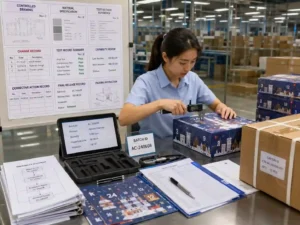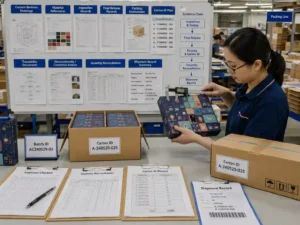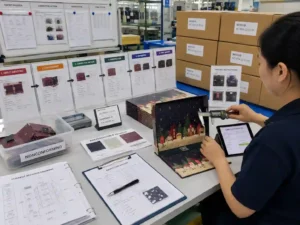
Quick answer: Cat treat advent calendar boxes are custom seasonal paper packaging solutions designed to hold multiple cat treat sachets, mini pouches, dental bites, sample packs, or small pet accessories in numbered compartments. For B2B buyers, the right box is not only a retail display item; it is a structure, insert, artwork, filling, QC, and export-packing project. Before requesting a quotation, buyers should confirm treat pack dimensions, weight, compartment count, box style, insert material, printing finish, MOQ target, sample needs, shipping method, barcode area, and carton packing requirements. A strong supplier should help test product fit, dieline accuracy, opening function, assembly tolerance, and export durability before mass production.
Cat treat advent calendar boxes are usually developed for seasonal retail programs, online gift sets, pet brand promotions, subscription campaigns, and distributor-exclusive product bundles. Unlike standard gift boxes, they must manage many small SKUs or repeated treat packs while keeping each compartment easy to open, secure during transport, and attractive on a shelf or product page.
For brands comparing custom advent calendar boxes manufacturer options, the main purchasing question is not “which box looks best?” It is “which structure can protect the treat packs, support efficient assembly, pass sample approval, and arrive safely in export cartons?”
What should buyers understand before choosing cat treat advent calendar boxes?
Buyers should first understand the relationship between product format, box structure, insert design, and filling method. Cat treat packaging often uses small pouches or sachets, so compartment size, finger access, door strength, and pouch movement control are more important than decoration alone.
A cat treat advent calendar may hold 12, 24, 25, or another custom number of compartments. Each compartment can contain one treat pouch, a mini sachet, a dental chew sample, a sealed soft treat pack, or a small accessory such as a toy charm. Because cat treat packs are usually flexible and lightweight, the insert must prevent sliding, bunching, or pushing against the numbered doors during shipping.
Buyer tip: Treat pouch dimensions should be measured after filling, not only from the flat packaging artwork file. A soft pouch may become thicker at the seal, wider near the bottom gusset, or uneven after packing. This affects insert clearance and door-opening performance.
Cat treat advent calendar boxes normally work as secondary packaging. The treat itself should remain inside its own sealed primary food pack unless the project specifically requires direct food-contact packaging. If direct food contact is involved, buyers should verify material compliance with official guidance such as the FDA food contact substances guidance or the relevant destination-market regulations.
Which box structure works best for cat treat advent calendar packaging?
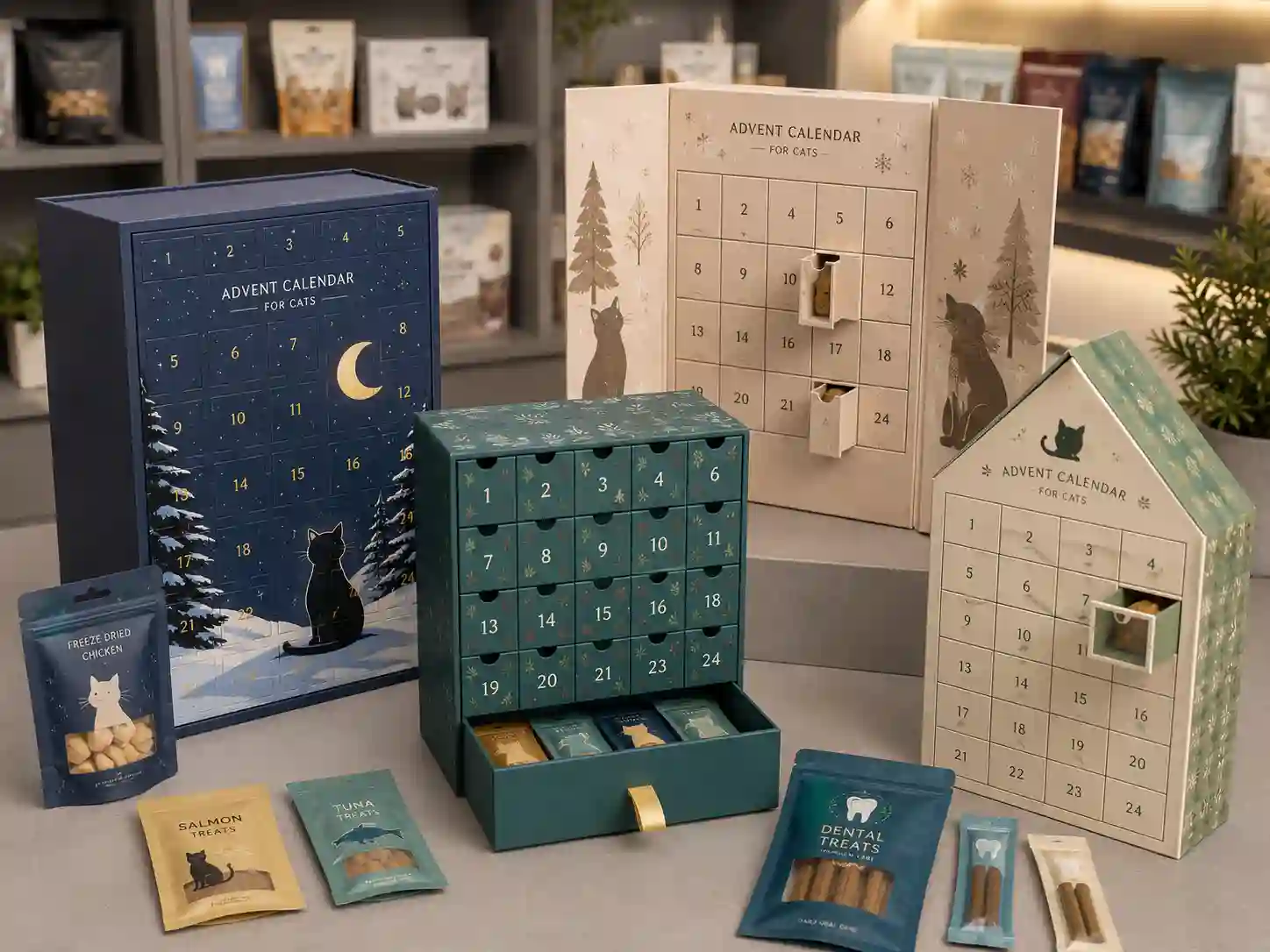
The best structure depends on product weight, retail channel, budget, visual positioning, and assembly method. For cat treat advent calendar boxes, buyers commonly compare door-opening paperboard boxes, drawer boxes, rigid boxes, and folding carton structures.
| Structure option | Best for | Key advantages | Buyer checks |
|---|---|---|---|
| Door-opening box | Classic numbered advent calendar experience with small cat treat pouches or sachets | Strong seasonal display value, clear numbered layout, good for retail shelves and e-commerce photos | Door perforation strength, pouch pressure against doors, finger access, opening sequence, insert alignment |
| Drawer box | Premium pet treat gift sets, multi-flavor collections, refillable campaign boxes | Better perceived value, smooth opening, strong product presentation, reusable feel | Drawer sliding tolerance, stopper design, pull-tab strength, carton weight after filling |
| Rigid box | Higher-value cat treat gift sets, distributor programs, brand launch kits | Excellent stiffness, premium finish options, suitable for heavier or mixed items | Greyboard thickness, insert fixing method, freight volume, unit cost, export carton protection |
| Folding carton | Cost-sensitive retail campaigns and larger-volume seasonal runs | Lower freight volume before assembly, efficient production, good for lighter treat packs | Paperboard grade, locking strength, assembly speed, compression resistance after filling |
A door-opening cat treat advent calendar box is often the most recognizable option for retail and marketplace listings. However, it requires careful dieline work because each door must open cleanly without tearing neighboring doors or exposing other compartments. If the treat pouch is too thick, it can press against the door panel and weaken the perforation during export handling.
A drawer box can be useful when the brand wants a more premium unboxing experience or when each treat pack is placed in a small tray compartment. The buyer should test whether the drawer still slides smoothly after all compartments are loaded. Drawer tolerance can change when paper wrap, insert thickness, and filled product weight are added.
A rigid box gives better structure and higher perceived value, but it is not always the lowest-cost solution. It may increase unit cost and shipping volume. For brands selling through pet boutiques, subscription programs, or high-end gift channels, this cost may be justified. For price-sensitive mass retail campaigns, a folding carton or reinforced paperboard door-opening box may be more practical.
How should buyers choose inserts for cat treat pouches and sachets?
The insert should hold each cat treat pack in position without damaging seals, crushing the pouch, or making it difficult for the consumer to remove the item. Insert choice affects product fit, assembly speed, sustainability positioning, cost, and the final box thickness.
Common insert materials include paper insert, PET tray, EVA insert, foam, and molded pulp. For cat treat advent calendar boxes, paper inserts and PET trays are often practical because they can organize many lightweight sachets. EVA and foam can work for premium mixed gift sets, but buyers should check odor, material preference, and destination-market expectations. Molded pulp may support eco-positioning, but tooling, shape accuracy, and surface finish should be reviewed early.
When is a paper insert suitable?
A paper insert is suitable when the cat treat packs are lightweight and have consistent dimensions. It is usually a good option for brands that want recyclable-looking packaging, lower material complexity, and efficient flat production.
Paper inserts can be designed as dividers, folded trays, stepped compartments, or locking panels. The challenge is controlling pouch movement. Flexible treat packs can slide under dividers or lean forward behind the doors. The dieline should include enough holding points to keep each pouch visible and stable.
When should buyers consider PET trays?
A PET tray is useful when the product requires more precise cavities or when the buyer wants a clean molded shape. It can hold sachets, small cups, or mixed treat formats more consistently than a simple paper divider.
The trade-off is tooling, material visibility, and sustainability perception. Buyers should confirm tray thickness, cavity draft angle, anti-slip design, and whether the tray can be loaded efficiently during packing. For transparent or semi-transparent trays, surface scratches and dust control should also be considered.
When do EVA, foam, or molded pulp inserts make sense?
EVA and foam inserts are more common for premium sets, fragile accessories, or mixed pet gift items. Molded pulp can be considered when the buyer wants a molded protective insert with a paper-based appearance.
For cat treat boxes, EVA or foam is usually unnecessary if all items are flexible sachets. It may become useful when the calendar includes jars, tins, small toys, or heavier accessories. Molded pulp needs earlier development because tooling, drying shrinkage, and cavity accuracy can affect product fit.
Factory tip: Insert testing should include the real filled pouch, not only a printed paper dummy. The real pouch shows air volume, seal thickness, product movement, and compression behavior during carton packing.
What material and board choices affect strength and cost?
Material selection should match the box structure, product weight, export route, and retail positioning. The key decision is whether the box needs lightweight paperboard efficiency, rigid greyboard strength, or a balanced structure with reinforced panels.
Paperboard is common for folding cartons and door-opening boxes. It can be printed directly with CMYK or spot colors and finished with matte lamination, gloss lamination, spot UV, foil stamping, or embossing. Greyboard is commonly used for rigid boxes and wrapped structures. It offers better stiffness, but it adds cost, weight, and freight volume.
For cat treat advent calendar boxes, the product itself is often light, but the box can become wide and shallow because of the compartment layout. This means bending resistance and corner protection matter. A large flat calendar may look fine in a sample room but bend during carton stacking if the board grade, insert support, or export carton arrangement is weak.
Buyers should ask the supplier to recommend board thickness based on actual product weight, box size, and carton packing quantity. Exact board selection should be confirmed after sample testing instead of being copied from a different product category.
How should artwork, printing, and finishing be prepared?
Artwork should be prepared on the approved dieline, with clear numbering, bleed, safe areas, barcode zones, and finish layers separated. For cat treat advent calendar boxes, artwork must also consider door cuts, perforation lines, and how numbered panels look after opening.
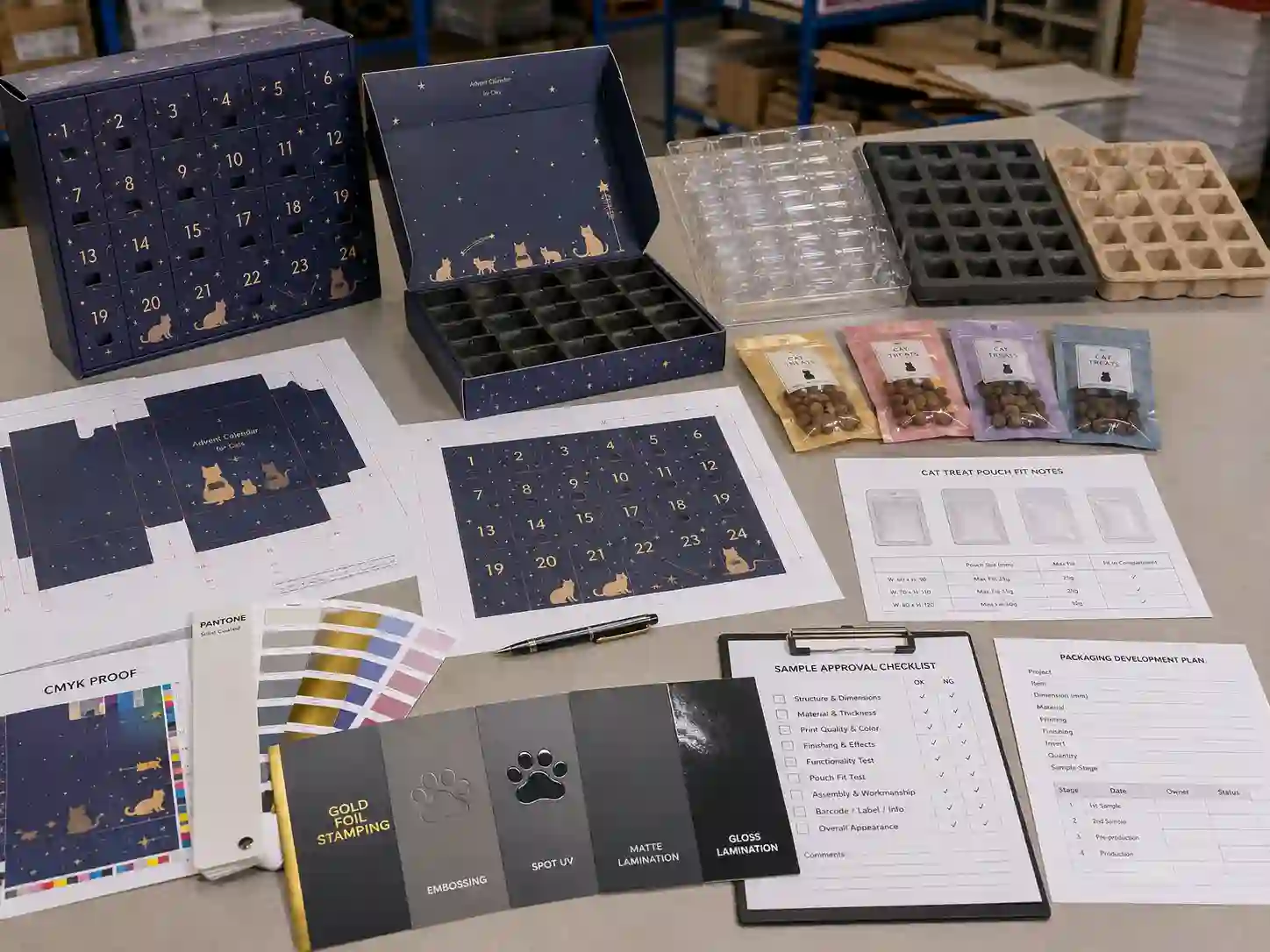
CMYK printing is suitable for most full-color seasonal artwork. Pantone colors may be needed for brand-critical colors, especially when the calendar must match existing cat treat pouch packaging. Foil stamping, embossing, spot UV, matte lamination, and gloss lamination can create stronger shelf impact, but they also require accurate registration and extra production steps.
Buyers should not place small text, QR codes, or important claims too close to door edges, creases, or perforation lines. If each door has a number, the numbering system should be checked against the insert and filling plan. A mismatch between door number and product flavor can create expensive rework during assembly.
Buyer tip: For multi-flavor cat treat calendars, create a product loading map before approving artwork. The loading map should show compartment number, product SKU, pouch size, flavor name, barcode or batch logic if needed, and any market-language requirements.
What sampling process should buyers expect before mass production?
Buyers should expect at least a structural prototype and, for confirmed orders, a printed pre-production sample before mass production. Sampling is the stage where structure, insert fit, artwork, opening function, and packing method are verified together.
A white sample or blank prototype helps check dimensions, compartment layout, insert structure, and product fit. It may not show final color or finishing. A digital printed sample can help review overall design, but it may not match offset printing exactly. A pre-production sample should be made closer to mass production materials, printing, finishing, and assembly method.
The sample approval process should include:
- Outer box dimensions and shelf-facing orientation
- Cat treat pouch fit after filling, including seal thickness and air volume
- Door-opening or drawer function test
- Insert alignment with door numbers or drawer positions
- Artwork position, bleed, dieline, and numbering sequence
- CMYK proof or Pantone color review
- Finish placement for foil stamping, embossing, spot UV, matte lamination, or gloss lamination
- Assembly method and expected packing speed
- Export carton layout and protection method
Quotable B2B statement: A cat treat advent calendar sample should be approved as a packed system, not as an empty box, because the filled pouch changes insert pressure, door performance, and carton stacking behavior.
What MOQ and cost drivers should procurement teams compare?
MOQ and cost are affected by structure, box size, material, printing method, insert type, finishing, assembly complexity, and export packing. Buyers should compare quotations by specification, not only by unit price.
A lower unit price may exclude insert tooling, sample cost, special finishing, stronger export cartons, pallet packing, or extra QC requirements. A higher quotation may include better material, more reliable assembly support, or safer shipping protection. Procurement teams should ask suppliers to state what is included and what is optional.
| Cost driver | Why it matters | Questions to ask |
|---|---|---|
| Box structure | Rigid box, drawer box, door-opening box, and folding carton structures require different materials and labor | Is the quotation based on the exact structure shown in the dieline or only a similar reference? |
| Insert material | Paper insert, PET tray, EVA, foam, and molded pulp have different tooling, assembly, and material costs | Is insert tooling included? Has the insert been tested with real filled cat treat packs? |
| Printing and finishing | Foil stamping, embossing, spot UV, and lamination add process steps and setup requirements | Are finish areas shown as separate artwork layers and included in the quoted price? |
| MOQ | MOQ affects paper purchasing, printing setup, die-cutting setup, and unit cost | What price breaks are available at different quantities? |
| Assembly and packing | Calendars with many compartments need careful loading and inspection | Who loads the products, and what loading map or QC process will be used? |
| Export packing | Large flat boxes and premium rigid boxes may need stronger cartons, corner protectors, or pallet control | What is the carton size, quantity per carton, gross weight, and pallet plan? |
Lead time should be discussed early. Custom advent calendar boxes usually involve dieline design, sample making, artwork confirmation, material preparation, printing, finishing, die-cutting, assembly, inspection, and export packing. Buyers should allow time for sample revisions, especially when the box uses custom inserts or complex door openings.
For broader specification support, buyers can review Giftpackpro’s custom advent calendar box services before sending an RFQ. This helps purchasing teams understand which details should be confirmed before sample development starts.
How should buyers compare cat treat advent calendar box suppliers?
Buyers should compare suppliers by engineering support, sample accuracy, communication quality, QC process, export packing ability, and quotation transparency. A suitable supplier should understand both seasonal paper packaging and the practical fit issues of pet treat packs.
Supplier comparison should include more than photos of past boxes. Buyers should ask how the supplier checks dielines, builds prototypes, tests inserts, controls printing color, manages pre-production approval, inspects mass production, and protects goods for export. For overseas buyers, clear communication and documentation can reduce costly misunderstandings.
Decision guide: which supplier is safer for your project?
| Buyer situation | Recommended supplier capability | Reason |
|---|---|---|
| You have only a concept and product pouch sizes | Supplier with dieline design and prototype support | The project needs structure development before accurate pricing |
| You have final artwork but no tested insert | Supplier with insert engineering and sample review | Artwork approval alone does not prove product fit |
| You need retail-ready premium packaging | Supplier experienced with rigid box, drawer box, finishing, and export packing | Premium presentation requires material, color, finish, and assembly control |
| You need a cost-sensitive seasonal run | Supplier able to compare folding carton and paperboard door-opening structures | Structure optimization can reduce cost without removing core function |
| You sell through e-commerce or Amazon-style channels | Supplier with carton testing awareness and packing advice | Single-unit shipping and warehouse handling can damage weak corners or doors |
Buyers can also review custom advent calendar box products to understand common structure types and then contact the Giftpackpro packaging factory with product-specific requirements for cat treat packaging.
What QC checks matter for cat treat advent calendar boxes?
QC should verify structure, insert fit, printing, finishing, assembly, opening function, carton packing, and shipping marks. For cat treat calendars, the most important QC point is whether the filled product remains correctly positioned behind each numbered compartment.
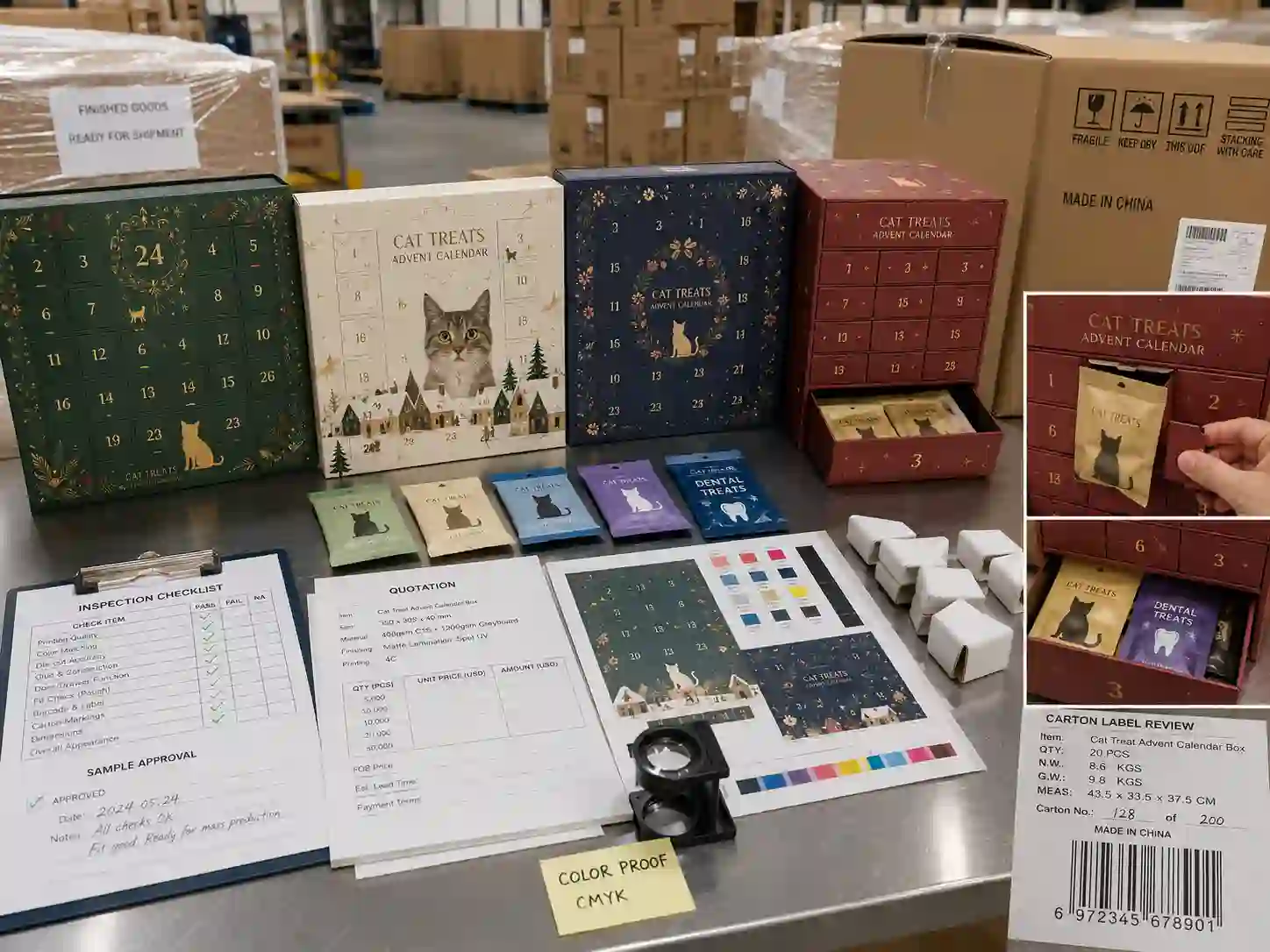
A practical QC checklist for mass production should include:
- Dieline version matches the approved sample
- Outer dimensions and compartment sizes meet tolerance requirements
- Paperboard or greyboard thickness matches the approved specification
- Printing color is checked against CMYK proof or Pantone reference
- Foil stamping, embossing, spot UV, matte lamination, or gloss lamination is correctly positioned
- Doors open cleanly without tearing neighboring panels
- Drawers slide smoothly if a drawer box structure is used
- Insert is fixed securely and aligned with numbered doors
- Cat treat pouches do not push doors open during handling
- Barcode label area and shipping marks are readable and correctly placed
- Export carton strength, quantity per carton, gross weight, and pallet plan are confirmed
QC tip: Random inspection should include packed units from different production times, not only early finished samples. Door tension, glue strength, and insert alignment can vary during long assembly runs if process control is weak.
If barcode placement is part of the retail or logistics plan, buyers may also need to follow official barcode requirements from organizations such as GS1 barcode standards. The barcode area should be reserved before artwork approval, not added after printing files are finalized.
How should export packing be planned for overseas shipments?
Export packing should be designed around box size, carton weight, stacking strength, shipping method, and warehouse handling. Cat treat advent calendar boxes often have large front panels, so corner protection and carton compression control are important.
For ocean shipment, the supplier should confirm export carton size, carton board strength, quantity per carton, gross weight, pallet dimensions, pallet height, pallet wrap, corner protectors, and shipping marks. For air shipment or courier shipment, dimensional weight can strongly affect freight cost, especially for rigid boxes and drawer structures.
Buyers should ask whether the calendars will be shipped flat, semi-assembled, or fully assembled. A folding carton may reduce shipping volume if packed flat, but a door-opening advent calendar with fixed inserts may need to be shipped assembled. The decision affects freight cost, assembly labor, and damage risk.
Factory tip: Do not approve export carton packing only by unit count. Ask for a carton packing photo or diagram showing box orientation, inner protection, carton label position, and pallet stacking direction.
What information should buyers prepare before requesting a quotation?
Buyers should prepare product dimensions, target structure, quantity, artwork status, insert requirements, sample expectations, delivery market, and packing requirements before asking for a quotation. The more complete the RFQ, the more accurate the price and lead time will be.
Before you request a custom quote, prepare the following details:
- Project name and target launch season
- Quantity or expected MOQ range
- Number of compartments, such as 12, 24, or 25
- Cat treat pack dimensions after filling, including thickness and weight
- Product format, such as sachet, pouch, dental treat pack, tin, jar, or mixed item
- Preferred structure: rigid box, folding carton, drawer box, or door-opening box
- Insert preference: paper insert, PET tray, EVA insert, foam, molded pulp, or supplier recommendation
- Artwork status: concept, dieline needed, print-ready file, or revised file
- Printing requirements: CMYK, Pantone, foil stamping, embossing, spot UV, matte lamination, or gloss lamination
- Sample requirement: blank prototype, printed sample, or pre-production sample
- Destination country and expected shipping method
- Export carton, pallet, barcode label, and shipping marks requirements
- Target delivery date and any retailer approval deadline
Buyers who are still comparing ideas can also use advent calendar box buying guides to review structure, insert, sampling, and production planning topics before finalizing the RFQ.
What common mistakes should buyers avoid?
The most common mistakes are approving artwork before product fit is tested, choosing a structure only by appearance, underestimating insert development, and comparing supplier prices without matching specifications. These mistakes can cause sample delays, poor opening function, higher freight cost, or mass production rework.
- Using flat pouch dimensions only: Always measure the filled cat treat pack, including seal areas and air volume.
- Ignoring door pressure: If the pouch presses against the door panel, the calendar may open poorly or bulge during shipment.
- Skipping insert samples: A beautiful outer box can fail if the insert does not hold products in position.
- Placing artwork too close to cuts: Numbers, claims, QR codes, and barcodes need safe distance from perforations and creases.
- Comparing only unit price: Check whether tooling, sample, finishing, assembly, QC, export carton, and pallet packing are included.
- Leaving shipping marks until the end: Carton labels, barcode areas, and retailer logistics requirements should be planned before packing.
Quotable B2B statement: The lowest quotation is not always the lowest landed cost if the box requires extra assembly, stronger cartons, urgent sample revisions, or replacement after transport damage.
FAQ: Buyer questions about cat treat advent calendar boxes
Can cat treat advent calendar boxes hold different pouch sizes?
Yes, but mixed pouch sizes require a carefully designed insert and loading map. Buyers should provide the filled dimensions and weight of every pouch type so the supplier can prevent movement, bulging, or incorrect compartment fit.
Are rigid boxes better than folding cartons for cat treat calendars?
Rigid boxes are better for premium presentation and stronger structure, while folding cartons are often better for cost-sensitive and higher-volume campaigns. The best choice depends on product weight, target retail price, freight budget, and brand positioning.
What sample should be approved before mass production?
At minimum, buyers should approve a structural sample with real filled products. For confirmed production, a printed pre-production sample is recommended to check color, finish, dieline accuracy, insert fit, and opening function before mass production begins.
Can Giftpackpro help design the dieline and insert?
Yes, Giftpackpro can support custom structure and insert development when buyers provide product dimensions, quantity, structure preference, and artwork requirements. Buyers can start by sharing product photos, pouch sizes, target compartment count, and reference packaging ideas.
How early should buyers start a seasonal cat treat calendar project?
Buyers should start early enough to allow structure planning, sampling, artwork revision, material preparation, production, QC, export packing, and international shipping. Projects with custom inserts, special finishing, or retailer approval steps need more development time than simple repeat orders.
How should buyers move from idea to sample or quotation?
To develop cat treat advent calendar boxes efficiently, buyers should treat the project as a packaging-engineering and purchasing process. Start with product fit, choose a realistic structure, confirm insert requirements, prepare artwork on the correct dieline, approve samples carefully, and compare quotations by full specification.
Giftpackpro works with overseas brands, wholesalers, gift companies, retail buyers, packaging distributors, and purchasing teams that need custom advent calendar boxes for seasonal programs. When you are ready to request a sample or quotation, prepare your cat treat pouch dimensions, compartment count, preferred structure, quantity, artwork status, insert preference, finishing requirements, destination country, and packing instructions. This allows the factory team to recommend a practical structure, estimate MOQ and lead time, and quote cat treat advent calendar boxes more accurately.