
Quick answer: Mini bottle advent calendar boxes are custom seasonal packaging systems designed to hold small glass bottles, beverage vials, tasting samples, fragrance miniatures, or liquid gift items in numbered compartments. For B2B buyers, the most important decisions are structure strength, insert accuracy, bottle protection, printing method, MOQ, sample approval, export packing, and quotation detail. A low unit price is not useful if the bottle fit is loose, the doors tear, the drawer jams, or the export carton fails under compression. Buyers should compare suppliers by dieline engineering, insert testing, material options, color proofing, QC process, lead time control, and packing reliability.
Mini bottle packaging is different from light candy or paper gift packaging because each bottle adds weight, impact risk, and leakage concern. A good calendar must look retail-ready while also surviving assembly, handling, warehouse stacking, and international shipping. This guide explains how overseas brands, wholesalers, retail buyers, gift companies, and procurement teams can plan mini bottle advent calendar boxes before requesting samples or quotations from a factory.
What should buyers confirm before choosing mini bottle advent calendar boxes?
Buyers should confirm bottle dimensions, filled weight, quantity per calendar, sales channel, packing method, artwork complexity, and target delivery date before choosing a structure. These details directly affect material thickness, insert design, labor cost, MOQ, sample timing, and export packing.
The most common mistake is asking for a quotation with only an outside box size or a reference photo. Mini bottles require a more technical RFQ because the factory needs to understand whether the product is glass, plastic, aluminum, sealed liquid, or sample vial. A 24-piece glass bottle calendar may need stronger greyboard, reinforced paperboard inserts, or a PET tray, while a 12-piece lightweight plastic vial calendar may work with a folding carton and paper insert.
Buyer tip: Send the factory the real bottle height, diameter, cap size, filled weight, and photo from multiple angles. If the bottle has a rounded shoulder, pump cap, dropper, spray head, or irregular label area, the insert opening should be tested with the real product, not only calculated from a drawing.
Which box structure is most suitable for mini bottle campaigns?
The best structure depends on bottle weight, retail display needs, opening experience, assembly labor, and budget. Rigid boxes are stronger and more premium, while folding cartons are usually more cost-efficient for lighter samples and higher-volume promotional programs.
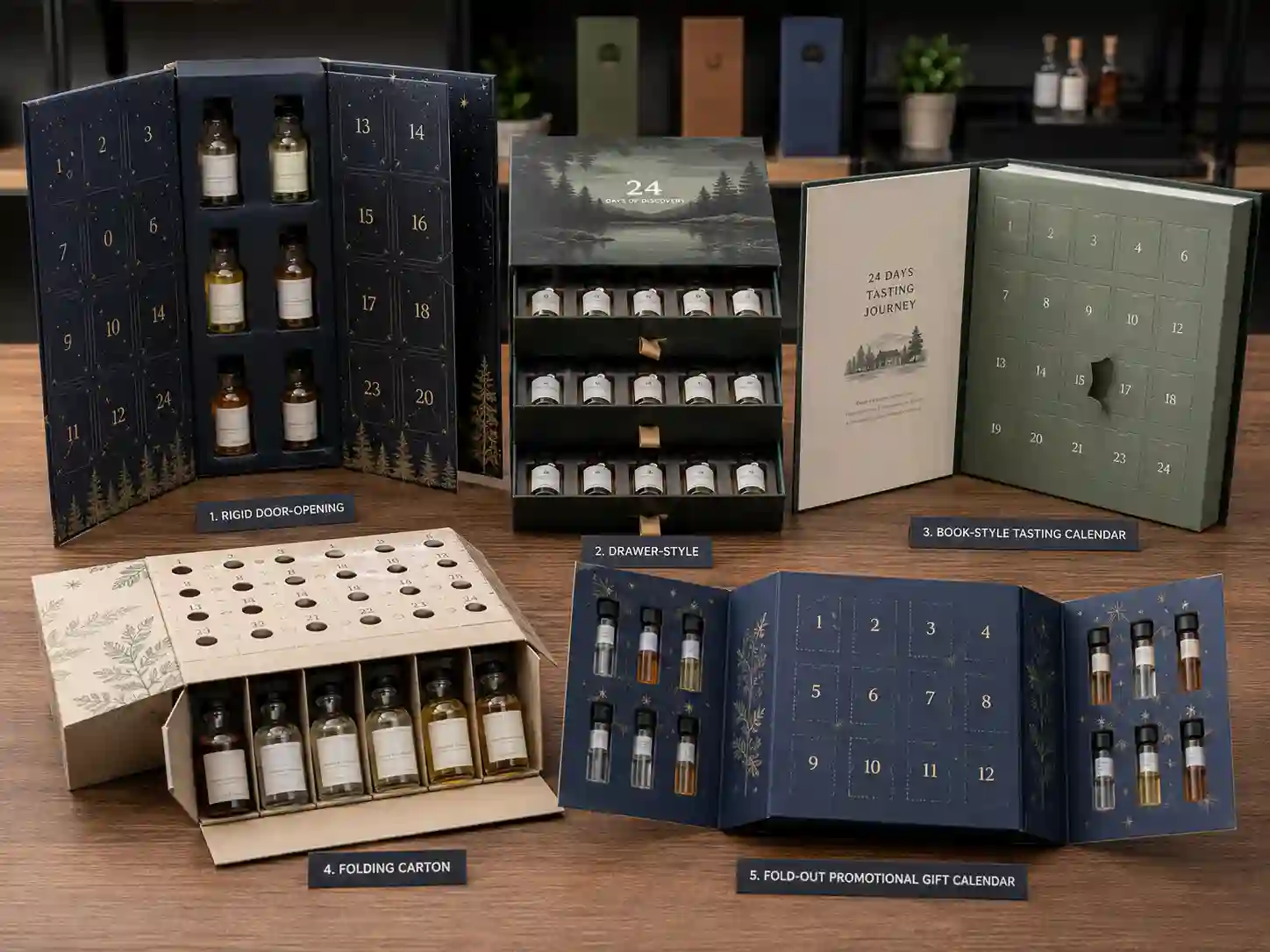
| Structure option | Best for | Cost impact | Buyer concern |
|---|---|---|---|
| Rigid door-opening box | Premium mini glass bottles, tasting sets, luxury gift campaigns, retail display | Higher material and labor cost because greyboard, wrapping paper, and assembly are required | Door perforation strength, bottle support, hinge durability, and carton compression |
| Drawer box | Heavy bottles, refill kits, sample collections, reusable gift packaging | Medium to high depending on drawer count, sleeve thickness, and insert design | Drawer sliding tolerance, insert movement, and outer sleeve strength |
| Book-style calendar | Brand storytelling, tasting guide inserts, premium retail shelves, influencer kits | Higher because of cover board, hinge area, magnetic closure options, and hand assembly | Spine strength, flat opening, magnetic alignment, and bottle balance |
| Folding carton calendar | Lightweight bottles, plastic vials, entry-level promotions, higher MOQ projects | Lower unit cost at scale because printing and die cutting are efficient | Paperboard stiffness, tearing around doors, and insert load capacity |
| Fold-out promotional calendar | Limited seasonal launches, brand display kits, mixed small samples | Varies by panel count, insert type, and manual assembly complexity | Panel stability, open-display footprint, and packing efficiency |
For heavy mini bottles, structure choice should start from load-bearing performance rather than only appearance. A door-opening rigid box may look attractive, but if the insert does not support the bottle from the base and side wall, the doors may bulge after assembly. A drawer box may be safer for heavier sets because the drawer base supports vertical weight more evenly.
Factory tip: For mini bottle advent calendar boxes, the inner structure is often more important than the outside artwork. The outside box creates shelf appeal, but the insert controls bottle protection, product alignment, assembly speed, and customer experience.
How do inserts affect price, protection, and MOQ?
Inserts affect both product safety and total cost because they control bottle fit, tooling, material usage, assembly time, and packing volume. Buyers should choose inserts based on bottle weight, fragility, sustainability requirements, visual presentation, and order quantity.
A paper insert is common for cost-controlled projects, especially when bottles are light and the calendar has a strong outer box. PET trays offer accurate cavities and clean presentation, but mold cost and plastic requirements should be considered. EVA and foam inserts provide strong cushioning for glass, but may not fit every sustainability policy. Molded pulp can support eco-oriented positioning, but buyers should confirm surface finish, tolerance, color, tooling time, and moisture control.
Which insert material should buyers compare?
Most buyers should compare paperboard insert, PET tray, EVA insert, foam insert, and molded pulp before confirming the sample. Each option changes the quotation, the sample method, and the final packing plan.
- Paper insert: Good for cost control, recyclable positioning, and simple compartments. It needs strong paperboard, accurate folding, and enough side-wall height for mini bottles.
- PET tray: Good for precise bottle cavities and clean retail presentation. Buyers should check tray thickness, cavity depth, anti-scratch handling, and tooling cost.
- EVA insert: Good for premium protection and heavier glass. It adds material cost and should be checked against buyer sustainability preferences.
- Foam insert: Useful for cushioning fragile bottles, but density, odor, compression recovery, and visual finish should be approved before mass production.
- Molded pulp insert: Good for paper-based packaging stories and shaped support. Buyers should review tooling, tolerance, edge smoothness, and drying consistency.
QC tip: Insert testing should include a loaded shake test, upside-down check, door-opening check, drawer movement check, and simulated carton stacking review. A bottle that looks secure on a table may still move during export handling.
What materials control strength and cost?
The main material decisions are outer paper, paperboard or greyboard thickness, insert material, lamination, and reinforcement method. Heavier bottles usually need stronger greyboard, thicker paperboard, reinforced insert walls, or added support under the bottle base.
Rigid box structures often use greyboard wrapped with printed paper. Folding cartons use paperboard such as white card, kraft card, or specialty paperboard depending on strength and finish requirements. For mini bottles, buyers should not reduce board thickness only to lower the unit price. Thin board can cause bowing, door tearing, drawer deformation, and poor shelf appearance after loading.
If the project needs responsible paper sourcing, buyers can ask the supplier what chain-of-custody documentation is available and verify requirements through official FSC resources. Do not assume a logo or statement can be printed without proper approval from the relevant certification system.
How do printing and finishing choices affect the quotation?
Printing and finishing affect the unit price, sample cost, production lead time, and QC risk. Simple CMYK printing with matte lamination is usually more cost-efficient, while Pantone colors, foil stamping, embossing, spot UV, metallic paper, and complex lamination increase setup and inspection requirements.
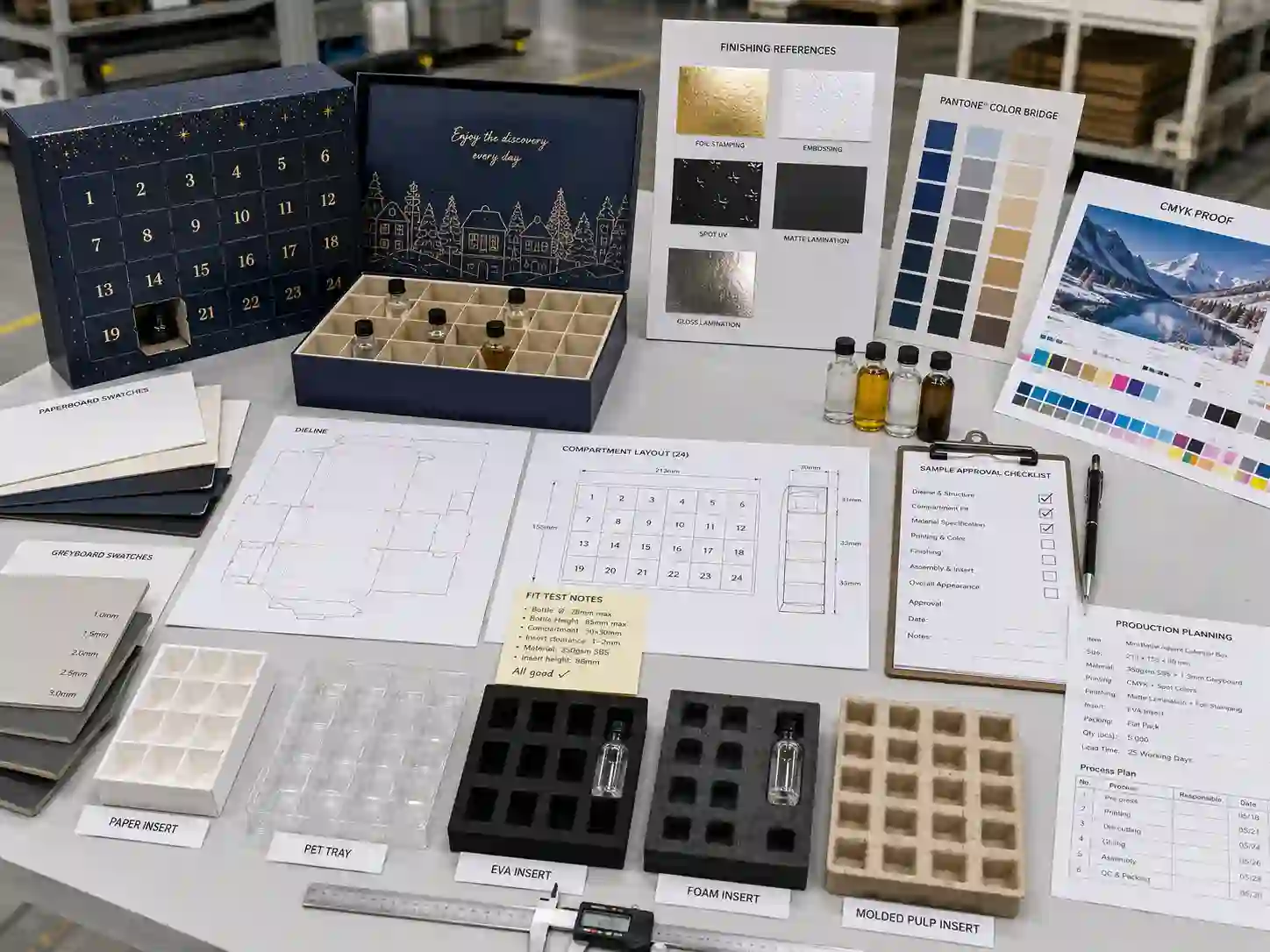
For seasonal packaging, artwork often includes numbered doors, product names, ingredient notes, barcode areas, warning statements, campaign messaging, and retailer requirements. Buyers should provide final artwork on the confirmed dieline. Changing artwork after the printed sample can delay production because the factory may need to remake plates, adjust die lines, revise color proofing, and recheck numbering positions.
What artwork details should be checked before sampling?
Buyers should check dieline size, bleed, safe area, door numbers, cut lines, crease lines, barcode position, color mode, Pantone references, and finish layers before the prototype stage. Incorrect artwork can create expensive revisions after sample approval.
- Confirm CMYK artwork and Pantone references separately.
- Mark foil stamping, embossing, debossing, and spot UV layers clearly.
- Keep text away from perforation lines, drawer edges, glue areas, and crease lines.
- Check whether matte lamination or gloss lamination changes the perceived color.
- Leave enough barcode and label space if the calendar will enter retail or e-commerce fulfillment.
- Make sure every numbered door matches the correct compartment layout.
Buyer tip: A printed sample should not only be judged by color. Buyers should open doors, remove bottles, reload bottles, slide drawers, inspect insert alignment, and check whether printed areas crack near folds or perforations.
What are the main cost drivers in mini bottle advent calendar boxes?
The main cost drivers are structure type, material thickness, insert material, bottle count, printing complexity, finishing process, manual assembly, sample requirements, packing method, MOQ, and export carton design. A clear quotation should separate the major cost factors so buyers can compare options fairly.
Mini bottle calendars often require more labor than flat paper packaging because inserts must be placed accurately, doors or drawers must work smoothly, and loaded fit checks may be needed. If the supplier also loads bottles or coordinates with a filler, the buyer should confirm whether the quotation includes product loading, sealing, labeling, master carton packing, palletizing, or only empty packaging production.
| Cost driver | Why it matters | Cost-control option |
|---|---|---|
| Box structure | Rigid boxes, drawers, and book-style structures need more material and manual work than simple folding cartons. | Use a folding carton or simplified drawer layout for budget-sensitive campaigns. |
| Insert design | Precise cavities, heavy bottle support, and multiple materials increase tooling or labor. | Standardize bottle size and use one insert material where possible. |
| Board thickness | Thicker greyboard or paperboard improves strength but increases material cost and shipping weight. | Test the minimum safe thickness instead of guessing from appearance. |
| Printing and finishing | Foil stamping, embossing, spot UV, and specialty paper add setup and QC steps. | Limit premium finishes to the front panel, logo area, or sleeve. |
| Manual assembly | Door boxes, drawer boxes, and fitted inserts may need hand assembly and inspection. | Reduce unnecessary parts and confirm whether flat packing is possible. |
| Export packing | Heavy loaded boxes need stronger export cartons, dividers, corner protectors, or pallets. | Design master cartons based on real loaded weight and shipping route. |
How should buyers think about MOQ and lead time?
MOQ depends on material sourcing, printing setup, die-cutting, insert tooling, finishing process, and factory scheduling. Buyers should treat MOQ as a manufacturing planning number, not only a sales rule.
Small trial orders may be possible for simple structures, but the unit price is usually higher because setup costs are spread across fewer pieces. Larger orders may reduce unit cost, but they require earlier artwork approval, more careful production scheduling, and stronger QC planning. For custom advent calendar boxes, seasonal deadlines are especially important because packaging must arrive before filling, retail listing, influencer seeding, or warehouse delivery.
Lead time usually includes quotation confirmation, dieline preparation, blank sample, artwork adjustment, printed sample, pre-production sample, material purchasing, mass production, final inspection, export packing, and shipping. Buyers should ask whether the quoted lead time starts from deposit payment, artwork approval, sample approval, or material arrival.
Factory tip: The safest seasonal projects approve structure and insert first, then artwork, then final production. Approving decoration before bottle fit is confirmed can lead to beautiful packaging that does not protect the product.
What sampling process reduces production risk?
The best sampling process starts with a structural prototype, continues with a printed sample, and ends with a pre-production sample before mass production. This process helps buyers confirm fit, strength, color, finishing, assembly tolerance, and export packing before paying for full production.
Recommended sample stages for mini bottle projects
- Blank structural sample: Confirms size, compartment layout, door or drawer function, insert support, and bottle fit.
- Printed sample: Confirms artwork position, CMYK or Pantone color, lamination, foil stamping, embossing, spot UV, and visual presentation.
- Loaded fit sample: Uses real bottles or accurate dummies to check weight, balance, insert strength, and opening experience.
- Pre-production sample: Confirms final materials, final artwork, final finishing, final insert, and packing method before mass production starts.
For mini bottle advent calendar boxes, sample approval should be documented with photos, measured dimensions, approved material references, and signed-off comments. If the buyer changes bottle size, cap height, insert layout, or artwork after sample approval, the quotation and lead time may need to be revised.
How can buyers compare suppliers fairly?
Buyers should compare suppliers by technical packaging ability, not only by the lowest unit price. A qualified supplier should ask about bottle weight, compartment layout, insert tolerance, material strength, artwork layers, sample approval, QC process, export carton strength, and shipping marks.
When comparing a custom advent calendar boxes manufacturer, ask whether the factory can support dieline creation, material selection, sample making, printing proofing, insert testing, production inspection, and export packing planning. For buyers who need structured support, Giftpackpro provides custom advent calendar box services for project planning from structure discussion to sample and quotation preparation.
Supplier comparison checklist
- Does the supplier understand heavy product support and glass protection?
- Can the supplier provide a dieline based on real bottle dimensions and layout requirements?
- Can the supplier produce blank samples, printed samples, and pre-production samples?
- Does the supplier explain material options such as paperboard, greyboard, PET tray, EVA insert, foam, and molded pulp?
- Can the supplier check door perforation, drawer movement, insert fit, and assembly tolerance?
- Does the supplier provide clear export carton specifications, carton label area, shipping marks, and pallet planning?
- Does the quotation clarify what is included and excluded?
Buyers can also review custom advent calendar box products to compare structure directions before asking for a sample. If factory capability matters to your sourcing decision, the Giftpackpro packaging factory page can help you understand the supplier background before starting RFQ discussion.
What QC checks matter most before export?
QC should check structure, insert fit, printing, finishing, assembly, loaded stability, carton compression, and shipping marks before goods leave the factory. For mini bottle packaging, the final inspection should include both appearance and functional protection.
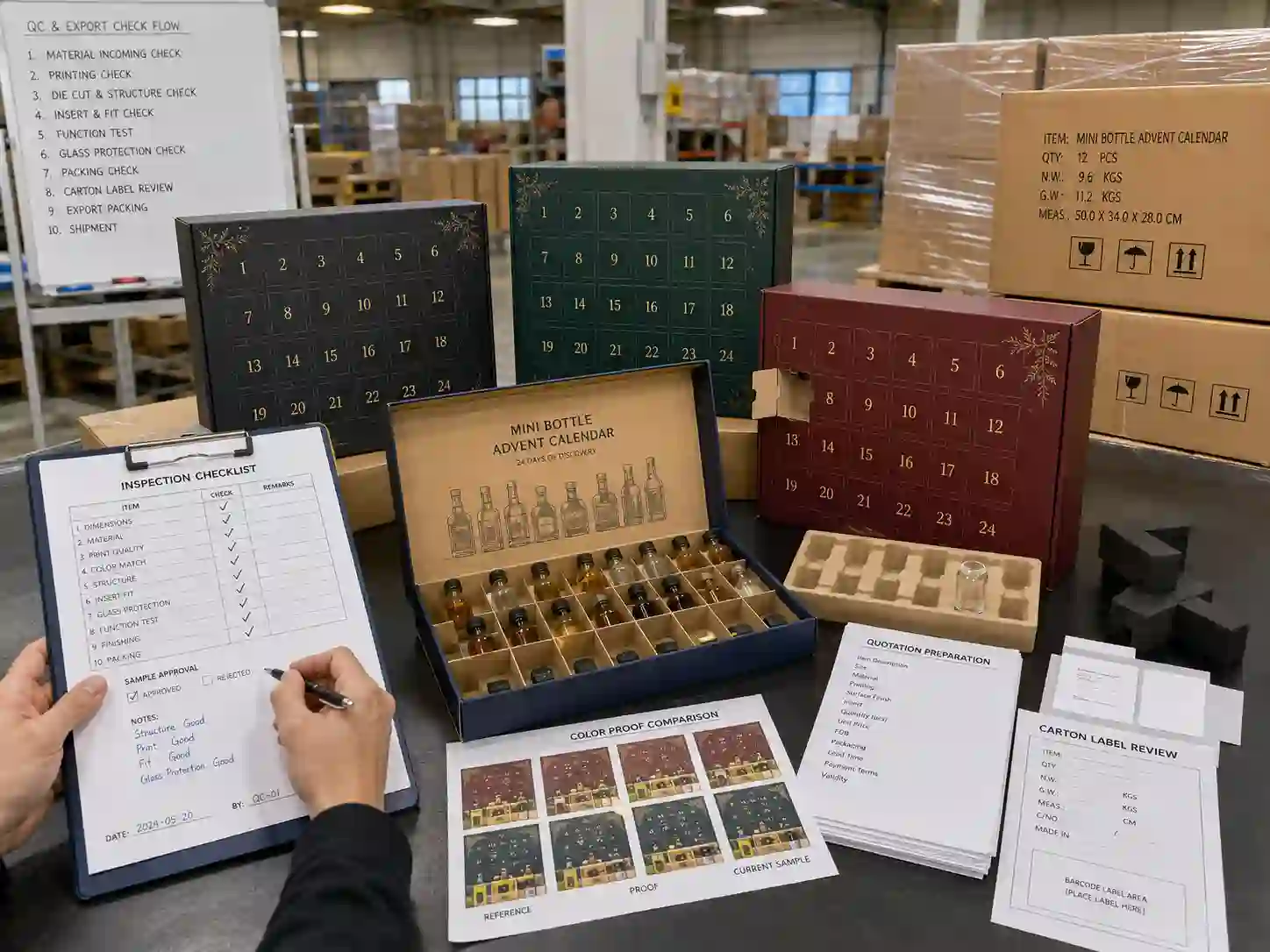
Because mini bottles are often glass or liquid-filled, buyers should not rely only on surface inspection. The calendar should be checked in loaded condition or with accurate weight simulation. Doors should open without tearing too easily. Drawers should slide without jamming. Inserts should hold the bottle in position during handling. Export cartons should be selected based on actual weight, stacking height, shipping route, and warehouse handling.
For distribution testing, buyers can discuss suitable test methods with their logistics team and review official information from ISTA. The exact test requirement should match the product, route, sales channel, and buyer compliance policy.
Practical QC checklist for mini bottle advent calendar boxes
- Confirm outside size, inner compartment size, and insert opening size against the approved sample.
- Check paperboard or greyboard thickness, wrapping quality, glue position, and edge finish.
- Open numbered doors and confirm that perforations work without tearing nearby artwork.
- Slide drawers several times to check friction, alignment, and sleeve deformation.
- Load real bottles or weight dummies to test insert strength and box balance.
- Check CMYK color, Pantone color, foil stamping, embossing, spot UV, matte lamination, and gloss lamination against approved proof.
- Inspect export carton thickness, gross weight, sealing method, shipping marks, barcode label area, and pallet plan.
- Take final inspection photos before shipment and keep them with the production record.
QC tip: A strong outer carton cannot fix a weak insert. If glass bottles move inside the advent calendar, the product can still be damaged even when the master carton looks undamaged.
Decision guide: which option fits your project?
Buyers can narrow the packaging choice by matching the product weight, budget, retail channel, and timeline. The right decision is usually the option that balances protection, cost, and production reliability.
| Buyer situation | Recommended direction | Reason |
|---|---|---|
| Premium glass mini bottles for retail shelf display | Rigid door-opening box or book-style box with reinforced insert | Stronger structure, better shelf presentation, and more premium unboxing experience |
| Heavy bottle set with repeated opening | Drawer box with sturdy base and fitted insert | Drawer base supports weight more evenly and can improve product access |
| Budget-sensitive high-volume promotion | Folding carton with paper insert or simple PET tray | Efficient printing, die cutting, and packing help control unit cost |
| Eco-oriented campaign | Paperboard structure with paper insert or molded pulp insert | Supports paper-based positioning, but tolerance and strength must be tested |
| Mixed bottle sizes or irregular caps | Custom insert with prototype testing before artwork approval | Different bottle shapes increase movement risk and require accurate cavity planning |
What information should buyers prepare before requesting a quotation?
Buyers should prepare product specifications, target structure, quantity, artwork requirements, insert preference, sample expectations, packing method, shipping destination, and deadline before requesting a quotation. A complete RFQ helps the factory quote faster and reduces later price changes.
Before contacting Giftpackpro, prepare the following:
- Bottle quantity per calendar, such as 12, 24, or 25 compartments.
- Each bottle size, cap size, filled weight, and material type.
- Preferred structure: rigid box, drawer box, door-opening box, book-style box, folding carton, or fold-out calendar.
- Preferred insert: paper insert, PET tray, EVA insert, foam, molded pulp, or open to factory recommendation.
- Target order quantity and expected MOQ flexibility.
- Artwork status: concept only, final artwork, dieline needed, or color proof required.
- Printing and finishing requirements: CMYK, Pantone, foil stamping, embossing, spot UV, matte lamination, gloss lamination, or specialty paper.
- Sample requirement: blank sample, printed sample, loaded fit sample, or pre-production sample.
- Export packing requirement: flat packed, assembled empty boxes, loaded product, master carton size limit, pallet requirement, shipping marks, or barcode label area.
- Destination country, delivery deadline, and whether the goods will go to retail warehouse, e-commerce fulfillment, distributor warehouse, or campaign event.
For more planning references, buyers can read additional advent calendar box buying guides. When your project details are ready, you can request a custom quote with bottle specifications, target quantity, artwork files, and delivery requirements.
Common mistakes buyers should avoid
Most production problems can be avoided by confirming structure, insert, artwork, sample, and export packing before mass production. Mini bottle projects become risky when buyers approve only the visual design and ignore weight, fit, tolerance, and carton handling.
- Choosing structure from appearance only: A beautiful box may fail if the board thickness and insert are not suitable for bottle weight.
- Using estimated bottle sizes: Cap height, shoulder shape, and filled weight can change the insert design.
- Skipping the blank sample: A printed sample is not the best first step if the structure has not been tested.
- Overusing premium finishes: Foil, embossing, spot UV, and specialty paper can raise cost and add QC complexity.
- Ignoring export carton strength: Heavy calendars need carton compression planning, pallet review, and shipping mark control.
- Comparing quotations without specifications: Two prices may not include the same board thickness, insert material, sample, packing method, or QC level.
FAQ: Mini bottle advent calendar boxes for B2B buyers
What is the best structure for mini bottle advent calendar boxes?
The best structure depends on bottle weight, quantity, and sales channel. Rigid door-opening boxes and drawer boxes are often better for heavier glass bottles, while folding cartons may be suitable for lightweight plastic vials or high-volume promotional campaigns.
Can mini bottle advent calendar boxes hold glass bottles safely?
Yes, but the structure and insert must be designed for glass protection. Buyers should test real bottle fit, insert strength, box balance, carton compression, and export packing before mass production.
Which insert is best for heavy mini bottles?
For heavy glass bottles, a reinforced paper insert, PET tray, EVA insert, foam insert, or molded pulp insert may be used depending on the budget and protection target. The safest choice should be confirmed through loaded sample testing.
Why does MOQ vary between suppliers?
MOQ varies because different structures, materials, printing processes, insert tooling, and assembly methods have different setup costs. A simple folding carton may have a different MOQ from a rigid drawer calendar with a custom PET tray and foil stamping.
How can buyers reduce the cost of mini bottle advent calendar boxes?
Buyers can reduce cost by simplifying the structure, using one bottle size, limiting premium finishing, choosing efficient insert materials, approving artwork early, and planning export packing correctly. Cost reduction should not remove the support needed for heavy bottles.
Should buyers approve a printed sample before mass production?
Yes. A printed sample helps confirm artwork, color, finishing, door numbering, and brand presentation. For mini bottle projects, buyers should also approve a loaded fit sample or pre-production sample to confirm protection and assembly tolerance.
What should be included in a clear quotation?
A clear quotation should include structure, size, material, insert type, printing, finishing, MOQ, sample cost, sample lead time, mass production lead time, packing method, export carton details, and whether loading, palletizing, or shipping marks are included.
Ready to plan your mini bottle advent calendar project?
Mini bottle advent calendar boxes require more than attractive printing. Buyers need a packaging plan that connects structure, insert strength, bottle protection, sample approval, MOQ, QC, export packing, and quotation details. Giftpackpro helps B2B buyers develop custom advent calendar packaging for seasonal campaigns, retail programs, and promotional gift sets. To start efficiently, prepare your bottle specifications, target quantity, preferred structure, artwork status, insert preference, and delivery deadline before you request a custom quote.


