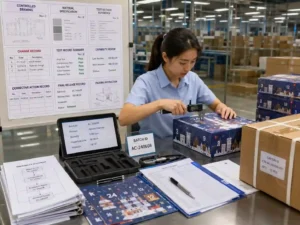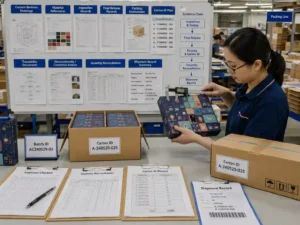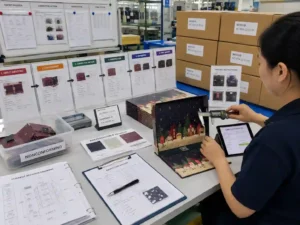
Quick answer: Kids advent calendar boxes should be planned around product safety, compartment fit, opening experience, print durability, MOQ, and export packing before artwork is finalized. For B2B buyers, the main cost drivers are box structure, material thickness, insert type, number of cavities, finishing process, manual assembly time, sample revisions, and carton packing method. A practical RFQ should include product dimensions, target quantity, box style, insert preference, artwork requirements, retail barcode area, export carton rules, and delivery schedule. The best supplier is not only the lowest quote, but the factory that can control dieline accuracy, insert tolerance, color proofing, QC, and shipping damage risk.
Kids gift campaigns often include mixed small items such as stationery, stickers, craft accessories, hair accessories, toy-like gifts, puzzles, novelty erasers, mini activity cards, and party favors. Because these items vary in shape, weight, fragility, and safety expectations, kids advent calendar boxes require more engineering review than a simple paper gift box. The buyer must check structure, inserts, printing, MOQ, labor, and packing as one connected project.
Giftpackpro works as a custom advent calendar boxes manufacturer for B2B seasonal packaging projects, including children’s gift calendars, toy-related gift sets, stationery calendars, activity calendars, and mixed-item promotional boxes. This guide focuses on how overseas buyers can compare options, control cost, and prepare a clear quotation request.
What should buyers confirm before choosing kids advent calendar boxes?
Buyers should confirm the product list, age-positioning requirements, retail channel, box opening method, quantity target, and deadline before choosing a structure. These decisions affect dieline design, material thickness, insert selection, artwork layout, sample timing, and final quotation.
A kids gift advent calendar is usually more complicated than a beauty or chocolate calendar because the product assortment may include rigid items, soft items, flat cards, small accessories, and irregular shapes in the same set. If the internal layout is not tested early, the printed sample may look attractive but fail during assembly, storage, e-commerce shipping, or retail display.
Buyer tip: Before requesting a price, divide the gift items into groups: flat items, thick items, fragile items, rolling items, and items with sharp corners. This makes insert planning faster and reduces sample revisions.
For B2B purchasing teams, the first decision is not “which design looks cute?” The first decision is whether the packaging can be produced consistently at the required quantity, packed safely for export, and delivered within the campaign schedule.
Which box structure is best for kids advent calendar boxes?
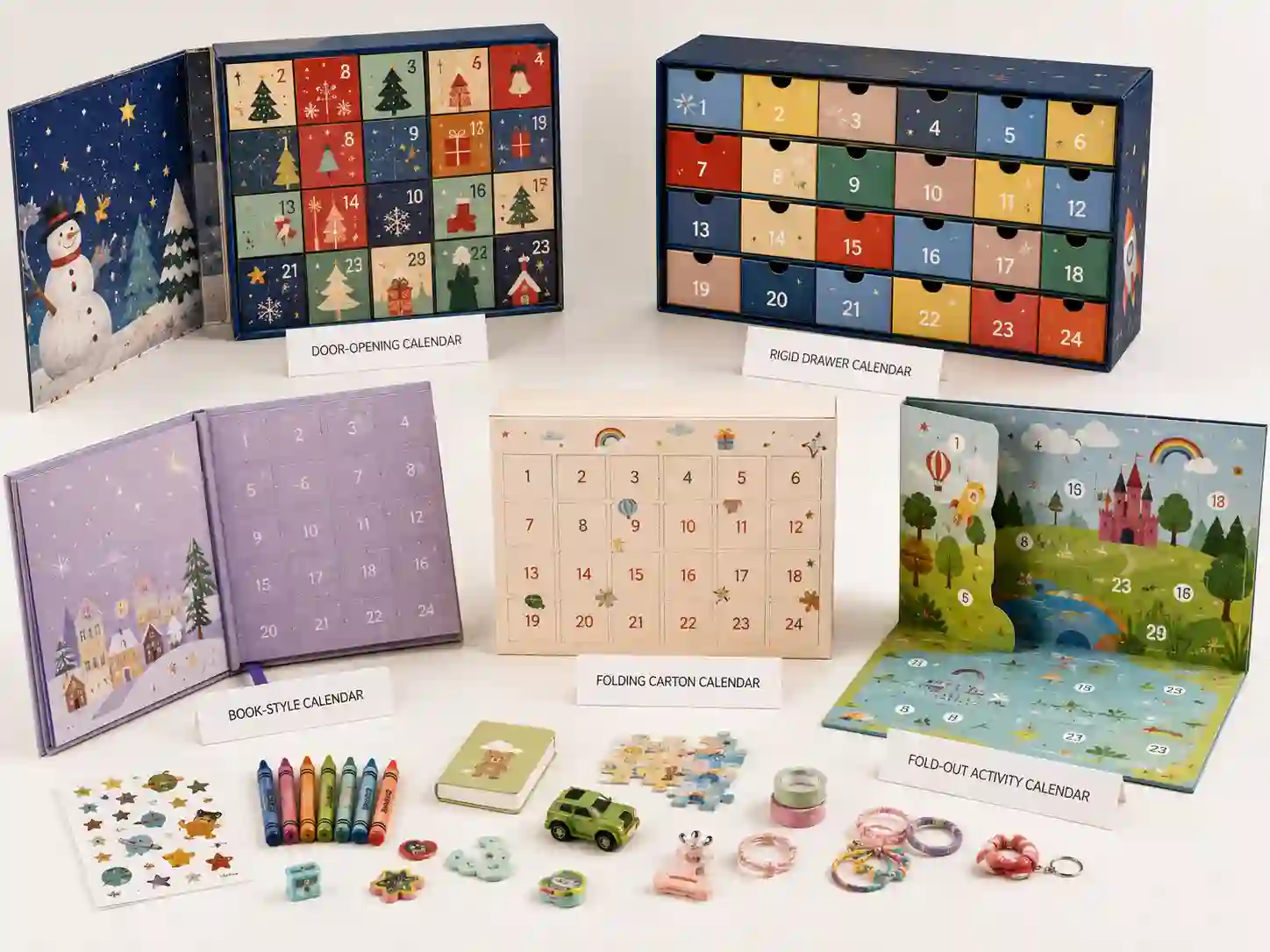
The best structure depends on product weight, display goal, MOQ, budget, and assembly tolerance. Door-opening boxes are common for classic countdown layouts, drawer boxes feel more premium, folding cartons reduce unit cost at higher quantities, and fold-out calendars can support activity-based children’s gift sets.
| Structure option | Best use case | Cost impact | Key engineering check |
|---|---|---|---|
| Door-opening advent calendar box | Light to medium kids gifts, stickers, stationery, craft pieces, small toy-like items | Moderate; cost rises with many doors, reinforced panels, and complex die-cutting | Door tear resistance, finger notch position, product visibility, and cavity alignment |
| Rigid drawer box | Premium gift sets, heavier mixed items, higher perceived retail value | Higher; greyboard, wrapping paper, drawer assembly, and manual labor add cost | Drawer sliding tolerance, sleeve strength, pull-tab durability, and insert locking |
| Book-style rigid calendar | Retail display, branded seasonal gift sets, storytelling layout without using licensed characters | Higher; magnetic closure, ribbon, hinge structure, and wrapping increase labor | Spine strength, hinge opening angle, magnet placement, and overall flatness |
| Folding carton calendar | Cost-sensitive campaigns, lightweight products, larger volume orders | Lower at scale; efficient printing and die-cutting, but less premium than rigid box | Paperboard stiffness, locking tabs, wall strength, and shipping compression |
| Fold-out activity calendar | Craft kits, educational sets, stationery programs, interactive retail promotions | Variable; depends on folding panels, insert complexity, and assembly method | Panel folding accuracy, product sequence, display stability, and user opening path |
A rigid box normally gives better protection and shelf presence, but it also increases material weight, labor time, shipping volume, and MOQ pressure. A folding carton may be suitable when the products are light and the campaign requires a competitive landed cost. A drawer box can be attractive for reusable gift packaging, but buyers should test drawer movement after the insert is loaded because a tight drawer may jam during retail handling.
Quotable B2B statement: The lowest-cost advent calendar structure is not always the lowest-risk structure; if the insert shifts, doors tear, or drawers jam, the campaign cost moves from packaging savings to replacement, repacking, and customer complaints.
How do inserts affect product fit, MOQ, and cost?
Inserts control product position, opening experience, and damage prevention, so they directly affect both unit cost and QC risk. For kids advent calendar boxes, the insert should be chosen after measuring every gift item, not after the outer box artwork is approved.
Common insert options include paper insert, PET tray, EVA insert, foam, and molded pulp. Each option has different tooling, MOQ, tolerance, appearance, and sustainability considerations. A paper insert may be cost-effective for flat stationery or light accessories. A PET tray can hold irregular objects neatly and is useful when visibility or molded cavities are needed. EVA and foam provide cushioning for mixed items but may increase material cost and sustainability review. Molded pulp can support eco-positioning and cushioning, but shape detail and tooling requirements should be checked early.
Which insert is most practical for mixed children’s gift items?
For mixed children’s gifts, a combined insert solution is often more reliable than one universal tray. A paperboard divider may hold flat items, while selected cavities can use PET, EVA, or foam for thicker or fragile items.
For example, a kids gift calendar containing crayons, stickers, mini puzzles, hair clips, and small craft accessories may need different cavity depths. If every cavity is made to the deepest product, the calendar becomes thicker and more expensive. If every cavity is made shallow, the larger items may press against the doors or deform the printed face panel.
Factory tip: Ask the supplier to build the insert layout from real product samples or accurate 3D dimensions. A product photo alone is not enough for cavity depth, finger access, or shake-test planning.
What materials should buyers compare for structure and cost control?
Buyers should compare paperboard, greyboard, wrapped paper, corrugated support, and insert material together because material choice affects strength, print effect, MOQ, assembly, and freight. Kids advent calendar boxes usually need a balance between attractive retail appearance and practical durability.
For a rigid box, greyboard thickness influences stiffness and perceived quality. A thicker board may improve structure but also increases cost, weight, and shipping volume. For folding cartons, paperboard grammage and fiber quality influence the ability to hold die-cut doors without tearing. For inserts, the material must match product weight, cavity detail, and assembly method.
If buyers require responsible paper sourcing, they can review official information from the FSC paper and packaging page and ask suppliers whether relevant material documentation is available for the selected paper. Buyers should verify documents instead of assuming that every paper option is certified.
How can buyers reduce cost without weakening the box?
Cost control should start with structure simplification, insert optimization, and finish selection rather than reducing material thickness blindly. A slightly simpler dieline with stable assembly can be cheaper and safer than a thin material that needs extra reinforcement later.
- Use one outer box size for several SKU assortments when possible.
- Group similar product sizes to reduce insert complexity.
- Limit unnecessary windows, ribbons, magnets, and specialty components.
- Use foil stamping or spot UV only on high-impact areas instead of the full front panel.
- Request tiered quotation quantities to understand the real MOQ breakpoints.
- Confirm whether the box ships flat, semi-assembled, or fully assembled.
Buyer tip: A lower unit price can be misleading if the packing method increases carton size, pallet volume, or local repacking labor after arrival.
How do printing and finishing choices change the quotation?
Printing and finishing choices change the quotation through plate setup, color proofing, production speed, defect risk, and manual handling. CMYK is common for full-color children’s artwork, while Pantone colors are useful when buyers need tighter brand color control.
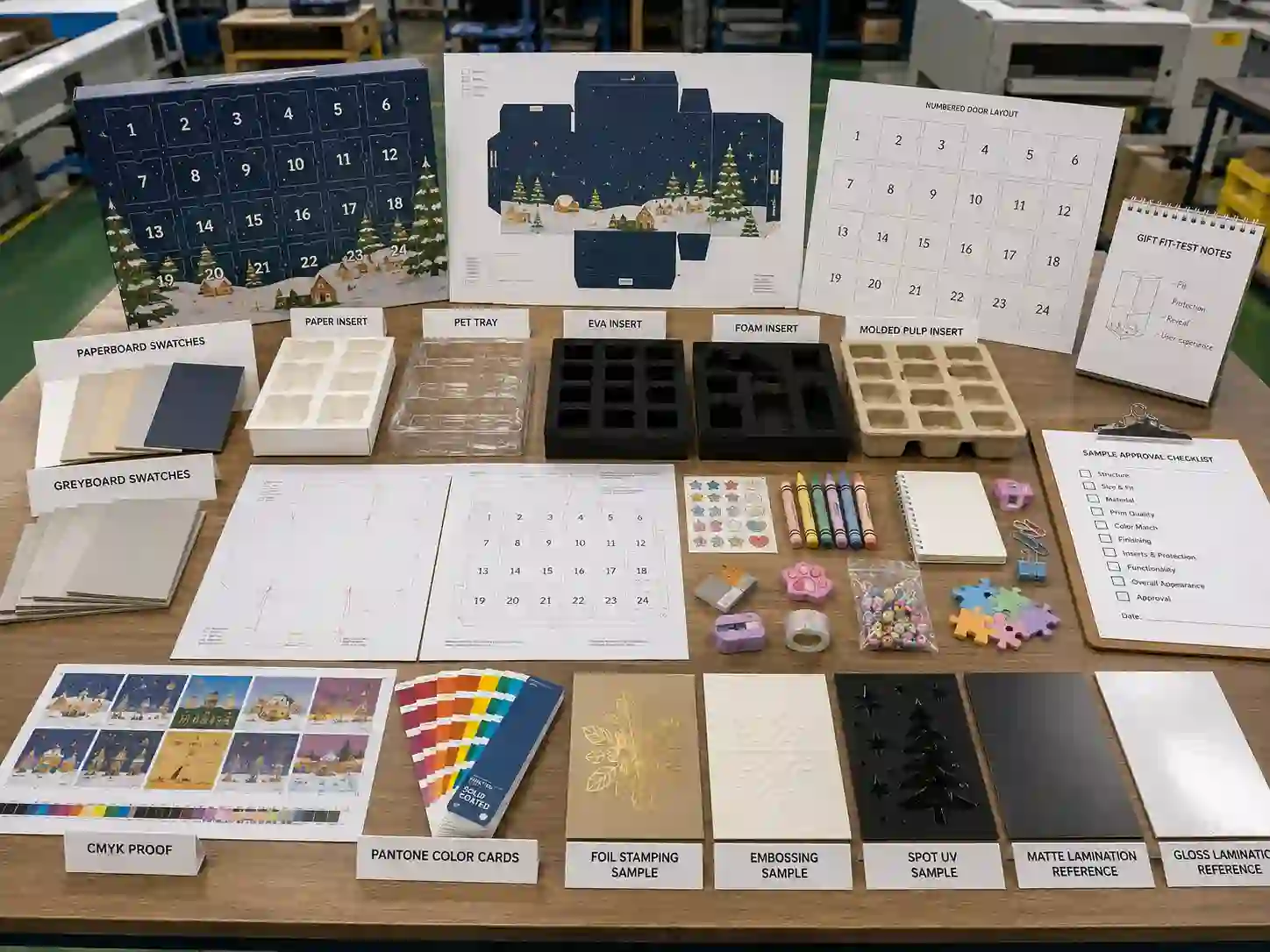
For kids advent calendar boxes, artwork usually includes numbered doors, playful patterns, product category icons, safety information, barcode area, recycling marks, and retailer-specific labeling zones. These details must be aligned with the dieline. If door numbers cross cutting or creasing lines, the final product may look inaccurate even if the print color is correct.
Common finishing options include matte lamination, gloss lamination, foil stamping, embossing, debossing, and spot UV. Matte lamination can create a soft retail look and protect printed surfaces. Gloss lamination can increase brightness but may show fingerprints or reflections. Foil stamping and embossing can create premium highlights but require accurate registration and add cost. Spot UV can emphasize icons, numbers, or brand elements, but it should not interfere with folding, creasing, or door-opening areas.
What artwork checks are critical before sample approval?
Buyers should check dieline position, bleed, safe area, door numbers, color values, barcode area, legal text, and finish layers before approving a printed sample. Any change after pre-production sample approval may affect cost, lead time, and mass production consistency.
- Confirm that all numbered doors open in the correct sequence and direction.
- Keep important text away from cut lines, crease lines, and perforation areas.
- Mark CMYK, Pantone, foil, embossing, spot UV, matte lamination, and gloss lamination layers clearly.
- Check whether small text remains readable after lamination and die-cutting.
- Reserve a clean barcode label area if retailers or warehouses require it.
- Use generic artwork for sample testing when final licensed artwork is not approved yet.
QC tip: For kids gift packaging, the printed face panel should be checked after door-opening tests, not only before. Some coating or lamination choices may crack near perforation lines if the design is not tested.
What MOQ and cost drivers should buyers expect?
MOQ depends on structure, material procurement, printing setup, insert tooling, finishing process, and assembly workload. Buyers should not ask only for one quantity; they should request tiered quotations so purchasing can compare unit price, setup cost, and total landed cost.
For custom advent calendar boxes, MOQ is not only a sales number. It is connected to the factory’s material purchasing, printing sheet efficiency, die-cutting setup, insert production, and assembly line planning. A small quantity with many cavities, foil stamping, custom PET tray, and rigid drawer structure may have a high unit cost because setup and labor are spread across fewer units.
Which cost items should appear in a professional quotation?
A useful quotation should separate the key cost assumptions, not just provide one unit price. Buyers should ask whether the quote includes sample cost, tooling, printing, finishing, insert, assembly, inner packing, export carton, pallet requirement, and shipping marks.
| Cost driver | Why it matters | Buyer control method |
|---|---|---|
| Box structure | Rigid drawer, book-style, door-opening, and folding carton boxes require different material and labor levels. | Compare at least two structures before locking the dieline. |
| Insert type | PET tray, EVA, foam, molded pulp, and paper insert have different tooling, MOQ, and assembly needs. | Send full product dimensions and ask for insert recommendations. |
| Printing and finishing | Pantone, foil stamping, embossing, spot UV, matte lamination, and gloss lamination add setup and QC steps. | Use premium finishes only where they improve retail value. |
| Manual assembly | Multiple drawers, partitions, ribbons, magnets, and complex compartments increase labor cost. | Ask whether the structure can be simplified without reducing the buyer experience. |
| Sample revisions | Extra prototype rounds add time and sometimes material or tooling cost. | Prepare complete product data before the first sample. |
| Export packing | Fully assembled boxes use more carton and pallet volume than flat-packed structures. | Compare packing methods and carton quantity per master carton. |
Quotable B2B statement: MOQ planning is a cost-engineering decision, not just a purchasing target; the most efficient quantity is the point where material setup, printing setup, insert production, and assembly labor become stable.
How should buyers compare suppliers for kids advent calendar projects?
Buyers should compare suppliers by engineering support, sampling accuracy, insert testing, printing control, QC process, export packing experience, and communication quality. A lower price is not enough if the supplier cannot explain the dieline, insert tolerance, sample approval process, or carton packing plan.
A reliable supplier should be able to review product dimensions, recommend box structures, explain material options, prepare blank and printed samples, check artwork against the dieline, and provide mass production inspection points. For overseas buyers, export packing experience is especially important because seasonal campaigns leave little time for replacement production.
When comparing the custom advent calendar box services available from different suppliers, ask whether the factory can support structure design, sample prototyping, insert testing, artwork checking, bulk production, final inspection, and shipment preparation. Buyers can also review custom advent calendar box products to compare drawer, door-opening, folding carton, rigid, and fold-out formats before submitting an RFQ.
Supplier comparison checklist
- Can the supplier create or adjust the dieline based on real product dimensions?
- Can they provide blank sample, digital proof, printed sample, or pre-production sample options?
- Do they check paperboard thickness, greyboard strength, insert fit, door opening, and drawer function?
- Can they explain the difference between paper insert, PET tray, EVA insert, foam, and molded pulp?
- Do they provide clear quotation assumptions instead of a vague unit price?
- Can they show how export cartons, pallet layout, shipping marks, and barcode label areas are handled?
- Do they communicate artwork risks before mass production?
- Can they support realistic lead time planning for seasonal campaigns?
For buyers who need a factory-side partner, the Giftpackpro packaging factory page can help explain production capability, while the advent calendar box buying guides section can support internal purchasing research before contacting a supplier.
What sampling process reduces mass production risk?
A good sampling process should move from structure confirmation to printed sample approval and then to pre-production sample control. For kids advent calendar boxes, the sample must prove not only appearance but also product fit, opening function, insert stability, and packing durability.
The first prototype may be a blank sample made from paperboard or greyboard to check size, structure, and opening function. A printed sample then confirms artwork, CMYK or Pantone color, lamination, foil stamping, embossing, and spot UV effects. A pre-production sample should match the final material, print, insert, assembly method, and packing requirement as closely as possible.
What should be tested on a kids gift calendar sample?
Buyers should test loaded weight, shake resistance, door opening, drawer movement, insert fit, product removal, surface durability, and carton packing. A sample that is only reviewed on a desk may miss problems that appear during warehouse handling or international transport.
- Load every compartment with real product or accurate dummy product.
- Open doors or drawers in sequence and record any tearing, jamming, or misalignment.
- Shake the loaded box gently to check product movement and cavity retention.
- Check whether any item presses against the printed front panel.
- Confirm that children’s gift items can be removed without damaging the insert.
- Review color proof under practical retail lighting, not only on a screen.
- Pack samples into export cartons and check compression risk.
Factory tip: Do not approve mass production from an empty printed shell. For kids advent calendar boxes, the loaded sample is the real packaging test.
How should QC and export packing be planned?
QC should cover material inspection, printing inspection, insert fit, assembly tolerance, function testing, carton packing, and shipping mark review. Export packing should be designed before mass production finishes, not after goods are already assembled.
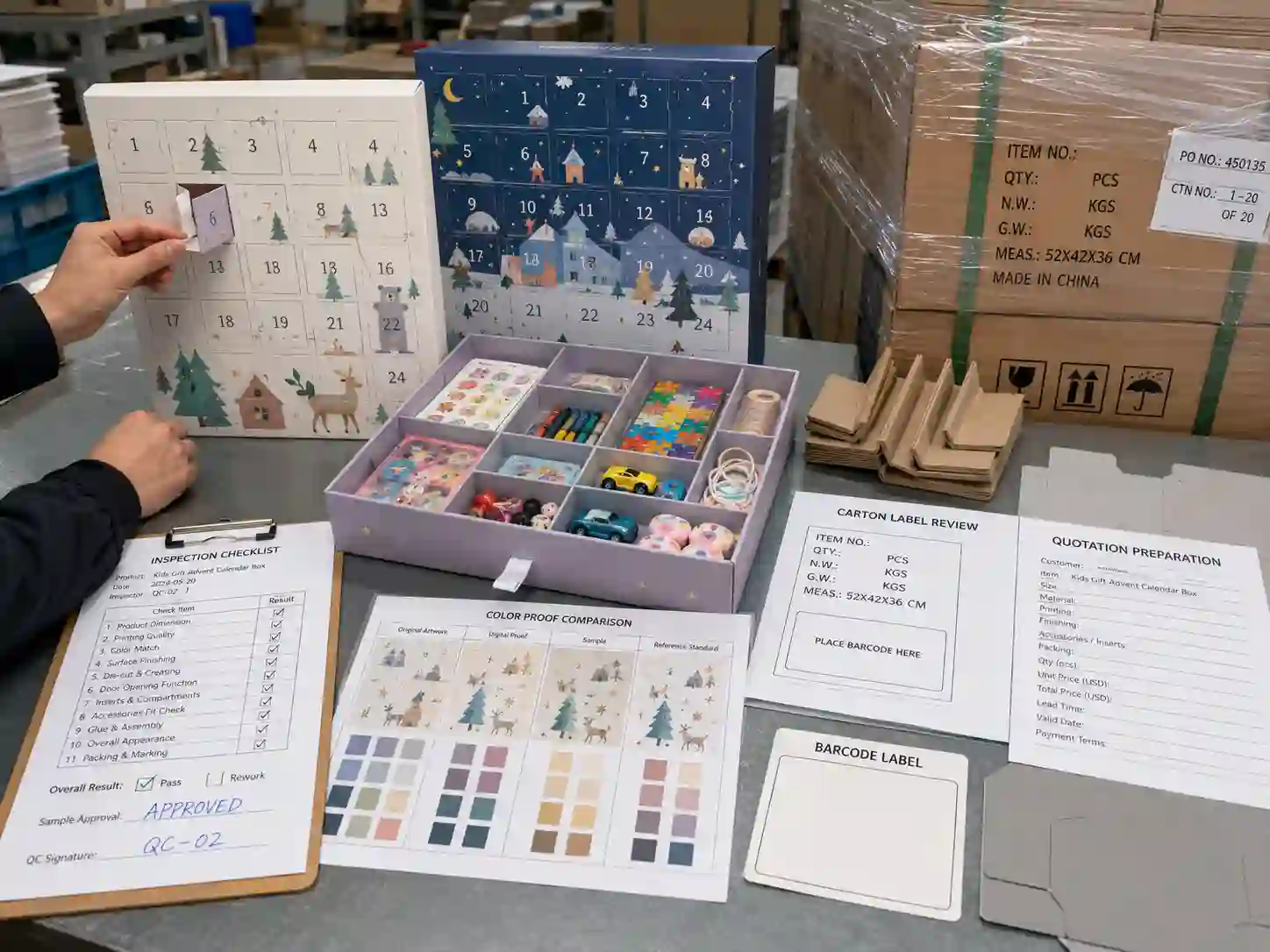
For kids gift calendars, common QC points include door perforation strength, drawer smoothness, glue position, magnet placement if used, lamination adhesion, color consistency, insert cavity alignment, product fit, barcode label area, and carton drop or compression concerns. Buyers should define acceptable tolerance levels for visible defects, color variation, glue marks, crushed corners, and functional issues.
For transportation planning, buyers can review testing concepts from the ISTA test procedures page and discuss with the supplier or logistics provider which test level is appropriate for the shipment route, product weight, and retail requirements. Not every project needs formal testing, but the packing method should be chosen with transport risk in mind.
What export packing details should appear before shipment?
Export packing details should include master carton size, quantity per carton, gross weight, net weight, carton material, corner protection, pallet plan, shipping marks, barcode label area, and whether boxes are flat-packed or assembled. These details influence freight cost, warehouse handling, and damage risk.
- Use stronger export cartons for assembled rigid boxes or heavier mixed-product calendars.
- Add corner protectors when premium retail boxes have sharp edges or wrapped paper surfaces.
- Confirm pallet height and wrapping method for warehouse and container loading.
- Keep shipping marks generic unless the buyer provides approved wording.
- Check whether retailer labels, Amazon labels, or warehouse barcodes need reserved flat areas.
- Request carton photos or packing records before final shipment release.
QC tip: Inspect the first packed master cartons before full packing continues. Carton packing errors are easier to correct at the start than after all goods are sealed and palletized.
Decision guide: how should buyers choose the right specification?
Buyers should choose the specification by matching product value, product weight, retail channel, order quantity, and campaign deadline. The right choice is the structure that protects the goods, supports the sales channel, and stays within MOQ and lead time limits.
| Buyer situation | Recommended direction | Reason |
|---|---|---|
| Budget-sensitive campaign with lightweight stationery gifts | Folding carton or simple door-opening paperboard calendar with paper insert | Controls material and freight cost while keeping the countdown format. |
| Premium kids gift set for retail shelves | Rigid door-opening or book-style calendar with selected premium finishing | Improves shelf presentation and perceived value, but needs stronger sampling control. |
| Mixed gifts with irregular shapes | Door-opening or drawer box with custom PET, EVA, foam, or mixed insert system | Improves product retention and reduces movement inside compartments. |
| E-commerce shipping focus | Compact structure, reinforced corners, practical export carton plan, limited fragile finishing | Reduces shipping damage and avoids oversized dimensional weight. |
| Short lead time seasonal launch | Use proven structure, simpler finish, and faster insert method | Reduces sampling revisions, tooling delay, and production uncertainty. |
If the project is still early, buyers can ask Giftpackpro to compare two or three specification routes rather than quoting only one design. This helps procurement teams understand how structure, insert, printing, and packing decisions affect the final landed cost.
What information should buyers prepare before requesting a quotation?
Buyers should prepare product dimensions, quantity targets, box style preference, insert requirements, artwork files, finish expectations, packing rules, and delivery schedule before requesting a quotation. A complete RFQ reduces guesswork and makes supplier comparisons more accurate.
RFQ preparation checklist for kids advent calendar boxes
- Target order quantity and requested price tiers, such as trial order and bulk order quantities.
- Product list with length, width, height, weight, and special handling notes for each item.
- Preferred structure: rigid box, folding carton, drawer box, door-opening box, book-style box, or fold-out calendar.
- Number of compartments and whether every compartment has a different size.
- Insert preference: paper insert, PET tray, EVA insert, foam, molded pulp, or supplier recommendation.
- Artwork file format, dieline status, CMYK or Pantone requirements, and finish layers.
- Surface finishing preference: matte lamination, gloss lamination, foil stamping, embossing, debossing, or spot UV.
- Sample requirement: blank prototype, printed sample, loaded sample, or pre-production sample.
- Retail requirements: barcode area, warning text area, recycling marks, label zone, and display orientation.
- Export packing requirements: carton size limit, pallet requirement, shipping marks, warehouse labels, and destination market.
- Target delivery date and whether the deadline is for factory shipment, warehouse arrival, or retail launch.
To start a project, buyers can request a custom quote with the above information. A clear RFQ helps the factory recommend a realistic structure, estimate MOQ, plan sampling, and reduce avoidable quotation changes.
What common mistakes should buyers avoid?
The most common mistakes are approving artwork before product fit is tested, choosing an insert based only on appearance, underestimating assembly labor, ignoring export carton volume, and comparing quotations with different assumptions. These mistakes can make a low initial price become expensive during production.
- Mistake 1: Sending only a reference photo. A photo cannot define cavity depth, insert tolerance, material thickness, or carton packing.
- Mistake 2: Approving the outer box before the insert. If the insert changes later, the box size, dieline, and cost may also change.
- Mistake 3: Adding too many finishes. Foil, embossing, spot UV, and specialty lamination can improve appearance, but they also add setup time and defect checkpoints.
- Mistake 4: Treating MOQ as fixed across all structures. MOQ changes when the project uses special material, custom tray tooling, rigid assembly, or complex finishing.
- Mistake 5: Ignoring packed carton volume. A beautiful assembled calendar can become expensive if it occupies too much shipping space.
- Mistake 6: Comparing incomplete quotes. One supplier may include sample, insert, assembly, and export carton, while another may quote only the printed box shell.
Buyer tip: When comparing suppliers, ask each factory to list what is included and excluded. This is the fastest way to identify hidden cost differences.
FAQ: kids advent calendar boxes for B2B purchasing
What is the best structure for kids advent calendar boxes?
The best structure depends on product weight, number of compartments, retail positioning, and budget. Door-opening boxes are practical for classic countdown layouts, drawer boxes are better for premium mixed gifts, and folding cartons are useful for lightweight, cost-sensitive campaigns.
How do inserts change the cost?
Inserts change cost through material, tooling, cavity complexity, assembly time, and tolerance control. Paper inserts are often cost-efficient for flat or light items, while PET tray, EVA insert, foam, and molded pulp may be better for irregular, fragile, or heavier products.
Can buyers reduce MOQ for a custom kids gift calendar?
MOQ may be reduced by using standard material, simpler structure, fewer special finishes, shared outer dimensions, or a paper insert instead of custom molded tooling. However, very low quantities usually increase unit cost because setup and labor are spread across fewer boxes.
Should buyers request a blank sample or printed sample?
Buyers should usually start with a blank sample when structure, size, or insert fit is uncertain. A printed sample is better after the dieline and product layout are stable, because it checks color, finishing, lamination, door numbering, and retail appearance.
What artwork files are needed for production?
Factories usually need editable artwork placed on the approved dieline, with bleed, safe areas, CMYK or Pantone values, finish layers, barcode area, and any required warning or recycling text clearly marked. Buyers should confirm file requirements before final artwork submission.
How can buyers compare two supplier quotations fairly?
Buyers should compare structure, material thickness, insert type, finishing, sample terms, MOQ, lead time, assembly method, export carton, packing quantity, and shipping mark support. A fair comparison requires the same specification, not only the same product name.
What QC checks are important before shipment?
Important QC checks include printing color, lamination adhesion, door opening, drawer function, insert alignment, product fit, glue quality, corner condition, carton packing, barcode label area, shipping marks, and pallet wrapping. Loaded sample testing is especially important for mixed kids gift items.
How should buyers move from idea to quotation?
Buyers should move from idea to quotation by preparing product details, choosing a target structure, confirming insert needs, defining print and finish expectations, and sharing MOQ and delivery requirements. For kids advent calendar boxes, the most useful quotation is based on real product-fit information and practical export packing assumptions.
Giftpackpro can support overseas buyers with structure discussion, dieline planning, sample review, insert testing, printing proof checks, bulk production, QC, and export packing for seasonal paper gift packaging. To prepare an accurate request, send the product list, target quantity, preferred box style, artwork status, insert expectations, finishing preference, packing rules, and delivery schedule through the request a custom quote page.
Well-planned kids advent calendar boxes are not only attractive retail packaging; they are engineered seasonal gift sets where structure, inserts, printing, MOQ, sampling, QC, and export packing work together before mass production begins.