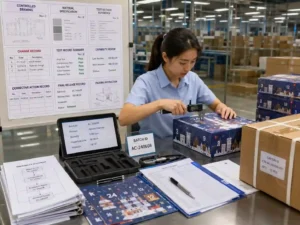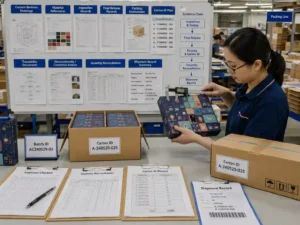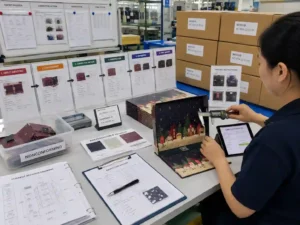
Quick answer: Stationery advent calendar boxes are custom paper packaging systems designed to hold pens, markers, stickers, clips, washi tapes, erasers, notebooks, stamps, rulers, craft tools, and other small stationery gifts in numbered compartments. For brands and purchasing teams, the most important decisions are structure, insert fit, artwork accuracy, sample approval, MOQ, QC, and export packing. A reliable supplier should help buyers test blank samples, printed samples, insert tolerance, door-opening function, drawer movement, barcode area, carton strength, and pre-production samples before mass production. Sampling is especially important because stationery items often vary in length, thickness, weight, and surface protection needs.
What should buyers understand before ordering stationery advent calendar boxes?
Buyers should understand that stationery advent calendar boxes are not only printed gift boxes; they are multi-compartment packaging projects that combine structure engineering, insert design, product loading, printing control, assembly tolerance, and export packing. A small mistake in compartment size, board thickness, or artwork position can affect the full seasonal campaign.
Stationery products create special packaging challenges because they may include long pens, thin sticker sheets, soft washi tapes, small erasers, metal clips, delicate paper tags, and uneven gift combinations. A box that works for stickers may not automatically work for markers or mini notebooks. Before choosing a structure, the buyer should confirm product dimensions, product sequence, retail display direction, opening style, weight distribution, carton packing method, and the target sample approval schedule.
For overseas brands, wholesalers, retail buyers, Amazon sellers, gift companies, and packaging distributors, the safest approach is to treat the project as a packaging development program rather than a simple print order. A custom advent calendar boxes manufacturer should review the product list, recommend structure options, prepare a dieline, test insert fit, and guide the buyer through blank sample, printed sample, pre-production sample, and final QC steps.
Which stationery products affect structure and insert design most?
The product mix determines the structure more than the artwork does. Pens, markers, rulers, sticky notes, stickers, tapes, stamps, craft accessories, and small paper goods each require different compartment depths, opening sizes, and insert support.
Long items such as pens, pencils, brushes, rulers, and craft tools often need horizontal compartments or drawer-style layouts. Flat items such as sticker sheets, memo pads, envelopes, and bookmarks need shallow compartments that prevent bending. Round items such as washi tapes, stampers, glue sticks, and mini correction tapes may need cavities that stop rolling during transport.
Buyer tip: Do not approve a stationery advent calendar box based only on the outer size. Ask the supplier to test the real product set, including the thickest pen, tallest tape roll, widest sticker sheet, and heaviest mixed compartment.
Which box structure is best for stationery advent calendar boxes?
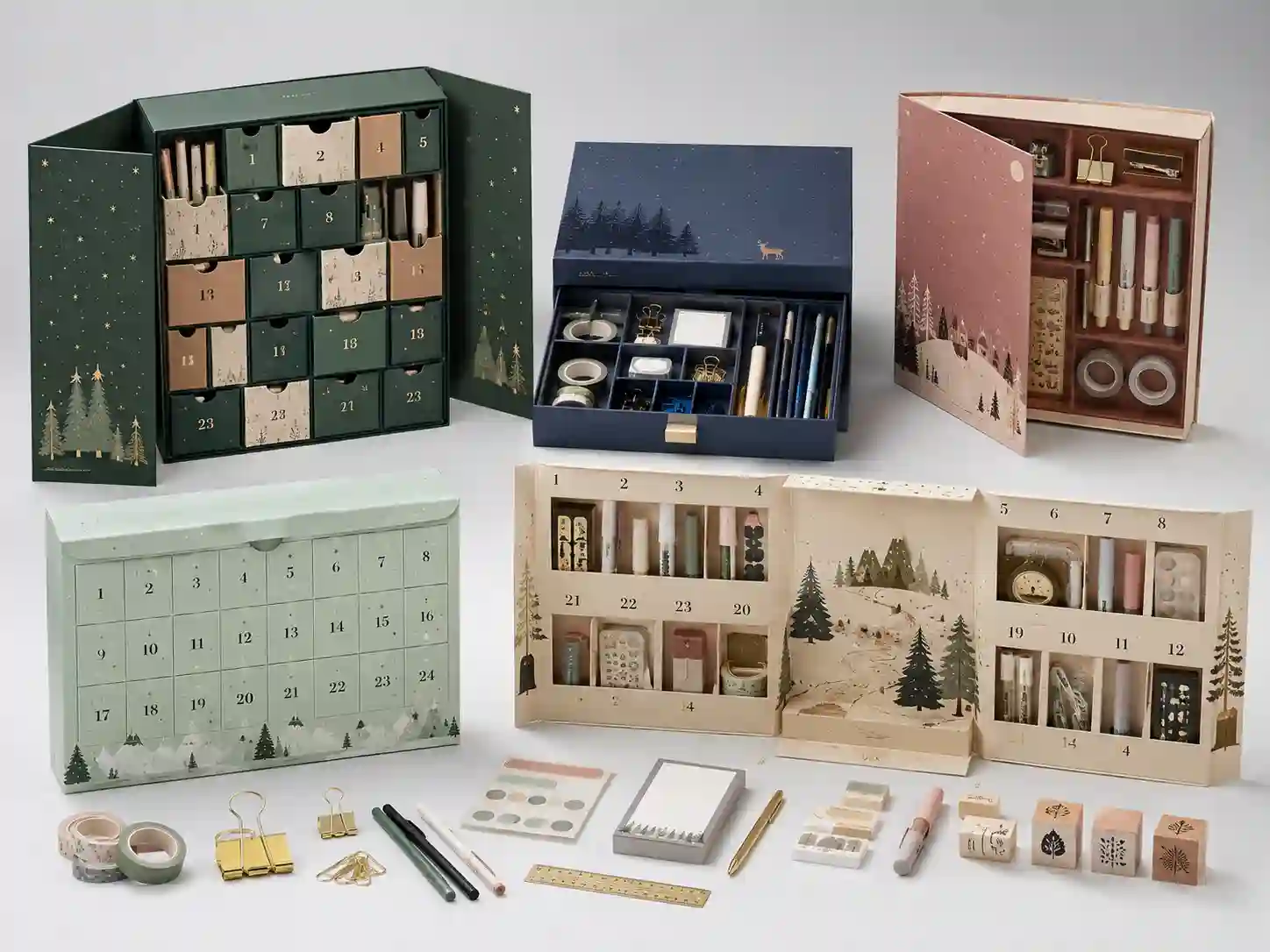
The best structure depends on product weight, retail positioning, assembly budget, and user opening experience. For stationery advent calendar boxes, common options include door-opening boxes, drawer boxes, book-style rigid boxes, folding carton calendars, and fold-out structures.
A door-opening box is useful when the buyer wants a familiar numbered panel layout and flat front display. It works well for stickers, erasers, clips, small tapes, and mixed craft accessories. However, the door perforation and opening window must be tested carefully so products do not fall out or block the door from opening.
A drawer box is better when the product mix includes pens, markers, pencils, thicker tapes, or heavier stationery kits. Drawers can protect longer products and create a premium unboxing experience, but they increase material use, assembly labor, packing volume, and sample testing time.
A book-style rigid box can support premium stationery sets with notebooks, writing tools, stickers, clips, and craft accessories. It is suitable for gift companies and retail buyers who need a stronger presentation box. A folding carton calendar is usually more cost-controlled and suitable for lighter product sets, but it requires careful board selection and insert engineering to avoid deformation.
| Structure option | Best for stationery items | Key sample check | Buyer consideration |
|---|---|---|---|
| Door-opening box | Stickers, erasers, clips, mini tapes, small accessories | Door tear line, product retention, front panel flatness | Good retail display, but compartment depth must be controlled |
| Drawer box | Pens, markers, rulers, craft tools, heavier mixed sets | Drawer sliding tolerance and pull-tab strength | Premium feel, higher assembly cost and larger shipping volume |
| Book-style rigid box | Premium stationery gift sets and multi-item campaigns | Hinge strength, insert positioning, magnetic or ribbon closure | Strong presentation, suitable for higher-value retail programs |
| Folding carton calendar | Lightweight paper goods, stickers, memo notes, small samples | Board stiffness, crease lines, compartment collapse risk | Cost-efficient, but not ideal for heavy or long stationery items |
| Fold-out calendar | Activity kits, craft sets, mixed stationery collections | Panel alignment, fold durability, product balance | Useful for display storytelling, needs accurate layout planning |
How should inserts be engineered for stationery product fit?
Inserts should hold each item in position during transport while allowing easy removal by the end user. For stationery advent calendar boxes, insert design must consider length, thickness, surface scratching, paper bending, rolling movement, and mixed product weight.
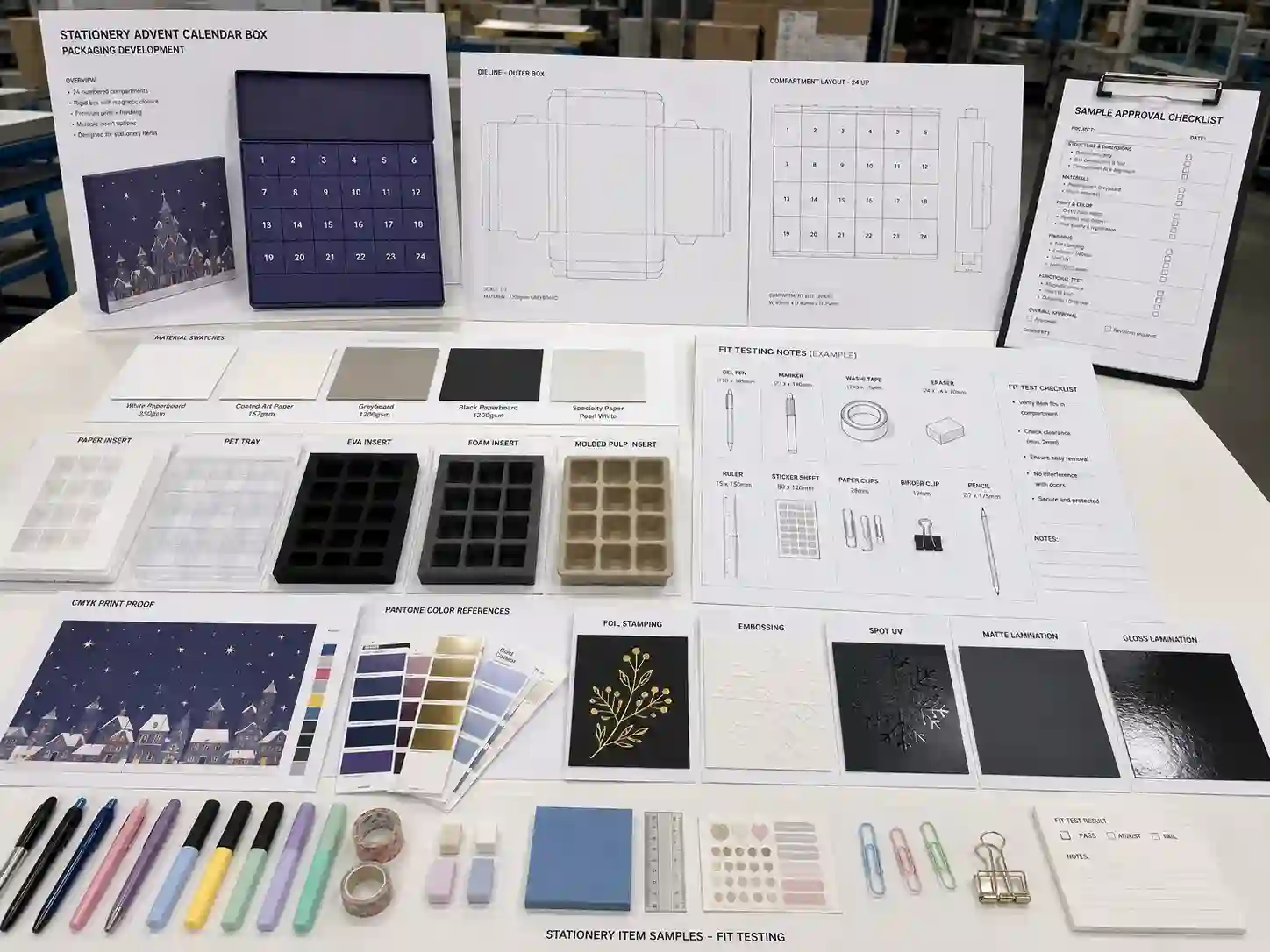
Paper inserts are commonly used for lightweight stationery items because they are printable, recyclable in many programs, and cost-efficient. They work well for stickers, memo pads, small envelopes, clips, and erasers. PET trays can provide clearer cavities and better shape retention for small tools, tapes, and accessories, but buyers should check local packaging and recycling expectations. EVA insert and foam insert options can protect premium pens, metal tools, or fragile craft accessories, but they may increase cost and may not fit every sustainability target. Molded pulp may suit certain eco-positioned gift sets, although cavity precision, surface texture, and minimum order conditions should be checked early.
Good insert sampling should test not only whether the item fits, but whether it stays in place after carton handling. For pens and markers, the insert should prevent side-to-side movement. For stickers and paper goods, the compartment should avoid bending edges. For washi tape and round stampers, the cavity should stop rotation and prevent pressure against the door panel.
Factory tip: When a stationery set contains both long and small products, the factory should create a compartment map before finalizing the dieline. This helps avoid one oversized box that wastes space or one tight layout that causes assembly problems.
What materials matter most for stationery advent calendar packaging?
The right material depends on product weight, structure, retail positioning, and export distance. Buyers should compare paperboard, greyboard, coated paper, specialty paper, insert material, and export carton strength as a full system.
Paperboard is often used for folding carton calendars and internal components. Greyboard is widely used for rigid box structures because it provides stronger shape support for drawer boxes and book-style boxes. Coated paper can be printed with CMYK or Pantone colors and mounted onto greyboard for premium rigid packaging. Specialty paper may create a textured or premium stationery feel, but it should be tested for print accuracy, lamination compatibility, foil stamping, and scuff resistance.
For brands with sustainability requirements, buyers can ask suppliers whether paper materials can be sourced with FSC-related documentation and then verify the claim through official channels such as FSC. The packaging supplier should not simply claim responsible sourcing without paperwork that the buyer can review.
How should artwork, printing, and finishing be checked before sampling?
Artwork should be checked against the dieline before a printed sample is made. The buyer should review door numbers, cutting lines, bleed, safe area, barcode space, product names, legal copy, color references, and finishing layers.
Stationery advent calendar boxes often use playful graphics, numbered doors, icons, product callouts, and retail shelf information. Because there are many small panels, artwork errors are common if the file is not carefully prepared. Door numbers can be too close to perforation lines, small text may sit on crease areas, or spot UV and foil stamping layers may shift if not separated properly in the artwork file.
CMYK printing is suitable for many full-color graphics. Pantone color matching is useful when a brand needs tighter control over signature colors. Matte lamination can reduce glare and create a soft stationery-style appearance. Gloss lamination can make colors more vivid, but fingerprints and reflections may be more visible. Foil stamping, embossing, and spot UV can highlight numbers, logos, or decorative areas, but each finish adds tooling, setup, and sample approval requirements.
What is the correct sampling process for stationery advent calendar boxes?
The correct sampling process usually moves from blank sample to printed sample to pre-production sample. Each sample stage answers a different buyer question and reduces risk before mass production.
A blank sample checks structure, size, opening method, insert fit, board strength, assembly feasibility, and product loading. It may use plain paper or unprinted board, so it is not the right stage for final color approval. For stationery items, the blank sample should be tested with real products or accurate dummy products that match weight and dimensions.
A printed sample checks artwork, color, surface finish, door numbers, brand presentation, and retail appearance. It helps buyers review CMYK, Pantone, foil stamping, embossing, spot UV, matte lamination, gloss lamination, and other finishing effects. However, a printed sample may still be handmade, so buyers should ask which parts may differ from machine mass production.
A pre-production sample is the final reference before bulk production. It should reflect approved materials, structure, insert, printing, finishing, assembly method, and packing direction as closely as possible. For a large seasonal order, the pre-production sample becomes the benchmark for factory QC and buyer approval.
| Sample stage | Main purpose | What buyers should approve | Common mistake |
|---|---|---|---|
| Blank sample | Verify structure and product fit | Size, compartment layout, insert tolerance, opening function | Approving structure without testing real stationery items |
| Printed sample | Review visual appearance | Color, artwork position, numbers, finishing, surface effect | Treating handmade sample color as an exact bulk guarantee |
| Pre-production sample | Confirm final mass production reference | Material, print, insert, assembly, packing method | Starting production before all revisions are signed off |
How should buyers review and approve samples?
Buyers should approve samples with a written checklist, not only by visual opinion. The approval record should include structure, size, product fit, artwork, material, finish, insert, carton packing, and revision status.
For stationery advent calendar boxes, the sample approval process should include a full product loading test. The buyer or factory should place each pen, sticker pack, tape roll, eraser, clip, ruler, or notebook into its assigned compartment. Then the sample should be opened, closed, tilted, gently shaken, and checked for interference with doors or drawers.
Buyers should also confirm how items are loaded during bulk assembly. Some stationery products may need a fixed direction so a printed pen barrel, sticker front, or tape design faces the correct way. If the assembly team does not have a clear loading guide, the final calendar may look inconsistent even when the box itself is correct.
Sample approval checklist for stationery advent calendar boxes
- Confirm outer box size, calendar thickness, and retail display direction.
- Check each compartment against the real product or approved dummy product.
- Test door-opening, drawer sliding, fold-out panel movement, or book-style hinge function.
- Review paperboard or greyboard thickness and whether the structure resists bending.
- Check insert material: paper insert, PET tray, EVA insert, foam, or molded pulp.
- Confirm dieline, bleed, safe area, numbering order, barcode area, and warning copy position.
- Review CMYK or Pantone color proof against the approved artwork file.
- Inspect foil stamping, embossing, spot UV, matte lamination, or gloss lamination placement.
- Check sample assembly tolerance, glue position, door tear strength, and drawer pull strength.
- Record all revisions in writing before approving the pre-production sample.
How do MOQ, lead time, and cost drivers change during sampling?
MOQ, lead time, and cost depend on structure complexity, material selection, printing method, finishing, insert tooling, assembly labor, and export packing. Sampling helps buyers identify cost drivers before they become bulk production problems.
Rigid box calendars usually require more manual assembly and stronger greyboard, so they often cost more than folding carton calendars. Drawer boxes may need separate drawer units, sleeves, pull tabs, and insertion labor. Door-opening boxes may require accurate die-cutting, perforation control, and product-retention testing. PET trays, EVA inserts, foam inserts, and molded pulp inserts may require tooling or mold preparation, which affects sample cost and lead time.
Finishing choices also affect cost. Foil stamping may require a stamping die. Embossing may require tooling and accurate pressure control. Spot UV requires a separate finishing layer. Matte lamination and gloss lamination affect both appearance and surface protection. If the buyer is comparing quotations, each supplier should quote the same structure, size, board thickness, insert material, printing specification, finishing process, sample requirement, packing method, and quantity.
Quotable B2B statement: For custom stationery advent calendar boxes, the cheapest unit price is not always the lowest project cost; poor sampling can cause artwork revisions, insert rework, delayed launch dates, and higher replacement risk.
How should buyers compare stationery advent calendar box suppliers?
Buyers should compare suppliers based on development ability, sample accuracy, communication, production control, QC process, export packing experience, and quotation transparency. A low price without sample control is risky for seasonal packaging.
A capable supplier should ask for product dimensions, product weights, artwork files, desired structure, insert preference, order quantity, target delivery date, and destination market. The supplier should also explain which items are included in the quotation and which items require separate tooling, sample, finishing, packing, or freight costs.
When reviewing custom advent calendar box services, buyers should check whether the supplier can support dieline creation, blank sample development, printed sample review, material sourcing, insert engineering, production planning, final inspection, and export packing. Buyers can also review custom advent calendar box products to compare structure styles before sending an RFQ.
Supplier decision guide for buyers
| Buyer question | Better supplier response | Risky supplier response |
|---|---|---|
| Can you make a sample with our real stationery products? | Requests product dimensions, weights, and product loading sequence | Quotes only from outer box size |
| How will you control insert fit? | Prepares compartment layout and tests tolerance before production | Uses one generic insert for all items |
| How do you handle artwork revisions? | Checks dieline, bleed, color, finishing layers, and approval records | Starts printing before written approval |
| What QC points are checked? | Checks material, printing, assembly, insert fit, function, and packing | Only checks final appearance |
| What is included in the quotation? | Separates sample, tooling, unit price, packing, and shipping assumptions | Gives one unclear price without specifications |
What QC checks are needed before mass production and shipment?
QC should start before mass production and continue through printing, die-cutting, assembly, product loading, carton packing, and shipment preparation. For stationery advent calendar boxes, functional checks are as important as visual checks.
Before mass production, the factory should confirm the approved pre-production sample, signed artwork file, material specification, insert drawing, packing instruction, and acceptable tolerance. During production, QC should check paper color, board thickness, printing registration, lamination quality, die-cut position, glue strength, door opening, drawer sliding, insert placement, and product loading accuracy.
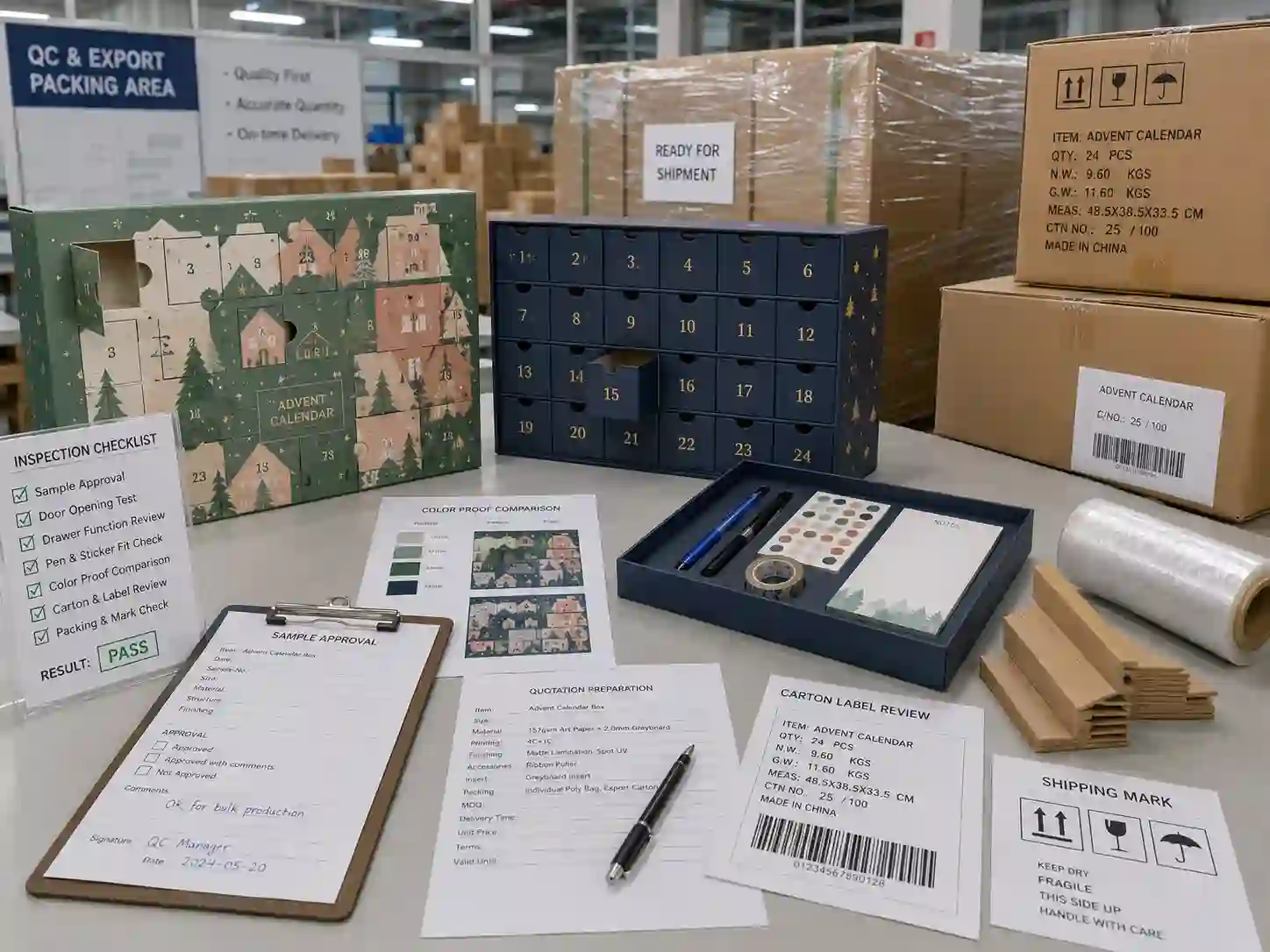
Final inspection should include random box opening tests, compartment checks, barcode position, carton label review, shipping marks, master carton condition, and pallet packing if required. If the product will be sold through retail or e-commerce channels, buyers should also confirm barcode requirements through official sources such as GS1 barcode standards and provide correct barcode artwork before printing.
QC tip: A stationery calendar can pass a visual inspection but still fail in use if a pen blocks a door, a sticker sheet bends inside a shallow cavity, or a drawer is too tight after lamination and assembly.
How should export packing be planned for stationery advent calendar boxes?
Export packing should protect the finished calendar structure, prevent corner crushing, control moisture risk, and make carton handling clear for warehouse teams. The right export packing method depends on whether the calendars are shipped flat, semi-assembled, fully assembled, or pre-loaded with stationery products.
Fully assembled stationery advent calendar boxes need stronger master cartons, correct carton orientation, and enough protection around corners and edges. Drawer boxes and rigid boxes may need individual polybags, tissue wrapping, corner protectors, or inner cartons depending on surface finish and buyer requirements. Folding carton calendars may be more space-efficient, but they still need protection from bending and compression.
Shipping marks should be generic and accurate, including item number, carton number, quantity, gross weight, net weight, carton size, and destination details if required by the buyer. For Amazon, retail warehouse, or distributor delivery, carton label requirements should be confirmed before mass packing. Pallet packing, pallet wrap, and carton stacking direction should be discussed early when the order is large or when the destination warehouse has strict receiving rules.
What information should buyers prepare before requesting a quotation?
Buyers should prepare product details, structure preference, artwork status, quantity, target market, sample requirement, packing method, and timeline before asking for a quotation. The more complete the RFQ, the more accurate the sample plan and price comparison will be.
For Giftpackpro, buyers can share a product list and request support from the Giftpackpro packaging factory to evaluate structure, insert, sampling, and packing options. Buyers who are still comparing concepts can review advent calendar box buying guides before preparing the RFQ.
RFQ preparation checklist
- Product list with quantity per calendar and number of compartments.
- Product dimensions and weights for pens, stickers, tapes, clips, notebooks, tools, and other stationery items.
- Preferred structure: rigid box, folding carton, drawer box, door-opening box, book-style box, or fold-out calendar.
- Insert preference: paper insert, PET tray, EVA insert, foam, molded pulp, or supplier recommendation.
- Outer size target or retail shelf size limitation.
- Artwork file status, dieline requirement, CMYK or Pantone color needs, and finishing expectations.
- Required sample type: blank sample, printed sample, or pre-production sample.
- Estimated order quantity, target MOQ, and expected repeat order plan.
- Export packing preference: flat packed, assembled, product-loaded, master carton, or palletized.
- Destination country, delivery deadline, and warehouse labeling requirements.
What mistakes should buyers avoid?
The most common mistakes are approving artwork before the dieline is final, choosing inserts before product dimensions are confirmed, skipping a blank sample, and comparing quotations with different specifications. These mistakes can create hidden costs and production delays.
Buyers should avoid using estimated product sizes when real stationery items are available. They should not assume all pens, tapes, or sticker packs will fit into standard compartments. They should also avoid requesting too many premium finishes before confirming the budget, MOQ, and sample timeline. If the project has a fixed launch date, the buyer should approve the sample schedule early and leave time for revisions.
Another common issue is unclear packing responsibility. Some projects require only empty packaging, while others require product loading, set assembly, barcode labeling, carton labeling, and pallet packing. These should be clarified in the quotation, not after production starts.
FAQ: Stationery advent calendar boxes for B2B buyers
Can one stationery advent calendar box hold both pens and stickers?
Yes, but the insert layout should separate long, flat, round, and small items. Pens may need horizontal cavities, while stickers need shallow compartments that prevent bending. A blank sample should be tested before printed sampling.
Do I need a blank sample before a printed sample?
For most custom stationery advent calendar boxes, yes. A blank sample helps verify structure, insert fit, door opening, drawer movement, and product loading before spending time and cost on printed graphics and finishing.
What is a pre-production sample?
A pre-production sample is the final approved sample used as the production benchmark. It should match the confirmed material, print, finish, insert, assembly method, and packing plan as closely as possible.
Which insert is best for stationery products?
There is no single best insert for every stationery set. Paper inserts are common for lightweight items, PET trays can hold shaped items clearly, EVA or foam can protect premium tools, and molded pulp can support some sustainability-focused projects.
How can buyers control cost without weakening the box?
Buyers can simplify structure, reduce unnecessary finishing, use paper inserts where suitable, optimize compartment layout, confirm MOQ early, and avoid repeated artwork changes after sampling. Cost control should not remove necessary insert support or export protection.
What artwork files should buyers provide?
Buyers should provide editable artwork based on the approved dieline, with bleed, safe areas, CMYK or Pantone references, finishing layers, barcode area, and any required warning or retail information clearly marked.
How can Giftpackpro support sampling and quotation planning?
Giftpackpro can help buyers develop stationery advent calendar boxes from product-fit review through sampling, pre-production checks, QC, and export packing. The best starting point is a clear product list, size information, quantity target, artwork status, sample expectation, and delivery timeline.
For brands, wholesalers, retail buyers, e-commerce sellers, gift companies, and packaging purchasing teams, a structured sampling process reduces risk before mass production. To start a project, prepare your stationery product list, preferred calendar style, insert expectations, artwork files, target MOQ, and shipping requirements, then request a custom quote.