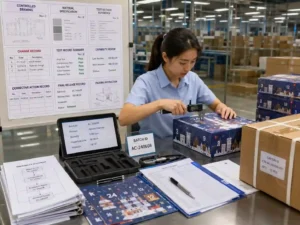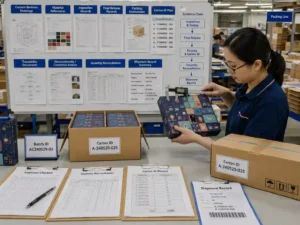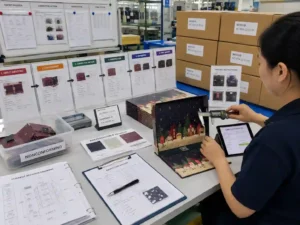
Quick answer: To design stationery advent calendar boxes for seasonal campaigns, buyers should confirm the stationery product mix first, then match each item to the right box structure, insert material, artwork method, sample process, QC checklist, and export-packing plan. Pens, markers, stickers, washi tapes, clips, memo pads, erasers, rulers, stamps, and craft accessories all create different compartment, weight, and movement-control requirements. A reliable factory should help you check dielines, insert fit, printing accuracy, assembly tolerance, durability, barcode space, carton strength, and quotation details before mass production starts.
Stationery advent calendar boxes are not only decorative retail packaging. For brands, wholesalers, e-commerce sellers, and purchasing teams, they are engineered multi-compartment packaging systems that must protect many small products, display well, assemble efficiently, and survive international shipping. This guide explains how to plan a seasonal stationery calendar from a factory-side production and quality-control perspective.
Giftpackpro works as a custom advent calendar boxes manufacturer for overseas buyers who need practical support on structure, inserts, samples, MOQ planning, printing, bulk production, inspection, and export packing. Use the sections below as a purchasing checklist before sending an RFQ or approving a pre-production sample.
What should buyers decide before designing stationery advent calendar boxes?
Buyers should decide the product list, campaign channel, target retail position, box structure, insert style, artwork requirements, sample approval method, and shipping method before design work begins. These choices affect dieline size, material strength, labor cost, MOQ, lead time, carton packing, and final quality-control standards.
A stationery advent calendar may include many SKUs with different shapes and weights. For example, a slim gel pen needs length control, stickers need flatness protection, washi tape needs circular cavity support, and memo pads need enough depth so the door or drawer can close without pressure. When these items are planned after artwork is finished, buyers often face rework, enlarged box size, delayed samples, or higher unit cost.
Buyer tip: Treat the calendar as a production project, not only a graphic design project. The best-looking artwork cannot fix an insert that allows pens to slide, paper corners to bend, or stickers to curl during shipping.
Prepare the stationery product map first
Create a product map showing each day number, product name, product dimensions, product weight, packaging status, and special protection requirement. If the calendar includes mixed stationery items, separate them into slim products, flat products, round products, fragile accessories, and grouped craft kits. This map helps the factory build the compartment layout and check whether a door-opening box, drawer box, rigid box, folding carton, or fold-out calendar is realistic.
- Long items: pens, pencils, markers, rulers, brushes.
- Flat items: stickers, cards, memo pads, paper sheets, labels.
- Round items: washi tapes, mini stamps, erasers, clips in small pots.
- Small loose items: paper clips, charms, refills, craft accessories.
- Grouped items: activity sets, mini stationery kits, school gift packs.
Which box structure works best for stationery seasonal campaigns?
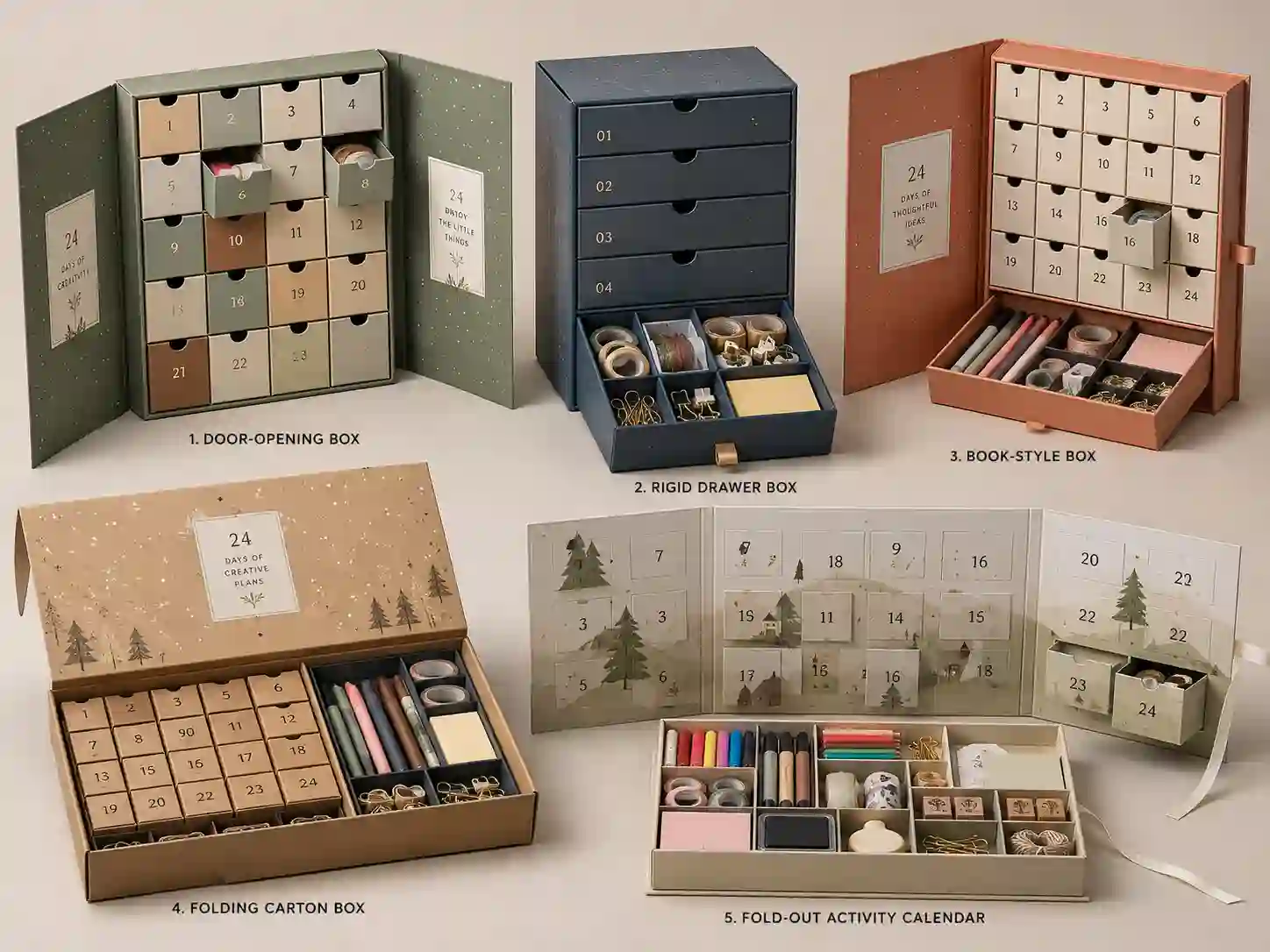
The best structure depends on product weight, compartment count, retail price level, shipping method, and how the buyer wants consumers to open the calendar. For stationery advent calendar boxes, the most common structures are door-opening paperboard calendars, rigid drawer boxes, book-style rigid boxes, folding carton calendars, and fold-out activity calendars.
| Structure option | Best for | Production and QC focus | Buyer consideration |
|---|---|---|---|
| Door-opening box | Stickers, erasers, clips, small stationery gifts, lightweight pens | Door perforation strength, paper insert alignment, compartment depth, number placement | Good for retail display and classic calendar opening, but requires accurate die-cutting and insert registration. |
| Rigid drawer box | Premium stationery sets, pens, markers, washi tapes, gift kits | Drawer sliding tolerance, greyboard thickness, pull tab strength, insert locking | Higher perceived value and better reuse potential, but more labor and material cost. |
| Book-style rigid box | Premium brand campaigns, curated writing sets, desk accessories | Magnetic or ribbon closure, hinge durability, board wrapping, inner tray fit | Good for gifting and retail shelf presence, but carton size and shipping volume may increase. |
| Folding carton calendar | High-volume lightweight stationery promotions | Paperboard caliper, creasing, locking tabs, flat-packing accuracy | Cost-efficient for large runs, but less suitable for heavy or premium product mixes. |
| Fold-out activity calendar | Kids stationery, craft activities, classroom or hobby campaigns | Panel folding, insert stability, instruction card placement, display angle | Useful when the calendar also functions as an activity board or visual campaign display. |
For most mid-to-premium stationery campaigns, buyers compare a door-opening paperboard structure with a rigid drawer box. The door-opening version is usually better for a broad product mix and visible numbered doors. The drawer version is better when the buyer wants a premium unboxing experience, stronger product separation, and a structure that feels like a gift box.
Factory tip: For long stationery items, avoid forcing every product into square compartments. A mixed layout with vertical pen cavities, flat sticker pockets, and small accessory cavities usually improves fit and reduces empty space.
How should inserts be engineered for pens, stickers, washi tapes, and craft accessories?
Inserts should stop stationery products from moving, bending, rubbing, or blocking the opening mechanism. The right insert depends on product shape, surface sensitivity, weight, sustainability requirements, and whether the item needs to be visible after opening.
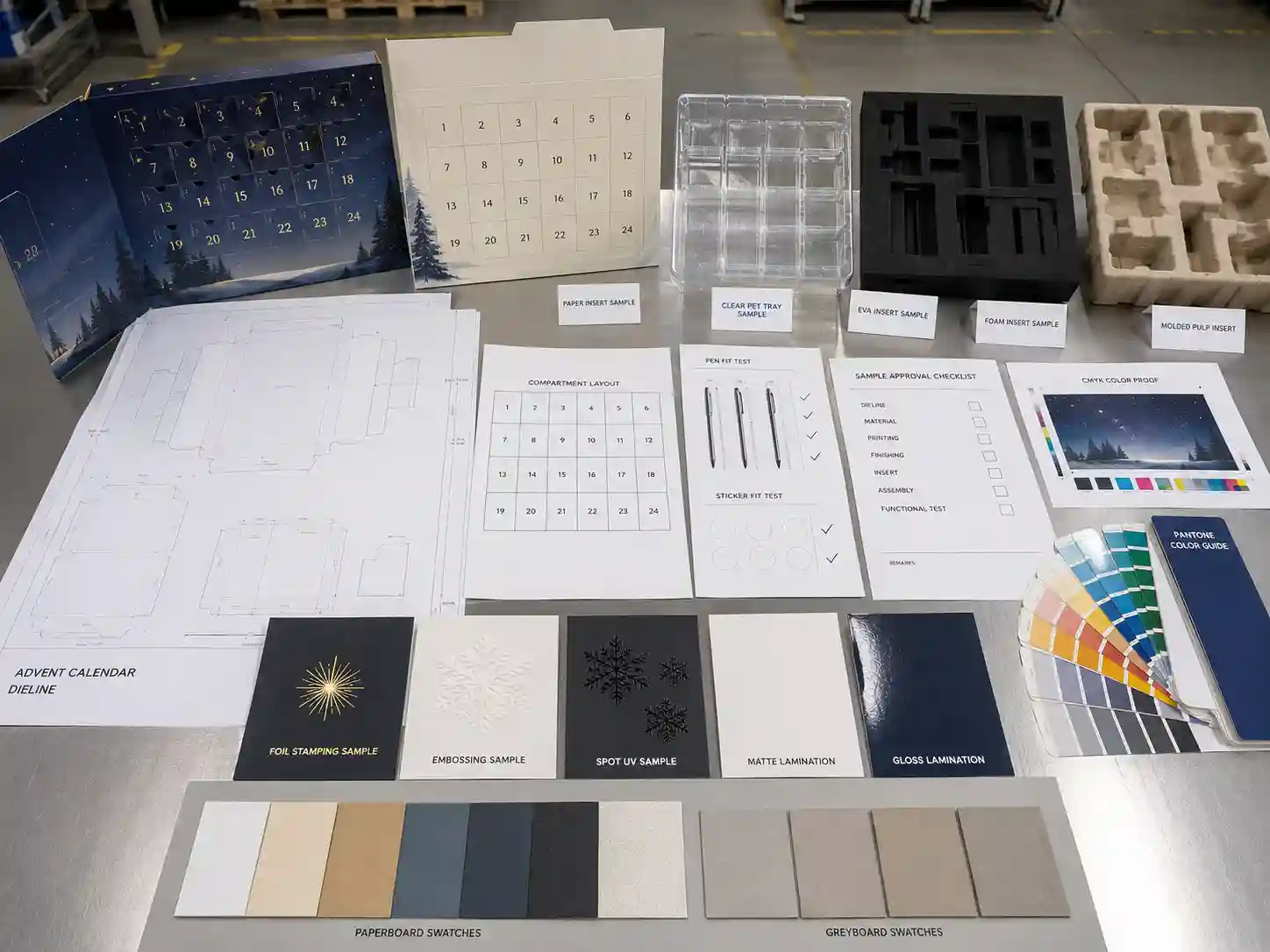
Paper inserts are common for lightweight stationery advent calendar boxes because they are printable, recyclable in many markets, and cost-effective. PET trays offer clear product visibility and tighter formed cavities for items such as washi tapes, mini stamps, erasers, and clips. EVA insert and foam provide stronger cushioning for premium pens, metal stationery tools, or delicate accessories. Molded pulp can be considered when buyers need a more paper-based protection solution, but tooling, surface finish, and cavity detail should be reviewed during sampling.
Insert-fit points buyers should check before mass production
- Each pen, marker, or ruler should be held without bending the insert or pressing against the outer wall.
- Stickers and memo pads should remain flat, with enough clearance to prevent curled corners.
- Washi tapes should not roll out of place when the box is tilted or packed vertically.
- Small clips, refills, and erasers should not migrate into neighboring compartments.
- Door-opening calendars should allow the consumer to remove the item without tearing the surrounding artwork.
- Drawer calendars should slide smoothly after the insert and products are loaded.
QC tip: Do a loaded shake test on the approved sample. If products move noticeably before shipment, they will move more during courier, sea freight, warehouse handling, or e-commerce delivery.
Which materials and printing choices affect quality most?
Material and printing choices affect both appearance and production stability. For stationery advent calendar boxes, buyers should pay close attention to paperboard strength, greyboard thickness, surface paper, lamination, color control, finishing registration, and how well the print tolerates repeated handling.
Rigid boxes typically use greyboard wrapped with printed art paper. Folding cartons and door-opening calendars may use paperboard with die-cut doors or panels. Premium campaigns may add foil stamping, embossing, spot UV, matte lamination, or gloss lamination. These finishes can improve shelf impact, but they also add cost, production steps, and inspection points.
CMYK printing is suitable for full-color artwork and illustrations. Pantone color matching is useful when brand color consistency is important. Buyers should approve color proofs under controlled lighting and understand that uncoated paper, coated paper, matte lamination, and gloss lamination can make the same color appear different.
For paper sourcing claims, buyers can verify chain-of-custody and responsible sourcing requirements through official organizations such as FSC. Do not assume a material claim is included in a quotation unless it is clearly requested and documented.
What production steps should buyers understand before approving bulk stationery calendar boxes?
Buyers should understand that production includes dieline confirmation, material purchasing, printing, surface finishing, mounting, die-cutting, insert forming, assembly, product-fit checking, final inspection, and export packing. A delay or change in any step can affect lead time and cost.
- Dieline and structure confirmation: The factory checks box size, compartment layout, door position, drawer tolerance, folding lines, glue areas, and barcode label zones.
- Material confirmation: Paperboard, greyboard, art paper, lamination film, insert material, ribbon, magnet, or pull tab components are confirmed.
- Artwork preflight: Files are checked for bleed, safe area, CMYK or Pantone settings, image resolution, dieline layers, number placement, and finish separation.
- Printing and proofing: Printed sheets or proofs are reviewed for color, text, alignment, and finishing effects.
- Surface finishing: Matte lamination, gloss lamination, foil stamping, embossing, or spot UV is applied where approved.
- Die-cutting and forming: Doors, panels, drawers, trays, and insert cavities are cut or formed according to the approved dieline.
- Assembly: Workers mount printed sheets, build rigid structures, glue panels, insert trays, check drawer movement, and align compartments.
- QC inspection: The factory checks printing, structure, insert fit, assembly tolerance, durability, carton packing, and shipping marks.
Quotable B2B statement: A stationery calendar is approved for mass production only when the printed structure, insert, and real products work together; approving artwork alone is not enough.
How should sampling and pre-production approval be handled?
Sampling should confirm structure, size, product fit, artwork, printing color, finishing, insert performance, and packing method before mass production. Buyers should not approve bulk production from a render, flat dieline, or unloaded box sample when the product mix is complex.
There are usually several sample stages. A blank sample checks structure and size without final printing. A printed sample checks artwork, color, finishing, and visual presentation. A loaded sample checks whether real stationery items fit, stay in place, and allow doors or drawers to operate properly. A pre-production sample becomes the reference for mass production and final inspection.
Sample approval checklist for stationery advent calendar boxes
- Confirm outer box dimensions and whether they match retail shelf or shipping limits.
- Check each compartment against the real stationery item dimensions.
- Open every door or drawer to review access, tear lines, and user handling.
- Review CMYK color, Pantone color, foil stamping, embossing, spot UV, matte lamination, and gloss lamination against the approved proof.
- Check number sequence, barcode position, warning text, QR code, and generic label areas.
- Test loaded weight, product movement, drawer function, door strength, and corner durability.
- Confirm export carton quantity, carton size, gross weight, shipping marks, and pallet plan if needed.
Buyers using custom advent calendar box services should share product samples or accurate mockups early. Real samples allow the factory to test insert depth, compartment clearance, door opening, and product movement more accurately than photos alone.
What MOQ, cost, and lead-time factors should buyers compare?
MOQ, cost, and lead time are affected by structure complexity, material selection, insert type, printing process, finishing, assembly labor, packing method, and the number of sample revisions. Buyers should compare quotations by specification, not only by unit price.
A folding carton calendar may have a lower material cost, but it may not provide the premium feel or protection needed for heavier stationery items. A rigid drawer box may cost more because of greyboard, wrapping, assembly labor, and stronger export cartons. A PET tray may require tooling or mold setup, while paper inserts may be more flexible for lower-volume customization.
Decision guide: when to choose each production route
| Buyer situation | Recommended direction | Why it works |
|---|---|---|
| Large promotional campaign with lightweight stickers, clips, and small erasers | Folding carton or door-opening paperboard calendar with paper insert | Balances cost, MOQ, and production speed while supporting numbered doors. |
| Premium stationery gift set with pens, washi tapes, stamps, and memo pads | Rigid drawer box or book-style rigid box with paper, EVA, or PET insert | Improves perceived value and product separation for mixed-size items. |
| E-commerce campaign where courier handling is expected | Stronger rigid or reinforced paperboard structure with movement-control insert | Reduces product shifting, crushed corners, and customer complaints. |
| Eco-positioned stationery campaign | Paperboard structure with paper insert or molded pulp insert where practical | Supports paper-based packaging goals, but sample testing is still required. |
| Fast seasonal launch with limited approval time | Simpler dieline, fewer finishes, standard material options, clear sample approval deadline | Reduces technical risk and helps control production lead time. |
Buyer tip: A lower quotation may exclude thicker greyboard, stronger inserts, custom finishing, individual product loading, barcode label application, or pallet packing. Ask the supplier to list what is included and what is optional.
What QC inspection points matter most during mass production?
The most important QC points are color consistency, dieline accuracy, door or drawer function, insert fit, glue strength, assembly alignment, loaded product stability, carton packing, and shipping-mark accuracy. For stationery advent calendar boxes, small dimensional errors can create large handling problems because many compartments must align at the same time.
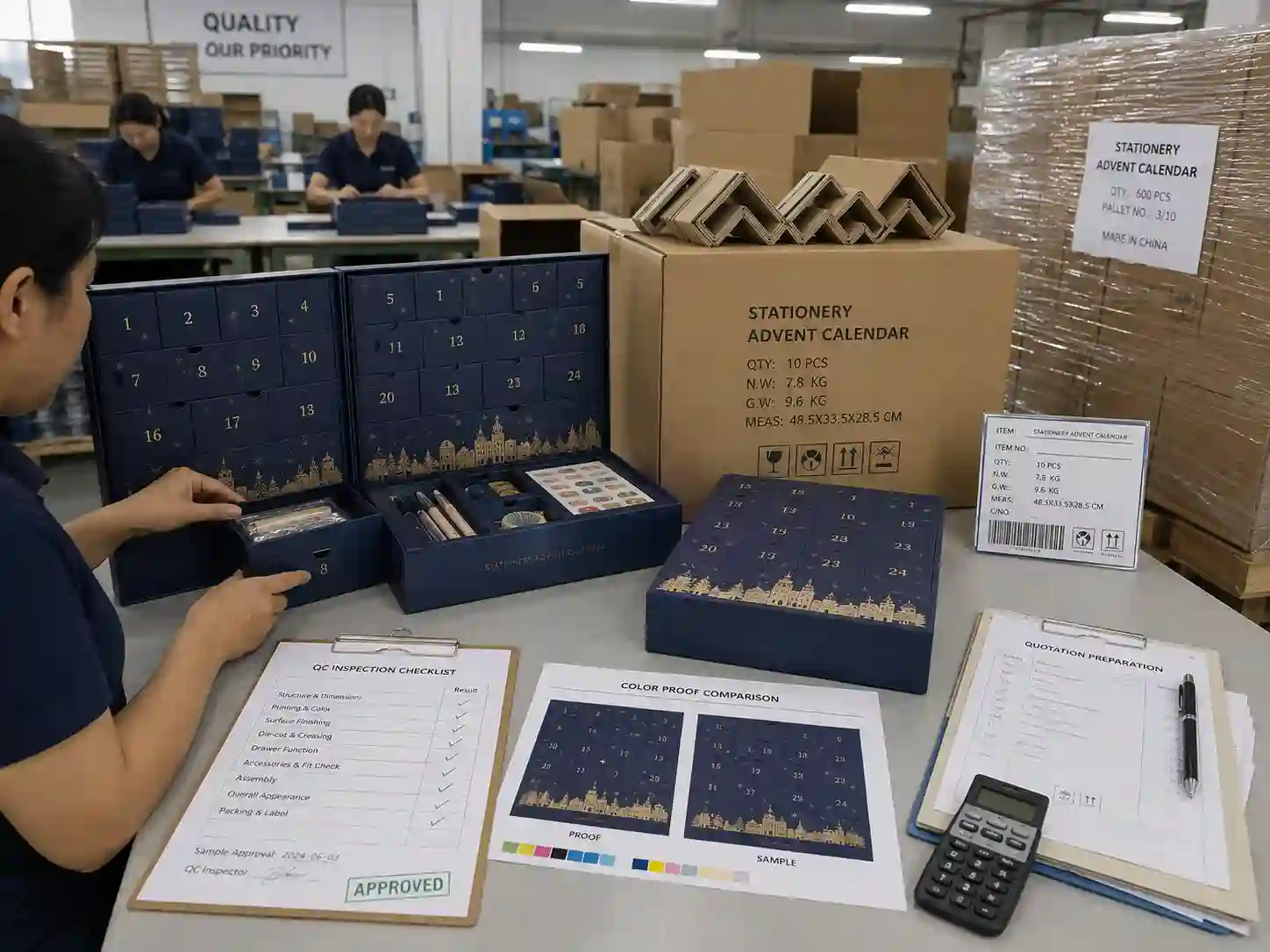
QC should not happen only at the end. During mass production, the factory should inspect incoming material, printed sheets, surface finishing, die-cut pieces, assembled boxes, loaded samples, and export cartons. Buyers can request inspection photos, pre-shipment samples, or third-party inspection depending on order value and risk level.
Mass-production QC checklist
- Printing check: Confirm color, text, number sequence, registration, barcode area, and finish position.
- Material check: Confirm paperboard thickness, greyboard rigidity, insert material, lamination surface, and visible defects.
- Structure check: Test drawer sliding, door perforation, hinge movement, folding lines, and box squareness.
- Insert check: Confirm cavity size, tray position, paper insert locking, EVA or foam cut accuracy, and molded pulp stability.
- Assembly check: Review glue overflow, corner wrapping, panel alignment, magnet or ribbon placement, and gap tolerance.
- Loaded-box check: Place real stationery products inside and check movement, access, and closing pressure.
- Durability check: Review corner strength, compression risk, carton stacking, and basic transport handling simulation.
- Packing check: Confirm export carton size, quantity per carton, protective material, shipping marks, carton labels, and pallet arrangement.
QC tip: Door-opening calendars require special attention to perforation depth. If the cut is too light, consumers may struggle to open the door; if it is too deep, doors may tear or open during packing.
How should export packing be planned for overseas buyers?
Export packing should protect the finished calendar structure, prevent corner damage, control carton weight, and support warehouse handling. Buyers should confirm whether boxes ship flat, assembled, loaded with stationery products, or packed as empty packaging for local fulfillment.
Assembled rigid boxes need stronger master cartons and careful stacking because they occupy more volume. Folding carton calendars may reduce shipping volume if flat packed, but buyers must confirm who will complete final assembly and product loading. For e-commerce sellers, protective outer cartons, corner protectors, barcode labels, and carton drop-risk planning can reduce after-sales issues.
Shipping marks should be generic, clear, and consistent with the packing list. If the products require retail barcodes, buyers should provide barcode files and placement requirements before printing. For barcode system guidance, buyers can refer to official GS1 barcode standards and confirm local retail requirements with their sales channel.
How should buyers compare stationery calendar box suppliers?
Buyers should compare suppliers by engineering support, sample accuracy, insert development ability, printing control, production capacity, QC process, export-packing experience, communication clarity, and quotation transparency. A stationery calendar supplier must understand both visual packaging and multi-item product fit.
When reviewing a supplier, ask whether they can provide blank samples, printed samples, pre-production samples, dieline support, material options, insert testing, and inspection photos. Review previous custom advent calendar boxes or similar multi-compartment packaging projects, but avoid relying only on showroom photos. The key question is whether the factory can control repeatable quality in bulk production.
Buyers can review custom advent calendar box products to understand possible structures, then contact the Giftpackpro packaging factory with product details for a more accurate recommendation. For broader purchasing topics, the advent calendar box buying guides section can help teams compare structure, cost, sampling, and export decisions across categories.
What information should buyers prepare before requesting a quotation?
Buyers should prepare product dimensions, quantity, structure preference, insert requirement, artwork status, printing and finishing needs, sample expectations, packing method, destination market, and delivery schedule before requesting a quotation. The more complete the RFQ, the more useful the quotation will be.
RFQ preparation checklist
- Project name and target launch season.
- Estimated order quantity and possible repeat-order plan.
- Number of calendar days or compartments.
- Product list with dimensions, weight, and photos for every stationery item.
- Preferred structure: rigid box, drawer box, door-opening box, folding carton, book-style box, or fold-out calendar.
- Insert preference: paper insert, PET tray, EVA insert, foam, molded pulp, or factory recommendation.
- Material preference, sustainability requirements, and any buyer-verification needs.
- Artwork files, dieline status, logo placement, barcode position, and language versions.
- Printing method: CMYK, Pantone, foil stamping, embossing, spot UV, matte lamination, or gloss lamination.
- Sample requirement: blank sample, printed sample, loaded sample, or pre-production sample.
- Export packing requirement: assembled packing, flat packing, master carton, pallet, corner protector, shipping marks, or e-commerce outer carton.
- Destination country, shipping method, required delivery window, and inspection requirements.
When the information is ready, buyers can request a custom quote from Giftpackpro. Sharing real product samples or detailed product drawings helps reduce sample revisions and improves quotation accuracy.
What common mistakes should buyers avoid?
The most common mistakes are approving artwork before confirming product fit, choosing a structure only by appearance, ignoring insert tolerance, underestimating assembly labor, requesting complex finishes too late, and comparing quotations without matching specifications. These mistakes can delay sampling, increase cost, or create quality problems in mass production.
- Mistake 1: Treating all stationery items as similar. Pens, stickers, washi tapes, clips, and memo pads behave differently inside compartments.
- Mistake 2: Choosing a box size before confirming the full product map. One long ruler or marker can force a larger dieline.
- Mistake 3: Ignoring door and drawer clearance. Products that fit in a cavity may still block smooth opening.
- Mistake 4: Approving digital color only. Printed proofs are important because paper, lamination, and finishes change appearance.
- Mistake 5: Reducing carton strength to lower cost. Damaged corners and crushed boxes can cost more than stronger export cartons.
- Mistake 6: Leaving barcode and shipping marks until the end. Retail and logistics labels need planned space on the artwork and cartons.
FAQ: stationery advent calendar boxes for B2B buyers
What is the best structure for stationery advent calendar boxes?
The best structure depends on product mix and campaign positioning. Door-opening boxes work well for classic numbered compartments, while rigid drawer boxes and book-style rigid boxes are better for premium stationery gifts with heavier or mixed-size products.
Can one calendar include pens, stickers, washi tapes, and memo pads together?
Yes, but the insert must be engineered around the full product map. Long, flat, round, and small loose items need different cavity shapes and movement-control methods.
Should buyers choose paper insert, PET tray, EVA insert, foam, or molded pulp?
Paper insert is practical for many lightweight stationery products. PET tray helps with formed cavities and visibility. EVA and foam provide stronger cushioning for premium items. Molded pulp may fit paper-based packaging goals, but sampling is important to confirm detail, strength, and appearance.
What should be checked on a printed sample?
Buyers should check color, finish, dieline alignment, number sequence, barcode space, door or drawer function, insert fit, product movement, glue quality, and carton packing plan. A printed sample should be reviewed with real products whenever possible.
How does MOQ affect stationery advent calendar box cost?
MOQ affects material purchasing, printing setup, finishing setup, die-cutting, tooling, and assembly efficiency. More complex structures, custom inserts, and special finishes usually require more planning and may increase the practical MOQ.
What is the role of a pre-production sample?
A pre-production sample is the approved reference for bulk production. It should confirm the final structure, material, artwork, printing, finishing, insert, product fit, and packing method before mass production begins.
How can buyers reduce risk before mass production?
Buyers can reduce risk by sending accurate product dimensions, approving a loaded sample, confirming artwork proofs, defining QC standards, checking export carton design, and comparing supplier quotations by complete specifications rather than unit price only.
Conclusion: design stationery advent calendar boxes around production reality
Successful stationery advent calendar boxes are designed around real products, reliable inserts, controlled printing, stable assembly, practical QC, and safe export packing. For seasonal campaigns, buyers should confirm the product map, choose the right structure, test the insert, approve a realistic pre-production sample, and prepare complete quotation details before bulk production begins.
Giftpackpro can support overseas brands, wholesalers, retail buyers, e-commerce sellers, and purchasing teams with custom structure development, sampling, printing, QC, and export packing for stationery calendar projects. Prepare your product list, dimensions, artwork status, target quantity, and delivery schedule, then contact Giftpackpro to discuss the most practical production route for your campaign.