Quick answer: To design kids advent calendar boxes for seasonal campaigns, buyers should define the gift mix, target retail channel, safety-sensitive product fit, opening structure, insert material, artwork style, MOQ, sample approval steps, QC standard, and export packing method before requesting a quotation. For B2B orders, the best design is not only attractive on shelf; it must hold different small gift items securely, open smoothly for repeated daily use, protect printed surfaces during shipping, and remain efficient for mass production. A practical RFQ should include product sizes, estimated order quantity, artwork requirements, preferred structure, packing method, destination market, and launch deadline.
Kids gift campaigns often combine many small products in one seasonal box: toys, stationery, stickers, craft accessories, hair accessories, puzzles, small books, candy-related non-food items, or mixed gift bundles. This makes the packaging more complex than a single-product gift box. Buyers need to think like both a merchandiser and a packaging engineer: what children will see first, how parents will judge quality, how retail buyers will display the box, and how the factory will control structure, insert fit, printing, assembly, and export packing at scale.
Giftpackpro works as a custom advent calendar boxes manufacturer for overseas brands, wholesalers, gift companies, retail buyers, packaging distributors, and purchasing teams that need seasonal paper gift packaging. This guide explains how to compare structures, materials, inserts, artwork, sampling, MOQ, QC, and quotation details before developing custom kids advent calendar boxes for seasonal campaigns.
What should buyers decide before designing kids advent calendar boxes?
Buyers should decide the gift assortment, user age range, retail channel, opening experience, product protection level, and production budget before choosing a box structure. These decisions affect almost every manufacturing detail, from dieline layout to insert tolerance, printing finish, carton packing, and lead time.
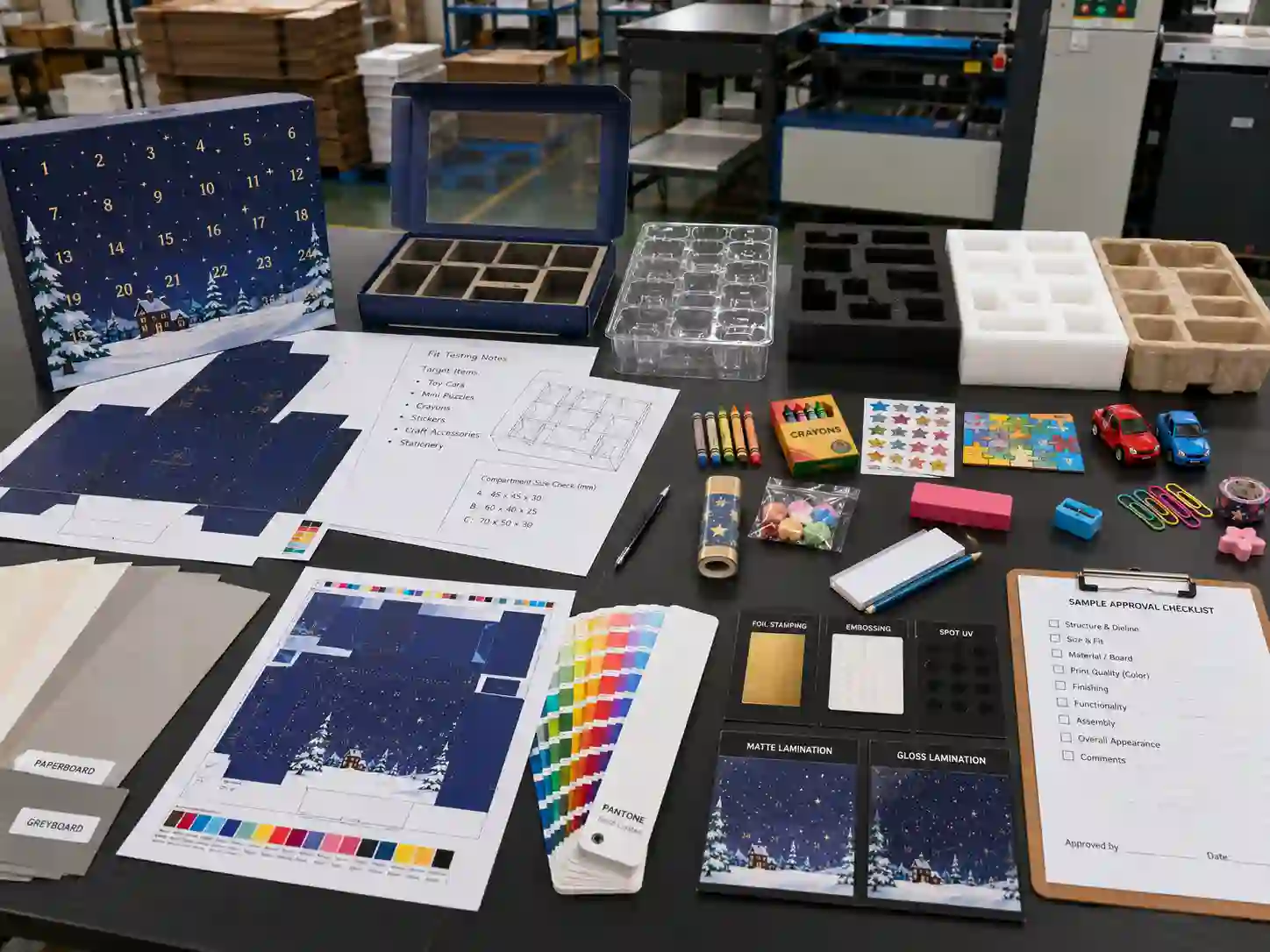
For kids gift advent calendars, product fit is the first design constraint. A box for flat stickers and paper crafts can use shallow compartments and a lightweight folding carton. A mixed gift set with toy cars, crayons, mini puzzles, hair clips, small stationery, or craft parts may need a rigid box, drawer box, PET tray, EVA insert, or stronger paperboard insert. If the products vary in height, weight, or shape, the factory should review physical samples or accurate 3D dimensions before confirming the dieline.
Buyer tip: Do not start artwork before confirming the compartment layout. For kids advent calendar boxes, numbers, door cuts, drawer fronts, instruction areas, warning text, barcode space, and retail claims must match the final structure. Changing the insert after artwork approval can shift opening positions and create costly rework.
Which kids gift categories fit advent calendar packaging?
Kids advent calendar boxes work best when the product assortment can be divided into clear daily surprises and held safely in separate compartments. The structure should be selected according to product shape, fragility, weight, and how much visual display the buyer needs.
| Kids gift category | Common product examples | Recommended packaging approach | Key buyer concern |
|---|---|---|---|
| Stationery and craft gifts | Crayons, erasers, stickers, stamps, small craft tools, paper shapes | Door-opening box, fold-out calendar, or folding carton with paper insert | Compartment size consistency and prevention of item movement |
| Small toys and activity items | Mini cars, puzzles, blocks, badges, generic figurine-shaped items | Rigid box, drawer box, or door-opening box with PET tray, EVA insert, or molded pulp | Mixed product height, loose parts, and insert holding strength |
| Hair accessories and small fashion gifts | Hair clips, bands, rings, charms, small accessory cards | Book-style box, drawer box, or paperboard tray with card slots | Neat presentation and protection from scratches |
| Educational gift sets | Flash cards, mini books, puzzle cards, activity notes | Folding carton, fold-out activity calendar, or book-style calendar | Flatness, print readability, and easy daily removal |
| Mixed promotional gift sets | Stickers, stationery, small toys, craft parts, coupons, sample gifts | Custom advent calendar boxes with varied compartment depths | Insert engineering and balanced box weight |
For buyers developing a retail campaign, the product mix should be reviewed together with display requirements. A box for Amazon or e-commerce shipping may need more internal protection and a stronger export carton. A box for retail shelf display may need a stable base, strong front panel, clean barcode area, and finishing that resists scuffing during handling.
Which structure is best for a kids seasonal gift campaign?
The best structure depends on product weight, opening experience, retail price point, and assembly budget. Rigid boxes feel premium and protect heavier mixed gifts, while folding carton calendars are lighter and more cost-efficient for large-volume campaigns.
When should buyers choose a door-opening box?
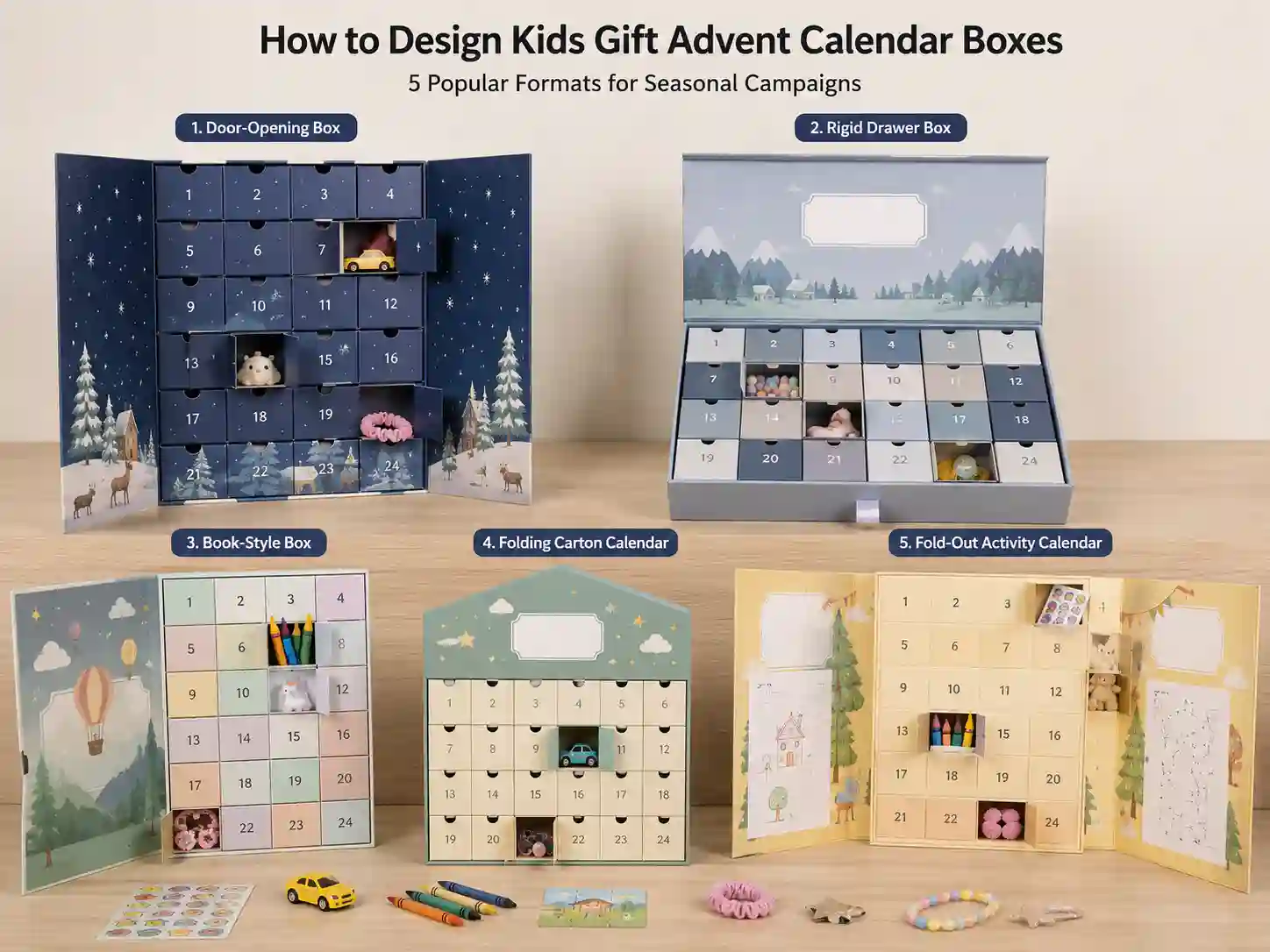
A door-opening box is suitable when buyers want a classic daily reveal layout with numbered windows. It works well for stickers, stationery, small toys, flat accessories, light craft items, and mixed gift products that can be positioned behind perforated doors.
The main engineering challenge is door function. The door should open without tearing the surrounding print area, but it should not open during packing or transit. Buyers should ask the factory to test door-cut depth, perforation strength, paper thickness, and insert alignment during sampling. If the product is too close to the door, children may press against the item and damage the surface before opening.
When should buyers choose a drawer box?
A drawer box is suitable for a premium kids gift calendar with reusable drawers or a more organized unboxing experience. It is often used when the gift mix includes different shapes, heavier items, or products that need easier removal than door-opening compartments allow.
Drawer boxes require tighter assembly control. The drawer should slide smoothly but not feel loose. For mass production, buyers should check drawer tolerance, glue position, greyboard thickness, wrap paper tension, and whether the drawer front remains aligned after packing. A drawer structure usually costs more than a folding carton because it uses more material and assembly labor.
When should buyers choose a rigid box or book-style box?
A rigid box or book-style box is a good choice for higher-value seasonal campaigns, retail gift sets, and brand-led launches. It supports premium printing and finishing such as foil stamping, embossing, spot UV, matte lamination, or gloss lamination.
Rigid construction is helpful when a box needs to hold mixed items without bending. Greyboard thickness, wrap paper quality, hinge strength, and magnetic closure options should be confirmed in the prototype. For kids gift applications, buyers should avoid overly sharp corners, difficult closures, and deep compartments that make small items hard to remove.
When should buyers choose a folding carton calendar?
A folding carton calendar is suitable for high-volume campaigns where cost, shipping efficiency, and fast assembly matter. It works best for light products and shallow compartments.
Folding carton calendars can reduce unit cost and carton volume, but they have less structural strength than rigid boxes. Buyers should confirm paperboard thickness, folding strength, door tear performance, and whether the box can stand properly on shelf after loading products.
How should inserts be designed for kids advent calendar boxes?
Inserts should hold each item securely, keep the numbered opening positions accurate, and protect products from movement during export shipping. For kids gift calendars, the insert is often more important than the outer box because the product mix is usually varied.
A paper insert is common for lightweight stationery, stickers, flat accessories, and craft items. PET tray inserts can provide cleaner cavities for shaped items and are useful when visibility or precise molding is needed. EVA insert and foam insert options provide stronger cushioning for heavier or more delicate products, but buyers should review cost, thickness, appearance, and destination-market requirements. Molded pulp can be considered for a paper-based, molded structure where shape support and sustainability positioning are important.
Factory tip: For mixed kids gift assortments, the factory should not design all compartments with the same depth unless the products are similar. A crayon, sticker sheet, mini puzzle, and toy car all need different holding logic. Good insert design controls movement without making daily product removal difficult.
- Measure each product by length, width, height, and weight.
- Group products by similar depth before creating the compartment map.
- Check whether small parts need individual bags before insertion.
- Confirm whether doors, drawers, or lids interfere with the tallest item.
- Test the box after loading real products, not only empty insert samples.
- Review whether children can remove items easily without tearing the box.
How should materials be selected for safety-sensitive kids gift packaging?
Materials should be selected for structure, print quality, handling durability, and market expectations. For kids gift campaigns, buyers should also verify product-related safety, labeling, and compliance needs with their own product team because packaging is only one part of the final retail set.
Common material choices include paperboard for folding cartons, greyboard for rigid boxes, coated paper for printed wrap, corrugated board for export cartons, paper inserts, PET tray inserts, EVA insert sheets, foam, and molded pulp. A premium campaign may use greyboard with printed art paper and matte lamination. A mass retail campaign may use paperboard with CMYK printing and simple surface protection.
Buyers who want responsible paper sourcing can ask suppliers whether FSC-related material options are available and verify claims through official FSC information at FSC. For retail barcode planning, buyers can also check official barcode standards and guidance from GS1. These references help buyers prepare questions, but final compliance should be confirmed according to the product type and destination market.
How should artwork and printing be planned for a seasonal kids campaign?
Artwork should be planned around the dieline, opening structure, numbering system, barcode area, warning text, and retail display panels. For kids advent calendar boxes, attractive artwork is important, but inaccurate dieline alignment can ruin the opening experience.
The factory should provide a dieline showing trim lines, bleed, crease lines, glue areas, door cuts, drawer fronts, insert positions, and safe zones. Buyers should keep key artwork away from perforation lines and deep folds. Numbered doors should be large enough to read clearly after printing, lamination, and die cutting. If the box includes multiple product categories, artwork can use simple icons or generic category cues, but it should avoid real trademarks, copyrighted characters, and fake logos unless the buyer has documented rights.
Which printing and finishing options matter most?
CMYK printing is common for full-color seasonal artwork, while Pantone colors are useful when a brand needs tighter color matching. Matte lamination can reduce glare and protect the surface, gloss lamination can create a brighter retail look, foil stamping can highlight numbers or campaign elements, embossing can add texture, and spot UV can emphasize selected artwork areas.
Each finish affects cost, lead time, and production risk. Foil stamping and embossing require tooling. Spot UV and lamination require alignment control. Heavy ink coverage may show cracking on folds if paperboard and surface treatment are not tested. Buyers should approve a printed sample or pre-production sample when color consistency and shelf appearance are important.
Buyer tip: For kids gift packaging, do not use tiny white text on busy artwork near door cuts. During die cutting and folding, small shifts can make text look uneven or difficult to read. Keep safety text, barcode space, age-grade information, and product notes in stable, low-risk areas of the dieline.
What sampling steps should happen before mass production?
Sampling should confirm structure, product fit, artwork position, color, finishing, opening function, and export packing assumptions before mass production. A good sample process reduces the risk of delays after the buyer has already booked a launch window.
- Blank structural sample: Confirms size, structure, insert layout, door opening, drawer movement, and product fit before printed artwork is added.
- Printed sample or prototype: Checks CMYK or Pantone color, lamination, foil stamping, embossing, spot UV, number position, barcode area, and retail appearance.
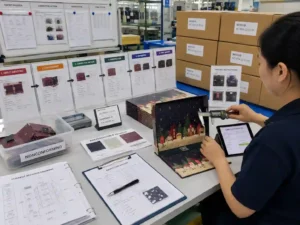
- Loaded sample test: Uses real or dummy products to check compartment fit, box balance, product movement, and ease of removal.
- Pre-production sample: Confirms the final approved materials, artwork, insert, finishing, packing method, and quality standard before mass production.
Buyers should record all sample comments in writing. Important approval notes include material thickness, door-cut function, insert cavity depth, drawer tolerance, artwork revision version, color reference, surface finish, barcode position, export carton quantity, and shipping mark format.
Quotable B2B statement: A kids gift advent calendar sample should be approved as a loaded packaging system, not as an empty printed box, because product movement, compartment depth, and opening function only become clear after the gifts are placed inside.
What drives MOQ, cost, and lead time?
MOQ, cost, and lead time are mainly driven by structure, material thickness, printing complexity, finishing, insert tooling, assembly labor, order quantity, and packing method. Buyers should compare quotations by specification, not only by unit price.
A folding carton calendar usually has a lower MOQ and lower unit cost than a rigid drawer box, but it may not be suitable for heavier mixed gifts. A rigid box with drawers, PET tray, foil stamping, embossing, and spot UV will normally require more sampling time, more production steps, and more assembly control. Insert tooling can also affect cost when PET tray or molded insert shapes are customized.
| Cost driver | Why it matters | Buyer decision |
|---|---|---|
| Box structure | Rigid box and drawer box structures use more material and hand assembly than folding cartons. | Match structure to retail price point and product weight. |
| Insert type | Paper insert is usually simpler; PET tray, EVA, foam, and molded pulp may need more testing or tooling. | Choose the insert based on product fit, not appearance alone. |
| Printing colors | CMYK is efficient for full-color artwork; Pantone adds color control but may add cost. | Use Pantone where brand color accuracy is critical. |
| Surface finishing | Foil stamping, embossing, spot UV, matte lamination, and gloss lamination add process steps. | Apply premium finishes only where they improve shelf impact or brand value. |
| Assembly complexity | Many drawers, deep compartments, and mixed inserts require more labor and QC. | Ask whether the quote includes assembly and product loading support. |
| Export packing | Assembled boxes take more carton volume than flat-packed components. | Compare freight impact before confirming the final packing method. |
How should buyers compare kids advent calendar box suppliers?
Buyers should compare suppliers by engineering support, sample accuracy, communication quality, production control, export packing experience, and quotation detail. The lowest unit price is not the best choice if the supplier cannot control inserts, dielines, door function, assembly tolerance, and shipping protection.
A capable supplier should ask about product dimensions, order quantity, target market, launch date, artwork status, insert preference, box structure, finishing requirements, packing method, and inspection expectations. If a supplier quotes without asking for product sizes or structure details, the quotation may be too rough for serious procurement planning.
Supplier comparison checklist
- Can the supplier recommend rigid box, folding carton, drawer box, door-opening box, or book-style structures based on product weight and channel?
- Can the supplier create or review the dieline before artwork is finalized?
- Can the supplier test paper insert, PET tray, EVA insert, foam, or molded pulp options?
- Can the supplier provide blank sample, printed sample, and pre-production sample stages?
- Does the quotation clearly list material, size, printing, finishing, insert, packing, MOQ, lead time, and payment terms?
- Does the supplier have experience with export carton packing, pallet loading, shipping marks, and barcode label areas?
- Can the supplier explain QC checkpoints for printing, die cutting, gluing, assembly, insert fit, and final packing?
Buyers can review custom advent calendar box products to understand possible structure directions, then use custom advent calendar box services to plan sampling, artwork checking, and production support. For factory background and production capability, buyers may also review the Giftpackpro packaging factory.
What QC checks are important before shipment?
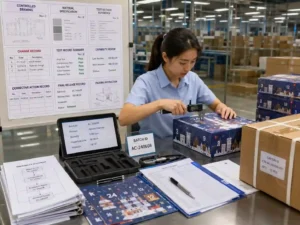
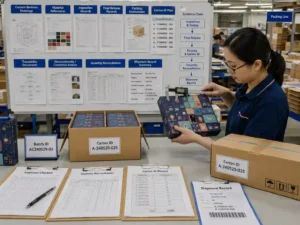
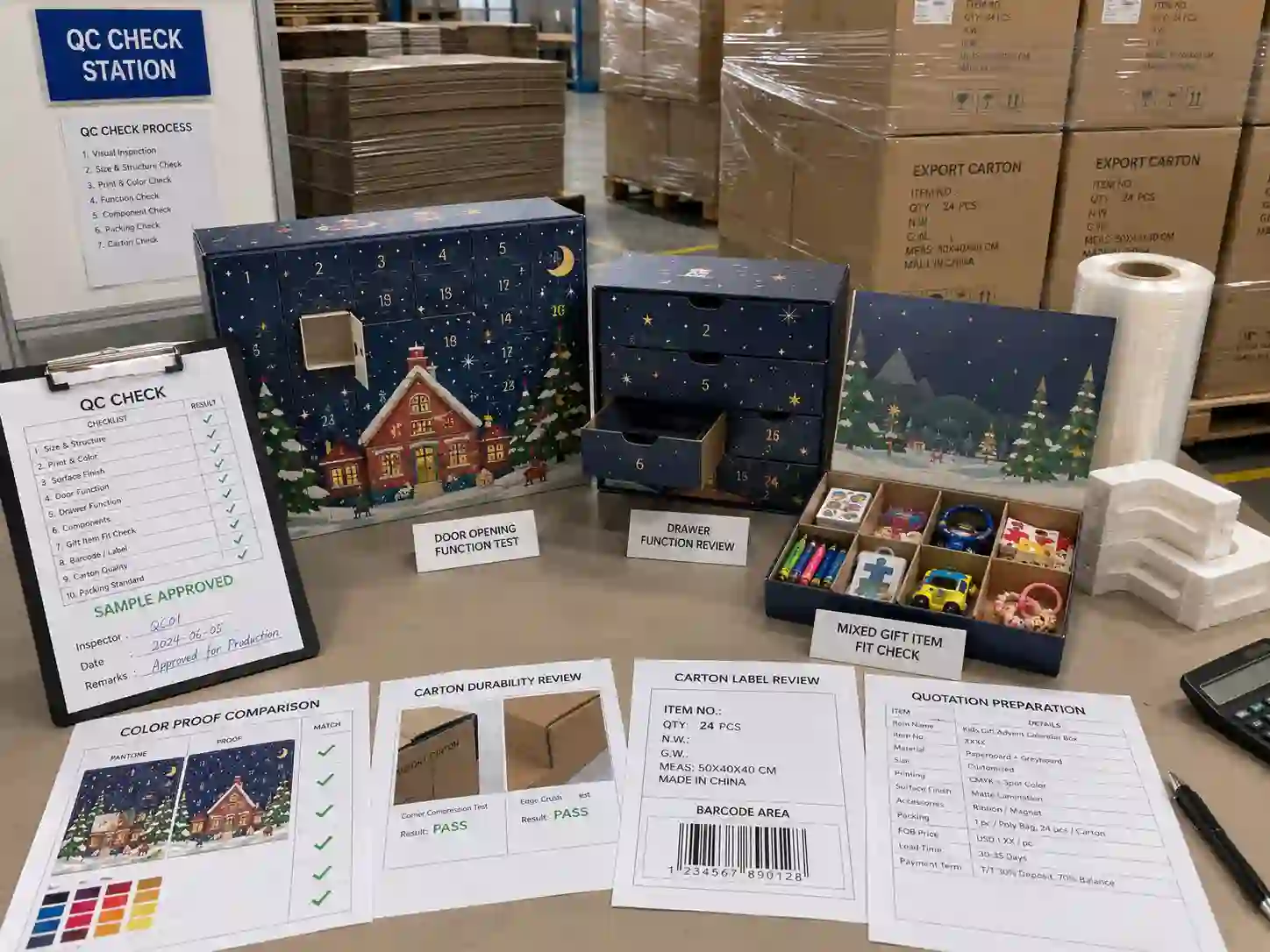
QC should verify structure, print quality, insert fit, opening function, assembly strength, carton packing, and shipping marks before shipment. For kids advent calendar boxes, a finished box can look attractive but still fail if doors tear badly, drawers jam, inserts loosen, or mixed items shift during transport.
QC should start from incoming material checks and continue through printing, lamination, die cutting, gluing, assembly, product loading, final inspection, and export packing. For printed surfaces, inspectors should check color variation, scratches, glue marks, lamination bubbles, foil alignment, spot UV registration, and embossing position. For structure, inspectors should check box squareness, door-opening function, drawer movement, hinge strength, insert placement, and whether the loaded box can withstand normal handling.
QC tip: Inspect both empty and loaded samples from mass production. Empty boxes show printing and assembly issues clearly, while loaded boxes reveal insert movement, drawer pressure, door bulging, carton compression, and handling risks.
How should export packing be planned for overseas buyers?
Export packing should protect the finished advent calendar boxes from compression, corner damage, moisture exposure, label confusion, and rough handling during international transport. The packing method should be discussed before final quotation because it affects carton size, pallet plan, freight cost, and delivery risk.
For assembled kids advent calendar boxes, the factory may use individual polybags, tissue protection, corner protectors, inner cartons, master export cartons, and pallets depending on structure and buyer requirements. Folding carton components may sometimes be packed flat to save space, but buyers must confirm who will assemble and load the products later. If the factory is responsible for assembly and loading, the quotation should state whether product insertion, sealing, barcode label application, and final carton labeling are included.
Shipping marks should be generic and accurate. Carton labels may include item number, PO number, carton quantity, gross weight, net weight, carton size, destination, and barcode label area if required by the buyer. Retailers and e-commerce platforms may have their own carton labeling and pallet rules, so purchasing teams should provide those requirements early.
What information should buyers prepare before requesting a quotation?
Buyers should prepare product dimensions, product weight, target quantity, structure preference, artwork status, insert requirements, finishing options, packing method, destination country, and launch deadline before requesting a quotation. Clear RFQ information helps the supplier quote accurately and avoid repeated revisions.
RFQ preparation checklist for kids advent calendar boxes
- Product list for each day or compartment, including size and weight.
- Photos, drawings, or physical samples of each gift item.
- Preferred box structure: door-opening box, drawer box, rigid box, folding carton, book-style box, or fold-out calendar.
- Estimated order quantity and expected MOQ flexibility.
- Target retail channel: wholesale, retail shelf, Amazon, e-commerce, promotional gift, or distributor program.
- Artwork file status, dieline needs, CMYK or Pantone requirements, and logo usage confirmation.
- Preferred finishes such as matte lamination, gloss lamination, foil stamping, embossing, or spot UV.
- Insert preference: paper insert, PET tray, EVA insert, foam, molded pulp, or factory recommendation.
- Sample needs: blank sample, printed prototype, loaded sample, or pre-production sample.
- Export packing requirements, shipping marks, barcode label area, pallet rules, and destination port or warehouse.
- Required delivery date, seasonal launch date, and approval deadline.
Buyers can use the advent calendar box buying guides to compare related structures and planning topics, then request a custom quote with the checklist above. Giftpackpro can review the structure, insert, artwork, sample plan, and export packing method before preparing a practical quotation.
Decision guide: how should buyers choose the right design path?
Buyers should choose the design path by matching product complexity, retail value, order quantity, and launch timeline. The right path balances presentation, protection, production efficiency, and shipping cost.
| Buyer situation | Recommended design path | Reason |
|---|---|---|
| Large-volume promotional campaign with lightweight items | Folding carton or door-opening paperboard calendar with paper insert | Helps control unit cost and supports efficient mass production. |
| Premium retail gift set with mixed toys and accessories | Rigid box, book-style box, or drawer box with engineered inserts | Improves perceived value and protects mixed product shapes. |
| Gift set with many irregular product sizes | Custom compartment layout with PET tray, EVA, foam, or molded pulp testing | Reduces product movement and keeps the daily opening experience consistent. |
| Fast seasonal launch with limited artwork time | Use a proven structure and focus customization on print, insert layout, and finishes | Reduces dieline risk and shortens the approval process. |
| E-commerce or overseas distribution program | Stronger outer structure, tested export carton, clear shipping marks, and pallet plan | Reduces damage risk during long-distance shipping and warehouse handling. |
What common mistakes should buyers avoid?
Buyers should avoid treating kids advent calendar boxes as standard gift boxes. The daily-opening structure, mixed product fit, insert tolerance, child-friendly removal, and export packing requirements make them more complex than ordinary seasonal packaging.
- Approving artwork before the dieline is fixed: This can cause number misalignment, door cuts through important artwork, or barcode placement problems.
- Using one compartment size for all products: Mixed gifts need different cavity sizes and depths to prevent movement.
- Ignoring product loading sequence: Some products may be difficult to insert after the box is assembled.
- Choosing premium finishing without testing folds: Heavy ink, foil, lamination, and embossing can create cracking or registration issues if not tested.
- Comparing quotes without matching specifications: A lower quote may exclude insert tooling, assembly, product loading, stronger cartons, or pallet packing.
- Skipping the loaded sample: An empty prototype cannot reveal all fit, pressure, door bulging, and transit risks.
- Finalizing export packing too late: Carton size, pallet plan, shipping marks, and barcode label areas affect logistics and should be planned early.
FAQ: buyer questions about kids advent calendar boxes
What is the best structure for kids advent calendar boxes?
The best structure depends on the product mix and retail plan. Door-opening boxes work well for classic daily reveals, drawer boxes suit premium mixed gifts, rigid boxes support higher-value campaigns, and folding cartons are practical for high-volume lightweight items.
Can one box hold toys, stationery, stickers, and accessories together?
Yes, but the insert must be engineered around the actual product sizes. Mixed kids gift assortments often need varied compartment depths, paperboard dividers, PET tray cavities, EVA, foam, or molded pulp support to prevent movement.
Should buyers request a blank sample or printed sample first?
For new structures, buyers should usually start with a blank structural sample to confirm size, insert layout, opening function, and product fit. After the structure is approved, a printed sample can confirm artwork, color, finishing, and retail appearance.
What artwork files are needed for production?
Buyers should prepare editable artwork based on the final dieline, including bleed, safe zones, CMYK or Pantone references, numbering, barcode area, warning text, and any finishing layers such as foil stamping, embossing, or spot UV.
What affects MOQ for custom kids advent calendar boxes?
MOQ depends on structure, material, printing method, finishing, insert type, tooling, and assembly complexity. A simple folding carton calendar may support a lower cost structure, while a rigid drawer box with custom inserts and premium finishes usually needs more production planning.
How can buyers reduce damage during export shipping?
Buyers should confirm export carton strength, inner protection, corner protection, carton quantity, pallet loading, moisture control where needed, and shipping marks. Loaded samples and carton packing reviews help identify compression and movement risks before shipment.
CTA: how to start a kids gift advent calendar packaging project
Before asking for a sample or quotation, prepare the product list, product dimensions, target quantity, preferred structure, artwork status, insert requirements, finishing preferences, launch deadline, destination market, and export packing requirements. With these details, Giftpackpro can recommend a practical structure, develop a dieline, compare insert options, plan sampling, and quote the project more accurately.
For buyers planning seasonal kids advent calendar boxes, the most efficient next step is to share the gift assortment and target order quantity, then discuss structure, insert, sample, QC, lead time, and export packing with a factory-side packaging team. This helps turn a creative seasonal campaign into a manufacturable, inspectable, and shippable B2B packaging project.