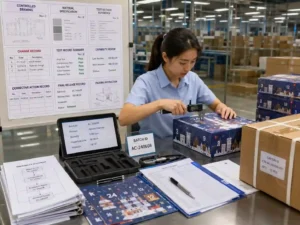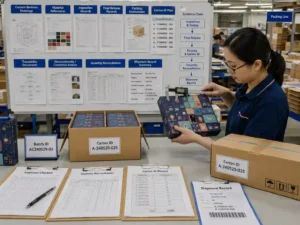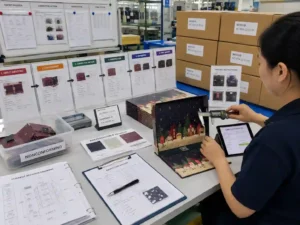
Quick answer: To design jewelry advent calendar boxes for seasonal campaigns, buyers should define the jewelry assortment, retail price level, box structure, insert protection, artwork process, sample approval steps, MOQ, lead time, QC standard, and export packing method before requesting a quotation. Jewelry packaging is different from cosmetics, chocolate, candles, tea, coffee, toys, beverages, and general gift calendars because the products are small, scratch-sensitive, easy to lose, and often need a premium opening experience. A reliable supplier should help check the dieline, compartment sizes, anti-scratch insert materials, printing proof, assembly tolerance, shipping marks, and carton packing before mass production.
What should buyers understand before choosing jewelry advent calendar boxes?
Buyers should first understand that jewelry advent calendar boxes are not only decorative seasonal packaging; they are multi-compartment retail packaging systems that must protect small items, present value, and stay efficient for assembly and export. A good design balances visual impact, theft-aware retail labeling space, insert security, production cost, and shipping durability.
Unlike many custom advent calendar boxes used for chocolate, candles, cosmetics, tea, coffee, toys, beverages, or mixed gifts, jewelry calendars usually hold lightweight but delicate products such as rings, earrings, bracelets, charms, pendants, brooches, hair accessories, and small gift sets. The packaging must prevent scratching, tangling, movement, drawer confusion, and missing-piece complaints during seasonal fulfillment.
For B2B buyers, the most important early question is not “Which box looks beautiful?” but “Which structure can be produced, assembled, inspected, packed, shipped, and sold at the target price point?” Giftpackpro supports overseas brands, wholesalers, retail buyers, and gift companies as a custom advent calendar boxes manufacturer for seasonal paper gift packaging projects.
Which jewelry advent calendar box structure fits your campaign?
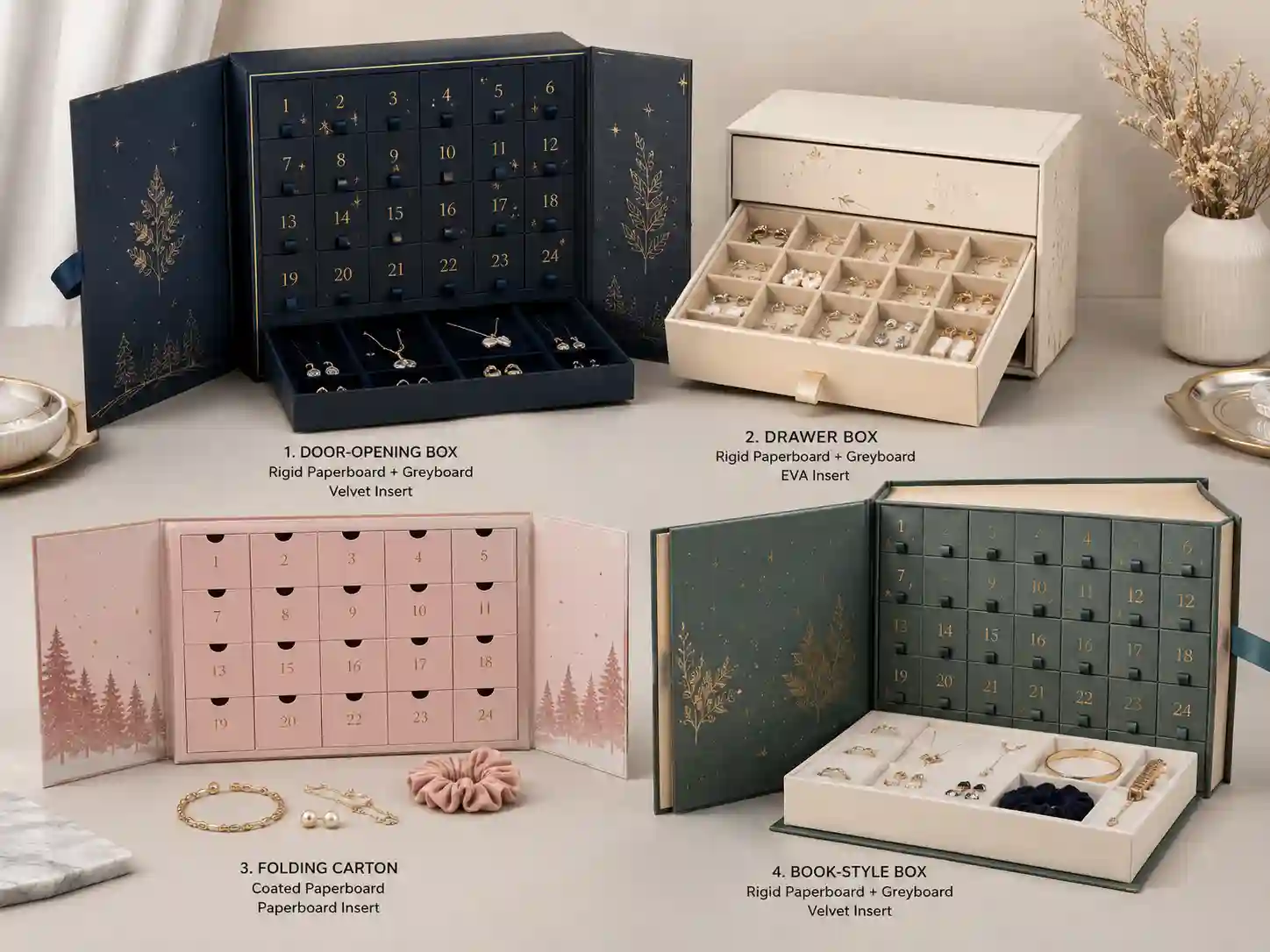
The right structure depends on jewelry value, sales channel, display method, order quantity, and the buyer’s budget. Rigid boxes usually create the most premium impression, while folding carton structures are better for lighter, cost-sensitive campaigns.
| Structure option | Best for | Buyer advantages | Watch points |
|---|---|---|---|
| Rigid door-opening box | Premium jewelry sets, brand campaigns, retail gifting | Strong presentation, good shelf presence, suitable for foil stamping, embossing, spot UV, and matte lamination | Higher unit cost, larger shipping volume, longer sampling and assembly time |
| Drawer box | Charm sets, ring sets, bracelet campaigns, limited editions | Premium opening experience, good item separation, reusable feeling | Drawer tolerance must be tested; loose drawers can slide during transit |
| Book-style advent calendar box | Story-led jewelry collections, gift sets, e-commerce product pages | Large branding surface, strong unboxing layout, easy to show product sequence | Needs careful hinge and magnet testing if magnets are used |
| Folding carton advent calendar | Mass retail promotions, lower-weight accessories, price-sensitive campaigns | Lower cost, flatter shipping before assembly, flexible printing | Less premium than rigid greyboard; compartment strength must match product weight |
| Fold-out or multi-panel box | Visual merchandising, gift companies, mixed jewelry and accessory sets | Strong display impact and storytelling space | More complex dieline, higher risk of alignment issues if not sampled carefully |
Buyer tip: If the jewelry has a higher retail value, choose a rigid box or drawer box with anti-scratch inserts. If the campaign is a large-volume promotional gift, a well-engineered folding carton with paperboard inserts may offer better cost control.
How should buyers plan compartment size and jewelry layout?
Compartment planning should begin with the actual product list, not the artwork. Each ring, earring card, charm pouch, bracelet, pendant card, or hair accessory should have a measured space with allowance for insert thickness, finger access, and assembly tolerance.
Jewelry advent calendars often fail when buyers use one repeated compartment size for products that are actually different in thickness or shape. A pair of earrings on a card, a bracelet in a pouch, and a pendant with a chain may all need different cavity depths. If the box is designed only from flat product dimensions, the final calendar may bulge, rattle, or make items difficult to remove.
For B2B development, prepare a product matrix before the supplier makes the dieline. Include product name, item quantity, size, weight, packaging method, anti-scratch requirement, and door or drawer number. This helps the factory confirm whether the layout is realistic before sample production.
What layout decisions matter most for jewelry?
- Use smaller compartments for rings, charms, and pendants, but avoid spaces so tight that the buyer cannot remove the item easily.
- Separate chains and bracelets to reduce tangling during shipping.
- Add insert depth or retention points for products that may move when the carton is tilted.
- Reserve space for item labels, retail barcode stickers, warning labels, or theft-aware seals if required by the sales channel.
- Keep the door-opening sequence logical for assembly and end-user handling.
Which insert material is best for jewelry protection?
The best insert depends on the jewelry finish, product weight, sustainability target, and target retail price. Velvet and EVA are common for premium anti-scratch presentation, while paper inserts and molded pulp can work for more cost-sensitive or paper-focused campaigns.
| Insert type | Typical use | Strengths | Limitations |
|---|---|---|---|
| Velvet insert | Rings, pendants, bracelets, premium gift sets | Soft touch, premium presentation, helps reduce surface scratching | Higher cost, needs clean handling during assembly |
| EVA insert | Small jewelry pieces, structured premium calendars | Good shape control, strong item holding, clean cavity cutting | Less paper-based; surface finishing may need lining for delicate items |
| Foam insert | Lightweight jewelry or accessory protection | Flexible, protective, easy to cut for different shapes | May look less premium unless covered or lined |
| Paper insert | Cost-sensitive seasonal campaigns, paper-focused packaging | Printable, recyclable in many local systems when designed correctly, efficient for volume orders | Less soft protection for polished jewelry; structure must be reinforced |
| PET tray | Clear product positioning, mixed small items | Precise cavities, stable placement, good visibility during packing | May not match paper-based sustainability goals; scratching risk should be tested |
| Molded pulp | Natural-look gift sets, paper-based campaigns | Protective, textured, suitable for eco-positioned projects | Less suitable for very tiny or luxury jewelry unless surface quality is acceptable |
Factory tip: Ask for insert testing with real jewelry samples or accurate dummy samples. A cavity that looks correct in the dieline may still be too loose after lamination, wrapping, tray forming, or hand assembly.
How should artwork, printing, and finishing be planned?
Artwork should be developed after the structure and dieline are confirmed, because door cuts, drawer fronts, folding lines, hinge areas, and insert openings can affect the visible design. For jewelry advent calendar boxes, printing and finishing should support a premium retail look without making production unstable.
Common decoration options include CMYK printing, Pantone spot colors, foil stamping, embossing, debossing, spot UV, matte lamination, gloss lamination, soft-touch lamination, and textured paper. Premium jewelry campaigns often use foil stamping and embossing on the cover, but buyers should avoid placing fine foil details across fold lines, door perforations, or high-friction drawer edges.
A dieline review should check bleed, safe area, barcode placement, door numbers, product claims, retail label space, and panel orientation. For seasonal campaigns sold in multiple markets, buyers should also confirm language versions, recycling marks, importer information, age-related warnings when relevant, and GS1 barcode requirements. GS1 provides official guidance on barcode standards through GS1 barcode standards.
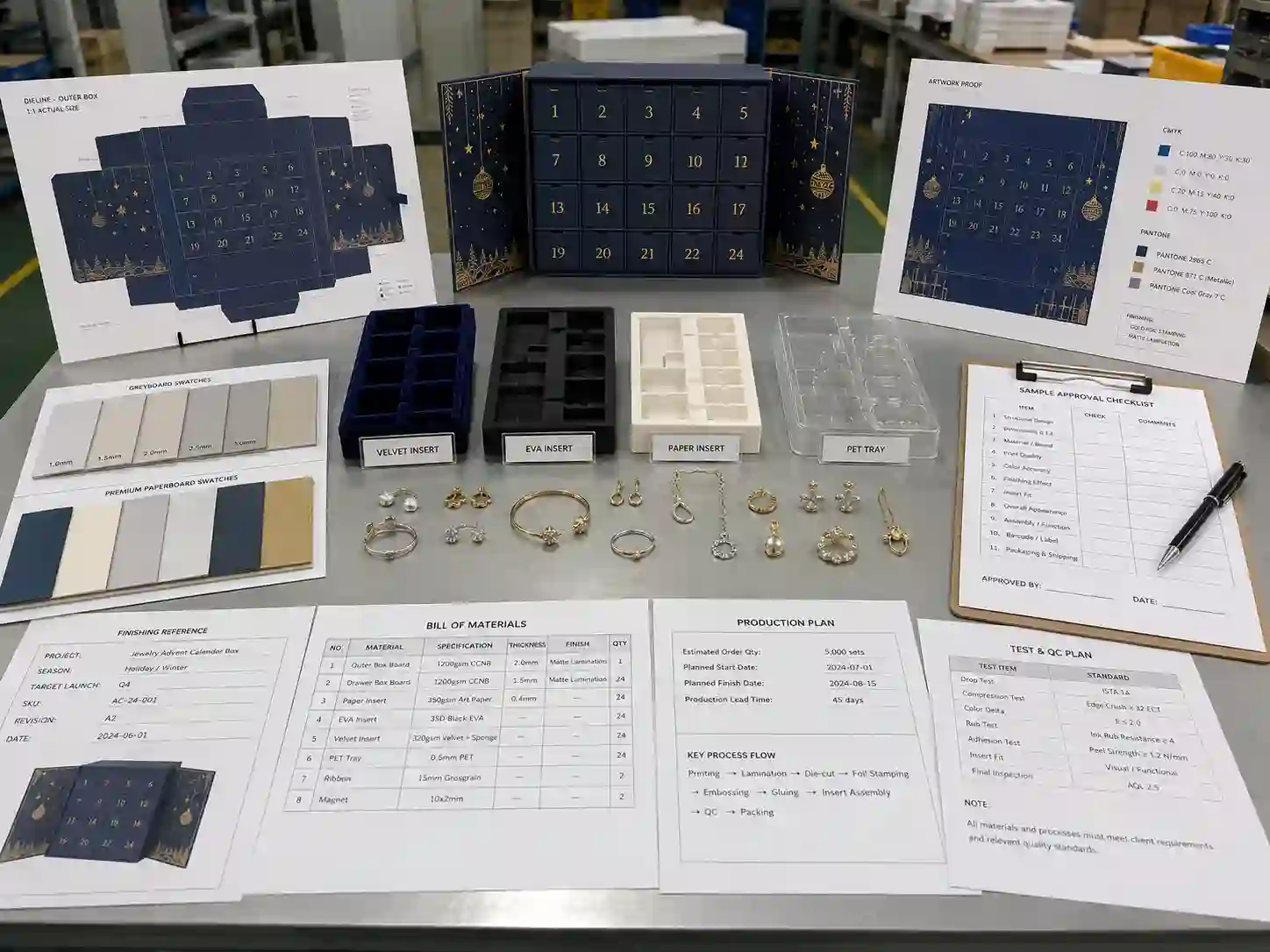
Which finishing choices make sense for jewelry calendars?
- Foil stamping: Useful for premium logos, date numbers, borders, and limited-edition details.
- Embossing: Good for luxury texture, but the artwork should avoid very thin lines that may not press clearly.
- Spot UV: Effective for highlighting patterns, icons, or product names on matte surfaces.
- Matte lamination: Often chosen for a premium, controlled look and better scuff resistance than uncoated print.
- Gloss lamination: Good for bright retail colors, but fingerprints and reflections should be considered.
- Pantone color: Useful when brand color consistency is more important than standard CMYK matching.
Buyer tip: Request a digital proof for layout checking, but use a physical print proof or pre-production sample when color, foil, embossing, lamination, or retail shelf appearance is critical.
What sample process should buyers expect before mass production?
A responsible sample process should move from structure confirmation to artwork proofing, prototype testing, pre-production sample approval, and then mass production. Skipping the sample stage is risky because jewelry calendars combine small compartments, decorative surfaces, inserts, and manual assembly.
The first prototype may be a white sample or blank sample used to test size, structure, insert fit, drawer movement, door opening, and general assembly. After the blank structure is approved, the printed sample can show CMYK, Pantone, lamination, foil stamping, embossing, spot UV, and final visual effect. The pre-production sample should represent the actual production method as closely as possible.
Giftpackpro’s custom advent calendar box services can support buyers through structure discussion, material selection, sample development, artwork checking, and production planning. Buyers can also review related advent calendar box buying guides to compare packaging decisions across jewelry, cosmetics, candles, chocolate, toys, tea, coffee, beverages, and gift categories.
Sample approval checklist for jewelry advent calendar boxes
- Confirm outer box size, depth, opening method, and shelf display direction.
- Check each compartment against the real jewelry item or approved dummy sample.
- Test anti-scratch protection for polished metal, plated jewelry, stones, beads, and chains.
- Open and close doors, drawers, hinges, ribbons, magnets, and sleeves several times.
- Review CMYK, Pantone, foil stamping, embossing, spot UV, matte lamination, and gloss lamination against approved artwork.
- Check barcode size, retail label area, item numbering, warning text, and shipping mark requirements.
- Shake, tilt, and handle the sample to see whether products move, fall out, or tangle.
- Approve the signed sample or written sample comments before bulk production begins.
Quotable B2B statement: “For jewelry advent calendar boxes, sample approval should confirm both the retail appearance and the hidden insert performance, because most customer complaints come from poor fit, surface damage, missing pieces, or weak opening details.”
How do MOQ, cost, and lead time change by design choice?
MOQ, cost, and lead time depend on box structure, material, printing process, insert type, assembly complexity, and export packing requirements. A simple folding carton calendar usually costs less and moves faster than a rigid drawer box with velvet inserts, foil stamping, and multiple hand-assembled parts.
Common cost drivers include greyboard thickness, paperboard grade, laminated paper area, number of compartments, insert material, tray tooling, drawer quantity, magnetic closure, ribbon pullers, foil stamping plates, embossing dies, spot UV screens, printed color versions, and manual packing steps. Buyers should also include sample cost, pre-production sample time, mass production time, inspection time, and sea or air freight planning in the campaign calendar.
Exact MOQ and lead time should be confirmed project by project. Buyers can reduce quotation delays by preparing technical details before contacting the supplier, especially when the design has many SKUs, language versions, or retail labeling requirements.
Decision guide: which option should you choose?
| Buyer situation | Recommended direction | Reason |
|---|---|---|
| Luxury jewelry gift set for retail stores | Rigid door-opening box or book-style rigid box with velvet or EVA insert | Supports premium presentation, stronger structure, and high-value unboxing |
| Charm bracelet or pendant campaign with many small pieces | Drawer box or rigid compartment box with fitted EVA, velvet, or lined insert | Improves item separation and reduces movement |
| Large-volume promotional accessory calendar | Folding carton with paperboard insert | Better cost control and efficient production for seasonal volume |
| E-commerce gift set shipped individually | Rigid or reinforced paperboard structure with tested insert retention and protective mailer plan | Reduces damage risk during parcel handling |
| Eco-positioned seasonal campaign | Paper insert, molded pulp, FSC-verified paper options, and simple finishing | Aligns better with paper-based packaging goals and easier material communication |
For paper sourcing claims, buyers should verify requirements with official programs rather than relying on supplier statements alone. The Forest Stewardship Council provides information on FSC certification and responsible forest sourcing.
What QC points are critical for jewelry advent calendar boxes?
QC should focus on structure, appearance, insert fit, assembly accuracy, product retention, carton strength, and labeling accuracy. Jewelry calendars have many small compartments, so a small production error can affect many units at once.
During incoming material inspection, the factory should check paper, greyboard, lamination film, printed sheets, foil effect, insert material, magnets, ribbons, glue, and tray quality. During production, operators should monitor die-cut accuracy, folding, wrapping, glue position, drawer clearance, door opening, numbering sequence, and insert placement. Final inspection should confirm that the finished box matches the approved sample and packing specification.
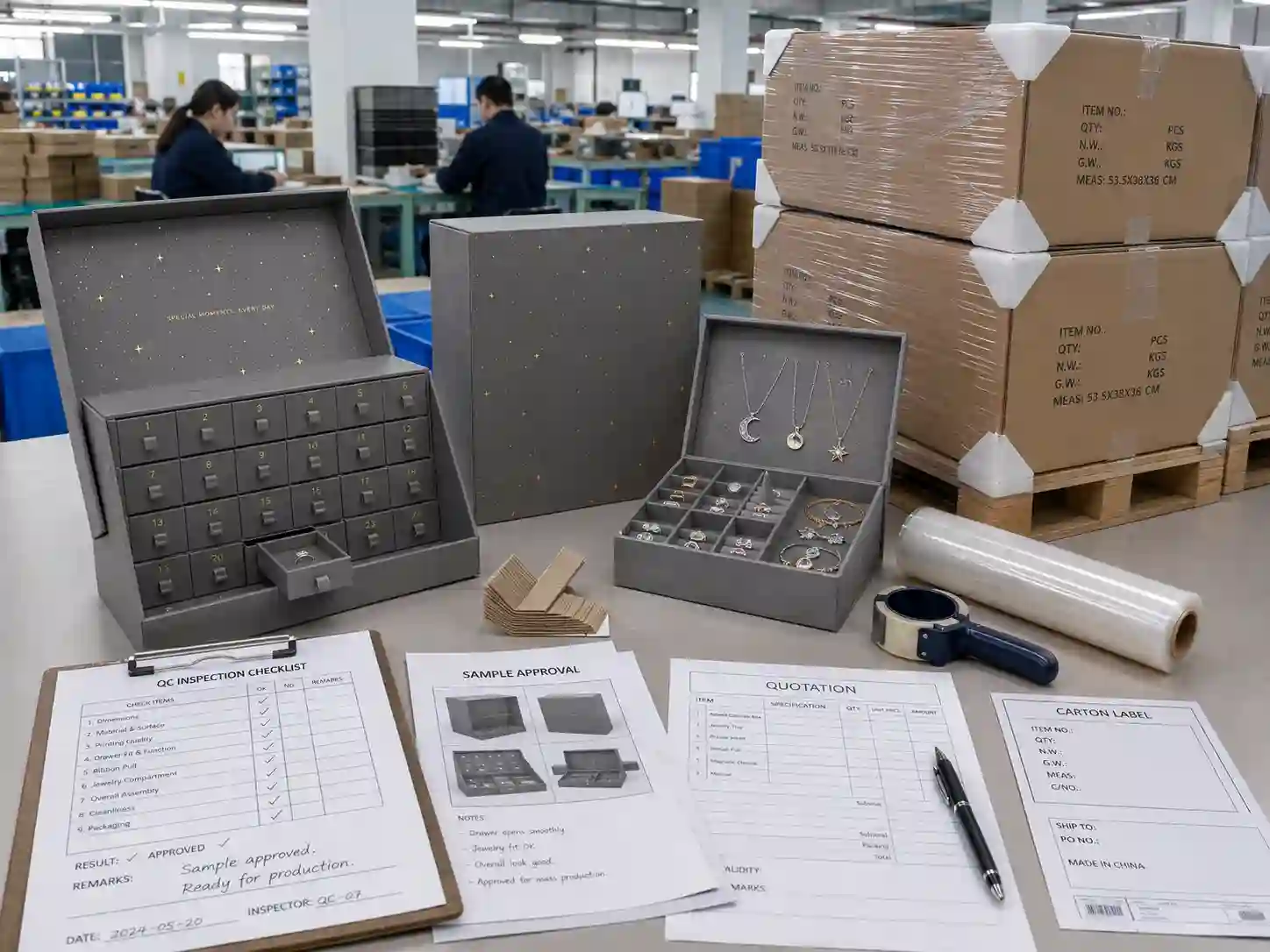
QC checklist for B2B buyers
- Compare mass production units with the approved sample and signed artwork proof.
- Check color consistency between panels, batches, and language versions.
- Inspect foil stamping, embossing, spot UV, lamination, glue marks, scratches, dents, and edge wrapping.
- Verify that each door, drawer, and compartment number is in the correct position.
- Test jewelry fit, anti-scratch protection, product retention, and removal experience.
- Confirm retail barcode, product label, warning label, recycling mark, and shipping mark placement.
- Check export carton size, carton weight, inner packing, corner protection, and pallet plan.
- Record defects clearly with photos, quantity, severity, and agreed corrective action.
QC tip: For jewelry advent calendar boxes, inspect both empty packaging and packed samples. Empty boxes may pass visual inspection, but packed boxes reveal real issues such as chain movement, drawer sliding, compartment collapse, and surface scratching.
How should export packing be planned for seasonal delivery?
Export packing should protect the calendar structure during factory handling, container loading, pallet movement, warehouse storage, and final distribution. The packing method should be agreed before mass production because carton size, pallet height, and shipping marks can affect cost and delivery planning.
For rigid boxes and drawer calendars, buyers should confirm whether each unit needs a polybag, tissue wrap, sleeve, inner carton, corner protector, master export carton, or pallet. Export cartons should be strong enough for stacking and should show clear shipping marks, item code, quantity, gross weight, net weight, carton dimensions, destination, and handling symbols when required.
For e-commerce or Amazon-style fulfillment, buyers may need additional drop-test planning, carton labeling, barcode placement, and individual unit protection. Testing requirements vary by channel, so buyers should confirm the latest retailer, marketplace, or logistics requirements before production.
How should buyers compare jewelry advent calendar box suppliers?
Buyers should compare suppliers by structure engineering ability, sampling process, insert experience, artwork checking, QC control, export packing knowledge, communication speed, and quotation transparency. The lowest unit price is not always the lowest total cost if the supplier cannot control fit, finishing, packing, or delivery timing.
A practical supplier comparison should include sample quality, dieline accuracy, material options, ability to produce rigid boxes and folding cartons, insert recommendations, printing proof management, defect handling, carton packing proposal, and export documentation support. Buyers should ask whether the factory can provide photos or videos during sample review, production, QC, and packing stages.
Visit Giftpackpro packaging factory to understand the factory-side packaging focus, or browse custom advent calendar box products to compare structure ideas before finalizing a jewelry calendar project.
Supplier selection questions to ask
- Can the supplier help adjust the dieline based on jewelry size, insert material, and assembly tolerance?
- Can they make a blank prototype before full printed sampling?
- Can they provide rigid box, folding carton, drawer box, and door-opening box options?
- Can they test velvet, EVA, paper insert, PET tray, foam, or molded pulp insert choices?
- Can they check CMYK, Pantone, foil stamping, embossing, spot UV, matte lamination, and gloss lamination details before mass production?
- Can they define QC points and export carton packing before the purchase order?
- Is the quotation clear about material, size, quantity, insert, printing, finishing, sample cost, MOQ, lead time, and packing method?
What information should buyers prepare before requesting a quotation?
Buyers should prepare product details, target structure, quantity, artwork requirements, insert expectations, packing needs, destination, and timeline before asking for a quotation. The more complete the RFQ, the faster the supplier can recommend a realistic solution.
Quotation preparation checklist
- Target quantity or estimated MOQ range.
- Outer box size or product size list for all jewelry items.
- Jewelry type, weight, finish, and scratch-sensitivity notes.
- Preferred structure: rigid box, folding carton, drawer box, door-opening box, book-style box, or fold-out box.
- Preferred insert: velvet, EVA, foam, paper insert, PET tray, or molded pulp.
- Printing requirements: CMYK, Pantone, foil stamping, embossing, spot UV, matte lamination, gloss lamination, or special paper.
- Dieline, artwork file, reference sample, or design concept if available.
- Retail label, barcode, warning text, language version, and theft-prevention label space.
- Sample requirement: blank sample, printed sample, or pre-production sample.
- Export packing request: export carton, inner carton, pallet, shipping marks, carton label, and destination port or country.
- Required delivery window for seasonal launch, retail shelf date, or warehouse appointment.
Buyers who are ready to compare structure, insert, sample, MOQ, lead time, QC, and export packing details can request a custom quote from Giftpackpro with the above information. This helps the packaging team recommend a practical design instead of giving a vague estimate.
What common mistakes should buyers avoid?
The most common mistakes are choosing structure before product measurement, approving artwork before dieline confirmation, using weak inserts, skipping packed-sample testing, and requesting quotation without enough technical details. These mistakes can delay sampling, increase cost, or create avoidable mass production risks.
- Using cosmetic box logic for jewelry: Jewelry needs smaller cavities, softer contact surfaces, and more precise retention than many cosmetics or gift items.
- Ignoring anti-scratch protection: Polished jewelry, plated accessories, stones, and beads can be damaged by hard trays or rough paper edges.
- Overloading small drawers: Drawer calendars look premium, but drawer size and friction must be tested with actual packed items.
- Placing foil or embossing across die-cut doors: Decoration may crack, shift, or look uneven near cuts and folds.
- No space for retail labels: Barcodes, price labels, anti-theft stickers, recycling marks, and importer labels need planned areas.
- Approving only digital renderings: Renderings cannot confirm material thickness, opening feel, insert fit, or packing durability.
- Forgetting export packing early: Oversized boxes can increase freight cost, carton size, pallet height, and warehouse handling issues.
FAQ: Jewelry advent calendar boxes for B2B buyers
Are rigid boxes better than folding cartons for jewelry advent calendars?
Rigid boxes are usually better for premium jewelry campaigns because they offer stronger structure and a higher-value presentation. Folding cartons are better when the buyer needs lower cost, lighter weight, and larger promotional volume.
Which insert is safest for scratch-sensitive jewelry?
Velvet inserts, lined EVA inserts, and soft foam inserts are common choices for scratch-sensitive jewelry. The safest option should be confirmed through sample testing with the actual jewelry finish.
Can one box design hold rings, earrings, bracelets, and charms together?
Yes, but the dieline should use different cavity sizes or insert cuts for each product type. Mixed jewelry calendars need careful layout planning to prevent tangling, movement, and difficult removal.
What is the difference between a prototype and a pre-production sample?
A prototype usually tests structure, size, insert fit, and opening method. A pre-production sample should reflect the final materials, printing, finishing, assembly method, and packing approach before mass production starts.
What affects the quotation most?
The main quotation drivers are box size, structure, greyboard or paperboard thickness, insert material, printing colors, finishing processes, order quantity, manual assembly steps, sample requirements, export carton packing, and delivery schedule.
How early should buyers start a seasonal jewelry calendar project?
Buyers should start early enough to allow for structure design, dieline adjustment, blank sample, printed sample, pre-production approval, mass production, QC, export packing, and international shipping. Seasonal campaigns leave little room for repeated sampling after the launch window is fixed.
How should buyers move from idea to production with Giftpackpro?
To design jewelry advent calendar boxes successfully, prepare the jewelry list, target structure, insert preference, artwork direction, quantity, sample needs, QC expectations, export packing plan, and delivery schedule before requesting a quotation. A practical RFQ allows Giftpackpro to evaluate the structure, recommend suitable materials, estimate MOQ and lead time, and plan a sample that can be approved for mass production.
For overseas brands, wholesalers, retail buyers, e-commerce sellers, gift companies, and packaging purchasing teams, the best result comes from treating the calendar as a complete packaging system rather than a decorated paper box. When the structure, insert, artwork, sample approval, QC, and export packing are aligned early, jewelry advent calendar boxes can support premium presentation, efficient production, and more reliable seasonal delivery.