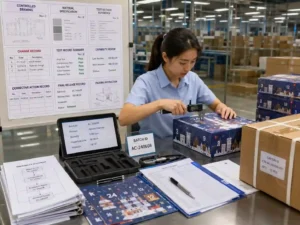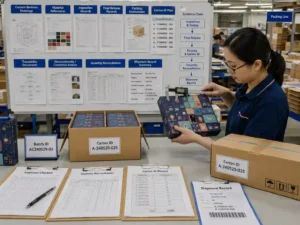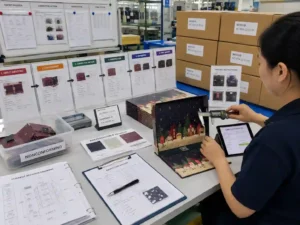
Quick answer: Jewelry advent calendar boxes are custom seasonal packaging systems designed to present rings, earrings, bracelets, charms, pendants, hair accessories, and small gift items in numbered compartments. For B2B buyers, the best solution depends on product size, anti-scratch protection, insert material, door or drawer structure, artwork accuracy, premium finishing, MOQ, sampling, QC, and export packing. A strong project starts with confirmed product dimensions, target retail channel, dieline approval, color proofing, insert testing, and clear quotation details before mass production.
For jewelry brands, wholesalers, retail buyers, e-commerce sellers, and gift companies, the packaging must do more than look festive. It must protect small items, support a premium unboxing experience, provide space for labels or anti-theft requirements, and survive bulk export handling. This guide explains how to specify jewelry advent calendar boxes from a factory and purchasing point of view.
What should buyers understand before ordering jewelry advent calendar boxes?
Buyers should understand that jewelry advent calendar boxes are not standard gift boxes with printed numbers; they are multi-compartment packaging projects that combine structure, insert engineering, artwork control, finishing, assembly tolerance, and export packing. Small jewelry pieces can shift, scratch, tangle, or disappear inside the wrong compartment, so packaging decisions must be made around real product samples.
A good buyer brief should define the product range first. A calendar for earrings and rings may need shallow anti-scratch cavities, while a bracelet or charm calendar may need deeper compartments, soft insert lining, or small pouches. If the project includes mixed SKUs, the largest and most fragile items should guide the insert layout.
Jewelry packaging also has retail security requirements. Some buyers need space for barcode labels, warning labels, material care cards, anti-theft tags, batch codes, or retailer routing stickers. These requirements should be considered during dieline planning, not added after artwork approval.
Buyer tip: Before requesting a quotation, prepare a product size table with length, width, height, weight, surface sensitivity, and packing method for every jewelry item. This helps the factory suggest the right structure, insert, paperboard, and finishing options without guessing.
Which box structure is best for a jewelry advent calendar project?
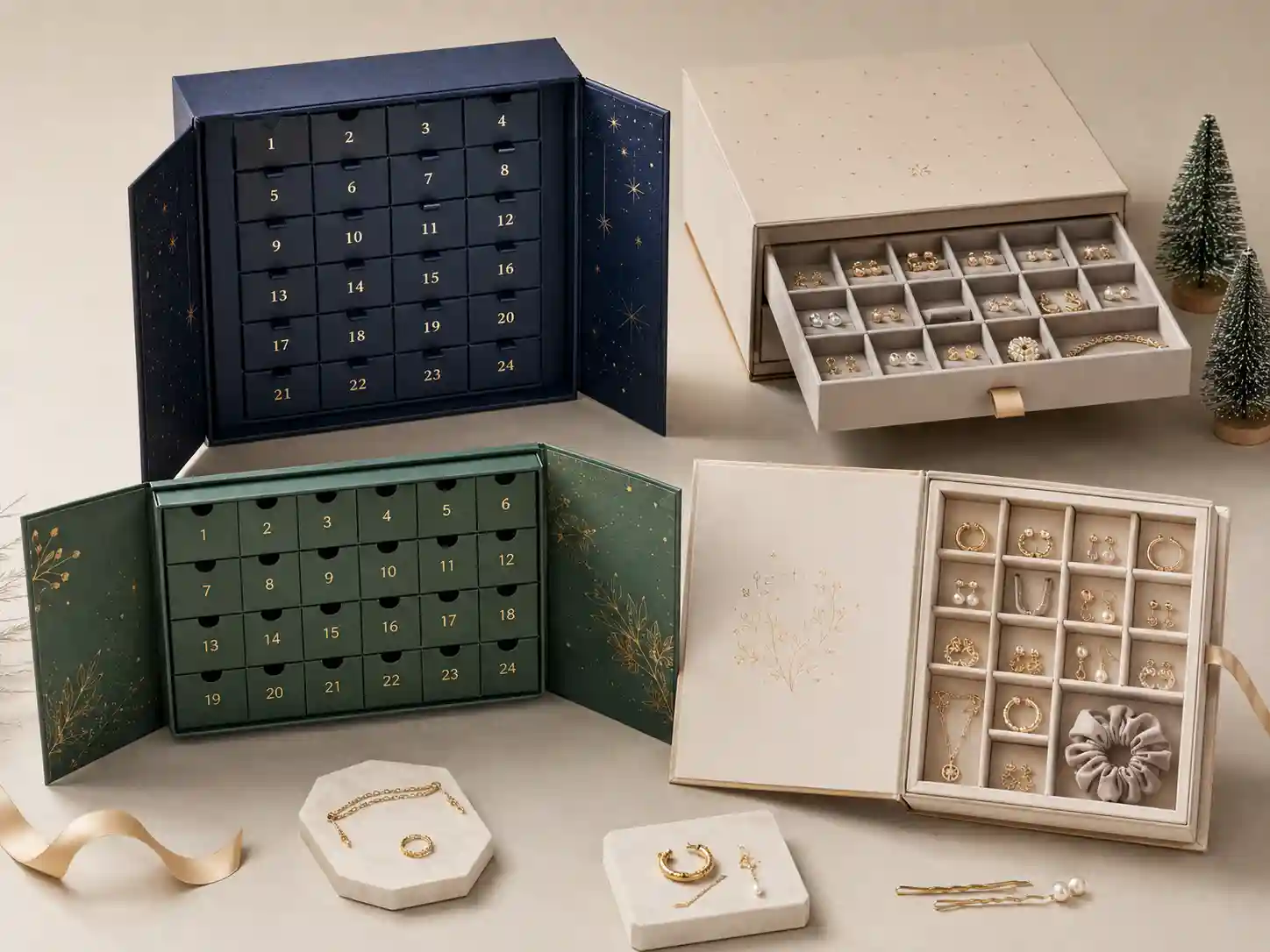
The best structure depends on target price level, retail display method, shipping route, and the opening experience you want to create. Rigid door-opening boxes and drawer boxes usually feel more premium, while folding carton calendars can be more cost-efficient for lighter items and larger promotional runs.
| Structure option | Best for | Buyer advantages | Watch points |
|---|---|---|---|
| Rigid door-opening box | Premium jewelry gift sets, boutique retail, influencer mailers | Strong presentation, good surface for foil stamping, embossing, spot UV, and matte lamination | Higher unit cost, more assembly time, requires careful door tolerance checking |
| Drawer box | Bracelet, charm, ring, or mixed jewelry calendars with premium reveal | Smooth opening experience, strong perceived value, good for reusable packaging concepts | Drawer friction, sleeve tightness, and insert movement must be tested with real products |
| Book-style advent calendar | Retail gift displays and branded seasonal launches | Large artwork area, strong shelf impact, clear storytelling space without using real licensed characters | Magnet, ribbon, hinge, and panel alignment should be checked during sampling |
| Folding carton calendar | Cost-sensitive promotions, lightweight jewelry accessories, large-volume campaigns | Efficient material use, lighter shipping weight, suitable for high-volume retail programs | Less rigid protection; insert support and carton board strength matter more |
| Hybrid rigid outer box with paperboard insert | Mid-to-premium jewelry brands needing balance between cost and protection | Good appearance with flexible insert layout and manageable cost | Insert compression, glue strength, and compartment accuracy require factory QC |
For luxury-positioned jewelry advent calendar boxes, a rigid box with separate doors or drawers usually gives the strongest retail impression. For online sellers shipping direct to consumers, the structure should also consider drop resistance, outer carton protection, and whether the calendar will be packed with additional mailer protection.
If the buyer is unsure which structure fits the product line, reviewing existing custom advent calendar box products can help compare door-opening, drawer, folding carton, and book-style formats before starting a new dieline.
How should inserts protect small jewelry items from scratches and movement?
Jewelry inserts should hold each item in a stable position while preventing surface abrasion, metal-to-metal contact, and movement during transport. The insert choice affects product protection, opening experience, cost, sustainability positioning, and assembly speed.
Common choices include paper insert, PET tray, EVA insert, foam insert, velvet-covered insert, and molded pulp. For jewelry, buyers often choose EVA or velvet-covered inserts for premium presentation, but paperboard inserts can work well when products are individually packed in small envelopes, fabric pouches, cards, or sleeves.
- Paper insert: Good for lightweight jewelry cards, envelopes, charms, and accessories. It is cost-efficient and easier to recycle when designed without mixed materials.
- EVA insert: Suitable for rings, pendants, earrings, and small items needing stable cavities. It can be laminated with velvet-like surface material for a softer look.
- Foam insert: Good cushioning, but buyers should check surface compatibility and odor requirements, especially for premium jewelry presentation.
- PET tray: Useful when precise cavities and visibility are needed, but it may not deliver the soft-touch feeling some jewelry brands expect.
- Molded pulp: More suitable for eco-positioned projects, though fine jewelry cavities may need additional testing for surface texture and fit accuracy.
- Velvet insert: Strong premium appearance for rings, earrings, and pendants, but cost, lint, glue, and color transfer checks should be included in sampling.
Factory tip: Do not approve an insert only from a 2D drawing. For jewelry calendars, cavity depth, finger access, anti-scratch surface, and product removal comfort should be checked with physical samples before pre-production approval.
Which printing method should buyers choose: CMYK or Pantone?
CMYK is suitable for full-color artwork, gradients, patterns, and seasonal graphics, while Pantone is preferred when brand color consistency is critical. Many jewelry advent calendar boxes use both: CMYK for decorative artwork and Pantone spot colors for key brand tones or solid background colors.
CMYK printing can show natural variation across paper types, lamination, and production batches. A color that looks bright on a screen may appear darker after matte lamination or slightly different on coated and uncoated paper. Pantone can improve consistency for brand colors, but buyers should still approve a printed proof on the intended material.
For overseas purchasing teams, the safest workflow is to confirm artwork in stages: digital artwork check, dieline check, digital proof, printed color proof, sample approval, and pre-production sample before mass production. This reduces the risk of wrong numbering, shifted artwork, barcode issues, or color mismatch after bulk printing.
Brands can review custom advent calendar box services to understand how structure development, artwork checking, sample making, and production support connect during a custom packaging project.
Which finishing options create a premium jewelry presentation?
Finishing should match the jewelry brand position and the structure of the box, not simply add decoration. Matte lamination, gloss lamination, foil stamping, embossing, debossing, and spot UV all change the appearance, touch, cost, and production risk of jewelry advent calendar boxes.
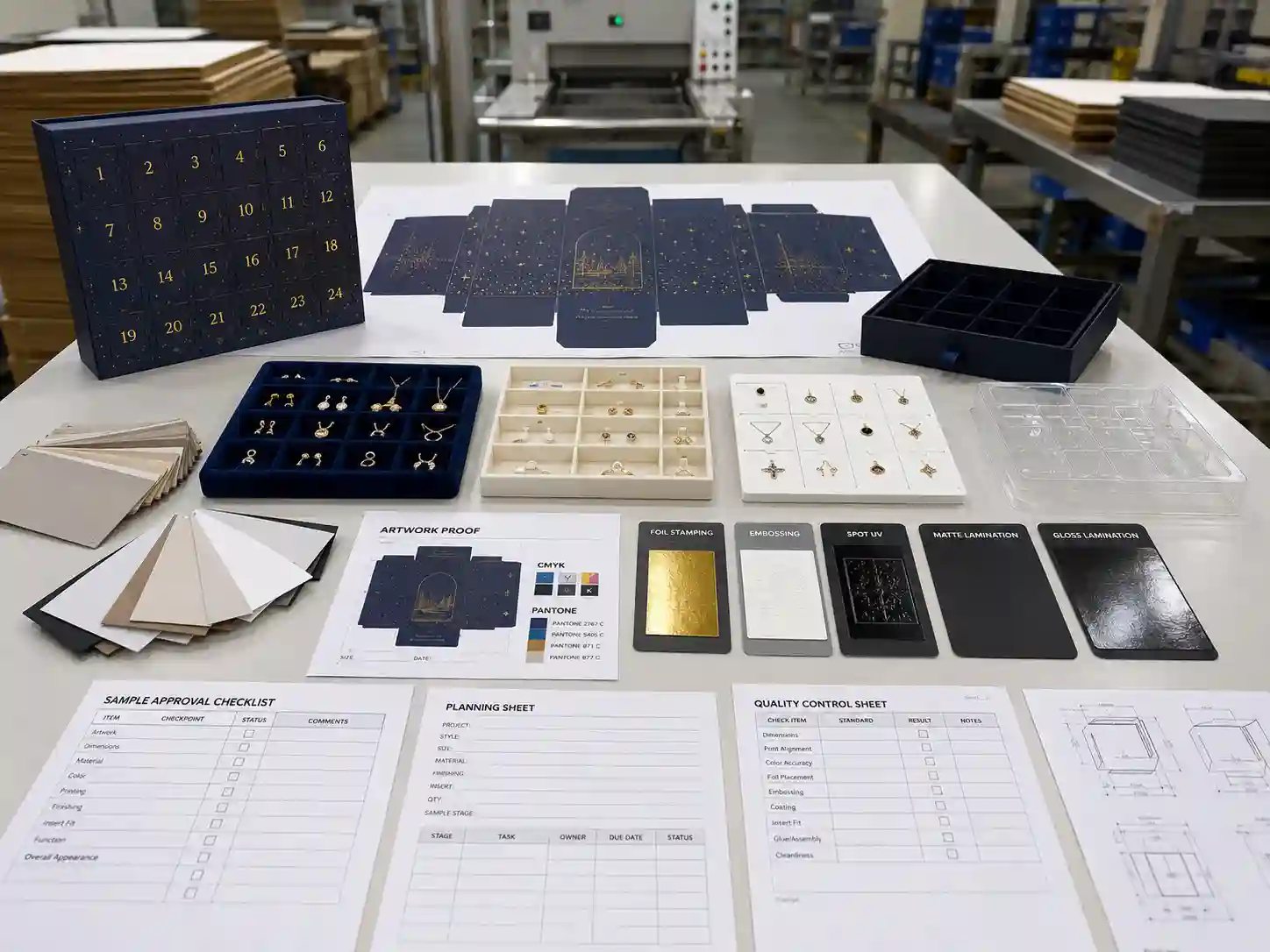
| Finishing option | Best use | Production note |
|---|---|---|
| Matte lamination | Premium soft appearance, luxury jewelry packaging, darker color palettes | Can show scratches or fingerprints on dark backgrounds; sample testing is important |
| Gloss lamination | Bright retail display, vivid seasonal artwork, stronger shine | May reduce a luxury feel if overused; check glare under retail lighting |
| Foil stamping | Logo, numbers, borders, stars, jewelry-themed accents | Fine lines and small numbered doors require accurate registration tolerance |
| Embossing or debossing | Logo mark, texture, premium brand detail | Works best on stable board and simple shapes; avoid too much fine detail |
| Spot UV | Highlighting numbers, patterns, product names, or decorative areas | Needs precise alignment with printed artwork; test on matte surfaces |
| Soft-touch film | High-end gifting and boutique presentation | Check scuff resistance, fingerprints, and compatibility with foil or UV |
For jewelry packaging, less can feel more premium. A matte laminated rigid box with controlled foil stamping and subtle embossing may look more expensive than a crowded design with too many finishes. Buyers should also consider production repeatability. Fine foil numbers on 24 small doors can create more registration risk than foil on one main logo panel.
Buyer tip: Ask the supplier which finishing areas need minimum line thickness, spacing, and tolerance. Confirm these limits before final artwork, especially if the calendar has small doors, small numbers, or detailed metallic patterns.
How should artwork, dielines, and color proofs be checked?
Artwork checking should confirm that the dieline, print layout, numbers, cut lines, fold lines, glue areas, barcode zones, and finishing layers all match the final structure. Most costly artwork mistakes happen when beautiful graphics are approved before the functional packaging details are checked.
For a jewelry advent calendar, the dieline should show every compartment, door, drawer, sleeve, hinge, insert opening, and glue area. Buyers should confirm that numbering is readable, door edges do not cut through important artwork, and retail label space remains clear. If the box needs a barcode, batch code, country-of-origin label, age warning, recycling mark, or anti-theft label area, reserve that space early.
Artwork checklist before sample production
- Confirm final box size, compartment count, and product position for each date.
- Check that all text is outlined or fonts are supplied according to factory requirements.
- Use high-resolution images and avoid low-quality web graphics.
- Separate CMYK, Pantone, foil stamping, embossing, debossing, and spot UV layers clearly.
- Confirm bleed, safe zone, cut line, fold line, perforation, and glue area.
- Check barcode size, quiet zone, and scan position if retail labeling is required. Buyers can review official GS1 barcode standards for general barcode guidance.
- Confirm spelling, numbering sequence, legal symbols, recycling marks, and shipping label areas.
- Approve a printed proof under practical lighting, not only on a computer screen.
QC tip: Print approval should include both color and construction. A beautiful proof is not ready for production if door perforation, drawer movement, insert fit, or barcode scanning has not been checked.
What MOQ, sample, and lead time factors should buyers expect?
MOQ and lead time depend on structure, material, printing, finishing, insert type, order quantity, and factory capacity during seasonal production. Jewelry advent calendar boxes with rigid construction, velvet or EVA inserts, multiple finishing processes, and hand assembly usually require more time than simple folding carton calendars.
Buyers should avoid treating MOQ as the only cost question. A lower MOQ may have a higher unit cost because printing setup, tooling, foil dies, cutting dies, insert molds, and sample labor are spread across fewer units. For retail programs, the better question is whether the supplier can deliver stable quality at the required quantity and timeline.
Typical project stages include quotation, dieline confirmation, artwork adjustment, prototype or white sample, printed sample, pre-production sample, mass production, final QC, export packing, and shipment. Exact timing should be confirmed with the factory based on structure and season.
A custom advent calendar boxes manufacturer should be able to explain which parts of the project drive cost and time: greyboard thickness, paperboard grade, insert complexity, number of compartments, foil area, lamination type, assembly method, carton packing, and pallet requirements.
How should buyers compare suppliers for jewelry advent calendar boxes?
Buyers should compare suppliers by engineering capability, sample accuracy, artwork checking, insert testing, QC process, communication quality, and export experience, not only by unit price. Jewelry calendars are detail-heavy products, so weak sample control can create expensive problems during mass production.
| Supplier comparison point | What to ask | Why it matters |
|---|---|---|
| Structure development | Can the factory recommend rigid, drawer, folding carton, or book-style formats based on product dimensions? | Prevents overbuilding or under-protecting the packaging |
| Insert engineering | Will they test EVA, velvet, paper, PET, foam, or molded pulp inserts with actual jewelry samples? | Reduces scratching, rattling, tangling, and poor opening experience |
| Artwork checking | Do they review dieline, bleed, Pantone, CMYK, foil, embossing, spot UV, and barcode placement? | Prevents print and finishing errors before mass production |
| Sample process | Can they provide white sample, printed prototype, and pre-production sample when needed? | Helps buyers approve structure, color, and assembly before bulk order |
| QC system | What do they inspect before export packing? | Confirms doors, drawers, inserts, color, glue, finishing, labels, and cartons are checked |
| Export packing | Can they prepare strong export cartons, shipping marks, pallet packing, and carton labels? | Protects packaging during international shipping and warehouse handling |
Buyers can also review the Giftpackpro packaging factory background to understand factory-side capabilities, production focus, and project communication before starting a custom order.
What QC checks are important before mass production and shipment?
QC should confirm that approved samples and mass production match in structure, color, finishing, insert fit, assembly, labeling, and export packing. For jewelry advent calendar boxes, small differences in compartment size or door tolerance can affect the buyer’s product presentation.
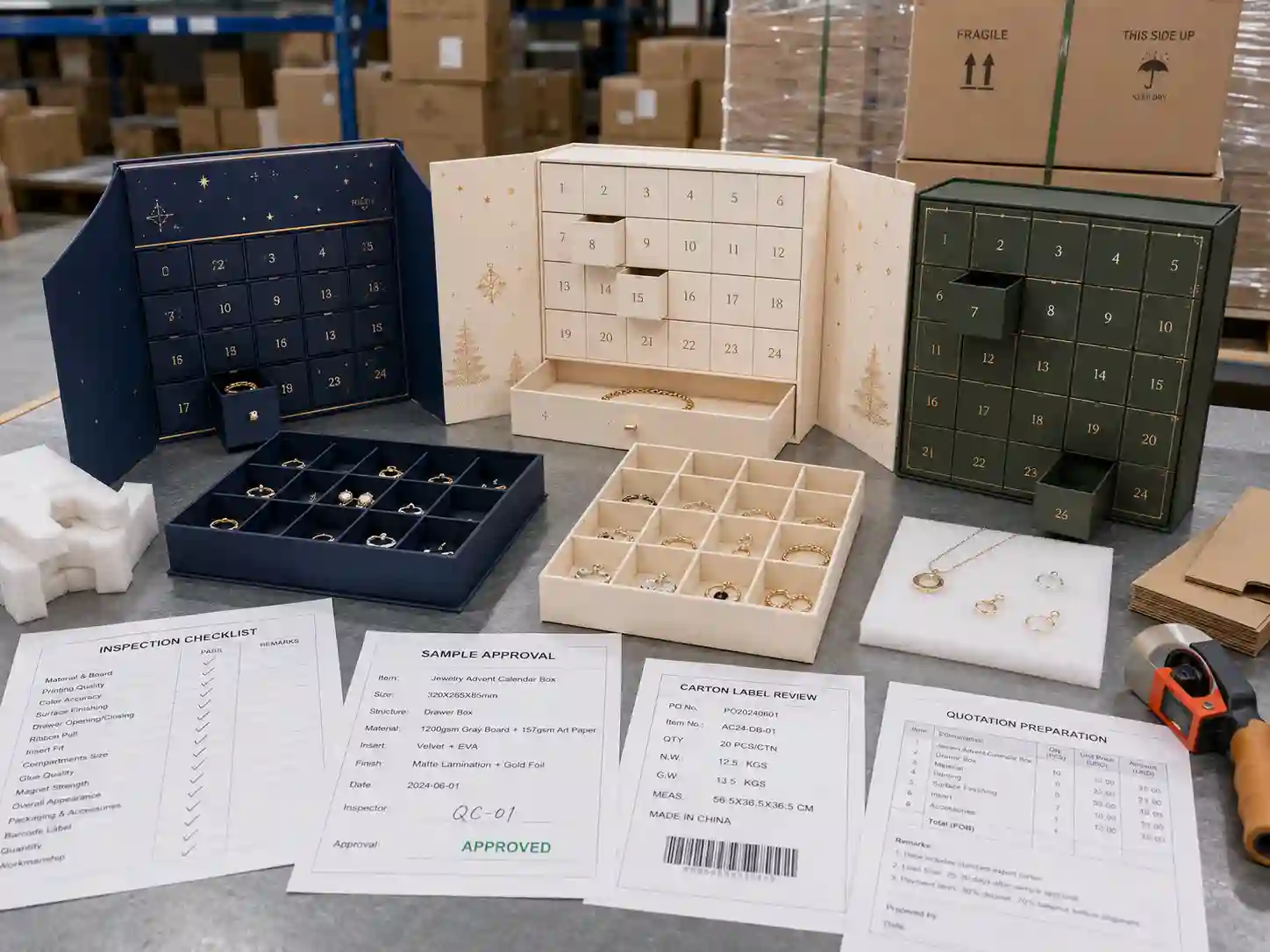
Practical QC checklist for jewelry advent calendar boxes
- Check outer box dimensions, compartment count, and assembly alignment against the approved sample.
- Test door opening, drawer movement, perforation strength, ribbon pull, magnet closure, and hinge durability where applicable.
- Confirm insert cavity size, anti-scratch surface, product removal access, and movement after gentle shaking.
- Inspect CMYK color, Pantone color, foil stamping, embossing, spot UV, matte lamination, and gloss lamination.
- Check glue marks, edge wrapping, board warping, scratches, dents, dust, lint, odor, and surface scuffing.
- Scan barcodes and check retail label placement when required.
- Confirm product sequence if the factory is involved in loading jewelry or accessory items.
- Verify inner packing, export carton strength, carton label, shipping marks, pallet wrapping, and corner protection.
If buyers need transit testing, they can discuss test expectations with the supplier and reference official resources such as the International Safe Transit Association for packaging performance testing concepts. The exact test plan should match the product value, carton size, shipping method, and retailer requirements.
Quotable B2B note: For jewelry advent calendar boxes, QC is not only a print inspection; it is a product-fit, opening-experience, insert-security, and export-packing inspection.
How should export packing be planned for jewelry advent calendar boxes?
Export packing should protect the finished calendars from compression, corner damage, moisture exposure, label confusion, and pallet movement during international transport. Premium packaging can lose retail value if cartons are weak or pallet packing is not planned.
Buyers should specify whether the calendars ship empty or pre-loaded with jewelry. Empty calendars still need corner protection, inner bags, dividers, and strong export cartons. Pre-loaded calendars may need extra insert security, anti-rattle packing, carton orientation control, and tighter carton drop considerations.
Shipping marks should be generic and accurate. Carton labels usually include item number, purchase order number, quantity per carton, carton size, gross weight, net weight, destination, and handling marks when required. Retail buyers may also require pallet labels, carton sequence labels, or warehouse routing information.
Factory tip: Approve the carton packing method before mass production finishes. Waiting until the end can create problems with carton size, pallet count, freight estimate, and warehouse receiving requirements.
What information should buyers prepare before requesting a quotation?
A complete RFQ helps the factory quote faster and more accurately. Buyers should provide product dimensions, structure preference, insert requirements, artwork expectations, quantity, destination, timeline, and packing needs when asking Giftpackpro for a sample or quotation.
Quotation preparation checklist
- Project name and target launch season.
- Calendar format: rigid box, drawer box, door-opening box, book-style box, or folding carton.
- Number of compartments and product list for each compartment.
- Jewelry dimensions, weight, surface sensitivity, and whether items are packed in pouches, cards, sleeves, or loose formats.
- Preferred insert: paper insert, PET tray, EVA insert, foam, molded pulp, velvet-covered insert, or factory recommendation.
- Material preference: paperboard, greyboard, specialty paper, coated paper, or recyclable positioning.
- Printing requirements: CMYK, Pantone, inside printing, outside printing, or numbered doors.
- Finishing requirements: matte lamination, gloss lamination, foil stamping, embossing, debossing, spot UV, or soft-touch film.
- Artwork status: ready file, dieline needed, color proof needed, or design still in progress.
- Estimated order quantity, target MOQ, sample request, pre-production sample needs, and delivery deadline.
- Export packing requirements: carton limit, pallet request, shipping marks, retailer label, Amazon/e-commerce prep, or warehouse instructions.
- Destination country, shipping method, and any retailer compliance documents buyers need to verify.
Buyers can browse more advent calendar box buying guides for planning ideas, then request a custom quote with product details, artwork files, and target quantity. For custom projects, the more complete the RFQ, the easier it is to compare structure, insert, printing, sample, lead time, and export packing options.
What common mistakes should buyers avoid?
The most common mistakes are approving artwork without a dieline check, choosing inserts without real product testing, ignoring barcode or label space, and comparing suppliers only by unit price. These mistakes can delay sample approval, increase rework, or create retail quality issues after production.
- Using one compartment size for all jewelry: Rings, earrings, bracelets, and charms may need different depths and access openings.
- Overusing finishing effects: Too much foil, spot UV, and embossing can increase cost and registration risk.
- Skipping color proofing: Screen color is not a reliable production standard for CMYK or Pantone approval.
- Ignoring insert surface: Rough inserts, exposed glue, or unsuitable foam can affect jewelry presentation.
- Forgetting retail labels: Barcode, anti-theft label, warning label, and shipping label space should be reserved early.
- Approving only a photo sample: Physical samples are important for opening feel, insert fit, surface finish, and assembly quality.
- Underestimating export packing: Weak cartons or unclear shipping marks can damage finished calendars before they reach the buyer’s warehouse.
Decision guide: how should buyers choose the right jewelry advent calendar box?
Buyers should choose the box by matching brand position, product protection, retail channel, budget, and launch timeline. The right option is the one that protects the jewelry, fits the supply chain, and can be produced consistently at the target quantity.
| Buyer priority | Recommended direction | Reason |
|---|---|---|
| Luxury presentation | Rigid box with drawer or book-style opening, velvet or EVA insert, matte lamination, controlled foil stamping | Creates premium opening experience and strong shelf value |
| Cost-efficient retail promotion | Folding carton or paperboard structure with paper insert | Reduces material and freight cost for larger campaigns |
| Mixed jewelry sizes | Custom insert layout with different cavity depths | Improves fit for rings, bracelets, charms, earrings, and accessories |
| E-commerce shipping | Stronger outer structure, secure insert, tested export carton | Reduces damage during parcel and warehouse handling |
| Strict brand color | Pantone color control with printed proof and approved pre-production sample | Improves consistency across bulk production |
| Retail barcode needs | Reserve label area on dieline and test barcode scanning | Prevents last-minute artwork changes and retailer receiving issues |
FAQ: jewelry advent calendar boxes for B2B buyers
Can jewelry advent calendar boxes be made with different compartment sizes?
Yes. Different compartment sizes are often recommended for jewelry projects because rings, earrings, bracelets, charms, and pendants do not have the same shape or depth. The factory should confirm the insert layout with real product samples or accurate 3D dimensions before production.
Is EVA or velvet better for jewelry inserts?
EVA is stable and can be cut into accurate cavities, while velvet-covered inserts create a more premium jewelry display. The better choice depends on budget, product sensitivity, desired appearance, and whether the jewelry is packed loose or inside pouches or cards.
Should buyers choose CMYK or Pantone printing?
CMYK is suitable for full-color graphics, while Pantone is better for controlled brand colors and solid tones. Many custom advent calendar boxes use CMYK artwork with selected Pantone brand colors and separate foil or spot UV layers.
Do jewelry advent calendar boxes need a pre-production sample?
A pre-production sample is strongly recommended for customized jewelry packaging, especially when using rigid structure, drawers, velvet inserts, foil stamping, embossing, or complex artwork. It helps confirm that production materials, color, finishing, and assembly match the approved standard.
What affects the cost of jewelry advent calendar boxes most?
Main cost drivers include box structure, size, board thickness, insert type, number of compartments, printing coverage, Pantone use, foil stamping area, embossing die, lamination type, assembly labor, MOQ, export carton specification, and pallet packing requirements.
Can Giftpackpro help with dieline and quotation preparation?
Yes. Giftpackpro can support structure discussion, dieline planning, insert option comparison, artwork checking, sample development, and quotation preparation for B2B buyers who provide product dimensions, quantity, timeline, and packaging requirements.
How to start a custom jewelry advent calendar box project with Giftpackpro
To develop jewelry advent calendar boxes efficiently, prepare your product list, compartment count, preferred box structure, insert expectations, artwork files, finishing ideas, target quantity, delivery schedule, and export packing requirements. Giftpackpro can then review the project from a manufacturing perspective and suggest practical options for structure, inserts, printing, sampling, QC, and quotation.
For brands, wholesalers, retailers, and gift companies, the best custom packaging projects start with clear technical information and realistic approval steps. Share your jewelry dimensions, sample goals, and launch timeline with Giftpackpro, then request a sample or quotation based on the structure and insert solution that fits your retail channel.