Quick answer: Candle advent calendar boxes need stronger structure and more precise inserts than many lightweight gift calendars because candles can be heavy, fragile, scented, oily, or packed in glass jars. Buyers should confirm candle size, jar weight, compartment layout, insert material, door-opening tolerance, printing method, sample approval process, MOQ, export carton strength, and pallet packing before mass production. A good supplier should help test paperboard, EVA, foam, PET, or molded pulp inserts against real candle samples, then confirm artwork, dieline, assembly, QC points, and shipping marks before bulk production.
This buying guide is written for overseas brands, wholesalers, gift companies, retail buyers, e-commerce sellers, and purchasing teams comparing candle advent calendar boxes for seasonal campaigns. It focuses on structure, inserts, fit testing, printing, QC, export packing, and quotation preparation rather than consumer holiday storytelling.
What should buyers understand before choosing candle advent calendar boxes?
Buyers should understand that candle advent calendar boxes are not only printed gift boxes; they are multi-compartment packaging systems that must hold weight, protect fragrance products, open smoothly, and survive export handling. The best solution depends on candle format, unit weight, fragrance sensitivity, retail channel, assembly method, and shipping route.
For candle packaging, the main risk is usually not the outside artwork. The main risk is poor product fit: a glass jar shifting inside a loose compartment, a candle tin rubbing against a printed door, wax or oil marking the paper surface, or a heavy box compressing during sea shipment. These issues should be solved during structure design and sample testing, not after mass production.
Giftpackpro works as a custom advent calendar boxes manufacturer for B2B buyers who need practical structure support, insert testing, artwork checking, sample approval, and export-ready packaging. Before you compare suppliers, prepare your candle dimensions, target quantity, launch schedule, sales channel, artwork plan, and packing requirements.
Buyer tip: For candles, always provide the real product or accurate dummy samples before confirming the insert. A 2 mm difference in jar diameter, lid height, or tin rim can affect door closing, insert strength, and final assembly speed.
Which candle formats affect the box structure most?
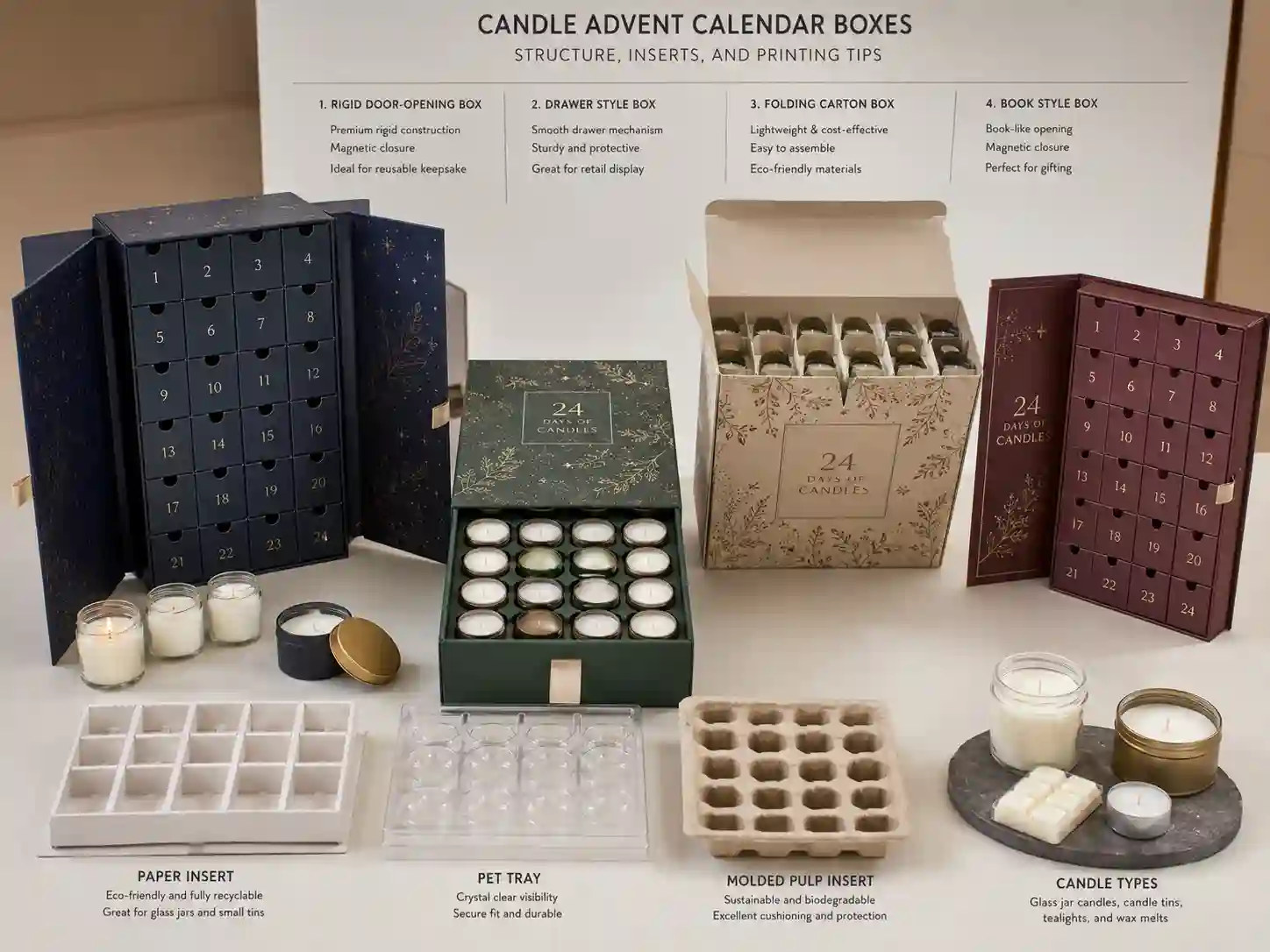
The candle format directly affects the box material, insert type, carton strength, and production tolerance. Glass jar candles require stronger inserts and higher compression awareness, while wax melts, tealights, and small tins may allow lighter paperboard structures if the layout is well balanced.
| Candle format | Main packaging risk | Recommended structure focus | Insert consideration |
|---|---|---|---|
| Mini glass jar candles | Heavy weight, breakage, lid movement, carton compression | Rigid box, reinforced door-opening box, book-style box, or strong drawer box | EVA, foam, thick paper insert, PET tray, or molded pulp with tight cavities |
| Candle tins | Scratching, rattling, denting, uneven stacking weight | Drawer box, rigid door-opening box, or folding carton with reinforced insert | Paper insert, PET tray, EVA insert, or foam depending on weight |
| Tealights | Small size, movement, difficult removal from compartments | Folding carton, door-opening box, or compact rigid box | Paperboard insert or PET tray with finger cutouts |
| Wax melts | Scent transfer, oil marks, heat sensitivity, surface rubbing | Paperboard or rigid structure with protective inner packaging | Paper insert, PET tray, or molded pulp; avoid direct wax contact with printed paper |
| Mixed candle gift sets | Different heights, uneven weight distribution, assembly mistakes | Custom rigid box or drawer box with numbered compartments | Combination insert with cavity depth control and product map |
Quotable B2B statement: “For candle advent calendar boxes, insert accuracy is a cost-control issue as much as a protection issue; poor fit increases breakage risk, slows assembly, and can force rework during peak-season production.”
Which box structures work best for candle advent calendar boxes?
The right structure should match the candle weight, retail display plan, budget, and required unboxing format. Rigid boxes usually give better support for heavier candle sets, while folding cartons can work for lighter candles or smaller seasonal promotions.
When should buyers choose a rigid door-opening box?
A rigid door-opening box is suitable when the calendar needs a premium retail look and must protect heavier candle jars. Greyboard wrapped with printed paper provides stronger shape retention than a simple folding carton, and numbered perforated doors can create a clean daily-opening experience.
For glass jar candles, ask the supplier to check door tearing direction, cavity depth, inner clearance, and whether the door edge rubs the product. The board thickness, door size, and perforation strength should be reviewed during the prototype stage.
When is a drawer candle calendar better?
A drawer box is useful when the buyer wants reusable compartments, easier product removal, or a luxury gift-set feel. Drawers can also separate scented products more effectively than open cavities if each candle has its own small inner tray or sleeve.
However, drawer structures use more material and assembly time. They may also increase packed volume, which affects freight cost. Buyers should compare the unit price together with shipping volume, not only the factory price.
Can folding cartons be used for candle advent calendars?
Folding cartons can be used for lightweight candle tins, tealights, wax melts, and lower-weight promotional sets. They are often more cost-efficient and easier to flatten before assembly, but they need careful reinforcement if product weight is high.
For export orders, ask whether the folding carton will be shipped flat or assembled. Flat shipping may reduce freight volume, while assembled shipping may reduce packing labor on the buyer side. The right choice depends on who will load the candles, where assembly happens, and how strict the delivery schedule is.
Which insert material should buyers choose for candles?
Insert material should be chosen according to candle weight, surface sensitivity, fragrance risk, sustainability target, and budget. Paper inserts are common and cost-efficient, EVA and foam offer stronger cushioning, PET trays provide precise cavities, and molded pulp can support sustainability positioning if the shape is feasible.
| Insert option | Best use | Advantages | Buyer watch points |
|---|---|---|---|
| Paperboard insert | Light to medium candle tins, tealights, wax melts, simple jars | Printable, recyclable in many markets, cost-efficient, easy to customize | May need thicker board or layered design for heavy glass jars |
| PET tray | Consistent candle shapes, retail-ready presentation, precise cavities | Clear visibility, stable cavity shape, efficient assembly | Confirm local recycling expectations and tray thickness before ordering |
| EVA insert | Premium glass jars, fragile candle sets, luxury gift packaging | Strong support, clean cavity cutting, good product grip | Higher cost; color, smell, and material compliance should be checked |
| Foam insert | Fragile glass candles, shipping protection, premium sets | Good cushioning and shock absorption | Can increase perceived plastic use; test for odor and compression recovery |
| Molded pulp insert | Sustainability-led candle sets and heavier cavities with simple shapes | Paper-based appearance, protective, suitable for many eco-positioned projects | Tooling, surface texture, cavity accuracy, and minimum quantity need early review |
Factory tip: Insert selection should be confirmed after real product weighing. A 24-piece candle calendar with glass jars may look small, but the total box weight can become high enough to require stronger greyboard, tighter inserts, and more robust export cartons.
If your project needs paper-based sourcing claims, ask your supplier what documentation can be verified. For responsible forest material claims, buyers can review official information from FSC and request valid documentation from the supplier where applicable.
How should compartments be designed for fragile and scented candle products?
Compartments should prevent movement, protect product surfaces, and keep the calendar easy to open. The cavity should hold the candle securely without making removal difficult for the end user or assembly team.
For glass jars, the insert should support the lower body and reduce side movement. If the candle has a lid, the cavity height should account for lid tolerance. If the candle is shrink-wrapped or boxed before loading, the supplier needs the packed size, not only the bare product size.
For scented products, buyers should consider scent transfer between different fragrances. Strongly scented candles or wax melts may need individual wrapping, inner cartons, paper sleeves, or sealed units before they are placed into the advent calendar. This is especially important when one calendar contains multiple fragrances.
Wax and oil surface protection also matters. Some wax melts, fragrance oils, or candle surfaces may mark uncoated paper if they touch directly. Matte lamination, varnish, PET tray separation, glass jar lids, or inner protective packaging can reduce contact risk. Buyers should test the actual product under realistic storage conditions before mass production.
How should buyers compare paperboard, greyboard, and structural strength?
Buyers should compare material strength by total loaded weight, box size, compartment design, and shipping method. Greyboard is often preferred for premium rigid candle calendars, while paperboard works well for lighter folding carton designs and insert systems.
Important structural details include board thickness, wrap paper weight, glue area, drawer wall height, door perforation strength, hinge area, corner protection, and whether the insert transfers weight evenly to the outer box. A beautiful sample can still fail if the loaded box bends, the doors pop open, or the insert collapses during stacking.
QC tip: Do not approve an empty sample only. A candle advent calendar sample should be reviewed with the real product weight loaded into all compartments. Check door opening, insert deformation, box bending, corner strength, and whether the calendar still sits flat after handling.
What printing and finishing choices matter for candle advent calendars?
Printing and finishing should support brand presentation without weakening the structure or delaying production. CMYK, Pantone color, foil stamping, embossing, spot UV, matte lamination, and gloss lamination are common options, but each affects cost, lead time, surface durability, and proof approval.
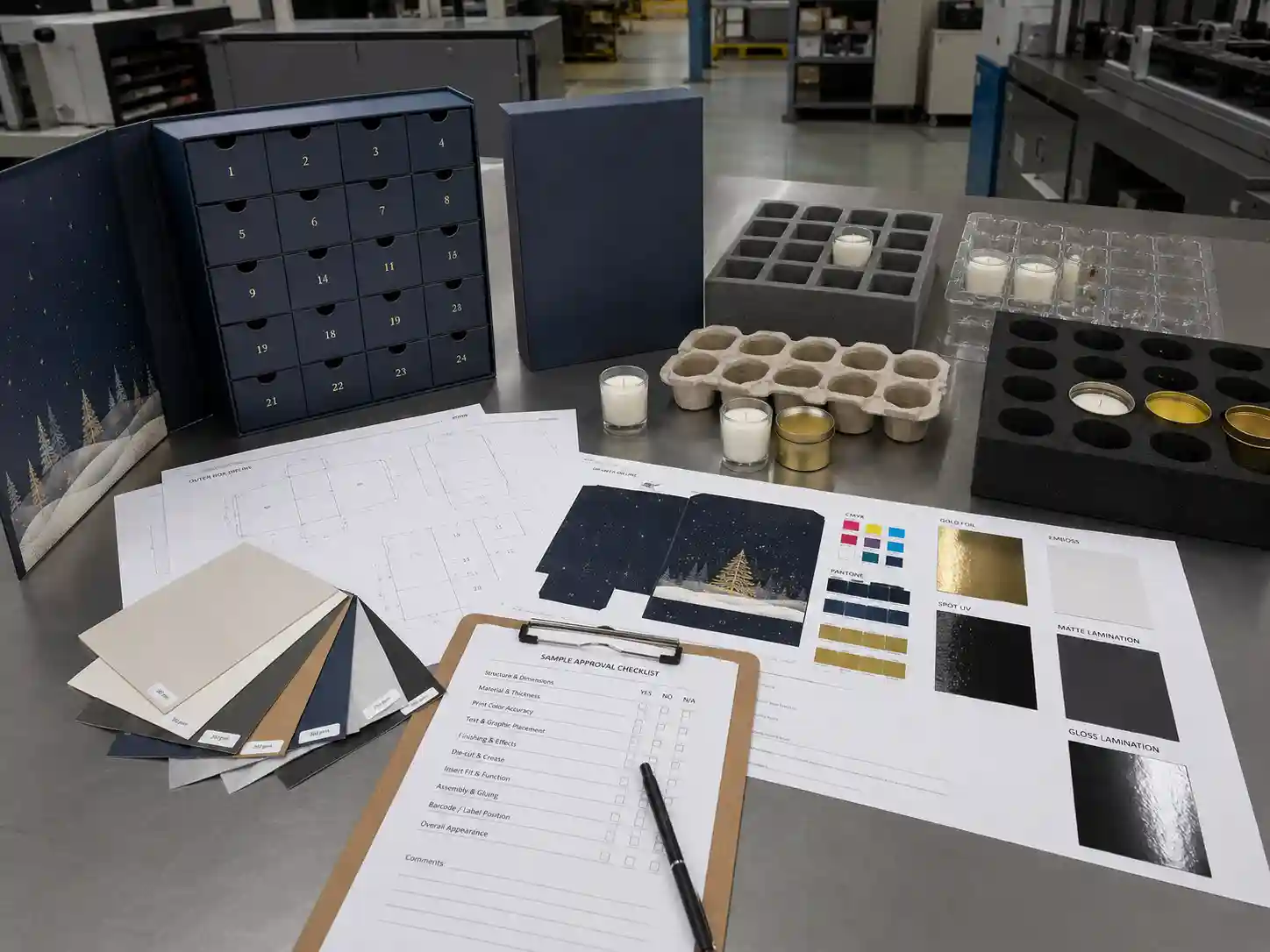
CMYK printing is suitable for full-color artwork, lifestyle patterns, and seasonal graphics. Pantone color is useful when brand color consistency is important, especially across multiple SKUs or retail campaigns. Foil stamping can highlight numbers, logos, borders, or limited-edition details, while embossing adds a tactile premium effect.
Spot UV can emphasize door numbers or design elements, but the artwork should be checked against perforation lines and folding areas. Matte lamination gives a soft premium finish and can reduce glare; gloss lamination creates a brighter retail effect but may show scratches more easily on dark artwork.
Buyer tip: Before approving artwork, ask for a dieline with cut lines, crease lines, perforation lines, bleed, safe area, glue area, and compartment numbers clearly marked. Misaligned door numbers are one of the easiest mistakes to prevent before plate making and mass printing.
What should happen during sampling and fit testing?
Sampling should prove the structure, insert, printing surface, and loading process before mass production. For candle calendars, buyers should request a prototype or pre-production sample using real dimensions and realistic product weight.
- Confirm product dimensions, packed dimensions, unit weight, and fragrance type.
- Create the dieline for the outer box, doors, drawers, insert, and compartments.
- Make a blank structural prototype to test fit, opening, and assembly.
- Load real candles or accurate dummy weights into all cavities.
- Check insert grip, product removal, door clearance, and box balance.
- Review artwork proof for CMYK, Pantone, foil, embossing, spot UV, lamination, and number placement.
- Approve a pre-production sample before mass production starts.
For projects with glass jars, the sample should be gently shaken, tilted, stacked, and opened repeatedly. The goal is not to create a laboratory report for every order, but to find obvious problems before bulk production. Buyers shipping through e-commerce channels may also request more formal transport testing. For packaging performance testing concepts, buyers can review official resources from ISTA and discuss suitable test levels with their logistics team.
Quotable B2B statement: “A pre-production sample is not a decorative approval item; it is the buyer’s last practical checkpoint for dieline accuracy, insert strength, artwork alignment, assembly tolerance, and loaded-box performance.”
How do MOQ, cost, and lead time usually change by option?
MOQ, cost, and lead time depend on structure complexity, material choice, printing finish, insert tooling, hand assembly, and order season. Buyers should not compare suppliers only by the lowest unit price; they should compare what is included in sampling, QC, packing, and export preparation.
| Decision factor | Cost impact | Lead time impact | What buyers should confirm |
|---|---|---|---|
| Rigid box structure | Higher material and assembly cost | Longer than simple folding carton | Greyboard thickness, wrapping quality, door or drawer tolerance |
| Complex insert | Higher if multi-layer, EVA, foam, PET, or molded pulp tooling is needed | May require extra prototype testing | Real product fit, cavity strength, removal space |
| Special finishing | Foil, embossing, spot UV, and lamination add process cost | Extra proofing and production steps | Finish area, color proof, registration tolerance |
| Low quantity order | Higher unit cost due to setup and sampling cost allocation | May depend on factory schedule and material availability | MOQ by structure, print method, insert type, and packing method |
| Export packing | Stronger cartons, corner protectors, pallets, and labels add cost | May add packing and inspection time | Carton size, gross weight, pallet plan, shipping marks |
MOQ is not always one fixed number. A simple folding carton candle calendar may have a different MOQ from a rigid drawer calendar with EVA insert and foil stamping. Buyers should ask whether the MOQ is driven by printing setup, board purchase, insert tooling, hand assembly, or finishing process.
What QC checks are important before export?
QC should check structure, printing, insert fit, assembly, packing strength, and labeling before the goods leave the factory. For candle advent calendar boxes, final inspection should include loaded-box behavior where possible, not only surface appearance.
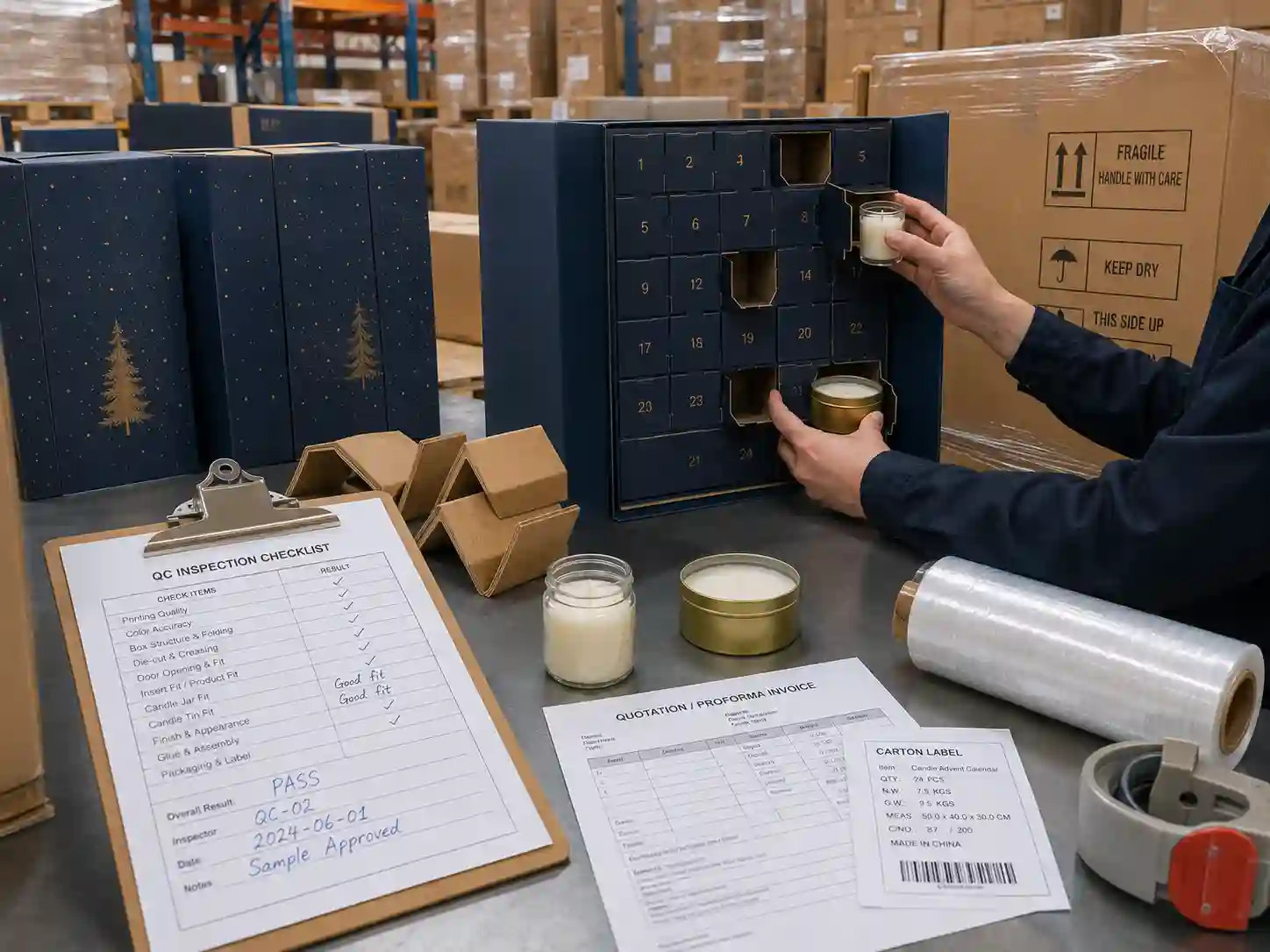
- Check outer box dimensions, compartment count, and door or drawer numbering.
- Confirm paperboard or greyboard thickness against the approved sample.
- Inspect printing color, CMYK registration, Pantone match, foil stamping, embossing, spot UV, matte lamination, or gloss lamination.
- Review dieline accuracy, folding lines, perforation strength, glue position, and door-opening performance.
- Test insert fit with real candles or approved dummy products.
- Look for rubbing marks, oil stains, wax contact, odor issues, and surface scratches.
- Check export carton strength, carton quantity, carton labels, shipping marks, and gross weight.
- Confirm pallet packing, corner protectors, pallet wrap, and carton stacking direction if required.
QC tip: Candle calendars should be inspected from both the buyer’s view and the warehouse view. The buyer cares about presentation and opening experience; the warehouse cares about carton compression, pallet stability, barcode labeling, and shipping marks.
How should export packing be planned for candle advent calendar boxes?
Export packing should protect the finished calendars from compression, corner damage, humidity exposure, and label confusion during international shipping. Candle calendars can become heavy when fully loaded, so carton strength and pallet plan should be confirmed before mass packing.
Important export packing decisions include single-unit polybag or paper wrap, inner protection, master carton size, carton board grade, corner protectors, pallet height, pallet wrap, shipping marks, barcode labels, and whether cartons should be marked by SKU or mixed assortment. For e-commerce sellers, carton drop risk and fulfillment handling should be reviewed early.
Carton compression risk is especially important for glass jar candle calendars. If the master carton is too large or too heavy, bottom cartons may deform during storage or sea shipment. Buyers should ask the supplier to recommend practical carton quantities and stacking limits based on loaded product weight, not empty box weight.
How should buyers choose a reliable supplier?
Buyers should choose a supplier that can explain structure, insert, sampling, artwork, QC, and export packing in practical production language. A reliable supplier should ask detailed questions before quoting instead of giving a generic price for all candle calendar projects.
When comparing suppliers, review their experience with custom advent calendar box products, their ability to support custom advent calendar box services, and whether the Giftpackpro packaging factory can provide sample checking, production updates, and export packing support for overseas orders.
Supplier comparison checklist
- Can the supplier develop rigid box, drawer box, door-opening box, folding carton, and book-style structures?
- Can they recommend paper insert, PET tray, EVA insert, foam, or molded pulp based on candle weight and fragility?
- Do they check dieline, bleed, safe area, number placement, perforation, and glue area before printing?
- Can they provide a blank prototype and pre-production sample before mass production?
- Do they explain MOQ by structure, insert, printing, and finishing process?
- Do they offer final inspection for printing, assembly, insert fit, and export cartons?
- Can they prepare shipping marks, carton labels, pallet details, and quotation documents for overseas buyers?
Decision guide: Which option should you choose?
The best choice depends on product weight, brand position, retail channel, and deadline. Use the decision guide below to narrow the structure and insert direction before requesting a quotation.
| Buyer situation | Recommended direction | Reason |
|---|---|---|
| Premium glass jar candle calendar for retail shelves | Rigid door-opening box with EVA, foam, PET, or reinforced paper insert | Better support, stronger presentation, improved protection for fragile jars |
| Luxury scented candle gift set with reusable feel | Drawer box or book-style rigid box with separate cavities | Improves unboxing, reduces product rubbing, supports higher gift value |
| Lightweight tealight or wax melt promotion | Folding carton or compact paperboard calendar with paper insert | More cost-efficient for lighter products and larger promotional runs |
| Sustainability-focused candle campaign | Paperboard structure with paper insert or molded pulp insert | Supports paper-based positioning, subject to strength and fit testing |
| E-commerce or long-distance export order | Stronger outer structure, secure insert, reinforced export carton, pallet plan | Reduces compression, breakage, and fulfillment handling risk |
What information should buyers prepare before requesting a quotation?
Buyers should prepare product, artwork, quantity, packaging, and shipping details before asking for a quote. The more complete the RFQ, the more accurate the quotation, sample plan, MOQ guidance, and lead time estimate will be.
RFQ preparation checklist
- Calendar type: rigid box, drawer box, door-opening box, book-style box, or folding carton.
- Number of compartments: 12, 24, 25, or custom layout.
- Candle details: product size, packed size, unit weight, jar material, lid type, fragrance type, and whether each item is individually wrapped.
- Insert preference: paper insert, PET tray, EVA insert, foam, molded pulp, or supplier recommendation.
- Artwork requirements: CMYK, Pantone, foil stamping, embossing, spot UV, matte lamination, gloss lamination, barcode, and warning text.
- Sample needs: blank prototype, digital proof, printed sample, or pre-production sample.
- Order quantity and target MOQ range.
- Delivery schedule, launch date, destination country, and shipping method.
- Export packing requirements: carton size limits, pallet requirements, shipping marks, carton labels, and warehouse instructions.
Buyers can review more advent calendar box buying guides or request a custom quote from Giftpackpro with the above information. A clear RFQ helps the packaging team recommend realistic structure, insert, printing, sample, and export packing options.
What common mistakes should buyers avoid?
The most common mistakes are approving artwork before confirming product fit, choosing weak inserts for heavy candles, ignoring scent transfer, and comparing prices without checking packing details. These mistakes can create delays, rework, damage claims, or higher total landed cost.
- Approving only an empty sample: The box may look correct but fail when fully loaded with candle weight.
- Using one cavity size for different candles: Mixed fragrances or formats often need different depths or support points.
- Ignoring wax and oil contact: Direct contact with printed paper may create stains or surface marks.
- Forgetting scent transfer: Strong fragrances may need individual wrapping or separation.
- Choosing finishing too late: Foil, embossing, spot UV, and lamination can affect dieline timing and cost.
- Underestimating export cartons: Heavy candle calendars need carton compression planning and stable pallet packing.
- Requesting a quotation without product data: Missing dimensions and weights make insert and structure pricing unreliable.
FAQ: What do B2B buyers ask about candle advent calendar boxes?
Are rigid boxes always required for candle advent calendar boxes?
No. Rigid boxes are often better for heavier glass jar candles and premium retail campaigns, but folding cartons can work for lightweight tins, tealights, or wax melts. The decision should be based on loaded weight, insert support, sales channel, and export requirements.
Which insert is best for glass jar candles?
There is no single best insert for every glass jar candle. EVA, foam, PET, molded pulp, and reinforced paper inserts can all work, depending on jar weight, cavity depth, budget, sustainability target, and required presentation. Real product fit testing is essential.
Can candle advent calendars include multiple fragrances?
Yes, but buyers should plan for scent transfer control. Individually wrapped candles, inner cartons, sealed wax melts, or separated compartments may be needed when strong fragrances are packed in the same calendar.
Should buyers test wax or oil contact with the packaging?
Yes. Some candle products, wax melts, or fragrance components may leave marks on unprotected paper surfaces. Buyers should test real products with the proposed insert, lamination, tray, or protective packaging before mass production.
What artwork files are needed for printing?
Buyers should provide editable artwork based on the approved dieline, with bleed, safe area, CMYK or Pantone instructions, finishing layers, barcode placement, and compartment numbers. The supplier should check artwork before plate making.
How early should buyers start a candle calendar project?
Buyers should start early enough to allow structure design, insert testing, sample revision, artwork proofing, material purchasing, mass production, QC, and export shipping. Seasonal packaging schedules can become tight quickly, especially when special inserts, finishing, or pallet packing are required.
Ready to develop candle advent calendar boxes for a seasonal campaign?
When requesting candle advent calendar boxes, prepare your candle dimensions, unit weight, fragrance details, compartment count, target structure, insert preference, artwork requirements, quantity, launch schedule, and export packing needs. Giftpackpro can then help review the structure, insert material, printing process, sampling route, MOQ considerations, QC checkpoints, and quotation details for your project.
For the most accurate quotation, include photos or drawings of the candles, packed product dimensions, real weight, artwork direction, destination market, and whether you need a blank prototype, printed sample, or pre-production sample before mass production.