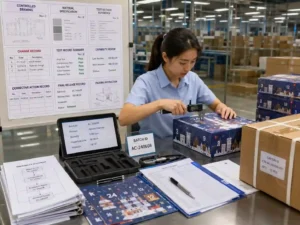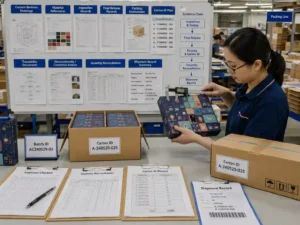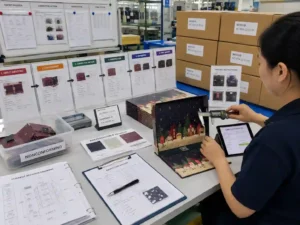
Quick answer: Jewelry advent calendar boxes should be planned around product size, compartment layout, insert protection, opening experience, MOQ, printing method, labor cost, and export packing. For B2B buyers, the lowest unit price is not always the best choice because small jewelry items need accurate inserts, anti-scratch protection, stable drawers or doors, clean artwork registration, and reliable carton packing. Before requesting a quotation, prepare jewelry dimensions, target box structure, quantity, artwork requirements, insert preference, retail labeling needs, shipping method, and sample expectations. This helps a supplier quote accurately and control cost before mass production.
For overseas brands, wholesalers, gift companies, and retail buyers, jewelry advent calendar boxes are not simple seasonal gift boxes. They combine premium presentation, small-item protection, labor-intensive assembly, printing accuracy, and export-safe packing. A ring, charm, earring pair, bracelet, pendant, or hair accessory may look light, but each item needs a stable compartment and a clear unboxing sequence.
This buying guide explains how to compare structures, inserts, materials, printing, MOQ, sampling, QC, export packing, and quotation details before working with a custom advent calendar boxes manufacturer. It is written for purchasing teams that need practical factory-side guidance, not consumer holiday storytelling.
What should buyers understand before ordering jewelry advent calendar boxes?
Buyers should understand that jewelry packaging cost is driven by structure complexity, insert precision, printing and finishing, manual assembly, sample approval, export packing, and order quantity. A small change in drawer count, insert material, foil area, or carton packing method can affect both unit price and production lead time.
Unlike a standard rigid gift box, a jewelry advent calendar needs multiple controlled spaces. Each compartment must hold a small item securely without scratching plating, bending chains, crushing earring posts, or mixing items during transport. The packaging must also create a premium opening experience while leaving space for barcode labels, anti-theft labels, warning labels, recycling marks, or retailer-specific carton marks.
Quotable B2B point: A jewelry advent calendar box is priced as a packaging system, not as one box; the cost includes outer structure, compartments, inserts, printing, finishing, assembly, inspection, and export packing.
Which box structure is best for jewelry advent calendar boxes?
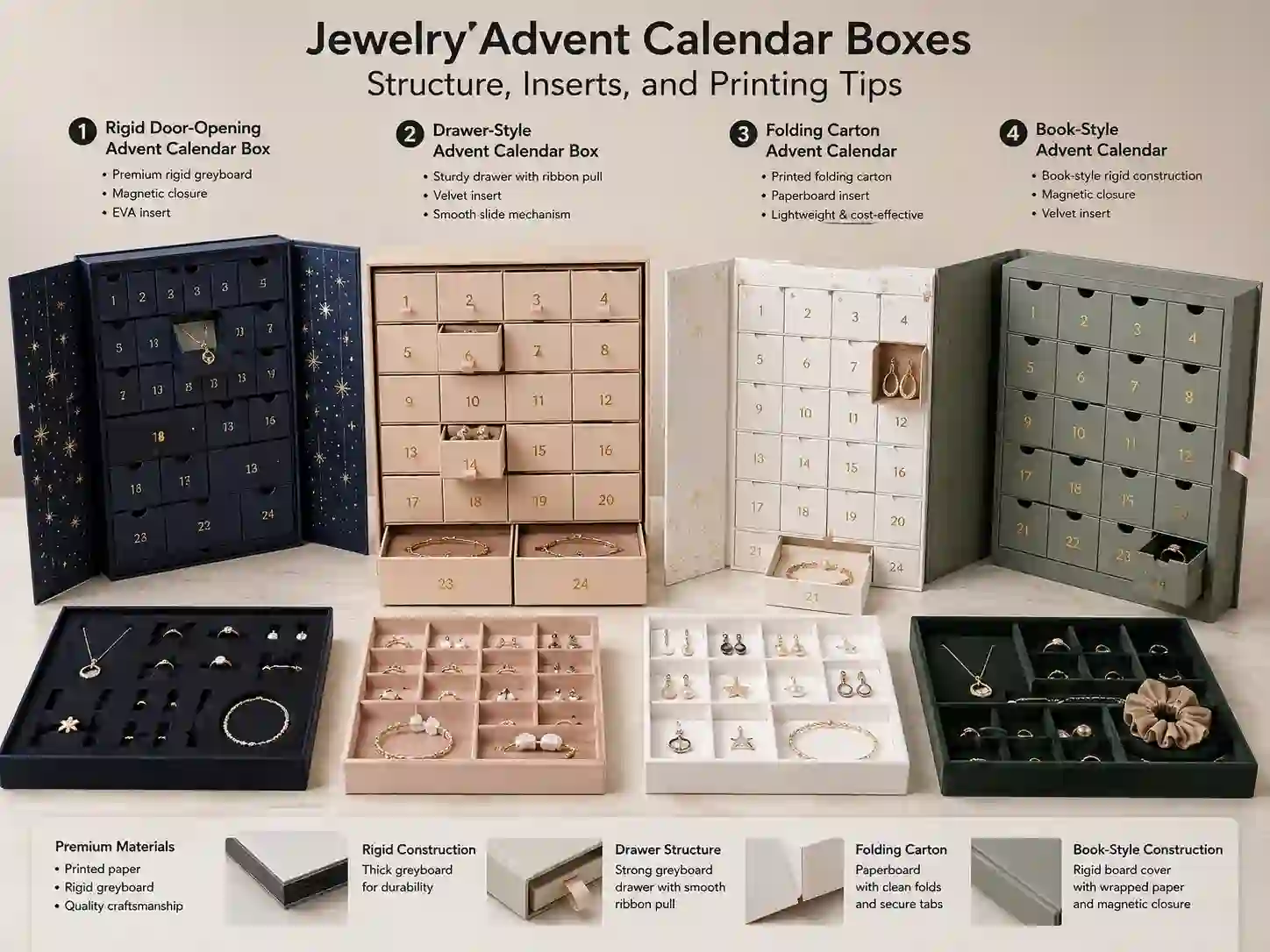
The best structure depends on jewelry weight, retail price point, shelf display needs, opening experience, and target MOQ. Rigid boxes usually create the most premium presentation, while folding carton structures can reduce cost and shipping volume for larger quantity programs.
Should buyers choose a rigid box, drawer box, door-opening box, or folding carton?
Rigid boxes are suitable for premium jewelry sets because greyboard gives strength and a high-end feel. Drawer boxes are useful when buyers want repeated daily pull-out interaction, while door-opening boxes are common for classic numbered advent layouts. Folding cartons are more cost-efficient but need careful structure testing when compartments are small or jewelry items vary in shape.
| Structure option | Best use | Cost impact | Buyer watch point |
|---|---|---|---|
| Rigid door-opening box | Premium retail jewelry calendar with strong shelf presence | Higher material and labor cost | Check door cutting, hinge strength, compartment tolerance, and foil alignment |
| Drawer jewelry calendar box | Gift sets with rings, charms, bracelets, earrings, or mixed accessories | Medium to high, depending on drawer count | Test drawer sliding resistance, finger notch size, and insert stability |
| Book-style rigid box | Premium unboxing experience and storytelling panels | Higher greyboard, wrapping, magnet, and assembly cost | Confirm magnet strength, spine durability, and flatness after loading |
| Folding carton advent calendar | Large promotional runs with lighter jewelry or accessories | Lower unit cost at higher quantity | Validate board thickness, lock design, and crushing resistance |
| Fold-out or tiered structure | Retail display programs needing visual impact | Variable; may increase labor and packing size | Check opening angle, balance, insert placement, and carton size |
Buyer tip: Do not choose structure only by appearance. Ask the supplier to confirm whether the same structure can pass loaded product testing, carton stacking, and export shipment handling.
How do inserts affect jewelry protection and cost?
Inserts affect both product safety and unit price. For jewelry advent calendar boxes, insert selection should consider anti-scratch performance, small-compartment accuracy, product visibility, sustainability preference, assembly speed, and replacement risk during packing.
Jewelry is often lightweight but delicate. Plated surfaces, stones, chains, earring posts, clasps, and charm loops can be damaged by rough contact or loose movement. The insert should hold each item neatly and prevent movement inside the compartment. For mixed jewelry sets, one calendar may require several insert styles instead of one universal tray.
Which insert material should buyers compare?
Velvet, EVA, paper insert, PET tray, foam, and molded pulp each serve different goals. The right choice depends on the item finish, target price level, retail positioning, and assembly process.
| Insert type | Advantages | Limitations | Typical jewelry use |
|---|---|---|---|
| Velvet-covered insert | Premium look, soft touch, strong anti-scratch presentation | Higher cost and more manual handling | Rings, pendants, earrings, bracelets, premium gift sets |
| EVA insert | Good cushioning, accurate cutting, stable product holding | May need surface covering for premium jewelry | Charms, bracelets, pendant cards, small accessory sets |
| Paper insert | Cost-efficient, recyclable direction, printable surface | Less cushioning than EVA or foam | Light charms, hair accessories, carded earrings |
| PET tray | Clear visibility, precise molded cavities, good repeatability | Tooling or forming cost may apply; plastic policy should be checked | Small retail items needing visible placement |
| Foam insert | Soft cushioning and flexible cutting | May not match all sustainability or premium branding goals | Fragile stones, delicate shapes, mixed components |
| Molded pulp insert | Paper-based protective option with natural texture | Less refined for very small jewelry details | Eco-positioned accessory kits and larger compartments |
Factory tip: For small jewelry compartments, insert tolerance matters more than insert thickness alone. A cavity that is 2 mm too loose can allow a pendant, earring, or charm to rotate and scratch during transport.
What materials influence MOQ, cost, and perceived value?
Material selection influences appearance, strength, MOQ, printing result, labor process, and export durability. Buyers should compare greyboard thickness, paperboard grade, wrapping paper, specialty paper, inner tray material, and carton strength before confirming a specification.
Rigid jewelry calendars often use greyboard wrapped with printed paper, specialty paper, or laminated art paper. Folding carton calendars use paperboard such as SBS, CCNB, kraft board, or other project-specific board types. The supplier should recommend thickness based on box size, compartment layout, expected loaded weight, and shipping method.
For brands with sustainability requirements, buyers can review paper sourcing options and ask suppliers what documentation can be provided. For example, buyers who need responsible forest sourcing may review information from the Forest Stewardship Council and then ask the supplier what claims, chain-of-custody documents, or label permissions are applicable to the project. Do not assume a material is certified unless the supplier can verify it for that order.
How do printing and finishing choices change the quotation?
Printing and finishing choices can significantly affect cost because they influence setup, materials, production speed, waste control, and manual inspection. CMYK printing is common for full-color artwork, while Pantone colors help control brand color consistency when a buyer has strict identity requirements.
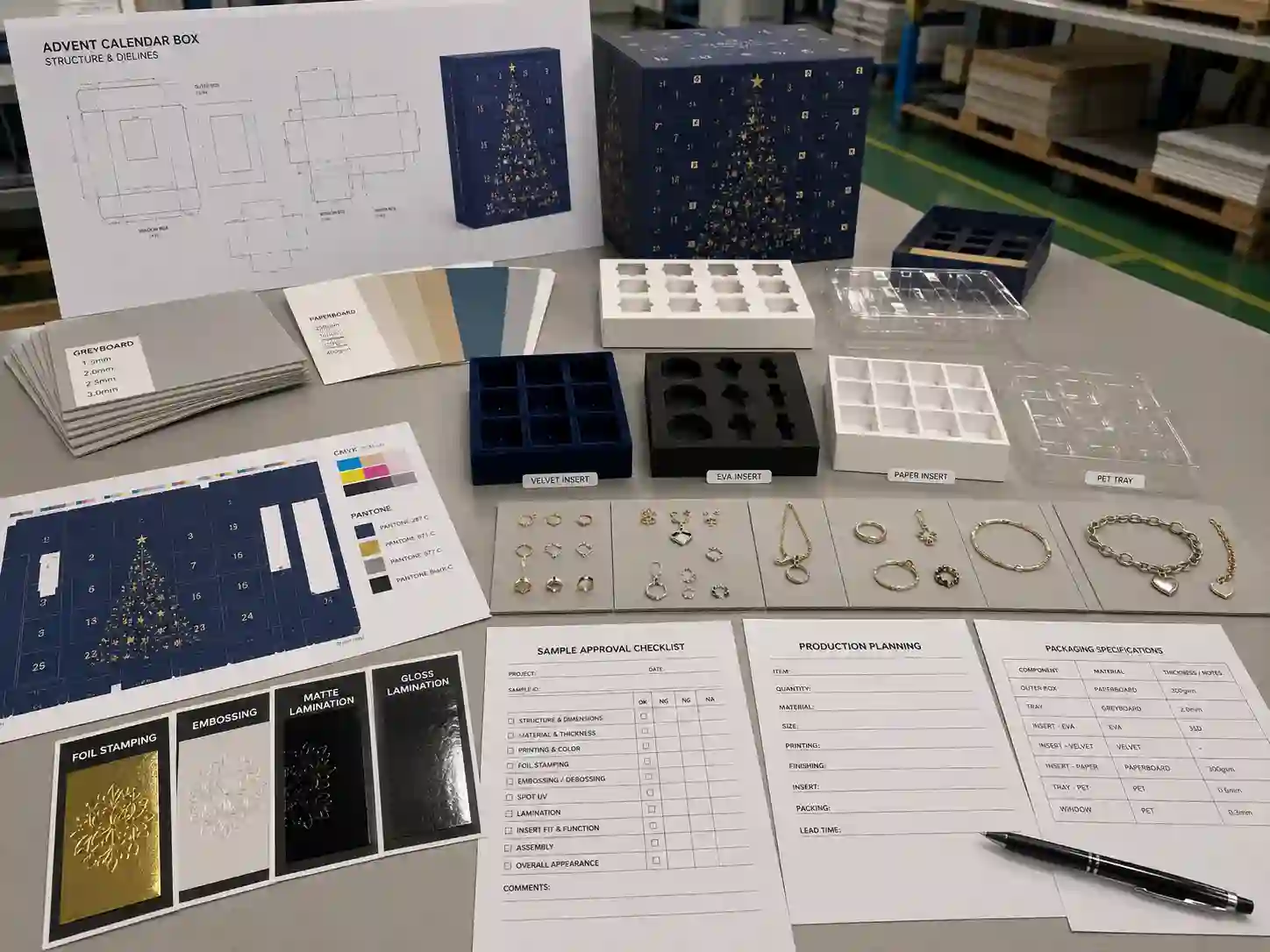
Which printing and finishing options should be planned early?
Plan CMYK, Pantone, foil stamping, embossing, debossing, spot UV, matte lamination, gloss lamination, soft-touch coating, window film, and special paper before sampling. Changing finishing after the prototype can require a new dieline, new proof, new tooling, or updated cost calculation.
- CMYK printing: Suitable for seasonal graphics, illustrations, patterns, and multi-color retail designs.
- Pantone color: Useful for brand color control, especially on premium jewelry gift programs.
- Foil stamping: Adds metallic detail but requires tooling, pressure control, and registration checks.
- Embossing or debossing: Creates texture but should be tested near folds, doors, drawers, and small numbers.
- Spot UV: Highlights logos, numbers, or patterns but may increase drying and inspection requirements.
- Matte lamination: Gives a refined retail look and helps protect printed surfaces.
- Gloss lamination: Creates shine and stronger visual contrast but may show fingerprints or scratches more clearly.
Buyer tip: If the calendar uses numbered doors, confirm that foil stamping, spot UV, and embossing do not make small numbers hard to read or difficult to tear open.
What MOQ should buyers expect, and why does quantity affect price?
MOQ depends on structure, material sourcing, printing setup, insert process, finishing, and assembly complexity. A simple folding carton calendar may have a lower practical MOQ than a rigid drawer calendar with velvet inserts, foil stamping, and multiple hand-assembled parts.
There is no universal MOQ that fits every jewelry calendar project. Buyers should ask whether the quoted MOQ is driven by paper purchasing, printing setup, die-cutting, insert production, finishing tooling, factory scheduling, or carton packing. Understanding the MOQ reason helps buyers adjust the specification instead of only negotiating price.
How does quantity affect unit cost?
Higher quantities usually spread fixed costs across more units. Tooling, printing setup, dieline adjustment, sampling, machine setup, and pre-production preparation do not disappear at low volume, so small orders often carry a higher unit cost.
| Cost driver | Why it affects price | Cost-control option |
|---|---|---|
| Box structure | More drawers, doors, magnets, or fold-out panels increase material and labor | Simplify the structure or standardize compartment sizes |
| Insert material | Velvet, EVA, PET, foam, paper, and molded pulp have different tooling and assembly needs | Use one insert material where possible and group similar jewelry sizes |
| Printing setup | CMYK, Pantone, foil, spot UV, and embossing add setup and inspection steps | Limit premium finishing to visible areas and key numbers |
| Manual assembly | Drawer making, insert placing, wrapping, and loading tests require labor time | Reduce unnecessary parts and confirm assembly method during sampling |
| Export packing | Stronger cartons, corner protectors, palletizing, and shipping marks add packing cost | Choose carton size based on product protection and container efficiency |
Quotable B2B point: MOQ is not only a sales threshold; it reflects the minimum practical quantity for material purchasing, printing setup, insert production, assembly scheduling, and quality control.
How should buyers compare suppliers for jewelry advent calendar boxes?
Buyers should compare suppliers by engineering support, sample accuracy, insert testing, artwork checking, production control, communication clarity, and export packing experience. A reliable supplier should ask detailed questions before quoting instead of giving a fast but vague price.
When reviewing suppliers, check whether they can discuss dieline, greyboard thickness, paperboard selection, insert cutting, sample approval, pre-production sample control, mass production tolerance, QC checkpoints, export carton strength, shipping marks, and quotation breakdown. These details show whether the supplier understands B2B custom advent calendar boxes rather than only selling a catalog item.
Supplier selection checklist
- Can the supplier recommend a structure based on jewelry size, quantity, retail channel, and budget?
- Can they provide a dieline for artwork placement and compartment layout?
- Can they make a blank prototype before full printed sampling if the structure is complex?
- Can they test rings, earrings, bracelets, charms, pendants, and hair accessories in the insert?
- Can they explain the difference between sample, prototype, and pre-production sample?
- Can they control CMYK, Pantone, foil stamping, embossing, spot UV, and lamination details?
- Can they prepare export cartons, shipping marks, carton labels, and pallet packing if required?
- Can they provide clear quotation terms, lead time, payment terms, and packing details?
Buyers can review Giftpackpro packaging factory information when evaluating factory capabilities, and compare available custom advent calendar box products to understand possible structure directions before requesting a project-specific quote.
What sampling process reduces risk before mass production?
A good sampling process confirms structure, insert fit, artwork, finishing, opening experience, and export packing assumptions before mass production. Buyers should avoid approving a calendar based only on a flat rendering because small jewelry compartments require physical testing.
Which samples should buyers request?
A blank prototype is useful for checking structure, size, drawer movement, compartment layout, and insert fit before printed artwork is finalized. A printed sample checks color, finishing, lamination, logo placement, number readability, and overall retail appearance. A pre-production sample is the approved reference for mass production and final inspection.
- Dieline review: Confirm box size, panel layout, bleed, safe area, door cutting, drawer direction, and insert positions.
- Blank prototype: Check opening experience, jewelry fit, compartment tolerance, and structural balance.
- Artwork proof: Review CMYK, Pantone references, foil areas, embossing zones, barcode space, and retailer labeling space.
- Printed sample: Check color, lamination, finishing registration, glue marks, edge wrapping, and numbering accuracy.
- Pre-production sample: Approve final structure, insert, printing, finishing, packing, and quality standard before mass production.
QC tip: Keep one signed pre-production sample with the factory and one with the buyer. Final inspection should compare mass production against this approved sample, not only against digital artwork.
What artwork and retail labeling details should buyers prepare?
Buyers should prepare print-ready artwork, dieline confirmation, barcode placement, legal or retail labels, anti-theft label area, recycling marks, carton marks, and product sequence instructions. Jewelry calendars often need more label planning than standard gift boxes because small compartments leave limited space.
Retail buyers may require UPC, EAN, SKU labels, anti-theft tags, age or warning statements if applicable, recycling symbols, country-of-origin marks, or carton labels. For barcode planning, buyers can review official barcode guidance from GS1 and confirm exact requirements with their retail channel.
- Leave enough flat space for barcode and retail price labels.
- Confirm whether anti-theft labels should be on the outer box, sleeve, back panel, or shrink wrap.
- Keep important artwork away from doors, perforation, drawer notches, and fold lines.
- Provide a product loading map if each day contains a different item.
- Confirm whether the final product will be shrink wrapped, sleeve packed, belly banded, or sealed with stickers.
For buyers who need support from concept to sample, custom advent calendar box services can help organize structure, insert, material, artwork, and production details into one development process.
How can buyers control cost without weakening the packaging?
Buyers can control cost by simplifying structure, standardizing compartment sizes, reducing unnecessary finishing, choosing practical inserts, confirming artwork early, and improving carton efficiency. Cost control should protect the product and brand experience instead of simply removing material.
Decision guide: where should buyers save and where should they invest?
| Decision area | Save here when | Invest here when |
|---|---|---|
| Outer structure | The program is promotional, high-volume, or e-commerce focused | The calendar is for premium retail, gifting, or high perceived value |
| Insert material | Jewelry is carded, lightweight, or already protected in small pouches | Products have plating, stones, delicate chains, or loose components |
| Finishing | Artwork already has strong color and pattern impact | Brand positioning depends on foil, texture, matte feel, or premium detail |
| Sampling | Only when repeating a proven structure with minor artwork change | Any new jewelry size, new drawer structure, new insert, or new retailer requirement |
| Export packing | Never remove basic protective packing without testing | Goods travel by sea, pass multiple warehouses, or ship as retail-ready cartons |
Factory tip: The easiest cost to reduce is often unnecessary complexity. A clean rigid calendar with fewer insert types may look more premium and cost less than an over-designed structure with too many small parts.
What QC points matter most before shipment?
QC should confirm that the approved sample, dieline, artwork, insert, assembly, labeling, and packing requirements are followed in mass production. For jewelry advent calendar boxes, inspection should focus on small-compartment accuracy, surface protection, opening function, and carton durability.
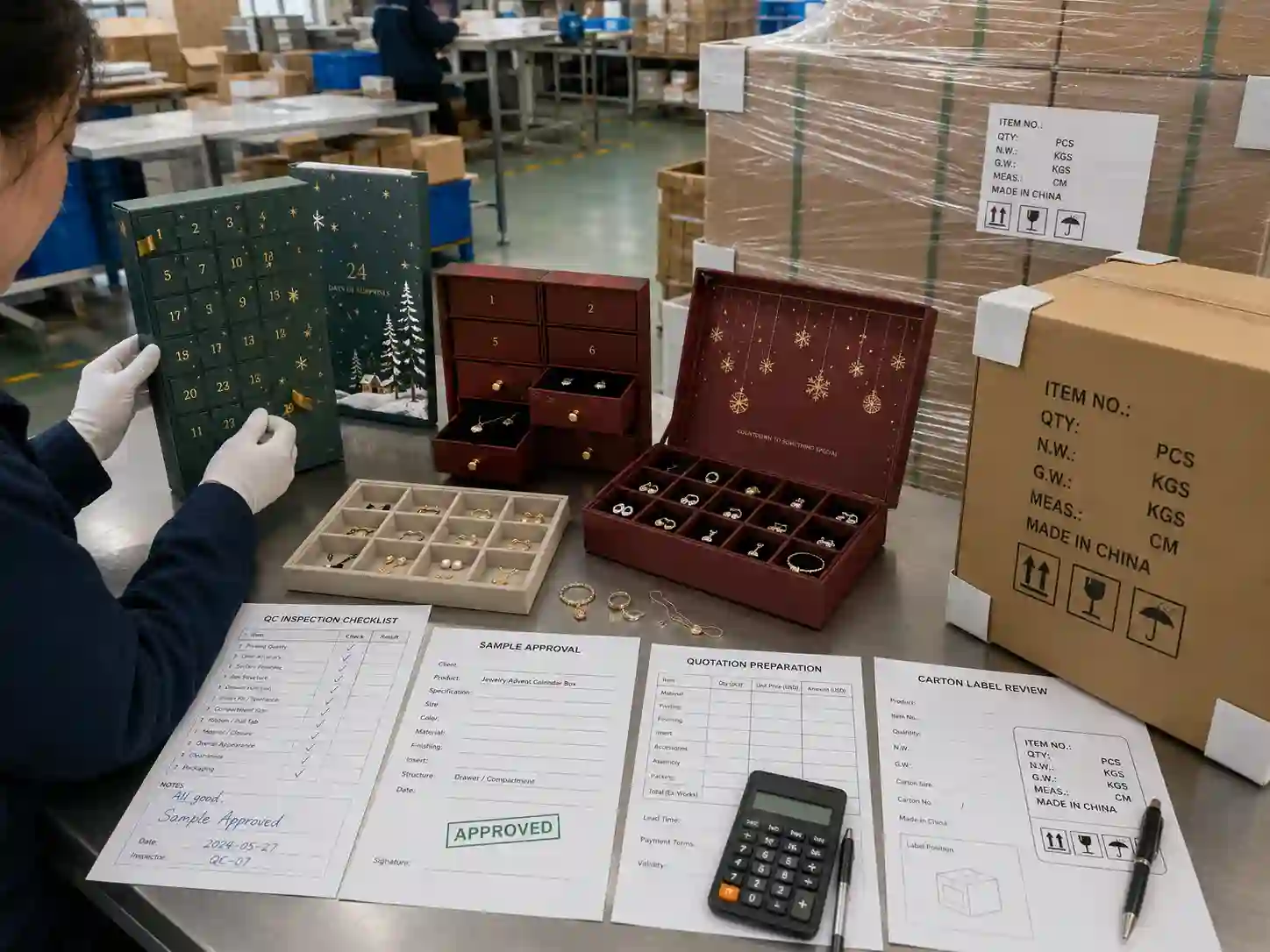
Practical QC checklist for jewelry calendar packaging
- Check outer box size, greyboard or paperboard thickness, and structure against the approved sample.
- Inspect door opening, drawer sliding, magnet closure, fold-out panels, and finger notches.
- Confirm compartment sequence and product loading map.
- Test ring, earring, bracelet, charm, pendant, and hair accessory fit inside assigned compartments.
- Look for glue marks, scratches, dented corners, loose wrapping paper, and rough edges.
- Check CMYK color, Pantone matching, foil stamping, embossing, spot UV, matte lamination, and gloss lamination quality.
- Verify barcode space, retail labeling area, shipping marks, carton labels, and carton quantity.
- Review export carton strength, inner protection, corner protectors, pallet wrap, and moisture protection if needed.
Quotable B2B point: Final inspection for jewelry advent calendar boxes should test the calendar as a loaded retail package, not only as an empty printed box.
How should export packing be planned for overseas buyers?
Export packing should protect finished calendars from compression, corner damage, moisture, rubbing, and carton handling during international shipment. Buyers should confirm carton size, quantity per carton, gross weight, net weight, shipping marks, pallet requirements, and whether the goods are packed retail-ready or bulk-packed.
Rigid calendars with drawers or doors may need corner protectors, inner polybags, tissue, separators, stronger export cartons, or palletization. For retail programs, carton labels and shipping marks must match purchase order requirements. For e-commerce sellers, packaging may need additional drop or compression testing depending on the fulfillment channel.
Buyers can ask suppliers whether carton dimensions are optimized for container loading, air shipment, courier shipment, or warehouse handling. A lower product unit price can be offset by inefficient carton packing, high dimensional weight, or damaged goods after arrival.
What information should buyers prepare before requesting a quotation?
Buyers should prepare product dimensions, quantity, structure preference, insert requirements, artwork direction, finishing needs, packing method, target delivery date, and inspection requirements before requesting a quotation. A clear RFQ helps the supplier quote faster and reduces later cost changes.
RFQ preparation checklist
- Target quantity or quantity range for MOQ comparison.
- Calendar format: 12-day, 24-day, 25-day, drawer, door-opening, rigid box, folding carton, or book-style box.
- Jewelry list with item dimensions, weight, material sensitivity, and packaging status.
- Insert preference: velvet, EVA, paper insert, PET tray, foam, molded pulp, or supplier recommendation.
- Outer box size target or retail shelf limitation.
- Artwork files, dieline needs, CMYK or Pantone requirements, and logo finishing areas.
- Finishing options such as foil stamping, embossing, spot UV, matte lamination, or gloss lamination.
- Retail labeling, barcode, anti-theft label, and shipping mark requirements.
- Sample requirement: blank prototype, printed sample, or pre-production sample.
- Export packing requirements, carton quantity, pallet needs, destination country, and shipping method.
- Expected lead time, launch date, inspection requirement, and quotation terms.
Buyers can read more advent calendar box buying guides before finalizing specifications, then request a custom quote when product dimensions and project details are ready.
Common mistakes buyers should avoid
The most common mistakes are requesting a price without product dimensions, choosing a structure before insert testing, approving artwork without dieline review, underestimating assembly labor, and ignoring export packing. These mistakes can lead to inaccurate quotations, delayed sampling, higher mass production cost, or damaged retail packaging.
- Only asking for the cheapest unit price: Low price may exclude proper insert, stronger carton, special finishing, or inspection requirements.
- Using one cavity size for all jewelry: Rings, earrings, charms, bracelets, and pendants often need different holding methods.
- Ignoring product loading sequence: A calendar with mixed items needs a clear packing map to prevent day-number errors.
- Changing artwork after sample approval: Late artwork changes can affect dieline, finishing tools, proofing, and schedule.
- Not planning label space: Barcode, anti-theft, recycling, and retailer labels need flat and readable positions.
- Skipping pre-production sample approval: Mass production needs a physical reference for structure, color, insert, and finishing.
FAQ: Jewelry advent calendar boxes for B2B buyers
What is the best structure for jewelry advent calendar boxes?
The best structure depends on budget, jewelry type, retail channel, and presentation goal. Rigid drawer boxes and rigid door-opening boxes are common for premium jewelry calendars, while folding carton calendars can work for larger promotional orders with lighter items.
Which insert is best for anti-scratch jewelry protection?
Velvet-covered inserts, EVA inserts with soft surface treatment, and carefully selected foam inserts are often used when anti-scratch protection matters. Paper inserts can be cost-effective for carded or pouch-packed jewelry, but loose plated items need more careful fit testing.
Why does the MOQ change between different calendar designs?
MOQ changes because each design has different material purchasing, printing setup, die-cutting, insert production, finishing, and assembly requirements. A complex rigid drawer box with foil stamping and velvet inserts usually needs a different MOQ than a simple folding carton structure.
How long does sampling take?
Sampling time depends on structure complexity, artwork readiness, insert material, printing method, and finishing process. Buyers should allow extra time for dieline checking, blank prototype review, printed sample approval, and pre-production sample confirmation before mass production.
What should be included in a jewelry advent calendar box quotation?
A quotation should state structure, size, material, insert type, printing, finishing, MOQ, unit price, sample cost, lead time, packing method, carton details, shipping term, payment term, and validity period. If jewelry loading or kitting is required, that labor should be listed clearly.
Can one calendar box design fit rings, earrings, bracelets, charms, and pendants?
Yes, but it needs careful compartment planning and insert testing. Buyers should provide exact product dimensions and identify which items are loose, carded, pouched, chained, or fragile so the supplier can design suitable cavities and packing sequence.
Ready to plan jewelry advent calendar boxes with a factory-side quotation?
Before requesting a sample or quotation, prepare the jewelry list, box structure preference, insert direction, artwork files, quantity range, labeling requirements, target delivery date, and export packing needs. Giftpackpro can then review the project as a complete packaging system and help compare practical options for cost, MOQ, sampling, QC, and mass production.
If your team is developing jewelry advent calendar boxes for a seasonal retail, wholesale, or e-commerce program, start with clear product dimensions and a realistic target budget. Then request a quotation that includes structure, insert, printing, finishing, sample, lead time, QC, and export carton details, not only a simple unit price.