Quick answer: Designing candle advent calendar boxes for seasonal campaigns starts with matching the candle format, box structure, insert strength, artwork plan, and export-packing method before sampling. Buyers should confirm the candle size, glass jar or tin weight, number of compartments, retail channel, opening style, material thickness, surface finishing, and shipping route before requesting a quotation. For B2B projects, the most important decisions are structure reliability, insert protection, dieline accuracy, sample approval, mass-production tolerance, final QC, and carton compression resistance. A good supplier should help convert product data into a practical box layout, not only print a decorative calendar.
What should buyers understand before designing candle advent calendar boxes?
Buyers should understand that candle advent calendar boxes are structural packaging projects, not only seasonal artwork projects. Each compartment must hold a candle safely while supporting the overall calendar shape during display, handling, storage, and export shipping.
Candle products create packaging challenges that lighter items do not. Mini glass jars add concentrated weight, candle tins can dent if the insert is weak, wax surfaces may need protection from rubbing, and fragrance oil can transfer scent if candles are poorly sealed. The box design should consider the product’s real weight, outer diameter, height, lid type, fragrance intensity, and retail handling conditions.
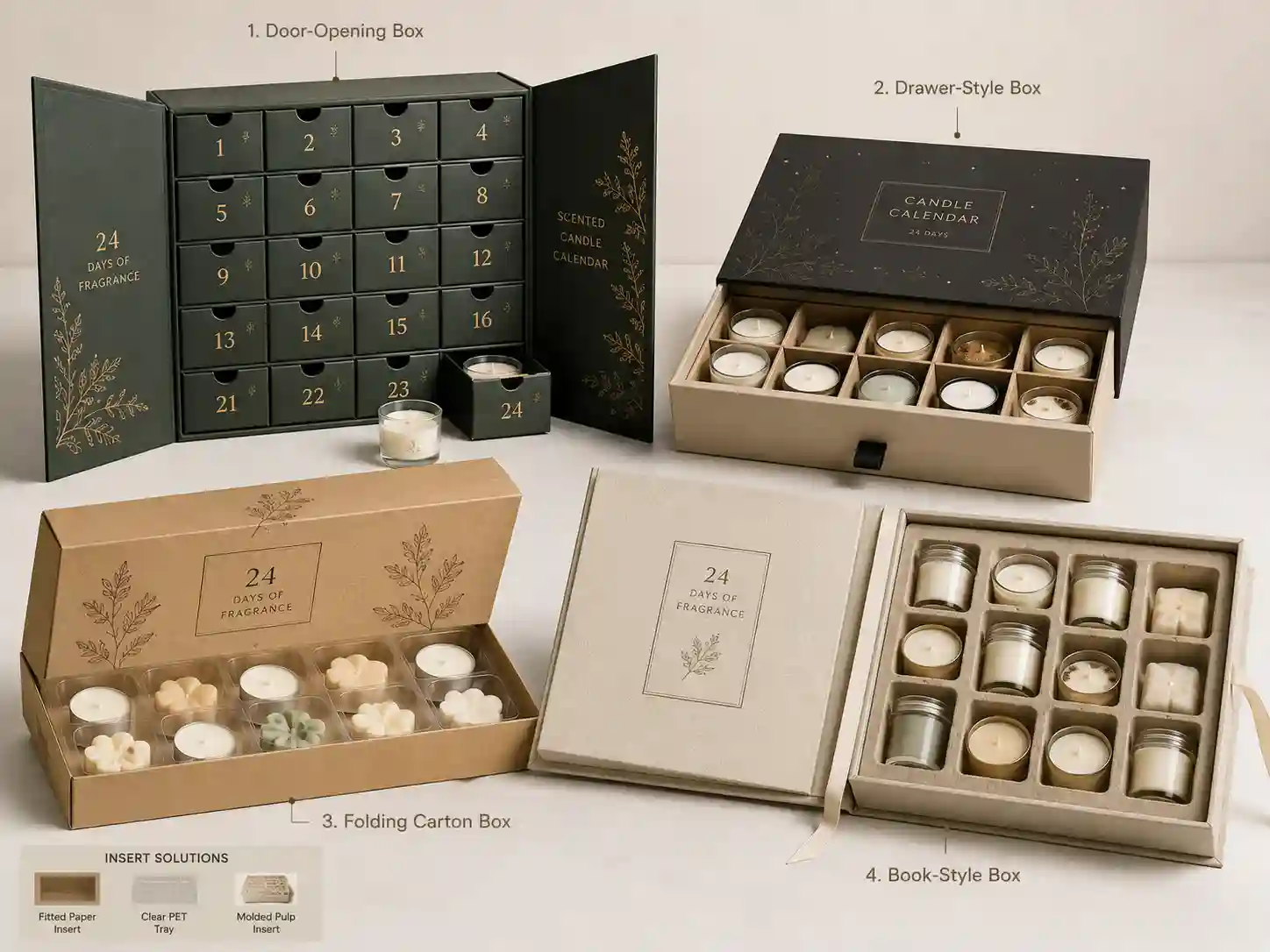
For brand owners, wholesalers, and gift companies, the early design stage should answer three questions: what candle formats are being packed, how the customer will open the calendar, and how the finished unit will be shipped. The answers determine whether a rigid box, drawer box, folding carton, fold-out design, or door-opening box is the most suitable option.
Which candle advent calendar box structure fits your campaign?
The best structure depends on candle weight, product count, budget level, retail channel, and the desired opening experience. For glass jars or premium gift sets, a rigid structure often provides better support; for lighter tins or tealights, paperboard options may be more cost-efficient.
Buyers comparing custom advent calendar boxes should look beyond the outside shape. They should check whether the structure can protect corners, keep drawers aligned, prevent doors from tearing, and support the total product weight after all candles are inserted.
| Structure option | Best use case | Key buyer concern | Practical design note |
|---|---|---|---|
| Rigid door-opening box | Premium candle gift calendars, glass jar candles, retail display | Greyboard thickness, door hinge durability, insert support | Use for heavier candle sets when the calendar needs a strong front-opening experience. |
| Drawer box | Mini candle tins, fragrance discovery sets, refill-style campaigns | Drawer sliding tolerance, pull-tab strength, assembly labor | Each drawer must be tested with real candle weight to avoid sticking or sagging. |
| Folding carton calendar | Lightweight tealights, wax melts, budget seasonal promotions | Paperboard stiffness, lock structure, carton compression | Good for cost control, but not ideal for heavy glass jars unless reinforced. |
| Book-style or fold-out box | Story-based retail displays, gift sets with mixed candle formats | Spine strength, magnetic closure, layout balance | Works well when buyers need a premium reveal and large artwork area. |
| Tray-and-sleeve design | E-commerce gift sets, simple unboxing, smaller candle counts | Sleeve friction, insert movement, shipping protection | Useful when the calendar concept is simplified for online fulfillment. |
Buyer tip: A beautiful structure can fail if the total filled weight is not checked early. Ask your supplier to calculate the approximate finished unit weight and confirm whether the selected structure needs thicker greyboard, reinforced corners, or a stronger insert.
When should you choose a rigid box?
Choose a rigid box when the candles are heavy, fragile, premium-priced, or intended for retail display. Rigid structures usually use greyboard wrapped with printed paper, giving better shape stability than standard paperboard folding cartons.
Rigid candle advent calendar boxes are suitable for mini glass jar candles, luxury fragrance sets, and campaigns where the packaging must support a higher perceived value. However, they usually require more material, more manual assembly, longer sampling time, and a higher unit cost than folding carton designs.
When is a drawer box a good choice?
A drawer box is suitable when each candle should feel like an individual gift or sample. It works especially well for tin candles, tealights, wax melts, and small fragrance combinations.
The main risk is drawer tolerance. If the drawer is too tight, users may damage the box when opening it; if it is too loose, drawers can slide during transportation. For B2B purchasing, the drawer sample should be tested after inserting the real candle weight, not only as an empty box.
When should buyers use a door-opening layout?
A door-opening layout is useful when the brand wants a classic advent calendar experience with numbered compartments. It is common for seasonal retail campaigns because the front panel carries strong visual impact.
For candle packaging, door perforation and compartment depth need careful checking. A weak door may tear unevenly, while a door that is too strong may be difficult to open. If candles are close to the door panel, leave enough clearance to prevent wax, lids, or labels from rubbing against the opening area.
How should candle size and layout be planned before dieline work?
Buyers should prepare exact product dimensions before the dieline is created. Candle diameter, height, lid shape, jar shoulder, label thickness, and allowable movement all affect the compartment size.
A dieline is the technical bridge between the candle product and the finished box. If the dieline is based on estimated product dimensions, the sample may look acceptable while the mass-production order creates fit problems. For glass jars, even small variations in diameter can affect insert tightness and loading speed.
Before layout planning, prepare a product matrix that lists each candle type, finished weight, fragrance, packaging status, and order sequence. If the calendar includes 12 or 24 candles with different sizes, the supplier needs to know whether the layout should be symmetrical, randomly arranged, or organized by product family.
What layout decisions affect cost and production?
Layout affects material usage, insert complexity, assembly time, carton size, and shipping volume. A compact layout can reduce freight cost, but a layout that is too tight may increase damage risk or make assembly slow.
- Confirm whether all candle compartments are the same size or mixed sizes.
- Leave enough finger space if candles need to be removed easily.
- Balance heavy glass jars across the box instead of placing all weight on one side.
- Check whether the calendar will stand upright, lie flat, or hang on a display.
- Allow space for insert walls, door flaps, drawer sleeves, and board thickness.
Factory tip: A candle calendar layout should be tested with real filled candles, not empty jars. Wax, lid, label, and fragrance seal all change the actual fit and finished weight.
Which insert material should hold candle products safely?
The insert should be selected according to candle weight, fragility, sustainability goals, appearance requirements, and assembly speed. For candle advent calendar boxes, insert strength is often more important than visual preference because the insert carries the product load inside the structure.
Common insert options include paper insert, PET tray, EVA insert, foam, and molded pulp. Each option has different advantages for fit, presentation, tooling, recycling expectations, and cost control.
| Insert type | Advantages | Limitations | Recommended candle use |
|---|---|---|---|
| Paper insert | Printable, paper-based, flexible for custom compartments | May need reinforcement for heavy glass jars | Tealights, tins, wax melts, light jars |
| PET tray | Accurate shape, good product visibility, stable cavity fit | Tooling and plastic-use concerns should be reviewed | Mini jars, tins, mixed gift sets |
| EVA insert | Premium cushioning, clean cutouts, good for fragile items | Higher cost and material considerations | Glass jars, premium candle sets |
| Foam insert | Strong cushioning and shock absorption | May not fit paper-based sustainability goals | Fragile glass candles and export-heavy projects |
| Molded pulp insert | Paper-based appearance, good cushioning, shaped cavities | Tooling, texture, and tolerance must be checked | Eco-positioned candle campaigns and e-commerce sets |
QC tip: Insert testing should include shaking, turning, lifting, and carton stacking simulation. If the candle moves inside the compartment during a basic handling test, the insert design should be adjusted before mass production.
How do material choices affect strength, cost, and retail appearance?
Material choices affect box stiffness, print result, hand feel, freight cost, and damage resistance. Buyers should choose paperboard, greyboard, wrapping paper, and insert material based on the candle weight and sales channel rather than appearance alone.
For rigid boxes, greyboard thickness is a major strength factor. Heavier candle calendars may require thicker board, stronger wrapping, and reinforced corners. For folding cartons, paperboard grade and caliper determine whether the box keeps its shape after filling and stacking. For door-opening boxes, the front panel material must support clean perforation and repeated handling during retail inspection.
Buyers with sustainability requirements should verify material sources and claims carefully. For example, FSC-related paper sourcing can be checked through the official Forest Stewardship Council website, while any recycled-content or local packaging compliance requirements should be confirmed for the destination market before ordering.
What customization choices should be finalized before sampling?
Customization should be finalized after structure and insert feasibility are confirmed. Printing and finishing cannot solve a weak structure, so artwork decisions should follow confirmed dimensions, dieline, and material selection.
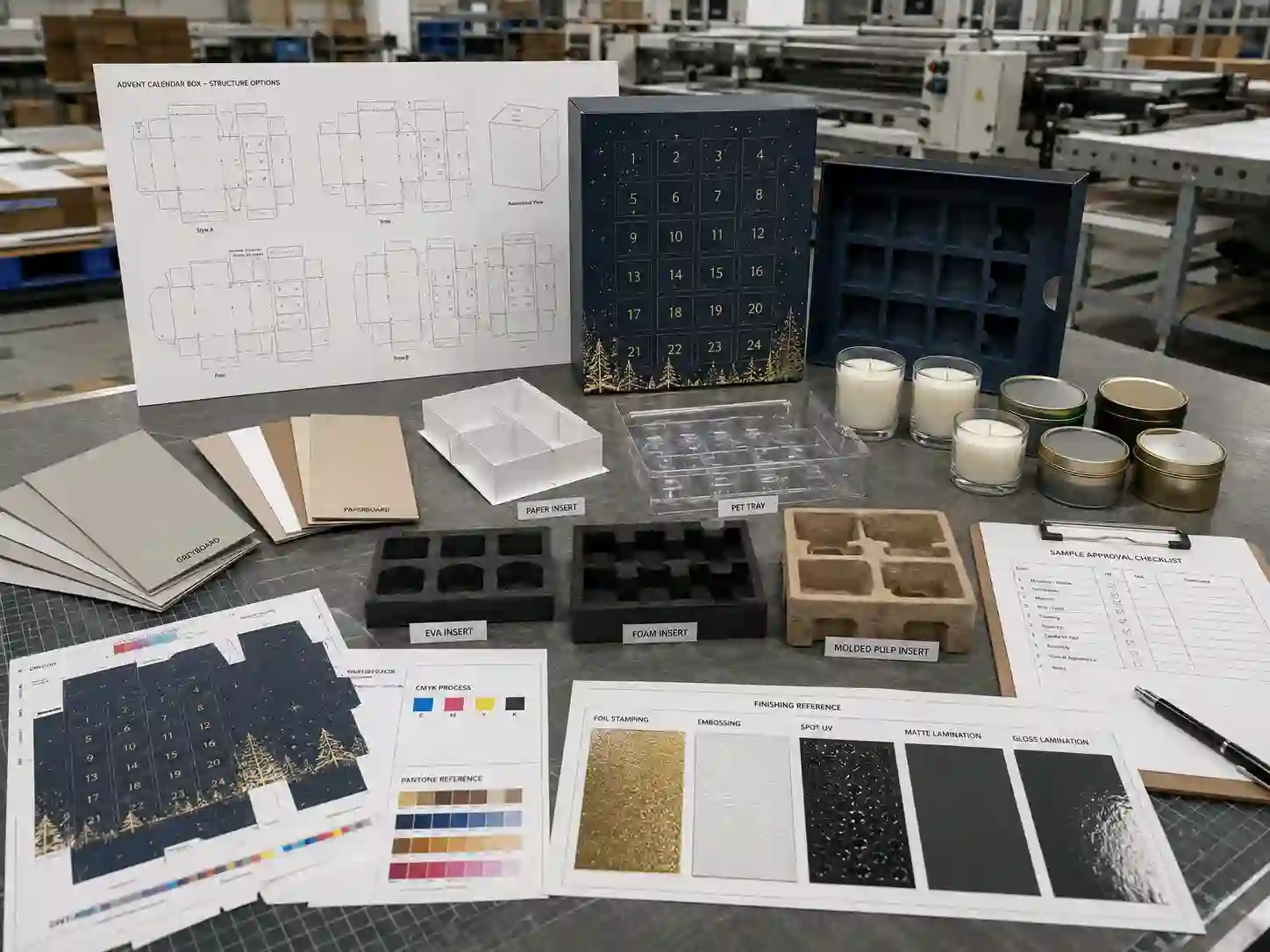
For candle advent calendar boxes, common customization options include CMYK printing, Pantone spot color, foil stamping, embossing, debossing, spot UV, matte lamination, gloss lamination, soft-touch coating, ribbon pulls, magnetic closures, window patches, and numbered doors. Each option affects cost, lead time, sample accuracy, and production tolerance.
CMYK is suitable for full-color seasonal artwork. Pantone color is useful when brand color consistency matters. Foil stamping can highlight numbers, logos, borders, or seasonal details, but it needs sufficient line thickness and stable placement. Embossing and debossing add tactile effect but require tooling and registration control. Spot UV works best when contrast with matte lamination is clear.
Factory tip: Confirm finishing positions on the dieline, not only on a flat artwork preview. Foil, embossing, and spot UV may shift slightly during production, so avoid placing critical effects too close to door cuts, folds, or drawer edges.
How should artwork be prepared for candle calendar production?
Artwork should be prepared according to the approved dieline with bleed, safe zones, numbering positions, barcode areas, and finishing layers clearly marked. Buyers should avoid starting final artwork before the structure and insert are approved.
- Use the supplier’s confirmed dieline instead of a self-made approximation.
- Mark CMYK artwork, Pantone colors, foil stamping, embossing, and spot UV as separate layers.
- Keep important text and numbers away from fold lines, door cuts, and glue areas.
- Confirm barcode size and readability if the calendar will enter retail distribution.
- Review whether shipping marks, carton labels, and retail labels use correct product information.
If barcodes or retail identification are involved, buyers can review official guidance from GS1 barcode standards before finalizing label placement.
What sampling process should buyers expect?
Buyers should expect a step-by-step sampling process that verifies structure, fit, artwork, finishing, assembly, and packing before mass production. A sample is not only a visual approval item; it is the main risk-control tool for candle packaging projects.
A typical B2B sampling flow includes dieline confirmation, white sample or blank prototype, printed sample, insert fit test, finishing review, pre-production sample, and mass-production approval. The process may vary depending on complexity, but the buyer should not skip the fit test for glass jars or fragranced products.
Which sample types matter most?
A blank structural sample checks shape, size, insert layout, and opening experience before artwork cost is added. A printed sample checks color, finishing, lamination, numbering, and the general retail look.
A pre-production sample is especially important when the order includes rigid structures, drawer systems, foil stamping, embossing, special inserts, or mixed candle sizes. It should represent the actual material, structure, finishing, and assembly method intended for mass production.
Buyer tip: Keep one approved sample with the buyer and one signed reference sample at the factory. During mass production, QC teams can compare color, structure, door opening, drawer movement, insert fit, and finishing against the approved reference.
How do MOQ, lead time, and cost drivers work for custom candle calendars?
MOQ, lead time, and cost depend on structure complexity, material selection, printing, finishing, insert type, tooling, and assembly labor. Buyers should ask for a quotation based on a defined specification rather than a general idea.
Rigid candle calendars, drawer boxes, and molded inserts usually require more setup and labor than simple folding carton calendars. Special finishing such as foil stamping, embossing, spot UV, and custom PET or molded pulp trays may add tooling cost and sampling time. Export packing and carton strength also affect the final quotation, especially for heavy glass jar sets.
| Cost driver | Why it matters | Buyer decision |
|---|---|---|
| Structure complexity | More parts mean more assembly time and tolerance control | Decide whether the campaign needs drawers, doors, fold-out panels, or a simpler tray system. |
| Material thickness | Stronger board protects heavy candles but increases material and freight cost | Match board strength to filled weight and shipping route. |
| Insert tooling | PET trays, EVA, foam, and molded pulp may need tooling or cutting setup | Choose insert type after testing candle fit and damage risk. |
| Printing and finishing | Special effects improve shelf impact but require process control | Use premium effects on high-value visual areas instead of every surface. |
| Assembly and packing | Drawer insertion, product loading, and carton protection affect labor cost | Clarify whether the factory supplies empty boxes only or packed gift sets. |
Lead time should be discussed in stages: dieline and structure development, sample production, sample revision, pre-production confirmation, mass production, final inspection, export packing, and international transit. Seasonal campaigns should leave enough buffer for artwork changes, material sourcing, and shipping delays.
What QC checks are important before shipping candle advent calendar boxes?
QC should verify structure, print, finishing, insert fit, candle protection, carton strength, and shipping marks before goods leave the factory. For candle products, damage risk often comes from weight concentration, weak inserts, loose compartments, and insufficient export carton protection.
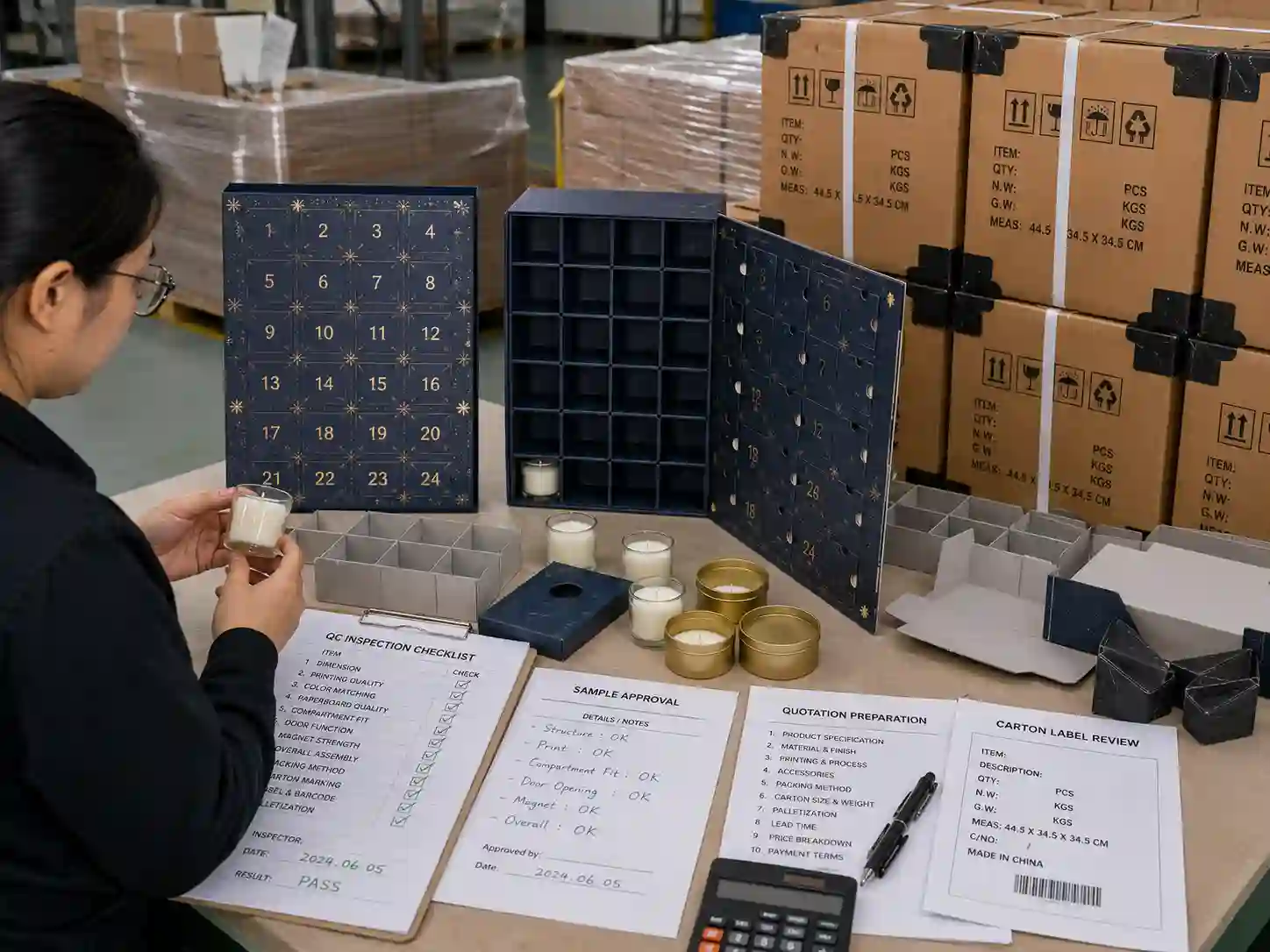
Final inspection should include dimensional checks, door-opening tests, drawer sliding tests, glue strength, lamination quality, foil or embossing position, color comparison, insert tightness, product loading review, carton drop or handling checks where required, and pallet packing review.
For export projects, buyers may also consider recognized transport-testing methods from organizations such as ISTA when a project requires formal package performance testing. Not every order needs formal laboratory testing, but heavy glass candle calendars should at least receive practical handling and stacking checks before shipment.
What candle-specific QC risks should buyers avoid?
Candle packaging QC should focus on glass breakage, lid movement, wax surface rubbing, fragrance transfer, insert deformation, and carton compression. These issues are easier to prevent during sampling than to solve after mass production.
- Glass jar weight: Confirm whether the insert and outer box can support the total filled weight.
- Wax and oil protection: Avoid direct rubbing between wax surface, lid, door panel, and insert edges.
- Scent transfer: Check whether fragranced candles are properly sealed before being placed in paper compartments.
- Insert strength: Test the insert after loading the heaviest candle format.
- Carton compression: Confirm master carton layout, carton board strength, corner protection, and pallet stacking plan.
QC tip: A candle calendar that passes visual inspection can still fail during export shipping. Always review the master carton, inner protection, pallet plan, and shipping marks together with the finished calendar sample.
How should export packing be designed for seasonal candle campaigns?
Export packing should protect the finished candle calendars from compression, corner damage, moisture exposure, rough handling, and pallet movement. Heavy candle calendars need stronger master cartons than lightweight paper gift boxes.
Buyers should confirm the number of units per export carton, carton dimensions, gross weight, carton board strength, inner separators, corner protectors, pallet size, pallet wrap, and shipping marks. If the order is going to Amazon, retail distribution, or a third-party warehouse, carton labels and barcode placement should be checked before packing starts.
For glass jar candle sets, avoid overpacking too many units into one carton if the gross weight becomes difficult to handle. A lower carton quantity may increase carton count, but it can reduce breakage risk and improve warehouse handling.
How should buyers compare candle calendar suppliers?
Buyers should compare suppliers based on structural engineering support, sample quality, insert testing, artwork handling, QC process, export packing experience, and quotation clarity. The lowest unit price is not always the lowest project cost if sampling revisions, damage claims, or delayed shipment occur.
A reliable supplier should ask for product dimensions, candle weight, target quantity, structure preference, insert needs, artwork requirements, destination market, shipping method, and packing expectations. If a supplier quotes without asking for these details, the quotation may be too general for purchasing decisions.
Giftpackpro works as a custom advent calendar boxes manufacturer for B2B buyers who need structure planning, sampling, production, and export packing support. Buyers can review custom advent calendar box products, learn more about custom advent calendar box services, and understand the Giftpackpro packaging factory before preparing an RFQ.
What information should be prepared before requesting a quotation?
Buyers should prepare product, structure, artwork, quantity, packaging, and shipping details before asking for a quotation. The more complete the RFQ, the easier it is for the factory to recommend the right structure and calculate realistic cost.
Use this practical checklist before contacting a supplier:
- Candle type: glass jar, tin, tealight, wax melt, or mixed format.
- Each candle size: diameter, height, lid shape, and label thickness.
- Each candle weight, including jar, wax, lid, and retail label.
- Number of compartments, such as 12-day, 24-day, or custom layout.
- Preferred structure: rigid box, drawer box, door-opening box, folding carton, fold-out box, or undecided.
- Insert preference: paper insert, PET tray, EVA insert, foam, molded pulp, or factory recommendation.
- Artwork status: rough concept, final design, brand colors, CMYK, Pantone, and finishing requirements.
- Surface finishing: matte lamination, gloss lamination, foil stamping, embossing, debossing, spot UV, or special coating.
- Estimated order quantity and target MOQ expectations.
- Sample requirement: blank prototype, printed sample, or pre-production sample.
- Export needs: carton quantity, destination country, pallet requirements, shipping marks, warehouse labels, or Amazon/e-commerce requirements.
- Target delivery date and seasonal launch schedule.
Decision guide: which design route should you choose?
Choose the design route by matching product risk, retail value, budget, and launch timing. The right structure is the one that protects the candle set while meeting the campaign’s cost and presentation goals.
| Buyer situation | Recommended direction | Why |
|---|---|---|
| Premium glass jar candle calendar for retail shelves | Rigid door-opening box with reinforced insert | Provides stronger structure, better display value, and safer support for heavier candles. |
| Fragrance discovery set with many small tins | Drawer box or book-style layout | Creates a gift-like opening experience while keeping each item organized. |
| Budget promotional campaign with tealights | Folding carton calendar with paper insert | Controls material and assembly cost for lighter products. |
| E-commerce candle gift set with shipping risk | Tray-and-sleeve or rigid box with strong export carton | Prioritizes transit protection and carton compression resistance. |
| Eco-positioned seasonal launch | Paper-based structure with paper or molded pulp insert | Supports a paper-focused packaging story, subject to local recycling and performance checks. |
What common mistakes should buyers avoid?
Buyers should avoid designing around artwork before confirming product fit, structure strength, and export packing. Most candle calendar problems come from late technical decisions, not from the visual design itself.
- Starting artwork before the candle dimensions and dieline are confirmed.
- Selecting a folding carton for heavy glass jars without reinforcement testing.
- Using the same compartment size for products with different lids or jar shoulders.
- Ignoring scent transfer when fragranced candles are packed close together.
- Choosing insert material based only on appearance instead of weight support.
- Approving an empty sample without testing real candles inside.
- Placing foil stamping or spot UV too close to door cuts and folds.
- Underestimating carton compression risk for export pallets.
- Requesting a quotation without quantity, size, material, insert, and shipping details.
FAQ: candle advent calendar boxes for seasonal campaigns
What are candle advent calendar boxes used for in B2B campaigns?
Candle advent calendar boxes are used to package multiple candles, tealights, tins, wax melts, or fragrance samples into a numbered seasonal gift format. B2B buyers use them for retail promotions, gift sets, e-commerce campaigns, wholesale programs, and brand launch projects.
Are rigid boxes always better than folding cartons?
No. Rigid boxes are usually stronger and more premium, but folding cartons can be suitable for lightweight candles and cost-sensitive campaigns. The right option depends on candle weight, retail positioning, order quantity, and shipping risk.
Which insert is best for glass jar candles?
Glass jar candles usually need a stronger insert such as reinforced paperboard, PET tray, EVA, foam, or molded pulp. The best insert should be confirmed by testing the real jar size and filled weight inside the sample.
Can one calendar include candles with different sizes?
Yes, but the layout and insert should be designed around the largest and heaviest items first. Mixed sizes may require custom cavities, varied compartment depths, or a more complex dieline.
What affects the MOQ for candle calendar packaging?
MOQ is affected by structure type, material sourcing, printing setup, finishing, insert tooling, and assembly complexity. Buyers should discuss MOQ after the supplier understands the size, structure, insert, and artwork requirements.
What is the difference between a prototype and a pre-production sample?
A prototype usually checks structure, size, and fit. A pre-production sample should match the final material, printing, finishing, insert, and assembly method before mass production starts.
How early should buyers start a seasonal candle calendar project?
Buyers should start early enough to allow for dieline development, sampling, revisions, artwork proofing, mass production, QC, export packing, and international shipping. Seasonal packaging projects should include schedule buffer because small delays can affect retail launch timing.
How can Giftpackpro help with candle advent calendar box design?
Giftpackpro helps B2B buyers turn candle product details into practical custom advent calendar boxes for seasonal campaigns. The design process can include structure recommendation, dieline planning, insert selection, material discussion, artwork proof support, sample development, mass production, QC review, and export packing coordination.
Before you request a custom quote, prepare candle dimensions, product weight, quantity, structure preference, insert requirement, artwork status, target market, and delivery schedule. Buyers who are still comparing options can also review more advent calendar box buying guides to understand structure, material, sampling, and purchasing decisions before finalizing an RFQ.
CTA: To design candle advent calendar boxes with fewer sampling risks, send Giftpackpro your candle size list, filled weight, preferred calendar count, reference structure, artwork plan, target quantity, and export destination. A clear RFQ helps the factory recommend the right structure, insert, material, sample route, and quotation for your seasonal campaign.