Quick answer: Candle advent calendar boxes are custom seasonal packaging systems designed to hold candles, candle tins, tealights, wax melts, or mini glass jars in dated compartments. For B2B buyers, the best solution is not only about appearance. It depends on candle weight, insert strength, door or drawer structure, wax and oil surface protection, scent transfer control, artwork accuracy, sample approval, mass production tolerance, QC, export carton strength, and quotation clarity. Before ordering, buyers should prepare candle dimensions, filled weight, fragrance count, quantity, target market, artwork needs, packing method, and delivery deadline.
For brands, wholesalers, gift companies, retail buyers, and e-commerce sellers, candle advent calendar boxes are usually developed as seasonal gift packaging with high retail value and strict launch timing. A good supplier should help you convert candle sizes, product layout, branding, insert material, printing finish, carton packing, and shipping requirements into a practical production plan.
Giftpackpro works as a custom advent calendar boxes manufacturer for overseas packaging projects where structure, sampling, export packing, and quotation details must be clear before bulk production starts.
What should buyers understand before choosing candle advent calendar boxes?
Buyers should understand that candle advent calendar boxes must protect heavier and sometimes fragile products while also presenting a gift-ready retail structure. A candle calendar is more demanding than a lightweight paper gift calendar because glass jars, wax surfaces, fragrance oils, and scented products create extra packaging risks.
The first decision is product format. Mini glass jar candles, candle tins, tealights, wax melts, fragrance tablets, and small boxed candles all need different compartment sizes and insert materials. A 24-day calendar with glass jars may require stronger greyboard, reinforced internal support, and a more conservative export carton plan. A wax melt calendar can often use lighter paperboard or a folding carton if the product weight is low and the retail channel is less demanding.
Buyer tip: Do not choose the box structure only from a reference photo. Send the actual candle diameter, height, filled weight, lid type, fragrance count, and packaging goal. The same visual design can need a different insert or board thickness when the candle changes from tin to glass.
Which box structure is best for candle advent calendar boxes?
The best structure depends on candle weight, retail positioning, assembly cost, and how the buyer wants customers to open each compartment. Rigid door-opening boxes are common for premium candle sets, while drawer boxes and book-style boxes work well when the buyer wants a reusable gift presentation.
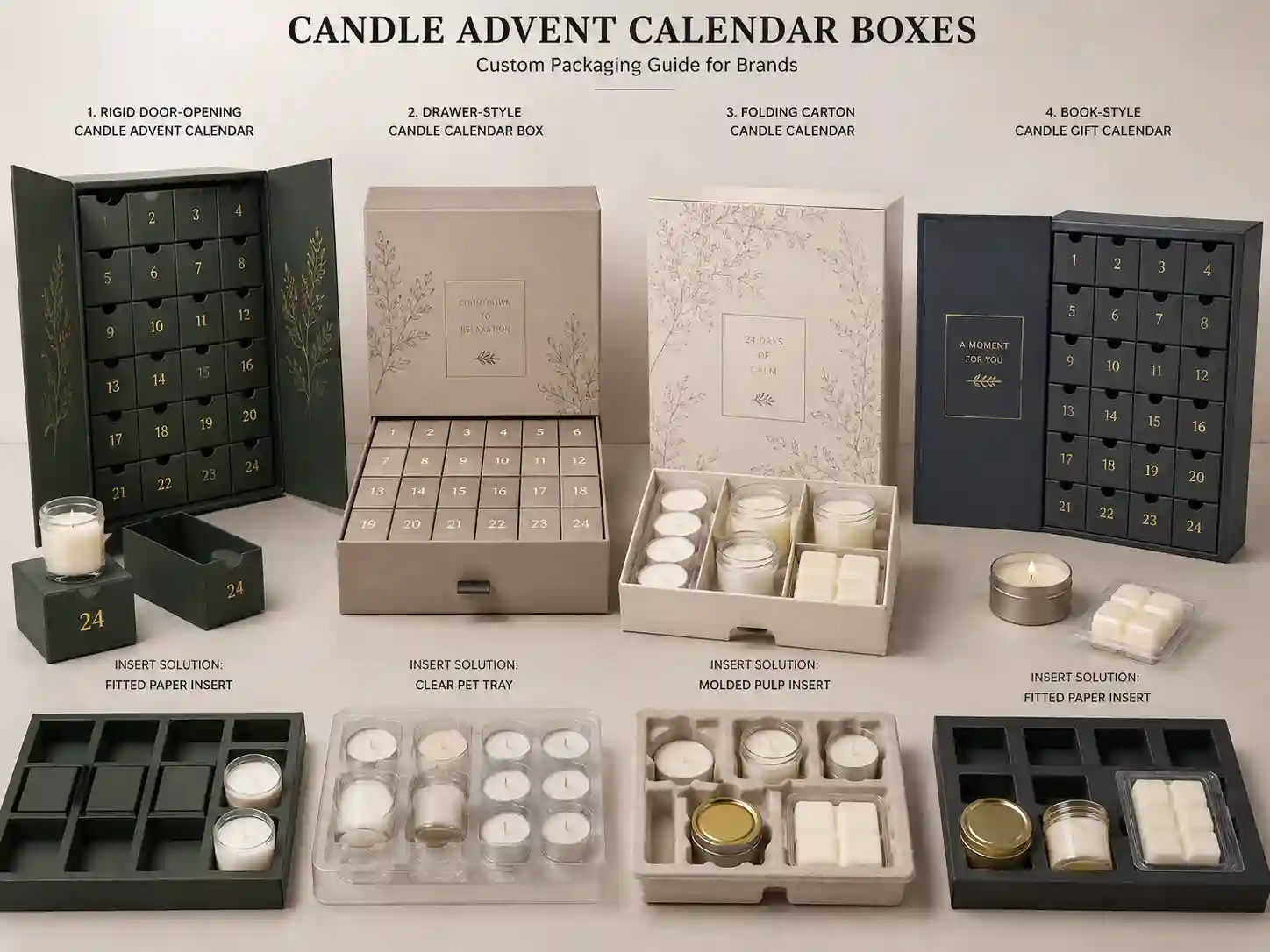
| Structure option | Best for | Key advantages | Main buyer checks |
|---|---|---|---|
| Rigid door-opening box | Premium mini candle jars, candle tins, mixed fragrance calendars | Strong presentation, good shelf impact, supports foil stamping, embossing, spot UV, and premium paper wrap | Door tolerance, insert support, board thickness, carton compression, assembled packing volume |
| Drawer box | Luxury candle gift sets, reusable packaging, heavier jars | Smooth unboxing, strong structure, easy compartment control with internal trays | Drawer sliding fit, pull tab strength, inner tray stability, labor cost for assembly |
| Book-style magnetic box | Gift company projects, retail launch kits, premium fragrance collections | High perceived value, large branding area, good for sample sets and storytelling panels | Magnet placement, spine strength, jar weight distribution, export protection |
| Folding carton advent calendar | Lightweight tealights, wax melts, small candle accessories | Lower unit cost, efficient flat packing, suitable for larger promotional quantities | Paperboard grade, folding tolerance, door tear strength, product weight limit |
A rigid box generally uses greyboard wrapped with printed paper. It is suitable when the buyer needs a premium finish and stronger support. A folding carton uses printed paperboard and can reduce cost and shipping volume, but it has limits when the candles are heavy. Drawer and book-style structures cost more but may create a stronger gift impression for retail or corporate gifting.
Quotable B2B statement: For candle advent calendar boxes, structure selection should start with the filled candle weight and opening method, not with artwork decoration.
How should inserts be selected for candles, tins, tealights, and wax melts?
Insert selection should be based on product weight, fragility, fragrance control, assembly efficiency, and sustainability goals. A weak insert can make an expensive rigid box fail because the candles move, tilt, rub, or break during transport.
Paper inserts are common for paper-based custom advent calendar boxes. They are printable, recyclable in many markets depending on local rules, and suitable for lightweight candles or wax melts. PET trays offer clear molded cavities and stable positioning for tins, tealights, and small jars. EVA insert and foam can provide strong cushioning for glass, but buyers should consider material preferences, recycling expectations, and market restrictions. Molded pulp inserts are useful when a buyer wants a paper-based protective tray with a more natural look.
What candle-specific insert problems should be tested?
The insert must hold each candle firmly without crushing labels, scratching tins, or pressing directly into wax surfaces. For glass jars, the cavity should control side movement and vertical lift. For wax melts, the tray should avoid surface rubbing, oil staining, and fragrance transfer between compartments.
- Glass jar weight: confirm filled weight, not empty jar weight, because filled candles increase compression and drop risk.
- Wax or oil surface protection: check whether a lid, wrap, paper separator, or PET cover is needed to prevent surface marks.
- Scent transfer awareness: strong fragrances may migrate if products are not individually wrapped or separated.
- Insert strength: test whether the insert collapses when the box is held vertically, stacked, or shaken.
- Assembly tolerance: confirm that workers can load candles quickly without forcing products into tight cavities.
Factory tip: A sample insert should be tested with real candles from the intended production batch. Substitute objects with similar size but different weight cannot fully predict glass impact, fragrance transfer, or wax surface behavior.
Which materials and finishes are practical for B2B candle calendar projects?
Material choice should balance premium presentation, candle weight, cost, and shipping risk. Rigid candle calendars often use greyboard with printed art paper, while folding carton calendars use paperboard that must be thick enough for door strength and product load.
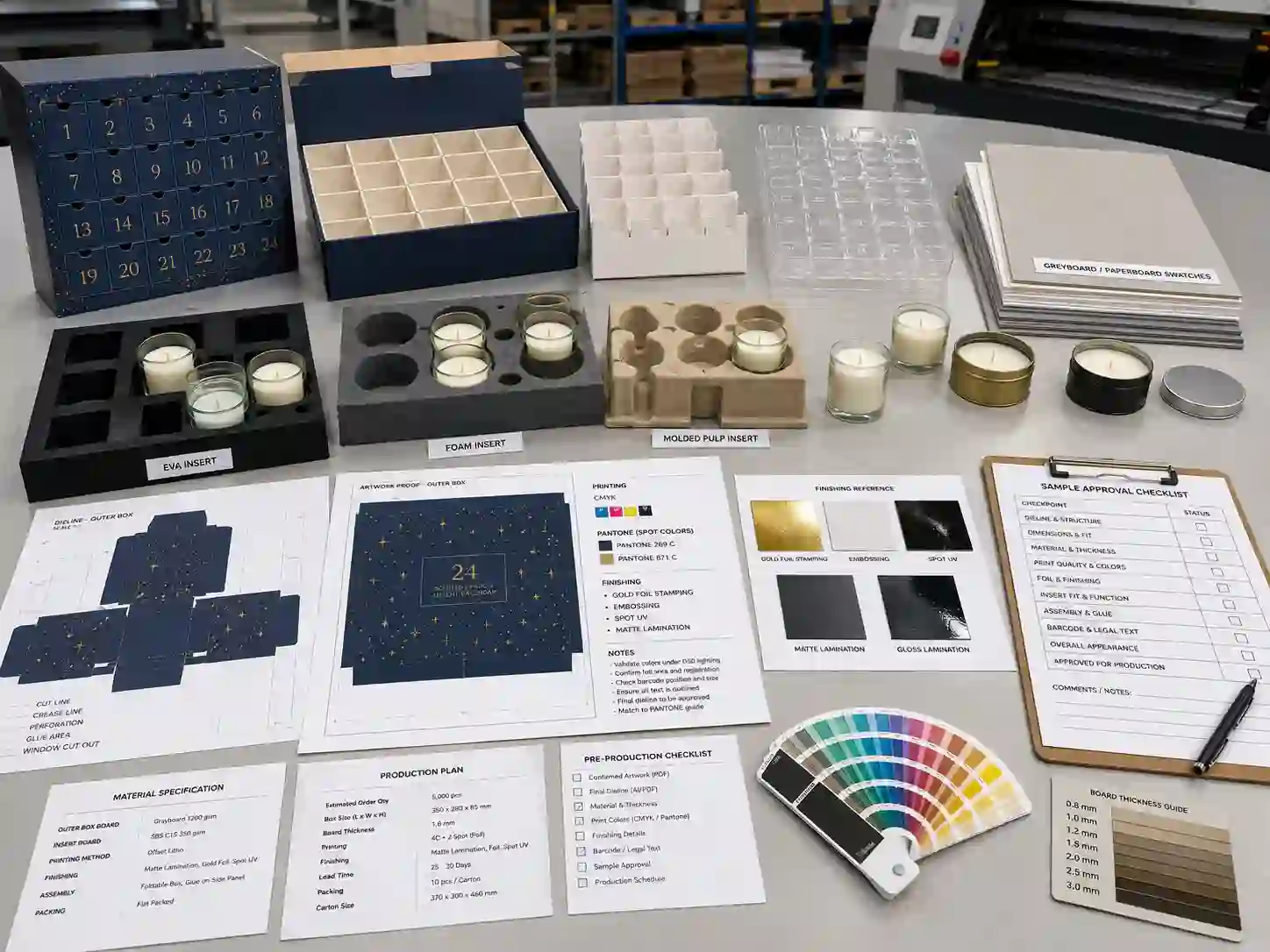
Common material decisions include greyboard thickness, paperboard grade, paper insert material, PET tray thickness, molded pulp density, and outer wrap paper. For eco-positioned projects, buyers may ask suppliers about responsibly sourced paper and chain-of-custody options. Buyers can review official guidance from the Forest Stewardship Council paper and packaging page when FSC-related material claims are important, but they should verify supplier scope and document availability before printing any certification logo.
Printing and finishing should support the brand position without creating production risk. CMYK is suitable for full-color seasonal artwork. Pantone color matching is useful for brand colors, but buyers should approve a physical color proof where possible because paper, lamination, and lighting can change appearance. Foil stamping works well for premium candle gift boxes, but foil areas should avoid folding stress and door tear lines. Embossing and debossing add texture but need enough board support. Spot UV can highlight patterns or numbers. Matte lamination gives a soft luxury feel, while gloss lamination increases shine and color impact.
How should buyers prepare artwork and dieline files?
Buyers should request the final dieline after confirming candle layout, insert type, and box structure. Artwork should not be locked before the supplier checks door position, number sequence, glue areas, bleed, barcode placement, shipping label needs, and finishing zones.
- Use the supplier’s dieline instead of adapting a consumer mockup.
- Keep important text and numbers away from cutting, creasing, and perforation lines.
- Mark foil stamping, embossing, spot UV, matte lamination, and gloss lamination layers clearly.
- Provide CMYK files and Pantone references where brand color accuracy matters.
- Confirm whether each door number must match a specific fragrance or product sequence.
- Check legal, recycling, barcode, and country-of-sale labeling requirements with your own compliance team.
Giftpackpro’s custom advent calendar box services can support structure discussion, dieline preparation, material selection, sample development, and bulk production planning for candle calendar projects.
What sample process should buyers expect before mass production?
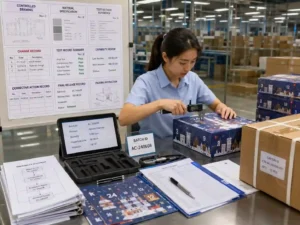
Buyers should expect at least one prototype or production-quality sample before approving mass production. Sampling is where structure, insert fit, artwork, opening experience, and packing assumptions are tested before the project moves into bulk manufacturing.
A white sample or blank prototype is useful for checking structure, compartment layout, candle fit, and insert strength without final printing. A printed sample helps buyers review artwork, color, finishing, lamination, door opening, drawer movement, and premium presentation. A pre-production sample should represent the approved materials, printing, insert, assembly, and packing method as closely as possible.
What should be approved on the sample?
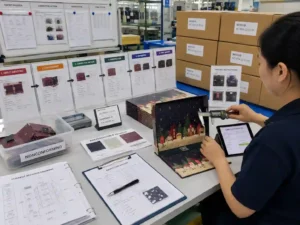
The sample should be approved against measurable details, not only visual impression. For candle advent calendar boxes, a sample that looks attractive but fails candle fit or export packing is not ready for production.
- Confirm outer box size, structure, and standing stability.
- Check every candle cavity with real products, including lids and labels.
- Open and close doors, drawers, or book panels repeatedly.
- Review number sequence, artwork alignment, color, and finishing position.
- Check insert holding strength when the box is tilted and lightly shaken.
- Inspect whether wax, fragrance oil, or candle labels contact rough surfaces.
- Confirm export packing method, master carton quantity, and shipping marks.
QC tip: Keep one signed approval sample with the buyer and one with the factory. During mass production, the factory QC team should compare printing, structure, insert fit, assembly, and packing against the approved sample.
What MOQ, cost, and lead time factors affect the quotation?
MOQ, unit cost, and lead time are affected by structure complexity, material selection, insert type, printing process, finishing, order quantity, assembly method, and export packing. A simple folding carton calendar with paper insert usually prices differently from a rigid drawer candle calendar with PET tray, foil stamping, and assembled export packing.
| Cost driver | Why it matters | Buyer decision |
|---|---|---|
| Box structure | Rigid, drawer, and book-style boxes use more material and labor than folding cartons. | Choose based on product weight, retail price point, and display goal. |
| Insert type | Paper insert, PET tray, EVA insert, foam, and molded pulp all have different tooling and material costs. | Match insert strength to candle format and export risk. |
| Printing and finishing | Pantone matching, foil stamping, embossing, spot UV, matte lamination, and gloss lamination add setup steps. | Prioritize finishes that affect shelf impact or brand consistency. |
| Sample requirements | Prototype, printed sample, and pre-production sample require different time and cost. | Use sampling to reduce mass production risk, not just to create sales photos. |
| Packing method | Flat packing saves volume, while assembled packing protects presentation but increases carton size. | Compare shipping cost and warehouse labor before confirming. |
| Order quantity and MOQ | Lower quantities carry higher setup cost per unit; larger quantities improve efficiency. | Ask for quantity price breaks instead of one single price. |
Lead time should be discussed in stages: dieline confirmation, sample production, sample shipping, buyer approval, material purchasing, printing, finishing, assembly, final inspection, export packing, and international transport. Seasonal packaging projects should leave buffer time because one artwork revision or candle size change can affect the dieline, insert mold, and production schedule.
How should buyers compare candle advent calendar box suppliers?
Buyers should compare suppliers by their ability to manage structure, insert engineering, sample control, production tolerance, QC, export packing, and communication, not only by the lowest unit price. Candle calendars involve heavier and more fragile products, so supplier reliability directly affects launch timing and damage rate.
When evaluating a supplier, ask whether they can explain the difference between rigid box, folding carton, drawer box, and door-opening box structures for candle products. A practical supplier should ask for candle weight, fragrance count, jar material, target market, retail channel, artwork status, packing method, and delivery schedule before offering a serious quotation.
Supplier comparison checklist
- Can the supplier recommend a structure based on filled candle weight and retail channel?
- Can they develop paper insert, PET tray, EVA insert, foam, or molded pulp options?
- Can they provide a dieline before final artwork preparation?
- Do they define sample type, sample lead time, and sample approval process clearly?
- Do they understand CMYK, Pantone, foil stamping, embossing, spot UV, matte lamination, and gloss lamination requirements?
- Do they check door-opening tolerance, drawer movement, glue strength, and insert fit?
- Do they specify export carton strength, pallet plan, shipping marks, and carton quantity?
- Can they support overseas buyers with clear RFQ communication and production updates?
Buyers can review custom advent calendar box products to compare possible structures before preparing an RFQ, and they can learn more about the Giftpackpro packaging factory when assessing production-side capability.
What QC points matter most before export packing?
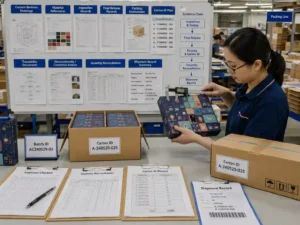
QC should confirm that the finished calendar matches the approved sample and can survive handling, storage, and shipment. For candle calendars, final inspection should pay special attention to weight distribution, insert strength, glass protection, door function, fragrance separation, and carton compression risk.
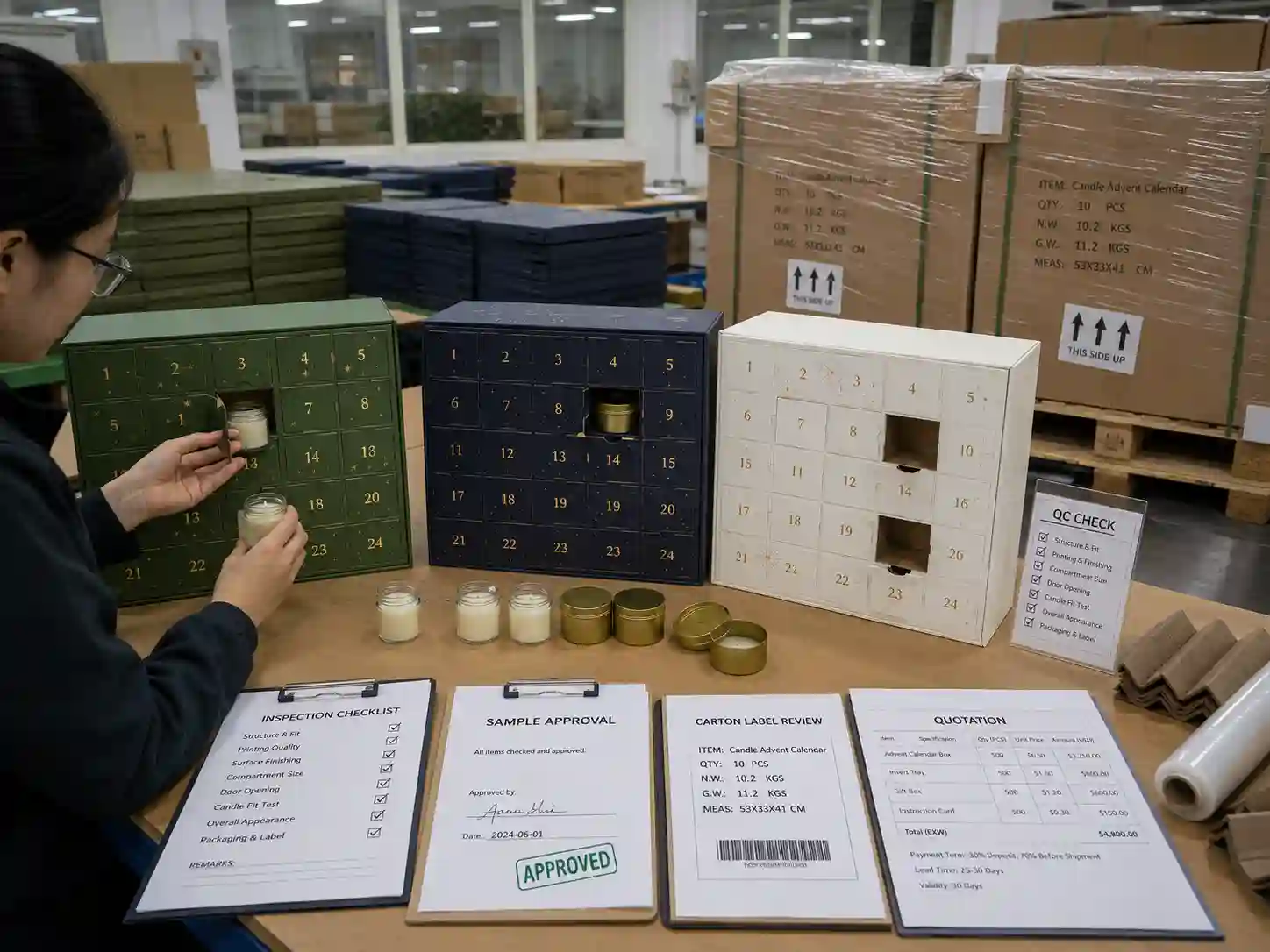
Common QC checks include material thickness, printing color, lamination quality, foil position, embossing registration, die-cut accuracy, door tear performance, drawer sliding fit, glue strength, insert position, candle cavity size, loading accuracy, barcode readability, carton label accuracy, and shipping marks. Buyers should also check whether products are packed in the correct fragrance sequence when each compartment is mapped to a date.
Export packing should be decided before mass production ends. Assembled candle advent calendar boxes may need individual polybag or paper wrap, corner protectors, inner cartons, stronger master cartons, and pallet wrap. If the calendar contains glass jars, the master carton should be evaluated for compression and drop risk. For more formal distribution testing, buyers can review official resources from the International Safe Transit Association test procedures and decide whether third-party testing is needed for their channel.
Quotable B2B statement: Export packing for candle advent calendars should be designed around the heaviest packed unit and the weakest glass or wax contact point, not around the outer box appearance alone.
What information should buyers prepare before requesting a quotation?
A clear RFQ helps the supplier quote faster and more accurately. Buyers should prepare product, structure, artwork, quantity, sample, packing, and delivery information before asking for a quotation.
RFQ preparation checklist
- Target product: mini glass jar candles, tins, tealights, wax melts, or mixed candle items.
- Product size: diameter, height, lid height, label area, and filled weight for each item.
- Calendar format: 12-day, 24-day, 25-day, or custom compartment count.
- Preferred structure: rigid box, folding carton, drawer box, door-opening box, or book-style box.
- Insert preference: paper insert, PET tray, EVA insert, foam, molded pulp, or supplier recommendation.
- Artwork status: final design, rough concept, brand guide, CMYK file, Pantone reference, or dieline request.
- Finishing requirements: foil stamping, embossing, spot UV, matte lamination, gloss lamination, or special paper.
- Quantity and MOQ target: required order quantity and possible quantity price breaks.
- Sample needs: blank prototype, printed sample, pre-production sample, and approval deadline.
- Packing method: flat packed, semi-assembled, fully assembled, individual packing, export carton, pallet, and shipping marks.
- Destination and deadline: target port, warehouse, retail launch date, and required delivery window.
For more planning resources, buyers can browse advent calendar box buying guides. When ready, prepare the details above and request a custom quote from Giftpackpro with candle dimensions, quantity, structure preference, artwork status, and delivery requirements.
Decision guide: how should buyers choose the right solution?
The right solution is the one that protects the candle, supports the brand position, fits the budget, and can be produced on time. Buyers should make decisions in a practical order instead of selecting decoration first.
| Buyer situation | Recommended direction | Reason |
|---|---|---|
| Premium mini glass jar candle launch | Rigid door-opening or book-style box with strong insert | Better support for weight, gift value, and retail presentation. |
| Luxury fragrance collection with reusable packaging goal | Drawer box or magnetic book-style structure | Creates a premium opening experience and stronger keepsake value. |
| High-volume promotional tealight calendar | Folding carton with paper insert or PET tray | Controls unit cost and shipping volume for lighter products. |
| Wax melt calendar with many fragrances | Paperboard or rigid structure with separated cavities | Helps reduce rubbing, fragrance mixing, and surface damage. |
| E-commerce shipment to individual customers | Stronger box, tighter insert, tested export carton or mailer plan | Single-parcel handling creates higher drop and compression risk. |
Buyer tip: If the calendar will be shipped through e-commerce fulfillment, do not rely only on a retail shelf sample. Ask the supplier to consider drop, vibration, compression, and outer carton protection because parcel distribution can be harsher than palletized retail delivery.
What common mistakes should candle calendar buyers avoid?
Most candle advent calendar packaging problems come from late product data, weak inserts, rushed artwork, unclear sample approval, or underestimated export packing. These mistakes can be avoided with a more disciplined RFQ and sampling process.
- Approving the structure before confirming filled candle weight: glass and wax weight can change board and insert requirements.
- Using one cavity size for different candle formats: mixed products may need different compartment depths or supporting ribs.
- Ignoring scent transfer: strong fragrances should be separated, wrapped, or tested before shipment.
- Placing foil or artwork too close to door cuts: finishing can crack or misalign near perforation and crease lines.
- Skipping a real candle fit test: insert cavities should be tested with actual jars, tins, labels, and lids.
- Underestimating carton compression: assembled rigid calendars are bulky, and heavy candles can stress master cartons during stacking.
- Requesting only the lowest unit price: weak packing, unclear QC, and poor sampling can create higher total cost after damage or delay.
FAQ: Candle advent calendar boxes for B2B buyers
What are candle advent calendar boxes?
Candle advent calendar boxes are custom packaging boxes with multiple compartments for candles, tins, tealights, wax melts, or fragrance-related products. They are usually made for seasonal retail, wholesale, gifting, e-commerce, or promotional campaigns.
What is the best structure for heavy glass candle jars?
Rigid boxes, drawer boxes, and book-style boxes are usually better for heavier glass jars because they provide stronger board support and a more premium presentation. The final decision should be confirmed by sample testing with real filled candles.
Can candle advent calendar boxes be flat packed?
Some folding carton designs can be flat packed, which can reduce shipping volume. Many rigid candle calendars are shipped assembled or semi-assembled because the structure, insert, and presentation need better protection.
Which insert is best for glass candles?
PET tray, EVA insert, foam, molded pulp, or reinforced paper insert can all work depending on jar weight, sustainability goals, cost, and transit risk. For glass candles, buyers should test side movement, vertical lift, impact protection, and carton compression.
How early should buyers start a candle calendar project?
Buyers should start as early as possible because structure design, dieline confirmation, sample production, artwork proofing, mass production, QC, export packing, and international shipping all require time. Seasonal launch projects should include buffer time for sample revisions.
What should be included in a candle advent calendar quotation?
A quotation should define structure, size, material, insert, printing, finishing, MOQ, sample cost, sample lead time, production lead time, packing method, export carton details, shipping marks, payment terms, and validity period.
Ready to develop candle advent calendar boxes with a factory-side plan?
Candle advent calendar boxes require more than a seasonal graphic design. Buyers need the right structure, insert, material, artwork setup, sample process, QC standard, export carton plan, and quotation details before production begins.
To request a sample or quotation from Giftpackpro, prepare your candle sizes, filled weights, fragrance count, preferred structure, insert preference, artwork status, order quantity, packing method, destination, and launch deadline. Clear project information helps the factory recommend a practical custom packaging solution and reduce avoidable sample revisions, production delays, and shipping damage.