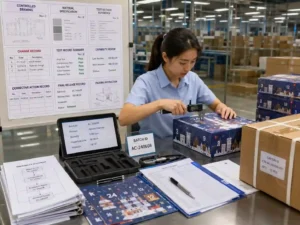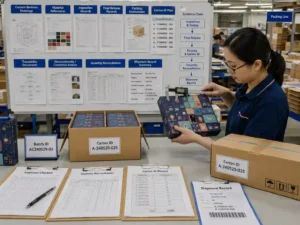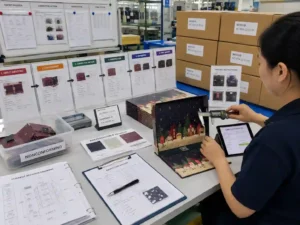
Quick answer: Snack advent calendar boxes are custom seasonal packaging systems designed to hold multiple wrapped snacks in separated compartments, usually for retail campaigns, e-commerce gift sets, subscription promotions, and distributor programs. Buyers should choose the box structure, insert material, door-opening method, artwork finish, carton protection, and quotation details based on snack size, weight, shelf display needs, shipping route, and assembly method. The most important early decisions are product measurement, compartment layout, food-contact material awareness, insert fit, sample approval, MOQ, lead time, QC standards, and export packing method.
For B2B buyers, snack advent calendar boxes are not only decorative gift packaging. They are a production project involving structure engineering, dieline accuracy, printing control, assembly tolerance, product protection, logistics planning, and supplier coordination. A small mismatch between snack size and insert design can create loose compartments, damaged doors, slow assembly, higher carton volume, or poor retail presentation.
This guide explains how overseas brands, wholesalers, retail buyers, Amazon sellers, gift companies, and procurement teams can compare options before asking Giftpackpro for a sample or quotation. For broader packaging options, buyers can also review custom advent calendar box products and related advent calendar box buying guides.
What should buyers understand before choosing snack advent calendar boxes?
Buyers should understand that the snack itself controls the packaging design. Size, weight, packaging material, odor, moisture sensitivity, labeling requirements, shelf display angle, and shipping method all affect the final structure and insert choice.
A snack advent calendar usually contains wrapped bars, biscuits, crackers, candy pouches, nut packs, dried fruit sachets, coffee snacks, mini cookies, or mixed promotional items. These products may have different thicknesses, shapes, and flexibility. A box designed only from a visual concept may look good in a rendering but fail during insert testing, door opening, or export shipment.
Buyer tip: Before discussing artwork, prepare the real snack samples or exact product dimensions. A useful packaging brief includes product length, width, height, weight, packaging material, orientation inside the box, total number of compartments, target retail channel, and preferred delivery condition.
Which structure is best for snack advent calendar boxes?
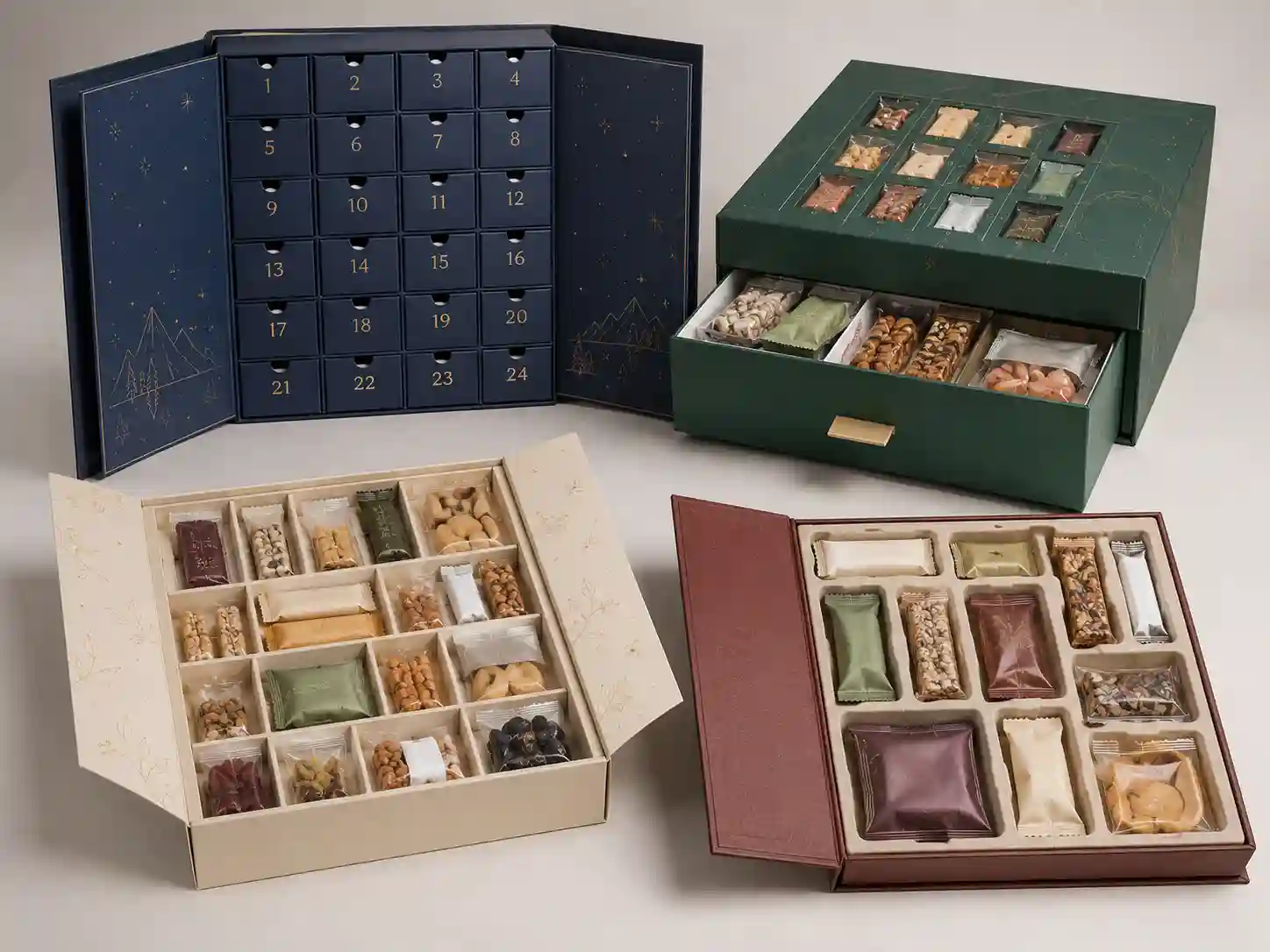
The best structure depends on the campaign budget, product weight, retail position, and assembly workflow. Rigid boxes are stronger and more premium, folding cartons are more cost-efficient for lighter snacks, drawer boxes improve reuse and unboxing control, and door-opening boxes work well for classic numbered daily compartments.
| Box structure | Best for | Main advantages | Buyer watch points |
|---|---|---|---|
| Rigid door-opening box | Premium snack gift sets, retail shelf displays, influencer kits, seasonal brand campaigns | Strong greyboard body, premium appearance, good protection for heavier mixed snacks | Higher unit cost, larger carton volume, longer sampling and assembly time |
| Folding carton advent calendar | Lightweight snacks, high-volume promotions, supermarket campaigns, budget-sensitive projects | Lower material cost, flat packing potential, efficient for large MOQ programs | Less rigid than greyboard, requires careful lock design and carton compression testing |
| Drawer box | Premium snack assortments, reusable gift boxes, e-commerce gift sets | Good opening experience, clear product separation, strong perceived value | Drawer tolerance must be controlled so it slides smoothly without being loose |
| Book-style box | Retail gift displays, corporate gifts, mixed snack kits with storytelling panels | Large printable area, strong visual presentation, suitable for brand campaign messaging | Magnet, ribbon, hinge, or closure details may increase cost and sampling complexity |
A rigid box normally uses greyboard wrapped with printed paper. It gives strong structure and a premium feel, but it also increases weight and shipping volume. A folding carton normally uses paperboard and can be more efficient for large-volume promotions. A drawer box can separate snacks into trays or small compartments, but the drawer gap and pull strength must be tested. A door-opening box needs accurate die-cutting so the windows open neatly without tearing neighboring doors.
Factory tip: For snack advent calendar boxes, the structure should be approved together with the insert. A strong outer box with a weak or loose insert still creates product movement, poor opening experience, and higher damage risk during shipping.
How should buyers choose inserts for different snack formats?
Buyers should choose inserts based on snack shape, weight, flexibility, moisture awareness, separation needs, and sustainability goals. Paper inserts are common for lightweight wrapped snacks, PET trays provide shape control, EVA or foam adds cushioning, and molded pulp can support certain eco-positioned gift sets.
Snack packaging often needs product separation. Chocolate-coated items, cookies, crackers, flavored pouches, and nut packs may have different odor and oil characteristics. The advent calendar box itself is usually secondary packaging, so each snack should normally remain individually wrapped. Buyers should not assume that decorative paper inserts are suitable for direct food contact unless the material and intended use are verified with the supplier and relevant compliance documents.
| Insert type | Common use | Advantages | Potential limitations |
|---|---|---|---|
| Paper insert | Wrapped snack bars, small pouches, biscuits, light candy packs | Printable, recyclable in many markets, easy to customize with dieline changes | Limited cushioning; needs accurate folding and compartment depth control |
| PET tray | Uniform snack packs, molded cavities, products requiring stable positioning | Good shape retention, clear cavity definition, efficient for repeat products | Mold cost may apply; recycling rules vary by destination market |
| EVA insert | Premium gifts, fragile snack containers, heavier mixed promotional items | Good cushioning and premium appearance | Higher cost; not always suitable for eco-focused campaigns |
| Foam insert | Fragile jars, tins, or snack accessories in mixed gift sets | Strong shock absorption and flexible cutting | May increase material cost and sustainability concerns |
| Molded pulp insert | Natural-positioned gift sets, heavier snack packs, plastic-reduction programs | Good molded support and paper-based appearance | Requires tooling and tolerance review; surface may be less refined than PET or EVA |
Quotable B2B note: “For snack advent calendar boxes, insert fit is not a finishing detail; it is the main control point for product separation, door-opening performance, and export damage reduction.”
What food and gift packaging issues should be checked early?
Buyers should check product separation, odor transfer risk, moisture awareness, labeling space, and material suitability before confirming the dieline. These issues are easier to solve during sampling than after mass production begins.
Snack advent calendars often combine sweet, salty, dry, crunchy, soft, or aromatic products. Even when every snack is individually wrapped, buyers should consider whether the package needs internal separation between strongly flavored items. Moisture-sensitive snacks may require tighter primary packaging from the food producer, while the advent calendar box should avoid trapping condensation during storage or long-distance shipping.
Because the box and insert may sit close to food packs, buyers should discuss material use clearly. If any component may directly touch food, request written confirmation of material suitability from the supplier and verify requirements in the destination market. For general reference, buyers can review the U.S. FDA’s official information on food-contact substances. For paper sourcing expectations, buyers may also ask suppliers about FSC options and verify information through the official FSC website.
Labeling space also matters. Snack advent calendar boxes may need barcode space, importer information, recycling marks, age warnings where applicable, nutrition or allergen references on the snack primary pack, country-of-origin statements, or campaign information. Giftpackpro can prepare the custom paper packaging structure, but buyers should verify all product and market labeling requirements with their internal compliance team or local consultant.
How do dielines and artwork affect production quality?
Dielines and artwork affect whether the snack calendar opens correctly, assembles efficiently, and looks consistent in bulk production. Buyers should check door cuts, fold lines, glue areas, insert slots, barcode position, bleed, color mode, and finishing layers before approving artwork.
A dieline is not just a drawing for designers. It is the production map for cutting, creasing, folding, gluing, wrapping, and inserting. For door-opening boxes, the dieline should define door size, perforation strength, finger notch position, numbering placement, and the safe area for artwork. For drawer boxes, it should define sleeve clearance, drawer pull position, and reinforcement areas. For folding carton structures, lock tabs and folding direction must be checked to prevent assembly delay.
Artwork should usually be supplied in print-ready files with CMYK color setup, linked images, outlined fonts, correct bleed, and separate layers for special finishes. Pantone color references are useful when brand colors need tighter control. Foil stamping, embossing, spot UV, matte lamination, and gloss lamination should be marked clearly on separate layers, not described only in email text.
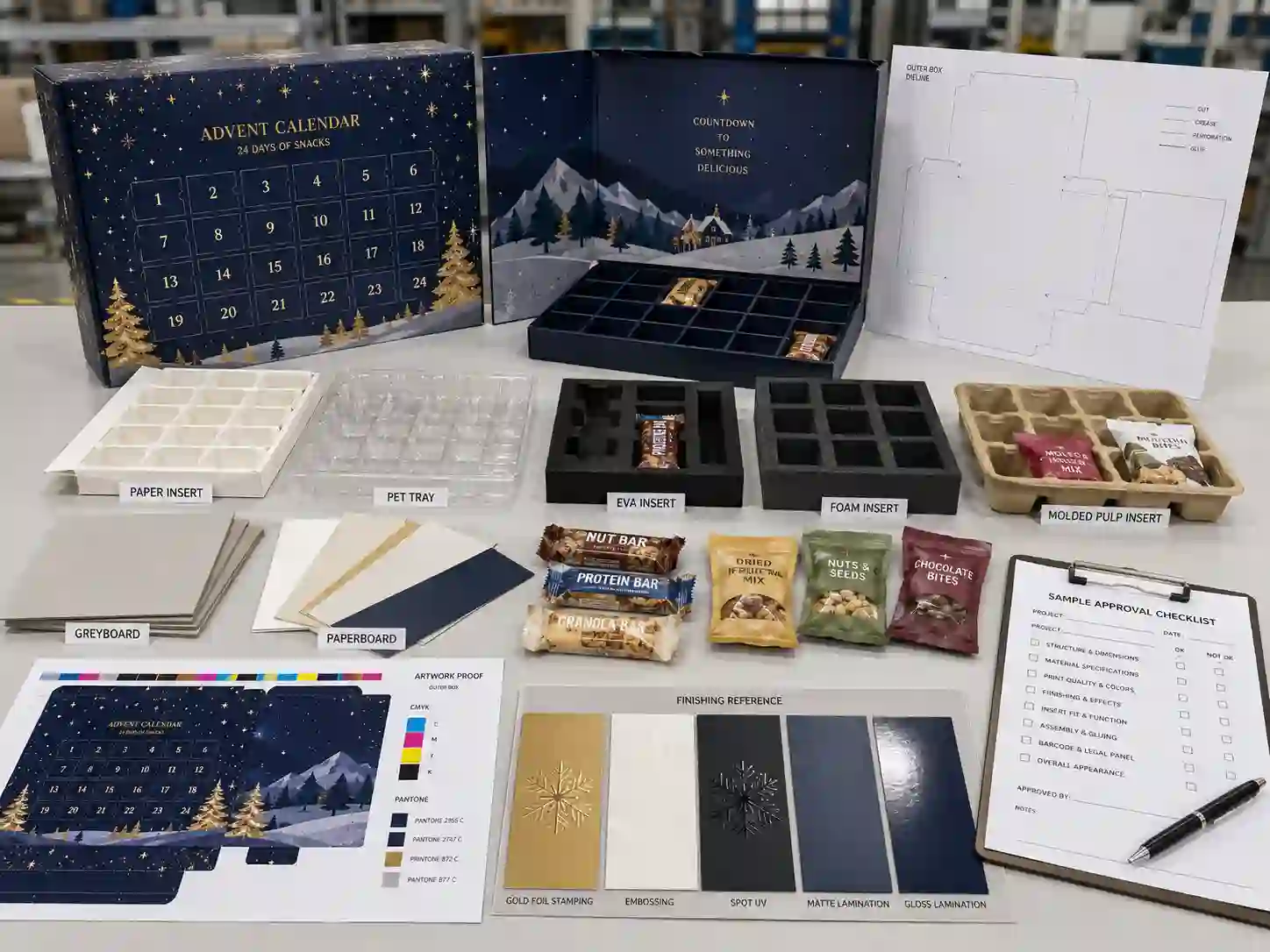
Factory tip: A pre-production sample should be reviewed against the approved dieline and artwork proof, not only against a digital rendering. Color, door alignment, insert fit, glue position, and surface finishing must all be checked on the physical sample.
Which printing and finishing choices work best for snack advent calendar boxes?
The best printing and finishing choices depend on brand positioning, retail lighting, handling risk, and cost target. CMYK printing is suitable for detailed seasonal artwork, Pantone helps control important brand colors, matte lamination creates a soft premium look, gloss lamination increases shine, and foil stamping or embossing can highlight logos or dates.
For B2B snack campaigns, print design should balance shelf impact with production reliability. A calendar with many small doors should avoid putting tiny legal text directly across cut lines. Dark full-coverage artwork may show scratches more easily during handling. Large foil areas may increase cost and require testing for registration. Spot UV can create a premium effect, but it should be used on stable areas rather than across heavy crease zones.
- CMYK printing: suitable for colorful campaign graphics and photographic artwork.
- Pantone color: useful for controlled brand colors and repeat seasonal programs.
- Foil stamping: good for premium accents, but requires accurate registration and tooling.
- Embossing: adds tactile value, especially on logos, icons, or title panels.
- Spot UV: highlights selected graphics, but should avoid unstable fold or cut areas.
- Matte lamination: common for premium gift packaging and softer visual effects.
- Gloss lamination: useful when shine, color brightness, or wipe resistance is desired.
Buyer tip: Ask for finishing costs as separate quotation lines when comparing suppliers. A lower unit price may exclude foil stamping, embossing, special lamination, insert tooling, or assembly labor.
What is the practical process from concept to mass production?
A practical B2B process includes project briefing, structure recommendation, dieline creation, artwork checking, prototype sampling, pre-production sample approval, mass production, QC inspection, export packing, and shipment coordination. Skipping any step increases the risk of rework, delays, or product fit problems.
- Project brief: Buyer shares snack dimensions, quantity, market, delivery date, budget target, and structure preference.
- Structure proposal: Factory recommends rigid box, folding carton, drawer box, door-opening box, or other structure.
- Dieline and insert layout: Compartment count, door size, product orientation, and insert type are defined.
- Artwork preparation: Buyer provides CMYK artwork, Pantone references, finishing instructions, barcode area, and labeling information.
- Prototype sample: A white sample or printed sample is made to test structure and product fit.
- Pre-production sample: Final materials, printing, finishing, insert, and assembly details are confirmed before bulk production.
- Mass production: Printing, mounting, die-cutting, wrapping, insert forming, assembly, and packing are controlled by the production plan.
- QC and export packing: Final boxes are inspected, packed in export cartons, labeled with shipping marks, and prepared for logistics.
Giftpackpro provides custom advent calendar box services for buyers who need factory-side support from structure planning to sample development and bulk production. Buyers who want to understand the supplier background can also review the Giftpackpro packaging factory.
How should buyers think about MOQ, lead time, and cost drivers?
MOQ, lead time, and cost depend on structure complexity, box size, material, insert type, printing, finishing, sample requirements, assembly labor, export packing, and order quantity. Buyers should compare quotations based on the same specifications, not only on the lowest unit price.
Custom snack advent calendar boxes often involve fixed setup costs such as printing plates, foil or embossing dies, cutting molds, insert molds, and sample labor. A small trial order may have a higher unit cost because setup costs are spread across fewer boxes. A larger order may reduce unit cost but increases material commitment, production scheduling needs, and QC responsibility.
Common cost drivers buyers should compare
- Rigid greyboard thickness or paperboard grade
- Overall box size and shipping carton volume
- Number of compartments and door cuts
- Paper insert, PET tray, EVA insert, foam, or molded pulp choice
- CMYK versus Pantone printing requirements
- Foil stamping, embossing, spot UV, matte lamination, or gloss lamination
- Manual assembly time and packing method
- Prototype sample and pre-production sample requirements
- Export carton strength, corner protectors, pallet use, and shipping marks
Quotable B2B note: “In custom advent calendar boxes, the cheapest quote is often the least useful quote unless it states material thickness, insert type, finishing method, packing details, MOQ, sample cost, and lead time.”
What QC points matter most before export?
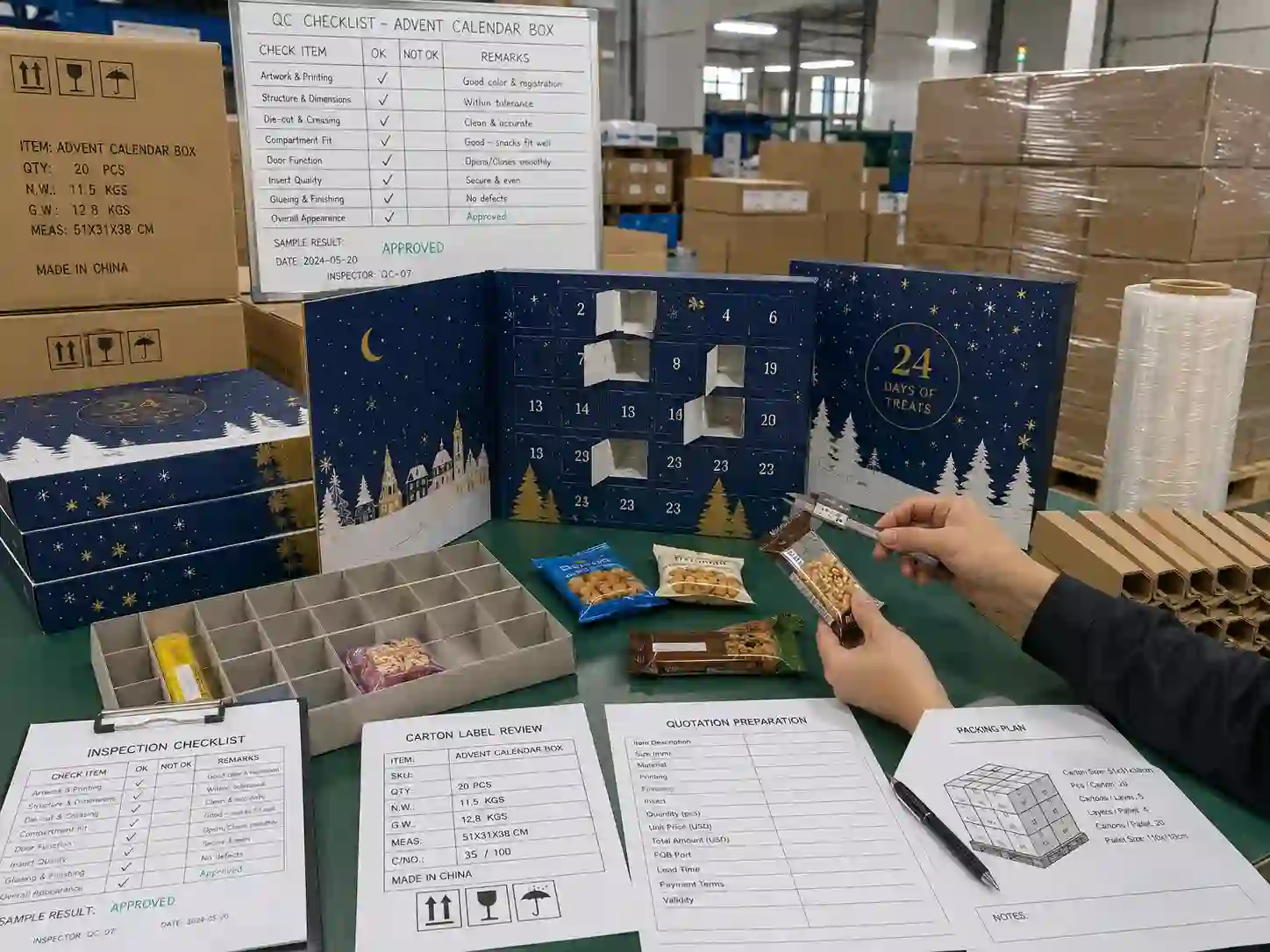
The most important QC points are structure strength, door-opening performance, insert fit, printing accuracy, finishing quality, assembly consistency, carton protection, and shipping mark accuracy. A snack advent calendar should be inspected as a complete package system, not as separate paper parts.
Final inspection should include both visual and functional checks. Doors should open without tearing surrounding panels. Insert cavities should hold snacks in the intended position. Drawers should slide without jamming. Glue should be clean and secure. Printed colors should match the approved sample within agreed tolerance. Foil stamping and embossing should align with artwork. Lamination should not bubble, peel, or scratch excessively under normal handling.
Practical QC checklist for snack advent calendar boxes
- Confirm box size, compartment count, and structure match the approved sample.
- Check real snack fit in every key compartment size.
- Test door-opening force and make sure perforations do not tear neighboring doors.
- Review insert stability after light shaking and carton handling simulation.
- Inspect CMYK or Pantone color consistency against the approved proof or sample.
- Check foil stamping, embossing, spot UV, matte lamination, or gloss lamination defects.
- Inspect glue marks, wrapping edges, corner quality, and drawer clearance.
- Verify barcode area, labeling space, carton label, and shipping marks.
- Check export carton strength, inner polybag use if needed, corner protectors, and pallet plan.
- Record inspection findings with photos before shipment approval.
QC tip: Always test the calendar with real filled snack weight when possible. An empty paper sample can pass visually while a filled calendar may sag, shift, or stress the insert during transport.
How should export packing be planned for snack advent calendar boxes?
Export packing should protect the calendar structure, printed surface, corners, doors, inserts, and carton labels during long-distance shipping. Buyers should confirm whether boxes ship flat, semi-assembled, or fully assembled because each method changes carton size, labor cost, damage risk, and warehouse handling.
Rigid snack advent calendar boxes are often shipped assembled because their structure and wrapped greyboard body cannot always be flat-packed. Folding carton calendars may be shipped flat or semi-assembled depending on the design. Drawer boxes may require protective paper, inner wrapping, or separators to prevent surface rubbing. For e-commerce gift sets, extra carton protection may be required because individual handling is more severe than palletized retail distribution.
Export cartons should be sized to avoid excessive empty space. Corner protectors can reduce crush damage. Pallet wrap improves load stability. Shipping marks should match the buyer’s purchase order and destination requirements. Carton labels may include item number, quantity, gross weight, net weight, carton size, country of origin where required, and handling marks. Buyers should confirm these details before mass packing begins.
For buyers planning distribution testing, the International Safe Transit Association provides official information about transport packaging test procedures through ISTA. Test selection should be confirmed based on the buyer’s shipping route, product type, and retailer requirements.
How should buyers compare suppliers for this packaging project?
Buyers should compare suppliers by structure experience, sample quality, material transparency, communication speed, quotation detail, production capacity, QC process, export packing knowledge, and ability to solve problems before shipment. A supplier should be evaluated on project control, not only unit price.
A reliable supplier should ask practical questions about snack dimensions, total compartments, product weight, delivery date, target market, insert type, artwork readiness, and packing method. If a factory gives a quick price without understanding the product fit, the quotation may not be accurate for final production. For custom advent calendar boxes, small structure changes can affect material usage, die-cutting, insert tooling, assembly time, carton volume, and lead time.
Supplier comparison decision guide
| Decision point | Better supplier response | Risky supplier response |
|---|---|---|
| Product fit | Requests real dimensions, sample photos, weight, and compartment plan | Quotes from artwork only without checking snack sizes |
| Structure advice | Compares rigid box, folding carton, drawer box, and door-opening options | Pushes one structure without explaining trade-offs |
| Insert planning | Explains paper insert, PET tray, EVA, foam, and molded pulp differences | Treats insert as a simple accessory without fit testing |
| Quotation | Lists material, size, printing, finishing, MOQ, sample, packing, and lead time | Provides only a unit price with unclear specifications |
| QC | Checks sample approval, dieline, printing proof, insert fit, and export carton | Only inspects visual appearance after production |
Giftpackpro works as a custom advent calendar boxes manufacturer for overseas buyers who need custom paper gift packaging with practical structure, insert, printing, and export packing support.
What information should buyers prepare before requesting a quotation?
Buyers should prepare product dimensions, quantity, box style, compartment count, insert preference, artwork status, target market, delivery deadline, packing method, and inspection requirements before asking for a quotation. A complete RFQ helps the factory quote faster and reduces later price changes.
Quotation preparation checklist
- Target quantity and expected MOQ range
- Number of snack compartments, such as 12, 24, 25, or a custom layout
- Snack dimensions, weight, primary packaging type, and photos
- Preferred structure: rigid box, folding carton, drawer box, door-opening box, or book-style box
- Insert preference: paper insert, PET tray, EVA insert, foam, molded pulp, or factory recommendation
- Material expectations, such as greyboard thickness, paperboard grade, or FSC option for verification
- Artwork files, dieline status, CMYK setup, Pantone references, and finishing layers
- Printing and finishing needs: foil stamping, embossing, spot UV, matte lamination, gloss lamination
- Sample type required: white sample, digital printed sample, handmade prototype, or pre-production sample
- Delivery date, shipping destination, carton label requirements, and pallet requirements
- Any retailer, marketplace, or importer requirements that affect labeling or packaging tests
Buyers can request a custom quote after preparing these details. If the project is still early, Giftpackpro can help review structure direction, sample needs, and quotation options before the final artwork is complete.
What common mistakes should buyers avoid?
Buyers should avoid designing from appearance only, confirming artwork before product fit, ignoring insert tolerance, comparing incomplete quotations, and leaving export packing decisions until the end. Most avoidable problems happen because the project brief is incomplete at the start.
- Mistake 1: Starting with artwork before measuring snacks. This can create doors or compartments that are too small for real products.
- Mistake 2: Choosing the cheapest insert without testing. A weak insert may increase product movement and damage claims.
- Mistake 3: Ignoring odor and moisture awareness. Mixed snack programs need primary packaging and separation planning.
- Mistake 4: Approving only digital renderings. Physical samples reveal fit, color, door strength, and assembly issues.
- Mistake 5: Comparing quotations with different specifications. Unit prices are not comparable if material, finishing, insert, and packing differ.
- Mistake 6: Forgetting carton protection. Premium printed calendars can be damaged by poor export cartons, weak corners, or unstable pallets.
- Mistake 7: Leaving labeling space too late. Retail and e-commerce teams may need barcode, recycling, importer, or shipping label areas.
Buyer tip: Ask the factory to confirm what is included and excluded in the quotation. Important exclusions may include snack filling, product sourcing, food compliance testing, barcodes, retailer testing, pallet charges, special cartons, or third-party inspection fees.
FAQ: Practical questions about snack advent calendar boxes
Can snack advent calendar boxes hold different product sizes?
Yes, but the insert layout must be designed around the largest and smallest items. Mixed snack sizes may require different cavity depths, paper dividers, PET tray cavities, or a hybrid insert design to keep products separated.
Are the boxes suitable for direct food contact?
Snack advent calendar boxes are usually secondary packaging for individually wrapped snacks. If any paper, plastic, foam, or pulp component may directly touch food, buyers should request material details and verify destination-market requirements before approval.
Should buyers choose rigid boxes or folding cartons?
Rigid boxes are better for premium presentation and heavier gift sets, while folding cartons are better for lightweight, high-volume, cost-sensitive campaigns. The best choice depends on snack weight, retail channel, budget, and shipping method.
How many samples are needed before mass production?
Many B2B projects use at least one structural prototype and one final pre-production sample. Complex projects with special inserts, foil stamping, embossing, or mixed snack weights may need additional sample rounds.
What affects lead time the most?
Lead time is affected by dieline confirmation, artwork readiness, sample approval speed, material availability, printing schedule, finishing complexity, insert tooling, assembly workload, QC, and export packing preparation.
Can Giftpackpro help if the buyer only has snack samples but no dieline?
Yes. Buyers can send snack dimensions, photos, quantity, and campaign goals, then discuss suitable structures through Giftpackpro’s custom advent calendar box services. The factory can help develop the dieline and sample plan.
What should be checked before shipment?
Before shipment, buyers should check the approved sample, final dimensions, product fit, door opening, print color, finishing quality, carton labels, shipping marks, carton strength, and pallet plan if pallets are used.
How should buyers move forward with snack advent calendar boxes?
Snack advent calendar boxes work best when buyers treat them as a packaging engineering and purchasing project, not only a seasonal design item. The right structure, insert, material, printing method, sample approval process, QC checklist, and export packing plan can reduce production risk and improve campaign readiness.
To prepare for a clear quotation, collect snack samples or exact dimensions, target quantity, preferred structure, insert idea, artwork status, finishing requirements, delivery deadline, destination market, carton label needs, and any retailer or e-commerce requirements. Then contact Giftpackpro to review the best structure and sampling route for your project.
For more planning support, browse advent calendar box buying guides, review available custom advent calendar box products, or request a custom quote for snack advent calendar boxes with your product details and campaign requirements.