
How to Design Advent Calendar Boxes for Better Unboxing
A strong advent calendar box unboxing experience is not only about attractive artwork. For importers, wholesalers, retail buyers, and brand teams, it also depends on structure, insert fit, drawer movement, door opening, packing method, and whether the China supplier can repeat the same result in bulk production.
When buyers compare factories, many quotations look similar on the surface. The real difference appears in sample engineering, communication quality, tolerance control, lead time planning, and export packing. This guide explains how to design advent calendar boxes for better unboxing while preparing a clearer supplier comparison and quotation brief.
Why Unboxing Design Matters for B2B Advent Calendar Projects
For a seasonal packaging project, the unboxing process is part of the product value. A box may look premium in photos, but if drawers jam, doors tear, inserts shift, or cartons arrive damaged, the buyer still faces complaints, delays, and extra cost.
A reliable custom advent calendar boxes manufacturer should understand both visual design and production control. The goal is to make the box easy to open, strong enough for shipping, suitable for filling, and consistent from pre-production sample to bulk order.
For B2B buyers, the best unboxing result usually comes from early decisions on:
- Box structure and opening method
- Drawer, door, or tray tolerance
- Insert material and product positioning
- Artwork alignment across panels
- Surface finishing and hand feel
- Bulk assembly method
- Export carton protection
Start with the Structure, Not the Decoration
Many buyers begin with colors, patterns, and printed artwork. These are important, but the structure decides how the user actually opens the box. For a better advent calendar box unboxing experience, the structure should match the product size, weight, filling process, and retail channel.
Common Structures for Better Unboxing
Drawer-style advent calendar boxes work well for products that need a premium pull-out feeling. Door-style boxes are useful when the buyer wants numbered openings on a flat front panel. Book-style rigid boxes can create a higher-end presentation for beauty, gift, stationery, or seasonal sets. Tray-and-sleeve structures may be suitable when the project needs easier filling and compact shipping.
Before choosing a structure, prepare the exact product dimensions, weight range, product category, and whether the goods will be packed in China or in the destination market. This information helps the supplier recommend the correct board thickness, insert depth, opening gap, and assembly method.
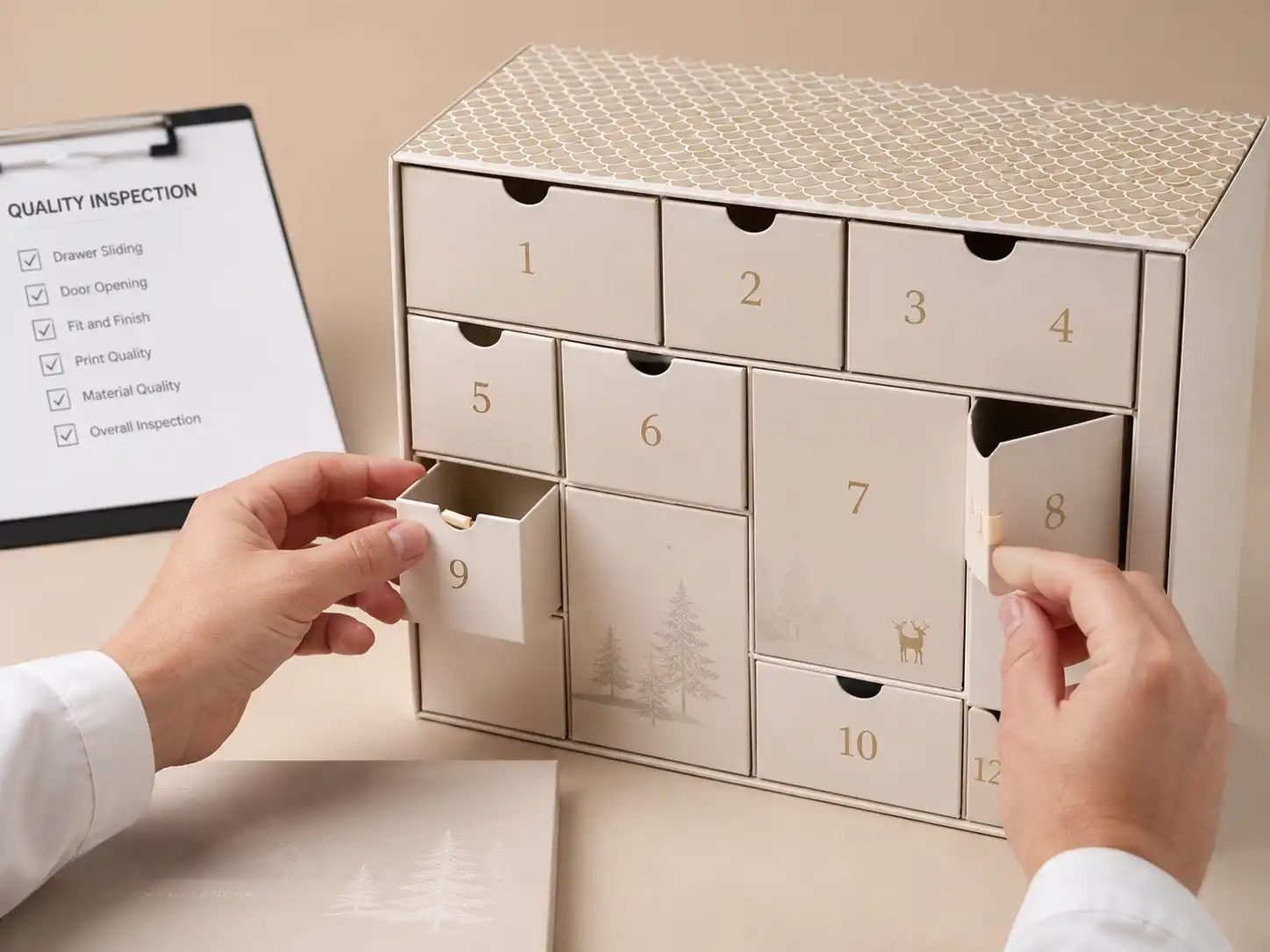
Check Door Opening and Drawer Sliding Early
The opening action should feel controlled but not tight. If a drawer is too loose, it may slide during transport. If it is too tight, the buyer may receive complaints during retail sales or gifting. Door panels also need careful cutting depth. A door that opens too easily may be damaged during packing, while a door that is too difficult to open can ruin the unboxing process.
During sample review, ask the supplier to test drawer sliding, door opening, insert fit, and repeated opening performance. These checks are especially important for advent calendar boxes with 12, 24, or 25 compartments because small tolerance problems can multiply across the full structure.
Design Inserts Around the Product, Not Around a Generic Template
Inserts are a major part of the advent calendar box unboxing experience. They control how products sit inside the box, how easily each item can be removed, and how well the set survives shipping.
Paperboard inserts are common for lighter products and recyclable packaging goals. Molded pulp can support sustainable positioning for some product types. EVA, foam, or PET trays may be used when products need tighter holding or a more shaped cavity. Each insert option affects cost, MOQ, lead time, and export packing.
What to Confirm Before Insert Design
Buyers should provide real product samples or accurate product dummies before final insert design. If product samples are not ready, the quotation may only be an estimate. A good supplier will ask for product length, width, height, weight, shape, fragile points, and whether the product has outer packaging.
For projects that require international compliance, buyers should also consider material sourcing and documentation. For example, buyers who need responsible paper sourcing can review official information from the Forest Stewardship Council and discuss available certification options with their supplier.
Use Artwork to Guide the Opening Sequence
Artwork should make the box easier to understand. In B2B projects, good artwork is not only attractive; it also supports production accuracy, retail display, and end-user opening flow.
For numbered advent calendar boxes, the numbers should be clear, readable, and positioned away from cutting and creasing lines. If the design uses foil stamping, spot UV, embossing, or textured paper, confirm whether those finishing effects cross fold lines or door perforations. Some effects look beautiful but may create cracking, misalignment, or weak opening points if not planned correctly.
Practical Artwork Rules for Better Unboxing
- Keep important text away from die-cut lines and opening edges.
- Use a clear number hierarchy for multi-door layouts.
- Ask for a dieline with bleed, safe area, crease lines, and cut lines.
- Check artwork direction on every drawer, sleeve, and side panel.
- Confirm whether the supplier will provide digital proof, printed sample, or pre-production sample.
If your team needs structural design, artwork adaptation, insert development, sampling, and production support, review the available custom advent calendar box services before preparing your quotation request.
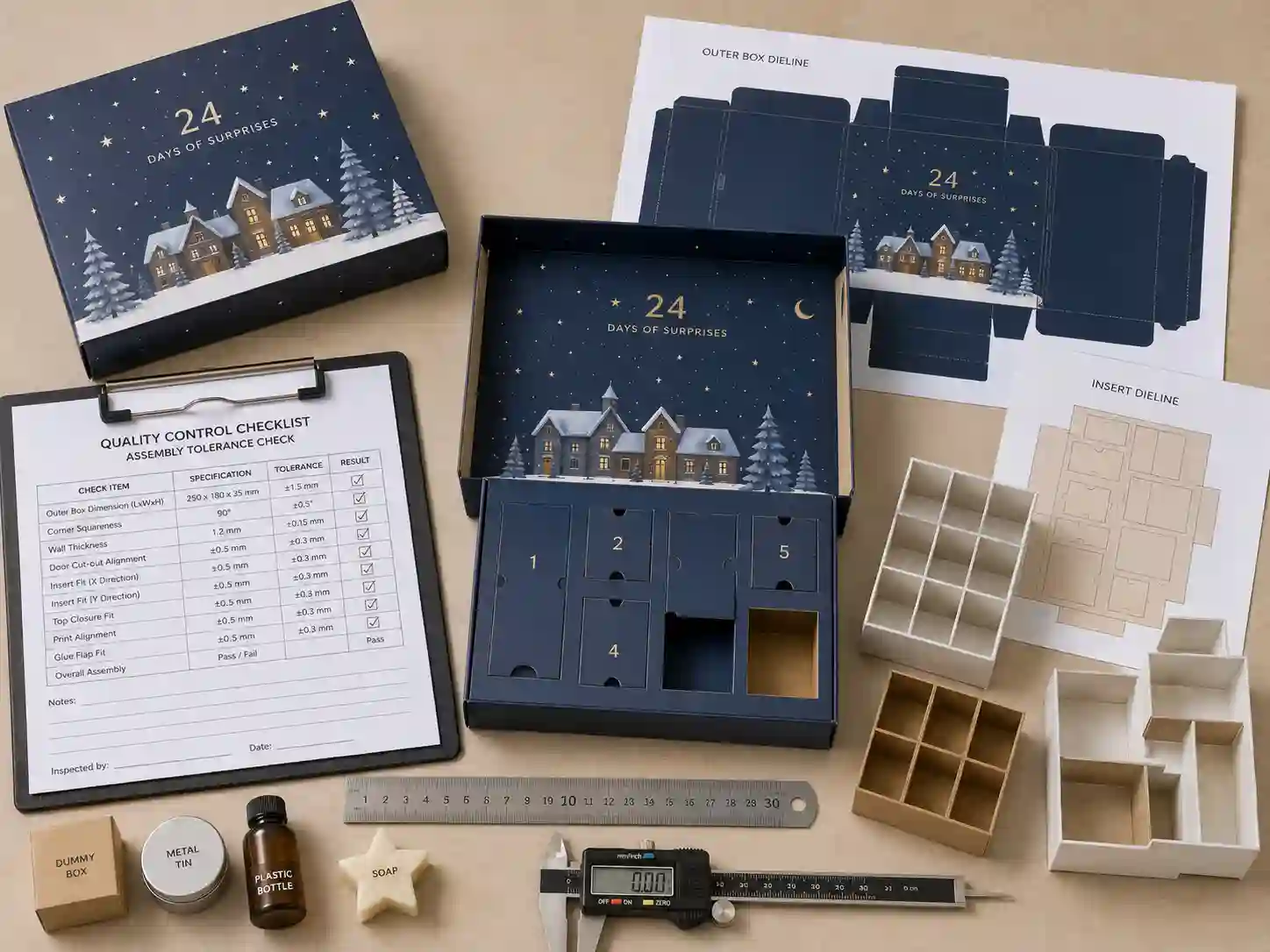
Compare China Factories by Engineering Support, Not Only Unit Price
China sourcing for advent calendar boxes often starts with several supplier quotations. The lowest price is not always the best value. A supplier may quote lower because the board is thinner, the insert is simplified, the packing method is weaker, or the sample does not include all finishing details.
To compare factories fairly, send the same brief to every supplier and ask them to quote the same structure, material, quantity, finishing, insert type, sample requirement, packing method, and delivery term.
| Comparison Item | What to Ask the Supplier | Why It Affects Unboxing |
|---|---|---|
| Structure | Drawer, door, book-style, rigid, folding, or tray structure | Controls opening feeling, product access, and display value |
| Board Thickness | Greyboard, paperboard, corrugated board, and thickness options | Affects hand feel, strength, and shipping durability |
| Insert Fit | Material, cavity size, product dummy testing, and tolerance | Prevents product movement and improves presentation |
| Printing and Finishing | CMYK, Pantone, lamination, foil, embossing, or spot UV | Changes visual impact, surface feel, and production risk |
| Sampling | Blank sample, digital sample, printed sample, and pre-production sample | Allows opening, insert, and artwork checks before bulk order |
| Export Packing | Flat packing, assembled packing, master cartons, and palletizing | Reduces deformation, scratches, and delivery damage |
| Lead Time | Sample time, artwork approval time, production time, and shipping time | Seasonal projects need enough buffer before retail launch |
Quotation Preparation: What Buyers Should Send
A clear quotation brief helps suppliers calculate cost more accurately and reduces repeated communication. It also helps buyers compare quotations from different China factories on the same basis.
For an advent calendar box unboxing experience project, prepare the following before requesting prices:
- Box style reference or structural idea
- Target size or product dimensions
- Number of compartments, drawers, or doors
- Product weight and product category
- Preferred insert material
- Artwork file status and printing requirement
- Finishing requirement such as matte lamination, gloss lamination, foil, embossing, or spot UV
- Order quantity and expected reorder plan
- Sample requirement and deadline
- Destination country and packing preference
- Trade term, shipping method, and delivery schedule
Buyers who are still comparing structures can review custom advent calendar box products to match the unboxing concept with practical box styles. If the project has a fixed launch date, it is better to request a custom quote with as much detail as possible instead of asking only for a general price range.
Communication Quality Is Part of Supplier Reliability
Good communication reduces risk. A reliable factory should be able to explain why a certain structure, material, or insert is recommended. The supplier should also point out possible problems before production, not after the bulk goods are finished.
When comparing suppliers, pay attention to how they answer technical questions. Do they explain tolerances? Do they ask about product samples? Do they provide packing suggestions? Do they understand export deadlines? Do they clarify payment terms, sample fees, and mold or tooling costs?
A supplier that only says “yes” to every request may create problems later. For a better unboxing result, buyers need a factory that can review structure, print design, insert fit, and export packing together.
Sampling Steps for Better Unboxing Control
Sampling is where the design becomes real. For custom advent calendar boxes, a digital mockup is useful for layout review, but it cannot fully confirm drawer sliding, door opening, board strength, or insert fit.
Recommended Sample Sequence
A blank structural sample is useful when the buyer needs to confirm size, opening method, insert layout, and filling process. A printed sample is useful when color, surface finishing, and artwork alignment must be checked. A pre-production sample is useful before mass production because it should represent the final approved material, structure, insert, printing, finishing, and packing method.
During sample approval, check the box from a buyer’s point of view and a warehouse point of view. Open every drawer or door. Remove and replace the products. Shake the box lightly to check movement. Review the insert holding strength. Check whether the outer surface scratches easily. Confirm whether the box can be filled efficiently by your packing team.
Giftpackpro can support buyers who need structured sampling and production discussion through its custom advent calendar box services, especially when the project includes inserts, special finishing, and export packing requirements.
Production Control: Keep Bulk Goods Consistent with the Approved Sample
The approved sample should become the standard for bulk production. Buyers should ask the supplier how the factory will control material, printing color, die-cutting, assembly, insert fitting, and final inspection.
For international quality systems, buyers can also refer to official information about ISO 9001 quality management when discussing process control expectations with suppliers.
Key QC Points for Advent Calendar Box Unboxing
- Drawer movement should be smooth and consistent.
- Door perforations should open cleanly without tearing the whole panel.
- Insert cavities should hold products without excessive pressure.
- Printed panels should align with numbers, windows, and die-cut areas.
- Glue areas should be clean and strong.
- Surface finishing should not crack at folds or opening points.
- Cartons should protect corners, edges, and printed surfaces during shipping.
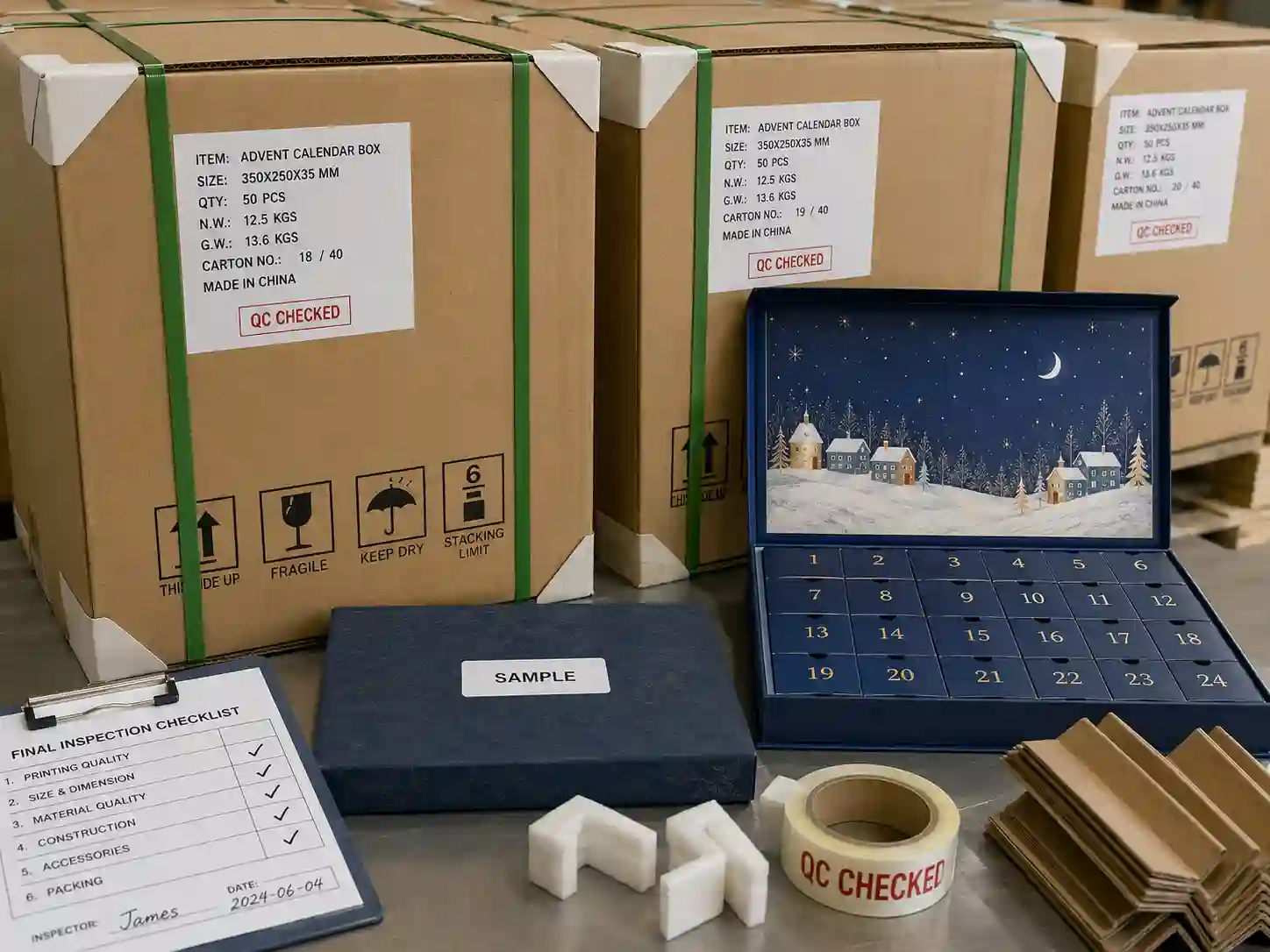
Export Packing Choices Affect the Final Unboxing Result
Even a well-designed box can fail if export packing is weak. Advent calendar boxes may be shipped flat, semi-assembled, or fully assembled depending on structure, labor plan, filling location, and shipping budget.
Flat packing can reduce volume, but the buyer must confirm assembly time and instructions. Fully assembled packing may protect presentation value and reduce local labor, but it usually increases shipping volume. For fragile rigid boxes, corner protection, carton strength, palletizing plan, and humidity control should be discussed before production.
If the box is for retail buyers or overseas warehouse delivery, ask the supplier to confirm master carton size, carton weight, shipping marks, barcode placement, and whether the cartons are suitable for pallet loading. These details help reduce damage and make receiving easier.
Payment, Lead Time, and Seasonal Risk
Advent calendar box projects are often time-sensitive. Buyers should not evaluate a supplier only by unit price. Payment terms, sample schedule, artwork approval speed, production capacity, and shipping buffer all affect the final project risk.
When comparing China factories, ask each supplier for a timeline that separates sample production, sample delivery, artwork revision, pre-production approval, bulk production, QC inspection, export packing, and shipping. This makes the lead time more realistic.
For seasonal packaging, late approval can be more expensive than a slightly higher unit price. A dependable factory should help the buyer identify schedule risks early and keep communication clear during each stage.
How Giftpackpro Supports Better B2B Unboxing Projects
Giftpackpro focuses on custom advent calendar boxes and seasonal paper gift packaging for overseas brands, wholesalers, gift companies, retail buyers, and purchasing teams. The Giftpackpro packaging factory can support buyers with structure discussion, insert planning, sample review, bulk production, quality control, and export packing.
Buyers who are still researching options can use the advent calendar box buying guides to compare materials, structures, printing, inserts, sampling, and shipping topics before sending a final request.
For a smoother advent calendar box unboxing experience, the best next step is to prepare product details, target structure, artwork status, quantity, schedule, and packing requirements. Then send the project brief through the request a custom quote page so the quotation can reflect the real structure, insert, sample, and export needs.
Final Checklist Before Confirming a Supplier
- Does the quotation match the same structure, material, insert, and finishing requirement?
- Has the supplier tested drawer sliding or door opening performance?
- Are product dummies or real samples used for insert design?
- Is the sample type clearly defined?
- Are MOQ, lead time, payment terms, and packing method written clearly?
- Does the supplier explain QC points before bulk production?
- Is export packing planned for the actual shipping route?
- Can the supplier communicate risks instead of only confirming every request?
A better unboxing result is built through structure, insert fit, artwork control, sampling, QC, and export packing. When buyers compare China suppliers with these points in mind, the final advent calendar box can look better, open better, ship better, and support a more reliable B2B packaging project.


